
So here I am in Salem, supposedly the Halloween capital of the world, wondering where all the creative costumes are. I’ve tried to embrace the “holiday” (invasion) this year (well not really, but I did take several walks) but all I have seen for costumes are flimsy puritans, vampires and superheroes and a sea of those little felt witch hats: nothing original or creative or made from a natural fabric (well, maybe the hats). My stepson came down from Maine for the weekend to prowl about with his friends in a pirate costume that he had purchased from one of those Halloween superstores along the way: I said “you can’t put together a PIRATE costume yourself! He did have the cool idea of going as Tiny Tim as he is 6’5” and on one crutch because of a sprained ankle, but I have yet to see him put this costume together. I’m wondering where the creativity is? Salem is instagram city at this time of year and those cheap costumes are hardly instagrammable: more of an effort would certainly result in viral views. Dogs have better outfits out there: I’ve seen pumpkins, bees, and even avocado toast! There is certainly lots of historical inspiration for humans, including British fancy dress books and digitized fashion plates and some great photography books on Halloween. We’ll see: the big day approaches.
But what are we to wear? Some suggestions from Arderne Holt’s Fancy Dresses Described or What to Wear at Fancy Balls (1887). You can be a box of dominoes or a bowl of lemons, and also a hornet or a witch (if you must). I think the hornet costume could do double duty as a bee.


Costume books published in the US are a bit less elaborate and historical than their British counterparts in the later nineteenth century, and also more…..paternalistic (is that possible)? We will skip past all the Native American costumes and go straight to the usual Halloween suspects, with a bit of whimsy for Miss Chess and Master Chimney Sweep….plus a pint-sized Guy Fawkes. These are still pretty elaborate costumes though—I’d have to distil them down considerably in terms of detail. Masquerade and carnival: their customs and costumes (1892) also includes some from Robin Hood: perhaps the inspiration for a c. 1907 item in the collections of Historic New England?


From the same period is this incredible handcrafted “Imperialist” skirt from the John Bright Collection—a template for any political commentary surely. I am hoping for some political costumes this year but we’ll see.

When I was looking for inspiration for this post, I discovered a new book and dusted off another. The discovery is an amazing book of photography entitled


The book I dusted off is a book I never opened and I have no idea when or where I got it: Jane Asher’s Fancy Dress, first published in 1983 (and later as Jane Asher’s Costume Book). It’s full of whimsical costumes modeled by British actors and actresses of the 1980s, including Terry Jones. One day last week I was showing an episode of Jones’ Crusades series to my students and the next I was looking at him dressed as a “blob”! Now these are costumes you can actually make, from around-the-house materials like cardboard toilet paper rolls (glued together to make a British judge’s wig). The little Elizabeth and peapod below are a little more involved, but this bat has wings made from a broken black umbrella!


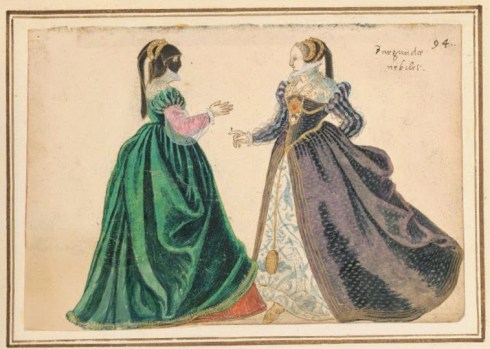


 Advertisements in the Salem Gazette and Register, 1821-1853: Cambric and Bombazine dresses from MoMu: Fashion Museum Antwerp and the Metropolitan Museum of Art.


 Salem Register, January & July 1862; South Peabody Wizard, January 1869; Newburyport Daily Herald, November 1886.
 The MEN: pro-veil John Endicott and anti-veil John Cotton.
 The WOMEN: what were they wearing? Well, these are English women rather than Salem women but they are contemporary and this first portrait is one of my very FAVORITES: an anonymous painter and subject, it it titled “A Puritan Lady”, 1638, Berwick Museum & Art Gallery. I think it was back to the “steeple-crowned hat”, if they ever took them off! You tend to see veils for particular occasions and times of life: the second portrait is of Jane Trevor, Lady Myddleton as a WIDOW, so she is wearing a mourning veil. National Trust, Chirk Castle, c. 1670.


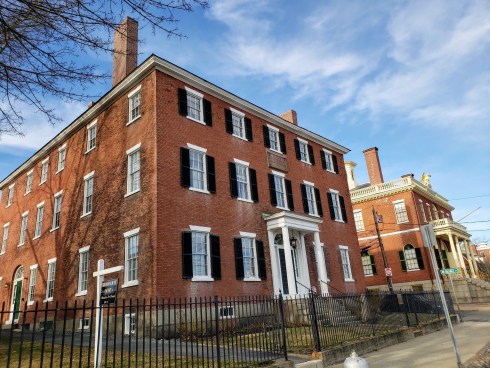
 Historical artist Peter Waddell’s
 Peter Waddell’s recreation of one of Dolley Madison’s “Wednesday Squeezes” with many turbans and feathers in evidence, White House Historical Association; the capture and burning of Washington in 1814, New York Historical Society. Mrs. Madison continued to be an active hostess in her temporary quarters, which Mrs. Crowninshield tells us all about, but she does not have much to say about the post-war state of Washington.






