Tag Archives: Civil War

The War on Paper

I spend a lot of time in cemeteries all year long (well perhaps not in the depths of winter) but in the weeks leading up to Memorial Day that time intensifies: late May is characterized by that heady mix of beautiful blooms and remembrance. Salem’s two larger cemeteries, Greenlawn and Harmony Grove, are nineteenth-century “garden cemeteries” which are beautiful places to wander and to remember, as they contain graves of soldiers who fought and died in the Civil War, the Spanish-American War, World Wars One and Two, Korea and Vietnam. The two Salem men who were killed in Afghanistan, James Ayube and Benjamin Mejia, are buried in these cemeteries as well: the former at Harmony Grove and the latter at Greenlawn. In the center of town, Salem’s older cemeteries, at Charter, Broad and Howard Streets, contain the graves of Revolutionary War veterans, as well as those who fought in earlier colonial conflicts, and the Civil War. This is one of the more important aspects of living in an old settlement: you can feel the weight of history.

20190524_124718

Harmony Grove is the cemetery where you feel the weight of the Civil War the most, or the “War to Preserve the Union” as its northern combatants called it (because that is what it was). Greenlawn has a G.A.R monument and many graves of Civil War soldiers, but there is something about Harmony Grove that feels more connected to that era. There is a central circle commemorating the young Salem men that died during the war, and survivors’ graves are interspersed throughout the cemetery: the grave of Luis Emilio, the Captain of the Mass. 54th is there. He survived the assault on Fort Wagner in South Carolina in 1863 and lived to tell the tale, but the grave of William P. Fabens, who died there the following year, is also at Harmony Grove.

20190524_124907

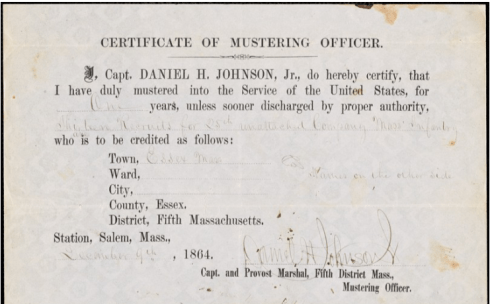
Stones can only tell you so much: if you want to want to know more, you need paper: the sources of the Civil War are plentiful and accessible in general but for Salem in particular, sparse, because of the removal of the Phillips Library.  With its present pledge to digitize more of its collections, this situation might change, but for now we are dependent on other repositories for glimpses of Salem’s Civil War history. Given Salem’s role as a regional center in northeastern Massachusetts, I was able to piece together a paper trail through two state digital databases, the New York Heritage and Digital Commonwealth, and a few other sources: this trail does lead us to the battlefield (or camp nearby) but is more evocative of the war at home. Salem emerges as a busy place of mobilization and recruitment, where young men from all over Essex County were mustered into service and dispatched to the major regional training camp in Lynnfield. At the beginning of the war, this is a process of enthusiastic volunteerism, but as it wears on it’s all about bounties and quotas. Massachusetts Adjutant-General William Schouler cited his own correspondence in his two-volume History of Massachusetts in the Civil War (1868) including this representative instruction to an official in Newburyport: Recruit every man you can; take him to the mustering officer in Salem and take a receipt for him. After he is mustered into United States service, you shall receive two dollars for each man. The officer will furnish transportation to Lynnfield. Work, work: for we want men badly. The correspondence between Daniel Johnson, the mustering officer and Provost Marshal in Salem who was responsible for recruiting men from Essex County in the last 18 months of the war and officials in the small town of Essex illustrates the intensifying local effort to meet quotas established by the state and federal governments.

MD Poster

MD Poster 2

MD POster 3

Civil War logistics 2

Civil War logistics 5

Civil War logistics DCRecruiting posters from 1861-1863, New York Historical Society via New York Heritage; Town of Essex Civil War records, 1864 via Digital Commonwealth.

Official records are illuminating yet necessarily focused on logistics; more intimate perspectives, bringing us closer to the camp or battlefield, can be found in diaries and journals. Two Salem soldiers recorded and projected their personal perspectives during and after the war: John Perkins Reynolds and Herbert Valentine. Reynolds (a grandson of Elijah Sanderson who was briefly detained by the British on the even of the battles of Lexington and Concord!) kept a diary of his service in the opening months of the war with the Salem Zouaves (at the Clements Library at the University of Michigan, and available here in print),  and also documented  his reminiscences of his time with the Massachusetts 19th (at the Massachusetts Historical Society). Valentine’s journals, scrapbooks, and visual impressions of the war are also in several repositories, including the Wilson Library at the University of North Carolina at Chapel Hill, the Z. Smith Reynolds Library at Wake Forest University, the Phillips Library, and the National Archives, which has digitized his watercolors of wartime scenes.
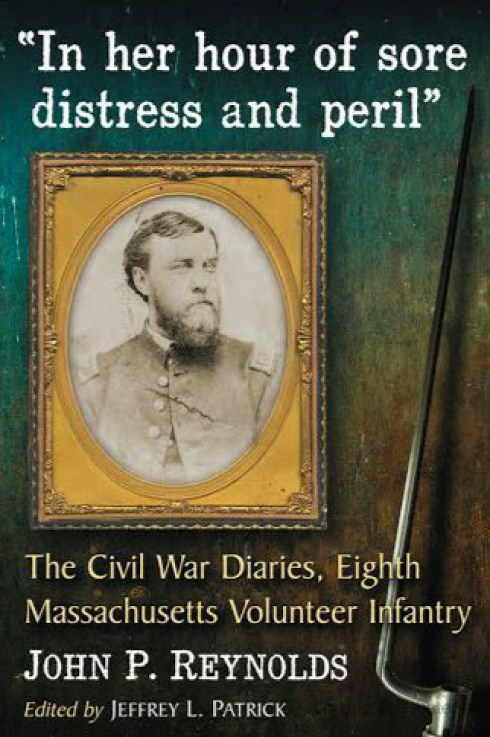
CIvil War Diary

Civil War Valentine 1

Civil War Valentine 2Valentine’s Virginia vignettes, 1863-64, National Archives.

These are not impressions that would have been available to contemporaries, but I think people who lived during the war would have have been exposed to its images and texts every day: posters, newspapers, the daily mail. A sea of Civil War envelopes survives, emblazoned with all sorts of colorful messages: surely this must be a fraction of what was produced and disseminated. According to its finding aid (which is online), the Phillips Library has 17 boxes of Civil War envelopes! Wow—-those will make quite a splash when they come online. My very favorite example (about which I wrote a whole blog post) depicting President Lincoln as the “Union Alchemist” was printed by Salem printers G.M. Whipple and A.A. Smith: I hope that there are more examples of their clever imagery in that Rowley vault.

Civil War Envelope - C-O-53 Library Co of Philadelphia Union Alchemist

Civil War Envelope 2

Civil War Envelope 3Library Company of Philadelphia and Richard Frajola.

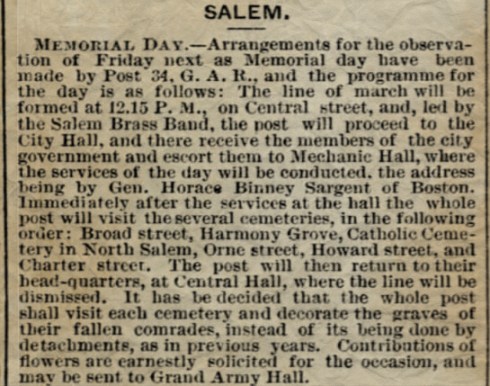
Newspaper accounts constituted a daily drumbeat and are thus too plenteous to consider here, but I did want to chart the beginnings of remembrance for this Memorial Day, so I looked at newspapers from the later 1860s and early 1870s—or so was my goal; I dug in and went quite a bit later. For the most part, the Salem story follows the national (or at least northeastern) pattern: in 1868 the first Commander-in-Chief of the Grand Army of the Republic declared May 30 to be Memorial Day and the Salem G.A.R obeyed his orders to the letter. I saw very few references to “Decoration Day”; Memorial Day seems to be have been the preferred designation right from the start. While local officials were invited to participate in the proceedings, the entire commemoration was a G.A.R affair until the early decades of the twentieth century. The only concerns expressed about the increasingly-ingrained “holiday” came right at its beginning and much later: an anonymous daughter of Civil War casualty expressed her concerns in 1870 that the proceedings were too commercialized, and certain members of the G.A.R leadership were profiting from supplying (see the C.H. Weber advertisement below), and much later the G.A.R itself expressed its concerns that a city-licensed circus was being allowed to operate on Memorial Day (see? protesting city-sanctioned circuses is a time-honored Salem tradition).

Memorial Day Salem_Register_1870-05-30_2

Memorial Day BG Mary 26 1873

Memorial day 1923 BG May 12

Memorial Day 30 May 1944 BGThe evolution of Memorial Day: C.H. Webber outfits participants for the occasion, Salem Register, May 19, 1870; Boston Globe May 1873, 1923, and 1944: the last GAR members in Massachusetts, including Thomas A. Corson of Salem, who died later that year at age 103.


Mirror of History

Louis XIV famously once said Fashion is the mirror of history but as we all know, sometimes mirrors show us things we don’t want to see. I was looking around for some inspiration for my Resistance Ball dress, when I discovered the work of an amazing Haitian-born, Brooklyn-based artist named Fabiola JeanLouis, a photographer, a stylist, a (paper)dressmaker, and a “maker” who seems to be able to embrace the past, present and future in her work, sometimes simultaneously. Her breakthrough exhibition, Rewriting History (2016), took my breath away. Look at this “mirror image”, in which the embroidery design on the back of the embellished dress of “Madame Beauvoir” mirrors the scars from the scourged back of the once-enslaved man named Gordon, displayed in a famous photograph by McPherson & Oliver that went viral during the Civil War.

Fabiola Jean Louis MADAME BEAUVOIR'S PAINTINGMadame Beavoir’s Painting

The juxtaposition of the very beautiful (women, dresses, surroundings) with very ugly historical events is jarring in these compositions, but also remarkably effective: you can’t look away. According to Ms. Jean-Louis, it’s not just the medium and the message but also the material: the paper gown sculptures are transformed in a way that allows me to represent layers of time and the events of the past as they intrude upon the present. Through the materials, I suggest that although we cannot change the past, we can act to change the present, as we activate the memories, visions, and legacies of our ancestors. Rewriting History seeks to reconnect viewers to the past so that parallels with current events are amplified.

Fabiola Jean Louis Madam LeRoy

Fabiola Jean Louis Rest in Peace

Fabiola Jean Louis Revolutionary-Dress-Top Madame Leroy and Rest in Peace; Revolutionary Dress Top (detail).

The beautiful Madame Leroy in her exquisite eighteenth-century gown with a stomacher (locket? window?) encasing a lynched man, an image which is repeated even more starkly in the model-less Revolutionary Dress. Less straightforward, at least for me, is Marie Antoinette is Dead, modeled on François Boucher’s portrait of a reclining Madame de Pompadour, but the updated subject seems to be a Voodoo Queen in a rococo dress. There are no fashion victims among Jean-Louis’s subjects: only powerful women, and heroines such as Mathilda Taylor Beasley: born into slavery in Georgia in 1832, she somehow escaped, and operated a secret school for African-American children in Savannah in the 1850s—a very dangerous act at that time and place. I cannot help but think of Charlotte Forten Grimké, a contemporary of Beasley’s and Salem’s first African-American educator, who ascended to that profession under far more advantageous circumstances in the North. Beasley is memorialized in Passing and Violin of the Dead, and now I know her name. I really can’t discern whether I am reacting to these works as a cultural consumer or an educator.

Fabiola Jean Louis Marie Antoinette is Dead

madamedepompadour

Fabiola Jean Louis CollageMarie Antoinette is Dead; Boucher’s Portrait of Madame de Pompadour (Neue Pinakothek, Munich); Passing and Violin of the Dead.  All photographs by Fabiola Jean-Louis with more + commentary at her website: www.fabiolajeanlouis.com .


Codfish Aristocracy

Growing up in York, Maine, my focus was increasingly over the river and out of state once I hit my teens, to Portsmouth, New Hampshire, a larger town with a mall, movie theaters, downtown shops, and lots and lots of restaurants. As I’ve said before, I think I ended up in Salem in large part because of its similarity to Portsmouth, and its greater proximity to Boston (now Salem surely has more restaurants, but fewer shops). For some reason which I can’t remember, my favorite restaurant in Portsmouth has always been The Oar House, which still exists, but a close second was The Codfish Aristocracy, which is long gone. I had very little historical curiosity then, as well as very little regard for American history, so I never questioned the name; only later did I delve into the origins of this interesting idiom. Since I have cod on the brain this week, I decided to delve into it a bit more, and of course, in this year of discovering all sorts of legacies of slavery, here is another one. I think there are several connections, actually. As a general reference to the New England aristocracy of families whose “new” wealth was based on the Atlantic fisheries and trade to both the West Indies and Europe, the term predates the nineteenth century; after all the original “sacred cod” was placed in the old Colonial State House in the early eighteenth century and the present one dates from 1798. Salem even has a claim for the origins of the term, based on the cod embellishment on the stairs in Colonel Benjamin Pickman’s beautiful Georgian mansion on Essex Street, built in 1756. A lithograph of this house was included in the materials chosen by a special Essex Institute committee to represent Salem at the Columbian Exposition in 1893, when it was “still standing though defaced by shops in front. It is said that the term “Codfish Aristocracy” arose from the fact that the end of each stair in the hall of this was house was ornamented with gilded codfish, Colonel Pickman’s fortune being derived from the fisheries”.

Cod in State House Griffin DC

Pendleton PickmanArthur Griffin photograph of the Sacred Cod in the State House, 1950s; The Pickman House by Pendleton’s Lithography, Digital Commonwealth & Boston Athenaeum.

New England cod fed both enslaved Africans and free Europeans and thus created great wealth in New England, but the derisive use of the term “Codfish Aristocracy”, in reference to the ostentatious and vulgar display of that wealth, comes later, in the 1840s and 1850s, and most prominently in the debate over slavery. He was not the originator of the phrase, but when Senator Andrew Pickens Butler of South Carolina remarked that We should regard it somewhat strange if we should require a codfish aristocracy to keep us in order in the midst of a speech on the floor of the Senate in the summer of 1850, it seemed to hit a chord. As a leading pro-slavery, anti-abolitionist voice, Butler drew heated criticism from Massachusetts Senator Charles Sumner, who indicted Butler as both “the Don Quixote of slavery,” and an admirer of “the harlot, Slavery” in his own Senate speech in May of 1856: in retaliation Butler’s cousin Preston S. Brooks responded by caning Sumner on the Senate floor days later, instigating his three-year incapacitation. In the following year, after Senator Clement Claiborne Clay introduced a bill repealing all laws allowing bounties to vessels employed in the fisheries under the rationale that 25 states were made to pay tribute to the Codfish Aristocracy of a mere six, papers in Massachusetts opined that “southern hatred of New England” was his true motivation.

Somewhere between the absolute disdain conveyed by the southern use of the term and the occasional pride displayed in the North was the New York attitude: more mockery than condemnation. There are three caricatures of the Codfish Aristocracy that represent this perspective well in the collection of the Library Collection of Philadelphia: literal representations are always an effective form of censure!

Codfish LC

Codfish LC 2

Codfish Aristocracy LC 3Three Codfish Aristocrats: McAllister Collection, Library Company of Philadelphia, c. 1840-1880.


Mid (19th)-century Thanksgiving

In the middle of the nineteenth century, Thanksgiving was a very different holiday in some ways, but familiar in others. It did not become a national holiday until 1863: before that the Salem papers (I’m using the Salem Register in this post) note with each passing year how many governors have issued proclamations adopting the “joyous festival, so long the ‘peculiar institution’ of New England”. How jarring to see this phrase applied to Thanksgiving—when I thought it was an exclusive reference to slavery!  I’m not sure I’m really comfortable with the phrase “Universal Yankee Nation” in this 1847 article either.

Thanksgiving 1847 collage

Apart from the provincial pride, Thanksgiving was also a busy public holiday, rather than merely a family gathering. It was both sacred and secular, and everyone was out and about in the morning (for church services) and the evening (for concerts and dances). I assume they ate their Thanksgiving dinners in between, as there were lots of advertisements for various foodstuffs  in the weeks before the big day, which was always in November in Massachusetts despite some December dates chosen by other states. Provisioning and preparations were very important: not just for family meals, but also for the meals that were prepared by different civic groups for orphans, prisoners, “inmates of the Alms House”, and (during the Civil War) soldiers.

Thanksgiving Salem_Register_1848-11-30_3

Thanksgiving Salem_Observer_1849-11-24_[2]

Thanksgiving Salem_Register_1849-02-05_4

Thanksgiving Salem_Register_1851-12-15_1

Thanksgiving Salem_Register_1851-11-24_3

Thanksgiving 1852 collage

Thanksgiving Salem_Register_1853-11-14_2

Thanksgiving Salem_Register_1854-11-20_2

Thanksgiving Salem_Register_1857-11-30_2

Thanksgiving Salem_Register_1863-11-05_2

Thanksgiving Salem_Register_1865-11-06_2

Thanksgiving Salem_Register_1875-11-15_2

These advertisements from the Salem Register (from 1847-75) give some semblance of what Thanksgiving festivities were all about in mid-nineteenth-century Salem but are an under-representation: people really wanted to give thanks in as many ways as possible, especially during the Civil War. But they also wanted to celebrate: Thanksgiving is always referred to as a “festival”. Turkey–and other fowl– was definitely on the menu as you can see from the “warning” to Salem’s resident birds, and cranberries as well. I remain extremely impressed by the entrepreneurialism of Mr. John Remond, an African-American man who served as the resident manager and caterer of (a very busy) Hamilton Hall while also running several provisioning businesses downtown: he arrived in Salem from the West Indies in 1798, all alone and only ten years old, and seems to have transformed himself into one of the city’s major players by the 1820s. He and his wife Nancy (who also had her own business–and they had eight children) were also active abolitionists and do not seem to have suffered the handicaps faced by most African-Americans in the nineteenth century, but then again, advertisements only reflect one small sliver of their lives. But they can tell us that year after year in Salem, oysters, whether individually or in pies, were much in demand for Thanksgiving.


The G.A.R. is Gone

The Grand Army of the Republic, the powerful veterans organization of Union veterans of the Civil War, was officially disbanded in 1956, following the death of the last Union soldier, Albert Woolson. At its peak, just before the turn of the twentieth century, the G.A.R. was an association possessed of great demographic, political, and social power. With over 400,000 members, it advocated for pensions and other veterans’ benefits at the national level and played multiple fraternal and civic roles in every city and town which had a post: over 7000 across the nation and 210 here in Massachusetts, of which Salem’s Philip H. Sheridan post (#34) was among the oldest and largest. Because of the decentralized nature of the G.A.R., its membership records are found primarily in local repositories, and its successor organization, the Sons of Union Veterans of the Civil War, maintains a register of record locations. Salem’s G.A.R. records–16 boxes in all–are in the Phillips Library of the Peabody Essex Museum, and so gone, with the rest of its material heritage, to a storage facility in Rowley.

G.A.R. Salem

G.A.R. Salem AtkinsonGreenlawn Cemetery in Salem, and the 2016 memorial for Medal of Honor recipient Thomas Atkinson.

It is tempting to dismiss the G.A.R. as a dusty and defunct fraternal order which only represented a certain minority of the population, but its impact was consequential: Decoration Day/ Memorial Day as well as more material forms of remembrance and veterans’ benefits are among its legacies. The Library of Congress’s guide to G.A.R. records in its possession highlights several potential subjects for research, including: social and charitable activities of Civil War veterans, the establishment and development of orphans’ and veterans’ pensions, and the post-war political activity of Union veterans as well as the attitudes of Union veterans towards government and the civil service. Many towns and cities–in our region Marblehead and Lynn come to mind immediately–have not only preserved their G.A.R. records but created museums for their interpretation. But Salem’s went to the PEM’s predecessor, the Essex Institute, like the records of most of its organizations, associations, and institutions, because the Essex Institute was Salem’s historical society. The Phillips Library’s finding aid for its G.A.R. records admits that these records create a detailed picture of an active GAR post with a large member base, yet this is a picture we can’t see—or paint—because of their inaccessibility, in apparent violation of the Massachusetts General Laws Part I, Title II, Chapter 8, Section 18:

The histories, relics and mementos of the Grand Army of the Republic of the department of Massachusetts and the records of the Massachusetts department of the United Spanish War Veterans, of The American Legion, of the Disabled American Veterans of the World War, of the Veterans of Foreign Wars of the United States, of the American Veterans of World War II, AMVETS, and of the Veterans of the Indian Wars shall be accessible at all times, under suitable rules and regulations, to members of the respective departments and to others engaged in collecting historical information. Whenever any such department ceases to exist, its records, papers, relics and other effects shall become the property of the commonwealth.

G.A.R. Boston 1927 3

G.A.R. collage

historycompleter00naso_0377The Massachusetts State House festooned for a G.A.R. encampment in 1927, Leslie Jones, Boston Globe; images from the History and Complete Roster of the Massachusetts Regiments, Minutemen of ’61 who Responded to the First Call of President Lincoln, April 15, 1861, to defend the Flag and Constitution of the United States (1910).


The Dashing and Devoted Landers

Lately I’ve been thinking about a Salem native, descended from the city’s most-monied maritime family, the Derbys, but still devoted to public service, very well-known in his day but little-known in ours: Frederick William West Lander (1821-1862). Today, you can find hardly a trace of Lander in Salem, a city that has a statue of a fictional television witch in its most public square. Yet he was referred to as “the fearless solder, the bravest of the brave” and “the very beau ideal of an American soldier” in his New York Times obituary. Yesterday, the first truly warm spring day of the year, I wandered past Lander’s rather secretive grave in the Broad Street Cemetery and wondered about him—about all that he came from, all that he did, and what he might have done if not cut down in the prime of his life by pneumonia contracted in a West Virginia encampment towards the end of the first year of the Civil War. Lander was educated in private academies before he went to Norwich University in Vermont to study engineering. After Norwich, he worked at surveying and laying trails, first for the Eastern Railroad in Massachusetts and later the Pacific Railroad way out west, leading five expeditions to map out transcontinental routes between 1853 and 1858. He was a commissioned a Special Agent of the U.S. Department of the Interior that year, giving him superintendent responsibilities over what had become known as the “Lander Trail” through Wyoming and Idaho. In 1860, purportedly after a 12-year acquaintance and 3-year engagement, Lander married the famous British-American stage actress Jean Margaret Davenport in a San Francisco ceremony called the “The Union of Mars and Thespis” by the San Francisco Daily Times. Seventeen months later he was dead, after being commissioned as a Brigadier General and leading charges in several battles. His was the first full-fledged funeral with honors of the war, held in Washington with President Lincoln and members of the Cabinet and Supreme Court in attendance. And then his body was transported in a special train to Salem, for burial in Broad Street.

by Mathew B. Brady

Harvard_Theatre_Collection_-_Jean_Margaret_Davenport_Lander_TC-22Matthew Brady daguerreotype of Lander, Smithsonian; Jean Davenport Lander at about the same time, Harvard Theater Collection.

Those are the bare biographical facts, but there is so much more to say about Lander—-and Mrs. Lander: he was not all Mars and by no means was she solely a thespian. Though Lander was obviously a man of action (and I have not even mentioned his dueling), he was also a champion of the arts: he included the Massachusetts artists Albert Bierstadt, Francis Seth Frost and Henry Hitchens on his 1859 expedition team out west–with glorious results–and addressed the “aptitude of the American mind for the cultivation of the fine arts” on the Lyceum circuit back east. He was also a poet, and although at least one publisher told him effectively not to give up his day job, several poems were published before his death, and more after, including Ball’s Bluffhis poetic account of the Union defeat at the Battle of Ball’s Bluff, with an opening stanza responding to the purported Confederate claim that fewer Massachusetts soldiers would have been killed in the battle had they not been too proud to surrender. This was the battle that really “brought the war home” for Massachusetts: as soldiers in two Bay State regiments accounted for more than half of the approximately 1000 Union casualties. Lander lived to tell the tale, but not for much longer.

Landers MAP SLM

Bierstadt Rocky Mountains

Ball's BluffOne of Lander’s early road surveys, from Danvers to Georgetown, Massachusetts, State Library of Massachusetts; Albert Bierstadt’s The Rocky Mountains, Lander’s Peak, 1863, Metropolitan Museum of Art; Soldiers from the 15th Massachusetts Regiment charge the Confederate line at the Battle of Ball’s Bluff, Illustrated London Newspaper, November 23, 1861, Library of Congress.

Jean Davenport Lander played several important Civil War roles as well. In the early days of the war, before her husband’s engagement and after they had taken up residence in Washington, Mrs. Lander happened to hear (I can’t fix the details!) whispers of a plot to assassinate President Lincoln. Whether by the confidence of her celebrity or the urgency of the times, she made her way to the White House hastily to report the conspiracy. Perhaps this was not as serious a threat as the earlier “Baltimore Plot“, but still, she acted to foil a presidential assassination plot! Her husband’s tragic war-camp death apparently inspired her (as well as his sister, the sculptor Louisa Lander) to start nursing, and she served as the supervisory nurse at the Union hospital in Beaufort, South Carolina for several years. After the war was over, Mrs. Lander resumed her acting career and seems to have been constantly on stage for the next decade or so, playing her last role in 1877: somewhat ironically, Hester Prynne of The Scarlet Letter.

Lander collageJean Margaret Davenport Lander as a bride in 1860 and Hester Prynne in 1877. Below: I’m assuming the friendship of Lander and Albert Bierstadt brought the latter to Salem at some point, because Christie’s has a Bierstadt landscape titled Salem, Massachusetts up for auction on May 22.

Bierstadt SalemAlbert Bierstadt, Salem, Massachusetts, 1861.


Bullet-ridden Bibles

I have been treating the digital remnants of the first and apparently-last PEM exhibition focused on the holdings of the Phillips Library as a requiem; when I first saw Unbound: Treasures from the Phillips Library of PEM back in 2011, the same year that the library closed in Salem with promises to return two years later, I enjoyed it immensely, but did not return multiple times because I believed I would see these items again. Now I fear I never will, so I go back, again and again, and again, in search of memento mori. One exhibition item that attracted a lot of attention then was a bible with a bullet embedded in its cover belonging to Private Charles W. Merrill of the 19th Massachusetts Regiment who nearly lost his life at the Battle of Fredericksburg after coming in the line of fire of two bullets: one entered near his right eye and was extracted from his left ear. Another ball would have entered a vital part of his body had it not been arrested by a Testament, in which it lodged. When this safeguard was shown the President, he sent to the hospital a handsome pocket Bible, in which, as an evidence of his warm regard, he caused to be inscribed: “Charles W. Merrill, Co. A., 19th Massachusetts, from A. Lincoln.”  [Devens, Pictorial Book of Anecdotes of the Rebellion, 1887] Unfortunately Private Merrill succumbed to his wounds in the next year, and his family placed the “safeguard” bible into the care of the Essex Institute, one of the progenitors of the Peabody Essex Museum.

Bullet-ridden bible Merrill PhillipsCharles William Merrill Papers, Fam. Mss. 611, Phillips Library, Peabody Essex Museum, Salem, Mass.

There’s a bit of (urban) mythology surround bullet-stopping bibles, tales of which predate and postdate the American Civil War. After the English Civil War some 200 years earlier, the Puritan preacher Richard Baxter, who briefly served as chaplain to the Parliamentary army, recounted an anecdote in which one of the Souldiers Pocket Bibles issued to Cromwell’s soldiers saved a man’s life, but these were 9-page pamphlets, so I’m wondering about the veracity of the claim. This little bible seems to have established the precedent for military pocket bibles, however, and there are many references to them on both sides of the Atlantic in the eighteenth and nineteenth centuries. They are much bigger in the nineteenth century–and presumably more bullet-proof: in addition to Merrill, I easily found references to seven Civil War soldiers whose lives were shielded by bulwark bibles—three union and four confederate—and I am sure there are more stories.

Bible collage

bible 2 collage

Bullet Bible Kelley

Bible Hall VT

The Souldiers Pocket Bible, 1643, British Museum; Francis Merrifield’s “Bunker Hill Bible”, Bonhams Auctions; the bibles of Corporal John Hicks Kelley of South Carolina (Darlington County Historical Commission) and Edwin Hall of Vermont, Heritage Auctions.

But it is in the twentieth century (ironically, as so many new weapons surpassed the rifle) that the bullet-proof bible became the bullet-proof bible. The onset of World War I centennial commemoration in 1914 has brought lots of interesting war stories and souvenirs to light, including several bullet-ridden bibles. The story of handsome British soldier Leonard Knight, who enlisted at 17 armed with a bible gifted to him by his Aunt Minnie, has been particularly resonant. There are more tales, including several harrowing ones involving ANZAC soldiers at Gallipoli. And all of these bespoke bibles culminate with the steel-plated “heart-shield bibles” that were the preferred gift for every soldier shipping off to the fronts of World War II: May this keep you safe from harm.

Bible Knight

Heart-shield BibleBritish soldier Leonard Knight and the bullet-ridden bible that has been passed down to five generations of his family; a heart-shield bible from World War II.


Electoral Ephemera Euphoria/Escapism

I’m still very preoccupied with the large collection of nineteenth-century ballots at the American Antiquarian Society: if I had time I would drive down to Worcester and immerse myself in the real paper; because I do not, I have to settle for digital immersion. Every little slip/image fascinates me–I woke up at 4:00 the night before last thinking why is the image of an upside-down chained beast associated with the movement AGAINST the incorporation of Boston as a city in 1822? Would livestock no longer be able to roam freely on the Common? That was my 4:00 am thought, but in the light of morning I realized the image probably had a more metaphorical meaning.

election-city-no

election-no-city

I still don’t know what the symbol of the chained beast means, but these particular ballot tickets represent the failing side: Boston did indeed become a city in 1822. So today, I’m going to focus on referenda, something we should all be familiar with as I believe nearly every state has ballot questions to decide on Election Day. Here in Massachusetts, our measures pertain to: 1) slot licenses; 2) charter schools; 3) the containment of farm animals (here we are, back to the chained beast!); and 4) recreational use of marijuana. In the nineteenth century, it was all about municipal incorporations, infrastructure, and above all, liquor. And taxation, of course: you know that old saying about death and taxes.

election-boston-no

election-3-referendum

election-liquor-no

election-liquor

election-common

election-taxation

Some of these private party tickets offered a public service by reminding voters when the polls were open–and where they where. Vote early [vote often?] and vote no.

election-collage

This last ticket obvious refers to the presidential election rather than a contemporary referendum, but I had to include it because it’s just so great: eminent historian George Bancroft weighing in on the [1864?] election. Imagine a world where an historian’s words could sway votes!

election-bancroft

All images courtesy of the American Antiquarian Society: their digitized collection of nineteenth-century electoral ballots and ephemera can be found here.


Clarissa Lawrence of Salem

The intertwined histories of Salem’s African-American community and Abolitionist movement in the mid-nineteenth century are often referenced and represented by the work of two strong women, Charlotte Forten Grimké (1837-1914) and Sarah Parker Remond (1824-1894), both born into families that were free, prosperous, and ardent advocates of abolition. Charlotte was a Philadelphia girl who came north to receive an integrated education in Salem: she graduated from the Higginson and Salem Normal Schools and became the first African-American to be hired to teach white students in a Salem public school when she accepted an appointment at the Epes School on Aborn Street. While in Salem she lived with the Remonds and became an active member of the Salem Female Anti-Slavery Society, and thereafter her continued advocacy for abolition was expressed primarily through her writing and her teaching, especially during her experience as a teacher of formerly enslaved children on the Union-occupied Sea Islands of South Carolina during the Civil War. Sarah Remond was a Salem native who followed in her parents’ and brother Charles’ footsteps in her dedication to the cause of abolition: she gave her first public speech for the cause when she was a teenager and was appointed a traveling lecturer for the American Anti-Slavery Society when she was twenty. In late 1858 she sailed for Britain to expose the horrors of slavery to a country which had close economic ties to the South, and delivered 45 lectures in the next few years, all of which attracted considerable crowds and press coverage–both abroad in the United States. Sarah never returned to Salem: after her citizenship status was questioned by the United States government upon her departure for Paris, she decided, in effect, to renounce it: she remained in Britain for several years, lecturing and taking classes at the Bedford College for Women, and then left for Italy after the Civil War.There she remained for the rest of her life, completing her medical degree, marrying, and entertaining family and friends from home.

There’s a lot more to say, and a lot more has been said, about both Charlette Forten Grimké and Sarah Parker Remond, but I’m interested in another African-American woman from Salem today: older, much lesser-known, but also an educator and an abolitionist: Clarissa Lawrence, also known as Chloe Minns, or “Mrs. Minns”. Her origins are obscure: we hear of her only in the Reverend William Bentley’s chatty diary when she is hired to run Salem’s first black public school in 1807. A “mulattoe” woman who could read but not write at the time of her appointment, Bentley is increasingly impressed with her as time goes by: every time he visits the “African School” on “Roast Meat Hill” he notes its “good order”. After he and Salem’s treasurer conducted a tour of all of Salem’s public schools in 1809 he observed that “In south Salem we found 40 children not provided with the best instruction. The African School by Mrs. Minns, 30 blacks, was better kept & several blacks repeated their hymns with great ease and propriety.” After the Reverend officiated at Mrs. Minns’ marriage to Schuyler Lawrence (her third, his second) in 1817 he commented that she “has acquitted herself with great honour, as to her manners & as to her instructions” and opined that the Lawrences were “the first grade of Africans in all our New England towns”. They settled on High Street, 8 High Street to be precise, where his seemingly-successful chimney-sweeping business was also located. She continued to teach (until 1823) and also held leadership positions in both the Salem Female Anti-Slavery Society and the Colored Female Religious and Moral Society of Salem. She cast off “Chloe Minns” (a name given to her in slavery?) and became Clarissa Lawrence, or Mrs. Lawrence. Like Charlotte Forten, she combined the causes of free education for blacks and abolition into an engaging appeal, and (two years after Forten was born in Philadelphia) traveled to that city to address the third national convention of the Women’s Anti-Slavery Society, asking her mostly white audience to “place yourselves, dear friends, in our stead”, and observing that “We meet the monster prejudice everywhere….We cannot elevate ourselves….We want light; we ask it, and it is denied us, Why are we thus treated? Prejudice is the cause.”

And that’s all I know about Clarissa Lawrence, which is just not enough. Compared to the well-charted lives of Forten and Remond, hers is relatively marker-less, especially her early life. The divergent circumstances of birth, wealth, and family created different paths for these three women, but the existence of slavery led them to a common place. I am writing about Clarissa today because I unexpectedly came upon a fruit of her labors yesterday, a beautiful sampler produced by one of her students in the collection of Colonial Williamsburg. Sarrah Ann Pollard’s sampler, produced at the “Clarrisa Lawrence School” in 1818, bears the inscription: virtue the [the] chief beauty of the ornament mind the nob/lest virtue of the female kind beauty without virtu[e] is [no value]. And now I’m wondering if I’ve even spelled “Clarissa” Lawrence’s name correctly, the way she would have wanted it.

Clarissa Lawrence School Sampler CWC

Clarrisa Lawrence School Sampler detail CWC

High StreetFramed Sampler by Sarrah [Sarah] Ann Pollard, 1818, Salem, Massachusetts. Collections of Colonial Williamsburg. 8 High Street, Salem: the former home of Mr. and Mrs. Schuyler Lawrence.


Cabin in the Sky

The evening before last I was incredibly privileged to be able to attend a gathering in a ship’s cabin at the top of the Hawthorne Hotel. Not an actual cabin of course, but a rather convincing model, built for the Salem Marine Society in the 1920s as a condition of the sale of their building to the developers of the hotel. The Society, which was founded in 1766, had met continually at this location since 1830, and while its members do not seem to have been particularly attached to their Italianate Franklin Building (which replaced the earlier McIntire Archer Block, destroyed by fire in 1860), they were very attached to the site. And so the new hotel opened in 1925 featuring not only six stories and the latest accouterments, but also a rooftop cabin room, inspired by the actual captain’s cabin of one of the last great Salem East Indiamen, the barque Taria Topan. This cabin in the sky also represents the fruitful collaboration between the barque’s one-time commander, Captain Edward Trumbull, and the architect of the Hawthorne, Philip Horton Smith. It remains the private meeting room of the Salem Marine Society and their occasional guests, of which I was fortunate to be one.

Salem Marine Society Cabin HH

Cabin Room HH

SMS Cabin Interior

Hawthorne Hotel Buildings Collage

Cabin HH Exterior

Nathaniel Bowditch presides over the Salem Marine Society’s cabin at the top of the Hawthorne Hotel, the evolution of construction on the spot, from Samuel McIntire’s Archer Block (completed by 1810) to the Franklin Building (built after 1860) to the Hawthorne Hotel (built in 1925); X marks the spot of the rooftop cabin.

I was so excited to be in this space that I was a bit frenzied and not very good company, I’m afraid. I just wanted to see and capture everything. My skittishness was compounded by the fact that it was an absolutely beautiful early evening, and the ship’s cabin opens up onto an equally enticing (on such a day) ship’s deck, affording amazing views of Salem in every direction. Up in the air, surrounded by water on three sides, Salem’s original maritime orientation is all too apparent: the next time someone complains to me about how inaccessible is, I’m going to tell them to take a boat.

View of the Harbor from HH

View of Salem Common

View of Essex Street from Rooftop

But all those dashing sea captains were back inside, hanging from the teak-paneled walls in the form of portraits (alongside navigational instruments and paintings of ships) and encased in the Society’s registry of masters, a vast compendium of faces from 1766 to the present. I could have spent hours with this volume, gazing at all these drawings, paintings, silhouettes, and photographs of men and (finally!) women. There are so many ways you could use this source: it’s not just a record of maritime history, but also genealogy, social history, military history, even fashion history. Hats, no hats, hats, no hats.

Captain Abbot

Captain Fisk of Salem

Captain Collage

Captains Collage

Captain Fillebrownp.

Captains Abbot, Fiske, Chipman, Millet, Ward (clockwise), Tucker (right) and Webb, masters and members of the Salem Marine Society; a 20th century portrait of Captain John Fillebrown, who served in the War of 1812 and died a prisoner of war at Dartmoor Prison in England, along with 270 other Americans.

There were stories to be found in the cabin as well. The most apparent and dramatic one concerned the status of the Society’s very first honorary member, Matthew Fontaine Maury, Commander in the U.S. Navy and the first superintendent of the U.S. Naval Observatory. Despite his maritime magnificence, Maury was a Virginian and so not eligible for membership in the Society, but its membership honored his achievements by bestowing an honorary membership on him in 1859 and hanging his portrait on the wall of their original rooms.Two years later, after Maury resigned his commission and joined the Confederacy upon the start of the Civil War, the Salem mariners rescinded his membership, condemned him as a traitor, and placed his portrait head down and against the wall. This “reverse orientation” remains to this day, though a visiting delegation of the Mary Washington Branch of the Association for the Preservation of Virginia Antiquities gifted the Society with another image of Commander Maury in 2008, which hangs alongside the reversed portrait. And so now, in the words of the southern Commander, “All is Well”.

Salem Marine Society Cabin Interior

Sticken from our rolls