Tag Archives: Chestnut Street

White on White

We had our first major snowstorm of 2016 yesterday, which paled in comparison with those of last year. I mocked those decision-makers who declared snow emergencies and canceled classes yesterday morning when the streets were merely wet, but by mid-afternoon I had to admit that they were correct: a wet, heavy, continuous snow had developed that would have caused numerous problems if everyone was on the road. Later in the afternoon I heard a sharp crack, and one of the the heavy, long branches of a tree across the street fell into my neighbors’ driveway. There was a strange white sky all afternoon which you will see in the pictures below (some of which I doctored just a bit), so contrast was rather elusive, but our bright yellow house was a perfect background for the broken branch. At the end of the day the white sky turned a beautiful pink, a moment which I completely failed to catch but fortunately my neighbor Bill did–and it looks like blue is back this morning.

White 016

White 018

White 019

White 033

White 035

White 044White 052

Chestnut Street Pink Bill Raye

Chestnut Street February 2016 and below, a similar winter’s day on the street in the 1890s–when McIntire’s South Church was still there.

Chestnut Street in Winter 1890s


Housework

For every sleazy developer who destroys an old house, there are many, many more Salem homeowners who take great care to restore and preserve their old houses, showering them with effort, energy, and money. I’ve been dwelling on the former too much lately, and not enough on the latter, even though I am literally surrounded by ladders in my own neighborhood. This summer I believe that I have heard the sound of saws every day, often all day, and I don’t mind a bit! I think there is a cyclical pattern to home improvement in neighborhoods, although to tell you the truth “housework” is intermittently never-ending for an old house. We’ve done a lot of interior work this summer to repair the damage from February’s ice dams, and in the fall roofing and chimney work will begin. At some point we need to take on our 1960s kitchen (the original one is in the basement and is now my “potting shed”): some people actually think it’s deliberately retro! Clapboard repair on the back next year, and then…….something else. Still, our challenges are nothing compared to what some of our neighbors have been through, and I truly appreciate their efforts, each and every day.

Housework 010

Housework 013

Housework 018

Housework 021

Housework 023

Housework 026

Housework 031

Just one walk’s worth of housework: houses in varying stages of renovation and painting projects in the McIntire Historic District.


The Reverend Billy Cook, Salem’s Self-Published Poet

As I am typing this, beside me is a little hand-bound and -printed pamphlet of verse, what one might call a chapbook, dating from 1852: it is one of many similar publications produced by the Reverend William “Billy” Cook (1807-1876) in the middle of the nineteenth century and sold to family and friends. The son of a prosperous ship captain, Cook spent his entire life in Salem except for stints at Phillips Academy in Andover and Yale University, from which he failed to graduate because of illness–both physical (typhus) and mental: his sole biographer, Lawrence Jenkins, writes in 1924 that “unkind Nature” had failed to outfit this “gentle soul” with a “complete and well-balanced headpiece”.  After his return to Salem, Cook studied for the ministry but never made it beyond the level of Deacon: nevertheless he and everyone else seems to have referred to him as “Reverend”. To make ends meet (as the captain’s money seems to have run out), Cook tutored private students in Latin, Greek and mathematics and began writing and sketching. He maintained what is referred to as an “art gallery” in his home on Charter Street and included woodblock illustrations in all of his publications. These woodblocks are quite primitive, nevertheless they highlight the fact that Salem was Cook’s entire world as numerous street scenes and buildings are intermingled among his verse whether they have anything to do with Salem or not. According to Jenkins, the woodblocks were carved from maple or birch wood by Cook with a jack-knife, and touched up with lead pencil or paint after they were printed–one page at a time–on a hand-press that he had built himself. This rather rudimentary process is revealed by the folk nature of the prints, but I think it also renders them a bit more timeless, and charming.

Cook Ploughboy Prints

Cook Ploughboy's Harrow

Cook East Church

Cook First Baptist Church Print

Cook St. Peters Church

Cook Tollhouse Print

Cook Pickering House Print

I wish I knew more about William Cook. Jenkins’ article definitely paints him as a rather eccentric figure, but isn’t he in a similar situation as his contemporary Nathaniel Hawthorne? The old Salem money had run out for both of them, and they had to depend on the their well-placed friends and ink-stained hands to provide for themselves. And they were both so so shaped by Salem. (I think the similarities must end here). The poem that illustrates Cook’s life the best for me is his “Chestnut Street”: not only did he include the names of all the contemporary residents of the street but also accompanying illustrations of nearly every building by my estimation (including the McIntire South Church). He had to: these were his patrons. So here we have quite a different Chestnut Street than that portrayed later in the photographs of Frank Cousins or the etchings of Samuel Chamberlain. Cook’s style emphasized the elemental fundamentals–chimneys and windows–and all those top-heavy, twisting trees–the lost elms of Chestnut Street, I believe.

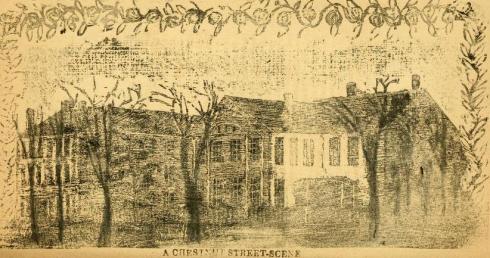
Cook Chestnut Scene

Cook Chestnut Scene 2

Cook Chestnut Street 5

Cook Chestnut Scene 7

Cook Chestnut Scene 8

All illustrations from The Euclea collection of Cook’s poetry, 1852;  For more on Cook see the only source: Lawrence Jenkins, William Cook of Salem, Mass.: Preacher, Poet, Artist and Publisher,” in the Proceedings of the American Antiquarian Society, New Series, Vol. 34, April 9, 1924-October 15, 1924.


Antique Automobiles Assembled (in August)

From my perspective, early August is not only for Americana but also antique automobiles, or perhaps they are the same thing. What started out as a small neighborhood event–a meeting of vintage automobiles on Chestnut Street sponsored by Historic New England’s Phillips House, accompanied by a makeshift lemonade stand organized by local children–has grown to a large assemblage of both cars and people. This year, there were 80 cars on the street with quite a crowd of onlookers and the added attractions of music, cannolis, and a Volkswagen van transformed into a photo booth. I think pretty much every decade of the twentieth century was represented by the cars–or at least the middle part thereof. Lots of Belairs, several wagons of varying vintage. There was a Lamborghini parked on the opposite side of the street which offered some pretty stiff competition, but the largest crowd of the afternoon was definitely in the proximity of the bright red Heinkel. It was nice, but no match for my “chrome crush” of last year, a BMW Isetta 600 Limo. The Heinkel was perhaps the primary representative of a group of classy foreign cars, mostly convertibles, which were surrounded by much bigger American cars. Even though it was not a car for purists (its owner had replaced the original seats with slightly more plush ones as he likes to drive his car) I really liked the 1960s Datsun convertible, and I learned quite a lot about its history.

Autos 040

Autos 056

Autos 082

Autos 083

Autos 147

Autos 110

Autos 041

Autos 094

Autos 047

Autos 071

Autos 155

Autos 152

Autos 140

Autos 038


The Eagle has Landed

Last October, the wooden eagle carved by Samuel McIntire over two centuries ago for the north facade of Hamilton Hall was removed for restoration and preservation purposes and two days ago a resin replica was (re-)installed in its place, and once again I had a bird’s-eye view from my third floor window. The cherry picker, contractors, replica and a little crowd arrived first thing in the morning and by 10:00 the new eagle was firmly in place, looking (from relatively far away) like it had always been there. The original eagle had been painted in the later nineteenth century and gilded in the 1920s, but apparently it was white in the first half-century of its existence, and so white it will remain, blending in nicely with the adjacent–and original–McIntire swags. Kudos to the Board of Trustees of Hamilton Hall for making this happen–as this was the last in situ McIntire eagle in Salem it has been a topic of conversation for decades. Now the old wooden eagle–its rot removed (or at least stabilized)–will endure in interior perpetuity (one hopes!) while its better-equipped copy braves the elements outside.

Eagle 019

Eagle 021

Eagle 022

Eagle 032

Eagle at Hamilton Hall


Event-fully Salem

There is so much going on in Salem this summer that I’m a bit overwhelmed, and have taken to hiding in my garden! This was my strategy this past weekend, which was hot and sunny and jam-packed with things to do: sadly I inadvertently missed PEM Curator Dean Lahikainen’s lecture on the recent renovation of the Ropes House and the Salem Garden Club’s seaside garden tour, along with the “Paddle for Plummer” fundraiser for the Plummer Home, though I deliberately missed the Salem Willows Seafood Festival, which is not a community “festival” at all but a corporate event held in a (roped-off) public park. There’s still plenty of time to see the Thomas Hart Benton exhibit at the Peabody Essex Museum and the exhibit on the alchemical activities of John Winthrop at the Witch House is just opening today. In a metaphor for this “close to home” summer, I also missed this weekend’s pop-up installation of giant inflatable rabbits down in Boston (Intrude by Australian artist Amanda Parer), but spent Saturday weeding with (three? four? rabbits) hopping (and napping) right in my backyard! On Sunday however, I could not avoid another event which happened right in my (de facto) front yard: Salem’s 4th annual Diner En Blanc pop-up picnic, which was held in the Chestnut Street park. You may be familiar with this……movement? (this sounds like too strong a word) in which people dressed in white “spontaneously” set up a picnic (with more white stuff, including food) in some secretive (right up to the afternoon of the event) location and dine together in pristine magnificence–it started in Paris nearly 30 years ago and now has spread to over 40 cities around the world, probably more, including Salem. As elsewhere, the dinner gets bigger every year as friends invite friends who invite friends….I wasn’t going to post on this happening (better word) as I thought it might seem a bit exclusive, almost as if we’re in Marblehead or Manchester-by-the Sea, but then I thought: what’s exclusive about this? Anyone can come, and they don’t have to pay for the privilege, like the Salem Willows Seafood “Festival”. Plus there was a great hat in attendance, which you simply have to see, and I am proud of my own blanc arrangement, made up exclusively from flowers from my garden.

Mid-July Weekend in Salem (and Boston–“Intrude” Rabbits courtesy of Mark Favermann):

Exclusive Events2

Exclusive Events 011

Exclusive Events 004

Exclusive Events

Intrude Mark Favermann July 12

Exclusive Events 049

Exclusive Events 066

Exclusive Events 106

Diner et Blanc

Exclusive Events 090

Exclusive Events 038

All that’s left is my ghost-like chair this morning.


Red, White, Blue & Calico

We are sticking very close to home this July Fourth weekend as we have welcomed a new cat only two weeks after losing Moneypenny and there are lots of adjustments to be made on the part of said new cat (Trinity), our older resident cat (Darcy), and ourselves. I wasn’t quite ready for a new cat, but I am a sucker for a calico and this one almost magically appeared at our local shelter after a rough start in life. So I find myself cleaning out closets and other mundane house chores in between hissing standoffs and prepping my upholstered furniture for the coming attack by a new young cat. Yesterday was actually a much more beautiful day than today, which is cloudy with incoming rain. I hope it holds off until after the fireworks tonight, because Salems are always spectacular: bigger and better every year. So I did leave the separated cats for a long walk, a long bike ride on my (also new) bike, the adorable Spokes and Stripes parade sponsored by Parents United and dinner at the Willows–under a bright red full moon which I couldn’t capture on camera. It looked briefly like Mars before disappearing behind a cloud bank. Most of the pictures below are from this sunny July 3rd: home, Chestnut Street, some sights and scenes around Salem including the Willows–all prepped for the big Horribles Parade this morning (which I missed, but I am sure there will be some great photographs at the Creative Salem site soon). My closet cleaning has uncovered lots of discoveries, including my favorite vintage dress which I purchased DECADES ago in Saratoga Springs, NY (and it was vintage then): I’m going to put in on in a few hours and go out to a fireworks barbecue on the water, mindless of clashing cats and impending rain. A happy, safe, carefree Fourth (and Fifth) to all.

Red White Blue Calico

Red White Blue Calico 3

Red White Blue Calico 2

Fourth of July 2015

Red White Blue Calico 7

Red White Blue Calico 4

Red White Blue Calico 5

Red White Blue Calico 6

Red White Blue Calico 13

Red White Blue Calico 12

Red White Blue Calico 8

Red White Blue Calico 10

Red White Blue Calico 11

Salem on July 3 and 4: Trinity (who did not come in a bag or a box but seldom leaves the latter), the house and garden (with daneberry–the only red on display), and a shadow silhouette against Hamilton Hall, the Hall and Chestnut Street, a patriotically-painted house on Essex, the Spokes and Stripes parade on Salem Common, the Willows, my newly-rediscovered old dress.


Flowers and Flags

That’s what late June and early July are all about in essence:  flowers (mostly roses) and flags. This particular year, even more so regarding the latter. I worked on my garden quite a bit during this mostly sunny week, and I was so happy to wake up to hard-driving rain this morning because it meant I could have a Sunday day of rest–or laundry. Much of the garden is in full flower, but as I’ve been going for interesting leaves rather than short-lived flowers over the past few years green dominates. I think I went a bit too far in this direction so I introduced some interspersed old-fashioned mallows in the central garden this year, and I think they provide a nice pop of color. But mostly it’s about roses, which I have yet to master and probably never will–but even a fool can grow roses in June (July and August are quite another matter). Now for the flags: we usually have a full range of flags flying on Chestnut–from standard and more unique versions of the stars and stripes to the Hawaiian flag at the Phillips House to the rainbow flag, flying for last week’s North Shore Pride Parade but obviously bearing even more resonance now. I like to display my great-great-grandfather’s 45-star memorial flag on the side of the house, but it’s “flying” in the front parlor until the weather clears up. If anyone knows a good source for (cotton) reproductions of historic flags, please let me know: I’d like to buy a 24-star flag, the official version when our house was built in 1827. There was a more jarring display of flags last week, fortunately only digital, when The Nightly Show with Larry Wilmore used a photograph of Hamilton Hall (just next door!) to create a “Confederate Flag Museum”: I’m including it here because it’s always good to remember that not everything is beautiful.

Late June in Salem 007

Late June in Salem 005

Late June Roses in Salem

Late June Roses

Late June Roses Ropes Garden

Late June Roses Ropes Garden fence

Late June in Salem 002

Late June Flag in Salem

Nightly Show Confederate Flag Museum

Late June garden with roses, roses, roses (only the yellow ones are mine: the rest are from the Ropes Garden and Flint and Becket Streets). Flags–real and fortunately NOT–on Chestnut Street.

Appendix: and even worse, someone hung a real Confederate flag on the Robert Gould Shaw/ Massachusetts 54th Memorial in Boston yesterday, and it remained there for several hours before a Lowell woman pulled it off: https://www.bostonglobe.com/metro/2015/06/28/confederate-flag-hung-from-regiment-memorial/bLFrtGsKCLAEpFFDBsX0DK/story.html.


Casting Dice

The sheer beauty of the Chestnut Street park this spring–just outside my bedroom window–combined with the solicitousness of my neighbors in picking up after their dogs (newly allowed this year) has got me thinking about lawn games, played, of course, on a perfect summer day (or early evening), g&t in hand. There is always croquet or bocce, but somehow three pictures of lawn dice popped up on my computer screen in the last few days, so right now that’s my focus: I’m not quite sure what you do with these jumbo dice, but I like the concept. When looking around for some game possibilities, I fell down the rabbit hole that is the history of dice–back to antiquity. What we think of as a simple game certainly had some weighty symbolism attached to it in the past: the die is cast for Julius Caesar, Roman soldiers casting dice to determine who would get the bloodstained garments of Jesus after the crucifixion, dice games played with Death Personified during the Middle Ages, vice, vice, and more vice. Think about the evolution of the verbs associated with dice: casting is somewhat suspicious, but once it evolves into a game of throwing, it becomes an increasingly harmless activity. And tumbling dice are clearly even more innocuous.

Park 002

Lawn Dice

Dice Smithfield Decretals BL

Dice Players Walters Art Gallery

DES94132 Fashion textile design depicting tumbling dice, French, c.1930s (gouache on paper) by French School, (20th century); © The Design Library, New York, USA; French,  it is possible that some works by this artist may be protected by third party rights in some territories

Jumbo Wooden Dice sets from Paper Source, Crate and Barrel, and The Grommet; lazy (half-naked!) dice players in the Middle Ages and Renaissance (The Smithfield Decretals, British Library MS Royal MS 10 E IV; Walters Art Gallery MS W4492V by Master Jean de Mauléon, c. 1542); the modern design motif: tumbling dice fabric from the 1930s, ©The Design Library, New York.


May it always be May

May seems especially sweet this year after our cruel winter, and last week was particularly beautiful–with the wisteria and the dogwoods in full flower along with many of my favorite plants: bleeding hearts, Solomon seals, Alexanders, and lilies of the valley. It was also one of the busiest weeks of the academic year, with grading, senior events, and graduation, so I rushed around from place to place while still managing to stop and smell the lilacs. Warm days, cool nights: perfect hair and cotton sweater weather. Gorgeous, golden light in the late afternoon and early evening spilling into my north-facing front parlor. The only off-key event of these lyrical days was the Mad Men finale which was just not worthy, in my opinion:  I don’t want to see Don Draper chanting om! Sorry for the digression–I just had to get that out there. Back to the real world, which I would like to always be May-like, but then, of course, May would not be May, but just everyday.

Pictures of May in Salem starting with a colonial musician walking down Chestnut Street, then the view from my bedroom, the view from my office, and lots and lots of flowers.

Peak 13

Peak 2

Peak 3

Peak 4

StickWork 050

Peak 8

Peak 9

Peak 10

Peak 11

Peak 12

