Tag Archives: Cemeteries

Hawthorne’s Salem Notebook

For a blog with Salem in its title, I have written relatively few posts about witches, or Hawthorne. Faithful followers will understand the former slight, but I haven’t really discussed my thoughts about Hawthorne here, I think. Essentially I am not a fan of the man or his works. He strikes me as very haughty and melancholy and over-dramatic and not subtle and there are particular aspects of his biography and character which I really don’t like, particularly his attitude towards race and any expression of social reform and his treatment of Salem sculptor Louise Lander in Rome. I don’t think his novels have aged well: just a brief comparison with a near-contemporary like Jane Austen will illustrate what I mean. Despite her smallish world, much smaller than that of Hawthorne, her works are classic and current because she understood people much better than he did. It’s no revelation that Hawthorne was a misanthrope, but it’s difficult to get past that, really, at least for me. In the last year or so, I have been trying to get closer to Hawthorne by reading his notebooks: they’re by my bedside in nice editions and I have been been dipping into them regularly. I started with the European notebooks (English, Italian) and then last month picked up the “lost” notebook, which he kept in Salem from 1835-1841. And now I find myself looking at him not altogether but a bit differently: he seems young, very impressionable, very curious, but still judgemental. True to form, young Nathaniel was not really social in any sense in the world—he even calls himself a recluse—but he is a good observer so he is a good source for Salem. This notebook was published by his widow Sophia in the 1860s in a highly-edited American version: most critics use the word bowdlerized. She took out all the interesting bits! More than a century later it was rediscovered, and published in a 1978 facsimile edition by the Pierpont Morgan Library, which has the original manuscript in its collection.

The entries in the notebooks are basically observations interspersed with story ideas. Hawthorne is always walking around Salem: in general (but not always) he prefers to walk away from the city center into nature, to the Willows and Winter Island, to North Salem, along the coastline. Sometimes something he sees will prompt a story idea but usually the story ideas are coming out of his head rather then his environment. He seems to be practicing describing settings, rather than people’s characters. Sophia took out his descriptions of a well-dressed drunken couple observed on a trip to Boston, and young ladies bathing at the Salem shore, but they are restored in the 1978 publication, and another (really great, but again somewhat detached) discourse on society is a great description of the celebration of July 4 (his birthday!) on Salem Common. I made a list of highlights, but you will surely have your own: the lost notebook, which is also Hawthorne’s Salem notebook, is a quick, engaging read.

On Nature: Hawthorne loves the shoreline and describes its features in great detail. He seems to relish “marine vegetables” in general of an olive color, with round, slender, snake-like stalks, four or five feet long, and a great leaf, twice as long, and nearly two feet broad; these are the herbage of the deep-sea. I had never heard of samphire, or mutton sauce, growing somewhat like asparagus; it is an excellent salad at this season, salt yet with an herb-like vivacity, and eating tender. A succession of cookbook authors agree: where have I been? It’s all over Juniper Point, along with jellyfish. Hawthorne also liked to observe farmland and farm animals, especially pigs, which surely are types of unmitigated sensuality; — some standing /^in/ the trough, in the midst of their own and others victuals; — some thrusting their noses deep into the filth; — some rubbing their hinder-ends against a post; — some huddled together, between sleeping and waking, breathing hard; — all wallowing in each other’s defilement; — a great boar -going /swaggering/ about, with lewd actions; — a big-bellied sow, waddling along, with her swag-paunch. He’s judgemental even of PIGS.

Samphire illustration by Mrs. Henry Perrin from British Flowering Plants (1914).

I would have like to have seen this, but the Bulfinch Almshouse/Hospital was demolished in 1954: The grass about the hospital is rank, being trodden, probably, by nobody but me. The representation of a vessel under sail, cut with a pen knife, on the corner of the house. I would have liked to have seen both the building and the vessel carving.

The Salem Almshouse and Hospital of Contagious Diseases built 1816, Frank Cousins glass lantern slide, Phillips Library, Peabody Essex Museum via Digital Commonwealth.

Looking glasses: Young Hawthorne clearly loved nature, but he was a materialist too, interested in and inspired by structures and objects. I found multiple reference to mirrors: To make one’s own reflection in a mirror the subject of a story. An old looking-glass—somebody finds out the secret of making all the images that have been reflected in it pass back again across its surface.

Wondrous Forces: Many of the story ideas which pop up in the notebook involve plots in which some sort of wondrous force drives the action. I like this one: a person to be writing a tale, and to find that it shapes itself against his intentions; that the characters act otherwise than he thought; that unforeseen events occur; and a catastrophe which he strives in vain to avert. It might shadow forth his own fate — he having made himself one of the personages. Hawthorne seems very interested in all forms of magic, particularly of the kind that alters forms, like alchemy. What I think was the Deliverance Parkman House (demolished just before Hawthorne began his notebook entries; he must have seen it) draws forth several alchemical connections: the house on the eastern corner of North & Essex streets (supposed to have been built about 1640) had, say sixty years later, a brick turret erected, wherein one of the ancestors of the present occupants used to practice alchemy. He was the operative; a scientific person in Boston the director. There have been other Alchemysts of old in this town — one who kept his fire burning seven weeks, and then lost the elixir by letting it go out.

Stereoview of a drawing of the Parkman House, New York Public Library Digital Gallery.

Macabre bits: Hawthorne’s interest in the dead and dying are pretty well-known and there are certainly lots of death references in the notebook: one story idea involves a young couple [who] take up their residence in a retired street of a large town. One day, she summons several of the neighbors in, and shows them the dead body of her husband. That’s it! I wonder where he was going with that? He is of course enchanted with and by the Old Burying Ground on Charter Street where he encounters the grave of his witch-trial judge ancestor and the famous epitaph of Nathaniel Mather, “an aged person that had seen but nineteen winters in the world.” Hawthorne admits that he is quite considerably affected by these words, which he himself revealed to the world when I had away the grass from the half buried stone, and read the name.

July 4: Probably my favorite entry is Hawthorne’s depiction of a very festive Fourth in Salem in 1838. It was a “very hot, bright sunny day,” and the town was “much thronged”. On the Common were booths selling gingerbread &c. sugar-plums and confectionery, spruce-beer, lemonade. Spirits forbidden, but probably sold stealthily. On the top of one of the booths a monkey, with a tail two or three feet long. He is fastened by a cord, which, getting tangled with the flag over the booth, he takes hold and tries to free it. The object of much attention from the crowd, and played with by the boys, who toss up ginger bread to him. He goes on to describe more of the festivity, but he can’t help himself from commenting on the “plebianism” of the crowd!

True Crime via Wax Figures: A very festive July 4th/birthday for Hawthorne as he also attended an exhibition of wax figures which made quite an impression on him. Wax-figure displays had been happening in Salem from at least the 1790s: they were often patriotic or religious in theme, but this particular “statuary” consisted  almost wholly of murderers and their victims; — Gibbs and Wansley the Pirates; and the Dutch girl whom Gibbs kept and finally murdered. Gibbs and Wansly were admirably done, as natural as life; and many people, who had known Gibbs, would not, according to the showman, be convinced that this wax figure was not his skin stuffed. The two pirates were represented with halters round their necks, just ready to be turned off; and the sheriff behind them with his watch, waiting for the moment. The clothes, halters, and Gibbs’ hair, were authentic. E K. Avery and Cornell, the former a figure in black, leaning on the back of a chair, in the attitude of a clergyman about to pray; — an ugly devil, said to be a good likeness. Ellen Jewett and R. P. Robinson; — she dressed richly in extreme fashion, and very pretty; he awkward and stiff, it being difficult to stuff a figure to look like a gendeman. The showman seemed very proud of Ellen Jewett, and spoke of her somewhat as if this was figure was a real creature. Strang and Mrs. Whipple, who together murdered the husband of the latter. Lastly the Siamese Twins. The showman is careful to call his exhibition the “Statuary”; he walks to and fro before the figures, talking of the history of the persons, the moral lessons to be drawn therefrom, and especially the excellence of the wax- work. Gibbs and Wansley were notorious pirates, Ellen (Helen) Jewett was a Maine girl who became a prostitute in New York City and her murder in the spring of 1836 triggered sensationalist headlines for the rest of the year as R.P. Robinson was tried and acquitted of the crime. E.K. Avery was Ephraim Kingsbury Avery, a Rhode Island Methodist minister accused of murdering a factory worker in his congregation named Sarah Cornell whom he had impregnated: he too was aquitted and this was another sensational murder case involving a (very) lasped clergymen which perhaps inspired The Scarlet Letter. In yet another notorious case, Jesse Strang and Elsie Whipple conspired to murder the latter’s husband outside Albany in 1827: she was acquitted and he was executed. I guess “Siamese twins” refers to the conjoined Bunker twins from Thailand who were thrown in here for good sensationalistic measure.

Cornell Digital Collections.

Social Commentary: Hawthorne does not seem to be interested in the contentious causes of his time and place. Salem was characterized by dynamic temperance and abolition movements in the 1830s, and he makes no mention of them in his notebook except for another story idea, a sketch to be given of a modern reformer — a type of the extreme doctrines on the subject of slaves, cold-water, and all that. He goes about the streets haranguing most eloquently, and is on the point of making many converts, when his labors are suddenly interrupted by the appearance of a keeper of a mad-house, whence he has escaped.

While I enjoyed reading Hawthorne’s Salem journal more than the European ones, especially in this unadulterated form, I can’t say I like him anymore than I did before I delved in. I do admire his curiosity, his descriptive abilities, as well as his tendency to engage—-and often wrestle with—the past, even in his odd anti-humanistic way. When I read his proposal of a history of modes of punishment, ancient and modern I finally understood the rationale behind the Salem Museum of Torture! (just kidding; I doubt a Hawthorne connection). And while a statue on Hawthorne Boulevard and the House of the Seven Gables stand testament to Hawthorne today in Salem, there is also a wax representation, which seems appropriate, given his fascination with that genre.

I pinched this photo of Hawthorne’s wax figure at the Salem Wax Museum of Witches & Seafarers from the author J.W. Ocker’s website, Odd Things I’ve Seen. In “Wax City,” Ocker observes that Salem tells its history through wax museums, and I agree, although I would put quotations around the word “museums.” Ocker wrote the great book The Season With the Witch about his residency in Salem during Haunted Happenings in 2015, and since Salem’s tourism has escalated so much over the past decade, I think he should return for a sequel.


Heroes Uncovered

Salem has three historic downtown cemeteries and the one closest to my house is Broad Street, where I go weekly to wander around and learn something new from the gravestones. Its neighbors have been stewards for as long as I’ve lived in Salem, but over the past few years the cemetery has just looked better and better, acquiring a new permanent entrance sign featuring its notable occupants and seasonal flags for those who were veterans. Yesterday, there were more waving flags than ever, as the Friends of the Broad Street Cemetery held an event showcasing the efforts of their vice-president Kenneth Dike-Glover, who has uncovered many previously unknown graves of veterans, particularly those of the Revolutionary War. Ken was aided by a newly-discovered map, a local example of the Veterans Graves Registration project undertaken under the auspices of the WPA in the 1930s, and he told us in exuberant detail how he worked with this map to mark graves that he (we) didn’t even know were there. It was a lot of work, and it is ongoing: one particular mystery involves of the most famous graves in the cemetery, that of Timothy Pickering, Quartermaster- General of the Army during the Revolution and later Secretary of War and State, who just might not be buried under the perfectly preserved and DAR-marked Pickering family stone but rather under a derelict and unmarked one a few feet over! This is just one example of the often-perplexing process of correlating written documents with physicial spaces: it’s not as easy as it sounds. Maps do not always reveal all; sometimes they create more mysteries. But there were definitely revelations in terms of uncovered ground markers and veterans less conspicuous than Pickering whose graves were “hiding” under their family markers–now uncovered, and in plain sight. Ken had marked each grave with a flag and brief biographical and historical references, so after his talk, we all wandered around and got to know these uncovered heroes. I can’t imagine a more perfect Memorial Day activity.

A beautiful day in the Broad Street Cemetery. Ken Dike-Glover and the WPA Map; City of Salem Veterans Agent Kim Emerling, and some of the marked graves, including the two Pickering tombs. The Friends of the Cemetery are soliciting volunteers to help with their inititatives and advocacy, so if you’re interested in early American history (or just cemeteries), check out their facebook page here.

As I was meandering about digesting all of this new information, I was struck by how many privateers are interred in this cemetery. I knew about Jonathan Haraden, the superstar of Salem’s privateers (on whom we have a short chapter in Salem’s Centuries, featuring lots of new research!) but Captains David Smith and Francis Dennis (among others) were new to me and I look forward to reading more about their exploits and service. Captain James Barr (one of about a score of Revolutionary War veterans who lived long enough to be photographed) is also buried in Broad Street, along with approximately 70 of his contemporary brothers-in-arms, but the cemetery also features the recently-rededicated tomb of Brigadier General Frederick Lander and on an adjacent stone, the poignant epitaph of his Civil War comrade, Brevet Colonel Samuel Cook Oliver, who was wounded severely at Antietam: died after many years of suffering, cheerfully and bravely borne.

Salem heroes, long-known and recently-uncovered.


Tips for Salem “Septoberween”

Residents of Salem have long noticed that our city’s Halloween festivities are not confined to October, hence “Septoberween,” a phrase I’ve heard once or twice. It’s been crowded for some time though—all summer, late spring—people are coming for a general goth spookiness, I think, rather than just for Halloween. Of course, none of it is connected to Salem, or the Salem witch trials, because they were not witches but try telling that to a bridal party wearing little witch hats in July. I’m not sure what’s going to happen to Salem’s dark tourism, but it does seem as if something needs to change in its overall management (I’ve given up on messaging). Whatever happens, if anything at all, will be the result of a top-down decision rather than any impetus from mere residents. After last Halloween season, when weekend crowds of a million people pushed around downtown, I decided that I had experienced my last Salem October: my husband and I are packing up the cats and moving to Maine for a month. Fortunately we have a big family house in York Harbor, which my parents generally vacate for a cozier condo nearby, so I’m going home. I think this is a good solution for my Halloween angst, but we’ll see: I’ll still be commuting to Salem several times a week! Since I’m getting out of town, I thought I would push up my annual little advice to visitors post a bit, especially as I’ve received a lot of email queries over the summer. This is hardly an exhaustive list: if you want that I suggest Destination Salem  (truly the master list of events and a very dynamic site, but skip the “History” sections which are dreadful), or Things To Do in Salem or the dedicated Haunted Happenings site. I am no booster, as regular readers of this blog know, so the most important assertion I can make here is that there is only one museum in Salem, the Peabody Essex Museum (PEM), and the best advice I can give is to avoid all the other venues calling themselves museums if you are seeking authentic objects and/or professional curation based on the most recent scholarship. If you are coming to Salem because you want to learn about the Salem Witch Trials, the PEM offers a lot, but not the whole story: that’s not its mission. However, in the past five years or so, the PEM has really engaged with the Trials, and this year is offering an exhibition entitled The Salem Witch Trials. Recovering Justice. I popped in yesterday and found it very accessible and continuous with its previous exhibitions’ focus on authentic documents and objects.

Given the focus is on recovering justice, I think it would have been nice to exhibit some of the restitution requests (+transcriptions) submitted by victims and victims’ families that are referenced above: these statements by those related to the “Sufferers in the time of the Witchcraft” are very compelling and can amplify the judicial tragedy. The struggle to clear the names of those who were not included in the 1711 Reversal of Attainder could have been given more attention as well—it extended all the way up the 21st century! The exhibition does include the most recent attempt at restitution: the successful campaign of North Andover middle-school students to exonerate Elizabeth Johnson, who confessed to practicing witchcraft and was condemned to death but obtained a reprieve but no reversal. Similar heroic efforts happened in the 1950s when Ann Pudeator “and certain other persons” were legally exonerated, and again in 2001 when those “certain other persons” were named in a formal resolution. The Recovering Justice exhibit invites its onlookers to dig deeper in both primary and secondary sources, and also to visit other galleries in the PEM: the month of October gets its own “chapter” in Salem Stories and related objects and images can also be found in On this Ground: Being and Belonging in America.

News clippings from exoneration efforts in the past (which also offer interesting insights into the commercialization of the Witch Trials in Salem), further reading in the Recovering Justice exhibition (including my colleague Tad Baker’s definitive book), October in Salem Stories and portrait of Witch Trial judge Samuel Sewall by John Smibert, 1733, in On this Ground gallery.

The PEM has a Trials “collection focus” page on its website with FAQs and also offers an audio self-guided “Salem Witch Trials Walk,” but if you want a more personal and narrative experience, you might want to take a walking tour, of which Salem has many. The quality spectrum seems very wide: you could take a tour with someone who has studied early American history for years and has the credentials to prove it, or you could be led around by someone who (literally) just got off the bus. I get asked for recommendations quite often and I am hesitant to offer any, because I just haven’t taken many tours. I am curious about a couple of things, however, and I’ve been working on a longer piece on Salem tourism for a while (now interrupted by the Salem’s Centuries project) so I intend to take more tours in the future. Having just watched them, I’m particularly interested in how tour guides use the physical space of Salem, where so few structures tied to the Trials exist, and also in what kind of context is presented: local, regional, Anglo, global? When you read reviews on Tripadvisor or Google, tourists often comment on authenticity (“all we saw were parking lots”: a paraphrase of a common complaint) or lack thereof: I’m curious how guides compensate for/use the relatively modern streetscape of Salem (the PEM must have noticed the authenticity issue too, as it has used that word in all press materials relating to its exhibitions). So with these questions in mind, I did take a walking tour this past weekend, with Krystina Yeager, a student in the Salem State MA program who was in my Renaissance grad course last spring. Krystina operates a tour called the Historian’s Guide to Salem and produces a podcast as well, and I chose her tour because I was impressed with her work in class but also thought her perspective on the Salem trials might be similar to mine, as she has been more focused on English witchcraft. We set off on a hot Sunday afternoon at a vigorous pace of walking and talking, and I was really glad that the tour group wasn’t too big–maybe 12 or so when the city allows groups of 40. If you’re a mere pedestrian on the streets of Salem you literally cannot get out of the way of such big groups. Krystina had me at the very beginning of her tour when she uttered the name “Martin Luther” as the Reformation is undeniably the biggest factor in instigating and intensifying fears and accusations of witchcraft in early modern Europe. She presented a comparative context throughout while still focusing on the very personal stories and suffering of each and every victim of 1692. It was a very source-based tour: standing before a parking lot and the new building on the site of the former Salem jail, she described conditions within using the detailed restitution requests I referenced above. So that’s how you rise above the parking lot—with some pretty vivid testimony! Krystina explained the Protestant demonization of magic, the power vacuum that gave rise to the odd legal “system” put in place during the Trials, and the character of Giles Corey as close as we could get to the site of his torture–and much more. We wound up at the Salem Witch Trials Memorial downtown, a site that seems both authentic and modern at the same time and certainly an appropriate place to end the story of the “Sufferers in the time of the Witchcraft.” I was exhausted! This tour seemed to echo the whirlwind pace of the Trials themselves over the months of 1692 in its intensity, and I recommend it enthusiastically.

Krystina Yeager explaining Puritan theology and disdain of counter-magic in the courtyard of the First Church and the horrors of the Salem gaol in 1692 in a rather less inspirational spot: clearly tour guides have to be conjurers! Our ending point at the Witch Trials Memorial overlooked by the 17th Century Pickman House, which is now the Welcome Center for both the Memorial and the adjoining Charter Street Cemetery.

And speaking of authenticity, as I have throughout this post, I really can’t recommend the adjoining sites overseen by the Charter Street Cemetery Welcome Center enough, and its establishment was a City initiative, in collaboration with the PEM. A decade ago, both the Witch Trials Memorial and the adjoining Charter Street Cemetery, otherwise known as the “Old Burying Ground,” were being completely overrun by tourists: the walls of the former and graves of the latter were actually endangered by abuse. I don’t even like to think or write about it, if you want to “go” there, read this post, which I typed with my hands shaking. The City stepped up, restored the cemetery and opened an orientation center in the adjoining Samuel Pickman House owned by PEM. Welcome Center staff monitor both the cemetery and the Memorial, and every time I go there, even last Septoberween, there is an air of respect and stewardship for these sacred places. I saw Amber Shannon, another Salem State History grad who works at the Welcome Center, on my way out, keeping her eyes on both the cemetery and the Memorial and clearly steeling herself for the crowds to come. I think everyone in Salem was doing that, this first weekend in September.

Amber Shannon of the Charter Street Cemetery Welcome Center and Rory Raven of Salem on Foot Toursthe first Sunday in September, (relative) calm before the storm. I haven’t been fortunate enough to take one of Rory’s tours, but when I heard him speak at an event he made an impression, and so when some family members visited a couple of years ago I signed them right up. They raved, and so I would certainly recommend his tour as well, especially if you’re interested in a more general tour of Salem and not just the Witch Trials. As I’ve been ranting about here for years now, there’s so much more to Salem!


March Memorials in Boston

This past Sunday, the anniversary of the Boston Massacre, I went into Boston to take the “Massacre and Memory” tour offered by Revolutionary Spaces, the newish organization that maintains and interprets both the Old State House and Old South Meeting House. I always enjoyed going to Massacre reenactments at the former on March 5, but this tour was a whole other dimension of historic interpretation. I was rather amazed at the guide’s ability to present: a) the events of that day in 1770; b) deep background and wide context for the events of the day; c) the divergent sources which presented the events of the day afterwards; d) the day’s immediate and long-term “remembrance”; e) the use of the remembrance of the day by abolition activists in the mid-19th century and anti-busing activists in the twentieth century; f) a very strong sense of both the geography of Revolutionary-era Boston as well as the purposes and perceptions of the revolutionary spaces which we visited; and g) a consideration of how we might tell interpret historic events in the future as we proceed through our digital age. All that in about 2 hours! This was the first tour of the season for our young guide, and she was on fire. No Salem simplistic storyteller was she (what I hear out my front windows when it’s warm: and then Giles Corey was pressed to death (MORE WEIGHT), and then this happened, and then this happened): instead she offered us layers and layers of history: its creation, dissemination, legacy and utility.

Revolutionary spaces indeed: The Old State House, Faneuil Hall (where the first post-massacre meetings were held), and the Old South Meeting House, with George Washington and Andrew Oliver standing by. So many markers in Boston! All in copper and bronze: in the street, on buildings, everywhere. 

The Tour began at the Old State House, before which the Massacre took place, and ended at the Old South Meeting House, where the first memorial massacre orations were held. I had a lot to think about after this layered presentation, so I wanted to go back to Old State House and consider the exhibitions there: the tour ticket included admission to both Revolutionary Spaces buildings. But when I got back to the Old State House, there wasn’t really open admission: there were other scheduled tours which I didn’t want to take so I stomped off in my fashion. I was in a very bitchy mood for about ten minutes as I strode down Tremont Street, because I wanted to process the Boston Massacre on my own terms, this very day, and somehow I felt I was prevented from doing that. But then I came to the Old Granary Burying Ground, and the marker to the five victims of the Massacre therein, which led me to their monument on the Boston Common, and as I was gazing at Crispus Attucks’ prone figure on its plaque, I saw the new memorial to Martin Luther King, The Embrace, in the corner of my eye. So off I went to the presence of The Embrace, which has received rather mixed reviews in our area since its debut in January. I wasn’t sure how I would respond to it—it looks rather intimidating in media images—but I really liked it: it’s smaller in scale and more detailed in reality. And it was fun to see people reacting to it: touching it, walking under it, taking selfies all around it. The engagement with and around this installation reminded me of the very active engagement of Bostonians with the living memory of the Massacre: weeks later and centuries later. And then I walked up the hill to another engaging memorial: Augustus Saint-Gaudens’ masterful monument to Robert Gould Shaw and the Massachusetts 54th right across from the Massachusetts State House. What a memorial trifecta! The thread between these three memorials was African-American history of course, but I didn’t really think about it that was as I was making connections in my mind on my walk. I just felt grounded in Boston history, Massachusetts history, American history.

Memorials: a circle of remembrance from Old Granary to the (new) State House.

[N.B. When I was all worked up I noted my frustration with my exclusion from the Old State House on Facebook: Revolution Spaces staff almost immediately reached out and offered me free admission at my convenience. So now I’m a bit embarassed but impressed with their professionalism!]


The Skeletons of Lagrange Street

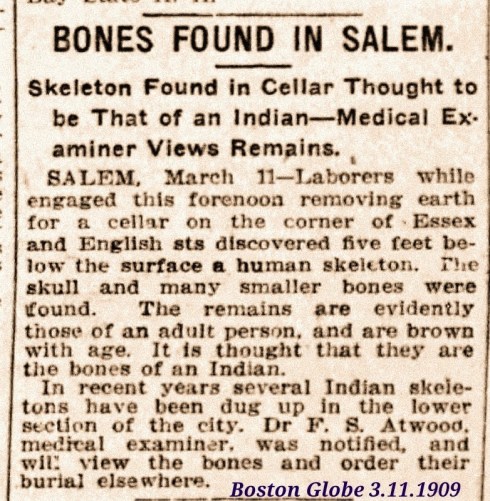
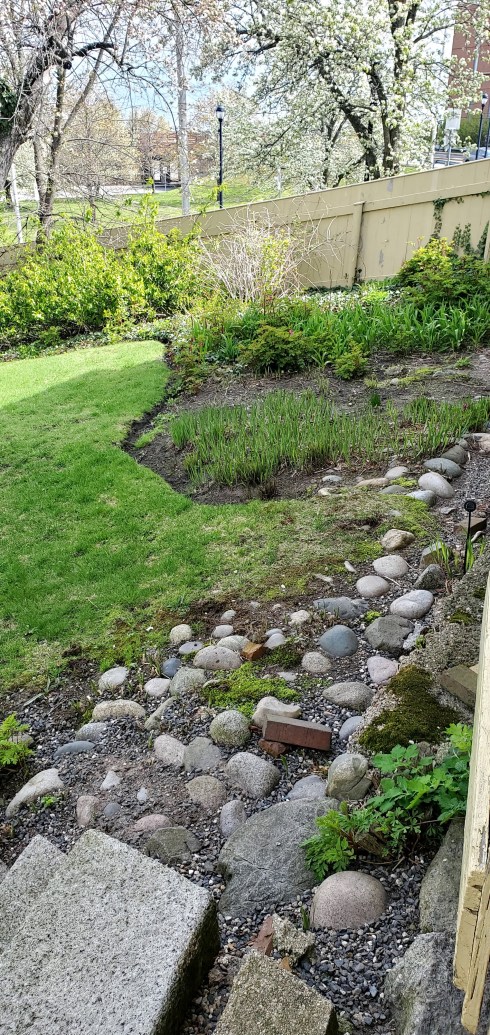
Salem is a place where everybody always says that the “past is present” or something to that effect; one discerns the ongoing presence of the past in the old structures and streets and cemeteries. That used to ring true for me, but not so much anymore. I still have a sense of Salem as a palimpest city, though: with layers and layers of history beneath my feet, reinforced when I walk by one of the seldom-ceasing infrastructure projects downtown and see all the cobblestones that lie beneath. I often think of Salem in the nineteenth century, when there was so much new but also so much more old all around, as a time when people must really have been aware of the past in a material way because of the contrast: the factories were so big and noisy and the surviving relics of the “olden time” so decayed, rather than perfectly preserved (if they survive) today. And it seems as if every time one of those relics was demolished for new construction, more relics were found underground, sometimes human remains. Nathaniel Hawthorne has a story in one of his notebooks of a skeleton that was found, in parts, underneath High Streeet, identified by one of the older residents of the neighborhood as a Frenchmen who came to town. It was a notable, but not a shocking, discovery: I perused nineteenth-century Salem and Boston newspapers and regular reports of skeletons uncovered in Essex Country appeared fairly regularly, generally presumed to be Native Americans. Even early in the century, Salem’s great diarist, the Reverend William Bentley, ran over as soon as remains and “curiosities” emerged from the soil: to Winter Island, to Northfields, and to Southfields. Over time, the majority of the reported skeletons of Salem seem to have surfaced in a pretty specific area: in South Salem, along Palmer’s Cove, on a street that was called Lagrange in the 19th century and is now Leavitt. Here is the unfolding tale of their uncovering:

So, some awareness that there might have been an Indian Burial Ground in what was then Southfields as early as the 1850s, and a succession of extractions from 1809 on with no apparent effort to protect the site. Of course not, this follows in the tradition of founding father Thomas Jefferson, who conducted an archaelogical dig adjacent to Monticello even as he noted local Native Americans making “sorrowful” visitations, and Surgeon General Joseph K. Barnes, who directed U.S. Army medical officers to collect the skulls of Native Americans in 1868, so that the craniological collection of the Army Medical Museum could facilitate “the progress of anthropological science by obtaining measurements of a large number of skulls of the aboriginal races of North America.” Later in the nineteenth century, the pseudo “race sciences” of phrenology and eugenics continued to justify this competitive collecting. The reference above to the Essex Insitute’s possession of an infant skeleton is not surprising, given that one of its founding institutions was the Essex County Natural History Society. It’s my only clue as to where any of these skeletons might have wound up (so far), but it is leading me nowhere: the Peabody Essex Museum’s 2018 completed inventory of human remains and associated funerary objects (in compliance with the Native American Graves Protection and Repatriation Act or NAGPRA of 1990) does not reference remains from the Lagrange area specifically. The inventory includes “the physical remains of 45 individuals of Native American ancestry” taken from sites in Salisbury, Newbury, Ipswich, Gloucester, Marblehead, Revere and Salem. The Salem remains were taken from an “old cistern in Front Cellar in 1993” (????) and south Salem, so this could be Lagrange Street: the cranial fragments unearthed from this site apparently belonged to a teenager. It looks like one skeleton (in the 1892 clip) simply dissolved in the open air, but I am curious about how the rest of the remains were treated, and what became of them. My only remaining thread is intrepid medical examiner Frank S. Atwood, who seems to be taking the remains into professional custody, at the very least. Called to the scene of yet another discovery at the corner of English and Essex Streets in 1909, it is reported that he ordered their burial elsewhere. In just the past year or so, several unmarked graves of African-Americans have been identified and restored, and I’m wondering if that is within the realm of partial possibility for these earlier, displaced, settlers of Salem.

Lagrange Street on the 1911 Salem Atlas: in three years all this would be swept away by the great Salem Fire, and then rebuilding, again.


My Salem Heritage Trail

I’m still frustrated with our city’s “revisioned” “heritage” trail: its blatant commercialism, its yellow color (the exact same shade as the lines in the middle of the road; tour guides have told me that their tourists ask if they have to keep right on the sidewalk which actually might not be a bad idea with the crowds at this time of year), the missed opportunities it represents. None of the promised streamlined signage is up yet so all we have is a yellow line superimposed right on top (or sometimes beside) the still-visible objectionable red line. Any criticism is met with a chorus of “it’s not finished yet!” from all involved, but it’s hard to have confidence going forward when the “product” is so obviously flawed, in terms of both presentation and content.

I’ve laid out my concerns about the latter in detail in an earlier post, but after walking the yellow line a few times I have another complaint: it’s not telling a story. It’s just a string of places, with no connecting narrrative or theme. Maybe this is coming too, but it’s not here yet. There seems to be a mismatch between narrative history and the built environment in Salem: you can have one or the other but not both. I’m sure the countless private tour guides are out there telling stories because that’s what successful, marketable walking tours do, but they are handicapped by Salem’s overwhelming focus on the Witch Trials. If you’re trying to present place-based history, the Trials don’t offer you a lot of options for Salem as there are only two actual material places associated with them: Judge Corwin’s House or the “Witch House” on Essex Street and the Witch Trials Memorial/Old Burying Point on Charter Street.  A few “sites of” are fine for a walking tour but ten or more? It’s difficult to conjure up 1692 while standing in a parking lot. The combination of the emphasis on the Trials and the relative absence of structures from that era has placed an emphasis on performances in commercial interpretations, and ghosts, of course. But Salem has a wealth of historical structures, and they can and should tell stories too. My alternative Salem Heritage Trail is built primarily around buildings, and inspired by the Creating or Building walking tours you see in many cities, tours which are designed by heritage professionals to present a comprehensive and materialistic history of urban development. It’s a stripped-down version of tours I give to family and friends, and following the example of Toronto’s exemplary tour, Creating Toronto: the Story of the City in 10 Stops, I limited myself, with great difficulty, to ten sites.

Trail Sites/Stops: My trail starts at the Pickering House on Broad Street and ends at Salem Common. I’ve chosen the sites along the way because they are beautiful and important buildings and spaces, but also because they represent a number of events and themes in the “making of” Salem: they have to do double or triple or more interpretive duty! I’m aiming for 400 years of history through 10 buildings or sites, on a tour that should take about 90 minutes. It’s definitely a work in progress.

The Pickering House: Salem’s oldest house is a marvel visually and historically. It can represent both the first wave of European settlement and because of its conspicuous and active family, also a series of events and relationships that shaped Salem: King Philips’s War and relations between European and native populations, transatlantic trade, the Revolutionary War. As the house evolves, so does Salem. From the vantage point of the house, one can see the outskirts of Salem’s first African-American section as well as its Italian-American neighborhood, and the line at which the Great Salem Fire ended in 1914.

Hamilton Hall: Built on former Pickering land, along with the rest of Chestnut Street, Hamilton Hall represents the dynamic civic culture of Salem following the Revolution as well as the singularly Federal style of Samuel McIntire and the range of reform and entrepreneurial activities of Salem’s most prominent African-American family, the Remonds. It is also an important site of women’s history, as so many philanthropic events organized by Salem women were held at the Hall: from Abolitionist and soldiers’ aid events in the middle of the nineteenth century, to Red Cross efforts during World War I to the creation of the Hamilton Hall Ladies’ Committee after World War II.

The First Church: It’s the First Church, so it has to be on the tour even though its not in its original location—we’ll pass by there later. The history of the congregation should be prioritized over the history of the building: the transition from Puritanism to Congregationalism to Unitarianism, Hugh Peter & Roger Williams, the religious aspects of the Trials, Leslie’s Retreat, and then Salem’s (19th century, as opposed to today’s) Gothic phase (with a tie-in to the Pickering House).

The Witch House: The home of Witch Trial Judge Jonathan Corwin is the authentic witch-trial site in Salem, but also a place that can represent and illustrate the commercialization of the trials in the nineteenth century as well as the increasing role of historic preservation in the twentieth. This is a good spot to start the discussion of the legal aspects of the trials, but the next stop is better.

Court Houses on Federal Street: These courthouses are a great illustration of Salem as “shire town” or county seat, a very important part of its history and identity. When I was on History Alive’s “Charlotte’s Salem” tour a few weeks ago, Charlotte explained some of the legal aspects of slavery which were causing her anguish in 1857 right in front of the courthouses, and I thought it was the perfect spot, particularly because it was so quiet on a busy Saturday night. The Witch Trials were of course, trials, so this seems like a good spot to address their legal aspects, as well as the famous “witch pins” and several other important Salem trials. The different architectural styles of the court houses evoke their eras in Salem’s history.

Old Town Hall: The terrain between the court houses and Old Town Hall is full of important sites……that are no longer there: the actual 1692 court house, Town House Square, the site of Salem’s first meeting house, and the former sites of conspicuous residents like Judge John Hathorne and Lady Deborah Moody. I guess that dreadful Bewitched statue is part of the “creation” of Salem but I prefer to look at it as an abberation and I don’t want it in my story/tour. So we’ll just skip through Town House Square to the Old Town Hall or walk down Church Street past the Lyceum and cut over to Essex Street. Old Town Hall (long known as the “Market House”) and Derby Square remains a very busy place, so it’s the perfect space to represent the extremely dynamic and diverse commercial history of Salem. It’s also a great place to focus on food food: Salem seems like a foodie designation now but I think it always has been, and Derby Square and adjacent Front Street was a restaurant row. I guess it’s been reduced to an Instagram stage now, which seems appropriate since Instagram photos are one of Salem’s major products.

Old Burying Ground/ Witch Trial Memorial: The last three stops of my trail consider Salem’s evolving public presentation of history, along with other themes and events associated with each site. From the later nineteenth century on, as the City focused increasingly on tourism, there were three major draws: the Witch Trials, Nathaniel Hawthorne, and maritime history. For me, the Salem Witch Trials Memorial represents the triumph of the Trials: the City could go forward into full-fledged witchcraft tourism now (in 1992) as it had erected a memorial and pledged itself to toleration going forward. The more recent restoration of the adjacent Old Burying Ground and addition of the first-period Pickman House as a welcome center for both seems to me an admission that Witch City needed a bit more regulation: Salem has always taken care of its cemeteries.

The Salem Maritime National Historical Site. Carved out of Salem’s Polish neighborhood along Derby Street, Salem Maritime is also an illustration of history in the public sphere: it is a rebuilding and reframing of the City’s glorious maritime past, almost like a maritime memorial. Standing on Derby Street looking out onto Salem Harbor, we can consider both Salem’s maritime history as well as the historical and ongoing effort to preserve and showcase Salem’s maritime history, especially as the Custom House is closed for restoration. With its streetside shop on one side of the Derby House and garden out back, it is also a good place to consider Salem’s Colonial Revival influences and impact.

And on to Salem Common: where we could tell the entire history of Salem, from rope walks to food trucks! I think it would be interesting to end the trail with a consideration of what is “public” and what is not as it pertains to the Common and the myriad events that have happened there over the centuries. So many events: military musters and drills, neighborhood playground competitions, baseball games, concerts and films, speeches and protests, carnivals and circuses, commemorations. Just this past weekend, I was walking around the Common while a large food truck festival which apparently had no local vendors was happening, on “common” land.

What I left out. Many places! The ten-stop limit really challenged me. And of course, there will be no “suffering mannequins” on my tour. I left out both the Peabody Essex Museum and the House of the Seven Gables because these institutions are independent draws which also feature their own audio tours: both are obviously central to Salem’s urban and identity development. The PEM’s new Salem Witch Trials Walk looks like a good introduction to the Trials and there are also “PEM Walks” audio “postcards” for each of the Museum’s historic houses. Both Salem Maritime and the House of the Seven Gables also offer excellent audio tour options. So there’s really no need to follow that yellow line; indeed, no need for any paint on the sidewalks of Salem.


Skirting Witches and Pirates in Salem

Walking is my preferred form of transportation in Salem, but I tread carefully: I want my path to be lined with beautiful old houses, colorful shops and lovely green (or white) spaces. Attractions exploiting the terrible tragedy of 1692 and out-of-town-yet-territorial pirates cloud my view and dampen my day. I’m happy to meet real witches and pirates on my walkabouts, but kitschy parodies annoy me. If you are of like mind, there are many routes you can take in Salem on which you will not cross paths with anything remotely touristy, but if you are venturing downtown you must tread carefully too. Avoid the red line at all costs and follow my route below, which I have superimposed on an old map of the so-called “Heritage Trail”: I’m starting at my house on lower Chestnut Street and making a witch-less circle.

Across from my house is Chestnut Street Park: this is not a public park but a private space, owned by all the homeowners of Chestnut Street. It was once the site of two churches in succession: a majestic Samuel McIntire creation which lasted for almost exactly a century and was destroyed by fire in 1903 and a stone replacement which was rather less majestic and lasted about half as long. The gate is usually open to everyone, but not for reseeding time as you can see by the sign. I walk down Cambridge Street by the park and across Essex into the Ropes Mansion Garden, not looking great now but an amazing high summer garden. Then I walk down Federal Court and across Federal Street to the Peirce-Nichols House which is owned, like the Ropes Mansion, by the Peabody Essex Museum. Unlike the Ropes, I can’t remember when the Peirce-Nichols was last opened to the public: it’s been decades. It has a lovely garden in back which was always open, and my favorite place to go at this time of year because of its preponderance of Bleeding Hearts. The gate to the back of the house has been closed for a couple of years now, but it is latched and not locked, so I entered and went into the rear courtyard, passing the memorial stone dedicated to the memory of Anne Farnam, the last director of the Essex Institute before it was absorbed into the Peabody Essex Museum on my right. I never knew Anne but I’ve learned a lot from her articles in the Essex Institute Historical Collections so I always pay tribute. The gate to the garden in back was latched and locked, so I presume the museum does not want us to venture in there. I hope it was ok to go that far! While I am grateful for these pem.org/walks recordings I’m always wondering why these houses are never open.

Continue down Federal Street past the courthouses: you must avoid Lynde Street and Essex Street where witch “attractions” abound. I take a left after Washington street onto a street that no longer exists: Rust Street. I like the juxtaposition of the newish condominiums and the old Church and Bessie Monroe’s brick house on Ash Street on the right: a symbol of the opposition to urban renewal in Salem. Then it’s on to St. Peter Street, past the Old Jail and the Jailkeepers’s House (below), right on Bridge, and then right again, onto Winter Street.

Winter Street

As you approach Salem Common, you must bear left and head for the east side, as the west side is the territory of the Salem Witch “Museum.” There are some side streets with wonderful houses between the Common and Bridge Street which might be a bit more pleasant to traverse than the latter but you will be cutting close to the “Museum”: that’s why I always go with Winter. Once there, go straight by the Common on Washington Square East : you will pass the newly-renovated Silsbee Mansion, which long served as the party palace Knights of Columbus and has been converted into residential units with a substantive addtion and exterior restoration, and one of my favorite houses on the Common, the Baldwin Lyman House.

On Washington Square East.

Washington Square East will take you right to Essex Street: cross and go down the walkway adjacent to the first-period Narbonne House into the Salem Maritime National Historic Site. No witches or pirates here: you’re safe! I love the garden behind the Derby House: I think it is probably at its best in June when the peonies are popping but it’s a great place to go all spring and summer and even in the fall. On Derby Street, you can turn left and go down to the House of the Seven Gables or go straight down Derby Wharf: I went to the end of the wharf on this particular walk. The Salem Arts Association is right here too, but beware: there is a particularly ugly witch on its right so shade your view lest your zen walk be disturbed.

Salem Maritime National Historic Site and the Salem Arts Association.

Back on Derby. Adjacent to the Custom House is a wonderful institution: the Brookhouse Home for Women, established in 1861! The Home is located in the former Benjamin Crowninshield Mansion, and it is very generous with its lovely grounds, which provide my favorite view of Derby Wharf. I always stop in here, and then I work my way back up to Essex Street on one side street or another. Essex Street east and west are wonderful places to walk, but the pedestrian-mall center is witch-central: a particularly dangerous corner is Essex and Hawthorne Boulevard, where the Peabody Essex’s historic houses face some of the ugliest signs in town. It’s a real aesthetic clash: gaze at the beautiful Gardner-Pingree House, but don’t turn around! If you want to go to the main PEM buildings or the Visitors’ Center further down Essex, approach from Charter Street north on another “street” that no longer exists: Liberty Street.

From the Brookhouse Home to the PEM’s row of historic houses on Essex Street. Memorial stone in the Brookwood garden: Miss Amy Nurse, RN, an Army Nurse (1916-2013).

Charter Street is the location of Salem’s oldest cemetery, the Old Burying Point, recently restored and equipped with an orientation center located in the first-period Pickman House, which overlooks the Witch Trials Memorial. So this is a wonderful, meaningful place to visit, but beware: just beyond is the “Haunted Neighborhood” or “Haunted Witch Village” (whatever it is called)  situated on the southern end of the former Liberty Street, abutting the cemetery. This is a cruel juxtaposition during Haunted Happenings, when you literally have a party right next to sacred places, but not too noticeable during the rest of the year, because for the most part witchcraft “attractions” create dead zones. But the tacky signage can still spoil your walk so avert your gaze as much as possible. Charter Street feeds into Front Street, Salem’s main shopping street, and from there you can find the path of least (traffic) resistance back to the McIntire Historic District, which is very safe territory. Broad, Chestnut, upper Essex and Federal Streets are lined with beautiful buildings, as are their connecting side streets, so take your pick. I usually just walk around until I get in my 10,000 steps: on this particular walk I ended up on Essex.

Charter, Front & upper Essex Streets.


Pirates Plunder Charlotte Forten Park

What do place names mean? Whenever I’m walking around a town or city I look at the names of streets and spaces and assume that they are clues to the history of said town or city but what if these names mean nothing? What if they are just slapped on there to give an impression, rather than as a form of remembrance—and honor? Taking its cue from our long-serving Mayor, Kimberley Driscoll, Salem’s municipal government sees itself and sells itself as progressive, and loses no opportunity to broadcast that message, often in reference to “history”. Actually, this public relations policy predates Mayor’s Driscoll’s reign: Salem had to become a City of “toleration” to compensate for its famous Witch Hunts and enable those who profit from that tragedy to do so with a clear conscience. It seems to me that the virtue-signaling has been switched on to hyperdrive more recently, however. The Trump era afforded Mayor Driscoll many opportunities to expound upon the lessons of real witch hunts as the Mayor of Salem, a tolerant (and hip, never forget hip) city which nevertheless showcases a statue of a fictional television witch in the midst of its most historic square, Town House Square. Two relatively new Salem parks have been named after prominent African-American residents of Salem, even though their locations bear no relation to their namesakes. To my knowledge, Remond Park, on the outskirts of town far from where that family lived and worked, has been the scene of no commemoration or education apart from a sign bearing incorrect information since its naming a few years ago. The name represents the extent of the City’s commitment to the Remonds’ memory. Charlotte Forten Park, once a muddy vacant lot bordering the South River along Derby Street, was created in 2019 and named for Forten (Grimké), the African-American abolitionist, poet and educator who came to Salem in 1854 to live with the Remonds while receiving her education in the city’s recently-segregated public schools and later Salem Normal School, the founding institution of Salem State University. Forten became Salem’s first African-American teacher upon her graduation, and went on to live an active life of advocacy, instruction, and reflection. Salem residents had a rare moment of enfranchisement in that they were actually able to VOTE on the name of the park upon its completion, and Sarah won by a mile, I think! It was a rather rigged election with only a few choices and I can’t even remember what the other names were, but still, it was a somewhat public process, a rarity for Salem. I will share my guilty secret that I didn’t vote for Charlotte (I think I wrote in Luis Emilio). It’s not that I don’t admire her, or believe that she deserved such recognition: it’s rather that I thought that the finished space, which was more modern concrete than timeless green, did not reflect her interests or her character in design or location. You just have to read a few snippets of Charlotte’s Journals to discern her love for nature, and calmness: she was always ready to engage with the world but she needed respites from it as well. The new park, with its limited green space and its mission to be a happening place with a plaza for programs and performances and built-in percussion features, seemed rather disconnected to Charlotte for me, but the City pledged to pay tribute to her life and legacy with more than a name.

Charlotte Forten Park in Salem, shortly after it opened in 2019 in two pictures from my post from that year and a photograph from the City’s facebook page (tables and chairs; the photographer wasn’t identified, sorry! It’s a great photo: this space always looks nicer at night); An excerpt from Charlotte’s Journal: she loved to walk in Harmony Grove Cemetery, which is very close to the house of Caroline Remond Putnam, with whom Charlotte lived for a while.

There’s been talk of a statue of Charlotte for the park: not sure what the status is of that project. I think that would be great, but as of this weekend, I really don’t see how this space can be crafted into anything evocative of Charlotte, because “her” park has been plundered by PIRATES! Real Pirates. The Real Pirates Museum (as opposed to the New England Pirate Museum, just across Derby Street) has opened up adjacent to the park, with a broad walkway carved out of the park and an entryway into and out of the park. This new business advertises its location as “on Charlotte Forten Park” and paintings of pirates embellish its walls, thus framing the park. Charlotte Forten Park appears to have been transformed into Real Pirates Park. And so I guess the answer to my opening question what do place names mean is “not much” in reference to this poor park, even nothing. Perhaps it could be relocated to a more meaningful space with room for remembrance and reflection: that section of Mack Park across from Harmony Grove Cemetery?

Charlotte Forten Park (or Real Pirates Plaza?): April 10, 2022.


The Era of Excessive Mourning

I’m giving a talk at the end of the month on the impact of the Reformation on the theology of death and practice of mourning, on both sides of the Atlantic in the seventeenth and eighteenth centuries. I’ve got the former down, but I’m a bit confused by the latter, and particularly by the rise of large, elaborate funerals from the later seventeenth century. Puritans in both old and New England modeled their mourning on the Calvinist disdain for the Catholic culture of death, with its emphasis on transcendent saints, purgatory, prayers, rituals, and material remembrance. As there was nothing that the living could do to facilitate the passage of the deceased into heaven, funerals should be short and simple, and excessive monuments could easily trespass into the territory of idolatry. That’s the ideal, but was it the reality? The most straightforward directive for funerals, the Directory of Publick Worship (1647) of the Westminster Assembly charged with reforming the Church in the midst of the English Revolution, asserted that because the custom of kneeling down, and praying by or towards the dead corpse, and other such usages, in the place where it lies before it be carried to burial, are superstitious; and for that praying, reading, and singing, both in going to and at the grave, have been grossly abused, are no way beneficial to the dead, and have proved many ways hurtful to the living; therefore let all such things be laid aside on the one hand, and on the other that the Christian friends, which accompany the dead body to the place appointed for publick burial, do apply themselves to meditations and conferences suitable to the occasion and that the minister, as upon other occasions, so at this time, if he be present, may put them in remembrance of their duty. Meditations? I get that, but conferences could clearly be held in the pub after the burial. The Directory’s final say on funerals, that this shall not extend to deny any civil respects or deferences at the burial, suitable to the rank and condition of the party deceased, while he was living relays what happened: as the religious significance of the funeral was lessened, their social roles increased, as an expression of the deceased (and their families) status in society. Monument comes to mean something a little more…..mobile.

Every little detail of the funeral of Robert Devereux, the 3rd Earl of Essex and first General and Commander of the Parliamentarian Army, is included in this 1646 broadside.

Essentially what happened is that funerals became more for the living than for the dead. Perhaps they always were, to some extent, but the Reformation extended that extent considerably. Over the course of the seventeenth century, we can see this consequence in print, in broadsides publishing funeral sermons and elegies, as well as the new funeral custom: the issuing of funeral “tickets”.

A Selection of Funeral Tickets from the British Museum.

Across the pond in British America, there weren’t many funeral tickets, but there were lots of printed elegies, and lots of gifts dispersed to the (presumably invited) mourners by the family of the deceased: the traditional ring, the occasional “scarf”, and gloves, so many gloves. The custom of gifting the minister and pallbearers with white gloves seems to have been extended to include everyone who attended the funerals of former members of wealthy New England families in the first half of the eighteenth century: the family of Andrew Faneuil dispensed 4000 pairs of gloves to mourners in 1738! This custom was burdensome to many families, obviously, and the Massachusetts General Court passed “An Act to Retrench the Extraordinary Expence in Funerals” in 1742, ordering that “no scarves, gloves (except six pair to the Bearers, and one pair to each Minister of the Church or Congregation where any deceased person belongs), wine, rum, rings shall be allowed at any Funeral, upon the Penalty of Fifty Pounds,” an extravagant fine for extravagant funerals! As you can see below, Charles Apthorp’s Boston funeral reverted to past practice in 1758 after the act ran out, as his family distributed 95 pairs of gloves to attendant mourners. The attempts of local and provincial governments to regulate “excessive mourning” in the eighteenth century illustrate another consequence of the Reformation: the so-called “secularization of the parish”:  it was the state, or the assembly, or the town, which regulated funeral practices, not the Church. In his multi-volume History of Salem, Massachusetts (1924), Sidney Perley reports that in 1697, the town’s selectmen established rules about both the ringing of bells and the order of processions for funerals: ministers had no say.

Major Thomas Leonard’s funeral elegy, Library of Congress; a mourning ring for Edward Kitchen of Salem, Yale University Art Gallery; Announcement of the 1742 Act; Charles Apthorp portrait by Robert Feke (Cleveland Museum of Art) and a list of the 95 gloves dispensed by his family on the occasion of his 1737 funeral, King’s Chapel.

I had no idea that “excessive mourning” was such a conspicuous issue in colonial British America, so was particularly surprised to see the First Continental Congress address it by including elaborate funerals with other forms of “expensive” diversions” which were prohibited: just a black ribbon or crepe armband or necklace, and no funeral gifts of scarfs and gloves. After the Revolution, elaborate funerals must have returned, and so did the penalty system: the selectmen of Boston and Salem issued very detailed and stern warnings against excessive funeral gifts and dress in 1788 in an attempt to encourage an “economical plan of mourning.” By this time, I think the era of elaborate funerals was coming to an end, only to be revived and extended by the Victorians, of course. When Mary Ball Washington died in the following year, newspapers across the new country lauded the first President’s restrained mourning for his mother, as “the heart that mourns need no external sign to speak the agony that preys within.”

The size and customs of funerals are just one avenue into this big topic, but I’m wondering if these showy funerals represent the triumph of a a transatlantic Anglicanism over Puritanism, among other themes and trends. On a more material level, I’m also wondering if coffins became more common in North America, land of a million forests, than still-shrouding Britain in this period! Fortunately I’m giving this talk with my colleague Tad Baker, an expert on colonial material culture (as well as the Witch Trials and myriad other topics), so he can speak to the issue and other details of the built landscape of the Old Burying Point on Charter Street in Salem, the sponsor of our event. I’ve got some things to say about early modern European cemeteries, but he has a lot more expertise in this realm.

Here’s the link to our talk, “The Protestant and Puritan Way of Death,” for the Charter Street Welcome Center: https://www.facebook.com/events/1275084503014361/

And here are some great resources—I’ve got to continue brushing up on this topic myself so I welcome more suggestions!

Craig M. Koslofsky, The Reformation of the Dead: Death and Ritual in early modern Germany, 1450-1700.

Thomas W. Laqueur, The Work of the Dead. A Cultural History of Mortal Remains. 

Peter Marshall, Beliefs and the Dead in Reformation England 

Steven C. Bullock, “Often Concerned in Funerals:” Ritual, Material Culture, and the Large Funeral in the Age of Samuel Sewall” New Views of New England: Studies in Material and Visual Culture, 1680-1830, eds. Martha J. McNamara and Georgia Barnhill (2012: available here).

Steven C. Bullock and Sheila McIntyre, “The Handsome Tokens of a Funeral: Glove-Giving and the Large Funeral in Eighteenth-Century New England,” William and Mary Quarterly 69 (April 2012).


A Picky Guide to October in Salem

I think this might be the first time I’ve written up a “things to do” in Salem for Halloween, a holiday that lasts for at least two months here and seems to be on the way to becoming a year-long “celebration” with perhaps a month break for Christmas. I’m the ultimate Halloween Scrooge, I’ll never be able to get past the opportunistic exploitation of tragedy issue, and Salem has enough boosters already. BUT, this year is a bit different as I am teaching the Salem Witch Trials for the very first time, in a couple of seminars for freshmen designed not only the explore the historical event and its impact but also to introduce them to the requisite skills of critical thinking and effective discourse. None of my students are from Salem, so I want to introduce them to the city as well. They are excited to be here and the last thing they need is a Halloween Scrooge: every Thursday after our last class of the week they ask for weekend recommendations and it would terribly wrong for me to simply say LEAVE. They should form their own impressions about Salem in general and Salem in October, so here is my guide to helping them do that. It’s not just for students and those new to Salem: I get emails about October every year so I’m trying to address general queries as well.

Get the story straight and the lay of the land. Where to go for general orientation when there is no Salem Museum? The only option is the Salem Visitor Center on Essex Street, right in the midst of the sprawling Peabody Essex Museum campus. The Center is a collaboration between the National Park Service and Essex Heritage: at present there’s not much there besides flyers, books for sale, banners, and restrooms, but you can purchase tickets and view the best introduction to the trials: Salem Witch Hunt: Examine the Evidence. We’ve spent the last month in class doing just that, but I still recommend this documentary to my students and anyone visiting Salem with the goal of learning more about the trials.

The Salem Armory Visitor Center and the Peabody Essex Museum’s Plummer Hall and Daland House adjacent: empty in the midst of much activity!

Choose your tour carefully. Walking tours are the best way, and really the only means, for the student/visitor to get both the lay of the land and the Salem story, but it’s important to know which Salem story you want to hear. I have no idea how many walking tours are offered now: I was walking down Charter Street the other afternoon (a relatively short street) and I encountered six, encompassing amplified guides each surrounded by 30+ tourists. It felt like a gauntlet. It’s impossible not to hear what guides are saying as you walk down the street, and they are spinning very different tales. So this is an opportunity for consumer research. Use the crowd-sourced tourism review sites: they are very illuminating. I’m taking my seminar students on their own walking tour in November, but I’m sure many of them want to go on ghost tours now and are are too afraid to ask for recommendations from me: I have none, so I would just tell them (and any visitor so-inclined) to do their research. There are a few below-the-radar historical and architectural tours that I’d like to mention here, however. Dr. Donald Friary, the former executive director of Historic Deerfield who now lives in Salem, is giving two focused tours of the Salem Maritime National Historic Site sponsored by Essex Heritage, and you can also book tours with him (and other guides) here. Two other tour companies which seem to be offering more intimate and focused (cultural and architectural) experiences are here and here.

In addition to Dr. Friary’s tours, the Salem Maritime National Historic Site offers several audio and digital tours of their site; The tour group in Derby Square above is about the average Salem size in October: this particular guide was doing a great job explaining the changing coastline of Salem while keeping their rapt attention: I’m sure I couldn’t do that!

Salem museums are not created equal. Salem has only two museums which are accredited by the American Alliance of Museums, whose core standards are available here: the Peabody Essex Museum and Historic New England’s Phillips and Gedney Houses. Actually the small museum administered by Essex Heritage out at Bakers Island is also accredited, but I doubt that very many October visitors are going to make it out there and it is closed for the season. The word museum is used very loosely in Salem, so beware: this is another realm for which online reviews will be helpful. Last year, the Peabody Essex Museum decided to engage with the Witch Trials by offering its first exhibition on the events of 1692 in quite some time, and it was truly wonderful to see objects and texts which I had only read about for the first time. This year, the PEM is continuing its engagement with The Salem Witch Trials: Reckoning and Reclaiming. I’m a bit confused by this exhibition so I’m going to go back again myself as well as with my students, but I will say that, once again, the authenticity of the objects and texts is striking when contrasted with so much faux in Salem, and I know from reading all these reviews that authenticity is something that very many Salem visitors are seeking. Historic New England offers a bit of specialty programming for both of its Salem properties in October: just the other day I went to a stirring presentation of Poe poems at the Gedney House, and the Phillips House is presenting Wicked Wednesdays for children.

Poe at Gedney House by Theater in the Open: these performance are over but remember, remember for next year. They use the house really well.

The Salem Witch Trials Memorial and Charter Street Cemetery. A big change here in terms of stewardship, so I can recommend a visit to these important, sacred sites. In past years, they were both overrun, but a partnership between the Peabody Essex Museum and the City of Salem has created a more protected and interpretive environment, based at the adjacent first-period Pickman House. The cemetery has been restored very carefully, and it’s really one of the most poignant places in Salem. Unfortunately the tackiest attractions in Salem are adjacent, literally blowing smoke into the cemetery, but that’s the reality of Salem in October: poignant and tacky.

FilmsThere are many opportunities to see timely films in Salem during October: on the Common, at the recently-revived Cinema Salem, on the patio of the East Regiment Beer Company. I’m looking forward to a screening of the animated House of the Seven Gables at Cinema Salem on the 28th in an evening sponsored by the Gables which will also feature a Q and A with the creator/director, Ben Wickey.

Just walk around: I suspect that my students just want to walk around in the midst of the packed Instagram crush that is downtown Salem, although a few of them did express concerns about the density of the crowds last weekend. So for them, and any visitor seeking a bit more space, I would recommend just walking around the neighborhoods: in the McIntire District, adjacent to the Common, along  and off Derby Street. There’s lots of beautiful houses to see, many decorated for the season, and lovely gardens behind the Ropes Mansion and Derby House. I’m hearing that the Haunted Happenings Marketplace, now on Salem Common, is a bit more carefully curated than in years past, so I might even venture over there today (a Saturday!) on foot, of course: opinions may differ about the character and impact of Salem’s Halloween, but the one thing everyone agrees on is the need to discourage driving dramatically: traffic and parking are just too scary.

Derby and Ropes Gardens, Federal Court, and WAY further afield on Lafayette Street.