
Tag Archives: Boston Tea Party

Salem and the Boston Tea Party

I’m excited about this weekend’s commemoration of the 250th anniversary of the Boston Tea Party: while the regional Revolution 250 initiative has been geared up for some time, I think that the countdown to the semiquincentennial of the beginning of the American Revolution will really intensify now. 2026 is going to be an interesting year in Salem, with both the 400th anniversary of its European settlement and the 25oth anniversary of the Revolution (though I have no doubt that Halloween will crowd both of those commemorations out). Leading up to the Tea Party anniversary, participants have been recognized through the Boston Tea Party Particpant Grave Marker Project overseen by the Boston Tea Party Ships and Museum and Revolution 250, and ceremonies were held for two Salem men: the Reverend John Prince and William Russell. These two guys do not represent the best Salem connection to the Tea Party, however: the Reverend was a witness rather than a particpant, and Russell, a true Revolutionary hero, wasn’t even from Salem—he was likely buried here because of his son’s residence. The best Salem tie to the Tea Party is rather the fourth ship (or the seventh, depending on your perspective). In late September of 1773, seven ships left London laden with East India Company tea bound for the colonies: four were bound for Boston (the Eleanor, Dartmouth, Beaver and William), while the Nancy was destined for New York, the Polly for Philadelphia, and the London for Charleston. The Eleanor, Dartmouth and Beaver became the “tea party ships” but the William never made it to Boston, as it was wrecked on Cape Cod. And that’s where Salem comes in. Here’s how the story played out in the newspapers.

The William was on the rocks in Provincetown, most of its barrels of East India tea intact and ready to be destroyed or salvaged. The revolutionaries back in Boston hoped that their Cape comrades would follow their example and ditch the tea, but that didn’t happen: it was succesfully salvaged and transported to Boston on the Salem schooner Eunice, captained by John Cook and owned by George Bickford. Both Cook and Bickford were called to task and eventually excused by their fellow Salem residents weeks later, only after the latter was paid a visit by “a company of natives, dressed in the Indian manner, armed with hachets, axes &” in Salem’s brand new smallpox hostpital. The shipowner and his captain were excused with a judgement of “mere inadvertence” but the town’s freeholders took the opportunity to condemn the “detestable tea” yet again, and form a standing committee of nine to ensure that it was repelled from Salem ships and shores forever, as it represented nothing less than “an open attempt to enforce the Ministerial Plan, and a violent Attack upon the Liberties of America.”

Essex Gazette, 25 January 1774.

So that was that: Salem would have its own “tea party” in October of 1774 but it was very much part of THE big party of December 1773, as were so many communities in eastern Massachusetts and beyond. “Essential” commodities have power, both in the past and the present, as the words above illustrate so well. The East India Tea was a rallying commodity, and the Boston Tea Party was a rallying event in its time and after. Its symbolism and choreographed imagery made it so, and it lived on in both American political and popular culture. An event that can be captured visually and displayed on everything from the French scenic wallpaper gracing the walls of the White House to a Currier & Ives print bearing pride of place in a humble parlor is a powerful one, especially as its name evolved from the “riot” (Governor Thomas Hutchinson’s term) to “party” (first used in the Salem newspapers in 1826–before that, it was mostly “the destruction of the tea.”)

Nathaniel Currier, The Destruction of the Tea in Boston Harbor (1846, one of Currier & Ives’ most popular prints); Zuber Boston Harbor/ Boston Tea Party wallpaper, 1852; The Tea Riot, from Jacob R. Neff, Thrilling incidents of the wars of the United States (1853); The Boston Tea Party-Destruction of the Tea in Boston Harbor, December 16,1773, Ballou’s Pictorial (1856); a 1920s postcard, 20th century folk art diorama and 1940s Wedgwood plate; graphic from the 200th anniversary commemoration.

Anniversary History: Local Edition 2023

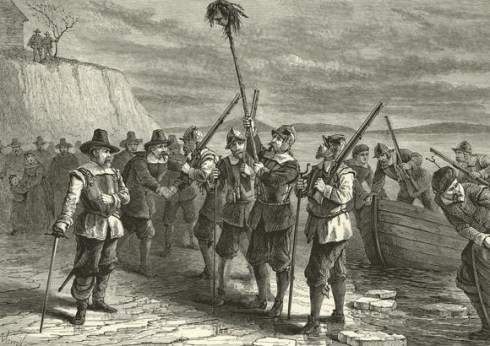
Looking ahead to the new year from a local history perspective, there are commemorative moments for at least six events: five European settlements and a tea party, the 250th Anniversary of the Boston Tea Party, to be precise. A century and a half earlier, there were settlements at Gloucester, Massachusetts and Portsmouth, Rye (the Pannaway Plantation) and Dover (the Cocheco Plantation), New Hampshire. The ill-prepared and -fated Wessagusset Colony was established in Weymouth, Massachusetts in 1622 but its demise came the following year after the brutal Wessagusett “Incident,” more appropriately referred to as a massacre. Commemorative history should acknowledge both the good and the bad, the heroic and the tragic, the kind and the cruel, and so the Wessagusett Massacre of March 1623, a veritable “red wedding” which harmed relations between Native Americans and English settlers for years to come, demands a spotlight. Like the first Gloucester settlement by the Dorchester Company, Wessagusett was decidedly not a plantation in the seventeenth-century sense, but rather a fishing and trading station of 60+ men financed by London merchant Thomas Weston. “Weston’s Men” were completely unprepared for the New World and by the winter of 1622-1623 they were starving, and altogether dependent on both Plymouth and the Native Americans in the region. But foodstuffs were scarce for everyone that winter, and everyone was anxious. Rumors of an impending Native American raid on both settlements drove the Wessagusett men to seek aid from Plymouth, and militia leader Myles Standish and eight men sailed a shallop to the northern settlement and issued an invitation to Massachusett tribal leaders Pecksuot, Wituwamat, and others to attend a summit during which commenced a slaughter just as they all sat down to dinner. I’m going to let Charles Francis Adams tell the tale, as he presented it in his anniversary address on the occasion of the 250th anniversary of Weymouth: the savages were taken by surprise, but they fought hard, making little noise but catching at their weapons and struggling until they were cut almost to pieces. Finally Pecksuot, Wituwamat and a third Indian were killed; while a fourth, a youth of eighteen, was overpowered and secured; him, Standish subsequently hung. The massacre, for such in historic justice it must be called, seeing that they killed every man they could lay their hands on, then began. There were eight warriors in the stockade at the time,—Standish and his party had killed three and secured one; they suddenly killed another while the Weston people despatched two more. Only one escaped to give the alarm, which spread rapidly through the Indian villages. Interesting language for 1873: savages is employed, but Adams does not refrain from calling this slaughter a “massacre” unlike many of his contemporaries who labeled it a pre-emptive strike. Several Wessagusset men also died during the massacre, and the rest opted to abandon the settlement; Standish returned to Plymouth with the head of Wituwamat on a pike in ancient English warrior fashion, “to ornament the Plymouth block-house as a terror to all evil-disposed savages” in the words of Adams. This massacre seems worthy of a bit more commemorative reflection, at least a fraction of what the Boston Massacre receives continuously.

“The Return of Myles Standish from Wessagusset,” from Pioneers in the settlement of America: from Florida in 1510 to California in 1849 by William August Crafts, 1876. Ironically, nearly 300 years later (299!) Myles Standish lost his head when the Standish monument in Duxbury was struck by lightning: according to this post by Carolyn Ravenscroft, archivist of the Duxbury Rural and Historical Society, his replacement head was too heavy for the damaged “body,” so an entirely new Standish was created by Boston sculptor John Horrigon, pictured here in 1930.

I’m not sure what the plans for the commemoration of the Wessagusset Massacre are but all the early settlements have been planning their 400th anniversaries for quite some time, particularly Gloucester, which has assembled a multi-layered calendar of commemorative initiatives and offerings focused overwhelmingly on the city’s social history. I’ve been so impressed with the “400 Stories” project, which aims to collect, present and preserve stories from 400 of Gloucester’s residents from 1623 to 2023, thus connecting the past to the present. There are books, an artistic competition for a new commemorative medal, walking tours, festivals, and a gala: the evolving celebratory schedule is at Gloucester 400.

Portsmouth is all geared up too, although its big reveal party is on January 6 so I don’t know all the details. The PortsmouthNH400 site is here, and so far its signature product is a lovely bookA History of Portsmouth NH in 101 Objects, to which both my Salem State History colleague Tad Baker and alum Alyssa Conary have contributed. There’s an ongoing speakers’ series and exhibition based on the book, and on January 6 Portsmouth’s Memorial Bridge will be illuminated in blue, PortsmouthNH400th’s commemorative color. Like Gloucester, Portsmouth is also collecting stories (of 400 words) from its residents, to be compiled in a commemorative book designed to update its 350th anniversary history. Rye and Dover also have their 400th anniversary committees and calendars, derived from considerable public participation: the mission of Dover400 is “to honor our past, celebrate our present, and to inspire our future through meaningful and creative community engagement.”

The 250th anniversary of the Boston Tea Party is going to be big: after all, from the Boston perspective, it was “the single most important event leading up to the American Revolution.” I’m excited about all of the offerings by Revolutionary Spaces at the Old South Meeting House and the Old State House, including an exhibition on the power of petitions, an “immersive theatrical experience,” and various programs on the nature and expression of protest. Of course the Boston Tea Party Ships & Museum has plans as well, and is already counting down to the big reenactment on December 16, 1773. And there will be merch, including lots of commemorative tea.

Teas from Elmwood Inn & Oliver Pluff & Co.


Turkey Figs

I was researching the major tea importers and purveyors in Salem in light of the upcoming anniversary of the Boston Tea Party, but another commodity kept popping up in the sources: turkey figs. I didn’t look at any customs records, but newspaper adverts both before and after the Revolution provide evidence of large imports of Turkey figs in Salem, and presumably a corresponding demand. I’m wondering if this is a by-product of what we now know was a very vibrant trade in fish and wine between Salem and the Iberian peninsula? It’s clear that figs were used for both medicinal and culinary purposes, although some purveyors favored one utility over the other. The very entrepreneurial apothecary Philip Godfrid Kast, for example, who had prosperous businesses in Boston, Salem, and Haverhill, clearly marketed them as a medicine in the 1770s and 1780s (though it also looks like he is providing Salem cooks with many of the ingredients for a Christmas “figgy pudding”).  This was nothing new to me—I’ve spent the last year reading early modern medical manuals for the book I’m working on and figs are always listed as one of the few “useful” fruits by Elizabethan authors—and the prescription of figs for various cough syrups and digestive tonics continued into the twentieth century. I presume New Englanders were eating lots of figs too but I can’t find any recipes in the early American cookbooks, and apparently Thomas Jefferson brought back a cutting of this particular variety, now called Brown Turkey Figs, only when he returned from Paris in 1789.

FIg Kast Collage

Turkey FIgs philip-godfrid-kast-trade-card (1)

Fig Collage 1804 1829Philip Godfrid Kast’s advertisements for Turkey figs in the 1770s and his 1774 trade card, American Antiquarian Society; Figs for sale in Salem, 1804-1829.

Not only do I not know what is happening to all those cases of figs being sold in Salem in the later eighteenth and early nineteenth centuries; figs are also difficult to identify as a culinary commodity in English cooking before the twentieth century. The classic “figgy pudding” seldom has any figs in it as the word was just a synonym for “plum”, denoting any dried fruit. Figgy pudding originated as a steamed savory potage and evolved into its sweeter, more Dickensian ideal over the early modern era and into the nineteenth century. Of course the Victorians invented Christmas as we know it, and the recipe for figgy pudding of Queen Victoria’s own chef, Charles Francatelli, contains no figs at all. In America, fig cultivation seems to have become centered on the South and California (particularly the valley surrounding Fresno) and so growers marketed a variety of fig recipes, encompassing everything from ices to jams to whips to “pickles”, and the use of figs in syrups for coughs and constipation continued into the twentieth century.

Fig PicMonkey Collage

Figs WellcomeJ.C. Forkner Fig Garden recipes, 1919 & California Fig Syrup Co. advertisement, Wellcome Library.


Tea Party Tempest

One of the most interesting jobs of the historian is figuring out when and why an occurrence becomes an EVENT.  Lots of things that happen never rise to the level of “history”, but those things that do often get embellished over time.  A great example is the Boston Tea Party.  As the anniversary of this big event occurs this week (December 16), I thought I’d take a break from the holidays and get back to history.

As I’m not an American historian I asked my question when did the Boston Tea Party become the Boston Tea Party to a number of experts, both in person and on the web.  There seems to be a general consensus that the event was almost immediately recognized as extraordinarily significant but that the actual term doesn’t appear until decades after the Revolution, when its last participants (particularly George Hewes ) began recording their memoirs.  Apparently the first historians of the American Revolution did not want to herald an event involving the destruction of property, but in 1826 newspaper reminiscences started to use the term “Tea Party” or “Tea-Party”, and it was consequently adopted by historians. (Apparently the first use of the term referred to the participants rather than the event).  There are comprehensive discussions and comments about every aspect of the Tea Party, and all the other pre-Revolutionary agitation in Boston, at the great blog Boston 1775.

Across the Atlantic, the historical significance of the Tea Party was realized relatively early.  Just several years into the Revolution, the German engraver Carl Gottlieb Guttenberg published The Tea-Tax Tempest, or the Anglo-American Revolution (1778), an adaptation of an earlier political print by John Dixon which was itself adapted by the British caricaturist William Humphreys as The Tea-Tax-Tempest, or Old Time with his Magick-Lantern (1783).  In both we have allegorical figures representing the world and Europe looking on at an exploding teapot and agitated Americans.

Tea Tax Tempest caricatures at the online exhibition “America in Caricature, 1765-1865”, Lilly Library at Indiana University.

With the close connections between France and America during the American Revolution, it was only natural that Europeans emphasized the American rebellion of the 1770s when the French Revolution broke out in 1789.  The Tea Party becomes a precedent, or a first act, in what may be a universal revolution.

The History of North America, E. Newberry, London, 1789.  Library of Congress.

So the occurrence of 1773 is clearly recognized as an important event well before the turn of the nineteenth century, a realization that is reinforced by the success of the American Revolution and the beginning (and drama) of the French.  But the tempest doesn’t become the “party” until James Hawkes’ Retrospect of the Boston Tea-Party with a Memoir by George R.T. Hewes (1834), and it takes off from there, in both print and image. The rest is history.

Covers of James Hawkes’ Retrospect of the Boston Tea-Party (1834) and H.W. McVickar’s children’s book The Boston Tea Party (1884), both Library of Congress.
