I’ve posted previously (several times, actually) on one of my favorite Salem Colonial Revivalists, the author, photographer, and photographic purveyor Mary Harrod Northend (1850-1926), but I am focusing on her again today for two reasons: 1) I’ve uncovered quite a bit of new information about her; and 2) I think those of you who live outside of Salem might not be aware of what has happened to one of her primary residences, which sustained a terrible fire in late November of 2018. I say “primary” because my new information has uncovered a variety of addresses for Mary, but I still think of 12 Lynde Street as Mary’s House, and it’s been sad to see it in a distressed state for the past year. But never fear, it is rising from the ashes: its very responsible owners have hired (SHAMELESS PLUG FOLLOWING) my husband to shepherd its restoration. Whatever fabric (brick foundation, though all the bricks had to be reset and cleaned, some wood, including the front doors which will be dipped) could be saved will be saved, and it will get new window frames, wooden siding and windows, and a rebuilt interior. It was even lifted to straighten it out! It will be stunning, but it’s still unsettling to walk by, especially as I have such a soft spot for Mary.


It looks better and better with each passing day, I promise! And while I have you here, does anyone know the name of the entrance detail motif? I have not seen that before: thankfully it was unharmed. Mary’s professional life remains enthralling to me: it started late in life (when she was in her 50s) and was still going strong when she died from complications sustained in an automobile accident in 1926. Consequently it was compacted, and intense: besides her twelve published books there were literally hundreds, maybe even thousands, of magazine articles, on everything from andirons to bread crumbs. In 1914 alone, she sold over 150 articles, employed a stenographer, several file clerks, and a full-time photographer, enabling her to illustrate her own works as well as those of other authors. She had started out ten years earlier with her own camera, and a few sporadic submissions to random publications: now she was almost an industry unto herself, an industry based on highlighting the best of Salem rather than exploiting the worst, darkest days. I guess that’s why I admire her so much.

Here is a letter documenting the very beginning of her career, ten years earlier, from the Century magazine collection at the New York Public Library’s Digital Gallery. At this point in her life, Mary, her widowed mother and younger sister, were living in what sounds like genteel poverty, in the Rufus Choate House just next door to 10-12 Lynde Street. As you can read, Mary has yet to take up her camera or her pen to highlight Salem’s streets and houses, but she is still trading on her Salem connections and heritage: in this case seeking to publish some letters from Nathaniel Hawthorne’s “most intimate friend”, Horace G. (Connolly) Ingersoll, written to her father. She is trying to get in on the big Hawthorne anniversary that year (and boy is she a bad writer! or typist. or both). The Century did not publish these letters, but they are the substance of a 1937 article published in The Colophon by Manning Hawthorne. Mary met with success with other submissions shortly thereafter, largely by abandoning her father’s connections in favor of her own perspectives on architecture and antiques, culled from living in the rapidly-disappearing world of “Olde Salem”. In a marvelous biographical article in the 1915 issue of Massachusetts Magazine, she credits her success to her “friends, the citizens of my hometown, Salem. Had they not thrown open their homes for my inspection and reproduction, I would have been nothing.” The article’s author, Charles Arthur Higgins, opines a bit after that admission, asserting that “now the owners of those beautiful Salem mansions are as proud of the fame and authority of their author as they are of her subject matter” and revealing that “Miss Northen has been repeatedly urged to maker her abode in New York; but she states that nothing can make her forsake the city that has so kindly aided her to fame.”


 Fame AND Authority: Occasionally Mary Harrod Northend would present wistful Wallace Nutting-esque views, but mostly she was all about bringing antique material culture into the modern world; notices in Who’s Who in New England and the Architectural Record, citations in trade catalogs were common from 1915 on.


 It seems as if Timothy Lindall’s gravestone has always been in the spotlight.


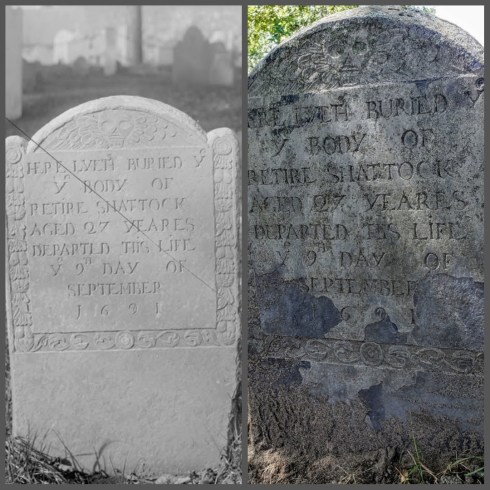
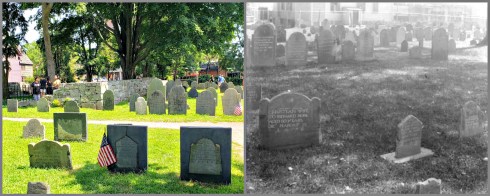
 I feel particularly bad for Mr. and Mrs. Nutting, put to rest in a lovely calm neighborhood and now in the midst of the Salem Witch Village! And I really wish that Cousins had photographed my very favorite Charter Street gravestone: that of Mr. Ebenezer Bowditch. What are those carvings? Does anyone know?
 Old Burying Point Cemetery, Charter Street, Salem, October 2017 & 2018.


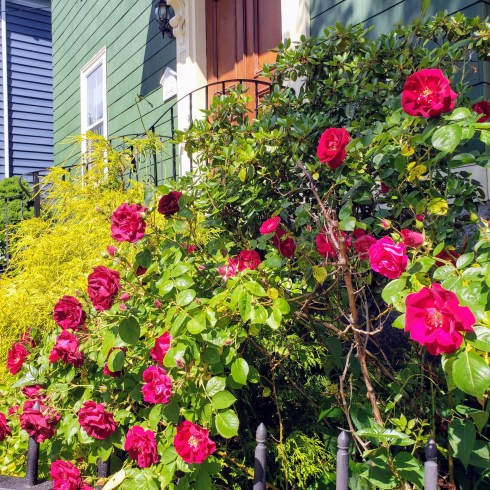


 John Ramsbottom’s “King Penguin” book, 1939, with its York and Lancaster illustration; Mrs. L. Burke’s The Language of Flowers, 1865; Rosa Mundi from Curtis’s Botanical Magazine, 1790s.


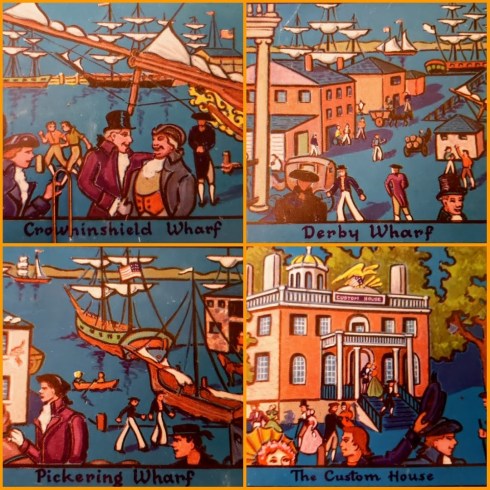


 The Hawthorne Hotel’s lobby and Main Brace cocktail lounge; Jonathan Butler, Harriet Shreve & John Pickering X in the Main Brace c. 1942 from Kenneth Turino’s and Stephen Schier’s Salem, Volume 2 (Arcadia Publishing, 1996); Larry O’Toole’s Salty Map of Cape Ann from


 A Treasure Trove of Silver in an old Salem house, from Walter Dyer’s Lure of the Antique (1910).
 Amazing photo of a lady (perhaps Mary Harrod Northend?) at the original location of the Hooper-Hathaway House (now on the House of the Seven Gables campus) inspecting some Old Salem wares in Dyer’s Lure of the Antique. The caption reads: “Don’t expect to buy these old treasures for a song. You are lucky to get them at all.” Once the Ward House was relocated and opened, it became the workshop of Sarah Symonds, who “perpetuated antiques” in the form of plaster-cast doorstops and mementos of famous Salem structures (Boston Herald, January 17, 1918). I think the days of buying antiques from guileless Salem homeowners were gone even by 1910, and in the next few decades the number of shops advertising in periodicals exploded.

 Salem Antique advertisement from the 1922 volume of the magazine Antiques, and from the collections of Historic New England.


 Atkinson’s Advertising, and her shop on the left-hand side of the Witch House, in photographs from the New Bedford and Cambridge Historical Societies, via Digital Commonwealth; Some items from the “Atkinson Collection” in Dyer: she was particularly known for her selection of Lowestoft.