Tag Archives: books

The Spider and the Fly

A little tweet from one of my favorite history bloggers brought me to a charming web illustration in the collection of the Library of Congress and then I was off–there is nothing better than a parable, especially one as universal and flexible as the spider and the fly. There have been all sorts of illustrative variants on this age-old story over the centuries, and I must begin with my very favorite, John Heywood’s 1556 illustrated poem, The Spider and the Flie. I understand that literary scholars have little love for this poem, but it is a very illuminating historical source, and a window into a very contentious time.  Heywood was a passionate Catholic in a time of surging Protestantism:  he envisions this religious conflict as a war between devious Protestant spiders and stalwart Catholic flies, with insect allies on both sides. The Catholic Queen Mary (“Bloody Mary” to the Protestants) is portrayed as a housemaid, squishing spiders and sweeping England clean.

The inspiration:  a couple caught up in a web of romance on the sheet music cover of the 1901 song, “The Spider and the Fly”, J.D. Cress, Library of Congress.

More serious matters at stake:  illustrations from John Heywood’s Spider and the Flie (LondonThomas Colwell, 1556).  Heywood looks on as a Catholic fly gets caught in a web with a Protestant spider army approaching, and then as the maid/queen Mary rids England of the spider.

An emblem engraving from the later sixteenth century: print made by Johann Theodor de Bry, Frankfurt, 1592 (British Museum).

The satirical and metaphorical use of the Spider and the Fly parable only intensifies in the nineteenth and twentieth centuries, with new printing and printmaking technologies and the publication of Mary Howitt’s famous poem in 1829, with its leading line:  will you walk into my parlor?  But even before Howitt, the device was used by British caricaturist Thomas Rowlandson (1756-1827) to depict the central figure of his age, Napoleon:  pictured below surrounded by an army of European flies. After Howitt, cunning spiders armed with webs were everywhere, luring naive young me into taverns and the big city.

Thomas Rowlandson, “The Corsican Spider in his Web”, 1808, Metropolitan Museum of Art; a London temperance poster from the 1820s, Wellcome Library, London; a 1916 New York cartoon, New York Public Library Digital Gallery.

You can always count on Puck magazine for this type of anthropomorphic visual satire, and I found two “Spider and the Fly” illustrations among its archive of covers:  I’m afraid that the precise issue regarding the Interstate Commerce Commission escapes me in the first (1907) image, but the second one, from 1913, looks pretty timely.


Columbus and the Guinea Pig

Christopher Columbus has been perceived as both a hero and a villain over the centuries, but the most historically objective way to glean his ongoing impact is through the prism of the “Columbian Exchange”, which focuses on the biological and environmental consequences of 1492.  The term was coined by Alfred Crosby, whose 1972 book of the same name influenced a succession of environmental, epidemiological, and commodity histories, including Jared Diamond’s Guns, Germs and Steel.  It is difficult to underestimate its impact, and it is one of the few academic historical theories that has trickled down to the general public.

A very simplified view of the Columbian Exchange; for a more comprehensive discussion, go to the source:  Alfred Crosby, The Columbian Exchange:  Biological and Cultural Consequences of 1492.

Crosby’s concept has become classic because it is so accessible; it’s about very basic things:  plants, animals, diseases–and their effect on people. Just a glance at my very basic annotated map reveals how momentous the merging of the eastern and western hemispheres was (and continues to be).  The most devastating consequences of the exchange were caused by the chain of events initiated by the introduction of Old World germs and smallpox into the New World:  the annihilation of the native population is linked to the trans-Atlantic slave trade through the introduction of cash crops like sugar and rice. On a much lighter note, it is difficult to imagine a world without American horses (and cowboys), Italian tomatoes, and potatoes everywhere.

For Europeans in the century after Columbus, America was an unexpected land of brightly-colored plants, exotic birds, and naked people, as exemplified by the popular print of Amerigo Vespucci (rather than Columbus) arriving in America–or rather waking up America.  Here we see another sensationalistic stereotype–cannibalism–illustrated by the leg-on-a-spit in the background.

Theodore Galle engraving, after Stradanus (Jan van der Straet), Discovery of America, from Nova reperta (New inventions and discoveries of modern times), c. 1599–1603.

Galle’s engraving was one of many images of New World flora and fauna produced for early modern audiences.  I’ve assembled a folder of favorites over the years, and thought I would share some on this Columbus Day, beginning with a very scary guinea pig, and an “Indian little Pig- Cony”  cut down to size from Edward Topsell’s History of Four-footed Beasts and Serpents (1658), a popular English bestiary. Like most early modern “scientific” texts, Topsell included both real and mythological creatures in his compilation, so there is another American (or “Guinean”) animal, an armadillo, along with a very strange creature from the “new-found” world. I am wondering if these last two would have been equally credible.

Large “Guinea Pig” illustration by Balthasar Anton Dunker, from Livre de divers animaux pour dessus de portes par les meilleurs maitres (1769); Edward Topsell, The History of Four-footed Beasts and Serpents. London : E. Cotes for G. Sawbridge,1658

In addition to guinea pigs, armadillos, and the odd fantasy creature for sensation’s sake, turkeys get a lot of ink in the early modern era, as do parrots, which could often symbolize the New World all by themselves. Turning to the plant family, the most influential (and beautiful) printed herbal of the sixteenth century, De historia stirpium commentarii insignes, or “Notable Commentaries on the History of Plants,” (1542) by Leonhart Fuchs, introduced five plants from the New World, including maize, marigolds, pumpkins, kidney beans, and chili peppers. It would take a little while longer for news of the most consequential American plants, potatoes, tomatoes and tobacco, to catch on. Of these three, tobacco was certainly the most popular, celebrated for both its pleasure and health benefits:  it was thought to smoke out toxins in the body rather than deposit them.

A turkey from Konrad Gesner’s  Historiae animalium (1551-1587), from which Edward Topsell “borrowed” heavily, chili peppers in Leonhart Fuchs’ Historia Stirpium, tobacco in Nicolas Monardes’ Joyfull Newes out of the New-founde World (1577), and exotic tropical American plants by Arnoldus Montanus, 1671.

Well, I could go on and on and on…..this is a big topic!  But I’ve already posted on tobacco at greater length, and tomatoes, and potatoes certainly deserve their own post. So I think it’s time to return to guinea pigs. The evidence is mounting to support the view that these little (easily transportable) creatures were kept as pets in some illustrious sixteenth-century households, including that of Queen Elizabeth. By the seventeenth century, they are depicted among more familiar animals, apparently assimilated into the European–global– menagerie as one very small manifestation of the Columbian Exchange.

Guinea Pigs in the center of two seventeenth-century Dutch scenes:  in the midst of a barnyard in a drawing by Jan Fyt (British Museum) and among the animals entering Noah’s Ark, by Jan Breughel the Elder (in the immediate foreground, with the turtles, squirrel and porcupines; Getty Museum).


Michaelmas

In pre-modern Europe, the year was once organized by saints’ days, overlaid on key dates in the agricultural year.  Of these days, Michaelmas, coinciding with the harvest and celebrated on the 29th of September, was among the most important, and it still remains relevant on the British academic calendar.  Michaelmas is named for the most powerful of the medieval angels, the archangel Michael, who was a real fighter, fighting Persians, devils and dragons. I’ve always thought he was the best representative of medieval militant Christianity:  he convinced Joan of Arc to take up the mission of ridding France of the English during the Hundred Years’ War, and even after the Reformation he remained a powerful figure in British culture, appearing as the “flaming warrior”  who drives the sinful Adam and Eve out of Paradise and then defends it from all intruders in Milton’s Paradise Lost.

BL MS Harley624 (12th century) ; Michael Burgesse (engraver) after John Baptist Medina, illustration to Book XII of Paradise Lost, (1688); Michael speaking to Joan of Arc in the famous painting by Jules Bastien-Lepage (1879; Metropolitan Museum of Art) and in a Puck adaptation from 1912 featuring Teddy Roosevelt (Library of Congress).

Because Michaelmas coincides with the harvest it became associated with lots of other things:  it was the day that the annual rents were due, as well as a taxes, and the last flowers and fruits of the summer became known as Michaelmas Daisies (asters), and Michaelmas peaches and pears. It was a widespread custom to serve goose on Michaelmas evening, and to avoid blackberries the next day and after:  at that season of the year called Michaelmas, the Devil is said to touch with his club the black-berries, or to “throw his club over them”, none daring after that period to eat one of them, ‘or the worms will eat their ingangs’ (John MacTaggart, The Scottish Gallovidian Encyclopedia: Or, the Original, Antiquated, and Natural Curiosities of the South of Scotland (1824).  There was also a custom involving apples harvested on Michaelmas Day that could forecast the rest of the year:  take oak apples and cut them, and by them you shall know how it shall go that year; spiders shew a naughty year, flies a merry year, maggots a good year, nothing in them portends great death (Lilly’s New Era Pater, or, A Prognostication  for Ever (1750).

Michaelmas Daisies by Jacob Huysum after Elisha Kirkall and John Martyn, 1741, Wellcome Library Images; Michaelmas Pears by Thomas Bensley, Pomona Britannica, 1812; a “Michaelmas goose”, 1840, British Museum.


Salem Sketches

It’s been difficult to focus on Salem these past few weeks with so much going on in the historical world:  the potential discovery of King Richard’s skeleton, the raising of a plague ship, a wife for Jesus (or maybe not)!  Then again, I’m not a fan of a parochial perspective; I’ve always felt that the present and the past and places are best viewed in the broadest context possible, so Salem is the world.  That said, occasionally I just want to act like a Victorian antiquarian and stay local. Today, I’ve got some very random sketches of Salem gathered from a variety of sources:  guide books, auction archives, historical societies, old books. Most are very vernacular and commercial, though a few are the works of well-know artists. They’ve been gathering virtual dust in my digital files for a while, so it is time to get them out there.

The sketches appear in chronological order, beginning with two charming drawings by the early nineteenth-century artist Michele Felice Cornè  (1752–1845), a Neapolitan who emigrated to the United States in 1800 and lived in Boston, Salem, and Newport. These drawings date from around 1810, when Cornè was living in Salem, enjoying the patronage of the Derby family. It takes a sketch to reveal little details like the toddler’s bassinet (cage?) below, details that would never appear in one of Cornè’s formal paintings of ships or houses. That’s what I like about sketches, as opposed to more formal compositions:  they give forth a seemingly-casual, and often more intimate, impression of daily life.

Cornè sketches, c. 1810, courtesy Newport Historical Society.

Lots of later nineteenth-century drawings of Salem exist, when both the city and its residents began to market “olde Salem”, first featuring architecture, and then (unfortunately) witchcraft. The sketches in Historical Sketches of the Old Houses of Salem (1870) display a bit of  (sometimes black) humor, as in Six Witches Will be Hung To-Day.  Come One! Come All! and our “Four Fathers”.  The decision to back the Witch City brand had not been made yet, in fact; this early guidebook looks like it is trying to offer up all of Salem’s attractions (including very big chimneys) at the same time.

The accomplished artist Eliza Pratt Greatorex (1819-1897), who was renown for her pen-and-ink sketches of American and European streetscapes, came to Salem to sketch (of course) the “Witch House” (more formally and correctly known as the Jonathan Corwin House) which she portrays as The Last of the Old Witch House.  Little did she know that it would endure as one of the centerpieces of the Witch City.

Eliza Pratt Greatorex, The Last of the Old Witch House, Salem, Massachusetts.  New York Public Library Digital Gallery.

More simplistic (and cheerful) sketches of Salem are in Lydia Louise Very’s Old Fashioned-Garden (1900) and What to See in Salem (1915), both published by the Salem Press Company. Very was part of the very interesting Very family of Salem, and sister of the transcendental poet Jones Very, for whom she cared during his long struggle with mental illness. Moving forward into the twentieth century, there is a pen-and-ink sketch of Chestnut Street that was published in several national newspapers in 1930.

No witches:  sketched views of Salem in 1900, 1915 & 1930.

Sketching continues, it just takes different forms in the present, like these characters from the new Salem video game by Ten Ton Hammer, featuring : Puritans, Permadeath, and Open PvP in a Fantastical New England. These guys remind me a bit of the “four fathers” of past sketches.


No Poe?

The Library of Congress is currently running an exhibition (both digital and material) entitled Books That Shaped America as part of their multiyear “Celebration of the Book”.  There are 88 books in all, and the list is intended to provoke reading, thought, discussion, and additions:  According to the Librarian of Congress, James H. Billington, it is a “starting point… intended to spark a national conversation on books written by Americans that have influenced our lives, whether they appear on this initial list or not.” To contribute to this conversation, you can take a survey on the site. I have found myself thinking about the list quite a bit over the last week or so, and every time I make a mental case on why a certain book should be (or should not be) on the list I go to the exhibit website and read the Library’s rationale.

The books include classic examples of both nonfiction and fiction:  the former category includes several works of grammar, cookbooks, scientific books, and quite a few works which call for social reform, pretty understandable given the list’s focus on impact, influence, identity. There are several early primers, but twentieth-century textbooks do not make the grade.  Amelia Simmons’ American Cookery (1796) is on the list, along with Irma Rombauer’s Joy of Cooking (1931), but not Fannie Farmer’s Boston Cooking-School Cookbook (the first to use standardized measurements) or Julia Child’s The French Chef Cookbook (which really revolutionized the American palate, in my understanding).

A history of how-to:  The New England Primer (1802), The American Woman’s Home by Catharine Beecher and Harriet Beecher Stowe (1869) and Dale Carnegie’s incredibly influential How to Win Friends and Influence People (1936).

The fiction works seem more predictable:  lots of New England authors, I must say, including Salem’s own Nathaniel Hawthorne, Thoreau, Melville, Alcott, Dickinson.  Washington Irving is on the list, as is, of course, Mark Twain.  All the expected southern authors (with the exception of Flannery O’Connor) are included, and many major twentieth-century texts, from The Jungle to In Cold Blood.  The list also includes classic children’s books, including  The Wonderful Wizard of Oz (1900), Good Night Moon (1947), and Where the Wild Things Are (1973).

Forceful Fiction:  Washington Irving’s Legend of Sleepy Hollow (1820), L. Frank Baum’s Wonderful Wizard of Oz (1900), and J.D. Salinger’s Catcher in the Rye (1951).

Actually, I think that children’s literature is a bit over-represented as compared to other genres.  And I know I’m biased, but history seems under-represented, as well as economics (Sandburg’s Lincoln? Milton Friedman?).  As for fiction, I think I’ve figured out why works by James Fenimore Cooper and Edith Wharton were not included but why no Poe?  Certainly The Raven must be put on the list, at the very least.

Antonio Frasconi illustration for/of The Raven, 1959, in the current exhibition at the Brandywine River Museum: Picturing Poe: Illustrations for Edgar Allen Poe’s Stories and Poems.


Eternal Elizabeth

Today is the birthday (in 1533) of Queen Elizabeth I, a fact that would have been well-known in her own time.  The coincidence of Elizabeth’s birthday with the eve of the nativity of the Virgin Mary was not lost on her subjects, and obviously enhanced her public reputation as the Virgin Queen. In a Protestant England shed of its saints, Elizabeth must have offered some consolation. There is so much to say about Elizabeth, but too much to say in a blog post and little that has not been said before. In addition to her rather remarkable lifetime, the thing that has always impressed me about Elizabeth is her durability; even though she was a mortal person who died in 1603 she never really seems to go away. Every generation has had its Elizabeth:  the seventeenth century brought her back as a stark orderly contrast to Civil War-strife, there were lots of comparisons between Elizabeth and the equally-long-reigning Victoria in the nineteenth century, and we have certainly had our share of Elizabeths–from Bette Davis to Cate Blanchett to Judy Dench and Helen Mirren–in the last century.

Images of Elizabeth:  her lifetime.  Except where noted, all portraits are from the collection of the National Portrait Gallery, London.

The “Clopton Portrait”, 1560, one of my favorites:  a portrait of the young queen before she became the subject of sophisticated royal iconography. Private Collection.

The “Pelican Portrait”, c. 1575, often attributed to Nicholas Hilliard.  Here we have a highly stylized Elizabeth and all sort of symbolism.  This mask-like face will be the template for some time.  The pelican brooch on her bodice is a reference to self-sacrifice:  a long-held legend told of pelicans feeding their children with their own blood.  At around this time, it was clear that Elizabeth would not marry, therefore she had sacrificed her personal desires for the English people. Walker Art Gallery, Liverpool.

One of several official Armada portraits, this painting by George Gower marks the wondrous victory over the “invincible” Spanish Armada in 1588.  Elizabeth is now well on her way to becoming larger than life.

Elizabeth does not age in her portraits in the 1590s, even though she is in her sixties.  Her waistline gets smaller and smaller, and she wears increasingly fantastical clothing.  Commissioned by Bess of Hardwick in 1592, this painting is still at Hardwick Hall.  It has been copied many times, and the amazing skirt has served as the inspiration for wallpaper and textiles in the twentieth century. The drawing, from the collection of the British Library, is dated 1775.

Elizabeth Ever After:

Line engraving by Crispijn de Passe the Elder, after Isaac Oliver, 1603.  A very influential image, disseminated widely in the seventeenth century, and influencing images of Elizabeth to the present.  As an example, look at Alix Stone’s costume design for Elizabeth in a production  of Benjamin Britten’s Gloriana, 1966.  Victoria and Albert Museum, London.

In a 1868 lithograph, a Vision of Queen Elizabeth tries to rouse Queen Victoria from her prolonged mourning following Prince Albert’s death:  snap out of it!

Modern Elizabeths:  Bette Davis, one of my favorite Elizabeths, in The Private Lives of Elizabeth and Essex (1939), and Cate Blanchett in the poster for Elizabeth (1998).  I love the poster (which is based on the “Coronation Portrait” of Elizabeth in the center–the original portrait, attributed to Nicholas Hilliard, was destroyed by fire and this is an early seventeenth-century copy), and Cate Blanchett, but the movie is a historical hot mess!

Appendix:  the best book on representations of Elizabeth:  Sir Roy Strong’s Cult of Elizabeth.  Elizabethan Portraiture and Pageantry.


Books for Back to School

The Fall Semester starts today, and I get to impose reading on college students who are, make no mistake, reluctant readers. In my opinion, and experience, this particular generation is particularly reluctant:  they have so much else to do!  They have to keep track of their friends’ activities on Facebook, they have to check their phone messages, they have to text every waking thought and state of being, and as I teach at a large public university, they have to work.  In terms of daily priorities, I imagine that reading is very far down the list.  I do not despair, because once I get them to read (by forcing them to write papers) it is clear that the majority of my students can comprehend and analyze texts quite well, but I find myself putting more and more thought and time into choosing the books for my courses as I know that these books have a lot of competition:  they have to catch my students’ attention, and hold it.

I am teaching courses on Medieval Europe, Tudor-Stuart England, World History, and the Expansion of Europe this semester, and here are some of the texts that I’ve chosen for these courses, with a little bit of the rationale for my choices.  All of these courses (except for Expansion of Europe, which is a graduate seminar) have (boring) textbooks that the students read (I think/hope) for background, and several monographs which are the basis of their papers.  I will spare you the textbooks, which are a completely different teaching issue.  I’m almost to the point of ditching the textbooks altogether but not quite yet.

Another realization that has (much too slowly) dawned on me is that my students “learn” most of their history from movies, so when I get them in a class they have preconceived notions that I have to take on. Usually I get students who love Tudor England or medieval Europe, but actually know very little about these eras.  I used to reproach them, but now I’m more inclined to take advantage of their rather romantic interests.  For the Tudor-Stuart course, I’m actually assigning a biography of Anne Boleyn, for whom a veritable cult exists.  Anne Boleyn is now clearly more popular than even her superstar daughter Elizabeth I, so they’re going to read all about the tragic queen/master manipulator in context, from a reliable source:  Eric Ives’ updated biography is accessible yet scholarly, and I’m going to give them an essay prompt for the book that will force them to dig deeper.

Speaking of digging deeper, my medieval course is going to have a strong archeological theme this semester. Too often material sources (as opposed to literary ones) are not given serious consideration by historians, but students find archeology fascinating.  So I’ve chosen tw0 texts that I think should really illuminate (and de-romanticize) the Middle Ages for my students:  Barbarians to Angels.  The Dark Ages Reconsidered by Peter S. Wells, and Colin Platt’s King Death. The Black Death and its Aftermath in Late Medieval England.
I threw some architectural history in there too with Philip Ball’s Universe of Stone.  A Biography of Chartres Cathedral, which I also chose because it was written by a non-academic.  I like to contrast scholarly and trade publications in my courses, and my students (like the general reading public) inevitably favor the latter.

World History is a tough course, for both the students and myself:  it’s “big” history, hard to grasp.  We have a two-course core curriculum world history requirement at Salem State, and so our entire department (and a battalion of adjunct professors) teaches it.  I have to admit that I bring my decidedly Eurocentric perspective into my world history courses; I just can’t help myself.  The book that I chose for this semester’s course, Paul Freedman’s Out of the East:  Spices and the Medieval Imagination, reveals this bias, as it examines “the East” from a western focus. I’m hoping some of my students might point this out in their papers.  A somewhat similar book, perhaps more successfully global in its approach, is one of the eleven books I’ve assigned for my Expansion of Europe seminar, Timothy Brook’s Vermeer’s Hat.  The Seventeenth Century and the Dawn of the Modern World.  I cannot recommend Brook’s book highly enough:  whether you know a little bit about the seventeenth century, or a lot, it accomplishes what the best history books do:  transportation to another world.  My students better like it.


Road Trip, Part Three: Pilgrimage to the Mount

The contrast between Edith Wharton’s aunt’s house, Wyndcliffe, and her own Berkshire “cottage”, The Mount, could not be more extreme:  decaying Victorian Gothic indulgence as opposed to restored (or in the process of being restored) and restrained American neo-Classicism.  Even before Wharton penned her fictional bestsellers she wrote a popular interior design manual with her friend and collaborator Ogden Codman, Jr., The Decoration of Houses (1898), and The Mount fulfilled her vision. There have been some obstacles and challenges in its ongoing restoration over the past 15 years, but on this beautiful August morning it looked bright and cheerful and orderly. By all accounts, Wharton considered The Mount to be her first real home, and it seems like such a shame that she only spend a decade in seasonal residence, from its construction in 1902 until the break-up of her marriage and departure for France in 1911.

Our vivacious guide kept referring to the house as English in inspiration and style, and I suppose it is:  Wharton always proclaimed her admiration for the Georgian style above all others.  But The Mount felt very American to me, in that assimilated, melting-pot way: Georgian house, Italian gardens, French courtyard.  None of the original furnishings are in the house, so contemporary designers have recreated an updated Edwardian ambiance inside, adhering to the original finishes and arrangements whenever possible.  I did like Bunny Williams’s dining room, but I was more drawn to the original features of the house no matter how mundane:  hardware, the “trunk lift”, the unrestored scullery in the basement.

Less decorative license was taken upstairs in the private rooms of The Mount, including in what is arguably the most important room in the entire house, Mrs. Wharton’s bedroom, where she did all of her writing, in bed.  She would write every morning, numbering her pages and casting them to the floor, where her maid would pick them up and send them off to her secretary to be typewritten.  She loved little yapping dogs, whose presence is felt by the placement of stuffed animals around the house and a pet cemetery out back.

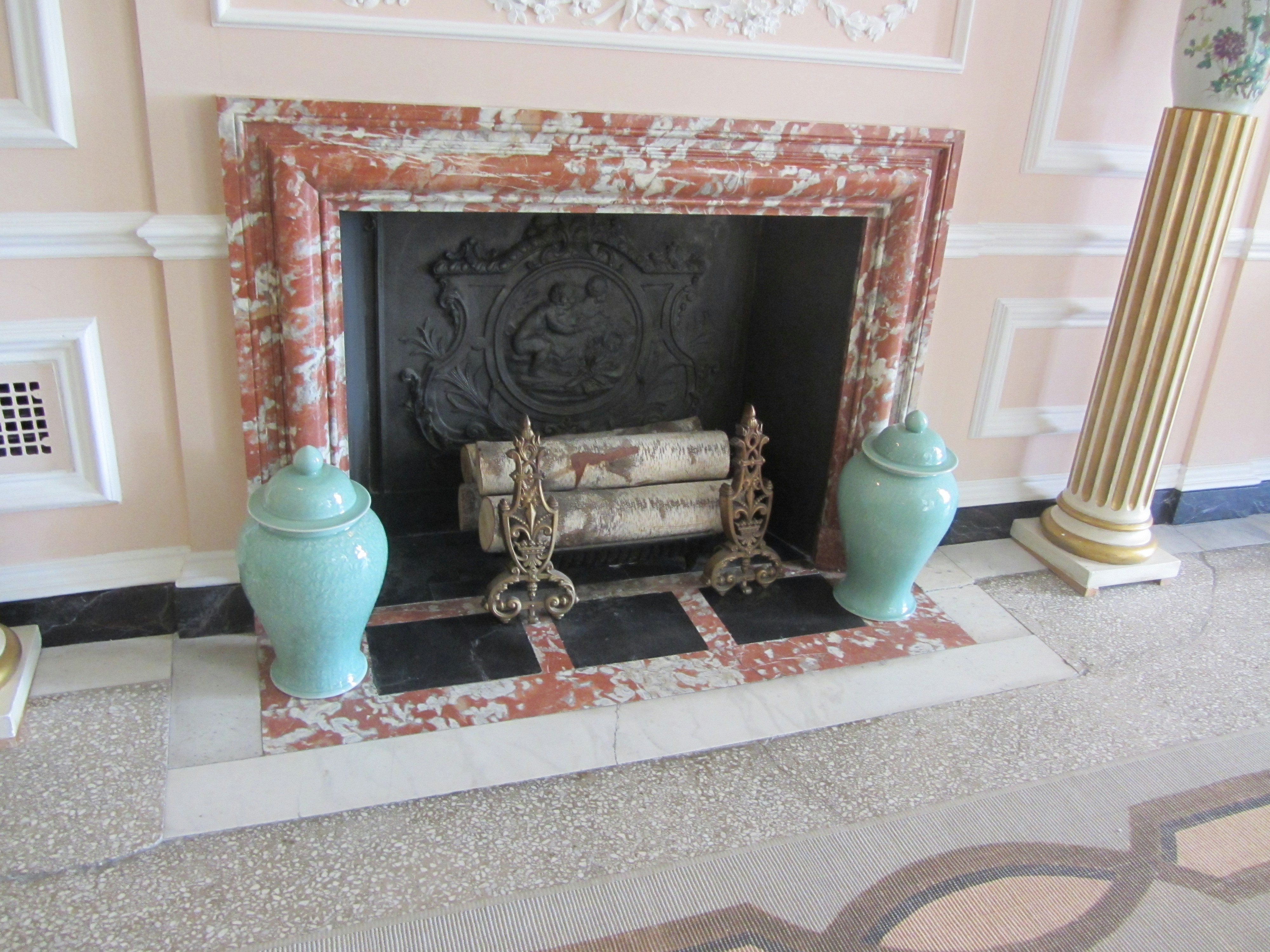
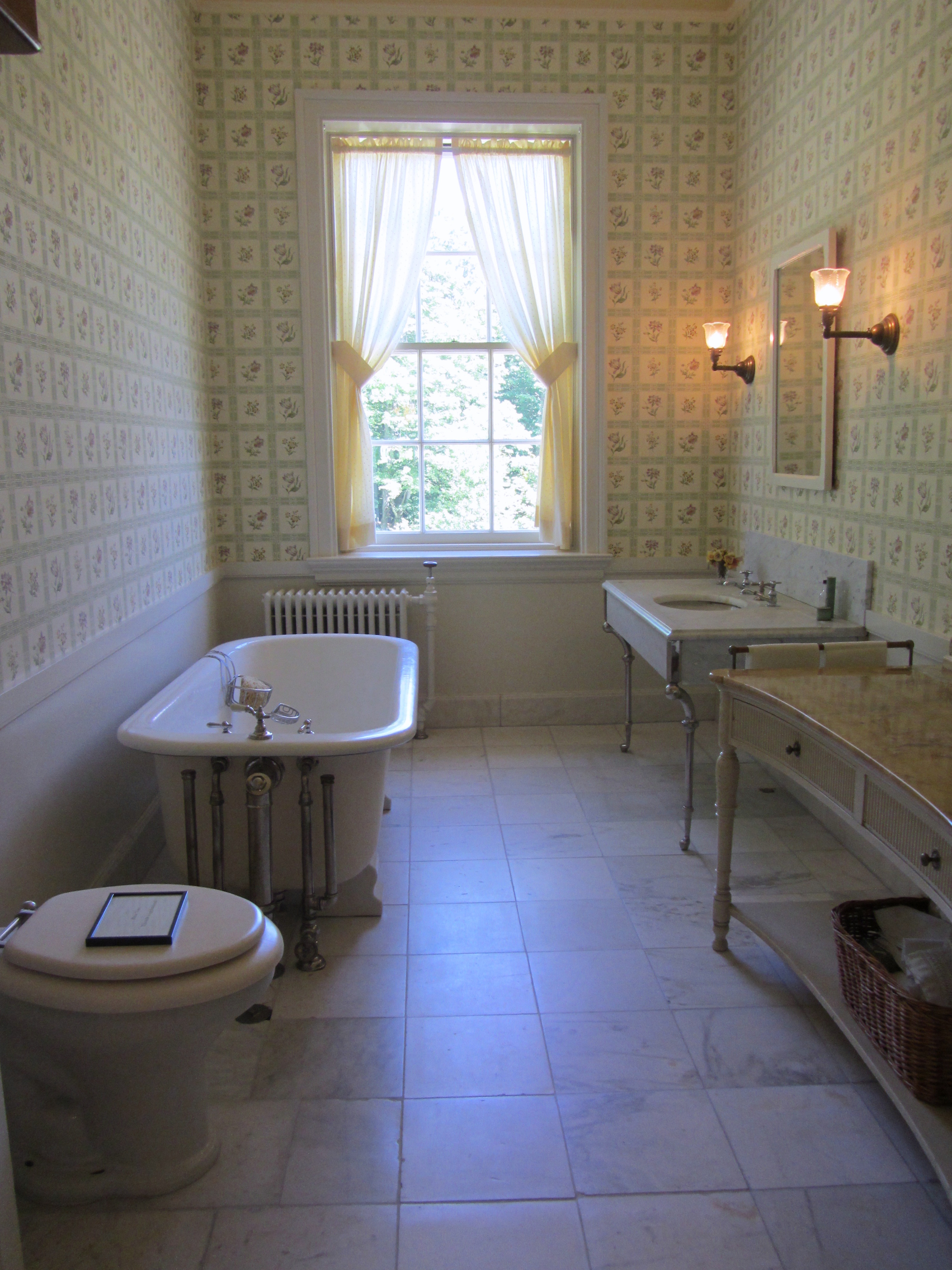
Private spaces made public:  Edith Wharton’s bedroom and adjacent bathroom.

The Mount, Plunkett Street (off Route 7), Lenox, Massachusetts.

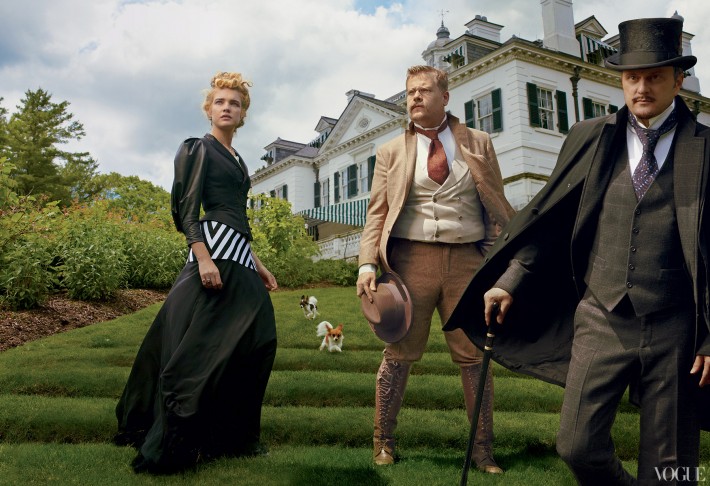
Because I was having a completely indulgent day (one in a series), after my morning at The Mount, I stopped on the way back to my inn to pick up that must-have publication of the season, the September issue of Vogue Magazine.  I opened it up, and there she was:  Edith Wharton in Vogue!  Or model Natalia Vodianova playing Edith in residence, in an 18-page article and spread entitled “The Custom of the Country” by Colm Tóibín with photographs by Annie Leibovitz. There was Edith/Natalia ensconced where I just was, along with various actors, authors and models playing members of her inner circle who were regularly invited to the Mount (Henry James, Walter Berry, Theodore Roosevelt, her landscaper niece Beatrix Farrand, and sculptor Daniel Chester French–whose home I also visited yesterday).  A happy coincidence.


Road Trip, Part Two: Road to Ruin

I drove through south central Vermont towards the Hudson River Valley on roads still-ravaged by Hurricane Irene, a year ago, and along riverbeds of displaced rocks.  Not all was perfect and picturesque in the Green Mountain State; there has obviously been a lot of suffering.  There were poignant messages spray-painted on boarded-up houses:  why, Irene?

I checked in at my brother’s house in Rhinebeck, New York and we planned our itinerary for the next day:  first up, one of the most famous of the grand Hudson River Valley ruined mansions:  Wyndcliffe, built in an imposing Romanesque Revival style in 1853 by Edith Wharton’s paternal aunt, Edith Schermerhorn Jones (1810-1876).  Wyndcliffe has been in a state of decline for 50 years or so, and is now nearly ready to come down.  We approached it on a road marked private (in very small letters), and a very nice Kevin Kline-esque man reproached us, more for our own safety than any territorial inclination:  the “structure” does look like it could collapse at any moment and he said people had been going into it at night. We quickly took a few photographs and left, with additional protective neighbors watching us like guardians.

There are several stories swirling around Wyndecliffe.  It was the first of the really ostentatious, over-the-top mansions in the region: 24 rooms, terraced gardens on 80 acres, Norman-esque tower, elaborate brickwork.  It is said (again and again, although I could not find a contemporary source) that the house represented such a flagrant display of wealth that it inspired the phrase keeping up with the Joneses.  Better documented are Edith Jones Wharton’s visits to the house, which she did not particularly care for, but nonetheless used as a setting for at least one of her books, Hudson River Bracketed.  After her aunt’s death, the house became known as “Linden Grove” and “Linden Hall” with the tenure of industrial brewer Andrew Finck, whose descendants owned the property until 1927.  After that, a serious of owners (including a group of Hungarian nudists!) oversaw its slow but steady decline.

The house in its heyday, and in a series of exterior and interior photographs taken in 1975 by Jack E. Boucher, photographer for the Historic American Buildings Survey, Library of Congress:

And some pictures from yesterday, most of which were taken by my brother as I had forgotten to charge my camera battery!  The house is definitely beginning to cave in on itself (although the pictures above illustrate that this has been happening for some time) but maintains that strong sense of dignity and presence often apparent at the very end.


Clapboard Castles

I know that the great American photographer Walker Evans (1903-75) liked Greek Revival houses, factories, main streets, roadside advertising, picture postcards, and people from all walks of life, but I think he really, really liked hotels. In the vast Walker Evans Archive at the Metropolitan Museum of Art, there are many images of hotels, large and small, and I’ve recently come into possession of a Fortune Magazine article from August 1949 in which he photographs and writes about some of the most famous New England resort hotels of the last century. In “Summer North of Boston”, Evans refers to one of these grand hotels, the Poland Springs House in South Poland, Maine, as “the nation’s uttermost dream of secular grandeur, this clapboard castle, turreted, porticoed, balustraded, oriflammed”. And when you see the photographs of this sprawling hotel (erected in 1876 and destroyed by fire in 1975), you know just what he means.

Scan from “Summer North of Boston” by Walker Evans, Fortune Magazine, August 1949 and original photograph and c. 1910 postcard of the Polar Springs House from the Walker Evans Archive, Metropolitan Museum of Art; 1894 menu from the Polar Springs House, New York Public Library Digital Gallery.

I really wish I had seen this amazing building before it burned to the ground in what all the accounts describe as a “spectacular” fire–a fate that it shared with most of the grand hotels in Evans’ article.  His “north of Boston” encompasses a triangular region between the North Shore towns surrounding Salem in the south, Bar Harbor, Maine in the north, and the White Mountains of New Hampshire in the west. Within this area were the New Ocean House in Swampscott (1884-1969), Oceanside in Magnolia (a village of Gloucester, Massachusetts:  1876-1958), Wentworth-by-the-Sea in New Castle, New Hampshire (built in 1874 and still standing, though some people think its recent “restoration” was more of a reconstruction), the Samoset in Rockland, Maine (1902-1972), and the Mount Washington Hotel in Bretton Woods, New Hampshire (built in 1902 and still majestically and miraculously intact).

The New Ocean House, Oceanside, Wentworth-by-the-Sea, and the Samoset by Walker Evans, and the Mount Washington Hotel at the time of the 1944 Bretton Woods International Economic Conference by Alfred Steiglitz, Time Life Pictures/Getty Images.

Of all these American castles it is the Wentworth with which I had the closest connection:  I grew up nearby and actually attended my senior prom at what was then almost a relic.  The building experienced a conspicuous decline in the later 1980s and 1990s, becoming the focus of the national preservationist movement, before it was rescued and rebuilt after 2000.  It has lost its hyphens and become the Marriott Wentworth by the Sea.

The Wentworth in 2000 and today; the BEST book for the architecture and culture of the grand resort hotels of coastal New England:  Bryant Tolles’ Summer by the Seaside.  The Architecture of New England Coastal Resort Hotels, 1820-1950 (2008)