Tag Archives: books

Cauldron Connections

Every year about this time, there is a “it could only happen in Salem” story in the news: this year’s version reports a recent incident of assault and battery by cauldron in a downtown witchcraft shop. Trite but true, and it got me thinking about the association of witches and cauldrons, which I know dates back to the fifteenth century at the very least, and possibly earlier. So I took a little break from my various sabbatical projects and dug in, promising myself that I would devote only one hour to this diversion. It took me away for about 90 minutes, so that’s not too bad. Of course what immediately comes to mind, and is quoted in the newspaper article and all of its variants, is Shakespeare’s quote from Macbeth: Double, double toil and trouble; Fire burn and cauldron bubble. Fillet of a fenny snake, In the cauldron boil and bake. But that’s not the source of the connection; Shakespeare’s words and phrases, clever as they are, are generally a reflection. So what is the connection? I think there are three actually: the Hell-Mouth, the image of the concocting witch as an inversion of the nourishing mother, and poison. 

Cauldron Lamb Charles and Mary Lamb, Tales from Shakespeare, 1807

There’s nothing too terribly original about the first two connections; the last, maybe. The Hell-Mouth dates back to the early medieval era, when Hell was first personified as demonic monster who tortures and ultimately devours damned souls: the cauldron-like mouth is both the entrance to Hell and the scene of the torture and devouring, but increasingly in the later medieval manuscripts additional cauldrons (and demons) are added to this horrific depiction. As the cauldron is a tool of Satan, so too is the witch, who also utilizes cauldrons to stir up magical concoctions (with the bodies of unbaptized babies as a primary ingredient) in intensely-anecdotal late medieval texts like Johannes Nider’s Formicarius (1475). By the end of the fifteenth century and the beginning of the sixteenth, we can see these witches, encircling and stirring their cauldrons, in Ulrich Molitor’s De Lamiis et Pythonicis Mulieribus (Of Witches and Diviner Women, 1489) and Hans Baldung’s various witch woodcuts (c. 1510).

Cauldron Hell-Mouth BL 2

Cauldron Hell-Mouth

bosch_hieronymus_-_the_garden_of_earthly_delights_right_panel_-_detail_bird-headed_monster_or_the_prince_of_hell_-_close-up_head_lower_right

Cauldron weather-witches-molitor-14

Cauldron BaldungTwo hundred years of cauldrons: British Library MS Additional 47682, the Harrowing of Hell in the Holkham Bible Picture Book, 1327-35; British Library MS Additional 38128, cauldron-like Hell-Mouth, late 14th-early 15th century; the Prince of Hell with his Cauldron Hat in Bosch’s Garden of Earthly Delights, 1500, Museo del Prado; Molitor’s Weather Witches, 1489; Baldung’s Witches’ Sabbat, c. 1510, Metropolitan Museum of Art.

From the sixteenth-century depictions, which will become increasingly lurid into the next century coincidentally with the intense persecution of witchcraft, I think it’s a hop, skip and jump to the folk-tale witches of the nineteenth century and postcard witches of the twentieth from the early twentieth, but there’s one more connection I think is worth exploring, even though I haven’t quite worked it out. A key contributing cause of the early modern witch hunt was the translation of a particular Old Testament passage, Exodus 22:18, into the vernacular as Thou Shall not Suffer a Witch to Live, a translation which Reginald Scot contested in his early and popular skeptical treatise on witchcraft and its prosecution, The Discovery of Witchcraft (1584–one of Shakespeare’s sources). Scot maintained that the original Hebrew word utilized in the passage, which he referred to as Chasaph but is usually referenced (in its root form) as Kasaph, really meant diviner, seer, or poisoner rather than the “witch” of Christian demonology. Before the seventeenth century, the crime of witchcraft in England was perceived more specifically as maleficium, or harmful magic, rather then devil-worship, and poison was the most pernicious form of maleficium: it required knowledge, and skill (and perhaps a cauldron) and those found guilty of bringing about death by poison were sentenced to death by boiling in a cauldron! A sensational poisoning case in 1531 involved Richard Roose, a cook in the household of John Fisher, Bishop of Rochester, who attempted to murder his master by poison. The bishop was spared but two people in the household did indeed die before Roose was arrested, tried, convicted and sentenced to death by “boiling” in a cauldron in Smithfield.  So much inversion tied to the cauldron and the witch beside it: from nourishment, healing and life to poisoning and death, from childbirth and mother’s milk to infanticide and poisonous gall (referenced by Lady Macbeth) before both are transformed into innocent vessels.

Witchal©Historic New England


Land of the Livingstons

This past weekend I toured six “country seats” built by various members of the venerable and prominent Livingston family of the Hudson River Valley in the later eighteenth and nineteenth centuries: most privately-owned, one owned by the state of New York. My brother and brother-in-law live in Rhinebeck, so I have visited this region quite a bit, but I find new old houses every single time I return, and this time was no exception. When we started off, I was thinking only 6 houses? we’ll be done in a flash and $60 for six houses! as our Christmas in Salem tour features more houses and a lower ticket price but it took us most of the day and was well worth it: I had an urban house tour in my mind where you just walk from place to place but these are rural county seats situated on vast acres of land—-mostly waterfront. The scale of both houses and land was much larger than your average house tour, and the tour was a bargain: I’m alway happy to support historic preservation in any case, and in this case it was Hudson River Heritage. I’m going to present the tour in the very order that we saw these houses and give you my impressions of each along the way: no interior photography was allowed except in the state-owned property, Clermont, but as one of the houses is currently for sale and others are included in the amazing (again, expensive but worth it) newly-published book by Pieter Estersohn titled Life Along the Hudson. The Historic Country Estates of the Livingston Family and other publications I can show you some interior views.

You will notice it getting progressively brighter; the day started out pretty dreary and ended with sun. Still all houses shone.

RICHMOND HILL, built in 1808

This federal—-no I think proper Palladian is more accurate–house was simply stunning: beautiful proportions and details. It is the most formal farmhouse I have ever seen as it sits in the midst of 58 acres and many outbuildings, including a period Dutch barn, also unlike anything I have ever seen (I’m such a New Englander!). It has not been lived in for some time and is currently for sale: the photographs on the real estate site (I’m including the west bedroom and basement kitchen below–there’s a modern kitchen too!) are not really doing it justice in terms of the details: one of the mantles had a pinecone design which (again) I have never seen before. 

Hudson 1

Hudson 7

Hudson 6

Hudson 10

Hudson 11

Hudson 2

Hudson 8

Hudson 4

Hudson 5


CHIDDINGSTONE, Built in 1860

This is a “Bracketed Italianate” house which has recently been restored and redecorated with 15-foot ceilings and a stunning river view. The interior is all about height over width: the rooms were not all that large in terms of size but those high ceilings, along with the floor-to-ceiling windows and furnishings, made them seem positively grand.

Hudson CH 2

Hudson CH 3

Chiddingstone_834_510_000000_s

The front parlor photographed by Pieter Estersohn

Hudson CH 4


CLERMONT, Built from 1779-82

Then it was on to the oldest Livingston house, Clermont, which was built in the 1730s but burned mostly to the ground by the British during the Revolutionary War and rebuilt between 1779 and 1782. Clermont is a state historic site with an informative visitors’ center and extensive grounds along the river. Here we had a proper (essentially genealogical) tour and were able to take photographs: the interiors are furnished in the Colonial Revival style adopted by the last Livingstons to live at Clermont in the 1930s.

HUDSON CL2

HUDSON CL 3

HUDSON CL 4

HUDSON CL 5

HUDSON CL 6

HUDSON CL 7

HUDSON CL


MIDWOOD, built in 1888

Midwood is a sprawling Colonial Revival house situated on 87 acres along the Hudson: it made quite the contrast from Clermont as it is a very much lived-in and lively house, furnished in an eclectic style that must reflect the spirit of its owner and felt very “Bloomsbury” to me: we spent quite some time there just because there was so much to see and we were not alone. You can take your own tour here, and I’m sharing two interior views below.

Hudson M3

Hudson M4

Midwood collage

Side Parlors photographed by Christopher Baker


CLARKSON CHAPEL, built c. 1860

One of many board and batten Carpenter Gothic structures in the region, the Clarkson Chapel was built following a dispute–a schism, I suppose– at St. Paul’s Episcopal Church in nearby Tivoli. Here we met a wonderful guide/steward who had made her own chart of the division of the original Livingston Manor. This was very helpful, and another informative source is here.

Hudson Chapel

Hudson Chapel 2


EDGEWATER, Built in 1825

Our last stop was at Edgewater, a magnificent Greek Revival mansion perched on the Hudson shore in Barrytown, the long-time home of Richard Jenrette, who died earlier this year. My first house was a Greek Revival, and so I studied and bought everything I could about this iconic architectural style, and Mr. Jenrette’s Adventures with Old Houses (1995) became a bible of sorts: my copy is coffee-cup stained, page-marked, and well-worn. Edgewater is preserved, polished, and furnished to perfection, and signs of Mr. Jenrette were all around within: notes, cards, the lift on the magnificent stairs, the program to his memorial service. Of course the whole house is a memorial to him, as is the foundation which now owns Edgewater and his other homes: the Classical American Homes Preservation Trust. I had pored over pictures of Edgewater so many times that when I finally found myself inside, I felt like I was returning to it, which is the first time I’ve had that experience. That said, it’s even more beautiful than its photographs and is a very real, much-loved house indeed.

Edgewater

Edgewater 2

Edgewater 3

Edgewater 7

Edgewater 8

Photographs of the Music Room and Dining Room by Dorothy Hong for the Wall Street Journal (above); the Edgewater guesthouse (below) was built in 1996.

Edgewater 6

Edgewater 4

Edgewater 5


Sugar and Sage in the 17th Century

I’m working on three projects during my sabbatical this semester, but the one that has (re-)captured my attention, and to which I have devoted the most time so far, is an old study of the more utilitarian features of the long English Renaissance, including agriculture, medicine, home-keeping, construction (rather than architecture), engineering, navigation and other individual and collective “industrious pursuits”. Food and drink are at the intersection of several of these pursuits, so I’ve spent several weeks researching not so much what early modern people ate and drank but rather what they were supposed to eat and drink according to contemporary “authorities”. This is far more interesting than the basis of my other industrious pursuits, which is of course math. Eventually I must get into math but right now I’m enjoying reading about food. There are many opinions in the early modern regimens organized around the Galenic concept of the non-naturals, external and environmental factors which affect health: air, food & drink, rest & exercise, sleep & waking, excretions & repletions, and “affections of the mind”, but in this post I’m going to focus primarily–but not exclusively– on the advice of a physician-entomologist named Thomas Moffat, which was published posthumously as Healths Improvement: or, Rules Comprizing and Discovering the Nature, Method, and Manner of Preparing all sorts of Food used in this Nation in 1655, with “corrections and enlargements” made by Dr. Christopher Bennet. Moffatt wrote the original manuscript around 1595, and he segregated diet from all the other non-naturals in a manner that is more modern than early modern: it is an orderly and due course observed in the use of bodily nourishments, for the preservation, recovery, or continuance of the health of mankind. 

Food Moffett

Even though he was a practicing physician and an avid entomologist, Moffatt’s diet advice is more ancient Greek/biblical than empirical, though he does make the interesting distinction between “full, moderate, and thin” diets, which increase, repair, and lessen flesh, spirits and vapors in the body respectively. Most adults should follow moderate diets in alliance with their designated humoral complexion or temperament, representing the particular combination of humors (blood, phlegm, black and yellow bile) with their attendant qualities, or degrees (hot, cold, moist, dry). Everything and every substance has humors, not just bodies, so foods should be chosen to preserve health according to the rule that like is sustained by the like, or restore health by employing foods with contrary degrees. That’s all pretty standard for this time, but Moffat explores food to a greater degree than many of his contemporaries:  its taste and distaste, its preparation, when to eat it—and when (and how) to kill it if it is a beast. All beasts are fair game, both domestic and wild (even hedgehogs) and all parts of all beasts (believe me). A few expressions of vegetarianism will emerge over the course of the seventeenth century, but Moffatt’s treatise is not among them. Nearly every food is good for someone at sometime, but the when must be considered along with the what, as for example, seemingly-harmless butter, which is best at break∣fast, tolerable in the beginning of dinner; but at supper no way good, because it hinders sleep, and sendeth up unpleasant vapours to annoy the brain, according to the old Proverb, Butter is Gold in the morning, Silver at noon, and Lead at night. It is also best for children whilst they are growing, and for old men when they are declining; but very unwholesome betwixt those two ages….a veritable lifetime of no butter! Thankfully, Moffatt seems to be the only one proffering this advice; most regimen writers assert that butter is just fine, especially when salted and mixed with honey and/or sugar, the universal panacea of the early modern era (for those who could afford it).

Food Sugar Nova Reperta 1600 FolgerMaking miraculous sugar in Nova Reperta (New Inventions of Modern Times), engraved by Jan Collaert I, after Jan van der Straet, called Stradanus, and published by Philips Galle, 1600.

Sweeteners make everything better—water, wine, butter–not just better-tasting, but better, according to all opinions: “Sugar agrees with all ages and all complexions”, wrote Thomas Cogan in his Haven for Health (1584). Water should be avoided at all costs, unless it was pure rain water or mixed with sugar or honey; ale, beer and wine were much preferred, especially “Rhenish” (white) wine. Writing several decades before Cogan, Philip Moore summarized his diet advice according to ease of digestion and engendering of “good juice” in his Hope of Health: partridges, pheasants, chickens, capons, hens, small birds, newly-laid eggs, rare or poached, young pork, veal, new milk, fresh fish from gravelly and stony rivers…bread made of the flour of good wheat, being well-leavened, sufficiently salted and well baked in an oven, being two or three days old. And also pure wine. Even though “meate” is often used to refer to all food, it’s not difficult to glean that meat (or flesh) was key to a healthy diet, and chicken and mutton were generally preferred, “boiled and eaten with opening (fresh) cordial herbs”, a beefed-up version of the pottage most people probably were eating.

Food November

Food Trevelyon Miscellany 2Two calendar illustrations from Thomas Trevilian’s marvelous Miscellany, 1608: Folger Shakespeare Library MS V.b. 232 (formerly Folger MS 450517).

There is still a reticence about fruits and vegetables among seventeenth-century regimen writers, particularly the former, although that is changing: a terrible famine in the 1590s inspired a major reconsideration. William Vaughan, in his Approved Directions for Health, both Natural and Artificial (1600), asserts that fruits are eaten more for wantoness than for any nutritive or necessary good”, but he praises many vegetables, and gives us a recipe for the very best “sallet” made of pennyroyal, parsley, lettuce and endive, which “opens the obstruction of the liver and keeps the head in good plight”. Moffatt is more open to fruit, but like most of his contemporaries, he warns against the raw state: all apples are worst raw, and best baked and preserved (with rosewater, honey and/or sugar, of course). But by all means avoid “melomachia, the ‘apple-fight”; [as] cruel fluxes surprised the Army upon this, and many died of intolerable gripings. It seems as if most fruits are acceptable if they are baked, roasted, or “cunningly preserved”, with sugar, and taken with wine: figs, in particular, draw much commentary as a wholesome fruit, but only if consumed in the right way. According to Moffatt, figs are dangerous without wine, but wholesome with it. Vegetables can be nourishing as well, but only if you pick the “whitest and tendrest-leafed” and steep and cook them for quite some time. In addition to the application of fire, the accompaniment of wine, and sweeteners, garden herbs and spices, both “homebred” and imported or “outlandish”, can change the nature of everything, particularly sage, the versatile herb of salvation from time immemorial. Moffatt (and Bennett) leave sage to the herbalists, an indication of the increasing specialization of medical texts in the seventeenth century, but Vaughan gives us a “wholesome diet drink” for everyone, made of a variety of the most useful domestic herbs, processed in seventeenth-century style.

Stoneware jug 17th century with Vaughan Diet Drink


Considerations on Color

I teach what is commonly known as the “Scientific Revolution” in several of my courses, and I always endeavor to expose my students to the broad range of the “new science” in the seventeenth century as they tend to have a very narrow view of what this revolution entailed. We come to the topic from very different perspectives: for them, it’s all about the heliocentric universe (conception, proof, acceptance? I’m not sure which); for me, it’s about nothing less than a new conception of truth and a new methodology of inquiry. To demonstrate its truly revolutionary impact, I stress the universality of this methodology by exposing them to the range and variety of “ingenious pursuits”, encompassing everything from botany to medicine to chemistry to mechanics to navigation and from the theoretical to the practical. I’m a bit more interested in the latter–and that’s what I’m studying during this sabbatical–but sometimes it’s hard to separate the two approaches: a case in point is Robert Boyle’s Experiments and Considerations Touching Colourswhich was first published in 1664. Boyle is primarily known for his pioneering work in chemistry and physics, but his interests were varied: like his contemporary Isaac Newton, he also experimented with alchemy. As its title indicates, Experiments and Considerations Touching Colours consists of experiments and observations which “enquire seriously into the Nature of Colours, and assist in the investigation of it [them]”, and his empirical data consists of examples of craftsmen creating color, including the English dyers who had perfected the process of transforming a red acid extracted from the American cochineal insect into scarlet and crimson dyes: and voilà, Redcoats! (Well a bit later). It is these intersections of “science”, industry and art that really demonstrate the spirit of inquiry in the seventeenth century.

COnsiderations of Color

Wright, John Michael, 1617-1694; Mary Fairfax, Duchess of BuckinghamFirst edition of the Experiments and Considerations Touching Colour, 1664, Skinner Auctions; The Duchess of Buckingham with her crimson wrap, after 1659, York Museums Trust.

Just two years later, Robert Waller, another fellow of the Royal Society (which we should remember was very interested in technology as well as theoretical science) published a really cool color chart in the Philosophical transactions of the Royal Society of London. As you can read below, Waller had seen a “table of simple colors” some years previous but was resolved to “give a more philosophical and useful one by the addition of some mixt colors”. The vocabulary is similar to that of medicines–simple and compound–and like materia medica, everything was composed from nature but man was starting to amplify the process of production—or creation.

Creating Colors Waller 2

Creating Color Waller

Color Chart 1686Robert Weller, Tabula colorum physiologica (Table of Physiological Colors), Philosophical transactions of the Royal Society of London, 1666.

And then there is the remarkable Dutch manuscript brought to (internet) light by the book historian Erik Kwakkel a few years ago containing a “proto-Pantone” code of colors: the Treatise on Colors for Water Painting (1692) by A. Boogert. A single and singular copy forgotten and full of the most amazing colors and color compositions, this book set the design world on fire back in 2014—understandably so.

color-guide-960x731

Color Chart 1690sA. Boogert, Traité des couleurs servant à la peinture à l’eau, Aix-en-Provence, Bibliothèque municipale/Bibliothèque Méjanes, MS 1389 (1228). Photographs by Erik Kwakkel.


September Strategies

I had high hopes for this particular September, one of the very few Septembers that I didn’t have to go back to school as a student or teacher in my entire life as I am on sabbatical. I’ve always thought that September was one of the most beautiful months of the year, and looked forward to long golden walks after I put in several hours of reading and writing. We’re halfway through the month, and so far it hasn’t turned out that way: the weather was unbearably muggy and hot in the first week of September, and last week I had pneumonia! But I’m on the mend now, so those walks will happen, and in the meantime I have been extraordinarily productive, so I have adopted a pre-modern mentality and come to the conclusion that it was God’s will that I stay inside and write. With both my lungs and the weather clearing up, however, I’m planning on a more (physically) active second half of the month.

I’m working with early modern prescriptive literature: texts on how to better “order” your health and household and garden, and feeling deficient in my own “government” of all of the above. September was a busy month for my seventeenth-century authors, who prescribe many activities for their readers: harvesting, preserving, cleaning, potting-up, sowing and sewing, among other monthly tasks. In his Kalendarium Hortense, which was published in fourteen editions from 1664, the famous diarist John Evelyn is a taskmaster for two gardens, or really three: the orchard (he was a big forestry proponent, for both timber and fruit), the “olitory garden” (a word he apparently made up) which produced plants for culinary and medicinal uses, and the “parterre” or flower garden. As you can read below, much is in prime during September so there is much to do in all three gardens.

September Evelyn Cover

September Evelyn

September Evelyn 2

September Evelyn 3

September Evelyn 4

September Evelyn 5

I’m reading these texts for specific information about life and learning in the sixteenth and seventeenth centuries but it occurred to me that gardening and husbandry texts, in particular, are great sources for understanding climate change as the authors take careful note of the existing weather conditions. September was as much a transitional month for them as it is for us. Michaelmas is really the turning point: before that it can be either hot or cold. After our very humid early September, I was kind of relieved to read the observations of Thomas Tryon, a wealthy merchant, popular author, and energetic advocate of vegetarianism who seemed to exist on nothing but gruel in the month of September as the Air (which is the Life of the Spirit in all Cities and great Towns) is thick and sulpherous , full of gross Humidity (YES!) which has its source from many uncleanesses…..I guess they had to suffer through humidity as well, even in the midst of the “Little Ice Age”.

Tryon collage

The more elaborate horticultural texts are sources for garden design, machinery, experimental crops–even adjoining houses. One of my favorites is John Worlidge’s Systema Agriculturae, the Mystery of Husbandry Discovered (1669) , which also included a “Kalendarium Rusticum” of monthly tasks for the larger estate as well as other reference materials. This is a pretty substantive text describing the workings of a pretty substantive estate: thank goodness there is an epitome! For the steward of such an estate, as opposed to the mere gardener or farmer, September is all about getting ready for the plough, mending your fences, making cider (which Worlidge calls the “wine” of Britain) and perry, drying your hops, sowing a host of vegetables and planting your bulbs, gathering your saffron, “retiring” your tender plants into the conservatory, and tending to your bees. In these early days of an emerging agricultural revolution, it’s good to see some machines to help with all of this work: Worlidge’s work–and his calendar–are aimed at more of a collective or national audience than that of the individual householder as his reference to a “System” implies.

September Worlidge 1691

September WOrlidge title 1681

September Worlidge 1681 verse

September collage

September Worlidge BIG

September walter_d_ae_garten_idstein_fruehling_florilegium_nassau_idstein_1663 The 1681 edition of Worlidge’s Systema Agriculturae; a more ornamental continental garden from the Nassau-Idstein Florilegium by Johann Walter the Elder, Bibliothèque Nationale, Paris.


Hang the King and Queen in the Dining Room

Back to the seventeenth century, where I am working my way through a series of instructional books produced to meet the apparent and universal demand for better health, more wealth, and an enhanced quality of life. For most of yesterday I was in the company of William Salmon, Doctor of Physick, who wrote an comprehensive and detailed compendium titled Polygraphice: or The Arts of Drawing, Engraving, Etching, Limning, Painting, Washing, Varnishing, Gilding, Colouring, Dyeing, Beautifying and Perfuming, which was published in eight expanding editions from 1671 to 1701. Here we have the third edition, from the University of Heidelberg, which includes an additional “Discourse on Perspective and Chiromancy”. In some ways, this is your typical early modern mishmash of arts, “sciences”, and a bit of magic, but in other ways it is very precise and technical, the instructions for perspective and shading particularly so. Salmon is always referred to as an “empiric” in terms of his medical practice, but his publications are so diverse one assumes they are primarily derivative—yet there seems to be some strong opinions among the instructions.

Salmon Pyro

salmon1675_0068

salmon1675_0036

salmon1675_0079

And the long seventeenth-century title does not mislead us: Salmon offers up instructions on all aspects of drawing, engraving, and etching, he tells us how to mix up paint colours, of both water and oil, and how to gild, varnish and dye, and then he makes the remarkable transition from painting canvases to rooms to faces! This is the rationalization: some may wonder that we should meddle with such a subject as this, in this place, but let such know; the Painting of a deformed Face, and the licking over of old, withered, wrinkled, and weather-beaten skin are as proper appendices to a painter, as the rectification of his Errors in a piece of Canvas. Well. Since he’s in the realm of cosmetics, he tells us how to make a variety of waters, and touches on alchemy for a bit—more in forthcoming editions. I was delighted to see a very early reference to “Popinjay Green”, which I think must be my favorite color (no–apparently not that early a reference: the Oxford English Dictionary tells me that the word first appeared in English in 1322, and the reference to the color began appearing in the sixteenth century).

Popinjay Green Collage

Popinjay Susan Sandford

Adding an anachronistic image here: this “Popinjay” collage of a turn-of-the-century dandy by artist Susan Sanford just seemed to fit in this post + I like it.

There is very little creativity in this text about art, but the time, place, author, and genre dictate didacticism. Salmon instructs us not only how to make paints, but also which colors to apply to which subjects, whether it’s the sky or the clouds or the grass in a “landskip” or the skin of the subject of a portrait. Once the paintings are complete, he tells his readers where they should be “disposed of” (hung) in their houses: royalty in the dining room, forbear all “obscene pictures” in the banqueting rooms, and family pictures in the bedchamber. Art is essentially skilled imitation of nature, in an ideal sense: the work of the Painter is to express the exact imitation of natural things; wherein you are to observe the excellencies and beauties of the piece, but to refuse its vices.

Salmon CollageThe dining room at the royal palace of Holyroodhouse in Edinburgh, over which King George IV reigns.


“The Beautifying Part of Physic”

I’m diving deep into early modern recipes this month, and as the term recipe was not reserved for the culinary realm during this time that means instructions for all sorts of things: health, hygiene, magic, preservation, and cosmetics, or the “beautifying part of physic” according to one of the first books devoted exclusively to made beauty: Johan Wecker’s Cosmeticks (1660). Wecker’s categorization of cosmetics was in alignment with the contemporary understanding of the body and its operation, best expressed by Francis Bacon in his Advancement of Learning earlier in the seventeenth century:  the knowledge that concerneth man’s body is divided as the good of man’s body is divided, unto which it referreth. The good of man’s body is of four kinds, Health, Beauty, Strength and Pleasure: so the knowledges are Medicine, or the art of Cure; art of Decoration, which is called Cosmetic; art of Activity, which is called Athletic; and art Voluptuary, which Tacitus truly calleth eruditus luxus [refined luxury?]. This subject of man’s body is of all other things in nature most susceptible of remedy; but then that remedy is most susceptible of error. What cosmetic remedies does Wecker offer? Here’s the title page and his own summary of its contents:

Cosmeticks

Cosmetics Contents

As you can read, this book offers a lot: all deformities of Nature corrected, age renewed, youth prolonged, the least impediment amended. I am wondering if it was “promised to the world” by the prominent physician Nicholas Culpepper; I assume that’s just an advertising ploy. The egalitarian pitch (every one may be his own apothecary) is contradicted by many of the valuable ingredients of the recipes within, but there are also some very simple recipes with basic ingredients—essentially there are hierarchies of recipes for the same goal: whiter skin, smoother skin, spot-free skin, fairer hair, more hair in some places, less in others, a sweeter-smelling body. Women should have rose-water on hand at all times, and lots of lemons, the occasional pineapple, and be prepared to devote many eggs to their beauty regimens.

Cosmetics collage

A few skin-whitening recipes are above, with reference in one to the legendary ceruse, the white-lead concoction which all of my students think Queen Elizabeth I slathered on her face every single day to hide her smallpox scars and project majesty and Virgin Mary-ness, thanks to Shekhar Kapur’s Elizabeth (1998). We don’t have a lot of evidence for this cosmetic fable (see here), and I can’t find recipes for ceruse in any of the likely seventeenth-century texts, perhaps because it was purchased as a ready-made commodity (especially the preferred Venetian variety), or it was too much of a target for the anti-paint Puritans. I did find a Royal Society recipe of sorts (more like an industrial process) in a charming twentieth-century book about the history of cosmetics, Neville Williams’ Powder and Paint. A History of the Englishwoman’s Toilet, Elizabeth I—Elizabeth II (1957), but most of the cosmetic creams referenced in seventeenth-century recipe books featured the less-dangerous and -expensive “bear’s grease”(or that of any animal, but usually pigs) rather than ceruse. The marvellous Hannah Woolley’s skin waters, ointments and creams echo those of Wecker: even though some of her recipes are equally elaborate, it seems that “beautifying” is more about pampering (and removing) than paint (and adorning). Don’t get me started on patches–they are a whole other story.

Cosmetics Williams

Woolley 1685.jpgBeinecke Rare Book and Manuscript Library, Yale University

A recipe for an excellent “Pomatum”, to clear the Skin, from Hannah Woolley’s The accomplish’d ladies delight in preserving, physick, beautifying, and cookery : containing I, The art of preserving and candying … II, The physical cabinet, or, Excellent receipts in physick and chirurgery, together with some rare beautifying waters … and also … The art of angling. III, The compleat cooks guide ((1685).

Wash Barrows-grease, or [pig] Lard often-times in May-dew that hath been Clarified in the Sun, till it be exceeding white, then take Marsh-mallow-Roots, scraping off the out-sides, make thin slices of them, set them to macerate in a Balneo, and scum it well till it be Clarified, and will come to rope, then strain it, and put now and then a spoonfull of May-dew therein, beating it till it be through cold in often change of May-dew; then throw away that Dew, and put in a Glass, covering it with May-dew, and so keep it for your Use.


Watered Down

Salem is such a foodie/libations town now; I’m surprised there is so little culinary history served up. With countless restaurants, several bakeries and food shops, one brewery and another on the way, a cidery and distillery—all very busy—you would think there would be an ongoing audience for deep dives into the historical production and distribution of foodstuffs and beverages, but the only serious purveyors of such presentations (with ample samples!) are Salem Food Tours, and their affiliated attraction, the Salem Spirits Trolley, which runs in October. Good for them, but I think there’s room for more food-and-drink history, because Salem is not just a foodie town now; it always has been. The Peabody Essex Museum is hosting a brewing-themed event this week for which several area brewers have produced beverages based on the Museum’s collections: but only those collections that are right here in Salem so that’s not much to go on—the results must be somewhat watered-down if historical inspiration is the objective. A few trips up to the almighty Collection Center in Rowley and its encased Phillips Library would reveal more sources and more inspiration: here are some avenues of exploration that look particularly promising:

Women Brewers & Tavern-Keepers: there seem to have been quite a few in Salem!  One old Salem source that is quoted in all of the books about early American taverns and libations (quite a large genre) is a bill presented to the Parish Committee of the East Church for “Punch, Flip, Sangrey, etc.” by Abigail Brown, Tavern Keeper in 1767, and when Katherine Clarke inherited the Ship’s Tavern, one of Salem’s first, from her husband in 1645 she was licensed to keep it as long as she found a “fit man yt is godlie to manage the business”. Hannah Lemon Beadle also became the keeper of her family’s tavern on Essex Street following her husband’s death a bit later in the seventeenth-century, before it became the site of Witch Trial interrogations in 1692. 10 boxes of inn, tavern & retail licenses will yield lots of more information about just who was selling what.

Salem Spirits

Beadle's Tavern New England Magazine, 1892.

Spruce Beer. Logic tells me that Salem would have been a big producer of Colonial North America’s major contribution to the global world of beer, spruce beer, which compensated for shortages of both barley and hops in the New World and at the same time was recognized as a cure for scurvy. It was increasingly popular on both sides of the Atlantic in the later eighteenth and early nineteenth centuries: Dr. Bentley refers to it in his diary, and Jane Austen in her letters. It’s generally referred to as a home or “family” brew, however, so I supposed it was not produced commercially. I think there were alcoholic and non-alcoholic versions, and it seems to have been particularly popular in the summer. Here is General Jeffrey Amherst’s (of smallpox infamy) recipe:

Salem Spirits Spruce Beer

And here is Amelia Simmons’ recipe, with hops, from American Cookery (1796): it is notable that this is the only beverage recipe in the acclaimed “first” truly American cookbook:

Take four ounces of hops, let them boil half an hour in one gallon of water, strain the hop water then add sixteen gallons of warm water, two gallons of molasses, eight ounces of essence of spruce, dissol|ved in one quart of water, put it in a clean cask, then shake it well together, add half a pint of emptins, then let it stand and work one week, if very warm weather less time will do, when it is drawn off to bot|tle, add one spoonful of molasses to every bottle.

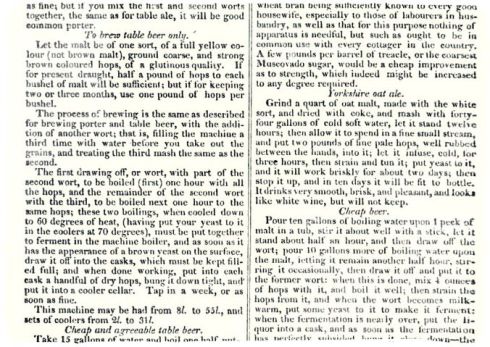
What’s in the mix? I suspect that a lot of brewing was home-based so it might be in the “black box” which historians cannot open, but the Phillips Library has manuscript and printed recipe collections which might yield some interesting intructions for all sorts of beverages. The most comprehensive of the latter seem to be Joseph Coppinger’s American Practical Brewer and Tanner (1815) and MacKenzie’s five thousand receipts in all the useful and domestic arts: constituting a complete practical library … : a new American, from the latest London edition (1829), but there are “small beer” recipes in many contemporary cookbooks. Beer is seldom advertised before the later nineteenth-century: I looked through the Salem Gazette and found every single beverage BUT beer referenced in the first decade of the nineteenth century, although Mr. Ropes (below) was always in the market for barley!

Salem Spirits American Practical Brewer

Salem Spirits Mackenzie's 5000 Reciepts Phillips

Spirit collage

There are more references to beer when it is mixed with something else: as in flip (which Abigail Brown furnished to the East Church Parish Council), the famous and “terrible” Salem drink Whistle Belly Vengeance, Bogus or Calibogus (spruce beer with rum), and Rattle-Skull ( dark rum and/or brandy and beer). Rum improved everything, of course, including cider (Stone-Wall or Stone-Fence).

Where are all the Tavern signs? I’ve got to admit that I’m as much, or more,  interested in the material culture of taverns as the consumption–especially tavern signs. Salem tavern licenses were granted with the requirement that “there be sett up in some inoffensive sign obvious ways for direction to strangers”, and apparently signs for The Sun and the Bunch of Grapes once existed in the collections of the PEM’s predecessor, the Essex Institute, but all I can find are Washington Hotel signs at present: as you can imagine, Washington taverns and hostelries were as common in every American town as Washington streets in the nineteenth century.

Washington collagePeabody Essex Museum and Alice Morse Earle, Stage-Coach and Tavern Days (1900).


August Anglo-Americana at Auction

August is high season for antique shows and auctions in New England: generally featuring Americana items with global goods mixed in, as our Yankee forebears, particularly those who dwelled in regional seaports like Salem and Portsmouth, were very worldly, of course, and lived with things that came from other parts of the world. A decade or so ago I was in full-court hunting mode during this season; now I’m an armchair/laptop peruser, although next weekend’s sale at Northeast Auctions looks so good I’m certainly going to attend a preview, at the very least. Such interesting wares! All my picks are from the two (or one long) auctions which will be held on August 18-19: the “Lifelong Collection of Susan MacKay and Peter Field” on Saturday with a general auction following, into the next day. There is no rhyme or reason to these selections: they just caught my fancy.

Auction GlobeAmerican Terrestrial Pocket Globe made in Wethersfield, CT, c. 1850. A pocket globe is surely better than a pocket atlas.


Auction Stumpwork 2English Stumpwork Profile Portrait of King Charles I of England, 1646.  How amazing is this—and there are more seventeenth-century lots in the MacKay/Field collection as well, including two more representations of King Charles I during the Civil War, or perhaps even after his execution! Royalist relics–from either side of the Atlantic.


Auction Silk Needlwork Silk Needlework Picture of a Gentleman wearing a Tricorn Hat, c. 1770. I like this guy from the next century too.


AUction Highboy

English William and Mary Japanned Pine and Hardwood Highboy. I do not have a highboy, or a William and Mary piece, and I would really like both: this doesn’t really suit my present house but who knows where we might end up? I like the subtle Japanning and it has a very low estimate!


Auction Chairs

Set of Eight American Sheraton Fancy Red Painted and Decorated Side Chairs. Do I need chairs? No, absolutely not. But these are RED fancy chairs. Hard to resist.


Andres JournalAndre’s Journal: an Authentic Record of the Movements and Engagements of the British Army in America from June 1777 to November 1778 as recorded from day to day by Major John Andre,” Edited by Henry Cabot Lodge, Boston: The Bibliophile Society, 1903. This is a beautiful two-volume book which was limited to 487 copies for Bibliophile Society members: I continue to be fascinated by how fascinated Americans were (are?) with Major Andre!


Auction Lady LibertyLady Liberty Standing on the Head of Great Britain underneath the Great Seal of the United States, American School, War of 1812. LOTS of War of 1812 items in this auction: this is my favorite.


Arbella NortheastThe Frigate “Arbella” of Salem. American School, early 19th Century. I guess I have to have a Salem item–this is a lovely ink & watercolor painting of a ship with which I am not familiar: the original Arbella brough John Winthrop to Salem in 1630, but I don’t know anything about this Arbella. Only the Phillips Library can tell us, I’m sure!


Auction Young SailorThe Young Sailor. American School, 4th quarter, 19th century, Mrs. Mary Ide Spencer/Artist. I just love this painting: I know it would make me happy every day if it were mine.


The Last Turban-Wearing Women of Salem

At a symposium on Hawthorne’s House of the Seven Gables last week, members of Salem State’s English Department offered really interesting insights into the text, its themes, context (and subtext) and characters. One presentation in particular, by the very prolific Nancy Schultz, focused on the connections between the two old characters in the book, the house itself and Hepzibah Pyncheon. This was particularly resonant for me, as I’m always interested in “Olde Salem” and Hawthorne’s description of Hepzibah, as quoted by Professor Schultz, immediately reminded me of a description of another woman, who lived in my house at almost exactly the same time in which The House of the Seven Gables was set: Mrs. Harriet Paine Rose. Let’s look at the descriptions of these two women, one fictional and the other real, but both very much characterized by their turbans.

Turban2

Turban Pickering Genealogy

Hawthorne is not very complimentary towards “Our miserable old Hepzibah”, a “gaunt, sallow, rusty-jointed maiden, in a long-waisted silk gown, and with the strange horror of a turban on her head!” The author of the entry in the Pickering Genealogy obviously holds Mrs. Rose in much higher esteem: she is (or was) beautiful and virtuous but was notably also “the last person in Salem who wore a turban”, implying that she was also a bit out of style. I would love to see the pencil sketch of the turban-wearing Mrs. Rose alluded to above, but haven’t been able to find it anywhere (it’s probably locked away in the Lee papers in the Phillips Library), but of course we have many illustrations of Hepzibah in her turban, as it was identified as such a “horrible” and characteristic feature of her persona. Such a contrast of an (un-)fashionable portrayal with those much more charming depictions of turban-wearing ladies earlier in the nineteenth century.

Turban MFA

Turban Portrait 1800-1810 Northeast

Turban Cowles collage

Turban Dixon collage

Turban 3

Turban Gables Graphic.jpgMary Ann Wilson, Young Woman Wearing a Turban, c. 1800-1825, Museum of Fine Arts, Boston; Portrait of a “fashionable” woman, c. 1810, Northeast Auctions; Hepzibah and her turban (or turbans, as they all seem to be different styles) by Maude and Genevieve Cowles (1899), A.A. Dixon (1903) and Helen Mason Grose (1924), and a more recent (1997) Classics Illustrated cover depicting a very grim turban-wearing woman indeed.

Hepzibah’s turban also reminded me of the most famous turban-wearer of all, Dolley Madison, who was photographed and painted wearing her characteristic headpiece in the year before her death in 1849, long after turbans were fashionable. This was her look and she was sticking to it, whether out of necessity or by design. It certainly does not look like a “strange horror”!

Dolley Madison Brady

Dolley Madison 2

Dolley collage Photograph of Dolley Madison by Mathew Brady, 1848, Library of Congress; Painting by William S. Elwell, also 1848, National Portrait Gallery. Dolley descends upon the White House and witnesses her husband’s presidential oath, be-turbaned of course, in two YA books, Dolley Madison, First Lady, by Arden Davis Melick (with illustrations by Ronald Dorfman), 1970 & Dolly Madison, Famous First Lady, by Mary R. Davidson (with illustrations by Erica Merkling), 1992.