Tag Archives: Art

Maypoles

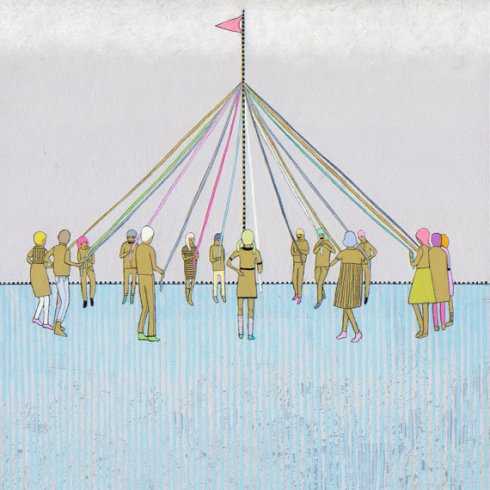
When I was a very little girl my family lived in a small village in central Vermont which had no preschool program, so my parents sent me to a private school the next town over.  My memories of this school are positively idyllic:  reading Peter Rabbit, singing, games, toast.  A singular memory, reinforced by a photograph of me looking like a little dark-haired Swiss girl in a dirndl, is of a Maypole, and going round and round it holding my ribbon.  Because of the Maypole, May Day was the most special holiday to me as a child, and I’ve tried to keep it up as an adult, with wreaths and May wine (made with sweet woodruff, a great spring plant) and a general spirit of merriment.  But I’ve yet to erect a Maypole in my backyard.

It is interesting to me that my experience with the Maypole happened in Vermont, the least puritanical of all the New England states. The Puritans hated Maypoles, and any ceremony or ritual or image that detracted from the word of God.  So dancing around the Maypole, a very popular custom in the medieval and Tudor eras, was prohibited during much of the very Puritan seventeenth century, both in old and New England.  There was definitely a revival in the eighteenth century, but it might have been too late for Massachusetts.  Thank goodness I had my Vermont childhood!

It’s hard to separate survival and revival in the history of the Maypole, but the custom seems to have been alive and well in the Elizabethan era, as illustrated by these amazing painted glass panels from the later sixteenth century depicting a Maypole and the various “Morris Dancers” who danced around it on May Day.  They are from Betley Hall in Staffordshire, and were somehow saved from Puritan iconoclasm and incorporated into a later house.  May Day celebrations seem to be part of every romantic history of the Elizabethan era, if only because the first Elizabeth makes a perfect May Queen.

Betley Hall glass panels, later sixteenth century, Victoria & Albert Museum, London; “May Day in the Reign of Queen Elizabeth”, Hodgson & Graves print, c. 1836, British Museum, London.

After the English Revolution, the maypoles of England reappeared, including a famously tall one in the Strand in London (to which, according to Walter Thornbury’s “St Mary-le-Strand and the Maypole” , Old and New London, Volume 3 (1878), Sir Isaac Newton attached his telescope) and in the center of the weeks-long “May Fair” in the Mayfair neighborhood.  The Great Fire and the great rebuilding of the later seventeenth and and eighteenth centuries removed maypoles from the streets of London but the custom apparently continued, as they appear in print and paintings as symbols of “Merry Old England”.  This particular symbolism seems to intensify in the nineteenth century, an age of dynamic change which threatened to sweep everything away that was both merry and old.  There is a definite revival of the Maypole motif in the later nineteenth and early twentieth century by the Arts and Crafts movement; as the old merrymaking custom endures, so too will traditional craftsmanship in the midst of mass production.

Country Dances Round a Maypole, Francis Hayman, c. 1741-42 (Supper Box Decoration at Vauxhall Gardens), Victoria & Albert Museum, London.

Edward Henry Corbould, May Day, 1873, British Museum, London; Kate Elinor Lambert, Woodcut device for the Stanton Press, 1921-22.

Another later nineteenth-century trend–the politicization of everything–also affected the maypole, which was appropriated primarily by the left side of the political spectrum, coincidentally with the association of May Day with workers’ movements.  Below are two illustrations of  a more modern Maypole:  around which monopolists and workers dance.

Frederick Barr Opper, the Monopolists’ May-pole (including lots of Vanderbilts), Puck Magazine, 1885 and Walter Crane, The Workers’ May-pole”, 1894, Library of Congress.

Back to basics:  of course, the survival (or revival) of the Maypole, in the nineteenth century and today, might simply be due to the fact that it provides entertainment for children, who probably see no greater meaning in its form than the focus of a simple dance in celebration of spring!  That’s my memory.

May Day in Central Park, c. 1905, Detroit Publishing Company, Library of Congress; May Pole by Jennifer Davis, Etsy.


Encircling Salem Artists

There’s been a lot of discoveries since I started this blog over a year ago, but one of the biggest has been a growing appreciation of the artistic environment which existed in Salem a century or so ago, well past what historians consider the city’s golden age.  Culturally speaking, Salem was vibrant not only in the 1790s, but also in the 1890s, when Frank Benson, Phillip Little, Ross Sterling Turner, Dwight Blaney, and John Leslie Breck were within its midst.  I’ve already written about Little and Benson, whose houses I can gaze upon from my bedroom window, but the other gentlemen are more recent discoveries.  Blaney, from an old Salem family (Blaney Street runs down to the Salem Ferry dock), was not only an artist but one of the first serious collectors of American antiques.  In many ways, he is a collecting link between several of these men:  Turner married his elder sister and lived in Salem, and both Blaney and Breck visited them often from their primary homes in the western suburbs of Boston.  Benson and Little were more grounded in Salem (though they summered in northern New England like all artists of means), Blaney seems to have been happily ensconced at both his main home in Weston and his summer house on Ironbound Island, off Mt. Desert in Maine (where he received many distinguished guests, including Breck and John Singer Sargent, and which you can read about here), but Turner and Breck seem like men of the world to me:  student days in Europe, considerable time at Giverny with Monet (Breck), long forays in Bermuda and Mexico (Turner).  They were both advocates of “modern” art, and seem to have been inspired by the cultural environment of greater Boston and the North Shore while at the same time occasionally at odds with it.

I found an interesting notice in the Boston Transcript from the spring of 1890, shortly after Breck had returned from Giverny to hold a one-man show at the St. Botolph Club through which Impressionism was introduced to Boston.  He had also formed a teaching studio with Turner in Salem (at the latter’s house on Bridge Street, a pretty busy thoroughfare now and then) and these developments apparently did not please the anonymous author of the “Fine Arts” column.

     Ross Turner and John Leslie Breck have returned to this country from foreign parts, and threaten to form a class for out-of-door work in painting at Salem during the month of June.  Mr. Turner will give instructions in watercolor work, and Mr. Breck in both oils and watercolors, as well as in drawing from models.  Mr. Breck is somewhat famous in a limited way as the only pupil of the impressionist Claude Monet, and we may as well be prepared for anything and everything when he lets loose a flock of sweet girl graduates, duly inoculated with the impressionistic visual virus, whose landscapes may blend the charms of amateurishness with those of other kinds of incoherence, “till all is blue”.

THE IMPRESSIONISTIC VISUAL VIRUS!  What a great line; it sounds very modern. What a reminder of how new (and apparently threatening)Impressionism was in the late nineteenth century–and also how conservative Boston was.  The reference to “sweet girl graduates” might be an allusion to Breck’s  romantic reputation, gained at Giverny.  No matter, both Turner and Breck seemed to prosper in the 1890s, both in and around Salem and beyond.  Here are some of my favorite works of both artists, representing careers that were both cut short:  Turner died in the Bahamas in 1915, “following a long illness”, while Breck died of asphyxiation in 1899–an apparent suicide–at age 39.

Ross Sterling Turner (1847-1915):  Street Scene in Munich, 1880 (Smithsonian Museum of American Art); The Old Manse (printed etching from Riverside Press’s Hawthorne Portfolio, 1884); Fairylands, Bermuda, 1890 (part of the Masterworks Museum of Bermuda Exhibit “The Wonderful World of Watercolours”, closing today); Doorway of Henry Lee Higginson Estate (outside Boston), 1894; and his most popular work, A Garden is a Sea of Flowers, 1912 (Museum of Fine Arts, Boston.

John Leslie Breck (1860-1899):  Willows (1888); Grey Day on the Charles (1894) and The Dragon in Winter, Essex (Massachusetts), 1896.  All accessed through the Smithsonian Institution Inventory of American Art and all in private collections.


Hearts and Jacks

It’s spring awakening time in the garden, and two of my particular favorites have popped:  Bleeding Heart (dicentra spectabilis) and Jack-in-the-Pulpit (arisaema triphyllum).  These two plants, so strident yet so vulnerable, really capture the spirit of the season for me more so than any other development.  The fact that their blooms are so short-lived makes them all the more precious.

Really beautiful.  Most of the plants in my garden were chosen for their European heritage, but these two have different origins.  The Bleeding Heart comes from China, and the Jack-in-the-Pulpit is a native wildflower. Somehow they snuck into my Eurocentric garden, thank goodness. Bleeding Hearts are often referred to as “old-fashioned” flowers but in fact they were not introduced to the west (by intrepid plant hunter Robert Fortune) until the 1840s.  I really prefer the white version of Dicentra, but the pink variety seems to be a lot more common, and more inspirational to artists and designers. Given the common name, you can imagine that there have been lots of literal metaphorical representations of the plant over the years, which I will spare you, but also some really lovely illustrations.

Miss Harris, Luna Moth on a Bleeding Heart, watercolor and white gouache over graphite on paper, 19th century (Fogg Art Museum, Harvard University); William Hood Fitch illustration for The Natural Order of the Vegetable Kingdom by Daniel Oliver, 1874;  “Flying Heart” wallpaper, late 19th-early 20th century (Victoria & Albert Museum, London); Jane Sassaman “Iris & Bleeding Hearts” fabric at amazon.com.

Jack-in-the-Pulpits didn’t have to be hunted down; they were right here in the shady woodlands of North America.  They don’t seem to be really appreciated until the mid-nineteenth century, when they were alternatively referred to as “Indian Turnips”.  George Goodale’s Wildflowers of America (1886) explains their oratorical name:  “the arched roof over the spare, erect body, bears a suggestive resemblance to the old-fashioned ‘sounding-board’ placed over a pulpit to increase the resonance of the speaker’s voice; and from this remote likeness has come one of the common names of the plant–Jack-in-the-Pulpit.”  Wildflowers contains 51 colored plates by illustrator Isaac Sprague, including that of  Jack-in-the-Pulpit below.

This plant, and particularly its flower, has inspired artists as diverse as Zelda Sayre Fitzgerald and Georgia O’Keeffe, who produced a whole series of Jack paintings:  she saw a bit more sensuality in the flower than Dr. Goodale did above!  Her six canvases, completed in 1930 and later donated to the National Gallery of Art, chart the evolution and essence of the flower:  below are numbers 2 and 3, depicting full bloom. More attainable, and permanent, images of Jack-in-the-pulpit can be found on the cotton fabric offered by Etsy seller fabricsandtrimmings.


Plant People

The chalkboard-painted backsplash in my kitchen( (which is really not a backsplash at all, a topic for another day), in a color called “peapod”, compelled me to find a few more spring green, pea pod accents for the room.  A simple search uncovered one of John Derian’s decoupaged mini-trays, featuring two people dressed in pea pods, an item that I’d seen before but never really took note of.  My curiosity about the source of the image led me to the blog of the New York Historical Society, which offered up more of Jerome B. Rice’s trade cards from 1885:  not only anthropomorphic peas, but a beet, onion, and potato as well!  Interesting that there is a Mr. Potato-body rather than a Mr. Potato Head, one of my favorite childhood games.

Jerome B. Rice Trade Cards from the Bella Landauer Collection at the New York Historical Society.

So now of course I forgot all about my kitchen and went off on a quest for anthropomorphic plant images.  It wasn’t a difficult quest, as I knew where to begin:  with the mystical medieval mandrake, a plant with a decidedly human root system which has long been the stuff of legend.  There are biblical references to it, as well as Shakespearean ones, and in between all the medieval herbals refer to the plant that shrieks or groans when it is pulled from the ground, a sound that is absolutely fatal to those who hear it, necessitating a dog-pulling technique if one wants to be bold enough to try.  All sorts of secret virtues, both magical and medicinal, are attributed to the plant, from the ancient era to Harry Potter.

Three views of the Mandrake:  Harley Manuscript 5294  (12th century) and Sloane Manuscript 4016 (15th century), British Library, and Hieronymous Brunschwig, Kleines Distillierbuch  (1500), Smithsonian Institution.

Now it is time for a distinguished late Renaissance plant person:  Rudolf II, Holy Roman Emperor from 1576 until 1612  (and avid cultural patron), depicted as Vertumnus, the Roman God of the seasons, by Giuseppe Arcimboldo.  You would think that Arcimboldo was on dangerous ground with this “portrait” but apparently Rudolf admired it–I’m sure that the latter knew what he was getting as this painting is very representative of Arcimboldo’s rather whimsical (strange?) works.  This is an image that never fails to amuse (repulse?) my students; it captures their attention at the very least!

Giuseppe Arcimboldo, Vertumnus (Rudolf II), 1590.  Note the pea pod eyelids!

Fast forward to the Victorian era and its obsession with flowers and their essence and meaning, very well expressed by J.J. Grandvilles Les Fleurs Animées (1847) in which a virtual army of flowers begs their commander Flower Fairy for permission to transform themselves:  “We are tired of this flowerlife. We wish for permission to assume the human form, and to judge, for ourselves, whether that which they say above, of our character, is agreeable to truth.”  They receive permission to join the human world, but the 54 etched and hand-colored plates that chart this evolution (devolution?) present them as beautiful but hybridized versions of humanity.

As far as I can tell, the  Grandville illustrations were issued as postcards in the 1870s and again around 1900, along with a veritable flood of flower people postcards on the market:  sugary sweet floral children and young maidens, which make Grandville’s flower girls look quite sophisticated and artistic.  Below is Miss Periwinkle, from a card dated 1900.

There are so many flower people out there from this era that I have to admit that I’m more interested in the rarer fruit and vegetable people, like the Rice pea pods that started my quest. Rice’s trade cards apparently initiated or reflected a trend of anthropomorphic crop images, as illustrated by the “cabbage girl” below (although what Dutch cabbage had to do with the flavoring this Baltimore company was offering I do not know), and a group of radishes from a British nursery in the 1890s.

The postcard manufacturers of the new industry’s golden age could clearly not resist the potential that “cantaloupe” (with or without an e) offered for plays on words, so we have several examples from the first decade of the twentieth century:  for a romantic attachment, and against:  we are too young, dear, we cantaloupe.

This last cantaloupe card is part of a series entitled “Garden Patch”, illustrated by E. Curtis for the prolific postcard publishers Raphael Tuck & Sons of New York City in 1907 and 1908. All of the cards in the series can be viewed here , including my favorites:  featuring a [water]melon, lettuce (be married), and a turnip (your nose is a little turn [ed]ip).  The latter is a bit of a stretch, but at least it gives us a full basket of vegetables.


Bicycle Girls

I seem to be returning to the topic of women bicyclists again and again, but I can’t help myself:  I’m so struck by the images I keep coming across.  The last photograph in the collection/exhibition I shared in my last post is an equally striking one:  ladies (and some men) on a cycling tour of the North Shore rest long enough on Salem Common to have their picture taken on October 15, 1885.  This is just before the introduction of the modern “safety bicycle”, so they have been touring, rather precariously I would think, on their penny farthings.  And I’ve cropped the photograph of Essex Street activities from this same post, just so we can see the shirtwaisted lady in the foreground a bit better:  she looks like a model for the bicycle art of her era, examples of which are below.

bicycle-girl-essex-street text

Some more photographs, spanning the era of a bicycle craze for women (and men) from the 1890s through the 1920s: a stereoview issued by the American Stereoscopic Company in 1897, an image from what looks like a rather well-to-do British family’s album in the collection of the Victoria & Albert Museum, and a bicycle girl messenger for the National Women’s Party in 1922 (Library of Congress).

These women look so happy–well at least most of them do.  Bicycle girls often appear in the illustrative art of the era as well, in single prints, advertising posters, and on magazine covers.  On both sides of the Atlantic, the most eminent graphic artists of the day appear to have been inspired by their carefree images, including Will Bradley, Cecil Aldin, and Charles Arthur Cox, who created 10 absolutely charming covers for the Chicago-based bicycling magazine Bearings in the 1890s.

Will Bradly advertisement for Victor Bicycles and Cecil Aldin illustration for Rudge Whitworth Bicycles, both 1896 and Collection of the Victoria & Albert Museum, London; Charles Arthur Cox’s covers for Bearings Magazine, New York Public Library Digital Collection.


Out and About in Concord

Yesterday was Patriot’s Day here in Massachusetts, commemorating the Battle of Lexington and Concord (even though it actually happened on the 19th; it’s a convenient long weekend for state employees such as myself).  My own Patriot’s Day tradition is to walk the Battle Road through Lexington, Lincoln and Concord, sometimes with a crowd, sometimes with just my immediate family, sometimes by myself.  This year I was all by myself, so I thought I might run the route rather than walk it, but I completely wimped out because of the heat:  it was in the high 80s, making it a very uncomfortable day for Boston marathoners (the other big event of the day).  I did walk most of the route, then I bailed and had lunch and went shopping in Concord Center.  Not very patriotic!

Concord is a stunning town, full of beautiful houses and lovely landscapesNathaniel Hawthorne definitely preferred his beloved Wayside to any of his Salem dwellings, I must admit.  Salem was a little busy for him in the middle of the nineteenth century, and he always felt the burden of his family’s witch-hunting past there.  Concord was bucolic, but not so isolated that he couldn’t find interesting people to talk to like the Alcotts (from whom he bought his house) and Ralph Waldo Emerson.

I’m always impressed by the variety of historic houses in Concord.  There are lovely colonial houses, but also houses in the full spectrum of nineteenth-century styles:  vernacular farmhouses, Greek and Gothic Revivals, Victorians,  and lots of center-gabled houses that I associate more  with New York than New England.  It is a wealthy town, so it has its share of Mcmansions too.  Here are a few photographs of some of my favorites, but I could have snapped many more.

Flags and banners all around Concord for Patriot’s Day; with the heat, it seemed more like July 4th than April 16th.  The tower on the last house above mirrors Hawthorne’s “writing tower” at the Wayside, below in 1910 Detroit Publishing and 1941 HABS photographs.

I have long admired the stone Gothic Revival house below:  look at the windows, the trim, the fence!  It’s spectacular.  Behind it is Concord’s hillside cemetery, with flags for Revolutionary War veterans.

More Concord houses:  a very random sampling.

A colonial house with a stone-like facade, the Old Manse, Hawthorne’s other Concord address, where he and his bride Sophia stayed after their marriage, an amazing house across from the Old Manse–its additions go on and on, a pristine colonial which is just over the line, in Lincoln, and my newest Concord house.

There’s a lot more to do in Concord than just walk around and take pictures of houses.  There is great shopping in its center, including one of my very favorite shops called Nesting on Main and a really neat kitchen shop, among others.  There are the Wayside and Orchard House museums and the great little Concord Museum, of which I am completely jealous for Salem, which deserves a dedicated history museum just as nice.  The Concord Museum gives you a great chronological timeline with period rooms and furnishings, and also has revolving exhibitions:  currently they are featuring 70+ treasures from the Massachusetts Historical Society’s collection arranged in an exhibition entitled The Object of History.

Tabletop items at Nesting on Main, Ralph Waldo Emerson’s study in the Concord Museum, along with the portrait of Dorothy Quincy, circa 1720 by an anonymous artist, part of “The Object of History:  Colonial Treasures from the Massachusetts Historical Society”, on view until June 17.

And then there is Walden Pond, which was very crowded this particular hot APRIL afternoon.


A Bicycle Tour of the North Shore

Now that it is Spring, I’m looking forward to getting back on my bicycle more often, and taking longer trips rather than just darting from here to there on a mission.  A couple of weeks ago, I purchased a lovely little book written and illustrated by Edmund H. Garrett, a prominent and prolific Boston-based commercial artist of the later nineteenth century:  Romance and Reality of the Puritan Coast (1897).  The whole premise of the book is a tour of Boston’s North Shore, “from the seat of a bicycle”, one of my own long-term goals.  Garrett’s route from Nahant to Gloucester was certainly a lot more bucolic than mine would be today, but routes 127 and 133 are still pretty bike-worthy, so I’m going to follow his path sometime this summer.

Even though Garrett deliberately avoided any sites associated with the “witchcraft hysteria” in Salem, his publisher had no problem selling the witch image in the above publicity poster.

Garrett bikes, stops, and tells little historical stories which are illustrated by his sketches.  He is clearly more interested in the romance of the North Shore than its present-day reality, and both the “puritan” past and the rocky coastline seem equally romantic to him. He blows through Lynn and Swampscott pretty quickly, is clearly enhanced with old town Marblehead, and once he gets to Salem he is primarily focused on Nathaniel Hawthorne and his haunts:  where the great author lived, worked and walked.

Past Salem, towards Gloucester, on what was then beginning to be called the “Gold Coast” because of the gilded-age mansions that were lining its shores, Garrett is more entranced by shady little lanes off the beaten track and old crooked houses–and the sea, about which he waxes poetically on nearly every page. After he reaches the end of his tour, the quaint village of Annisquam, Garrett pedals back to Gloucester–slowly, so he can enjoy the view—for dinner, with mention of what would naturally be a more laborious trip back to Boston.


Alternate Histories

I don’t really like to engage in “what if” history with my students or read alternative histories, but I like the visual images associated with the genre, ostensibly very current but actually quite historical itself.  Renaissance artists inserted anachronistic imagery in their works all the time, partly because they were so immersed in the classical era and could not help drawing comparisons to that time and their own. For example, the northern Renaissance painting The Martyrdom of St. Ursula and the 11,000 Virgins depicts contemporary Turkish soldiers slaying the virgins rather than the legendary Huns.  The Turks had conquered Constantinople in 1453 and were now poised to expand into Europe, whereas the Huns occupied a similar position a millennium before.

The Martyrdom of St. Ursula and the 11,000 Virgins, Master of the St. Ursula Legend, Cologne c. 1492. Victoria and Albert Museum, London.

Invasion seems to be the most popular premise for alternate histories:  the Turks in the Early Modern Era, Napoleon in the nineteenth century, Kaiser Wilhelm and Hitler in the twentieth.  Widely acknowledged to be the first book in an emerging genre of alternate history, Louis Geoffroy’s Histoire de la Monarchie universelle: Napoleon et la conquête du Monde (1836) envisioned a world pacified and modernized under the benevolent dictator Napoleon.  Between the reimagined Napoleonic worlds of the nineteenth century and the reimagined Germanic worlds of the twentieth century is a peculiar little story by Salem’s own Nathaniel Hawthorne, “P’s Correspondence” from Mosses from an Old Manse Volume II, in which the author’s deranged friend P recounts his encounters with Romantic poets of an earlier era in 1845 London.  Hawthorne’s version of Midnight in Paris!  Somehow Napoleon appears here too, completely feeble but still under guard, along with an even more incapacitated Sir Walter Scott.

A beautiful first edition of Geoffroy’s Histoire, a Currier & Ives print of the iconic Napoleon Crossing the Alps by JacquesLouis David (Library of Congress) , and a modern mash-up on a tee-shirt.

The twentieth century, with its succession of invasions and conquests and technology, created a natural environment for alternative histories, increasingly recognized as a genre with a special name:  uchronia (which seems to accommodate both “what if” speculations and constructed worlds).  The classic example is J.C. Squire’s If it Had Happened Otherwise:  Lapses into Imaginary History (1931; also published under a variant title:  If:  Or History Rewritten).  The quality of Squire’s contributors (including Winston Churchill) must have gone some way towards legitimizing the relatively new genre.

The late twentieth-century invention of photoshop brought about a whole new realm of visual alternative histories, and the most charming examples I could find were, of course, on Etsy, in the alternatehistories shop. So here, in sort-of chronological order, are slightly altered images of the signing of the Declaration of Independence in 1776, Chicago during the Columbian Exposition of 1893, and the Green Monster in Boston, just in time for opening day at Fenway next week.


Utopia, not Dystopia

Last week was a bit unnerving, unsettling, disconcerting.  Not only because of the unseasonably warm weather, but also because of a word (or two):  dystopia or dystopian.  The opposite of utopia, not a perfect, elusive place, often in the future, but rather a repressive and hostile place, definitely in the future, where individual freedoms are subjected to some all-powerful system. Whenever I was near a radio or a television,  I kept hearing that word, at least 20 times, more than I have ever heard that word in my life.  The primary contexts for the word were reviews of the Hunger Games film, set in a decidedly dystopian future, and related stories about the popularity of dystopian themes in young adult fiction, which is itself disconcerting.

As is always the case when things are not just quite right for me, I retreat to the past.  What better way to counter dystopia in the present than with some utopias of the past?  I really don’t know that much about ancient history, so I skipped the Garden of Eden, the Isles of the Blessed and Elysian Fields and went back to the Renaissance Utopia, Thomas More’s 1516 book, and then moved forward, more happily, toward the present.

Early Modern Utopias:  More’s Utopia, Tommaso Campanella’s City of the Sun (1602), Bartolomea del Bene’s City of Truth (1609), and Francis Bacon’s New Atlantis (1624).

As you can see (you’ll have to take my word on the cropped Bacon image), all of these utopias are self-contained islands or cities, apart from the corrupt world, and their very existence is a commentary on that world.  It’s also very interesting to me that in these four works, two written by Englishmen and two by Italians, a distinct nationalistic vision of utopia has emerged:  More and Bacon have located their utopias on islands and Campanella’s and del Bene’s utopias are walled cities.  The Italians seem to think they can find utopia through urban planning, which was both an artistic and a logistical enterprise. Not only did the Italian Renaissance inspire and create paintings like Piero della Francesca’s Ideal City (c. 1470) but also the Venetian “development” of Palmanova in 1593, a real “ideal city”.

With the coming of industrialization in the modern era, cities could not possibly be utopian.  The ideal life/world could now only be found in a long-lost Arcadian past or a pastoral enclave in the present.  American utopianism in the nineteenth-century seems to be best represented by the romantic landscapes of the Hudson River Valley school, like Thomas Cole’s Dream of Arcadia below, and social experiments like Brook Farm here in Massachusetts, where Nathaniel Hawthorne spent a few (apparently miserable) months in 1841.  A young and struggling writer at the time, Nathaniel clearly did not find his utopia at Brook Farm:  too much manure.

Thomas Cole, Dream of Arcadia, 1838. Denver Art Museum.

Joseph Wolcott, Brook Farm with Rainbow, 1845. Massachusetts Historical Society.

I’m not sure how the quest for utopia has fared in the twentieth century, and into the twenty-first.  Have we given up on it?  Are utopian ideas and ideals so personal that we don’t have a collective cultural vision?  Is is all about dystopia?  At least in the first part of the century, and despite the dreadful First World War, the Bauhaus movement was definitely driven by utopian ideals as well as the passion for modernism and the desire to integrate art, design and technology.  All of these goals are exemplified by the title and the typography of their publications from the early twenties:  the volumes of  Utopia:  Dokumente der Wirklichkeit (Utopia: Documents of Reality) were designed by Oskar Schlemmer in a style that still looks modern today.

An etching by the American artist Peter Larsen from just about the same time as the beginning of the Bauhaus School shows a decidedly more inaccessible Utopia, like that of Thomas More.  So we’re right back where we began, with those who believe that Utopia is within reach, or at least worth striving for, and those that believe it’s just a fantasy.

Peter Larsen, Utopia,1919. Smithsonian American Art Museum.


March Hares

The “frisky” behavior exhibited by European hares in March, the beginning of their mating season, has determined that the allusions “mad as a March hare” and “harebrained” have been with us for a while, far longer than Alice in Wonderland. In the sixteenth century, there are so many references to this seasonal disorder among rabbits, including John Skelton’s “as merry as a March hare”  in Magnyfycence (1520) and John Heywood’s “as mad as a March hare” in the first edition of his Proverbs (1546) that it seems well-established in the English language and culture.  So now it’s March, almost mid-March, and it’s definitely time for some March hares.

My search for some real long-legged European hares brought me to a beautiful book by Christine Gregory, Brown Hares in the Derbyshire Dales (2010), which contains some stunning photographs of hares in their element, in every season. Gregory seems to pursue her subjects with a singular intensity, with riveting results.

A Hare in March by Christine Gregory, from Brown Hares in the Derbyshire Dales.

In the past, visual depictions of hares came in a variety of forms: different types of cards issued over the centuries, fables and stories, the decorative arts. They also seem to be among the most anthropomorphic of animals (especially March Hares). There are of course many images of hares in hunting scenes in the medieval and early modern eras, but almost as many in “turning the tables”/ world-turned-upside-down scenes in which hares are the hunters rather than the prey.  I could focus an entire post on just this sub-genre, but I’ll just include one such scene today: The Hunter Caught by the Hares, a Georg Penz print from a Hans Sachs broadside (circa 1534-35) in the collection of the Museum of Fine Arts, Boston.

Cartophilic hares appear in both the early modern and modern eras, beginning with this “nine of hares” card, from a deck of 72 round cards engraved by the “Master PW’ of Cologne around 1500.  Rather than hearts and spades, the deck is organized into suites of roses, columbines, carnations, parrots and hares. A more dandified hare appears on a cigarette card from many centuries later.

The Nine of Hares, Master PW of Cologne, circa 1500, Collection of the Victoria & Albert Museum, London. Cigarette card, 1920s, New York Public Library Digital Gallery.

Nineteenth- and early twentieth-century hares take all forms: both straightforward and anthropomorphic representations, political caricatures, decorative motifs, and from the second half of the nineteenth century onwards, a steady succession of illustrations from children’s’ books. The most acclaimed graphic designers and illustrators all have their hares, including Christopher Dresser, Hugh M. Eaton, and Walter Crane.

A European hare from Samuel Griswold’s Pictorial Geography of the World (1849), A “grotesque dado-rail, being formed of the hare, which is especially suited to a dining room” by Christopher Dresser (1876),NYPL Digital Gallery, a Chelsea tile by William Frend De Morgan, c. 1873-76, Victoria & Albert Museum, London, and the March cover of Frank Leslie’s Popular-Monthly.

Crane’s March Hare, who first appeared in the 1865 edition of Alice’s Adventures in Wonderland, is my favorite, and more natural (and Arts & Craftsish) hares appear in his 1887 edition of Aesops Fables. Jessie Wilcox Smith’s March Hare and Mat Hatter appear in a domestic scene in her 1915 edition.

Illustrations from Walter Crane (1865 & 1887) and Jessie Wilcox Smith (1915), NYPL Digital Gallery.

There is a large trace (or drove, there seem to be quite a few applicable collective nouns) of contemporary hares from which to choose, but I finally settled on the two below:  Bruce Gernand’s 2004 etching, Hare in Transit, an updated version of the Tortoise and the Hare, and Julia Cassels’  very vertical Mad March Hare.