Tag Archives: Architecture

Secret Staircases

Every old house has secrets, but every old house does not have deliberately-constructed secretive places for hiding or hidden means of conveyence: such spaces are special. Novelists love secret staircases, and historians do too: they are evidence of intent. Well, I think everyone is fascinated by secret spaces in general: I have been since I was a child and my mother told me all about priest holes in England and that was that. When I was older and in England I was determined to find as many as I could, armed with the books below. When I was older still, and looking at the house I now live in, its owners (who were also realtors) showed me its two secret spaces: a door hidden in the master bedroom closet that opens up into the in-law apartment next door and a tunnel in the basement that opens up under the street. There’s a big door, with a big lock, leading to some underground space! I always call it a tunnel but I’m not sure how far it goes under Chestnut Street: as soon as the previous owners opened up the door and I saw black I ran upstairs! Twenty years later, I still haven’t been in that space: it’s too scary. I can assure you, however, that my husband and every single contractor who has worked in this house has been in there—they all seem to think it’s some sort of large coal bin but of course the previous owners told me it was a stop on the Underground Railroad. I have a theory that it might have been a space to store rum, as the man who built my house was Salem’s biggest distiller and he lived right across the street, but I’ve yet to find proof. So all of this is just an introduction to say: I’m interested in secret spaces! (And I was a Nancy Drew fan too and the Hidden Staircase is my favorite.)

I think that the American equivalent of priest holes are secret staircases and one of the most important secret staircases in America is right here in Salem, at the House of the Seven Gables. For generations of children in our region and beyond, myself included, the first impression or memory of the Gables is undoubtedly of the secret staircase: every child (and many adults) that I have taken to the Gables has been struck by both the idea and the experience of the secret staircase. Its aura is very interesting because it is a twentieth-century installation rather than an original feature of this seventeenth-century house. The House of Gables Settlement Association’s founder, Caroline Osgood Emmerton, and her architect James Everett Chandler, were “inspired” by Nathaniel Hawthorne’s novel in their restoration of the house: and so it acquired four more gables, a rebuilt central chimney, a second-story overhang, and a cent shop as well as additional room for the companion settlement mission. I love the headline for this Boston Sunday Globe article from January 1910:  all is revealed!

The house also acquired a secret staircase, right alongside the new chimney, even though there is no secret staircase in The House of the Seven Gables. So why? There are several reasons. The house’s previous owner, Henry Upton, maintained that there had been a secret staircase and so Emmerton believed that she was putting something back that had been there before. She also believed, apparently, that the novel needed a secret staircase and so she was giving the house one: “For it seems to be that we feel the absence of the secret staircase in the story just as we feel the absence of a bit of a picture-puzzle that has been lost and has left an unfiled place in the picture.” [The Chronicles of Three Old Houses,1935]. This seems like a bit of a rationalization to me, so I’m wondering if she merely wanted a secret staircase in the house to increase its allure: such discoveries made headlines in those days and they still do.

Boston Evening Transcript 8.5.1911 (not the word “museumized”!); the era of secret staircases: that found in Governor Tilden’s Gramercy Park mansion made national headlines in 1905.

And once the secret staircase was there, it took on a life of its own. I’m working on an article on the Colonial Revival in Salem, and just read a wonderful study on interpretation at the House of the Seven Gables over the last century, based on a succession of scripts [Tami Christopher, “The House of the Seven Gables. A House Museum’s Adaptation to Changing Societal Expectations since 1910,” in Amy K. Levin, ed., Defining Memory: Local Museums and the Construction of History in America’s Changing Communities (2007); the chapter on the Gables in Colin Dickey’s Ghostland is great too.]. In the beginning, the staircase was explained in terms of smuggling/tax evasion or “a means of escape in witchcraft times.” Then there was a shift to the Underground Railroad, and finally an admission of its 20th century origins. The staircase has reflected historical interests, and historical inquiry over time, but it has also been a means to express simple (childhood) curiosity, and there’s nothing wrong with that.

Early twentieth-century postcard and the secret staircase in 1950 (National Geographic) and today (or recently).


Christmas Trim

It’s going to be a super busy December, so I got a jump start on decorating my own house: we have eight fireplaces with mantles plus several other surfaces which “require” adornment so there’s a lot of sorting out and arranging to do. I have two rules, or should I say practices, which I observe for holiday decorating: I don’t bring greenery in until just before Christmas and I always choose a creature theme. Down in my basement, there’s a little room with shelves full of creatures of Christmases past: swans from last year, and then bears, foxes, sheep, hedgehogs, rabbits, mice, cats and lots of deer, of course. This year is all about pheasants, as I found some Royal Copley ones that I really liked this fall and wanted to keep them out: I’ve glitzed them up a bit and added some gilded companions. I love natural greenery but I can’t stand to see it fade, so usually I wait until the last possible moment to mix it in with my other decorations. This year I hedged on the rule, and added a few greens because I wanted some warmth and contrast, but more is coming! Someday I might go for simpler decorations but my holiday aesthetic is still pretty much all about abundance. The exception to the greenery rule has always been the Christmas Tree, but over the last few years we’ve had trees die on us before Christmas, so now we’re going to wait for that too. There’s nothing more depressing than a crispy Christmas tree, in my opinion.

Downstairs mantles, the “mantle” in the kitchen, measuring-cup creatures from Anthropologie and my pantry. The glittery squirrels always come out: they’re in the library. By the time I got to the second floor, I was running out of pheasants, so substituted a lowly duck. (There’s a few peacocks mixed in with the pheasants downstairs too, because peacocks). Last year’s swans on the shelf in the basement.

This past weekend was the Christmas in Salem tour, the major fundraiser for Salem’s historic preservation organization, Historic Salem Inc. It’s in a different neighborhood every year, and this year was all about North Salem, encompassing Buffum and Dearborn Streets, on either side of North Street, and a few homes off Dearborn. It was not at all a “colonial” tour, rather it had a bit of a retro feel to me despite the presence of many later nineteenth-century homes, including the gorgeous Queen Anne Ropes House. There was also a stunning 1915 bungalow on the tour, an unusual style for Salem. Gratitude and congratulations to all the homeowners: it’s quite an effort to open your home to 1000 people (believe me, I’ve done it twice). Christmas in Salem always puts me in the holiday mood: it’s such a lavish display of generosity and creativity and cheer: hopefully I’ve captures some semblance of these things in the pictures!

At the Ropes House: love, love, love the button garlands!!! Below: my friend Bradley guiding us through the kitchen in his Princess Diana black sheep sweater and everyone’s favorite “simple” decoration: red branches and floating candles.

Below: lots of textures and nooks and crannies on this tour! These are the details that gave me the retro feel.

What we want to see: table settings, a wreath, and a Christmas tree.

I hope all these homeowners are having a drink just about now (Sunday @5pm)!


Deerfield Thanksgiving

I know that it was a back-to-big-family-Thanksgiving for many people, but because of health and almost-conflicting family events my husband and I found ourselves alone this year. We made a last-minute decision to head to Historic Deerfield, where we stayed at the Inn for two nights and had a lovely Thanksgiving dinner at the Inn at Boltwood (previously the Lord Jeffrey Inn) in Amherst. We ran into old Salem friends and made new Pennsylvania friends at the Deerfield bar, walked around and in as many of those magnificent houses as we could, and “played” in the attic of the Flynt Center for Early American Life. I have under-appreciated this experience on past visits: there was something about this particular visit that made the “visible storage” of all sorts of items from Historic Deerfield’s collections—everything from ceramics to muskets to wrought iron, in multiples—so very engaging. Maybe it’s because we had this “attic” to ourselves. My husband and I have very different tastes, but he could be over there in the realm of metal-working tools while I was lingering in mocha ware, both of us content. We left the attic only because the weather was so beautiful: clear and sunny and bright, casting all those Connecticut River Valley doorways in stark relief.

Historic Deerfield has always been an exploration of maker/craft culture as much as architecture so a focus on objects on this particular visit seemed correct: I’ve always been too dazzled by the houses to take in the Deerfield-made baskets, famous blue-and-white embroidery pieces and pottery to take proper note of them in situ. Before there was Historic Deerfield, there was Arts and Crafts Deerfield, a haven and destination for traditional crafts and preservation at the turn of the last century, and before then there was of course colonial Deerfield: you can see and feel the layers as you walk down Old Main Street. We had the neighborhood to ourselves as we took a long walk on Thanksgiving morning, so we looked in a lot of windows and hung out in back amongst the barns.

A walk down Old Main Street from South to North and then back towards the Inn: village map with house names and dates.

A recent addition to Old Main Street are the Witness Stone markers laid before every house in which an enslaved person live and worked: these were installed just last month in partnership with the Connecticut-based Witness Stones Project. So there’s another layer uncovered and exposed. Museum neighborhoods can feel a bit static and fixed in time, but I’ve never felt that way about Historic Deerfield: rather it has always seems like an engaging mix of past and present or a cumulative work in progress to me. At the same time, time moves slower there: just turn off Route 5 for an hour or a day or two and catch your breath, take a walk, or rummage around in an attic.

Witness (to slavery) stones, a work in progress, and a signpost right in the midst of Deerfield Academy.


A Cooper’s Shop for Sale

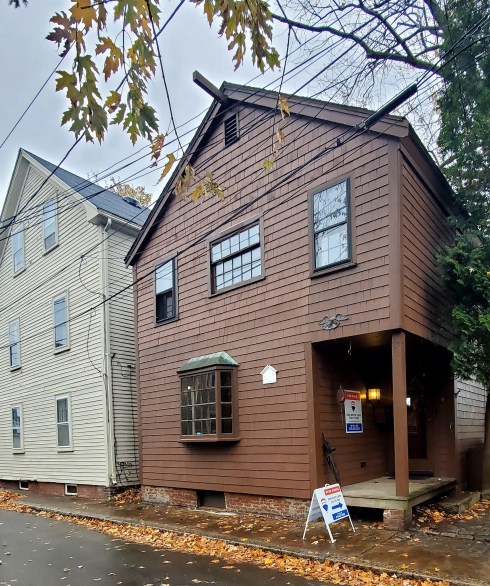
Wow, I don’t think I’ve posted on Salem real estate for quite some time! I’ve just been so serious, but actually there’s not much point: generally as soon as something comes on the market it is snapped right up. I’m sure that will be the case with this little house too, but I’ve also admired it, so I ran over this weekend for the open house. It’s a little two-story shop on Kosciusko Street, overlooking Derby Wharf and the entire Salem Maritime National Historic Site. Two stories, open-floor plan on both floors with a little bedroom and bathroom carved out of the second floor (as well as a “galley” full bathroom on the first), no parking, not much yard: very simple and very atmospheric.

As you can see, there’s been quite a few twentieth-century alterations to this building, especially its fenestration. The plaque report by Historic Salem, Inc. asserts that it is an eighteenth-century structure moved to this site about 1870. The MACRIS inventory calls it “colonial inspired!” Both reports also suggest that it might be an ell that was previously attached to the adjacent building at 159 Derby Street. I’m not sure how this precise 1701 date, so proudly proclaimed, came about. A photograph from the 1930s features an exterior that looks quite different: this can be found at the amazing house history of 159 Derby, now the home of the Salem Arts Association, researched by art historian Franny Zawadski. I was thrilled to learn that both houses were owned by the Salem chapter of the Ukrainian Workingmen’s Association, an organization about which I intend to find out a lot more.

The Shop on the far right above, and on the 1874 Salem Atlas.

I think there’s a bit of Colonial Revivalish embellishment here but it’s fine with me: someone wanted this little old building to look like a ye old cooper shop and it does! It also looks like minimal maintenance to me: a condo alternative with a very tight basement (the advantage of being moved to this spot, I imagine). Since I haven’t written a real estate post in some time, I think I should address the location a bit more. Anyone moving to greater downtown Salem at this point has to consider the impact of tourism, as our City seems hell-bent on driving that engine as much and as far as possible. If you complain about tourism now, you’re going to get a “well, you moved to Salem so you knew what you were getting” sentiment, which I don’t think is fair if you located here twenty years or more ago when Haunted Happenings was much less intense in terms of length and traffic volume of both feet and vehicles. But if you move to Salem now, you better know what you will face (especially if you don’t have a parking place). I think this location has the benefit of being in the zone but protected by the expanse of the Salem Maritime park: I was in this vicinity during the most crowded weekends last month and there were far fewer people here than in the center of the city. I just don’t think the majority of Salem tourists are interested in “history” and this cooper’s shop is in the thick of it.

First and second floors looking out on the Custom House and Derby Wharf (it was kind of dreary outside yesterday but I think the weather just enhanced the coziness).


My Salem Heritage Trail

I’m still frustrated with our city’s “revisioned” “heritage” trail: its blatant commercialism, its yellow color (the exact same shade as the lines in the middle of the road; tour guides have told me that their tourists ask if they have to keep right on the sidewalk which actually might not be a bad idea with the crowds at this time of year), the missed opportunities it represents. None of the promised streamlined signage is up yet so all we have is a yellow line superimposed right on top (or sometimes beside) the still-visible objectionable red line. Any criticism is met with a chorus of “it’s not finished yet!” from all involved, but it’s hard to have confidence going forward when the “product” is so obviously flawed, in terms of both presentation and content.

I’ve laid out my concerns about the latter in detail in an earlier post, but after walking the yellow line a few times I have another complaint: it’s not telling a story. It’s just a string of places, with no connecting narrrative or theme. Maybe this is coming too, but it’s not here yet. There seems to be a mismatch between narrative history and the built environment in Salem: you can have one or the other but not both. I’m sure the countless private tour guides are out there telling stories because that’s what successful, marketable walking tours do, but they are handicapped by Salem’s overwhelming focus on the Witch Trials. If you’re trying to present place-based history, the Trials don’t offer you a lot of options for Salem as there are only two actual material places associated with them: Judge Corwin’s House or the “Witch House” on Essex Street and the Witch Trials Memorial/Old Burying Point on Charter Street.  A few “sites of” are fine for a walking tour but ten or more? It’s difficult to conjure up 1692 while standing in a parking lot. The combination of the emphasis on the Trials and the relative absence of structures from that era has placed an emphasis on performances in commercial interpretations, and ghosts, of course. But Salem has a wealth of historical structures, and they can and should tell stories too. My alternative Salem Heritage Trail is built primarily around buildings, and inspired by the Creating or Building walking tours you see in many cities, tours which are designed by heritage professionals to present a comprehensive and materialistic history of urban development. It’s a stripped-down version of tours I give to family and friends, and following the example of Toronto’s exemplary tour, Creating Toronto: the Story of the City in 10 Stops, I limited myself, with great difficulty, to ten sites.

Trail Sites/Stops: My trail starts at the Pickering House on Broad Street and ends at Salem Common. I’ve chosen the sites along the way because they are beautiful and important buildings and spaces, but also because they represent a number of events and themes in the “making of” Salem: they have to do double or triple or more interpretive duty! I’m aiming for 400 years of history through 10 buildings or sites, on a tour that should take about 90 minutes. It’s definitely a work in progress.

The Pickering House: Salem’s oldest house is a marvel visually and historically. It can represent both the first wave of European settlement and because of its conspicuous and active family, also a series of events and relationships that shaped Salem: King Philips’s War and relations between European and native populations, transatlantic trade, the Revolutionary War. As the house evolves, so does Salem. From the vantage point of the house, one can see the outskirts of Salem’s first African-American section as well as its Italian-American neighborhood, and the line at which the Great Salem Fire ended in 1914.

Hamilton Hall: Built on former Pickering land, along with the rest of Chestnut Street, Hamilton Hall represents the dynamic civic culture of Salem following the Revolution as well as the singularly Federal style of Samuel McIntire and the range of reform and entrepreneurial activities of Salem’s most prominent African-American family, the Remonds. It is also an important site of women’s history, as so many philanthropic events organized by Salem women were held at the Hall: from Abolitionist and soldiers’ aid events in the middle of the nineteenth century, to Red Cross efforts during World War I to the creation of the Hamilton Hall Ladies’ Committee after World War II.

The First Church: It’s the First Church, so it has to be on the tour even though its not in its original location—we’ll pass by there later. The history of the congregation should be prioritized over the history of the building: the transition from Puritanism to Congregationalism to Unitarianism, Hugh Peter & Roger Williams, the religious aspects of the Trials, Leslie’s Retreat, and then Salem’s (19th century, as opposed to today’s) Gothic phase (with a tie-in to the Pickering House).

The Witch House: The home of Witch Trial Judge Jonathan Corwin is the authentic witch-trial site in Salem, but also a place that can represent and illustrate the commercialization of the trials in the nineteenth century as well as the increasing role of historic preservation in the twentieth. This is a good spot to start the discussion of the legal aspects of the trials, but the next stop is better.

Court Houses on Federal Street: These courthouses are a great illustration of Salem as “shire town” or county seat, a very important part of its history and identity. When I was on History Alive’s “Charlotte’s Salem” tour a few weeks ago, Charlotte explained some of the legal aspects of slavery which were causing her anguish in 1857 right in front of the courthouses, and I thought it was the perfect spot, particularly because it was so quiet on a busy Saturday night. The Witch Trials were of course, trials, so this seems like a good spot to address their legal aspects, as well as the famous “witch pins” and several other important Salem trials. The different architectural styles of the court houses evoke their eras in Salem’s history.

Old Town Hall: The terrain between the court houses and Old Town Hall is full of important sites……that are no longer there: the actual 1692 court house, Town House Square, the site of Salem’s first meeting house, and the former sites of conspicuous residents like Judge John Hathorne and Lady Deborah Moody. I guess that dreadful Bewitched statue is part of the “creation” of Salem but I prefer to look at it as an abberation and I don’t want it in my story/tour. So we’ll just skip through Town House Square to the Old Town Hall or walk down Church Street past the Lyceum and cut over to Essex Street. Old Town Hall (long known as the “Market House”) and Derby Square remains a very busy place, so it’s the perfect space to represent the extremely dynamic and diverse commercial history of Salem. It’s also a great place to focus on food food: Salem seems like a foodie designation now but I think it always has been, and Derby Square and adjacent Front Street was a restaurant row. I guess it’s been reduced to an Instagram stage now, which seems appropriate since Instagram photos are one of Salem’s major products.

Old Burying Ground/ Witch Trial Memorial: The last three stops of my trail consider Salem’s evolving public presentation of history, along with other themes and events associated with each site. From the later nineteenth century on, as the City focused increasingly on tourism, there were three major draws: the Witch Trials, Nathaniel Hawthorne, and maritime history. For me, the Salem Witch Trials Memorial represents the triumph of the Trials: the City could go forward into full-fledged witchcraft tourism now (in 1992) as it had erected a memorial and pledged itself to toleration going forward. The more recent restoration of the adjacent Old Burying Ground and addition of the first-period Pickman House as a welcome center for both seems to me an admission that Witch City needed a bit more regulation: Salem has always taken care of its cemeteries.

The Salem Maritime National Historical Site. Carved out of Salem’s Polish neighborhood along Derby Street, Salem Maritime is also an illustration of history in the public sphere: it is a rebuilding and reframing of the City’s glorious maritime past, almost like a maritime memorial. Standing on Derby Street looking out onto Salem Harbor, we can consider both Salem’s maritime history as well as the historical and ongoing effort to preserve and showcase Salem’s maritime history, especially as the Custom House is closed for restoration. With its streetside shop on one side of the Derby House and garden out back, it is also a good place to consider Salem’s Colonial Revival influences and impact.

And on to Salem Common: where we could tell the entire history of Salem, from rope walks to food trucks! I think it would be interesting to end the trail with a consideration of what is “public” and what is not as it pertains to the Common and the myriad events that have happened there over the centuries. So many events: military musters and drills, neighborhood playground competitions, baseball games, concerts and films, speeches and protests, carnivals and circuses, commemorations. Just this past weekend, I was walking around the Common while a large food truck festival which apparently had no local vendors was happening, on “common” land.

What I left out. Many places! The ten-stop limit really challenged me. And of course, there will be no “suffering mannequins” on my tour. I left out both the Peabody Essex Museum and the House of the Seven Gables because these institutions are independent draws which also feature their own audio tours: both are obviously central to Salem’s urban and identity development. The PEM’s new Salem Witch Trials Walk looks like a good introduction to the Trials and there are also “PEM Walks” audio “postcards” for each of the Museum’s historic houses. Both Salem Maritime and the House of the Seven Gables also offer excellent audio tour options. So there’s really no need to follow that yellow line; indeed, no need for any paint on the sidewalks of Salem.


Hooked on Kinderhook

I made a very quick trip out to the Hudson River Valley at the beginning of last week to visit my brother and brother-in-law, and despite its brevity I still made some discoveries, including the delightful Columbia County town of Kinderhook. I always try to find new places when I’m out there, so on the way home I headed north from Rhinebeck, where they live, before turning east towards Massachusetts. It was supposed to be an hour-long diversion to see the Martin Van Buren National Historic Site before I headed home, but there was so much to see in Kinderhook I lingered, and did not get to Salem until well after dark. The President’s house did not disappoint, but downtown Kinderhook blew me away: beautiful houses and gardens, so much history, a stunning art gallery. The picture-perfect historytown: well worth a weekend trip if you’re within driving distance (or a longer one if you’re not). For some reason, I expected Lindenwald, which Martin Van Buren purchased after his presidential term was over, to be a bit dull and dowdy but it was on my list: when I got there I found it neither. I’ve been on a Gothic Revival kick all summer long, but this house is more than that: it’s a late Georgian mansion house transformed into a Gothic Revival mansion with an Italianate tower! Quite a melange: and Zuber & Cie wallpaper inside. The house was built by Judge Peter Van Ness in 1797, and inherited by his son William, who was Aaron Burr’s second in the 1804 duel which fatally wounded Alexander Hamilton. After Van Buren was defeated (on a Whig ticket) in the 1840 presidential election he retreated to Lindenwald, but following another defeat in the election of 1848 (on the Free Soil Party ticket) he was ensconced there for the remainder of his life. In 1849 he hired architect Richard Upjohn (who must have been THE Gothic Revival architect as he designed my two favorite houses in that style: the Rotch House in New Bedford and Kingscote in Newport) to expand and transform it.

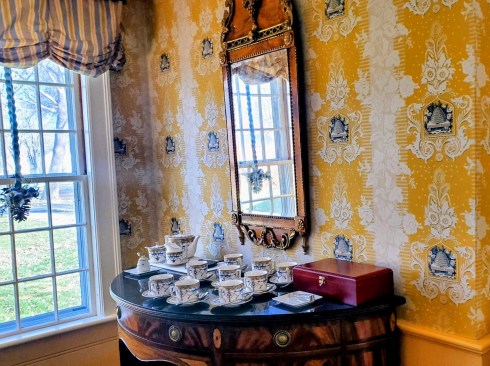
Exterior and interior views of Lindenwald, including the tower stairwell and first-floor parlors. The entire center of the house is one big dining hall with the restored Zuber paper: for some reason it was difficult for me to photograph so refer to the site’s website! Not sure what this little house was for but it is cute.

This was the last day of a week-long heat wave so I really wanted to stay in my car, but once I got into downtown Kinderhook I had to get out of it. There were so many beautifuly houses, I would just stop, run out and take a photograph, and run right back into the air conditioning. But this was happening so often and the houses were in such close proximity to one another that it was getting a bit comical, so I finally stopped and took a walk. There was a strong presence of history: I had the image in my mind of the Continental Army marching down the main street victoriously after the (Second) Battle of Saratoga in the fall of 1777, especially as I passed the house where the captive General Burgoyne was entertained which was very close to the house where the wounded Benedict Arnold was taken. Earlier in the war, General Henry Knox passed through Kinderhook on his heroic quest to deliver cannon from Ticonderoga to General Washington in Boston. There are all these beautiful brick houses—both Dutch and English. There were details on the wooden houses I had never seen before. I was a puddle after my walk through Kinderhook but it was worth it!

The Luykas Van Alen House, 1747, which is owned and operated by the Columbia County Historical Society, as is the James Vanderpoel “House of History,” built in 1810. (The Van Alen house had several front porches with these built-in benches you see on Dutch Colonial houses built in the 20th century). Some houses which caught my eye in Kinderhook Village–I could have included many more. House where General Burgoyne was entertained and Major General (Turncoat) Arnold was attended to.

It was so hot in the Van Buren house that our guide passed out these cool fans! Perfect keepsake and advertisement for all this region has to offer. New York State takes its history very seriously: there are markers everywhere (maybe even TOO many–a big statement from marker afficionado me), every town has an official historian, and no opportunity goes unutilized to showcase it.


A July Afternoon, Old Lyme

One hot morning last week I was looking at some paintings by the American Impressionist artist Matilda Browne (1869-1947) when I realized I wanted to see more. It was apparent that the best place to do that was the Florence Griswold Museum in Old Lyme, Connecticut, so I hopped in the car and drove down there, arriving in the early afternoon. I was supposed to be doing lots of other things but I ran (drove) away instead: I’m a firm believer in doing that from time to time and have always been grateful that I have the ways and means to do so. Old Lyme is a beautiful town: I’ve been there quite a few times but never to the Griswold Museum, and it was a real feast for the senses, especially at this time of the year, when the Colonial Revival garden in back of Miss Griswold’s mansion was at midsummer peak. There is the 1817 mansion, embellished with the art of Miss Griswold’s artist-boarders who established the Old Lyme Art Colony at the beginning of the twentieth century, the garden and grounds with trails along the Lieutenant River, the modern gallery with cafe and gift shop, and several studio-outbuildings which give the impression of an artistic community past and present. It was a perfect place to spend an afternoon in July, as everything was bathed in that golden midsummer glow, much like the painting by once-resident Edward Simmons of the same title. And I saw lots of Matilda Brown’s paintings too.

Edward Simmons’ July Afternoon, Old Lyme (1906) and the house, garden and grounds of the Florence Griswold Museum.

Florence Griswold’s life (1850-1937) was in some ways common, in other ways not. She was born into a wealthy family, exemplified by the grand 1817 mansion on Old Lyme’s main street, whose money was increasingly diminished to just the house and grounds with no means to keep both. After the death of her father in the 1870s, the house was transformed into a school for genteel ladies, and after the death of her mother in the 1890s, into a boarding house by Florence and her sister. The artist Henry Ward Ranger came to stay in 1899, and convinced other artists to follow suit in the years to come, and the house evolved into an artistic community with Miss Griswold very much in its center and her house the foundation of an emerging art colony in Old Lyme. Apparently extending patronage (in the form of credit) to artists became a higher priority than holding on to the family home, and she lost it before her death in 1937, but over the next decade the Florence Griswold Association was able to purchase it and establish the museum. The first floor of the house is maintained much as it was in her time, while the second floor has galleries devoted to the work produced there, including paintings of the house itself, illustrating her role as “the keeper of the artists.” Resident artists, including Matilda Browne, also painted the house itself, most prominently its door and mantle panels, leaving their mark in more ways than one. While the Old Lyme Art Colony is associated most prominent with American Impressionism because of the residency of Childe Hassam and others, you can also see works representative of the less well-known (at least to me!) school of Tonalism associated with Ranger. And there are also some very impressive cows.

ABOVE: Matilda Brown, Miss Florence’s; Charles P. Gruppe, The Griswold House at Old Lyme; Woodhull Adams, Miss Florence’s Parlor (1912); painted panels in the Griswold dining room. BELOW: Front hall and parlor of the Griswold House, Miss Griswold’s bedroom and a guest bedroom.

It was quite a shift to move from the mellow tones and painterly animals ensconced in the old Griswold House to the museum’s modern galleries, which are currently showcasing a retrospective of artist Dana Sherwood’s more whimsical work, including an installed Bedroom Bestiary (2021) below. Very charming images, but I wanted to stay in the past, as usual, and in the garden, which was lush, lush, lush. So back to Miss Griswold’s environment I went: to the realm of her boarders and borders. It was Matilda Browne who lured me to coastal Connecticut after all.

Works by Dana Sherwood in the 2002 Krieble Gallery; Matilda Browne’s Clark Voorhees House (1905) and Saltbox by Moonlight; William Henry Howe’s Repose, September Days in Normandy (1888-89); back in the garden—somehow I never thought of using sage as a border plant like this.


An Enigmatic Etcher

I wanted to share some examples of the work of the Salem artist George F. White, Jr., better known as George Merwanjee White (1849-1915), but I wish I could also share more details about his life. He’s a bit mysterious, particularly his chosen middle name, Merwanjee, a notable Parsi name. He was the proverbial “son of a Salem ship captain” whose most well-known works are quite local in focus, yet there is evidence that he also traveled widely, in both Europe and India. White’s father, George F. White Sr., made many voyages to the Indian Ocean for shipowners from Salem, Boston, and even New York, so perhaps his son might have accompanied him and was thus exposed to Indian influences, but this is complete conjecture on my part. In any case, by the time White Jr. married at the age of 27 he had shed the “F.” and acquired the “Merwanjee” and that is how he was known throughout his life. George M. White is recognized as part of an “Etching Revival” in Boston and Salem,, a movement which began in the last two decades of the nineteenth century in the latter city, exemplified by the little-known artists Harriet Frances Osborne and White and the more well-known Frank Benson. In addition to his etchings, White produced oil and watercolor paintings and was also recognized as a gifted producer of bookplates, but architectural etchings and drawings seem to be his preferred genre. There is a beautiful portfolio of his images of old Salem houses published by subsciption in 1886 entitled Etchings of Old Houses and Places of Interest in and about Salem which has been digitized for the “Peabody Essex Museum Publications” at the Internet Archive, and below are some of my favorite views. First, the process of production, followed by what was then generally known as the “Roger Williams House” and now the “Witch House,” the Philip English Mansion, the “Old Bakery” on St. Peter Street, later to be moved and renamed the John Ward House at the Essex Institute, the seventeenth-century survivor Narbonne and Pickering Houses, the lost Lewis Hunt and Richard Prince Houses, and Nathaniel Hawthorne’s birthplace in its original location on Union Street.


White’s images are of both old Salem houses—emerging landmarks—which had survived the dynamic nineteenth century (or most of it) as well as fabled houses which had not, thus expressing the beginnings of a preservation conciousness which is also evident in the similar sketches of Edwin Whitefield’s Homes of our Forefathers series, which was published just about the same time. Whitefield is a bit more romantic; White a bit more realistic. White wants to show and tell us what was special about the English, Hunt, and Prince Houses, and he’s wistful about the “picturesque” past: this is a word he applies to both the lost Prince House and the “living” Pickering House, the exterior of which was “fashioned” in the picturesque style of a bygone age in the 1840s. You can’t help but feel that modernity is encroaching.

Heliotype prints from George Merwanjee White’s Etchings of Old Houses and Places of Interest in and about Salem, Limited Edition, 1886.


The Justin Morrill Homestead

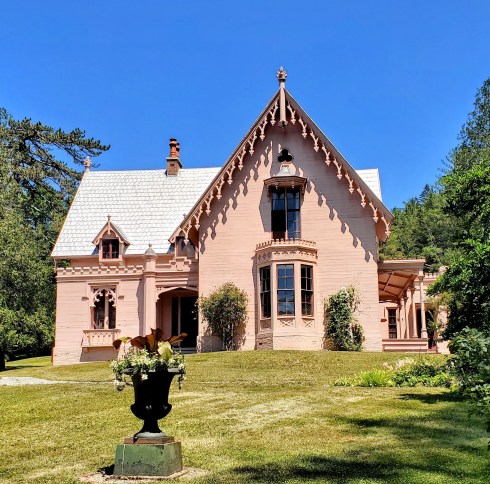
Another week: another pink Gothic Revival house! If you haven’t noticed, I’ve been on a Gothic Revival kick for a while. It’s a style you can’t help but notice, and Salem is fortunate to have some notable examples, but I think it was spending a couple of weeks last summer in the Hudson River Valley, a crucible of Gothic creation, which rejuvenated my interest. I saw Lyndhurst and Sunnyside there, along with many other romantic structures and motifs. There are wonderful Gothic Revival buildings in New England as well, and after I saw the Rotch house in New Bedford on my spring break I knew I wanted to see more, so it was off to see Kingscote in Newport, and Roseland Cottage just a few weeks ago. Now I have a long list of houses that I want to visit or revisit, including one with which I thought I was familiar: the Justin Morrill Homestead in Strafford, Vermont. I lived in this village as a child while my father was beginning his academic caeer at Dartmouth, and I remember running all around the estate in the summers: it was irresistable because it was pink, and the site of multiple outbuildings (also pink) which were the source of countless made-up stories and scenarios as well as a mystical, seemingly bottomless, pond. My childhood focus was much more on the grounds than the house, though I have been in the house a couple of times since then, but not with my current Gothic Revival gaze. So this past GLORIOUS weekend, my husband and I drove up to Stafford, where a pink quatrefoiled fence marks the entrance to the Morrill house and grounds.

This was the home of Justin Morrill (1810-1898), or I should say the summer home, as after he made his fortune he began a life of public service which placed him in Washington from 1855 until his death. He served as a US Representative from 1855-1867, and then Senator from 1867 until 1898. Unlike so many of today’s Washington politicians, Morrill was an actual lawmaker, distinguished first and foremost as the crafter of the 1862 Morrill Land Grant College Act which provided federal funding to establish public universities in every state, but he was also (again, notably different than today’s “public” servants) a remarkably effective committee chair, serving in that capacity for the House Ways and Means Committee during the Civil War and for the Joint Committee on Public Buildings thereafter, as well as on the Senate Finance Committee. He financed the Civil War and the completion of the US Capitol! This pastoral pink cottage must have been a welcome sanctuary for the very busy Morrill, and it was very much his house, completed just before his marriage to Ruth Barrell Swan of Easton, Massachusetts in 1851. Just as I had never really considered his house, I had not thought much about Morrill himself until my re-visit this weekend, but both of our guides, John for the exterior and grounds and Eli for the interior, were clearly both very much fans as well as purveyors of lots of detailed information about the Senator and his family. The house is also rather intimate, much more of a cottage rather than a mansion, and it is furnished with items taken from the Morrill home in Washington, so it feels as if you are visiting a home rather than a museum, albeit a home fixed in a particular place and time.

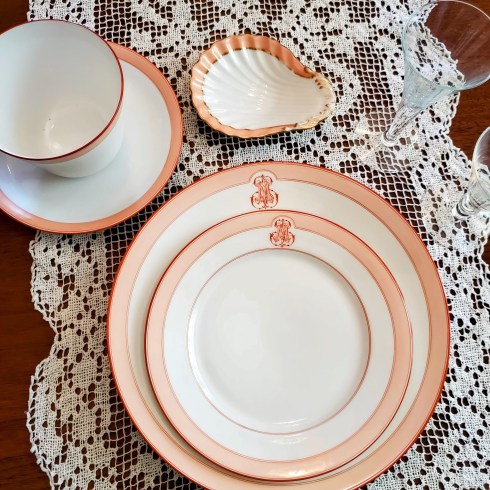
Interiors of the Morrill Homestead: some Gothic Revival orientation, including the Brooks House in Salem; the family (+dog) on the porch, pantry, downstairs hallway, Gothic door details, monogrammed china, the parlor, a downstairs bedroom, stained glass in the Senator’s study, second-floor landing, hallway, and back bedroom, attic details.

And now for some magic! The house has these amazing painted window screens clearly visible from the outside as European-esque landscapes in shades of grey and black, but inside you see only the mesh screen! I have seen painted window screens in Baltimore before, but never in New England. They seemed magical to me, as magical as the ice pond on the estate USED to seem to me as a child: surrounded by trees, you came upon it as a secret, dark place, and again, it was seemingly bottomless. But this weekend, cleared of about half of its guardian trees, it seemed very much like just a pond. In fact, that’s what my husband said to me: “it’s just a pond, Donna.” I couldn’t even take a good photo of it as it was so sunny, sorry. An older photograph conveying the dark and magical qualities it possessed in my childhood mind is also elusive: just imagine a black hole!

The Justin Morrill Historic Site is one of ten historic sites and National Historic Landmarks owned and maintained by the state of Vermont through its Division for Historic Preservation with the active support of the Friends of the Morrill Homestead. All the essential information about visiting the Morrill Homestead is at the Friends’ website, as well as evidence of their very active interpretation of the site:  https://www.morrillhomestead.org/. Special thanks to John Freitag who gave us such a great tour, but also gave me a very substantive historical answer to a question I’ve long wondered about the Strafford Town House (below): why such a large structure for such a small village? Of course it’s all about the local politics of the American Revolution—and after.


After the Fire: a New Salem Saltbox

I like to recognize the anniversary of the Great Salem Fire (June 25, 1914) every year, or most years, as it was such a momentous event in so many ways, starting, of course, with sheer destruction and dislocation: 1376 buildings burned to the ground (out of around 5000 structures in Salem proper), 18,000 people lost their homes and 10,000 people lost their jobs. Only three people died, which seems incredible given the magnitude of this conflagration, but 60 people were injured. Like every disaster of this scale, there are so many topics to address about its aftermath: the immense shelter and aid effort, the rapid rebuilding program, the plans for a “new” Salem. New might not be the correct word, as the architects and planners and owners who sought to rebuild on the broad swath of fire-ravaged land along Lafayette streets and the harbor were very interested in fire-resistant building materials but their aesthetic preferences were more traditional. This is a moment when Colonial Revival Salem comes into full flower, after germinating for several decades. You could label the traditional brick, stucco, and wooden buildings which line lower Lafayette and its side streets “conservative” but I prefer the terms referential or contextual: I’m always impressed with the deep appreciation displayed by early twentieth-century architects for Salem’s colonial and federal architecture and their desire to study and emulate heritage buildings. Perhaps post-fire architects, builders and planners were a bit too deferential to the past (architectual author and photographer Frank Cousins seems to view the opportunity before Salem as one of colonial compensation after all those sub-par Greek Revivals and Victorians were swept away) but I’m alway happy to see the past privileged over the present. I thought I’d illustrate this Colonial Revival moment with just one “new” house: a saltbox built on Cedar Street for Mr. and Mrs. George A. Morrill as designed by architect A.G. Richardson.

Two Cedar Street, built 1815: today, in the 1980s, and as newly-built.

A.G. Richardson was a Boston architect who lived in Salem, and thus the recipient of quite a few post-fire commissions. His pre-fire work does not seem to be overwhelmingly reflective of colonial inspiration, but more like a mix of old and new. He did design a “new Colonial house” for a harborview lot on Lafayette which was featured in House and Garden magazine in June of 1907. But the Morrill house at 2 Cedar Street looks much more traditional, and Frank Cousins and his co-author Phil Riley even praised it as “practical” in their Colonial Architecture of Salem (1919): “the resulting house as it stands to-day represents virtually and exact copy of the Maria Goodhue house in Danvers, erected in 1690 and destroyed by fire in 1899. Its long roof-line, formed by the lean-to continuation of the same pitch, contributes a uniquely appropriate character to the modern architecture to the modern architecture of Salem and was found to provide a very practical way of bringing a piazza in the rear and all service appurtenances under one roof, thereby saving expense and avoiding all leadage complications common to roors considerably broken by gables or dormers.” Riley had praised the Morrill house earlier as “in the spirit of old Salem” in his 1916 article in The House Beautiful, but I think I should note that there were not many surviving saltboxes in early twentieth-century urban Salem, so Richardson had to look to nearby Danvers for inspiration! Fortunately Cousins had photographed the Maria Goodhue house (see below, from the Cousins Collection at the Phillips Library via Digital Commonwealth) before it was destroyed by fire. The new door of Two Cedar Street was definitely old Salem, however: Richardson copied the entrance of the Captain John Hodges House on Essex Street.

There was something about the Fire that fueled preservation in Salem and elsewhere, as story after story in national newspapers and periodicals emphasized the fact that the older sections of Salem escaped its path: an early report indicated that the House of the Seven Gables had been swept away, and it seems like there was a collective sigh of relief when it was revealed to be false. Wallace Nutting, that exemplar of the Colonial Revival, featured ethereal ladies draped in timeless white dresses on the steps of Chestnut Street houses spared from the fire in his 1915 “expansable” catalog, and the equally timeless saltbox merged colonial charm, clean lines, and (space for) modern conveniences.