Tag Archives: Architecture

After the Fire: Orne Square

At the southern edge of the McIntire Historic District lies a mini-neighborhood of semi-detached English cottages, built of concrete in the early twentieth century rather than Cotswold limestone in the seventeenth.  This is Orne Square, laid out just after the great fire of 1914 under the auspices of the Salem Rebuilding Commission, with financing from the Salem Rebuilding and Phillips Trusts, and with inspiration from the dynamic Arts and Crafts and English  “Garden City” movements so popular at the time.

Each of the eight houses features two separate three-story townhouses with separate entrances and side and back gardens; there are common parking, lawn and garden areas as well.   The elbow-shaped Orne Square is a Salem public street, not a gated community, but  I don’t think there is a lot of cut-through traffic.  It’s a great little neighborhood.

Just around the corner from Orne Square is another English Arts and Crafts double cottage, a perfect example of the type of “reform housing” that the Boston architectural firm Kilham and Hopkins was proposing for other fire-ravaged areas of Salem.  This firm was waging a war on triple-deckers all over eastern Massachusetts, and their consultations and advocacy resulted in strict guidelines for the rebuilding of Salem and a strong preference for side-by-side double houses rather than multi-story buildings.  I’m not sure if Kilham and Hopkins are responsible for the Orne Square houses, but they did design and build a neighborhood of  “low rent brick cottages”   in North Salem, as well as the Woodbourne section of Jamaica Plain in Boston.

Architectural Forum 28 (1918)

Plans for Woodbourne

I’m reaching here for a bit more geographical and architectural context, but Orne Square seems like a smaller, less commercial version of the Hydrostone neighborhood of Halifax, Nova Scotia, constructed after the devastating 1917 explosion and fire following the collision of a French munitions ship and a Norwegian supply ship in the harbor during World War One.  I’m visiting there later in the summer, so I’ll see if the comparison stands.


Gothic Salem

Salem is quite Gothic in several ways, but this post is specifically about Gothic buildings.  I spent my early childhood in the picturesque village of Strafford, Vermont, the site of the Senator Justin Morrill homestead, a perfect pink Gothic Revival houses that made quite an impression on me as a child.  Surely you can see why. (Sigh)

As an adult, I think I prefer the austerity of colonial and Federal houses, but Gothic buildings have a lot of charm, and Salem has quite a few nice examples.  Even though Salem was decidedly urban by the time that the Gothic Revival style became fashionable in the middle of the nineteenth century, there are still some structures that are clearly based on the “bible” of the style, Andrew Jackson Downing‘s Cottage residences, or, A series of designs for rural cottages and cottage villas, and their gardens and grounds (1842). Several of these urban Gothic Revival cottages are in the previously pastoral North Salem, including these houses on and around Buffum Street, a lovely street that runs parallel to North Street/Route 114, one of the main entrance corridors in and out of town.

  I’m not sure if this adorable cottage is Gothic Revival or a later “storybook” style from the early twentieth century.  The proportions seem a bit different than those of the verified Gothic buildings, but it’s such a great house I wanted to include it anyway.

The cottage near the entrance to Harmony Grove Cemetery, in the later nineteenth century and today. 

Closer to downtown, there are two Gothic Revival houses facing each other on Broad Street:  The Pickering House and the William Brown cottage.  Actually, the Pickering House is only masquerading as a Gothic Revival house; it is really a “First Period” structure, indeed Salem’s oldest house, built in 1651. Successive generations of the Pickering family have lived in the house until just recently, including Timothy Pickering, Secretary of War and of State in the 1790s, and in the 1840s it was updated or “gothicized”.  The very distinctive Gothic Revival fence was added at that time as well.

The Pickering House and fence today and in 1940 (HABS, Library of Congress), followed by the William Brown House, built in 1847.


The gold standard for Gothic Revival houses seems to be the  Timothy Brooks House on Lafayette Street, built in 1851.  It is certainly a stately mansion, not a cottage, and the architectural details are incredible, including the entryway, windows, and trim. It also looks to be quite closely modeled on Downing’s Design no. II:  A Cottage in the English or Rural Gothic Style.  I believe that it was a single-family house until the 1980s, and then it was converted into condominiums, with additional built units in what might have been a carriage house or other outbuildings.

HABS, Library of Congress, 1953

The Gothic Revival style was suitable for both residential and institutional architecture, and ecclesiastical and educational institutions really embraced it in the mid-nineteenth century. Think of the campuses of Princeton, Yale, and Boston College, to name  just a few.  Two of Salem’s most influential churches, the Unitarian First Church and Episcopal St. Peter’s, rebuilt their very old churches in a remarkably similar (Normanesque) Gothic style at the same time:  the 1830s.  Perhaps friendly competition for the newest, latest (most inspirational?) style?  It is certainly ironic that nearly thousand-year old motifs were considered “new”!

  A Frank Cousins’ photograph of the First Church in the 1890s from the NYPL Digital Gallery and the First Church today; St. Peter’s Episcopal Church.

THE KEY DETAIL:  the quatrefoil.  Once you start looking for them, you see them everywhere…..

Quatrefoils from the First Church (above) and St. Peter’s Church (below), a quatrefoil bracket from the Brooks House, and the Pickering House quatrefoil fence.


Houses on the Move

There are countless ways that our ancestors were more environmental than us, though of course they didn’t see it that way:  they just didn’t like to waste.  Anything.  The whole idea of  “tear downs” would have been repellent to most people (maybe not nouveau riche millionaires) a century and more ago; if they wanted a bigger house or a house in another location, they just added on or moved the entire structure:  with horses, with oxen, by rail.  This still happens; the huge new courthouse project that is now coming to a close in Salem involved the moving of a huge brick Baptist Church and the preservationist practice of selling endangered houses for a dollar with the stipulation that they be moved is pretty standard.  But it is far less common than it was in the nineteenth century, when one gets the impression that there were many houses on the move.

The First Baptist Church on the move, January 2009 and the moving of the Peter Green house in Providence last year.

This post is one of several that I could do on houses that have been moved in Salem.  Like many older cities in the east, both public and private motivations have resulted in lots of building relocations. I have excluded the houses that have been moved by the House of the Seven Gables and the Peabody Essex Museum, both of which created “museum neighborhoods” by moving historic structures.  The latter wins the award for the house that has moved the farthest distance:  its eighteenth-century Chinese house, Yin Yu Tang, came from halfway around the world!  But even excluding these institutions, there are lots of Salem houses that have been moved, in their entirety, or in pieces.

I’m starting out with one of my very favorite houses, the Robert Manning cottage on Dearborn Street in North Salem.  This adorable  Dutch Colonial cottage was built by Nathaniel Hawthorne’s maternal uncle Robert Manning for his widowed sister, and Nathaniel lived there with his mother after his graduation from Bowdoin College.  The cottage was then across and down the street from its present location, adjacent to Manning’s own house and famous nursery, orchard and garden.  After the house passed out of the Manning family in the 1850s  it was relocated, though its original ell remained behind.

Frank Cousins Photograph, 1901

A more challenging move, both in terms of bulk and distance,  involved the Mason-Roberts-Colby-Nichols House, which was transferred from the Common to Federal Street by 60 oxen in 1818.  The relocated house then underwent a Federal makeover and acquired several additions, including the “Beverly jog” seen below.

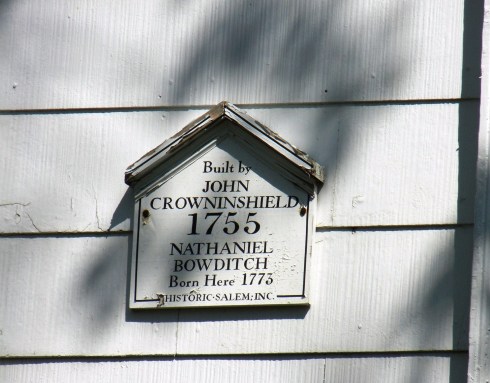
Relocation following redevelopment: many houses in Salem were moved because of street widening and other infrastructural modifications and larger institutional building projects.  The two Georgian colonial houses below were removed from St. Peter Street to nearby Kimball Court to make way for the St. John the Baptist Church complex at the turn of the last century.  The white house on Kimball Court (which acquired some interesting pillars after its move) is one of  several houses in Salem associated with the famed navigator Nathaniel Bowditch; the other Bowditch house (the present-day headquarters of Historic Salem, Inc.), where he lived for over a decade was moved (along with the Jonathan Corwin house) to make way for street-widening in 1944.

The Bowditch (Curwen) House in its original Essex Street location: a Frank Cousins photograph circa 1900

Bowdith house corrected

And here in its proper (past) situation–thanks to Mark Coughlin!

The Bowditch House today: around the corner on North Street

The sum of all their parts:  often houses were not moved in their entirety, but in pieces, and either reconfigured in a new enlarged house or attached to a pre-existing house in another location.  It is a quite a feat to figure out when and where and how precisely all this disassembling and reassembling happened in Salem, or any other similar town, but here are a few examples of  it:  another house with Bowditch connections, a portion of which was the Samuel Curwen house and store, an interesting house moved to a side street off Derby Street in 1856 which seems to consist of at least three, if not more, earlier houses, and the amazing Benjamin Punchard house on Federal Street, whose origins are somewhat shrouded in mystery but is believed to be a product of a colonial building moved to the site a decade before the American Revolution and later Federal-era additions.

The most interesting example of a partially relocated and reconstituted house is the Phillips House on Chestnut Street, now one of Historic New England‘s properties.  The house was erected (or assembled) in 1821 by Captain Nathaniel West, who moved part of  Oak Hill, the magnificent country estate of his deceased ex-wife (Elizabeth Derby West, daughter of Elias Hasket Derby, Salem’s wealthiest merchant and perhaps America’s first millionaire) in nearby South Danvers (now Peabody) to Chestnut Street and added additional rooms to create a new (late) Federal mansion.  Mrs. West had wanted the Captain to have nothing to do with Oak Hill, but after both her death and that of one of their daughters, he inherited a third of the estate and promptly removed his inheritance to Salem, creating a “spite house” of sorts just down the road!  A century later, the Phillips family commissioned architect William Rantoul to remodel the Chestnut Street house in the Colonial Revival style, and later still, sadly, Oak Hill was demolished to make way for the Northshore Mall.

The Phillips House in 1940, HABS, Library of Congress.  Frank O. Branzetti, Photographer.


The Pedrick Store House

At this week’s annual meeting of Historic Salem, Inc. the Salem Maritime National Historic Site was given a Preservation Award for the relocated and reconstructed Pedrick Store House, a circa 1770 building that was situated on nearby Marblehead’s harbor until 2003, when it was acquired by the National Park Service and moved to Salem.

A postcard of Tucker’s Wharf in Marblehead, with the store house in its original location (the larger structure on the left) is below.  When the town’s efforts to restore the building were unsuccessful and its razing imminent, the Park Service stepped in and moved it to Salem in pieces, commencing a six-year period of storage and reconstruction (using traditional techniques) on Derby Wharf.

For as long as I’ve lived in Salem, and certainly since the arrival of the replica Friendship in 1998, there has been discussion of the necessity of having more structures on Derby Wharf, in an ongoing effort to recapture at least some semblance of the frenzied commercial activity on the wharf in Salem’s golden age.  All the literary and visual evidence indicates that Derby Wharf, along with Salem’s other wharves (now mostly gone) were lined with multi-story store houses and outbuildings to service all aspects of the port’s business in the early nineteenth century.

Even a century ago, there were both more wharves and more buildings on the wharves.  The Salem artist Philip Little (1857-1942), Chestnut Street resident, civic leader, brother of architect William Little (who I wrote about here) and good friend and neighbor of fellow Salem artist Frank Benson (who I wrote about here) maintained a small studio overlooking Salem Harbor and was particularly inspired by the old wharves and wharf buildings which were still extant, but obviously in decline, during his lifetime.  He produced variations on the old Salem wharves image in many different mediums, including the etching, photograph, and oil painting below (Salem’s Old Wharves, 1915, Smithsonian American Art Museum; Derby Wharf, 1910 and A Relic of History, Old Derby Wharf, 1915, both Peabody Essex Museum and Salem State University website Salem in History). 

Little’s use of the word “relic” in the title of this last painting is interesting; it is an acknowledgement that the Wharf as he was capturing it was a remnant of the past, on its way out.  And soon the buildings of the wharf were gone, though the wharf itself survived because of its acquisition by the federal government and assimilation into the Salem Maritime park.  And as is often the case when things disappear, you notice their absence and want them back.


Preservation: Gains and Losses

Historic preservation has been an ongoing effort in Salem since at least the second World War, when the seventeenth-century Jonathan Corwin house (later, unfortunately, labelled the “Witch House”, was threatened by a street-widening project and Historic Salem, Inc. (HSI) was formed by a group of citizens determined to save the house.  They were successful, and HSI (along with other individual passionate preservationists) has gone on to fight urban renewal, save a succession of historic structures, and advocate for both individual restoration and adaptive reuse projects as well as a more general planning policy encompassing historic preservation.  There have been losses and gains over the past half century or so, both of which have had a dramatic effect on Salem’s streetscape.

Two projects of the last decade represent the dynamic of gain and loss in the continuum of preservation advocacy very well.  Most recently the very shabby Elks Lodge was transformed into the stately One Eaton Place Condominiums, a rehabilitation that is even more impressive given the building’s prominent place along one of Salem’s entrance corridors, North Street.  When HSI, which had a vested interest because its headquarters are immediately adjacent to this building as well as a more general preservation concern, informed the developers that their newly-purchased building had somehow lost its third story at some point in the twentieth century, they were more than eager to put it back and gain additional units at the same time.  This was a win-win for everyone, and (in a tough real estate market) the condominiums sold out within months of completion of the project.

In the loss column goes one of the most hard-fought preservation efforts in Salem’s history:  the effort to secure the redevelopment of the 1908 Salem Armory after its partial destruction by fire in 1982.  The imposing (many architectural adjectives come to mind:  fortress-like, castle-esque, Romanesque/Gothic/medieval revival) structure, long home to the Second Corps of Cadets of the Massachusetts National Guard, dominated several blocks of central Essex Street right up to its demolition in 2000, even after the 1982 fire, as these before and after images illustrate.


A Frank Cousins photograph of the Armory Billiards Room, c. 1910. Duke University Library Special Collections


HABS, Library of Congress

Ten years after the fire, 1992

At about the time of this last photograph, the newly-formed and adjacent Peabody Essex Museum (a merger of the Peabody Museum and Essex Institute) entered into a memorandum of agreement with the Massachusetts Historical Commission and other parties to incorporate the street-fronting “head house” into its expansion plans while the National Park Service proceeded to transform the rear “drill shed” into a Visitor’s Center.  Throughout the 1990s, the Museum delayed and eventually reneged on its agreement, transferring its expansion focus to the present Moshe Safdie-designed atrium addition across the street.  HSI initiated a legal action to save the head house but to no avail:  it came down in 2000.  In its place, the Museum left only the Tudor arch entryway standing (presumably to maintain some semblance of streetscape) and promised a “world-class” Armory Park to honor the Second Corps of Cadets.

I’ve always found the stand-alone entry a bit ghostly; it’s an architectural memento mori.  Amory Park is not really a place, but simply a pass-through path to the Salem Visitor’s Center beyond, which is a great resource for both Salem’s residents and visitors.  May is Preservation Month, a time to look around and remember both what has been saved and what has been lost.


Old Orange Houses

I went for a walk around Salem yesterday and suddenly noticed lots of orange houses.  I hadn’t realized there were so many; this is obviously another (old) design trend that has passed me by.  The orange houses of Salem are all on side streets and relatively small in scale, which is probably a good thing, as it’s a pretty powerful color.  No orange houses on stately Chestnut Street where Federal houses predominate and yellow is an exotic color, or on the main street of Salem, Essex Street, or on Washington Square, the street which surrounds the Common.  But if you look down any side street running off these broad boulevards, you’ll most likely see a pop of orange on a colonial or Victorian house.  Here is a sampling:  two orange houses right around the corner from our house, a mid-nineteenth century Gothic Revival cottage and a Georgian double house near the Common, a melon-colored house with Derby Wharf and The Friendship almost in its backyard, a wall of orange on a Derby Street triple-decker, and another gambrel-roofed later eighteenth-century house off Federal Street.

Surprising but true:  I could not find an orange house on Orange Street!


Doorways (and wreaths) around Salem

For architectural photographers of the early and mid-twentieth century, the doorway shot was a stock image.  Frank Cousins issued many doorway postcards and compiled a portfolio of images in 1912.  A decade later, his fellow Salem photographer Mary Harrod Northend issued Historic Doorways of Old Salem and Samuel Chamberlain included many Salem doorways in his popular New England Doorways in 1939.  As a frame itself, the doorway is an easily framed image, and can serve as the epitome of the architectural style of the entire house.  In the forward to New England Doorways, Chamberlain identifies the doorway (and the fireplace) as “focal points of interest in the early houses, where the builder might forget stern necessity for a moment and indulge in his distinctive desire for ornament.”

Two of Chamberlain’s photographs are below:  the Phillips House doorway on Chestnut Street and the pedimented “shutter door” of the Clark-Morgan House on Essex Street (a great Georgian colonial house which is currently for sale).  The caption below the Phillips House reads:  “Salem is the supreme New England setting for doorways of this formal pattern, which seem to reflect the opulence of Salem’s 19th century clipper ship owners and merchants.”  So here the doorway is not just representing the entire house, but also its location and era.

Indeed, these classic collections of Salem doorways generally include the more opulent mansions of the city, along with older houses and those with literary connections.  My own “harvest of a good many doorway hunting expeditions” (to quote Chamberlain again) therefore includes images of the doorways of smaller, lesser-known, but equally beautiful houses around town.  I was also looking for color and contrast on my expeditions, which are provided by both paint and the springtime wreaths on many Salem doors.

First, two eighteenth-century doorways on either end of Essex Street, with an updated version of the Clark-Morgan house (above) sans its shutter door.

Next, a sampling of doorways (and wreaths) in the vicinity of the House of the Seven Gables and Derby Street.

From the other end of town, a rather random sampling of doorways in the McIntire Historic District. I’ve always been partial to the brick house in the middle photograph, and its entrance its particularly beautiful.  Lots of external embellishment today, including a traditional Massachusetts golden cod.

I can’t resist throwing in a few Chestnut Street doorways:  the dual threshold of a Greek Revival double house, and the elaborate entrance of one of many brick Federal mansions on the street.  I wanted to showcase another shutter door, because there are many in the city, serving as excellent examples of how our predecessors created environmental air conditioning.


Diminutive Dwellings

Salem is primarily known for its grand Federal mansions, but there are lots of amazing smaller houses in the city as well.  I’m fortunate to live in quite a big house, but it has a small apartment attached to it, and at various times in my life when things were chaotic or complex or troubling I just wanted to shut the big house up and seek sanctuary in the tiny flat, where everything is small-scaled, compartmentalized, and manageable. There’s a whimsical, dollhouse-like, Alice-in-wonderland quality to the apartment, but of course I’ve never lived there, and as we have a very nice tenant I can’t just take up residence on a whim.

There are several small houses in Salem  that evoke similar feelings of simplicity through scale, and they have lots of charming (primarily Dutch) details to boot.  The first house below, built around the time of the American Revolution, is located just off Federal Street in the McIntire Historic District, and the other two nineteenth-century houses are located off Derby Street.

These are pretty tiny houses, with a very small footprint and perhaps one or two rooms on each floor (I cheated a bit with the last one, which has an addition).  In some future post I’ll showcase small old houses (which Salem has in abundance, particularly Georgian “urban cottages”), but these are really small old houses.  Lots of older cities in America and Europe have tiny, narrow rowhouses, often called “spite” houses, built to fill gaps in the existing streetscape, like these two Virginia houses:  the Spite House of Alexandria and the adorable little (again, Dutch) cottage built adjacent to the Old Stone House at the Edgar Allan Poe Museum in Richmond.

But there’s just something about a tiny freestanding house, like the Salem houses above and Mark Twain’s boyhood home in Hannibal, Missouri below, that is particularly appealing.  These houses are so self-contained and self-sufficient, but on such a small scale.  Of course the small house movement, and its even more environmentally correct tiny house movement, have been gathering steam for some time now.  An exemplar of the latter is below, from the Tumblewood Tiny House Company.

Mark Twain House in Hannibal, Missouri, 1933. HABS, Library of Congress


Brick-ended Houses

There are several houses in Salem which have brick sides or ends, even though the majority of the house is constructed of wooden clapboards.  Sometimes there is brick on each end of the house, sometimes on the front facade, sometimes along a rear wall.  I’ve always found the aesthetics of the brick and clapboard combination very pleasing, but never took the time to wonder about the utilitarian reasons behind the design.  The buildings below were all built between 1805 and 1820, in the central residential and commercial districts of an increasingly congested town.  The first two are located on lower Essex Street, Salem’s main street then and now, and the latter two are situated off Derby Street in the (then busy) Wharf area and on more residential Federal Street, respectively.

As these houses were built concurrently with and just after Chestnut Street, with its grand display of brick merchants’ mansions, I thought perhaps there might be a socio-economic explanation for these single brick walls:  showing a bit of brick to keep up with the China Trade Joneses.  However, the architects and preservationists whom I’ve consulted say it’s all about fire prevention.  And as you can see from the pictures above, the brick side is generally built around the chimney and proximate to another building.  It’s hard to imagine the constant danger of fire in these mostly wooden, clustered towns; in the same decade that these buildings were built, there were devastating fires just up the coast in Newburyport, Massachusetts, (1811)  and Portsmouth, New Hampshire, seaport cities very similar to Salem.  Portsmouth actually experienced three terrible fires in the first decades of the nineteenth century:  in 1802 (see below), 1806, and 1813–this last fire destroyed over 270 buildings.  With only a bucket brigade and a rudimentary hand-pumped water pump to protect them, it is easy to see why Salem’s householders might have put up a brick wall or two.

Wharves destroyed in the 1811 Newburyport Fire, Custom House Maritime Museum


The Salem Jail

Late last month, the American Institute of Architects recognized the rehabilitated and reconstituted old Salem Jail with a prestigious Housing Award.  In recognizing the architects (Finegold Alexander + Associates) and their developer clients (New Boston Ventures) the jury noted that there is such a strength in the conversion-through the beautiful historic adaptation, the buildings’ purpose has also been transformed from negative to positive.  Below, the “before and after” shots illustrate the aesthetic transformation from negative to positive quite well.

The transformation of the 1813 prison complex, which had languished in an increasingly deteriorating state in a prominent location for almost two decades, has been a remarkable addition to the Salem streetscape.  When it was shuttered by a judge’s ruling (that it was unfit for human habitation) in 1991, the Jail was the oldest continually operating house of correction in the country.  After its closure, the state mothballed the complex, which included not only the three-story 100-cell jail, but also a stately brick jail keeper’s house (attributed alternatively to both Samuel McIntire and his son Samuel Field McIntire), and a wooden carriage house.  A 1908 photograph and 1930s postcard show the complex in its (verdant) functioning days.

After a decade of deterioration and a fire which severely damaged the Jail Keeper’s house in 1999, efforts intensified to find a new purpose for the jail complex.  Historic Salem, Inc., along with other preservation organizations, was a key player in bringing about the transfer of the property from the state to the city of Salem along with a preservation mandate, which enabled the Salem Redevelopment Authority to move forward with a formal request for proposals.  Once the New Boston plan, which called for a mixed-use redevelopment of the complex with luxury condominiums, exhibit and studio space, and a restaurant, got underway, the economy promptly tanked and consequently concessionary changes were made.  To take advantage of existing federal tax initiatives, the proposed condominiums were replaced with 23 apartments (all of which will be eligible for condo conversion in five years) and a restaurant tenant was finally located after a series of false starts.  This past summer, all of the complex’s apartments were leased within weeks of its completion, and The Great Escape (of course) opened in the early fall.  This storied site (ironically just across the way from the former site of the Parker Brothers’ Factory) now functions as an impressive but much less intimidating gateway into Salem from the north.