Tag Archives: Architecture

Double Houses

Our house is part of a double house, in which a central party wall divides two autonomous units, a not-uncommon configuration in historic urban areas, large and small.  Though, as you will see in my pictures below, double houses are not exclusively urban constructions. I love living in our half of the double house, primarily because we have great neighbors, but also because there are no restrictions on privacy and lots of economic benefits which derive from the common wall:  I am certain that the heating bills for my very large house would be a lot higher without it!  Our particular property has very private spaces out back as well, as the previous owners of my house (several previous owners ago) extended an addition to my neighbors’ barn, creating separate courtyard gardens on each side. While our houses started out as mirror images of each other, many changes have been made over the nearly 2 centuries of the building’s existence, mostly to my side. Even though they are semi-detached (to use the British term), we could even paint our houses different colors if we wanted to (but we don’t).

It seems that every double house has its own story:  many were built by and for family members, but not all.  Here in Salem, there are several instances of fathers constructing double houses for their marrying daughters (in one case, daughters who are marrying brothers!). There are also business partnerships behind the construction of double houses.  Here on Chestnut Street and in the surrounding McIntire Historic District, I think builders were running out of land on which to build, and double-house construction offered an economic way to build two houses in a fashionable neighborhood.  I know that’s the story with our house, which was built by the distiller-developer Deacon John Stone who lived across the street:  he bought the lot as an investment, and constructed our house as an investment property, to be let out on both sides.  Quite soon after its erection, both sides of the house were sold to different families, and then its separate-but-connected history began. Some double houses were converted from single houses; some single houses were extended to become double houses.

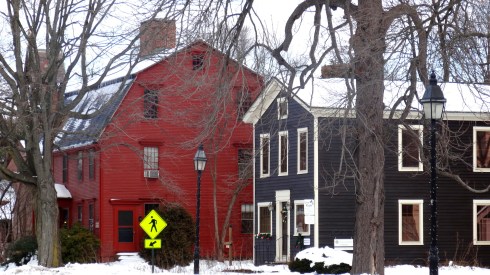
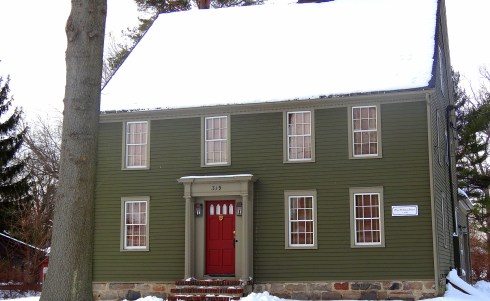
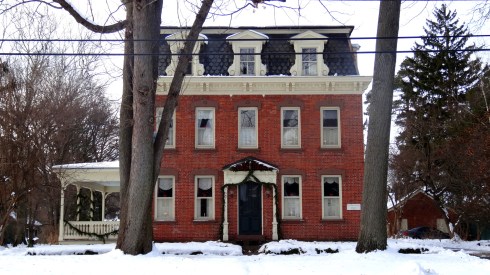
My favorite double house (besides my own, of course) is not in an urban setting or even in Salem:  it is in Byfield, Massachusetts, on a rural country road.  I don’t know anything about its construction, but the fact it is built in the midst of isolated farm/marshland leads me to believe there was a family connection; I can’t imagine strangers living side by side but maybe its dwellers were looking for close comfort.  On the day before the big snowstorm a couple of weeks ago, I was up in that part of Essex County, so I took some pictures of the Byfield house and some other double houses in nearby Newburyport, Newbury and Essex.

Double House Newbury

Double House Newburyport

Double House Newburyport entrance

Double House Historic New England

Double House Blue Anchor Tavern Newbury MA HABS 1940 bw

Double House Ipswich

Double House on the Marsh, Byfield, Massachusetts, the former Newburyport Academy on High Street in Newburyport, converted into a double house in 1842; the Swett-Ilsley House (Historic New England), which began its life as a single house in 1670 and then was extended (HABS photograph from 1940, Library of Congress); a double house in Ipswich.

Double houses in Salem are for the most part more straightforward constructions, but as is the case with our house, changes to the exterior on one side or another over time distort the mirror image, but usually in a relatively graceful way. There are lots of added bay windows and rear and side additions. I’ve don’t have any interior images today, but the comparative interiors of a double house often provide an interesting lesson in architectural history; generally one side is a bit more pristine and the other a bit more “modern”. There are lots of double houses in Salem, in every area of the downtown, so I chose a chronological sampling of those in my immediate neighborhood, and I’m picturing them in chronological order, starting with the Pickering-Mack-Stone double house on Chestnut Street, which was built in 1814-15 for two Pickering brothers. The western (right-hand) half of this house is currently for sale: it has absolutely beautiful “bones”, a Federal carriage house out back, and, according to Bryant Tolles’ Architecture in Salem, Andrew Jackson was entertained there in 1833 on a presidential visit to Salem.

Double Houses Salem 1807

Double House Cousins 1890s NYPL

Frank Cousins photograph of Chestnut Street in the 1890s, New York Public Library.

Next are two great Greek Revival double houses, the Thompson-West double house, built in 1845-46 on Chestnut Street (note the entrance bay window added to the left-hand side later in the nineteenth century), and the Nancy Courtis double house, built in the following year on Federal Street. Miss Courtis was a “singlewoman” who built the house and lived on one side her entire life while leasing out the other, no doubt a convenient arrangement for her. It’s a striking house, made all the more so because of its paint scheme.

Double Houses Salem 1840s

Double House Salem 1846-47

And last but certainly not least, two Victorian double houses in the same general area.  I’m really not sure about the date of this first house, which is further along Federal Street from the Courtis house:  it looks like it was built in the 1850s or 1860s to me, but I could be wrong. I wanted to include it because of its doorways, which are not located adjacent to each other but at opposite ends of the building.  This seems a bit unusual to me, especially for a town house.  Both sides of the house have their addition wings off the side,and matching dormer windows as well. The paint color (a very dark purple with salmon-orange doors) makes this house really stand out on the street. The last house, on Hamilton Street, was built in 1890 for the Reverend James Potter Franks, long-time rector at Grace Episcopal Church around the corner, and his daughters. The gabled entrance really stands out on this house; it is clearly the result of deliberate design rather than organic evolution.

Double House Victorian Salem

Double House Salem 1890


Snowfall in Salem

We have survived a lingering nor’easter named Nemo and have about two feet of heavy snow on the ground. Given our snowless winter last year, most people seemed cheered by the sight of snow and the possibility of really embracing winter, but give it a few days and that will change:  no one likes dirty snow and people have to go about their business. Yesterday, though, everything was pristine in a virtually carless Salem and nearly everyone I talked to was in a good mood, even as they dug out. As far as I know, most people have their power, and two snowplow fires and one trapped horse were the only emergencies confronting the Fire Department. I took several walks (such a pleasure with no cars!!), one in the morning when it was still snowing and one later in the afternoon when it was definitely clearing up, and took photographs on Chestnut, Essex, and Federal Streets. This morning dawned bright and sunny, perfect for more digging out, sledding and snowshoeing.

Snow 057

Chestnut Street Snow 2012@streetsofsalem

Snow 2 006

Snow 066

Snow 2 014

The Dean-Sprague-Stearns House, c. 1706, on Essex Street;  also known as the “East India House”.

Snow 2 054

Snow 2 024

Snow 2 028

A rather precarious situation on Federal Street.

Snow 2 039

Snow 2 042

No plows on this street yet.

Snow 2 059

Beautiful sunset at the end of the day.


Rumford Roasters

We live right next door to Hamilton Hall, an elegant Federal-era assembly hall attributed to Salem’s famous architect and woodcarver Samuel McIntire. I wake up every morning and look out my bedroom window at McIntire’s carved eagle and swags on the exterior, and I’ve posted about most of its interior spaces here as well.  The Hall’s grand ballroom, with its spring dance floor, Palladian windows, gilt mirrors, and musician’s balcony, always gets a lot of attention, but today I want to feature a more utilitarian room below the stairs:  the “brick hearth room” with its Rumford Roaster, the cutting-edge culinary technology of the early nineteenth century. Here it is, built into the large hearth that dominates the room, in my photographs and a doctored drawing from the very charming 1947 Hamilton Hall Cook Book (containing recipes for “Afternoon Tea Dainties”, “Shrimp Wiggle”, and many puddings).

Rumford Roaster 4

Rumford Roaster Drawing

Rumford Roaster 5

The Rumford Roaster transferred cooking from the open fire to an enclosed oven (the round opening, lined with metal inside), which was heated by the small square firebox directly below. There are openings in the sides of the oven to control the temperature, and the entire device was vented through the central chimney. The Rumford Roaster at Hamilton Hall is characteristic of the earliest examples in that it was built into the hearth (also see the roasters at the Gardner-Pingree House here in Salem and the Rundlet-May House in Portsmouth, below) but freestanding models developed a bit later. Its evolution seems to run parallel to the evolution of the American kitchen.

Rumford Roaster Gardner Pingree Salem

Rumford Roaster NE Home 2009 Geoffrey Gross photo Rundlett-May House

Rumford Roasters in the kitchens of the Gardner-Pingree House, Salem (Peabody Essex Museum) and the Rundlet-May House, Portsmouth, New Hampshire (Historic New England).

The Roaster was invented and named after Count Rumford (1753-1814), an absolutely extraordinary man whose biography reads like a (really bad) dime novel. Born plain old Benjamin Thompson in what was then the small village of Woburn, twelve miles northwest of Boston, he transformed himself into quite the continental Count through a combination of scientific genius and what can euphemistically be called “adventuring”. His biographical details can be found elsewhere (this account was good yet succinct; I think his life, work and times demand a larger volume), so I’m going to summarize as much as I can:  Thompson was apprenticed to merchants in both Salem and Boston in his adolescence, and then he obtained a position as a schoolmaster in Rumford (now Concord), New Hampshire. There he met and married a wealthy and well-connected widow about ten years his senior. Through her, he made all sorts of useful connections and became a commissioned officer in the New Hampshire militia by the mid-1770s, but it turns out that he was at best a Loyalist and at worst a spy: he fled to London in 1776, abandoning his wife and child, after accusations of  “being unfriendly to the cause of liberty”.

From a British perspective, Thompson distinguished himself in both public service and scientific experimentation during the American Revolution, serving in the British Colonial Office while simultaneously conducting experiments in ballistics and munitions: these lessons in military combustion would later be applied to more domestic mechanisms. He was knighted by King George III in 1784, but somehow was at the same time under suspicion of spying for the French !!! and so made his way to the Continent and wound up in the service of one of the most powerful German princes, Karl Theodor, PrinceElector, Count Palatine and Duke of Bavaria. He remained in Bavaria for over a decade, working on such diverse projects as poorhouse reform and urban planning (including the creation of the Englischer Garten in Munich) while continuing to conduct experiments on the nature and applications of heat. In 1791, Sir Benjamin Thompson was made a Count of the Holy Roman Empire, and he chose the title “Rumford”, in reference to his New England origins. This, and the fact that he left a good part of his fortune to Harvard University to establish a Rumford professorship, indicates that there were some misgivings about betraying his native country. During the last phase of the Count’s life, there is something of a “man without a country” air about him; despite his honors there were whispers of spying (AGAIN–this time for Britain), which forced him to leave Bavaria. His last decade was spent traveling back and forth between England and France, where he died in 1814, “the spy who conquered the cold”.

Rumford Portrait 1801

Gillray Scientific Researches BM

Count Rumford was certainly a household name by 1800, inspiring both portraits and caricatures. Above, a mezzotint portrait by John Raphael Smith (1801) and a caricature which is poking fun at Rumford’s fashionable Royal Society lectures:  he is the man who is “producing” steam in James Gillray’s 1802 print, Scientific Researches! New Discoveries in Pneumaticks! Or, an Experimental Lecture on the Powers of Air, both British Museum.  And look at these companion satires below!

Gillray Comforts 1800

Rumpford Caricature BM

James Gillray, The Comforts of a Rumford Stove, 1800; Charles Williams, Luxury, or the Comforts of a RUMPFORD, 1801, British Museum.

Well, back to the rather less racy Rumford stove at Hamilton Hall!  A couple of more shots are below, including open views of the oven (with the arm of a helpful Hall trustee) and the ash box below. There are great records of the administration and maintenance of the Hall in the nineteenth and twentieth centuries, so we know that this Roaster was supplied by Elijah Fuller of Neptune Street in Salem; I searched through the Salem Register for references to Fuller’s shop and found the notice below, from July 1803. Rumford was clearly a recognizable name–and product–over on this side of the Atlantic as well.

Rumford Roaster at Hamilton Hall Salem

Rumford Roaster Hamilton Hall interior

Rumford Roaster Ash Box

Rumford Cooking Utensils 1803

Hamilton Hall has been the setting for countless “assemblies” over its two hundred + years, including large dinners for such dignitaries as the Marquis de Lafayette, Nathaniel Bowditch, and Martin Van Buren in the first phase of its history; I imagine that the catering of these events was greatly facilitated by the presence of Count Rumford’s Roaster.

In the Spotlight:  a photograph of Hamilton Hall taken last week, during the dawn-to-dusk production of a music video.

Hamilton Hall


Carriage Houses

I was getting a bit depressed with all the devastation and demolition of the last few posts, so I went searching for structures that have survived:  not too difficult a task in my neighborhood. The weather is odd here (for January):  quite warm, foggy, air filled with moisture but no rain or snow. Rather dreary, really, as you can tell from the photographs. On dark days like these in the midwinter the built landscape really stands out, with no natural landscape to frame or cloak it. For some reason, on my walk yesterday I was particularly noticing the outbuildings rather than the facades:  Salem has many great carriage houses, most in pretty good condition.  This is impressive to me:  it’s hard enough to preserve a big old house, but keeping an ancient ancillary building in good shape is a true commitment. We lost our carriage house long ago:  it is evident on the late nineteenth-century street atlases of Salem, but after the turn of the century, it’s gone.

I don’t have anything similar for Salem, so I want to start with an image of  the Valentine-Fuller house in Cambridge, Massachusetts:  Mr. and Mrs. Fuller are on horseback in their carriage-house courtyard, circa 1890:  this seems like the peak time for carriage houses to me.  After that, they would either come down or be preserved as storage structures or garages. This house, which was built in 1848 on Prospect Street, was demolished in 1937, along with its outbuildings (oh no, more demolition).

HABS, Library of Congress

Back in Salem, carriage houses can be found in several neighborhoods, so this is just a sampler, or part one.  On the street where I live, Chestnut Street, there are some amazing carriage houses, several of which are laid out a considerable distance from their main houses so you really don’t get the courtyard effect that you see above. On one side of the street, a completely new parallel street, Warren Street, was laid out as an access route to these buildings. The photographs below are all of Warren Street carriage houses that belong to mansions on Chestnut, but two of them appear quite capable of fulfilling an independent existence.

Carriage Houses 006

Carriage Houses 007

Carriage Houses 008

Essex Street, which was the colonial (and remains the present) main street of Salem, runs parallel to Chestnut on the other side: because of its early settlement, it features many beautiful carriage houses–primarily wooden rather than brick. In the general vicinity of the Salem Public Library, stalwart structures peak out from behind the streetscape, particularly visible at this time of year.  Behind this trio of houses–Georgian, Colonial Revival built on the site of a pulled-down Federal at the turn of the century, and Federal–are some of my favorite carriage houses on the street and in Salem.

Carriage Houses 015

And then just across the street from the library, there’s this wonderfully restored Greek Revival, with its NEW carriage house aligned perfectly with what I assume are later nineteenth-century additions, creating a nice sense of enclosure for its yard.  Just a little down the street, is a (nearly) matched pair of Federal houses dating from about 1800, both of which have great carriage houses.  As you can see, carriage-house cupolas abound on Essex Street!

Carriage Houses 013

Carriage Houses 019

Carriage Houses 021

Essex Street LOC

Essex Street, circa 1910. Detroit Publishing Company/ Library of Congress

On my way across town to the Common, I stopped to take a photograph of a very controversial Federal Street carriage house.  It appears to belong to the very stately Victorian that was converted into condominiums a few decades ago, but actually is part of an adjacent property whose owner tried to do the very same thing with his carriage house at the same time (this was all before I came to Salem, so I’m not that clear on the details).  When he did not get approval, he moved out of his Federal Court house and let it and the carriage house rot. So this is the result, 20+ years later.

Carriage Houses 024

As this is the birthday week of Salem’s famed architect Samuel McIntire, I’ve got to feature some McIntire carriage houses which, again, is not difficult to do. Everybody’s favorite McIntire house, the Gardner-Pingree house, has a charming carriage house in back which has a slightly smaller stature, in keeping with the general scale of the house.  There’s a restoration project going on there now, so I’m sorry that the pictures give a work-site impression, but you can still see how great this outbuilding is.

Carriage Houses 028

Carriage Houses 033

Just next door, another house owned by the Peabody Essex Museum features one of the most prominent carriage houses in town:  the Andrew Safford House was built after McIntire’s in 1811, but you can see his influence in both the main house and the carriage house, both of which overlook Salem Common. When it was built in 1819, this was one of the most expensive houses in America, and it remains very impressive, nearly two centuries later.

Carriage Houses 040

Safford House

Carriage Houses 037

Safford Stable 1939

The Andrew Safford House and Carriage House, yesterday and in 1910 & 1939 photographs, Library of Congress.

Finally, my very favorite Salem carriage house.  The Clifford Crowninshield House (1806) is a McIntire house located on another corner of the Salem Common, just across from the Safford house. Behind the main house, almost hidden really, is a wooden carriage house with an elegant stature and very intricate details:  every time I pass by it makes me smile.

Carriage Houses 049

Carriage Houses 043

Carriage Houses 042


End of an Era

The razing of St. Joseph’s Church in Salem began this week, with the steeple coming down on Thursday and some serious demolition ongoing yesterday. This was the parish church of the Point neighborhood of Salem, closed by the Archdiocese of Boston in 2004. Since that time, plans for its removal and/or redevelopment have divided the community. Preservationists, represented by Historic Salem, Inc., sought to save the mid-century “International Style” structure (it was built in 1949-50, finally replacing the more majestic church that was destroyed in the great fire of 1914) while others favored the affordable housing plan put forward by the Archdiocese’s development arm, the Planning Office for Urban Affairs. The two sides/goals could not be brought together, and of course affordable housing always trumps historic preservation, so the church is coming down.

St. Joseph's Church and Parish House, Salem, Mass, MA

St. Joseph's Church Salem

St. Joseph’s before the fire of 1914, and the shiny new building of the 1950s.

While I did not care for the style of St. Joseph’s, I fear that something far worse will be erected in its place. This is a very vulnerable, and prominent, location in Salem, where the once-grand boulevard of Lafayette Street meets downtown, and it has been neglected for some time. And while the exterior left me cold, the cruciform-planned interior was apparently something to behold.  I regret that I never saw it while in use:  all I have to go on now are pictures, like the one held by one of the witnesses to yesterday’s demolition.

Saint Josephs 032

Saint Josephs 030

Saint Josephs 021

Saint Josephs 026

Saint Josephs 034


Vanished Vantage Points

There’s no better way to see how a landscape, or a streetscape, changes over time than to compare images of the past and the present. I am always on the hunt for nineteenth-century photographs and drawings of Salem, before urban renewal, before the great fire of 1914, before the CAR, so I can see how these forces altered the city, for better or for worse (mostly for worse).

I’m going to ease into what is often a shocking contrast of past and present with two photographs of a section of Federal Street, taken about a century apart.  This is the street looking east from the vantage point of the Peirce-Nichols House, one of Samuel McIntire’s most important commissions, looking toward North Street and the courthouses on the other side. The new (hugely out-of-scale) courthouse (or “judicial center”), which opened up for business just last year, is mostly out of the frame of the modern picture, or the contrast would indeed be shocking. What you do see, or what I see, is the brick former Baptist church, now law library, which was moved to its present location and situated on an angle so to accommodate the curve in the road and effect a transition from residential to institutional buildings on the street. This was an absolutely brilliant idea, whoever thought of it (I know that Historic Salem, Inc. advocated for it) as the courthouse project mandated the demolition of the smaller wooden buildings you see in that location in the earlier picture:  without the in-scale angled brick building, the judicial center would have even less connection to the street.

Vantage Point Fed Street 1910

Vanished Federal Street present

Now for a comparative vantage point that is a little more jarring:  Church Street in the 1890s and today. This was an old residential street in Salem, which was also the site of the original Salem Lyceum building, which you see here (the image is from Winfield S. Nevins’ Witchcraft in Salem Village, 1892 & 1916) as well as St. Peter’s Church, the source of its name.  In between the church, the Lyceum, and the great old firehouse (fortunately still there) were rows of primarily eighteenth-century houses, now all gone. The old wooden Lyceum was built about 1831 and burned down at the turn of the century, but it was replaced by a very elegant brick structure that was long the site of the Lyceum Restaurant, now 43 Church. Despite the unfortunate designs of both the District court on the right and the office building past the Lyceum on the left, the upper (foreground) part of Church Street is aesthetically pleasing and commercially successful (the site of an organic grocery store, a wine shop, and a coffee shop in addition to 43 Church), primarily because its buildings line up with the sidewalk, just like those in the older photograph. But in the background of the modern photographs, you see the ravages of urban renewal:  a large parking lot on the right, and a faux-Federal condominium building and brutally ugly parking garage/mall on the right.

Vanished Church Street Nevins Witchcraft

vanished vantages 014

vanished vantages 016

From the vantage point of St. Peter’s Church, looking west towards the Lyceum: all those house removed to accommodate cars.

Vantage Church Street

My last group of images shows a completely obliterated street:  Norman Street, a short street that has been transformed beyond all recognition in the twentieth century. Not a shred of its built historical fabric remains, including this wonderful house, the Benjamin Cox house at 21 Norman Street (with the man standing in front of it). It is gone, along with its garden, and all of its neighbors, replaced by office buildings and a wide, wide road so that commuters might easily speed through Salem on their way to the university, or Marblehead. The historic photographs below, which date from about 1875-85, are from the Brown Family Collection of the Schlesinger Library at Harvard, and the modern photograph was taken this morning.  It’s difficult to reconcile these two settings:  I think that the Cox House was located somewhere in the vicinity of the white car (the one driving, as opposed to the one parked) in the 2013 photograph.

Vanished Cox House 21 Norman

Vanished Cox House garden

Vanished Cox House Interior

Vanished Norman Street


Salem Savior

She was not the only hero(ine) in the story, but rather in good company:  still Ada Louise Huxtable played a big role in the prevention of the complete annihilation of historic Salem by the forces of urban renewal in the 1960s. The Pulitzer-Prize-winning architectural critic for The New York Times and The Wall Street Post, often referred to as the “dean” of American architectural criticism, died yesterday at the age of 91. The dominant themes of the obituaries that I am reading this morning are Mrs. Huxtable’s influence over both architectural criticism and the architecture of New York, but she shaped the architecture of Salem as well. So here is my little parochial appreciation.

Ada Louise Huxtable in her New York apartment, 1988.  Arnold Newman/Getty Images.

Ada Louise Huxtable in her New York apartment, 1988. Arnold Newman/Getty Images

Mrs. Huxtable. who summered in nearby Marblehead, heard of the urban renewal plans for Salem and was moved to write a rather passionate piece that the Times put on its front page on October 13, 1965: “Foes Fear Plans Will Mar Old New England Heritage; Urban Renewal Plan Threatens Historic Sites in Salem, Mass.” She reported on what was going on, but definitely put her own viewpoint in the article:  By setting up “design controls” for the new construction, the city guarantees itself, at best, “instant Georgian” (apparently she detested Colonial Williamsburg!) to replace the genuine example. The spurious product is a much better economic deal than the real thing…As things stand now, it will take some potent modern witchcraft to save Salem’s historic past.  A series of follow-up articles were published in the Times from 1967 to 1974, culminating, happily, with the latter year’s “How Salem Saved itself from Urban Renewal (September 29). During this period, local preservationists were galvanized to fight the demolition of 103 buildings in the city center in the name of “urban renewal”, and the plan shifted to the redevelopment and revitalization of Essex Street, Derby Square, and Front Street. Many buildings were lost, but not as many as would have been without the advocacy and inspiration of Mrs. Huxtable, I believe.

Many years later (1993), Mrs. Huxtable was interviewed by Robert Campbell, the architectural critic of the Boston Globe, and he asked her where in New England she thought she had had the most impact.  She replied:  I think I had more impact on Salem, because Salem had a hideous urban renewal plan. I remember going over it with the then-mayor and planner, and they were going to eliminate the beautiful Japanese garden next to the museum and they were planning roads that would take away whole blocks. So I went back to New York and sold it to the Times as a Page 1 piece … and that brought whoever was on the National Advisory Council on Historic Preservation in Washington to Salem. “What are you doing here?” That resulted in the change of planners and the total change in the plan.

Urban Renewal 015

Urban Renewal 018

Essex Street today:  a road does NOT run through the Japanese garden of the Peabody Essex Museum, but unfortunately the Brutalist parking garage with its first-floor shops did replace earlier commercial buildings.

Urban Renewal 020

Urban Renewal 009

Front Street, revitalized not destroyed, a far more successful shopping district than the nearby Essex Street pedestrian mall, and the Ash Street house (built in 1811) of another preservation heroine, Bessie Munroe.  She fought urban renewal in the 1960s while she was in her 80s! Unfortunately the house now looks over a parking lot, and a very ugly modern building built on the site of jail where the accused witches were held in 1692.


Old Wethersfield

Whenever I’m heading home from New Jersey or New York or points south, I always like to stop in at Old Wethersfield, Connecticut:  it’s a beautiful village just off the highway and just outside Hartford:  a convenient respite for a weary traveler. Old Wethersfield is a National Register Historic District, comprising 100+ houses from the seventeenth, eighteenth and nineteenth centuries situated along a main thoroughfare and a slender rectangular green, which is part of the larger town of Wethersfield. I had two restless guys with me yesterday but they still let me stop for a bit, to take pictures of some of my favorite houses and briefly run into Comstock, Ferre & Company, which has been selling heirloom seeds for two centuries. Wethersfield is known not only for its colonial architecture, but also for its venerable seed companies, including Comstock and the Charles C. Hart Seed Co. in the present and a whole host of provisioners in the past. The most profitable product of these companies, a red “Wethersfield Onion”, even gave the old town the nickname “Oniontown” for a while. I am also compelled to mention Wethersfield’s fascinating/notorious founder, John Oldham, who was exiled from the Plymouth Colony for “plotting against pilgrim rule” and went on to establish settlements in Hull, Gloucester, and Watertown, Massachusetts, and eventually Wethersfield, the first English settlement in Connecticut. (Oldham seems to have rubbed shoulders with Salem’s founder, Roger Conant, on more than one occasion). Travel and Leisure magazine just designated Old Wethersfield one of America’s “prettiest winter towns”, and it certainly appeared so yesterday afternoon with snow lining the brick sidewalks and artfully draped on the colorful colonial houses.

Just a small sampling of Old Wethersfield, New Year’s Day 2013:

Wethersfield 052

Wethersfield 046

Wethersfield 044

Wethersfield 045

The plaques and signs refer to the house above, as in the case of one of Old Wethersfield’s most famous houses, the Webb House, pictured below with its neighbors.

Wethersfield 080

Wethersfield Webb House 083

Wethersfield 084

Wethersfield 074

Wethersfield 077

Wethersfield 076

Wethersfield 086

More!!! And as you can see, there are “newer” houses in Old Wethersfield too.

Wethersfield 091

Wethersfield 092

Wethersfield 056

Wethersfield 053

Wethersfield 060

Wethersfield 090

The Comstock building, obviously a livelier place in the summer but still very much open, and an 1899 seed catalog cover featuring the Wethersfield Onion, the “greatest onion on earth”,  from the Smithsonian Institution Libraries’ Collection.

Wethersfield 049

Wethersfield Onion Smithsonian


New Year’s in New Jersey

This post is going to be a study in contrasts. We’re on the northern New Jersey shore visiting my husband’s family, hearing storm stories and seeing lots of storm damage. Superstorm Sandy is very much in evidence, two months after its arrival. Some areas in this region emerged relatively unscathed, while others were hit hard:  two cases in point are Allenhurst, where my husband’s family home is located, and Sea Bright, where our niece lives. These boroughs are located just a few miles from each other on the shore, but their present environments could not be more different.

shore 003

Crossing over into New  Jersey on the George Washington Bridge on a stormy day.

Allenburst is a wealthy little enclave right next to the storied Asbury Park. The train to New York runs right through its little village center, offering wealthy urban dwellers an escape from the sweltering city a century ago and a relatively easy commute now. In some ways Allenhurst reminds me of my hometown, York Harbor, Maine, which also developed as a summer community, but there are notable differences:  the village is laid out in a grid pattern, the architecture is on steroids, and of course, this being the Jersey shore, there is a boardwalk.  The cabanas of the Allenhurst beach club (they build these private clubs right on the beach here; I don’t really understand how that can happen on a supposedly-public beach, but there it is) were washed away by Sandy, and a little section of its boardwalk, but I couldn’t find much more serious damage in evidence. The houses of Allenhurst, are stately: grand Victorians, Tudors, lots of Spanish-styled, tiled-roofed mansions from the teens and twenties. From my New England perspective, I notice an absence of the simple Shingle style, and the presence of lots and lots of stucco. I am sparing you the huge tacky modern houses that have been built right on the ocean; the more charming houses are on the side streets of Allenhurst.

shore 048

shore 046

shore 033

shore 030

shore 038

shore 036

shore 068

Shots of Allenburst:  an oceanside mansion and  “smaller” houses along the side streets, one closed-off street section, pink iron deer!

Traveling up the coast to Sea Bright through Long Branch I stopped by the Church of the Presidents, which is undergoing a major renovation. Seven Gilded Age presidents, Ulysses Grant, Rutherford B. Hayes, James Garfield, Chester Arthur, Benjamin Harrison, William McKinley and Woodrow Wilson, vacationed in this area and attended this church; James Garfield died just across the way after several months of suffering after he was shot in the early summer of 1881.

shore 129

You can see piles of wood and sand and boarded-up houses along this road, although major development has occurred in this area and the large multi-story buildings (which have wiped out any trace of those associated with the seven presidents) look like they could withstand any storm, but maybe not.

shore 070

shore 075

shore 077

shore 080

shore 081

Among the melee, these column sections certainly give one a “fall of the Roman Empire” feeling–not quite sure where they came from.

And then to Sea Bright, a barrier beach town that was really devastated and remains so. Displaced residents, boarded-up storefronts, condemned buildings, and what many say is an unrecognizable beach constitute the aftermath of Sandy, but also a very vibrant spirit focused on recovery. The municipal government seems very responsive, there’s been all forms of outside help, and an organization called Sea Bright Rising seems poised to will that to happen in the New Year.

shore 115

shore 106

shore 104

shore 090

shore 108

shore 097

shore 101

shore 122

shore 113

shore 111

Sea Bright, New Jersey, two months after Sandy: the pictures speak for themselves except for the last one, which is of an island in the Shrewsbury River behind the borough, where all the boats from a nearby mainland marina ended up.


Christmas with Barbara

I love classic films, so naturally my favorite television channel is Turner Classic Movies:  I often have it on in the background when I’m home, as you never know what–or who–might turn up!  This month, I have to admit that it’s been on even more than usual, as December’s “Star of the Month” is Barbara Stanwyck, my very favorite movie star.  No one comes close to Barbara in her ability to fill the screen and capture her audience’s attention, in my opinion; certainly no actor or actress in the present (a time when movie stars seem much smaller), and perhaps only Cary Grant and Bette Davis in the past. I love everything about Barbara:  her toughness and her vulnerability, her flexibility, her stature, her walk, her ability to sit a horse, her little cropped jackets, her obvious professionalism. There is a sense of inner “simmering” in her that I find captivating, and I think she chose her roles very well. I find even her early 1930s movies–in which she seems to be playing the same downtrodden character again and again–watchable, but she really comes into her own in the 1940s, when she became the highest paid woman in America.

Barbara 1940s

Miss Stanwyck at the height of her power and popularity, Billy Rose Theater Collection, New York Public Library Digital Collection.

Two of my favorite Stanwyck films happen to be Christmas movies: Remember the Night (1940) and Christmas in Connecticut (1945). For as long as I can remember, I have generally watched both at least once during the holiday season, but this particular month I seem to be watching them again and again, so many times that I almost feel like I’m having Christmas with Barbara!

Remember-the-Night-321473cd

Christmas-in-Connecticut-d4c67732

I think most people have heard of or seen Christmas in Connecticut, and it is certainly a wonderful film with a charming Barbara (and a great supporting cast), but she is even more endearing in Remember the Night.  This movie, the first of what I think were three pairings with Fred MacMurray, shows the actress in transition from her 1930s vulnerability to her 1940s confidence:  she is both sad and funny, tough and vulnerable, skittish and resolute. MacMurray plays a New York City Assistant District Attorney who prosecutes Stanwyck’s shoplifter character in a Christmas Eve trial:  when he realizes 1) that the joyful jury will let her off in a collective display of Christmas spirit; and 2) that she is a fellow Hoosier, he postpones the trial until the New Year, bails her out of jail, and offers to drive her home to Indiana for the holidays as he is heading home himself (you have to suspend some  judgement here). On the way west, back to the country, they have various escapades and encounters that bring them closer together. One of the most poignant scenes in the film is when they arrive at her childhood home and face her dreadful mother; Fred will not let her stay there and he whisks her away to his own mother, the polar-opposite perfect mom, played, of course, by Beulah Bondi, Mrs. Bailey from It’s a Wonderful Life!  On the farm, they celebrate Christmas the old-fashioned way and fall in love, always knowing that they’re going to have to go back to the big city, and the big trial, after the holidays. And they do: neither compromises their principles or their admiration for one another and so the “resolution” of the film provides a nice contrast to more predictable Christmas fare, including Christmas in Connecticut.

rememberthenight_1940_bts_01_1200_100820090459

Barbara Stanwyck and Fred MacMurray look over their scripts with director Mitchell Leisen in this behind-the-scenes shot, TCM Archives.

Actually, as I write this, I am realizing that there is a major similarity between Remember the Night and Christmas in Connecticut:  in both films a very urban Barbara has got to go to the country and experience an “old-fashioned” Christmas (complete with country dances in both films) in order to find herself. In Christmas, Barbara plays a Martha Stewart-like character named Elizabeth Lane who writes a monthly column about her bucolic married life in Connecticut, including elaborate menus for perfect home-cooked meals. The problem, which doesn’t become a problem until her publisher (Sydney Greenstreet) forces her to entertain a war hero named Jefferson Jones (Dennis Morgan) for the holidays, is that Elizabeth Lane is actually a single “career woman” who lives in a New York City apartment and relies on local restauranteur Felix Bassenak (a perfect S.Z. Sakall) for both her daily sustenance and recipes for her column. She cooks up a scheme with her editor, Felix, and her long-suffering architect beau (Reginald Gardner), whom she promises to marry in exchange for his perfect Connecticut country house, which becomes the setting for their deception. The house is so perfect, with its vaulted ceilings, picture window, and huge stone fireplace, that it is almost a character in the film. In crystalline Connecticut, many situations ensue, involving babies, a cow named Mecushla (there’s a big cow scene in Remember the Night as well), flapjacks, a horse-drawn sleigh, and rocking chairs, and in the midst of all this Elizabeth/Barbara and her war hero fall in love. It is 1945, it is Christmas, and all is well.

barbara 036

barbara 043

barbara 060

Barbara in my bedroom:  facing her architect fiancé (“when you’re kissing me, don’t talk about plumbing”), facing the war hero seconds later, and in her perfect little cropped Christmas jacket.