
Sorry I’m a little late with this Presidents Day post, but I woke up this morning with an earnest desire to take a walk around Salem, an urge I haven’t felt for quite some time. And since it was Presidents Day, I had a walking theme, which is always nice. We had a lovely weekend in New Hampshire with old friends and a equally lovely dinner with my brother and brother-in-law when we returned last night, and I woke up feeling happy and finally rested from finishing THE BOOK. So off I went in search of presidential places on this sunny but chilly day. This is a little breezy, I certainly didn’t do any research, so feel free to make corrections and/or additions. I’ve plotted my tour on a 1915 “New Map of Salem for the for Motorists and Tourists” from the Library of Congress, and most of the tour stops (marked with stars) are standing today: one had yet to be built (the Hawthorne Hotel) and another (the Ruck House, marked by a special star) was torn down to make way for the new Post Office in the 1920s, along with 50+ other old structures in the vicinity.

I always start my walking tours at Hamilton Hall on lower Chestnut Street because I live right next door. So many things happened at the Hall, however, that it is not only a convenient place but also a logical place to start a Salem history tour. Quite a few presidents have visited the Hall, John Quincy Adams, Martin van Buren, and Theodore Roosevelt for certain. The latter came up to Salem from Harvard for debutante assemblies in the later 1870s, and I think he might have even met his first wife, Alice Lee, there, as several letters in the Pusey Library refer to their courtship amidst the assemblies. Then Vice-President Van Buren reportedly referred to Chestnut Street as “the most beautiful street I have ever seen” at an 1817 reception though this oft-quoted opinion has been attributed to others.


Keep walking up Chestnut and cross over to Essex on Flint, then walk eastward towards Grace Church, our second stop. President William Howard Taft, who maintained “Summer White Houses” over in Beverly for several seasons, attended services here occasionally from 1909-1912. Like several other presidents, Taft also visited the Peabody Museum and the Essex Institute and spoke at the Salem Armory, and an endorsement from Mrs. Taft indicates that he was a big fan of the chocolates at the Moustakis Brothers’ “Palace of the Sweets” at 220 Essex Street (although I’m pretty sure he didn’t shop for them there himself.) Continue walking eastward on Essex and cross over to Federal Street at Monroe, after passing the Cabot-Low-Endicott house on the right: I really think President Grover Cleveland visited his first Secretary of War, William Crowninshield Endicottt, there but I can’t find the documentation.


On Federal, we’re just going to head west for a bit until we come to the Peabody Essex Museum’s Assembly House, where President George Washington was wined and dined at a reception during his big trip to Salem in October of 1789–he stayed at the Joshua Ward House on the street that would be renamed in his honor after this visit, now The Merchant Hotel. Then it’s a long walk towards downtown along Federal Street to Washington and the Tabernacle Church, where Calvin Coolidge attended services while maintaining his Summer White House in Swampscott in the 1920s. Then we walk down to Town House Square where several presidents traversed and campaigned, including Ulysses S. Grant, Chester Arthur, and Theodore Roosevelt.


President and Mrs. Coolidge attending services at the Tabernacle Church, Salem, on July 4, 1925, Special Collections and University Archives, University of Massachusetts Amherst Libraries.

Walk down Essex Street to the East India Marine Hall of the Peabody Essex Museum, which was visited by a succession of presidents from John Quincy Adams to Taft and Coolidge. The Salem Armory (or what’s left of it) also hosted several presidential receptions. It’s difficult to orient yourself historically on Essex Street as so much is new, but Thomas Jefferson (1784), James Monroe (1817), and Andrew Jackson (1833) all visited famous dwellings in this vicinity. Jackson was not popular, and he did not attend a special “handsome and good dinner including mock turtle soup” for 150 attendees on June 26 prepared by famed Hamilton Hall caterer John Remond, pleading illness. His great opponent, the former president John Quincy Adams, later expressed his doubts about Jackson’s debility, which he called “politic,” at best.


Make your way over to Salem Common by the Hawthorne Hotel, from which President George H.W. Bush WALKED down Hawthorne Boulevard and Lafayette Streets for his speech at Salem State College (now University) in May of 1994. I’m not sure whether or not his fellow presidential speakers in the famed series, Presidents Ford, Carter, and Clinton, stayed or were “received” at the Hotel, but they were certainly in Salem!

On the Common, head for the northeast corner and the Washington Arch, recently restored by the Salem Common Neighborhood Association. (unfortunately the attendant sign is incorrect: while Salem’s privateering record is impressive, the port did not account for half of the estimated 1800 captured British vessels during the Revolution. This kind of sloppiness is unfortunately all too common with Salem’s historical signage). From the arch you can look at two “presidential” houses at either side of this corner, the former Silsbee house (now beautiful condos!) and the Joseph Story house, both of which served as venues for the reception of President James Monroe in the summer of 1817. From this vantage point, I can also imagine President James K. Polk’s entourage speeding down Winter Street towards Beverly in 1847.


Walk south towards Salem Harbor and Derby Street, where you will find the stately Brookhouse Home for Aged Women right next to the Custom House. It was built for Benjamin Crowninshield, who was a US representative and Secretary of the Navy under both Presidents Madison and Monroe, and the latter stayed her during his 1817 visit to Salem. From there its a pretty straight shot along Derby, Charter and Front Streets to the Joshua Ward House/Merchant, where President Washington stayed in October of 1789. A friend of ours restored the building (very meticulously!) and so as soon as it was open for business, we booked the very room in which Washington slept, which was quite a thrill! From the Merchant you can look out to where the Ruck house once stood, now occupied by the Salem Post Office. This was the home of Abigail Adams’ sister and brother-in-law so often visited by the Adamses in his pre-presidential years. The two wonderful pastel portraits of Abigail and John by Salem artist Benjamin Blyth were no doubt a product of their familiarity with this house and Salem.


Abigail and John Adams by Benjamin Blyth, c. 1766, Massachusetts Historical Society.

 Joseph Howard, watercolor of the Essex, after 1799, Peabody Essex Museum.
 Maps from Philip Chadwick Foster Smith’s The Frigate Essex Papers.


 Plans and photos of the Ezekiel Hersey Derby House, Phillips Library, Peabody Essex Museum; the Derby Room at the Philadelphia Museum of Art.








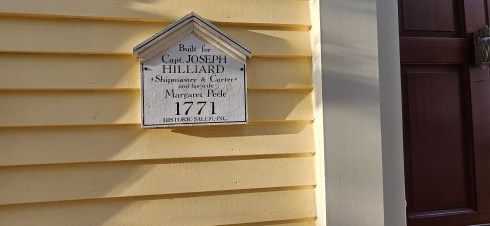


 Building in 1779-1780: now that’s confidence. Elias Hasket and Derby began construction on Salem’s Maritime’s




 How and when my Salem house was built.


 First up in my neighborhood, I wanted to showcase these two houses whose owners have invested in a lot of work! Kudos to them! Both are on Chestnut. As you can see, the first house has a way to go, but its very impressive entrance was just re-attached. It’s such a great house, with an amazing garden. Nathaniel Hawthorne lived briefly in the blue house. A rare Salem front garden on Essex—and this house has been thoroughly renovated as well. Besides the Witch House and the House of the Seven Gables, the only historic house that Salem tourists seem interested in these days is the Ropes House, because it was featured in Hocus Pocus of course. The Ropes Garden is consequently very crowded in the fall, but I caught it during a relatively calm time: more ropes in the Ropes Garden than ever before. This gate on Federal Court started off my iron hunt–I’m obsessed with it.


 Downtown is quite a vibrant shopping scene with more than occasional bones and bats, and porta-potties, of course. There are some very well curated shops amidst the general kitsch, particularly
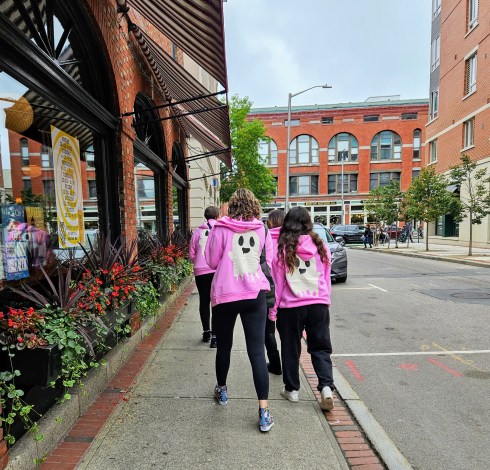


 Ghosts might trump witches this year eveywhere but Salem, of course. The ironwork at the Peabody Essex’s Gardner-Pingree House (which is never open) is simply astounding! A very busy Common, as the annual Food Truck Festival was underway, but once you get into the realm of Salem Maritime along Derby Street, not so busy. I still haven’t been in the Derby House even though it has been open this summer. The last photo just above is to remind me that I want to plant that particular variety of clematis next year!
 I finished up my walk on Charter Street, where the Witch Trial Memorial and Burying Ground is located. As soon as I entered the latter, I was confronted by these strange mannequins, propped up right against the Cemetery’s gate and stones! So Salem: the juxtaposition of the sacred and the tacky, remembrance and exploitation, enduring and ephemeral.

 Phillips Library PHA 67 & 151.
 Chestnut, Summer & Norman Streets from two perspectives. I’ll never get over how wonderful Norman Street was!


 Riding and looking north on Summer Street, and then south (Samuel McIntire’s house is on the extreme left of the last photograph).
 Broad Street, looking west.
 Cambridge Street, looking north and south.
 Work on Bott’s Court.
 Hamilton Street, looking north.


 Chestnut Street Houses—what’s going on with that figure at the third-floor level of the third photo above, which I think is #26?
 Warren Street, looking towards the “Turnpike” (Highland Avenue).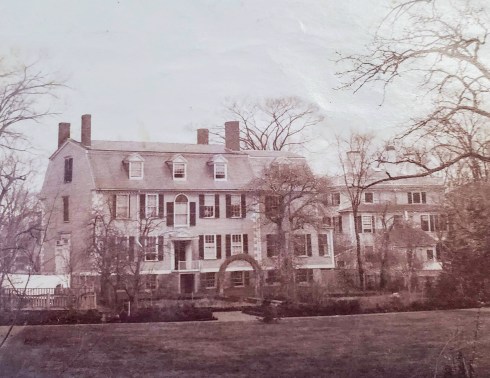


 This doesn’t line up perfectly, but what a great restoration +addition by Salem architect Oscar Padjen: very representative of the creativity of “Plan B”!






