Tag Archives: Architecture

Hallowed House

There have been several Salem houses—houses that are no longer standing—that have haunted me; I get almost desperate to find out as much as I possibly can about them and if and when I do I’m done. If they remain inscrutable, they remain with me. There is one house that I’ve been thinking about for years: I’ve learned quite a bit about it but not enough: I’m not sure I’ll ever learn everything I want to know (at least not now, while I can’t get into the Phillips Library!). I’m posting on this house today just so I can stop thinking about it for a while.

The house in question is (was) the Colonel Benjamin Pickman house, built in either 1740 or 1750 or sometime in the decade between depending on the source, right on Essex Street, adjacent to where the Peabody Essex Museum’s East India Marine Hall now stands. Its former site was the Museum’s Japanese garden, recently transformed into a construction site–which is why I’ve been thinking about the Pickman House: have the workers found any material remains? Or does it just survive on paper–and in pieces? This is a house that was famous in its day, and well after. It was designed by an English architect–previously unknown but possibly identified as Peter Harrison, who also possibly designed the Cabot-Low-Endicott House further along Essex Street and the “King” Hooper Mansion in Marblehead. Whoever the architect or builder was, all agree that it was the client, the Colonel himself, who had carved and gilded codfish affixed to every riser of the house’s central stairway in acknowledgement of the source of his wealth and position, thus inspiring that perfect phrase, “Codfish Aristocracy”. Its elegant furnishing were much commented upon by contemporary observers and diarists, as was its rusticated wooden siding, meant to mimic stone. There’s a long list of prominent diners at the house, including Alexander Hamilton: on June 20, 1800. The house was successively celebrated, lithographed, photographed, obscured, picked-apart, measured and drawn, and ultimately demolished in 1940 or 1941.

Pickman Lithograph Boston Athenaeum

Pickman collage

Pickman Cod

Benjamin Pickman Doorway Cousins

All representations of the Pickman House are based on the c. 1830 lithograph published by Pendleton’s Lithography which shows the house in its pristine eighteenth-century state (courtesy Boston Athenaeum); an amped-up Pickman codfish from Mark Kurlansky’s Cod: a Biography of the Fish that Changed the World; A Frank Cousins photograph of the enclosed doorway which Samuel McIntire added to the house c. 1800. 

We can’t see this famous house for most of its life, which only adds to its air of mystery (and vulnerability). Charles Webber and Winfield Nevins, the authors of Old Naumkeag: An Historical Sketch of the City of Salem and the Towns of  Marblehead, Peabody, Beverly, Danvers, Wenham, Manchester, Topsfield and Middleton (1877) inform us that a certain “Mrs. LeMasters” constructed several low shop buildings in front of the house in the 1870s, and so we only see dormer windows peaking out from above in all the late nineteenth and early twentieth-century views of Essex Street and the East India Marine Hall.  The Pickman family had moved west–into the residential McIntire District–away from the increasingly-busy downtown. A correspondent from the Philadelphia Inquirer who visited Salem in September of 1918 to see all the old storied mansions noted that the charming old house next to to the Peabody Museum has been all but obliterated by the shop front built out over its first and second stories…the gambrel roof, with its picturesque dormer windows, may still be seen overlooking the horrid shops, but all the inside fixtures have been destroyed. Progress is painful!

Pickman 1912

Pickman PEM PC

Pickman 1920s

20170924_180714

You can see the Pickman House dormer windows peaking out from above the storefront on the right of the two postcards and just above the P&Q shop, c. 1920s. These images were sourced for me from the Salem State Archives and Special Collections by Jen Ratliff–thanks! The house is completely invisible in the street- view photograph above from the late 1800s and the Phillips Library–it’s just behind the shops on the left, beginning with the “Importers of Crockery” storefront.

We do get to see the the unobstructed house (or what’s left of it), as a team of architects and photographers from the Historic American Building Survey went in to document it on the eve of its demolition–no doubt inspired by a succession of architects who had made the pilgrimage to Salem to measure and sketch this house, beginning with Arthur Little in 1877. As you can see, the storefronts didn’t just obstruct the house, they cut into it on the first and second stories. From that point on it must have been open season for house parts: an archway and a golden cod went to the Essex Institute, and all the other codfish went to a Pickman descendant’s Newport mansion: I think this one (where there is also a reproduction McIntire summer house) but I’m not certain.

pickman-house-parlor-arthur-little-early-new-england-interiors

Pickman House

Pickman HABS 1

Pickman HABS 2

Pickman HABS 3

Pickman HABS 4

Arthur Little sketch of the Pickman House parlor, Early New England Interiors (1878); William Martin Aiken sketch of Pickman architectural elements, 1883, Lowcountry Digital Archive; HABS MA-332 photographs and drawing, Library of Congress.

I’m not just interested in wood or architecture; I’m also interested in Colonel Pickman–but he remains pretty inscrutable too. Ultimately the only way to get to know him is through material remnants (like the silver he left to the First Church) or his family: his son Benjamin Pickman Jr. (whom I’ve written about here and here), was a Loyalist who left Salem during the Revolution but managed to easily assimilate into its social and political society upon his return–hence the dinner with Hamilton at the house! The more patriotic Colonel had died in 1773, so he doesn’t figure very prominently in the edited volume of his son’s diary and letters published in 1928. There is a beautiful portrait of the elder Benjamin by John Greenwood in the collection of the Peabody Essex Museum, but I’ve never seen it on display–nor the fluted archway and golden cod that is all that is left in Salem of the beautiful house that was once next door.

Benjamin PIckman collage

Colonel Benjamin Pickman of Salem, 1708-73.


New Condos in Old Ipswich

Shameless promotion of husband’s work follows. Ipswich is my second-favorite Essex County town, so I was thrilled when my husband got the contract to convert its former town hall into condominiums. The project was long and complicated but is now completed: I accompanied him to the open house last week to take some photographs, but in all honesty I’ll seize any opportunity to go to Ipswich, whose inventory of First Period and later antique homes is without parallel. The District Condominiums provide quite a contrast to this material heritage in terms of interiors, but the exterior restoration of the building is faithful to its second incarnation. It began its life as a (one-story) Unitarian Church in 1833, was considerably enlarged in 1876 when it was transformed into the town hall, and underwent a series of additional alterations during its service as administrative offices and a district court before it was sold by the town in 2004. There were hopes for a theater conversion, but eventually condominiums emerged as the only option for its preservation (visit the wonderful blog Historic Ipswich for a far more detailed history and lots of photographs). While the building has long presented a dignified silhouette along South Main Street, it has been vacant for a decade, so I hope residents are happy with the new residences. The building is on the National Register and the local historical commission holds a preservation restriction, so there were considerable constraints governing the construction process, most notably windows. As you can see, there were two windows added to the front facade, and smaller ones in the back and sides, but all the other windows had to be incorporated into the interior design, in one way or another.

Ipswich

Ipswich town hall 1930s

Ipswich 4

Ipswich 8

Ipswich 9

Ipswich 29

Ipswich 5

Ipswich2

Ipswich 16

Ipswich 3

Ipswich 11

Ipswich Museum

Ipswich 15

The former Ipswich Town Hall/District Court (today and in the early 20th century) transformed into condominiums–across the green, the Ipswich Museum @ the Heard House, c. 1800; and just a few steps away, the Ipswich River. 


White Album NH

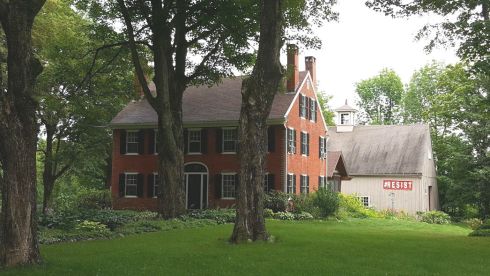
While the storm was churning down south, and politicking-before-the-primary was happening in Salem, we escaped north to New Hampshire for the weekend, where I “shopped” for a vacation house and my husband decidedly did not. He humored me, however, and let me stop at every single house that caught my eye to take a photograph, probably because none of these houses was actually for sale. When I scrolled through these photographs last night I realized that each and every one of these houses was white, including the Quaker meetinghouse we found after crossing a covered bridge (about the only image that’s going to break up the non-palette below) and the Shaker meetinghouse we stopped at on our way home. We spent Saturday night at the Highland House in Tamworth, which was built in the 1790s by a Salem mariner, merchant and tanner named George Dodge (1750-1821), who was clearly trying to escape busy Salem too! He was lured back to the city by his father’s will in 1808: the elder Captain George Dodge left his son a considerable fortune of $282,000 plus the responsibility of running his various businesses in Salem. I’m not sure George Jr. made it back to New Hampshire for any extended length of time, and when he died in 1821 he left his “considerable” Tamworth properties to the First Congregational Society.

White NH

White Interior

White Latch

Highland House on a misty (frosty?) Sunday morning, and a few interior details…..below: its neighbors, and a bit further afield in the foothills of the White Mountains.

White NH 3

White NH flowers

White NH2

White NH Hill House

White NH Chartreuse

White NH mountain

White NH Bridge

White NH hill house 2

White NH perfection 2

Charming Wonalancet Union Chapel below…Friends’ Meeting House in Sandwich and Shaker Meeting House at Canterbury Shaker Village, where we stopped on the way home. I do believe that I’ll be dreaming of this last hilltop house, with its eyebrow windows, until my dying day!

White NH Church

White Collage

White NH perfection


Among the Cathedrals

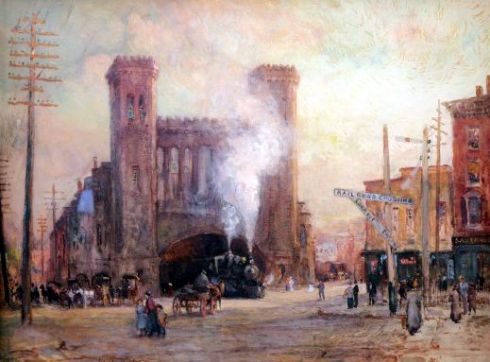
I’m always looking for artistic impressions of Salem’s long-lost train depot (1847-1955), so was thrilled to come across a painting by the Philadelphia-born artist Colin Campbell Cooper the other day. Campbell is universally characterized as an Impressionist, but he seems to have been fascinated by structure, as there are many cathedrals, skyscrapers, and train stations (the cathedrals of their day?) among his works: you can see why he was drawn to the Salem station. Here is his impression, from 1910, along with Walker Evans’ photograph from the 1930s and a street-level stereoview published by Charles Beckford: contrasting views of an imposing edifice.

Cooper Roundhouse

walker-evans-train-station

Salem Stereoview Beckford Cropped

Colin Campbell Cooper, Train Roundhouse, Salem, Massachusetts, c. 1910, Sullivan Goss Gallery; Walker Evans, Boston and Maine Train Station, c. 1931, ©Walker Evans Archive, Metropolitan Museum of Art; Charles A. Beckford, American Views series, n.d.

Cooper had a vibrant and varied artistic life. He was born in Philadelphia in 1856, and after his artistic education at the Philadelphia Academy of Arts (with Thomas Eakins) he was off: to New York, to Europe, to Asia, and eventually to California. While in the Netherlands in 1897, he met and married his first wife, Emma Lambert, who was also a promising and increasingly-prominent artist. They traveled extensively together: one dramatic voyage had them assisting in the rescue of Titanic survivors while aboard the RMS Carpathia en route to Gibraltar in the spring of 1912. Prior to this adventure they came to Salem together–perhaps they were visiting Frank Benson, or Philip Little, or maybe Ross Turner? I can’t discern the details, but three paintings bear witness to their time here in 1910-1911: Colin’s Train Roundhouse and Salem Mansion (alternatively titled A Salem Residence), for which he won the Beal Prize in 1911, and Emma’s Fruit Stand, Salem, Massachusetts.

Cooper Mansion

Cooper Market

Colin Campbell Cooper, A Salem Mansion, 1910, The International Studio, Volume 45; Emma Lampert Cooper, Fruit Stand Salem Massachusetts, Cottone Auctions.

After Emma’s death in 1920, Cooper relocated to California, where he became Dean of the Santa Barbara School for the Arts, and eventually remarried. He kept his studio in New York City, but California terraces began to replace the skyscrapers….and he became a playwright! He died in 1937, just a few years before the foundation of the Santa Barbara Museum of Art, for which he was an energetic advocate. Cooper’s paintings are in many American museums, and Sullivan Goss, the Santa Barbara gallery that represents his estate, is also a great resource for his life and work.

Cooper Glass Train Shed

CCC Grand Central Station MET

CCC Broadway

Cooper Beauvais Cathedral

Charles Campbell Cooper, Glass Train Shed, Philadelphia, and Grand Central Station, New York, both 1910 (the same year as his Salem paintings), Metropolitan Museum, New York; Broadway, c. 1909Biggs Museum of American Art; Beauvais Cathedral, 1926, Sullivan Goss Gallery.


Destination Tamworth

Even though I previously, and unjustly, relegated New Hampshire to the status of “drive-through” state, it doesn’t mean that I never stopped in its midst. I brake for historical markers, and I’m pretty certain that New Hampshire has more markers than all of the other New England states combined—and not just to dead white men like Mr. Webster below. All sorts of events, institutions and individuals are memorialized by green road-side Bicentennial markers: combined with the historical societies which seem to be located in nearly every New Hampshire town, they are a testament to a state that takes its history seriously. This earnest presentation is refreshing, frankly, especially when contrasted with Salem’s more cynical commercialization of just one aspect of its more varied past: history for history’s sake rather than for profit. Driving northwesterly across the state to the Lakes Region, I wanted to stop at each and every historical society, but I was pressed for time: I did stop at many markers.

NH Marker Webster

Many people are drawn to New Hampshire for its mountains and lakes, but these attractions are secondary to me: if you’ve spent any time at all on this blog you will have noticed my preference for the built landscape! So even though I had a prominent lakes/mountain destination last weekend, I became much more fixated on a town nestled between the two: Tamworth, established in 1766. Tamworth has everything: a picture-perfect town center, a pedigreed summer theater (the Barnstormers), a museum dedicated to life and work of  two country doctors (The Remick Country Doctor Museum & Farm) a presidential (Grover Cleveland) summer house, a babbling brook (the Swift River), a farm-to-table restaurant and grocer (The Lyceum), a general store (the Other Store), an amazing foundational edifice named Ordination Rock, a shiny-new distillery (Tamworth Distilling), and an inn (Highland House) built by a Salem sea captain! I’d love to have a summer house here (if I can convince my husband that it is possible to live more than a half-mile from the ocean and still be happy, a big if).

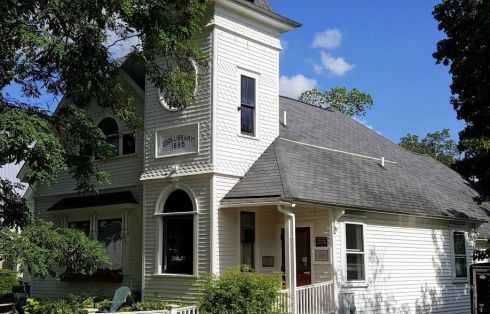
Tamworth Library

Tamworth House

Tamworth House 3

Tamworth Sign

Tamworth Barnstormers

Tamworth Poster Barnstormers

Tamworth Remick Museum

Tamworth Remick Barns

Tamworth Remick House

Tamworth Livestock

Tamworth Cow

Tamworth Brook

Tamworth Lyceum

Tamworth Poster

Tamworth Concert

Tamworth Distilling

Tamworth Brandy Sights & happenings of Tamworth: the Library, Barnstormers Theater, Remick Museum +Buildings+”Inhabitants”, Tamworth Lyceum, Sunday concert, Tamworth Distilling & Mercantile.

Given its heritage, of course Tamworth also has a historical society, recently re-christened (as you can see below) the Tamworth History Center. We found it open and bustling, with volunteers within eager to tell us about the town and the Center, which features revolving exhibits in its two ground-floor rooms: currently the early history of the Barnstormers is on, along with a very comprehensive genealogical exhibition on one of Tamworth’s prominent families. There is a dual preservation/presentation mission at present: focused continually on the town’s heritage as well as on the ongoing restoration of the Center’s c. 1830 headquarters. I enjoyed the exhibits immensely, but became a bit distracted by the untouched-for-decades attractions of the house’s central hallway! When restoration is complete, the house will not feature the traditional period rooms; instead it will serve as a forum, or center, for “the many stories that have made Tamworth unique, from 1766 onwards”. I want to hear more.

Tamworth History Center

Tamworth collage

Tamworth Exhibit

Tamworth HC

Tamworth HC2 Inside the evolving Tamworth History Center above; another visual presentation of Tamworth’s past—and present.

Tamworth PC


The Beautiful Barrett House

I’ve just returned from a brief getaway to the Granite State during which I drove all over much of its lower half (two-thirds?) but became focused on just two towns: New Ipswich and Tamworth. I don’t think I’ve ever developed a proper appreciation for this neighboring state and so I’m trying to work on that: I’ve lived in Vermont, Maine, and Massachusetts, and so New Hampshire was always just a place “in between”, to drive through rather than a destination. Growing up, my father worked at two universities on either side of the state, Dartmouth and UNH, but we lived in Vermont during the earlier period and Maine during the later–and not just over the line of either adjoining state. So I think I always wondered secretly: did my parents DISLIKE New Hampshire? During my teenaged years in southern Maine, Portsmouth, New Hampshire was our go-to town, but somehow I always disassociated it with the rest of the state, as if it was an island. It is not. This particular weekend I was headed up to see a friend in the Lakes Region but decided to take a detour to the southwestern part of the state so I could see a Historic New England house that I’d never visited before: the Barrett House in New Ipswich. Amazing: a high Federal house in a very unlikely place—or is it? New Hampshire is full of perfect white two-story federals, but the Barrett House is something more grand: Portsmouth-like, or even (dare I say it) Salem-like. What’s it doing in sleepy New Ipswich?

Barrett House

Barrett House exterior

Barrett House placque

Well of course New Ipswich was not sleepy when pioneering textile manufacturer Charles Barrett built this grand house as a wedding gift for his son Charles Jr. and daughter-in-law Martha Minot, whose father promised to furnish the house in a manner complementing its (then) cutting-edge style. Across the field in front was the textile mill, down the road was the (Third) New Hampshire Turnpike, connecting Vermont and Massachusetts. After New Ipswich chose not to accept a railroad stop several decades later, its manufacturing era came to an end but an impressive architectural legacy remained, including the 1817 “Appleton Manor” which is now for sale. Successive generations of the Barretts owned and occupied the house into the twentieth century, also their Boston businesses determined that it became more of a country retreat than a primary residence. This evolution echoes that of several houses in central New Ipswich, contributing to the preservation of its architectural landscape. Historic New England’s predecessor, the Society for the Preservation of New England Antiquities (SPNEA), acquired both the Barrett House and its neighboring George Barrett Sr. house in 1948.

Barrett House 1904

BarrettsThe house in 1904, Cambridge Historical Society; Barretts remain on the walls.

Like all of Historic New England’s properties, the house is interpreted in a very personal way, utilizing extensive family furnishings: Barrett Mill-made linens, Barrett-bound books, portraits, furniture, all manner of accessories. All of this creates a feeling of intimacy, as does the smallish scale of the rooms–I found the rather imposing exterior of this house to be somewhat deceptive. It’s perfectly open and light (look at all of those 12 over 12 windows!) and square and Federal: no Victorian additions or “improvements”, and only a bit of stuffy Victorian decor in a back parlor. Even the third-floor ballroom, which extends over the width of the house, retains an aura of intimacy: sparsely furnished with family chairs of different eras, gathered in a circle for conversation and company.

First Floor: front parlor and dining room (with Zuber et Cie wallpaper!). I particularly loved the Chinese Export dishes, which did not belong to the Barretts. The back parlor is a bit more of a mix, befitting a family room.

Barrett Parlor

Barrett downstairs

Barrett DR

Barrett Mantle

Barrett China

Barrett downstairs 2

Barrett books


Second Floor Bedrooms: back and front.

Barrett Bedroom 3

Barrett dining room

Barrett Linens

Barrett Bedroom

Barrett bedroom2

Barrett Chair

LOVE these “peacock” chairs, and below: “furnishing” for an early twentieth-century bathroom, one of the few additions to the house.

Barrett Bathroom


Third-floor ballroom.

Barrett ballroom

Barrett Ballroom 2


Outbuildings: Like Salem’s Ropes Garden, the Barrett House was the setting for the 1979 Merchant-Ivory film The Europeans. Actually it was used far more extensively than the Ropes, for both interior and exterior scenes, and the Barrett’s Gothic Revival gazebo was a particularly effective backdrop. The Carriage House is full of carriages (of course), including a carriage-hearse!

Barrett House collage

Barrett Carriage House 2

Barrett Carriage House 3

Barrett Carriage House


Just a few more New Ipswich houses, for context, beginning with Charles Barrett Sr.’s house next door. There seems to be a fondness for those center projected gable entrances, perhaps inspired by the Barrett House?

Barrett House Senior

Barrett House NI

Barrett House NI2

Barrett House NI4

Barrett House brick


The Last Collector of the Custom House

The life of David Mason Little (1860-1923) began in Swampscott and ended in Boston, but most of it was led in Salem, and in the fullest way possible: he was an MIT-trained naval architect, an inventor, a photographer, a silversmith, a military officer, a historian, a bank director, a mayor, and the last Collector of the Salem Custom House. Born into the wealthy and accomplished Little family of Little’s Point, Swampscott fame, he had many, many advantages, but certainly made the most of them. He was a descendant of Revolutionary soldier and scientist Colonel David Mason, his siblings included the famous maritime artist Philip Little, who lived a few buildings down and across the way from his Chestnut Street mansion, the architect Arthur Little, and the biographer Grace Little Oliver, his wife was the granddaughter of Salem’s great philanthropist John Bertram, and his youngest son Bertram became an influential collector and the director of the Society for the Preservation of New England Antiquities (SPNEA), the forerunner of Historic New England. These bare biographical facts do not do justice to this man, who seems to have been that rare combination of civil servant and polymath.

Little Collage The Honorable David Mason Little, and a Boston Globe article dated July 17, 1904, shortly after his appointment as Salem’s last Collector of the Custom House.

Little’s service–as quartermaster of the Second Corps of Cadets and state ordinance officer during the Spanish-American War, as city councillor, school board member, and Mayor of Salem–is commendable of course, but his inventiveness and artistry are compelling, primarily because of his range of interests. Like his brothers, he traveled around Europe following his graduation and returned armed with a fascination for “instantaneous” photography (capturing movement) and new rapid dry-plate equipment designed to facilitate the technique. He tinkered with this for a bit, and designed a new camera shutter (patent # US 284645 A)) as well as a steam yacht “specially fitted for photographic work” which he took out into Salem and Marblehead harbors during regattas. The result was his pioneering portfolio of yacht photography, Instantaneous Marine Studies, published in 1883–with a cover designed by his brother Philip. Years later, after his term as Mayor of Salem was completed, Little turned to another craft: metalwork. Learning the art of silversmithing from Arts and Crafts smith George Gebelin (to whom he also became a patron), Little crafted housewares for the family home on Chestnut Street, as well as this beautiful teapot for his daughter Marguerite, two years before his death in 1923.

Little Collage2

Little One

Picture 094

Little ResidenceCover and plates from Little’s Instantaneous Marine Studies (1883), a Little silver teapot in the collection of the Museum of Fine Arts, Boston; the Little residence at 27 Chestnut Street Salem.

Salem Garden Tour 2017

My takeaway from the weekend’s garden tour in Salem is a renewed appreciation of structure in the garden: fences, pergolas, pillars and garden sheds were everywhere in evidence, and both the small and large gardens were oriented towards the architecture of their adjacent houses. I’ve always been a bit more botanical-based, but now I find myself desperately wanting a little garden house! It was a very eclectic tour, ranging from very small gardens on River Street to a palatial garden on Chestnut, with a beautifully structured classical garden on Federal Street in between. We toured in the morning, well before a torrential downpour in the later afternoon–which must have stranded lots of people under available porches, or some other convenient structure. As for plant material, there was mildew-free bee balm, very well-kept roses, lots of vines, and lavender that is much more lush than mine. As always, I feel grateful to the gardeners/homeowners who put themselves out there and allowed us all to trespass for a while.

Garden Tour River 2

Garden Tour First

Garden Tour River 3

Garden Tour Santolina

Garden Tour River

Garden Tour Sheds

Garden Tour Shed

Garden Tour Federal 8

Garden Tour Federal 7

Garden Tour Federal 6

Garden Tour Federal 5

Garden Tour Federal 4

Garden Tour Federal 3

Garden Tour Beale 2

Garden Tour Beale 3

Garden Tour Chestnut

Garden Tour Beebalm

Garden Tour Apples

Garden Tour Chestnut lastSalem Gardens (+sheds) on River, Federal and Chestnut Streets.


A Perfect Fourth

I had a wonderful Fourth of July yesterday: pretty much perfect in every way. The weather was wonderful (not-too-hot, sunny, low humidity), the company charming, the events engaging, the food was great, the fireworks AMAZING, and I got to take an afternoon nap in the midst of it all. Just a perfect day. It started out with the traditional reading of the Declaration of Independence on Salem Common, then it was off to the Willows for the (again, traditional) Horribles Parade (rather tame this year in terms of political satire but I appreciated the historical perspective), then back home for lunch, and an hour or so of one of my favorite classic Revolutionary War-era films, The Devil’s Disciple (1959), followed by the aforementioned blissful nap, during which my husband and stepson were out checking our traps for a bounty of HUGE lobsters. Drinks in the garden, then off to Salem’s newest restaurant, Ledger, for the best burger I’ve ever had. We then made our way along Derby Street through huge crowds assembling for the fireworks to a friends’ harborside house, where we watched the most amazing fireworks display I’ve ever seen. Really. Across the harbor, Marblehead and more distant Nahant were setting off their tiny little displays and the BOOM, Salem blew them out of the water! I’m just exhausted in the best way possible (despite the nap) so the photographs will have to tell the story, although they can’t capture the full-blown experience of the fireworks, of course.

July 4 13

July 4 First

July 4 Cottages collage

July 4 Parade

July 4 2

July 4 5

July 4 3

July 4 7

July 4 Film

July 4 Lobsters

July Ledger collage

July 4 Collage

July 4th: our house festooned, the reading of the Declaration of Independence, Willows cottages ready for the parade and the Horribles Parade, The Devil’s Disciple (very clever script by George Bernard Shaw and wonderful performance by Laurence Olivier), just one day’s lobster harvest, Ledger, so-named because it is situated in the former Salem Savings Bank, the Custom House morning and night. Below: FIREWORKS.

Fireworks Best

Fireworks 4


Fireworks 2

Fireworks 3

Fireworks 5

Fireworks Last

Fireworks 1


Red, White & Blue in the Newburys

I visited a friend up in Groveland yesterday and drove home in a very indirect way, east along Route 113 and south along Route 1A: I could have been home in a half hour or so but instead my return trip took several hours, because I had to stop and look at houses, of course. Much of my drive was through the Newburys: West Newbury, Newburyport, and just Newbury. These are all beautiful towns: Newburyport is the most bustling, and justly celebrated for its colonial and Federal architecture, but I’ve always been equally impressed by West Newbury, which is characterized by a line of beautiful classic colonials–interspersed with the occasional First Period house—all perfectly preserved. They’re all on Route 113, the main route between Newburyport and Haverhill and beyond–once obviously a country road running parallel to the Merrimack River but now pretty busy. There’s no sidewalk, so you have to look for spots to pull over and then walk alongside traffic until you reach the object of your adoration. Normally I don’t have time to do this, but yesterday I took the time.

Newbury Colors 9

Newbury Colors 10

Newbury Colors 12

Newbury Colors 8

Houses on the West Newbury Training Field (+ World War I Memorial): two down, an amazing First Period house (which is actually light green).

Newbury Colors 7

Newbury Colors 11

Newbury Colors 5

Newbury Colors 4

Newbury COlors 3

Newbury Colors

Newbury Colors 2

Newburyport, all ready for the Fourth.