Tag Archives: Architecture

A Cabinetmaker is Captured

Even though a Salem company of militia men did not make it to Lexington and Concord in time to participate in the battles that commenced the Revolutionary War (I still can’t figure out what Timothy Pickering was doing on that day), there are still some important connections and contributions to note on this Patriots Day, including the publication of one of its most essential primary sources, the coffin-embellished broadside Bloody Butchery of the British Troops: or, The Runaway Fight of the Regulars, by Salem printer Ezekiel Russell. Russell documents the death of Salem’s one casualty of the day, Benjamin Pierce, but a source from years later established another important connection: Elias Phinney’s History of the Battle of Lexington, on the Morning of the 19th of April, 1775, published for the occasion of the 50th anniversary of the battles in 1825. Phinney took oral histories from participants who were still alive, published in the form of sworn affidavits in the book’s appendix, and the very first account was that of Elijah Sanderson, who was at the end of a long career as one of Salem’s most successful cabinetmakers. Sanderson’s testimony was given just weeks before his death in early 1825, and published not only in Phinney’s account but also in the regional newspapers that year, when historical consciousness of the importance of the Battles of Lexington and Concord seems quite well-developed.

Sanderson Phinney

Sanderson Essex Register Essex Register

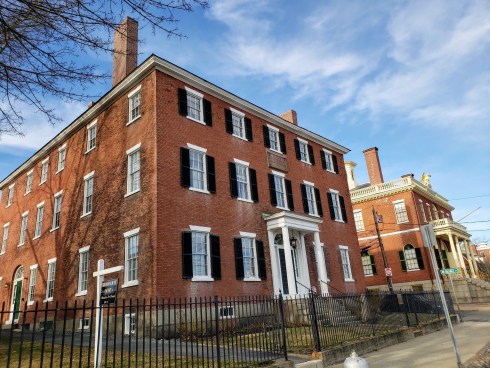
Elijah Sanderson and his younger brother Jacob were among the most prolific and consequential cabinetmakers of Salem, who spread the city’s craftsmanship and style far beyond New England through an expansive export trade in alliance with their partner Josiah Austin and several prominent merchants and shipowners.  Through their collaborative business, and with half-shares in several Salem ships themselves, they sent cargoes of furniture to the Southern seaports, the West Indies, Africa, and India in a series of voyages that are well-documented in the Phillips Library and have been analyzed by scholars Mabel M. Swan, Thomas Hamilton Ornsbee, and more recently, Dean Lahikainen. Their success was clearly tied to Salem, but in 1775 the Sanderson brothers were living in Lexington, in the home of their elder brother Samuel, when Elijah found himself swept up in the events of April 18 and 19, for a time even finding himself in the captive company of Paul Revere! I love his testimony because it rings true in its lack of heroism and drama: it must be true because it is recounted in such a detailed yet mundane manner! The Sanderson house was on the main road from Boston, and relatively late on the evening of the 18th Elijah noted the passing of a party of British officers “all dressed in blue wrappers”. He decided to discern what was up, so made his way to John Buckman’s tavern where an older gentleman encouraged him to “ascertain the object” of these officers, so he did so, on a borrowed horse in the company of two other comrades. There was general concern that the British were after John Hancock and John Adams, who had been “boarding some time at Parson Clark’s”. Elijah’s party was stopped by nine British officers a few miles down the road in Lincoln, and they were detained and examined, along with two other “prisoners”, a one-handed pedlar named Allen and Col. Paul Revere. After “as many question as a Yankee could” ask, the entire party mounted and made their way to Lexington, where the British officer named Loring observed “The bell’s a ringing, and the town’s alarmed, and you’re all dead men” but let them go, after cutting the bridle and girth of Elijah’s horse. We hear no more of Revere, but Elijah made his way to the tavern in Lexington and there promptly fell asleep! Yes, he fell asleep in the middle of the opening act of the American Revolution.

Buckman-Tavern-1

Sanderson Lexington The taproom of the Buckman Tavern, where Elijah Sanderson fell asleep by the fire; early 19th century view of the Battle of Lexington, New York Public Library Digital  Collections.

Well not for long: Elijah awoke to the sound of drums and ran out to Lexington Common where he fell in, without a gun, but then stepped out “reflecting I was of no use” to become the perfect eyewitness bystander of the Battle of Lexington. He heard the British commander say “Fire” and then all was smoke and fire. After the British left for Concord, Elijah ran home to get his gun,, but it was gone (his brother took it) and so he returned to the center of town to “see to the dead”. A few hours later he witnessed the retreat of the British from Concord, firing houses as they made their way back to Boston. He ends his testimony with two statements that he clearly wanted to get on the record: 1) he spoke with one casualty of the day several days prior: a certain Jonas Parker who “expressed his determination never to run from before the British troops” and; 2) his wayward musket was still in his possession, and his brother “told me he fired at the British with it” on that fateful day. What a life this man led: his experience in Lexington, combined with his brilliant Salem career, could provide the basis for an absolutely amazing book. Reading between the lines of the Sanderson scholars, I’m guessing it was the younger brother, Jacob, who was the better craftsman and workshop manager, while Elijah was the traveling dealer and supercargo, with the responsibility of selling their wares up and down several coasts. Jacob died in 1810, and Elijah carried on through a series of less profitable (or at less amenable if the legal notices are any indication) partnerships. Lexington pops up in each and every obituary notice of this memorable man.

Sanderson Label Winterthur

Sanderson Collage

20190413_120059

20190413_120006

20190413_120122

20190413_120224

Sanderson Salem Observer Feb 19 1825

“E & J Sanderson” label on a Salem-made pembroke table, Winterthur collections; Sanderson pieces from the New England Historic Genealogical Society, Christie’s Auctions, and the State Department; The Elijah & Jacob Sanderson House on Federal Street, 1783 (a very rare— I think—back-to-back double house which received Historic Salem Inc.’s first plaque!); just one Sanderson obituary.


Mrs. Crowninshield goes to Washington

A colorful, albeit a bit light, source for women’s history is the collection of letters written home by Mary Boardman Crowninshield (1778-1840), the wife of Benjamin Crowninshield, a congressman and Secretary of the Navy under Presidents Madison and Monroe. On the surface, Mary’s and Benjamin’s marriage looks like a typical Salem mercantile merger, but not so typical was her decision (or maybe it was their decision) to accompany her husband to Washington in the fall of 1815. The letters describing their trip, by carriage and steamship, and residence in Washington over the next few months were published by Mrs. Crowninshield’s great-grandson, Francis Boardman Crowninshield, in 1905, and they yield some interesting insights into the Washington social scene in the immediate aftermath of the British occupation of the city and burning of the White House in general, and what everyone was wearing (most prominently First Lady Dolley Madison) in particular.

Mary Crowninshield

Mrs. Crowninshield was clearly an observant and detail-oriented woman, but her lengthy descriptions of the dress of the women whom she encountered really stand out in comparison with her briefer assessments of events or her surroundings. Almost as soon as she arrives in Washington, she calls on Mrs. Madison in the Octagon House, where she takes note of the blue damask curtains and finds the First Lady dressed in a white cambric gown, buttoned all the way up in front, a little strip of work along the button-holes, but ruffled around the bottom. A peach-bloom-colored silk scarf with a rich border over her shoulders by her sleeves. She had on a spencer of satin in the same color, and likewise a turban of velour gauze, all of peach bloom. She looked very well indeed. You can’t expect Mrs. Crowninshield to get excited about the architecture: she hailed from Samuel McIntire’s Salem! But one would like to see some mention of the rebuilding of Washington, the slaves who lived in the Octagon House along with the Madisons, maybe a bit of politics: but no, it’s really all about who wore what where and when.

The Octagon Peter Waddell

20190325_170556

20190325_165931

20190325_170000Historical artist Peter Waddell’s depiction of the Octagon House in Washington, Mary Boardman’s childhood home on Salem Common, and the Salem house of the Crowninshields, where they entertained President Monroe in 1817, now the Brookhouse Home for Aged Women.

Well, if that’s what she wants to write about let’s go with it; these are her letters after all! She seems to be almost as impressed with the dresses of Mrs. Monroe as Mrs. Madison: the former is “very elegant”, dressed in “very fine muslin lined with pink” on one occasion and  “sky-blue striped velvet” on another, both times with velvet turbans embellished with feathers. Mrs. Crowninshield clearly is intimidated/impressed by all these velvet turbans in Washington: she has insufficient velvet and no feathers at all, and as they are very dear she combs her braided hair as high up as possible and weaves in flowers and ornaments—including a golden butterfly which Mrs. Madison actually admires. There is great concern about trim: Mrs. Crowninshield orders some very nice dresses from a Washington mantua-maker but implores her mother to send some red velvet trim from Salem along with Judge Story—–a Supreme Court Justice—when he makes his way back to Washington! And he does. This seems like the most insightful detail of Mrs. Crowninshield’s letters: imagine a Supreme Court Justice as a clothing courier!

Boardman The-Splendid-Mrs-Madison White House Peter Waddell

7-CaptureOfCityWashington24Aug1814_fullPeter Waddell’s recreation of one of Dolley Madison’s “Wednesday Squeezes” with many turbans and feathers in evidence, White House Historical Association; the capture and burning of Washington in 1814, New York Historical Society. Mrs. Madison continued to be an active hostess in her temporary quarters, which Mrs. Crowninshield tells us all about, but she does not have much to say about the post-war state of Washington.

But back to Dolley Madison, of whom Mrs. Crowninshield has the most to say, as she attended several events over the holidays in December of 1815 and January of 1816 hosted by the First Lady. Mrs. Crowninshield admires everything about Dolley—her demeanor, her apparent kindness, her ability to converse with ease—but above all, her clothes. Either Dolley rescued her famous wardrobe from the burning White House along with George Washington’s portrait or she replenished it with purpose. At a New Year’s Day reception, Mrs. Madison was dressed in a yellow satin embroidered all over with sprigs of butterflies, not two alike in the dress; a narrow border in all colors; made high in the neck; a little cape, long sleeves, and a white bonnet with feathers. That’s quite a close observation. At a Wednesday night levee, Mrs. Madison was adorned in muslin dotted in silver over blue and a beautiful blue turban with feathers. Mrs. Crowninshield noted that I have never seen her look so well and was clearly very pleased that Dolley had remarked that they “thought alike”, as she was dressed in blue as well. The last description of Dolley’s dress refers to a more elaborate dinner party, in which she was dressed in black velvet trimmed with gold [and] a worked lace turban in gold with a lace and gold kind of thing over her shoulders and looked “brilliant” in Mrs. Crowninshield’s worshipful estimation. Not long after this event, Mary Crowninshield returned to Salem, where the Reverend Bentley seems to have visited her immediately, in search of all the Washington gossip as well as her opinions of both the President and the First Lady. In her last letter, to her husband who remained in the capitol, she admits that I think I never shall want to go from home again.

Dolley's Buterfly gown

Dolley Dress 1934

Dolley Madison’s yellow silk “butterfly gown (s)” ? at the Smithsonian: the First Ladies Hall and a 1934 Curt Teich postcard.


Salem Women Build

I have a list of topics that I would research if I was ever going to pursue another Masters or Ph.D., which I am not. The list started long ago but these past seven years of blogging have definitely added to it, and consequently it includes a few Salem topics. This particular topic, however, predates the blog. Shortly after I moved to Salem, while I was still in graduate school, I started plaque research for Historic Salem, Inc. in order to learn more about my new city. This type of deed and local history research was very different from my dissertation research and so I thought it would give me a break, which it did, but it also raised some larger questions and problems which I did not have time to answer or even address at the time. One thing I noticed was the central role that women often played in the commission, financing, and disposition of property, particularly in the later half of the nineteenth century. As this is Women’s History Month everywhere and Women’s History Day here in Salem, I thought I would focus on some houses built specifically for women, whether widows or “singlewomen”, “gentlewomen” or freedwomen.

pixlr-1

This is by no means an exhaustive survey; basically it’s just the result of a few walks. But my impression today is the same as it was several decades ago: there were a lot of houses built in Salem for women. A more comprehensive and comparative study would be very revealing, I think. No doubt these plaques represent an underestimate, though I did notice Historic Salem’s more recent policy (certainly not in place when I was doing this research) to represent both husbands and wives on plaques, as well as other domestic arrangements. This raises the question of under-representation in historic preservation, which would make a great session for this year’s Massachusetts Preservation Conference.

20190323_155003

20190320_095248

20190320_102835

20190320_103955

pixlr_20190324090448570

20190320_110752

20190323_150527

20190320_100901

20190323_144915

Above: shopowner Annie Sweetser’s house on Forrester Street, Cynthia Lovell’s on Williams, the house built for the Tilton sisters on Pickman, Lydia King’s house on Lemon Street, Mary Lindall’s house on Essex, Mary Derby’s house on Beckford, and Maria Ropes’ house on Chestnut. At least part of  the conjoined houses on Essex and Broad were built for women: Susannah Ingersoll & Hannah Smith. Below: putting woman on the plaque on two Daniels Street houses! (Love these more detailed HSI plaques).

pixlr-2

pixlr-3

The economic and social spectrum of women builders is also very interesting. There are several educator builders, and a few independent “property owners”.  The wealthy philanthropist Caroline Emmerton, who restored (created?) the House of the Seven Gables, also commissioned a copy of the Richard Derby House for the last lot on Chestnut Street from architect William Rantoul, and hired Arthur Little to transform her Federal Mansion on Essex Street into a Colonial Revival exemplar. I was reminded just last week by my colleague Beth Bower of one of my very first plaque research projects, years ago: in which I found that a Lemon Street house was built for Mahala Lemons Goodhue, her husband Joseph, a mariner,  and their son Joseph Jr., a laborer. The present owners seem to have made their own sign featuring Mahala, which is fine, as I looked up the original report and I’m embarrassed to admit that I seem to have completely omitted the fact that the Goodhues were African-American! My dissertation must have dominated during that time, or I may have been more preoccupied with the history of the land rather than the people who built the house (which was my tendency)—-will definitely revise the record.

pixlr-4

pixlr_20190324095403030

Caroline Emmerton’s commissions on Chestnut and Essex, and the Lemons-Goodhue house on Lemon.


City of Seven Hills

I’m just back from a wonderful vacation to Lisbon during which I took hundreds of photographs, so advance warning to those who are more interested in local history and culture: this is definitely going to be a “streets of Lisbon” week! I’ve been to Portugal several times before, but my last visit was quite a while ago, and I never spent more than a few days in the capital so there were many discoveries: plus Lisbon is incredibly photogenic as it is so full of texture and color. I walked everywhere so I could capture every little detail, only popping on a yellow tram near the end of a long day when I was looking up at yet another hill (there are seven, just like Rome) which had something I had to see at its top. We had wonderful weather, and Lisbon appeared very bright and shiny, with its multichromatic buildings, both tiled and color-washed, contrasting with its black and white sidewalks and squares. Yellow popped out particularly, not just on the trams but also on private and public buildings and even the cranes which hovered over sections of the city. Like so many other cities, Lisbon appears to be having a building boom, encompassing both the construction of new structures and the “renewal” of others. It’s a city that has always embraced the new and cherished the old in a particularly effective way, certainly since the devastating earthquake of 1755 and no doubt well before, as it is an ancient settlement. I’ve got my favorite photos from the trip today, and my next posts will focus on the sidewalks and shops of Lisbon, then I’ll get back to some Salem stuff (though I think I have enough photos to feature Lisbon for some time).

Yellow City 20

Yellow City 33

Yellow Lisbon Black Horse Square

Yellow City 2

Yellow City 25

Yellow City 5

Yellow City 26

Yellow Lisbon 2The arch of the Praça do Comércio, the Square of Commerce, is the proper entry to Lisbon, from the sea, but it’s a nineteenth-century construction after the rebuilding of the square following the earthquake of 1755. A great mural in the Museu Nacional de Arte Antiga shows the pre-1755 square. The Church of The Church of Nossa Senhora da Conceição, the ruins of the Cormo Convent (another memorial to the losses of 1755), the interior of Lisbon Cathedral, just another beautiful church square, and a quote by the 18th century Jesuit father Antonio Vieira “Para nascer, Portugal. Para morrer, o mundo” testifying to the still-evident Portuguese pride in its global reach.

Yellow City

Yellow City 9

Yellow City 10

Yellow City 8

Yellow Lisbon Castle2

Yellow City 31

Yellow Lisbon Castle

Yellow Lisbon Church

Yellow City 4

Yellow City 3I’m trying to show the integration and proximity of new and old with these pictures, which include several streetscapes, views from the Castelo de S. Jorge, the Church of São Vicente of Fora, and a shot of the botanical garden, but they also present a lot of yellow, a very conspicuous color in Lisbon.

Yellow Lisbon Belem 3

Yellow City 32

Yellow Lisbon Belem

Yellow Lisbon Belem 2

Yellow Clevely Belem

Tarts

Yellow Lisbon CarriageBelem: site of the iconic Manueline Jerónimos Monastery and Belem Tower + tarts and the maritime history and coach museums, and a very strident 20th-century monument to the discoveries. 

Yellow Lisbon Museum

Yellow City 24

Yellow City 23

Yellow City 21

Yellow City 40

Yellow City 12

Yellow City 22

PharmacyMuseums:  so many! History museums and museums of every conceivable form of art: “ancient” (pre-1850), modern, decorative, TILES, marionettes. The famous Gulbenkian collection and several less well-known house museums: I was blown away by the CasaMuseu Medeiros e Almeida in particular. I have a new appreciation for Portuguese artists of the Renaissance (Gregório Lopes in particular: look at that Martyrdom of St. Sebastian). And I couldn’t leave without visiting the Museu da Farmácia, of course. 


The Snow Castle

We haven’t had many snowstorms this winter, but two nights ago about a foot of snow dropped onto the streets of Salem. My first thoughts when I woke up were: how much snow did we get (and) should I run down the street and take a picture of the snow house? Classes had been cancelled the night before, so that was no concern of mine. I saw that we had quite a bit of snow, so of course I thought of the Wheatland/Pickering/Phillips house, a Classical Revival confection that I always think of as the “snow house” or the “snow castle” as it looks so beautiful when its exuberant trim is frosted with snow. I adore this house in every season, but especially in the winter. It really is my first thought when I wake up on a snowy morning.

Snow Castle 3

Snow Castle 2

Snow Castle

It was quite warm yesterday morning, and so the snow had already started to melt by the time I made it down the street (as a snow day meant an extra cup of coffee) so here are some “freshly frosted” views from a few years back, when the blue sky afforded more contrast and shadow.

Snow Castle 2011

WHite Castle 2014

My Snow Castle, which I guess we should call the Wheatland-Phillips House after its original and present owners, was designed by Salem native John Prentiss Benson (1865-1947), a brother of the well-known American Impressionist Frank Benson who became an esteemed artist himself after his retirement from architecture. I don’t possess the architectural vocabulary to describe this house so I’ll use the words of Bryant Tolles from Architecture in Salem: “a spectacular, flamboyant example of the Colonial Revival style……[in which] the architect employed a variety of Colonial Revival idioms, including the ornate cornice (with dentils and pendants in relief), the wide fluted Corinthian pilasters (reminiscent of the work of McIntire, the flat window caps, the second-story Palladian window with miniature pilasters, the broad doorway with semi-elliptical fanlight, and the overly large flat-roofed porch with Corinthian columns” in a “innovative, almost whimsical manner”. Tolles concludes that “the house gives the impression of being an original late 18th century building” even though it is in fact one of the newest houses on Chestnut Street, constructed in 1896 for Ann Maria Wheatland, the widow of Stephen Wheatland, who served as the Mayor of Salem during the Civil War. I’m not sure why Mrs. Wheatland desired such a large house, but she lived in it until her death in 1927. Despite its mass, the house has always seemed whimsical to me, and also timeless, and its allure is no doubt enhanced by its stillness as I don’t think anyone has lived there during the whole time I’ve lived on Chestnut Street. I have to resist trespassing every time I walk by this house, in every season: in summer I see myself having a gin & tonic on its left-side (deck? seems to mundane a word) and I would love to see if there is a veranda out back. I do resist, so I don’t know.

Snow Castle 1940 HABSThe House in 1940; HABS, Library of Congress.

By many accounts, John Prentiss Benson wanted to be an artist from early on, but as that trail was blazed by his brother Frank, he settled for architecture. Nevertheless, he seems to have had a successful career, with a New York City practice and several partnerships. He lived for several years in Plainfield, New Jersey where there are several John P. Benson houses: there was a tour devoted to them in 1997 titled the “Mansions of May”. None of these houses—or that designed for his other brother Henry on Hamilton Street in Salem—seems to bear any resemblance to the Wheatland-Phillips House: it’s as if he just let loose with wild abandon. Perhaps Mrs. Wheatland gave him carte blanche, or very strict instructions. Or maybe he was influenced by memories of the Benson family home on Salem Common: an exuberant Second Empire structure that was situated on what is now the parking lot of the Hawthorne Hotel.

Snow Castle Jersey Houses

Snow Castle Portsmouth Benson Family Home

Snow House WillowbankOther Benson houses, including his own, top right; the Benson family home on Salem Common and Willowbank in Kittery Point, Portsmouth Athenaeum.

After his retirement from architecture in the 1920s, Benson moved to a waterside estate in Kittery Point, Maine named Willowbank and began painting full-time until his death in 1947: he was prolific, and consequently his identity is more that of a maritime artist than an architect at present. The Portsmouth Athenaeum has his papers, and has digitized many photographs of his life and work at Willowbank, which also happens to be the birthplace of the 6th Countess of Carnarvon, Ann Catherine Tredick Wendell, who became mistress of Highclere Castle in 1922. And thus we have a very distant and indirect connection, through John Prentiss Benson, between the Snow Castle and Downton Abbey!

Snow Castle Collage

Benson Galleon Vose Galleries

Galleon, 1923 by John Prentiss Benson @Vose Galleries: I love galleons, and I’m using this one to sign off for a while as I’m off to Portugal on spring break! I’ll be back with many pictures of azulejos, no doubt.


“Salem” Houses, 20th-century Style

There are two deep rabbit holes around which I must tread very, very carefully, or hours will be lost instantly: the Biodiversity Heritage and Building Technology Heritage digital libraries housed at the Internet Archive. One leads me through a never-ending cascade of flora and fauna; the other through the built environment–or prospective built environment, I should say, as many of its sources are building plans and catalogs. Just yesterday, when it started to snow and afternoon classes were cancelled, I thought to myself, let me just pop in there and see if I can find some inspiration for interior shutter knobs, and hours later I emerged with no knobs but lots of images of “Salem houses” instead. So here they are in chronological order: you will no doubt conclude, as I did, that “Salem” style loses its meaning over the twentieth century: the last house is from 1963, and it is difficult to see how it was inspired by Salem. Well, now that I’m looking at them altogether, it’s difficult to see how Salem was inspirational at all, except perhaps for a brief spell in the 1930s. House parts stick to their Salem inspiration, as there are plenty of mid-century “colonial” mantels, doors, and windows inspired by the craftsmen of “Old Salem”, but houses seem to break free of any connection to classical Salem influences: just look at the 1949 “Sam’l McIntire”! The concept of Salem seems to retain some currency throughout the century, but what it really means in terms of design or construction is anyone’s guess.


Salem Houses Herbert C. Chivers 1903 (2)

Salem Houses Aladdin 1915

Salem Houses 1915 collage

Salem Houses 1929 PicMonkey Image

Salem Houses 1933 PicMonkey Image

Salem Colonial 1933

Salem Houses 1936 Sears

Salem Houses Sears 2

Sam McIntire 1949

Salem Houses 1954

Salem Houses Collier-Barnett Co._0029 1963

“Salem Cottage” from St. Louis architect Herbert Chivers’ Artistic Homes, 1903; Aladdin Houses, 1915; the first “Readi-cut” Salem model, 1915; a “bungalow with the pleasing lines of the Colonial type” in The Book of 100 Homes, 1929; the reproduction “Pequot House” was included in the Ladies Home Journal House Pattern Catalogue of 1933, the same year that “a Salem Colonial” was published in Samuel Glaser’s Designs for 60 small homes from $2,000 to $10,000 : showing how to build, buy and finance a small home; two Sears “Salem” houses from 1936 and 1940; The “Sam’l McIntire” from the Warm Morning Small Homes plan book for 1949; Bennett Homes, 1954; a Salem “rambler” from There’s a Miles Home in your Future” book from the Collier-Barnett Co., 1963.


Enquiries and Enslavement

I’m in the process of teaching myself how to create digital maps with layers of history so I can visualize different times, places, events and environments. Such maps are a great teaching tool, and I also think it would be a great way to put all of the discoveries I’ve made while blogging into a more compact form. “Spatial history” is a very big trend in historical interpretation and the digital humanities, but it’s going to take me quite some time to reach this level of presentation. I thought I’d start small with a series of maps of Salem with one layer each: how many first period houses survived in say, 1890, houses of notable women of Salem from different periods, and houses (or locations) where enslaved people lived and worked before the abolition of slavery in Massachusetts in 1783. I decided to start with the latter topic because I thought it would be manageable, but it is not: there were far more enslaved people in colonial Salem than I thought—but this makes it all the more important that we place them.

Slave Adverts White Collage

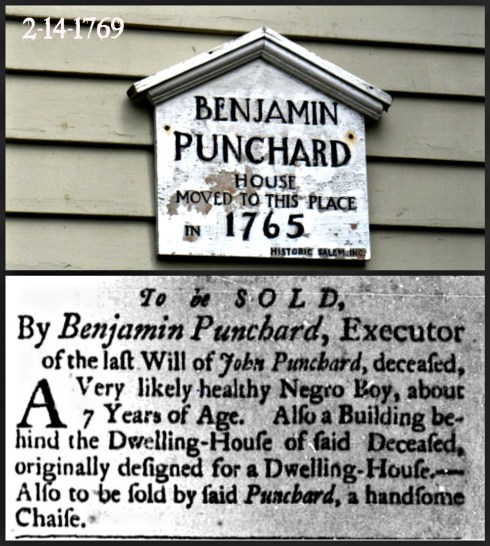
I’m still working on my “data set”, having searched through newspapers (for both “for sale” and “runaway” advertisement, vital statistics, and the amazing 1754 census at the Phillips Library in ROWLEY (yes, I’ve been there; I will report later). The latter breaks down Salem’s residents into five categories: “rateable”, males under 16, females, widows, and negroes, and according to its survey, there were 3462 people in Salem in 1754, of which 123 were African-Americans. The word “slave” is never used; only servant. There are discrepancies between this survey, the advertisements, and the vital statistics, so I’m not sure how I’m going to be able to come up with an absolutely accurate number: this might have to evolve into a collective or crowd-sourced project. I’ve identified some of the larger slave-owning families though: an analysis of their papers (most are also in the Phillips) would undoubtedly reveal more information

Slave Adverts Punchard

Slave Adverts June 13 1769 Essex Gazette

Slavery 1 collage

Slave Adverts Oct 29 1771All Essex Gazette

Enquire of the PrinterRunaway slave advertisements are very detailed; for sale notices less so. It’s almost as if people don’t want to give their names out, with some notable exceptions, like Captain David Britton, who was definitely more than personally invested in this trade. The map will require me to place the enslavers and the enslaved, but I don’t have much information on Britton: all I’ve found so far is a reference in Phyllis Whitman Hunter’s Purchasing Identity in the Atlantic World. Massachusetts Merchants, 1670-1780 to his membership in a Salem club called “The Civil Society” which met at a local inn on Tuesdays and Fridays ” for friendship and conversation”. There were club rules against cursing and unrefined behavior, but apparently not against slave-trading.

Slave Adverts Boston Evening Post July 24 1738

Slave Adverts Pompey and Horse

Slavery Waite

Slave Adverts PhelpsBoston Evening Post and Essex Gazette

Once you start researching this topic, it shapes how you look at your environment. I’m sure people in the South are used to this, but not people in New England. There were enslaved people in the House of the Seven Gables, and the very wealthy merchant Aaron Waite, whose long partnership with Jerathmiel Pierce has inspired the naming of Salem Maritime’s gift shop, enslaved at least one person, named Pompey. Nathaniel Hawthorne’s great-grandfather Jonathan Phelps, let out both his blacksmith shop and his “excellent workman” in 1773. Several enslaved men were compelled to work for their master Samuel Barnard in the Ropes Mansion, and he also loaned them out to his nephew way out in Deerfield. Richard Derby owned at least one slave, as did William Browne, Jonathan Clarke, Daniel King, Edward Kitchen, Josiah Orne, William Pynchon, and Bezaleel Toppan, and many more residents of mid-eighteenth-century Salem, both wealthy merchants and less conspicuous craftsmen. The fabulously wealthy Samuel Gardner (1712-1769), whose house was located on the corner of Essex and Crombie Streets and whose many possessions are easy to find in auction archives and museum collections, listed several enslaved men among his possessions in his will: he left his “Negro boy Titus, as a servant for life” to his “beloved wife Elizabeth”, but freed a man named Isaac, adding the provision that if Isaac was “unable to support himself, that he be supported by my sons George, Weld, and Henry, in equal shares…..so as to free the Town of Salem from any charge”.

Slavery Ropes

Samuel Gardner's Sugar Box.Samuel Gardner’s sugar box, collections of the Museum of Fine Arts, Boston.


Blank Buildings

Periods and events of the past are generally identified after they are over: history is about remembrance, and imposing order and meaning on what has happened. There’s no better way to convey this essential point than to reference wars: obviously people in the midst of the Hundred Years’ War, the Thirty Years’ War, and the Seven Years’ War had no sense that these were the historic events in which they were participating or enduring! Often historical and cultural eras overlap, and that means that styles are identified well after their expression: medieval, colonial, Victorian. But there are also cultural descriptions detached from precise historical periods: Gothic and Palladian come to mind but I suppose any “revival” style could fall into this category. This long preamble is just my mind wondering how people of the future will categorize Salem’s current architectural style: in a city long identified by its architecture, how will the buildings of the early 21st century be branded? I think we are turning a corner with the latest downtown building slated for construction—a condominium development on the site of the District Courthouse on Washington Street–but I’m not sure where this turn will take us.

Blank Architecture 1 Coming Soon on Washington Street via Building Salem.

The style–or perhaps I should say form–of this rendering is familiar: similar buildings have been built in the last decade on Federal and Lafayette Streets. But what is it? I am architecturally naive, but it looks like a Prairie-esque type design on steroids, shorn of craftsmanship and charm. I’ve often heard Frank Lloyd Wright characterized as the most influential architect of the last century, both for better and for worse. All I see when I look at these buildings are the shallow or flat roofs with their overhanging eaves, sometimes slanted and sometimes straight, and their bulk. They look vaguely Italianate, vaguely “Mediterranean”, vaguely Prairie, and like they could belong anywhere and everywhere, and as more of them are built in Salem, Salem becomes less and less Salem-esque.

Blank Architecture 2

Blank Architecture 3

Blank Architecture 6

Blank Architecture 5Ten Federal and 135 Lafayette; I think this “style” started with the Ruane Judicial Center nearly a decade ago, on the far right: it is very bulky with a conspicuous overhang. The panorama of courthouses on Federal Street makes quite a statement!

My title is a double entendre: I really don’t know what this architectural style is called or what architectural era we are in so I am inviting readers to fill in the blank______, but I also think that this architecture is blank: empty, soulless, devoid of any connection to its surroundings. We could do so much better; inspiration is all around us. A building in Lynn caught my eye just as I was driving back from the airport this morning: it features some of the very details that characterize these stark buildings in Salem but is clearly a composition rather than just a composite. It has texture, ornamentation, depth, craftsmanship: its builders were obviously proud to cast their mark on it, and mark its time, as it was built to last.

Blank Architecture 7

Blank Architecture 8The Loraine Apartment Building in Lynn’s Diamond District, designed by architect Samuel Rogers.


Wooden Houses on Beacon Hill

I had two appointments in Boston yesterday, but I parked my car in a spot that was rather inconvenient to both just so I could go over the hill: Beacon Hill, one of the few neighborhoods in which all the variant architectural styles of the nineteenth century coalesce into a completely harmonious quarter. Victorian exuberance was definitely restrained–to rooflines for the most part–for the greater good, and the Federal and Greek Revival aesthetic appears to have lingered and evolved rather seamlessly into the Colonial Revival. Brick is it on Beacon Hill, so it’s the wooden houses that really stand out: I snapped a few on my way over the hill to one appointment and back to another, but I was a bit pressed for time so I certainly didn’t capture them all. I always stop at one of my favorite Beacon Hill houses, which is also the oldest house in the neighborhood: the George Middleton House at 5 Pinckney Street, built in 1786-87. Distinguished by his service in the American Revolution as well as his roles as founder of the African Benevolent Society and Grand Master of the Prince Hall African Lodge of Freemasons, George Middleton is an important figure in Boston’s African-American history, just as Beacon Hill is an important locale: the Black Heritage Trail links his house to other important historical sites such as the African Meeting House and the Abiel Smith School. The Middleton house and One Pinckney Street, just two doors down, form a perfect little corner of Beacon Hill’s earliest built history on its North Slope.

beacon hill 5

beacon hill 5a

beacon hill 5b

beacon hill middleton house hneHistoric New England

Even though wooden houses are few and far in between on Beacon Hill, there are quite a few houses in which one or more part is clapboarded: a front facade or a side wall, or some “dependent” part. My favorite example of this is the amazing John Callender House on the corner of Walnut and Mount Vernon Streets, built in 1802 as a “small house for little money” according to Allen Chamberlain’s Beacon Hill: its Ancient Pastures and Early Mansions (1925—a really great book) and the long-term home of Atlantic Monthly editor Ellery Sedgwick a century later: every source refers to its conspicuous “boarding” along Mount Vernon Street as unusual for Beacon Hill. And then there are those bay windows made of wood, some very conspicuous and not quite so-understated: Beacon Hill was home to a vibrant artistic community in the later nineteenth and early twentieth centuries and some homeowners obviously wanted to bust out a bit.

beacon hill 6

beacon hill 6a

beacon hill 4

beacon hill 7

beacon hill walnut collage

beacon hill leon abdalian 1920s bpl

beacon hill collage 14 Walnut Street historic photographs from Historic New England, Allen Chamberlain’s Beacon Hill, MACRIS, the City of Boston’s Archives, and the Boston Public Library.


I Miss the Assembly House

I miss the Assembly House, a Georgian structure on Federal Street built as an assembly house in 1782 and transformed by Samuel McIntire into a more elaborate residence in the next decade: its proper name is the Cotting-Smith Assembly House (although it was charmingly called the “old Assembly House” after Hamilton Hall was built in 1805) and it was donated to the Essex Institute in 1965, the last building to be added to the Institute’s collection of historic houses, I believe. Of course the house still exists–I can see it at any time–but it has changed from when I first knew it: it has lost all of its trees–and its life. It is still, dark, and stark. It’s a shadow of its former self, or a ghost.

assembly house

assembly house 1926

assembly house howell-painting-1920-assembly-house mfa

assembly house cornell 8c73ca74-4027-453e-be51-e31e2437d593_size4

assembly house drawing hne bestThe Cotting-Smith Assembly House yesterday afternoon and in 1926, 1920 (in a painting by Felicie Ward Howell, collection of the Museum of Fine Arts, Boston), c. 1910 (Cornell) and an undated drawing (Historic New England).

I know, houses are not sentient beings as friends and family often tell me. But the Assembly House looks sad and it makes me sad to look at it, as I remember many happy times there in the 1990s, both before and after the Essex Institute and its houses were absorbed into the Peabody Essex Museum. I remember: teas, two baby showers, several anniversary dinners, a graduation party, a cooking class (???), coffees for candidates for local office—it seemed as if we were in there quite a lot! I remember feeling that the house was rather homey, despite its elegant interior details. I remember sitting on the back stairs talking to two friends who are no longer alive. I remember being wowed by the front staircase—with its second-floor landing and pedimented door—every time I saw it. But all these memories are from a long time ago, at least 20 years. I miss all of the Essex Institute/PEM houses, with the exception of the Ropes Mansion which was restored and reopened a few years ago. (Actually what I really miss is the Essex Institute, but that statement will always produce eye-rolls among those who believe that the Peabody Essex Museum rescued both the Institute and the Peabody Museum. This may be true–but it’s hard not to notice those dark stretches of Essex—and Federal—Streets).

assembly house hne

assembly house stairwell

assembly house hne 3

assembly house la sunday times aug 8 1926assembly house bg 1963

assembly house bg 1985Photographs of the Cotting-Smith Assembly House interior, Historic New England; Los Angeles Time, 1926; Boston Globe, 1963 and 1985.

The house where Lafayette danced in 1784 and Washington dined in 1789 and Susan Coolidge (above) came out and many other people celebrated weddings, anniversaries, and simply lived their lives was “restored, refurbished, and remembered” according to the 1985 story in the Boston Globe above but seems largely forgotten these days. It was celebrated across the country in 1926 as Salem marked its 300th anniversary, but seems likely to be overlooked as the city marks its 400th.