
We finally broke free of Salem for the last weekend of Haunted Happenings—-in the nick of time! It’s just been such a busy month, but on Saturday we abandoned all of our responsibilities and drove west to the Connecticut River Valley to visit my husband’s cousins, who live in the delightful town of Montague. I have been driving through or by Montague for many years, but never really stopped to explore it—or so I thought: it turns out that Turners Falls, a semi- regular pit stop for when when driving west or back east, is actually a village of Montague, along with Montague Center, Montague “City”, Millers Falls, and Lake Pleasant. We spent most of our time in Montague Center, and never found the elusive Lake Pleasant. On a long walk through the countryside surrounding the Center, we came across a beautiful first-period house for sale, which once belong to a mutual acquaintance of all of us: while staring at its characteristic over-the-top (by Salem standards) Connecticut-River-Valley doorway, I briefly imagined life “out west”, away from the Witch City and its exploitative “attractions” and Halloween hordes but also (unfortunately) far from work, family, and the ocean—which my husband could not live without. Oh well.


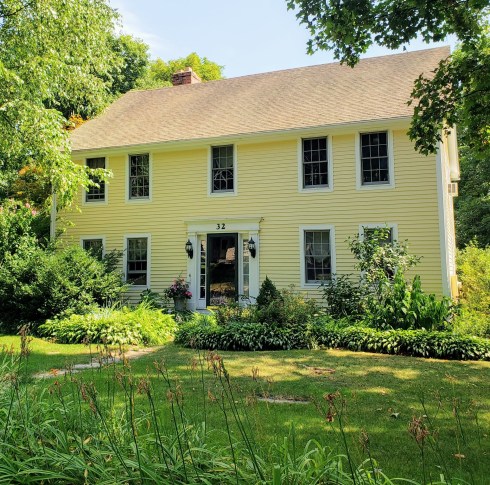
 A dreamy house—and former tavern—in Montague Center: listing here.
As you can see, Saturday was a beautiful day and we saw other wonderful houses (and many barns) as well, before lunching outdoors at a former mill and returning back to our cousins’ charming house—a former school and pocketbook factory— within which live FOUR cats (and a dog), and wonderful family heirlooms from Vienna arranged just so according to the wishes of their former owner. After indulging in cardamon-laced pastries on fine china (yes, we refugees were treated like royalty), we were off to Turners Falls, the largest of the Montague villages.


 All around Montague Center: house & barns, the Book Mill, Valley cats, Viennese heirlooms, the Homestead.
I have stopped by Turners Falls over the years because it is unusual among Massachusetts towns (or villages, I should say), most of which have evolved organically. Turners Falls is a planned industrial settlement, the initiative of Fitchburg industrialist and railroad entrepreneur Alvah Crocker in the 1860s. Laid out on a grid, with harnessed hydropower, factory buildings and housing and very conspicuous tall-spired churches, Turners Falls has the look of an “ideal” industrial community, even as its factories are now vacant. It has a big broad Main Street, and most of its shops and restaurants seemed very much alive, but all I was interested in on this particular visit was the workers’ housing—mostly brick rowhouses in varied states of repair. They were all striking in their efficient design, but it was their conditions which were so curious, like those below with the boarded-up windows and their recently-painted red stoops!


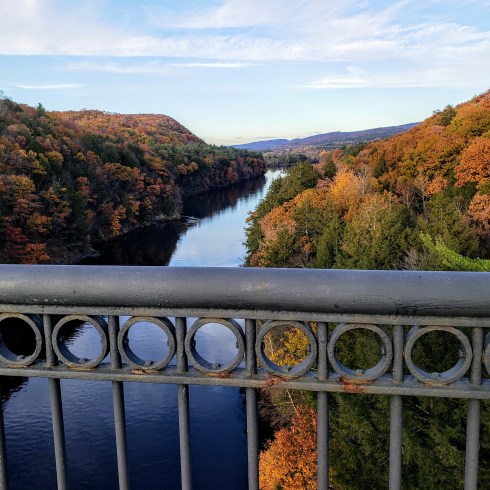
 Turners Falls, 1877, Digital Commonwealth ( I don’t think all of those streets were filled out!); the fast-flowing river after the Falls; workers’ housing. On the way home, the French King Bridge over the Connecticut River.


 The Old Burying Point on Charter Street is closed (thankfully) all month long; if you do come during the week you can ride a scooter around town—but not on the weekend as they have been banned because of the crowds.


 Fame AND Authority: Occasionally Mary Harrod Northend would present wistful Wallace Nutting-esque views, but mostly she was all about bringing antique material culture into the modern world; notices in Who’s Who in New England and the Architectural Record, citations in trade catalogs were common from 1915 on.


 The Superior Court House even has turrets!
 Bits and Pieces of seldom-seen Salem history: Salem printer Ezekiel Russell’s July 1776 Declaration of Independence, the Holyoke family coat-of-arms by Salem artist Benjamin Blyth, a letter from Alexander Hamilton to Salem tax collector Joseph Hiller, Nathaniel Bowditch’s presidential badge from the East India Marine Society, c. 1820, the “Gerrymander” in the Salem Gazette, Salem’s bicentennial banner, Nathan Read’s steam engine, and letters from Salem and Alexander Graham Bell; a photograph of Jessie Costello leaving the Superior Court in Salem after having been found innocent of poisoning her firefighter husband in an absolutely sensational trial in 1933, Boston Public Library, Leslie Jones Collection.
 A few of my favorite local history museums: the Newport Historical Society Museum, the Concord Museum, and the City of Raleigh Museum in North Carolina. Concord is a perfect role model for Salem: it has a historic national park, and several smaller house museums, but grasped the necessity of establishing a central historical museum for the general public in the 1970s.


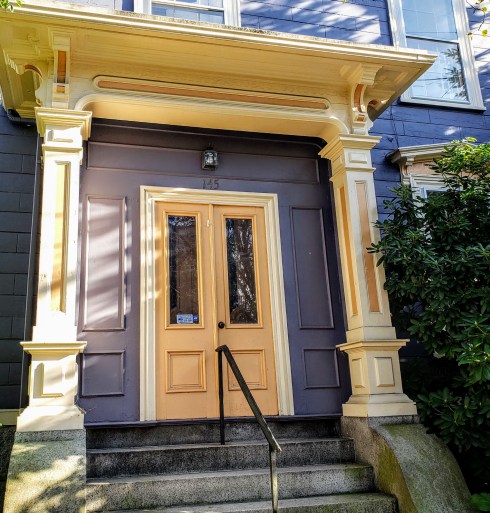

 Another reason to praise PEM: the beautiful restoration of the Daniel Bray House on Brown Street: it doesn’t have its new/old door yet as you can see–and I’m not sure if it will be painted this light orange color.


 Dark Brown/Red is a classic Salem combination.

 Turquoise is the current it-color, I think.


 T
T


 Larry Kupferman, Victorian Carriage House, Carnegie Museum of Art; the converted carriage house at A Cambridge House Inn, Cambridge, Massachusetts.


 Boston Street in the 1890s from the Frank Cousins Collection of Glass Plate Negatives as the Phillips Library, via Digital Commonwealth; the Trask Homestead/Black Horse Tavern on Boston Street—exterior and interior—in 1901, New England Historical and Genealogical Register Volume 55; the Symonds Chest which was once in the front parlor of the Trask homestead/Black Horse Tavern, Yale Digital Collections; 94-95 Boston Street, once Frye’s Tavern, now partly a tattoo parlor.




 The Hearse House in Marlow, New Hampshire.


 The McDermott Covered Bridge in Langdon (1864); the Meriden Bridge in Plainfield (1880); the Cilleyville (or Bog) Bridge in Andover (1887); the Keniston Bridge, also in Andover (1882); just two of Cornish’s FOUR covered bridges: somehow I missed the “Blow Me Down” Bridge and the Cornish-Windsor Bridge over the Connecticut River is


 Salisbury & Fremont, New Hampshire.
 Salem Register, August 19, 1841.






