Tag Archives: Antiques

Slippers and Slipware

It’s perhaps a bit early–though not too early considering our warm spring– but the lady’s slippers have arrived in my garden.  Late last week I took a walk through the woods and encountered the pink variety (sorry, no camera!) and this weekend out popped my yellow variety ( Cypripedium parviflorum or Cypripedium calceolus, there seems to be an ongoing debate about classification):  they always take my breath away the first time I turn the corner and see them.

I must say I do prefer the yellow variety; the pink ones look a little fleshy close up, with the flower resembling a lung more than a slipper!  Thanks to the journal function of writing a blog, I checked in on my lady’s slippers last year to find that I had seven slippers, while this year I have eleven, including one stem that has two flowers on it!  Words fail to contain my excitement.  Here is a shot from early this morning, after last night’s thunderstorm (during which I had to restrain myself from going outside to put an umbrella over them):  they survived, but are looking a bit put upon.

I was looking around to see how artists have been inspired by the Lady’s Slipper in the past and the present and found that ceramics seem to be the preferred medium for depicting this particular flower, which was once so common, and now relatively rare. My favorite discoveries were a beautiful piece of Staffordshire creamware from the late eighteenth century in the collection of the Victoria & Albert Museum, a Whately jug from the mid-nineteenth century, and a lovely little vase by Michael Stanley Pottery.


The World of Work Boxes

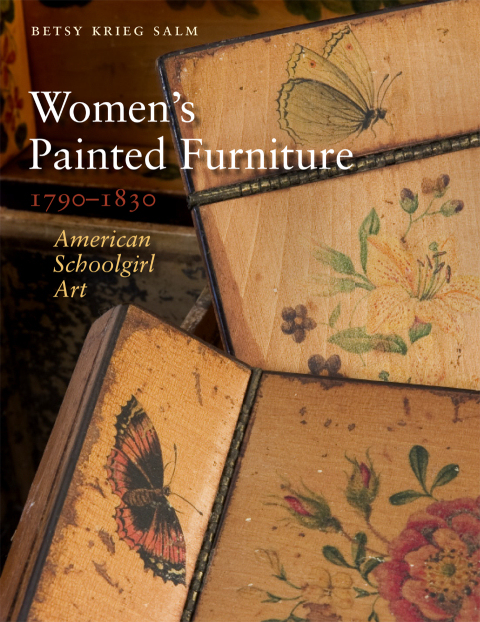
I was researching a post on painted “fancy chairs” from the Federal era and after when I got distracted by a great book and its subject matter: Betsy Krieg Salm’s Women’s Painted Furniture, 1790-1830 (University Press of New England, 2010) caught my eye in the library for numerous reasons (it’s a beautiful book, I love painted furniture, the era coincides with Salem’s golden age, so I knew I’d find some good stuff in it), but once I opened it I could not put it down. The result of three decades of research by the author (who is an ornamental artist herself), the book is art history, social history, education history, cultural history, world history all at the same time.

The subtitle, American Schoolgirl Art, is particularly appropriate as this book is about training, expectations, and influences as well as the motifs which decorate the furniture. I had never really considered the distinct genre of “schoolgirl art” and now I’m curious about its place in other eras and cultures. Lots of painted pieces are examined in Salm’s book, but my favorite by far are the work boxes produced by young women from relatively wealthy families, like Salem’s own Mary Derby Prince, the daughter of a Salem ship captain, with connections by blood and marriage to two of Salem’s most commercially aristocratic families, the Derbys and the Ropes. Another Salem box from the same era (and milieu) is that of Hannah Crowninshield, from the collection of the Peabody Essex Museum. Have I ever seen this before?  I don’t think so, but I could have walked right by it. I am familiar with samplers, of course, and the various types of wooden, decorated boxes produced for documents and other materials, but somehow I have never put the two together in the form of a work box, produced by young women as both an example of their work and for their work. Here are some of my favorites from the book:

Work Box by Ann Trask, Rowson Academy, Boston, circa 1810-20. Collection of Old Sturbridge Village.

Lid of Work Box by Hannah Bland, Massachusetts, circa 1810-30. Private Collection.

Detail of Lobstermen from Work Box of Fanny Barber, Gloucester, Massachusetts, 1821. Private Collection.

These boxes are so charming and so reflective of the environments in which these girls lived and worked, as well as the more general cultural influences to which they were exposed.  A little bit more context, for both American schoolgirl art and (transatlantic) work boxes in the first half of the nineteenth century:  a concise yet substantive article about the curriculum and culture at the Misses’ Martin’s School in Portland, Maine, and a few images of professionally-made work boxes from the British Empire. The first box is a particularly expensive example, with leather covering, silk lining, brass fittings, and custom-made sewing and needlework accessories, from the collection of the Victoria & Albert Museum in London.

Work Box, England, circa 1815. Collection of the Victoria & Albert Museum, London.

These last two “cottage” work boxes are both examples of Tunbridge ware, even though they were made in places thousands of miles apart:  southeast England and India. Tunbridge ware is the very intricate type of inlaid woodwork that emerged in the vicinity of Tunbridge Wells, Kent in the eighteenth century, characterized by the creation of mosaic patterns with different colored woods, and sometimes other materials. Tunbridge ware designs influenced American decoration and obviously Asian as well, as the second work box, made of wood veneered with ivory, was made in India around 1790-1800.

Tunbridge ware painted sewing box, early 19th century, Bleasdales Ltd.

Ivory-veneered Work Box, Vishakhapatnam, India, circa 1790-1800. Collection of the Victoria & Albert Museum, London.


Mirrors for Mantles

We have eight fireplaces and six mantles in our house, and because I seem to be inextricably tied to the rule that a mantle must have a mirror over it, I’m always on the hunt for the elusively perfect mirror.  It’s a rather casual hunt, as I have mirrors for all my mantels, just not the right mirrors. Right now, I’m on the lookout for a carved oval gilt mirror from the first half of the nineteenth century, a search that began when I spotted this Salem-made, circa 1820 mirror on ARTstor.

Sterling and Francine Clark Art Institute, Williamstown, Massachusetts

It’s a bit flamboyant but I love it and wish I could find out more about it; I think it would be a whimsical counter-piece to the more sedate and square mirrors that I already have.  But of course it’s not for sale, and if it were it would probably cost as much as the house.  There’s a somewhat similar oval mirror on 1stdibs from Jorgenson Antiques, but second mortgages must go towards structural necessities rather than decorative accessories!

Here are some other mirrors in the unattainable mirror files, starting with an elaborate oval overmantle mirror in the Cook-Oliver House here in Salem:  it takes a particularly impressive mirror to grace a McIntire-carved mantle.  And then, in no particular order, a Chippendale design for an overmantle mirror dated 1765, another design drawing for a horizontal oval mirror by James Wyatt from the same era (maybe all I want is drawing of a fancy mirror), and a watercolor of a Warwick Castle bedroom from a charming book of plates entitled Historic English Interiors (Hessling, New York, 1920).

HABS photograph by Arthur C. Haskell, 1939. Library of Congress

Victoria & Albert Museum, London

Courtesy Metropolitan Museum of Art

I thought I was looking for an oval mirror until I came across this picture of Ben Bradlee’s and Sally Quinn’s Georgetown dining room:  the embellished rectangular mirror is really lovely, especially over that mantle and against that paper–reproduced from a pattern that was in Mr. Bradlee’s mother’s home in New England.  He descends from the Salem Crowninshields, which might be how and why he was in possession of 12 McIntire chairs.  What you see below are copies; he donated the originals to the White House.


Juleneg

I don’t have a drop of Scandinavian blood in my veins, but I really love the northern European custom of Juleneg, in which a wheat sheaf is attached to a roof gable or adjacent pole or tree at Christmas time.  Elves or fairies are often pictured affixing these “Christmas bundles”– holiday feasts for the birds.  The wheat sheaf is so symbolic; for us it tends to symbolize the harvest, but it can also represent sustenance through the winter and hope fulfilled:  what better Christmas message?  I think we should adopt the Juleneg custom, especially here in Salem, where wheat sheaves have the additional connection to Samuel McIntire, the architect of our beautiful Federal city.

Wheat Sheaves for Christmas:  a Juleneg card from 1911, a McIntire mantle and pin from the PEM shop, the cover of a Federal-era snuffbox, and proofs for chromolithographic Christmas cards from Prang of Boston, 1880s (New York Public Library Digital Gallery).


The Return of the Dutch Chair

The very first antique I bought was a Dutch marquetry chair from the 1820s.  It cost either $425 or $475; I can’t remember exactly, but I was a graduate student in my 20s and it was a lot of money.  If it had been in good condition it probably would have cost a lot more, but one of its legs had been broken and repaired and there were some punky spots here and there. I didn’t know about CONDITION yet, but it hardly mattered to me.  I loved the chair’s curved back and arms and thought it was the most beautiful piece of furniture I had ever seen.  For quite awhile, it played a major role in several living rooms, but gradually it got pushed out, and relegated first to the second floor and then to the third, both because it was rather frail and I kept buying more and more chairs–a major weakness of mine.

The summer before last, the chair was in such an insignificant space that I thought, why don’t I see if someone can make it strong again?  I certainly won’t miss it!  So I called a series of restorers and woodworkers, all of whom said no, too difficult to fix or not worth the effort.  Finally, one nice man said he would give it a shot.  I said, take it away and take your time, and off he went.  I promptly forgot all about my old chair until the middle of this past summer, more than a year after it left my sight.  Mr. Pelletier (Pelletier & Son Furniture Restoration, 52 Howard Street Extension, Salem MA) delivered it to my door, refitted with new internal frame, missing marquetry pieces replaced, and French-polished.


I was very excited to have my chair back but obviously it was time for upholstery.  So off I ran to Zimman’s for my fabric (the best decorating resource anywhere80 Market Street, Lynn, MA; zimmans.com).  There’s so much to see there I always get a bit lost, but I finally emerged with a dull gold silk damask fabric that I thought would complement, rather than contrast with, the chair’s woodwork.  A couple of days later, Steve the upholsterer (UpRight Upholstery, 250 North Street, Danvers, MA; uprightupholstery.com) came to get the chair and it just returned (again).  It’s strong enough to be a living room chair now, but I prefer it in my bedroom, where it has pride of place.


Cat Scratch-free Couch

Like everyone who has cats in their house, particularly cats who stay indoors, I face the constant threat of shredded upholstery.  I’ve learned to live with it, knowing that I brought my cats into my house and they do have to scratch something, and it is generally a manageable issue, with the strategic placement of scratching posts and double-sided tape.  But there is one couch that my two cats would just not leave alone:  an 1840s Empire sofa, covered in a fine cotton fabric that both they and I love.  I tried all sorts of defensive mechanisms, to no avail; they could always find a patch of fabric to dig their claws into.  So finally I called it a day and called the upholsterer.

The culprits, greeting me at the door.


Their prey.

Since it was only the sides and back of the couch that were clawed, my upholsterer and I came up with a good solution (so far) to this particular problem.  I purchased a very tightly-woven thicker cotton coordinating fabric, and Steve upholstered half of the couch.  I think it looks really cool, and except for a few attempts, the cats have been paws-off.

Keeping their distance.

Sniffing, but not clawing.

Close-up of the two fabrics.

Close, but no clawing.

Safe and sound, for now.


New England Takes Shape

While looking for an early map to illustrate the Gulf of Maine for my last post, it became increasingly clear to me how important Cape Cod was to early modern navigators and cartographers.  It’s such a distinctive landmass, jutting, or curving, out into what was originally known as the “Western Ocean”;  it’s no wonder the Pilgrims landed first on its tip, in present-day Provincetown.  The more maps I looked at, the more it appeared to me that the Cape was absolutely central to the cartographic creation of New England as a region, though this might just be my eastern (or southern) bias.  I assembled a chronological succession of early maps from the digital collections at the Fordham University Library, the Osher Map Library at the University of Southern Maine, and the Norman B. Leventhal Map Center at the Boston Public Library to illustrate my point.

One of the earliest maps of the eastern coast of North America was drawn by the Italian cartographer Giralamo Ruscelli in 1561.  Ruscelli’s Tierra Nueva is based on the discoveries of the French-sponsored explorers Giovanni di Verrazzano and Jacques Cartier, consequently the place-names are in French and Latin and the depiction of New England (called Nurumberg and later “Norumbega”) is extremely minimized and conjectural.  There’s a small curved peninsula on the right-hand side of the map but as the island  of  “Terra Nova” (New World—Newfoundland) is just off of it, I doubt it is Cape Cod.  For reference (you can zoom in on the map at the BPL), the place labelled “Angoulesme” at center right is roughly equivalent to New York City.

Norumbega in the Theatrum Orbis Terrarum of Abraham Ortelius, 1570

Jumping forward several decades, New England begins to assume a recognizable shape, and gets its name, on the 1624 map of Captain John Smith, based on his explorations of a decade before.  This map was first published just after Smith’s return to England, and was very influential in the Pilgrims’ planning.  Here you see a very realistic Cape Cod (named “Cape James” for the King) and lots of English place-names, some of which stuck, most of which did not. “Cape Anna”  did become Cape Ann, though Salem (or Beverly, I can’t tell)  replaced Bristol and my home town of York did not retain its designation of “Boston”.
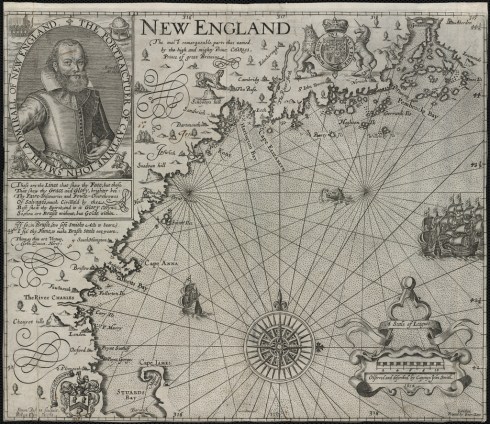
As there was constant competition for colonial territory in North America, French and Dutch maps also depict New England and its waters in detail.  Dutch cartography was the most advanced in Europe in the seventeenth century, and Dutch mapmakers issued a succession of “Nova Anglia, Novum Belgium et Virginia” maps from the 1630s, including that of  William Blaeu below.  Despite its distinct orientation, Cape Cod (or Codd) is immediately recognizable, and it is equally prominent in two late seventeenth-century English maps.  The last map below, published by John Seller in 1679, is entitled A Chart of the Sea Coasts of New England, New Jarsey, Virginia, Maryland & Carolina from Cape Hatteras to Cape Cod.  European cartographers clearly had a grasp on southern New England by this time, but northern New England, most especially Maine, remained elusive.

In the eighteenth century, everything intensified:  competition for empire, mapmaking technology, and settlement, consequently we see quite sophisticated political and navigational maps, like the detailed charts of the Atlantic coastline by the Swiss-born cartographer Joseph Frederick DesBarres, produced for his 4-volume atlas American Neptune (1777-1781).  The marine galleries at the Peabody Essex Museum feature a blown-up version of the DesBarres charts, revealing their intricate detail much more effectively than is possible here.


By contrast, London publisher Carington Bowles’ “pocket map”, also issued in the Revolutionary era, emphasizes the Inhabited parts of New England (Library of Congress).
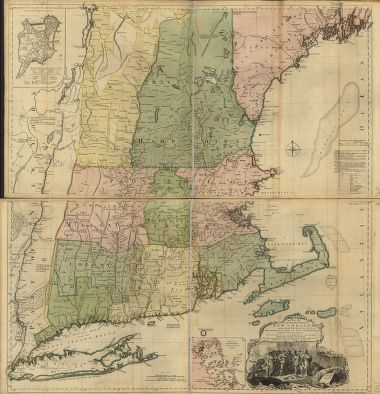
From Ruscelli to Russell.  After the Revolution, New England endures as an assemblage of states rather than colonies.  The John Russell map of 1795 illustrates the “Northern or New England” states of America, and the District of Maine, just prior to the boundary settlement between America and Great Britain.

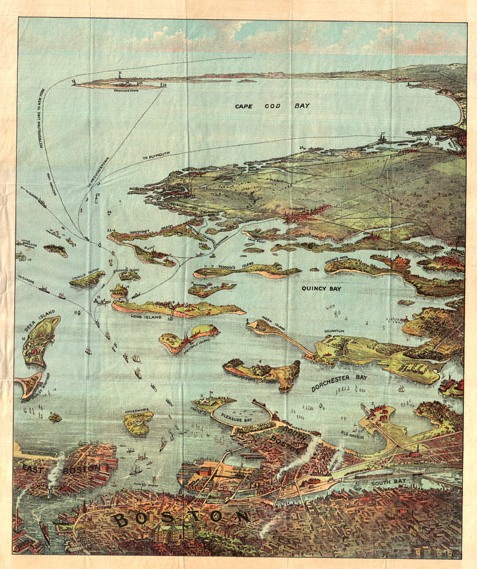
And finally, a completely different view of the Cape, from a century later and the golden age of  “bird’s eye” maps:  looking southward from Boston.

Royal Roses

I am a very casual collector of early and mid-nineteenth-century pottery, and have gone through different phases of interest and intensity of interest over the years:  simple white ironstone, creamware, red (pink) transferware, children’s plates.  I still have some of the latter, but have sold or given away everything else.  Along the way, the one type of pottery that I have not tired of are painted pearlware pieces in the “King’s Rose” or “Queen’s Rose” pattern, made in England in the first half of the nineteenth century for the American market.  Another variation, red and green without the lustre band, is called “Adams Rose” after the manufacturer, and sometimes these patterns are referred to as “Gaudy Dutch” or “Gaudy Welsh” as well.  I like these pieces (mostly plates) because they are painted, as opposed to transfer-printed; this makes them somewhat less common, but much more difficult to preserve.  I rarely come across one with perfect paint and when I do its price is more than I am willing to pay.  In their day, however, I think that they were basic dinnerware:  when I was digging out an herb garden behind my kitchen ell a decade ago I uncovered shards of the same patterned plates I had in my china cabinet!

So here are some of my pieces, which are generally tucked away on shelves and in corners; these plates are yet another floral motif that my husband only tolerates.

And here are some pieces that I do not possess but would like to:  two coffee pots, one in the King’s Rose pattern (which sold at Christies several years ago) and another in the more delicate Queen’s Rose pattern, along with a very exuberant teabowl and saucer from Patrician Antiques.


The Beginning of Branding

About two-thirds of the way through my summer graduate course on the Expansion of Europe in the early modern era we have already identified three examples of early branding, at least a century before this modern form of advertising is supposed to have been invented.  First, we have the logo of the Dutch East India Company, very visible on all Company ships from the early seventeenth century, then we have the brand of piracy, the immediately-recognizable skull-and-crossbones, and last but not least, Josiah Wedgwood’s abolitionist medallion, first appearing in the later eighteenth century in Britain and then crossing the Atlantic to appear in American anti-slavery materials.

One of the world’s first multinational corporations, organized for long-distance trade to the Indian Ocean and beyond, the Dutch East India Company (Vereenigde Oost-Indische Compagnie or VOC) became the chief importer of Asian goods and wares into Europe in the seventeenth century, opening the doors that Salem ships would sail through two centuries later.  The Dutch were the only Europeans that the Japanese would trade with, and their close commercial connection is evidenced by these two items:  an eighteenth-century hand-colored woodblock print (with the VOC logo clearly visible on the pale flag in the center) and a late seventeenth-century Arita charger made for the European market (from Christies):

Everyone is familiar with the pirate flag, and I wrote an earlier post on its early history.  The flag below, dating from the later eighteenth century, is from the Museum of London’s ongoing exhibition Piratesthe Captain Kidd Story.  This logo’s evolution from piracy to poison is another story altogether.

And here is another famous eighteenth-century logo,one of the first political brands and a transatlantic one at that:  the pioneering industrialist Josiah Wedgwood’s Am I Not A Man And A Brother medallion, made for the Society for the Abolition of the Slave Trade in the 1780s.  It became very fashionable and effective in Britain, and crossed the Atlantic after 1800.  Below is an original Wedgwood slave medallion from the Victoria & Albert Museum, and a woodcut illustration from John Greenleaf Whittier’s 1837 abolitionist poem Our Countrymen in Chains (Library of Congress).

These examples certainly predate modern advertising, but I think we can go even further back to see the origins of branding, at least to the emergence of printing and printers’ trademarks, or devices, in the fifteenth and sixteenth centuries.  Unique devices were fashioned by printers as marketing tools in this competitive new industry, and discerning buyers/readers would look for established marks.  The dolphin and anchor device of the famous Venetian printer-publisher Aldus Manutius certainly helped to establish his “brand”, but my favorite device is the cat and mouse (rat?) mark of his fellow Italian printer Melchoirre Sessa (fl. 1510-35).

Sources of Devices:  “First Impressions” Digital Exhibition at the John Rylands Library of the University of Manchester (Manutius–you can also make your own mark there) and the University of Florida’s Printers’ Devices Database (Sessa).


Cars at the Codman Estate

I went out to Historic New England’s Codman Estate in Lincoln, Massachusetts this weekend to view what must have been hundreds of antique automobiles parked in its surrounding fields.  As all of you in this area know, Sunday was a hot and bright day, and all that chrome seemed to make it hotter and brighter!  I liked the juxtaposition of the twentieth-century cars with the eighteenth-century house; the Codman house, alternatively known as “The Grange”, was built around 1740 but considerably altered in the 1790s, so that it looks like a proper (though a bit boxy) Salem Federal house to an amateur architectural historian such as myself.

I am sorry to disappoint antique automobile aficionados, but I arrived a bit late and wanted to take as many photographs as possible so I didn’t gather that much information about the cars.  This is really a shame, as their owners (all men, as far as I could tell) were extremely eager to tell onlookers all about them—both the history of the car and their history with the car.  I wish I had had more time to hear every car tale.  For the most part, except for a few Jaguars and MGs, this was an American car meet-up:  all models of Fords, Studebakers, Hudsons, Packards, Cadillacs. Lots of trucks!  I did see a few original Beetles, but the only older BMW was decidedly late for the party and turned away.

Not a great picture, but very representative of the day:  great variety and gleaming chrome.

I kept checking back, but I never saw this guy, only his legs.

  For some reason, I was particularly taken with all the trucks on display. Vintage trucks are so much more attractive than the behemoths on the road today! This early REO truck got a lot of attention (I liked its wheels).


Lots of big, LONG mid-century American cars, both convertibles and hard-tops.  The Thunderbirds seemed particularly numerous and beautiful, both inside and out.

My very favorite (despite Mr. Nader), the Corvair, and a perfect Packard.