Tag Archives: Antiques and Collectibles

August Americana Picks

August is the season of Americana offerings at auctions and antique shows, and I have my eyes on a few lots in upcoming auctions at my favorite regional auctioneers.I really don’t “need” anything, but that has never stopped me from looking, pretty much everywhere I go, but especially through online auction catalogs and at previews and shows. What am I looking for? I’m always entranced by transferware, even though (or perhaps because) I sold off my own collection of pink a few years ago. Creamware, pearlware and mochaware. MAPS, especially schoolgirl maps. SIGNS, Salem especially, but not necessarily. Fancy chairs, always. Interesting paper. Anything with an unusual texture or history. In the past, Federal card tables: they are going for a song now but I simply have too many. So here is what is tempting me from sales coming up over the next week or so at Northeast and Skinner Auctions.

at Northeast:

August American TT

August Americana Colonial Cupboard Northeast

August Americana Ships Passage 1817

August Americana Salem Harbor Soup Plate

Copeland Spode’s Transferware Tissue Patterns; Colonial Cupboard made in Hudson Valley, New York;  Ship’s Passage for the Brig “Ceres” of Salem, signed by President James Monroe, 1817; English creamware soup bowl (one of a pair–the other features Nantucket Harbor) decorated with green enamel and black transfer print of Salem Harbor.

At Skinner:

August Americana 1 Skinner

Americana Auctions Metamorphosis Skinner

August Americana Eagle Print Skinner

August Americana Chairs

August Americana Desk Skinner

A polychrome transfer-decorated Liverpool Pottery creamware pitcher, bearing the name of Captain James Barr, a Salem Privateer whose house is still standing on Lynde Streeet; A Metamorphosis, America or England, 18th century, watercolor and ink on paper depicting Adam and Eve, and a lion changing into a griffin; Framed print of an eagle with an olive branch; Set of NINE fancy chairs with old green paint (it looks black to me, but the description says green); a nineteenth-century schoolmaster’s desk. This last item is a bit rustic for me, but for some reason I just love it. Maybe because it’s almost back-to-school time. Maybe I want to bring it back to school WITH me and carry it around from room to room to bolster my mastery!


Marked by a Witch

I have featured maps on this blog many times: maps allegorical, anthropomorphic, and antique, maps featuring octopuses, spiders, relationships and myriad places and perspectives. An ongoing exhibition of pictorial maps at the University of Southern Maine’s Osher Map Library has inspired me to examine this particular cartographical creation yet again–along with a recent ebay score of one of my favorite local pictorial maps, Alva Scott Garfield’s “Scott-Map of Salem, Massachusetts”. Maps with pictographic elements go way back, but the Osher exhibition is focused on the mid-twentieth century, identified as “The Golden Age of American Pictorial Maps”. I wanted to confirm this chronology in my own mind, so I began perusing the larger collection of pictorial maps at the David Rumsey Map Collection: casual browsing led me down the virtual rabbit hole, of course!  Clearly you can map anything in a pictorial way: plants, animals, commodities, imaginary places, infrastructure and material culture, the past and the present: one of the major reasons the Osher exhibition identifies the mid-twentieth century as a golden age for these maps is the production of so many maps related to the campaigns of World War II, and these are among the most striking maps of this genre. I love global and national pictorial maps (a particular favorite is pictorial-map pioneer MacDonald Gill’s “Tea Revives the World”, produced in the darkest days of Britain’s World War II experience and pictured below), but the more I looked at the Osher and Rumsey maps and my newly-acquired ScottMap of Salem the more parochial my perspective became. Since the golden age of pictorial maps was roughly coincidental with the Salem’s increasing identification as the Witch City, I wondered if this would be apparent on regional and local maps. How often did a witch mark Salem’s place on the map?

Tea-Revives-the-World-Gill

Pictorial Map America 1940 Osher

Two Patriotic Maps from 1940: “Tea Revives the World” by MacDonald Gill and “America–A Nation of One People from Many Countries”, published by the Council Against Intolerance in America, Rumsey Map Collection and Osher Map Library.

Quite often, it seems, though the struggle between Salem’s divergent commercial and cultural identities is also evident on local pictorial maps from the mid-twentieth century. Situated between the big shoe representing Lynn’s characteristic industry to the south and the fishermen of Cape Ann to the north, Salem is represented alternatively by either the House of the Seven Gables or a broom-mounted witch, and sometimes both. Coulton Waugh’s beautiful map of “Cape Ann and the North Shore” (1927) identifies Salem with the Gables and the famous ship Hazard, but over the next several years the witch appears on Griswold Tyng’s illustrated Map of the Eastern United States (1929), Harold Haven Brown’s Picture Map of Massachusetts (1930) and Elizabeth Shurtleff’s very detailed map of Massachusetts, “the Old Bay State” (1930). One of my very favorite pictorial maps, Raymond Lufkin’s “Old Massachusetts” produced for The House Beautiful in 1930, is focused on the state’s architectural heritage, so witchcraft is literally marginalized (along with another notable event in Salem’s history, the landing of the first elephant in North America). Surprisingly there is no witch on Paul Spener Johst’s 1931 picture map of Massachusetts (just a BIG pilgrim), but the increasingly-familiar figure returns on Elmer and Berta Hader’s cartoon map of Massachusetts published in 1932, from their Picture Book of the States. From that point on, the flying witch marks the spot of Salem on most pictorial maps. By the time we get to the end of the “golden era”, Salem is firmly established as the Witch City on Ernest Dudley Chase’s official travel map of Historic Massachusetts, and the “Scott-Map of Salem” can make the rather whimsical claim that “aviation started in Salem”.

Pictorial Map North Shore 1927 Osher

Pictorial Map US Tyng 1929 Rumsey Map Collection

Pictorial Map Massachusetts Brown 1930

Pictorial Map Shutleff 1930

Pictorial Maps House Beautiful 1930

Pictorial Maps House Beautiful detail Salem 1930

Pictorial Map Massachusetts Johst 1931

Pictorial Map Haders 1932 Rumsey Map Collection

How Salem is marked on the map, 1920s-1960s: ABOVE: Coulton Waugh’s map, 1927; details of Tyng US Pictorial map, 1929, Brown “Picture Map“, 1930, and Shurtleff map, 1930; “Old Massachusetts” published by The House Beautiful, 1930; Johst map of Massachusetts, 1931; Hader pictorial map of Massachusetts, 1932; BELOW:  Ernest Dudley Chase’s Historic Massachusetts, “A Travel Map to help you feel at home in the Bay State”, 1957 (published by the Massachusetts Department of Commerce) and Alva Scott-Garfield’s “Scott-Map of Salem, Masschusetts”, 1960.

Pictorial Map Mass 1957 Chase

Pictorial Map Scott-Salem 1960

Save

Save

Save

Save

Save


What She Left Behind

It’s an intriguing challenge to characterize people by what they left behind, and potentially a foolhardy one.Yet sometimes (actually often) I can’t help myself. While cleaning out my study just yesterday I came across one of my favorite little books, Old Salem Gardens, an illustrated historical and horticultural tour of Salem published by the Salem Garden Club in 1946. At its end is a poem: “Invitation to a Certain Garden at 43 Chestnut Street, Salem, For B.H.”: Enter here slowly. Haste has no part or lot/In this so lovely spot, Peace and tranquility/Possess it wholly. Here sunlight falls/ Gently, where branches lean/Over cool walls. Light touches lucent green/ Pure red and mystic blue, Pearl-pink and azure, old/Lavender,—fold on fold, Curve on curve, line on line/Making a pattern of Perfect design……. The poem goes on, and the “B.H.” to whom it is dedicated is the owner and gardener of this “lovely spot”: Bessie Cushman Ingalls Hussey, the “tall and willowy” lady who contributed the Chestnut Street garden history to Old Salem Gardens. More than a decade ago, I wrote an article about the garden at 43 Chestnut Street for the Journal of the New England Garden History Society, but its focus was more on the garden’s designer, the prominent, Olmstead-trained landscape architect Herbert J. Kellaway, than Mrs. Hussey. Yesterday I was looking at my files from this research and found myself a bit more curious about the client. Mrs. Hussey’s biographical facts were relatively easy to find: though born in Canada, she grew up in New Bedford, with many ties to Martha’s Vineyard through her mother’s family. She married into a prominent North Shore family in 1897, and spent the first half of her married life at the ancestral home of her husband, John Frederick Hussey, in Danversport. In 1925 the Husseys sold this large brick mansion, called Riverbank, to the New England School for the Deaf, apparently well below its appraised value, and also established an endowment for the school. They left Riverbank (now condos, of course) behind and moved just down the road to Salem, immediately commissioning Kellaway to design a walled garden behind their new/old house at 43 Chestnut Street.

Hussey House Riverbank

Hussey House 43 Chestnut

Hussey Garden Plan

Hussey Garden 1925-26

Hussey garden rear view 1930s

Hussey Garden 43 Chestnut Street

Riverbank in the 1890s and the House and Garden at 43 Chestnut Street in the 1920s and 1930s from the collection of the present owner and the Trustees of Reservations.

Her contributions to the Salem Garden Club and other local organizations (the D.A.R. and Temperance society among them) testify to Mrs. Hussey’s assimilation into Salem society, and we can get a glimpse inside the house as well as out through some of the items that she purchased from her Edgartown relatives, the Morse family, and others that derived from the North Shore. Several of her possessions appeared as lots in a Northeast auction a couple of years ago, including a Morse highboy and weathervane, and some wonderful etchings by her Chestnut Street neighbor Frank Benson. I love the bookplate! These material mementos of Bessie Ingalls Hussey show that at the very, very least, she had great taste.

Hussey Morse Chest

Hussey Morse Sign

Hussey painting Lester

Hussey Eagle Benson

Hussey bookplate Benson

Northeast Auction lots from the estate of Bessie Ingalls Hussey, 2013, including a Massachusetts highboy c. 1750 from her Morse relatives, a Gabriel weathervane from the Stephen Morse boatyard in Edgartown, a painting of Gloucester Harbor by William Lester Stevens, c. 1921, and two etchings by Frank Benson inscribed to Bessie Ingalls Hussey, 1933.

Save

Save

Save


Grads and Hangtags

A very busy day yesterday, with Salem State’s commencement in the morning and the commencement of the Derby Square Flea salvage Art Market in the afternoon. There is very little to tie these two events together besides my attendance (and that of a few other people) but at the end of the day I was left with a lasting impression not only of commencement but also of creativity, on the part of both graduates and vendors! I’m going to spare you all of my graduation pictures but I wanted to showcase just a few of the extremely creative mortarboards on display at the morning graduation ceremony–I’ve really seen the practice of embellishing mortarboards explode over the last few years and this year it seemed like there were more than ever: the usual glitter and flowers and family names but also more inventive and inspirational projections (or recollections?) Below are two creations of new History grads, who I am very partial to of course, but it seemed to me that each and every discipline was well represented by this trend.

Commencement

Commencement 3

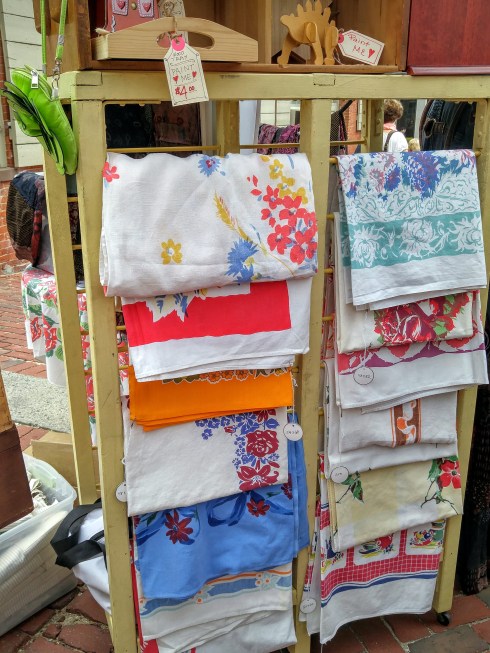
And on to the market…..which was obviously a huge success. Great vendors–lots of vintage collectibles and clothing, art, and up-cycled creations. It seemed to me that there was a lot of quality vintage hardware and textiles–the latter cleaned and pressed to perfection. I was a bit bleary from the morning’s festivities so was not really the purposeful picker that I generally am at these venues, but I did buy a very nice painting and marshaled all of my remaining strength to take some pictures. I’m sure that I will be back to form for the next market: on June 18.

Commencement 5

Commencement Collage

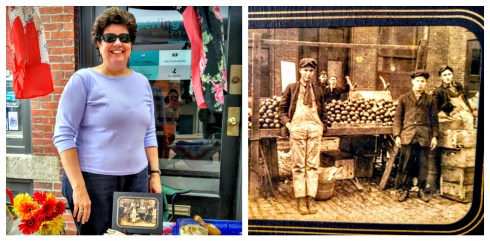
Here we have a proud vendor standing in the very same spot that her grandfather (on the right) had his stall when Derby Square was a food market!

Commencement 6

Commencement 17

Commencement 8

Commencement 10

Commencement 9

Commencement Collage 2

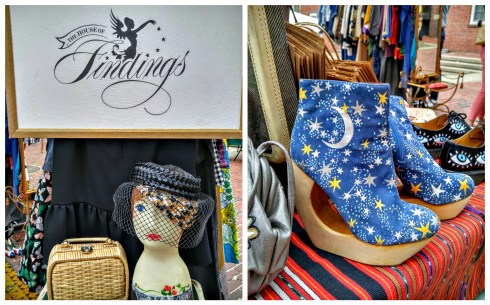
Very eclectic offerings.

Commencement 14

Commencement 18

The cars were not for sale but the books were–WHEN KNIGHTHOOD WAS IN FLOWER! The pioneering tale of romantic Tudorism: I would have picked this up, but I already have four or five copies, I think.


To Market, to Market

This coming weekend several friends of mine, three ladies who are clever and creative and fierce hunter-gatherers all, are launching a new endeavor, the Derby Square FLEA Salvage ART Market, a monthly pop-up venue featuring equally creative vendors of art, vintage and salvaged goods in both original and up-cycled form. The Market will be held every third Saturday from May through September in Salem’s venerable marketplace, Derby Square. For this first Market, there will be 23 vendors, all displaying their wares under perfect white tents, along with music and classic cars, befitting May’s launching theme of rev your engines. If you visit their wonderful website, you will see that each monthly market has its own theme, including July’s bicentennial in recognition of the anniversary of the Derby family’s donation to Salem of the land previously occupied by their majestic Bulfinch mansion (with the proviso that it remain commercial space). So this Market, like the weekly Farmer’s Market and all the enterprises along the adjacent Salem Marketplace across Front Street, honors the city’s past and present.

Derby Square Market Poster

Derby Square Poster

Derby Square Banner Sepia

Derby Square FSA is an invitation-only venture: these ladies have been “shopping” for their vendors for a year! There will be no witch kitsch in Derby Square on these summer Saturdays: think Brimfield rather than Haunted Happenings. Their vendors are listed on the website and the Market’s Facebook page, and I picked out a few representative items for a preview. I was happy to hear that my friend and neighbor Racket Shreve, a noted marine artist, will be selling cards and prints on Saturday, from the back of his 1962 Willys Jeep (most appropriately).Derby Square Market Collage

Derby Square Ashley Procopio Jewelry Packaging

Shreve Studio wall

Vintage handkerchiefs from Verve Design, Globe light from House of Champigny, Chair by 8 by Design (before it got a great seat), Soap from My Sweet Soap, Jewelry maker Ashley Procopio’s perfect packaging, Racket Shreve’s studio.

Like so many events and organizations in Salem (excluding all the witchcraft profiteers, of course), Derby Square FSA is a labor of love for the city and all it has to offer. Of course its organizers (who are again, full disclosure, my friends) are operating an enterprise, but they are also offering a service and a resource. Again, let me direct you to the amazing website which offers up a wealth of information not only about the Market but also about Salem: it should be bookmarked by visitors and residents alike. I’ll let them speak for themselves as they explain their vision for the transformation of Derby Square, the “heart of the city”, into a: a vital marketplace which showcases and connects what Salem is known for around the world–art and beautiful old things in a vintage American city.

Derby Square 1855 Harpers

Derby Square Market PC 1910

Derby Square Salem

Derby Square: 1855 (from Harper’s New Monthly Magazine), circa 1910, and this past weekend.

Derby Square FLEA salvage ART, a monthly pop-up market. Third Saturdays 10-5, May-September, Derby Square, Salem, Massachusetts, commencing MAY21!

http://www.derbysquarefleasalvageart.com/


What to do with my Stereoviews?

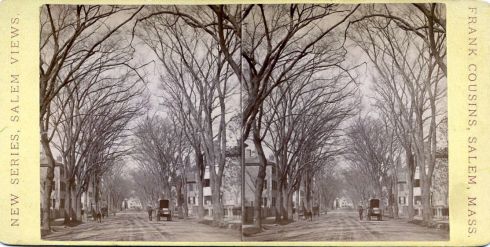
I’ve been a collector of sorts for much of my life but I never collected historic photographic images until I started this blog: I quickly realized their power to tell stories and provide context in this, our digital age. So I started buying some Salem images, mostly stereoviews, which were produced in vast quantities in the later nineteenth century. There were about six or seven major publishers of stereoviews here in Salem at that time, but I’ve focused almost all my collecting efforts on images associated with Frank Cousins, as either photographer or publisher. I just completed my collection of his sentimental “Salem in 1876” views, encompassing nearly every corner of central Salem. Now I’ve got a (shoe) box of stereoviews and I’m not quite sure what to do with them.

Stereoviews

Stereoviews 2

Steroview Chestnut Street Cousins

Frank Cousins published views taken both up and down Chestnut Street and all over the city, documenting “Salem in 1876”.

Stereoviews are relatively easy to acquire, especially of a city like Salem which has been selling its image, in one way or another, for quite some time. They turn up online very frequently and I always find them at the larger flea markets and paper shows. My collection is pretty focused on Cousins, but it also has a few views that I have never seen anywhere else, including a great (though completely unattributed and undated) view of Front Street from Washington Street and a rather unusual (forested!) view of the South Church that stood across Chestnut Street from my house for nearly a century. This McIntire masterpiece burned down in 1803: I’m trying to gather as many images of it so I can glean its impact from every possible perspective. My verdant view is contrasted with a more typical image of the church, from the best source for digitized stereoviews: the Robert N. Dennis Collection of Stereoscopic Views at the New York Public Library (where you can make “stereogranimators”).

Stereoview Front Street Salem

Stereoview Second Church Tilton

Stereo South Church Salem NYPL

(Stereo)view of Front Street, ?date, ?photographer); the South Church on Chestnut by Peabody & Tilton, c. 1875 and Guy & Brothers, c. 1884, Dennis Collection, New York Public Library.

Obviously I have a predilection for streetscapes but I like some (not all; some are creepy) of the more intimate, “up close and personal” stereoviews too. I’ve seen quite a few of people just standing outside their houses, being captured for posterity. A double dose of daily life. I love this image of a Salem Willows summer cottage with its residents, all ready for summer. This is not mine, unfortunately, but from another great source of stereoviews: the Center for Lowell History at the University of Massachusetts at Lowell Libraries.

Stereoview Juniper Point UMASS Lowell SP

“View at Juniper Point, Salem Neck, Mass.”, n.d., Center for Lowell History at the University of Massachusetts Lowell Libraries (the original Willows cottages were built for Lowell residents who wanted to summer on the coast).

So again, what to do with those stereoviews that I do possess? Ultimately I will leave them all to the Salem State University Library’s Archives and Special Collections, because what Salem needs is a Center for Salem History there, as the Peabody Essex Museum ceased its historical-society function long ago. But in the meantime, I’d like to find a more clever and creative way to preserve and display them. I’d like to get them out of the box! I guess I could frame them in some interesting combinations and create a gallery wall, but that’s about the extent of my creativity. Brass floating frames? Display them with a special “twinscope” at hand like this cool exhibit from just last year, Syracuse in 3-D (1860-1910)? I’m open to suggestions, because I do think there is something very engaging–both aesthetically and historically– about images in multiples. As evidence, I give you this beautiful invitation to the Pickering House’s annual garden party by Salem artist Racket Shreve, paired with Cousins’ stereoview, of course.

OLYMPUS DIGITAL CAMERA

Stereo Pickering

Stereoview Pickering House Cousins 1876

Scene from the interactive “Syracuse in 3-D” exhibit by Colleen Woolpert (+ more here); Racket Shreve’s quatre-Pickering House invitation; Frank Cousins’ “Salem in 1876” stereoview of the Pickering House.


Scent of a Queen

While I was looking for spring wine concoctions in A Queen’s Delight the other day I came across a recipe for “Queen Elizabeths Perfume”: Take eight spoonfuls of Compound water, the weight of two pence in fine powder of Sugar, and boil it on hot Embers and Coals, softly, and half an ounce of sweet Marjoram dried in the Sun, the weight of two pence of the powder of Benjamin to make a sweet, long-lasting perfume. As you can see, other delights are in there, including a rose and cypress perfume supposedly utilized by her brother Edward, and a toothpaste made of Mother of Pearl.

Queens Delight 4

This herbal scent seems a bit more complex (and long-lasting) than Elizabeth’s other perfume, recorded in C.J.S. Thompson’s Mystery and Lure of Perfume (1927) and the inspiration for the “perfume garden” designed by Laurie Chetwood and Patrick Collins which won a Gold Medal and the title of “Most Creative” at the 2009 Chelsea Flower Show. I wish I had seen this garden–which presented the evolution of Elizabeth’s perfume from plant to bottle in a “polysensorial” way–but we can all buy a bottle of the finished product at the Historic Royal Palaces gift shop (oh no, they only ship to the U.K). I think I might prefer the marjoram-based scent anyway; rose damask is a bit cloying.

Scent of a Queenp

PerfumeGarden2009

Perfume Garden Sketch ChettwoodArchitects

Elizabeth Perfume HRP

Sketch and photograph of the award-winning Perfume Garden, 2009, from a portfolio here; Elizabeth’s inspirational rose damask eau de toilette, available (in the U.K.) here.

Speaking of cloying: neither of these perfumes contains the exotic ingredient found in so many recipes for scented sachets, pomanders, and waters in the sixteenth and seventeenth century: musky secretions from the anal glands of the civet cat (not a cat at all), which could mask all unpleasant odors and serve as an aphrodisiac. Shakespeare gave King Lear a civet reference–Give me an ounce of civet, good apothecary, to sweeten my imagination–but a century later it was fortunately out of fashion if Samuel Cowper’s rhyme is any indication: I cannot talk with civet in the room, a fine puss-gentleman that’s all perfume.

Elizabethan Perfume Collage

Barbier Elizabethans 1928

Another perfume recipe from A Queen’s Delight and an Elizabethan perfume bottle from the “Cheapside Hoard” and the Museum of London; the Elizabethan pouchoir print by Georges Barbier from Richard Le Gallienne’s Romance of Perfume (1928).


Lincoln’s Laboratory

I’ve been digging around in bins and folders for scraps of paper for as long as I can remember, and I do recall one item that caught my attention years ago: it was an envelope with a still-bright print of Abraham Lincoln depicted as some sort of wizardly chemist, an alchemist, I also recall thinking, in the midst of a rather wordy laboratory. It had a sticker marked $5 on it which struck me as quite steep at that time. Now I see that this same envelope fetched $2600 at a recent auction! The envelope, produced by the Salem stationery and publishing firm of G.M. Whipple and A.A. Smith (1860-1875), has become a highly-coveted example of Civil War propaganda, and I clearly missed out.

Union Alchemist

Whipple and Smith were not only showing their colors; they were marketing a relatively new product: the envelope itself. Before 1851 U.S. postage was charged by the sheet, so people simply folded their letters with sealing wax and mailed them off. In that year a flat postage rate was introduced for mail under a half-ounce and traveling less than 3,000 miles, so protective “covers” were introduced, which became patriotic covers a decade later. More than 10,000 embellished envelopes were produced in the North during the Civil War, much less in the South. They became collectible items even during that time, as many survive unaddressed—like the one I saw some time ago and those below. I can see why the “Union Alchemist” envelope is coveted today: its image and message is a bit more intricate than the majority of pro-Union covers I have seen–many featuring Jefferson Davis swinging from a rope (actually he is there, in the upper left-hand corner, in a specimen jar, next to General Beauregard).

Union Alchemist 3

Lincoln is writing prescriptions in a laboratory full of his distillations, including pure refined national elixir of liberty and metallic soap for erasing stains..for the southern market; he is not only the Great Emancipator (and the Great Distiller) but also the renowned rebel exterminator. It’s such a great image and item: what was I thinking years ago when I passed it by? I’ve found quite a few more in auction and historical archives, but none available, for $5 or $500: this is definitely one that got away, but I did catch a Salem octopus!

Lincoln Envelope Hakes Auctions

Lincoln's Laboratory PMA

Union Alchemist 2

Union Alchemist 5 Cowans

Union Alchemist 8

Union Alchemist Bangor

Civil War Cover

Whipple & Smith’s “Lincoln’s Laboratory or the Union Alchemist” covers, from Hake’s Americana & Collectibles, The Helfand Collection at the Philadelphia Museum of Art, The John A. McAllister Collection at the Library Company of Philadelphia, Cowan’s Auctions, PBA Galleries, and the Bangor Historical Society.


A Witch Cake for Early April

Those who are familiar with the established narrative of the Salem Witch Trials will recognize the reference to a “witch cake”, in that case concocted of the urine of the afflicted mixed with rye meal and ashes, baked in cake form and fed to a dog with the hope that the beast would somehow reveal the name of the malevolent witch. In 1692 Tituba assisted Mary Sibley in the preparation of a witch cake in order to identify the person(s) responsible for bewitching the young girls in Samuel Parris’s household, an act that would later be used to condemn her. In Salem the witch cake was clearly used as a form of counter-magical test; while in Britain it was more commonly used as a defensive amulet against the bewitchment of a person or household. There are many surviving examples of anti-witchcraft charms and amulets in British collections, everything from pierced “hag-stones” to very familiar horseshoes, but more perishable cakes are hard to find. But here is one, which doesn’t look very perishable at all!

Witch cakes in April Card

This witch cake, which dates not from the seventeenth but rather the twentieth century, is part of the large (around 1400 items) collection of charms, amulets and talismans accumulated by British folklorist Edward Lovett (1852-1933), who seems to have been more interested in the magical artifacts and beliefs of his own time than those of the past. Lovett was an amateur folklorist in a time when that pursuit was being professionalized: he worked as a bank cashier by day and walked the streets of London by night, listening to the stories and purchasing the personal charms of street hawkers, sailors, and washerwomen, or whoever came upon his path armed with “protection”. (You can follow his steps here). This research formed the basis of his fascinating book Magic in Modern London (1925), and his collection can now be found chiefly in three institutions: the Pitt Rivers Museum at Oxford University, the Cuming Museum on South London (which has been closed due to a fire, but many of its collections have been preserved and digitized), and the Wellcome Museum. The items below, including a cow’s heart stuck with pins and nails (upper right-hand corner, used by a dairyman as a talisman against a man he believed had put a curse on his cows), and the two anti-witchcraft charms, the ram’s horn with attached key and hag-stone below, all come from the Cuming collection, along with the more familiar charms. Acorns abound, to guard against lightning, and the wishbone wrapped in blue and red ribbon is almost a work of art!

Charm Collage Lovett

Lovett Acorn Charm

Lovett Wishbone

And below are some Lovett amulets purchased from British soldiers who fought in the First World War: hand votives guard against the “evil eye”, geological charms protect the wearer from a host of evils, and black cats were actually lucky in some parts of Britain, unlike the rest of the world.

L0057378 Amulet brooch in the shape of a black cat, England, 1914-191

Back to the Witch Cake, about which I don’t have too much information. There is Lovett’s own description: around about Flamborough Head [in Yorkshire], “witch cakes are to be met with in almost every cottage. These are circular-shaped, with a hole in the middle and with spikes projecting on all sides. If you hang one up in your cottage and once a year burn it and replace it with another [presumably during Holy Week, or the first week of April], you will have good luck. But no recipe!


Miss Brooks Embellishes

I am featuring yet another new-to-me Salem artist today, Mary Mason Brooks (1860-1915), who worked primarily in watercolors over her career. Mary’s biography is spare: the obituary in the 1915 American Art Directory consists of only two brief lines: a painter in water colors, died September 20, 1915. She was born in Salem, Mass, studied in Rome and Paris; exhibited in New York and Boston, her home being in the latter city. I can fill in these lines a bit: she was born into an old and well-connected Salem family, grew up on Lafayette Street, and her father was the long-time Secretary of the Essex Institute who also published quite a few antiquarian pieces over his long career. After her training in Europe, Mary returned to Salem briefly and maintained a studio and school in the famous “Studio” at #2 Chestnut Street among her fellow Salem artists, but she was off to Boston and Jamestown, Rhode Island by her early 30s. She had both family and friends in Jamestown, located right over the bridge (then ferry!) from Newport, where an artists’ colony was emerging and where she eventually died, “suddenly”, at age 55. That’s about it for the written record on Mary Mason Brooks: her works are going to have to embellish her character for us. And there are many: it is apparent that Miss Brooks was no dilettante, but rather a professional, working artist. Most are watercolors: some European scenes, lots of flowers and trees, several structures, the occasional (appropriate for a Salem girl) ship. But the most charming–and in many ways most revealing–work of Miss Brooks that I could find is a book illustrated by her after its publication: a one-off edition of Eleanor Putnam’s Old Salem (1886 & 1899). This charming little book is a collection of previous-published Atlantic Monthly articles written by Harriet Leonora Vose Bates, who preferred to use the pseudonym of her ancestor Eleanor Putnam, published posthumously in two editions. It is basically a series of reminiscences about the stuff of old Salem—shops, schools, homes and things–which Miss Brooks illustrates in her special edition.

Miss Brooks Embellishes Old Salem

Miss Brooks Embellishes Old Salem Collage2

Miss Brooks Embellishes Old Salem Collage

I think it’s pretty gutsy to illustrate a book after its publication, and after its author’s death! And to sign your name right there on the title page! Miss Brooks probably thought her special edition would never see the light of day, but it made its way on to ebay, of all places, a century after her own death. I like the marginalia, which transforms a charming but mere book into something else entirely, but I also feel that I should present some of the artist’s more formal works which were represent her public oeuvre. They testify to a life well-lived, if short, in some beautiful places.

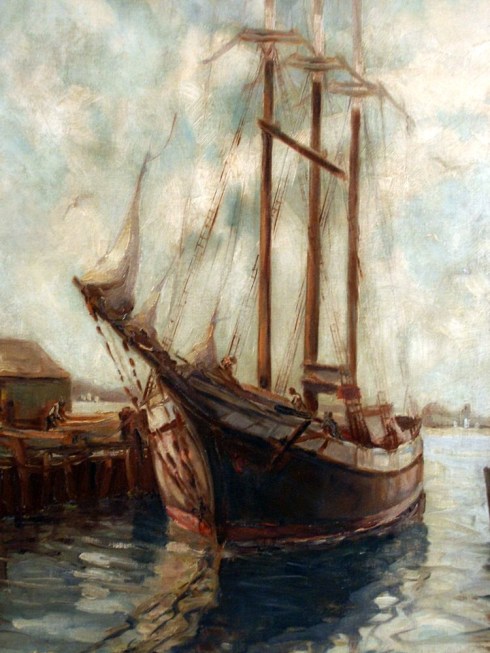
Mary Mason Brooks Salem Schooner

Brooks Garden Poppies

Brooks 3 Viewsp

Mary Mason Brooks watercolor Weston Historical Society

Watercolors by Mary Mason Brooks: Lumber Schooner; Garden of Poppies, Isles of Shoals; Three European Views, Skinner Auctions; and my favorite, a watercolor of the pool at Haleiwa, the Horace Sears Estate in Weston, Massachusetts, Weston Historical Society.