Tag Archives: Antiques and Collectibles

Salem Tokens, and my appreciation

Periodically, but continually, I get tokens from readers of my blog—scanned pictures or stories from old magazines, little pamphlets, scraps of Salem history—which I place in a file for safekeeping with the intent that I will devote one post to each item at some point. This file has grown pretty full, so I wanted to expose some of these items to the light of day. I’ve reserved some pieces for their own special posts, but I’m not sure I can contextualize all of these treasures so better just to get them out there as maybe someone else can! I’m so appreciative of all these gifts, and will be donating them to a public repository in due time, but for now I’m holding on to them, because I never know when inspiration will strike, or some other little piece of paper will come along to amplify something I already have. So here we go, perhaps the first of what may become a series of “tales from the files” posts, beginning with a lovely fundraising pamphlet issued by the Essex Institute in 1929, when its directors were seeking to raise the grand amount of $400,000. The focus is on preservation, accessibility, and “remembrance of things past” throughout the pamphlet, which features silhouettes of famous Salemites in the margins and highlights of the collections on every other page. I sense some emerging sentimentality around the old Essex Institute these days, with the prolonged absence of the Phillips Library: I’ve received several items in just the past few months.

Tokens first

Tokens Collage 2

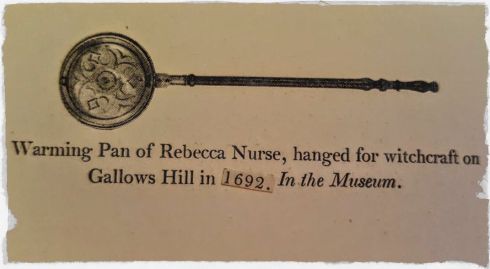
Tokens Nurse

I have quite a collection of little books, souvenirs I suppose, including several of Fred Gannon’s compilations from the 1940s published by Salem Books Co., guidebooks such as the Streets & Homes in Old Salem, published from 1930 to 1953, and leather industry newsletters: I love the photograph of the old tanneries (on Goodhue Street???) which is in the Leather in Salem and Peabody newsletter below, sourced (of course) from the Essex Institute.

Tokens 5

Tokens 4

Tokens9

Salem Tokens

Tokens Leather Collage

Token Tannery

My own postcard collection has been supplemented by gifts from readers, encompassing cards from all eras, undivided and divided backs, dignified black-and-white and cheerful chromes, depicting mostly Salem buildings—people don’t send me witches, except for very close friends! Last but far from least, I have been privileged to receive quite a few family photographs–scans of course–including one of my very favorites below: some lovely ladies and the bride at a Ropes Family wedding in 1898.

Tokens 6

Salem Tokens Lucia Ropes Wedding Day 1890s


Porcelain Propaganda

I’m thinking about Russia this week for two reasons. In a year of big historical anniversaries, we have now arrived at the centenary of the Russian Revolution–which I must say is not getting much play here, or even in Russia apparently! Regardless of how it turned out in the end, this was an extremely consequential event, almost right up there with Luther’s revolutionary Reformation, which has received some serious commemoration across the globe. It is always interesting to me what we choose to remember and what we choose to forget. I’m also thinking about Russia now, because of an event this week sponsored by the Pickering House featuring Ambassador Emeritus Thomas R. Pickering, former US Ambassador to the United Nations (under President George H.W. Bush) and Russia (under President Clinton). The title of Ambassador Pickering’s Thursday night talk is Russia and the United States: Marriage, Separation, Divorce? , which sounds very timely indeed. I have to admit that I’m thinking about Russia for a third, much more materialistic reason too: I recently came upon a trove of porcelain propaganda plates from the first decade of the Soviet Union, and I’m obsessed with both the images and the idea of these “vessels”. The idea is so contradictory: porcelain and propaganda? Porcelain is for the elite, propaganda for the masses: why should these two things ever come together? Apparently there is a utilitarian reason: in the years after the Revolution and Civil War, shortages were great and opportunities for projection were few, but when the new government took over the famous Imperial Porcelain Factory it found a ready supply of blank porcelain plates. Russian artists were mobilized to adorn these “canvases” with revolutionary symbols and slogans, a dramatic departure from the Factory’s previous designs: hammers and sickles rather than gilded flowers. The designs are all so striking: some are symbolic, some folkloric, some futuristic, all vivid. Here are a few examples from the Hermitage, which is opening an exhibition next month titled The Voice of the Time. Soviet Porcelain: Art and Propaganda.

PP Red Man Hermitage

PP Red Genius “Red Man” with “All Power to the Soviets” banner, Mikhail Adamovich and Maria Kirillova, 1921; “Red Genius” with the slogan “We will Emblazon the World with the Third International”, Alisa Golenkina, 1920.

PP Star

PP Large Star with a Shief

PP Eat“The Star”, Mikhail Adamovich, 1921; “Large Star with Sheaf “, Nina Zander, Sergey Chekhonin and L.Vychegzhanin, 1921; “Who Does Not Work, Neither Will He Eat”, Maria Lebedeva, 1920.

PP Stir

PP Cup and Saucer
“Stir” Cup & Saucer, Alexandra Shchekotikhina-Pototskaya, 1920;  “A Hammer, Sickle, and Gear Wheel” Cup & Saucer, Victor Rilde, 1921-22.

Continue reading


Flame-Stitch

For antiques aficionados, August is all about Americana auctions (couldn’t resist all the alliteration!) and there are always Salem pieces to discover. Among the lots of Skinner’s upcoming Americana auction, a late eighteenth-century pole fire screen captured my attention immediately, not just because it was made in Salem, but also because of its flame-stitch embroidery. Flame-stitch is one of my favorite perennial patterns, characterized by its durability and adaptability: it spans the ages (from at least the Renaissance) and can be easily adapted by time and place. It’s somewhat obscure origins–according to the curators at the Victoria & Albert Museum, it is a technique also sometimes known as Irish stitch, Hungarian stitch, Florentine stitch and bargello stitch, the variety of names indicating the uncertainty of its origins–perhaps explains its mutability. It is one of those patterns that can appear both “antique” and “modern”: flame-stitch cushions, in particular, seem timeless.

Flame-stitch Pole Screen Skinner

flamestitch collage

Flamestitch garden pillow

Mahogany pole screen, late 18th century, Skinner Auctions/ Flame-stitch pincushion, late 17th century, Victoria and Albert Museum/ Flame-stitch “Jasper” pillow, Jayson Home/ 18th century flame-stitched pillow, 1stdibs/ a faux flame-stitch pillow in my backyard.

In its modern incarnations, flame-stitch doesn’t necessarily need to be a stitch: the zig-zag, chevron pattern seems to be sufficient for the more general identification. No needle required, pattern without technique. The vibrant contrasting colors of flame-stitch fabrics past have also given way to more tone-on-tone variations of the present. I’ve always wanted to upholstery one of my couches in a flame-stitch fabric, and I must admit that both the Federal-era embroidered version (on the left) and the more contemporary variation (on the right) both appeal to me (although I really love the 18th-century embroidery fabric from a Newport-made slip seat–which might have originated as a pocketbook–AND the early 19th-century French and Lee Jofa chartreuse fabrics below).

flamestitch collage2

Flame-stitch Winterthur

a-woven-flamestitch-panel

Flamestitch Lee Jofa

American Country Federal Sofa, Northeast Auctions/ Southwood Mahogany Flame-Stitch Sofa, Chairish/ 18th-century slip seat upholstery, Winterthur Museum Collections/ Woven early 19th century French flame-stitch panel, 1stdibs/ Lee Jofa watersedge fabric.

Two historic flame-stitch items that often pop up at auctions are men’s pocketbooks or “wallets” and stools. An extraordinary example of the former is included in the upcoming Skinner auction: a later eighteenth-century Massachusetts wallet featuring African-American servants, or slaves, well-dressed but definitely in service. This was featured on Antiques Roadshow a while ago, and so I was not surprised to see it come up for auction (with an estimate of $10,000-$15,000). There are so many (somewhat less singular) examples in museum collections and auction archives that I imagine every late eighteenth-century man walking around with a flame-stitch wallet! For women, there were flame-stitch embroidered shoes, from earlier in the century. Obviously there are endless variations of both the historic technique and the modern pattern, but I think the form that captures the cherished quality of flame-stitch best are bible and book covers, which were also produced in great quantity in the eighteenth century.

Flamestitch wallet collage

Flame-stitch pocketbook bonhams

Flame-stitch purse CH

28.102.17a-b 0002

FS stool collage

Flamestitch Book Cover PMA

Rare flame-stitch Massachusetts wallet featuring African-American figures, Skinner Auctions/ American silver-mounted pocketbook inscribed “Thomas Stubbs”, 1798, Bonhams Auctions/ Flame-stitch pocketbook, late 18th century, Cooper Hewitt Museum, Gift of Mrs. Rollin Stickle/ Flame-stitch Latchet Shoes, c. 1700-1729, Metropolitan Museum of Art/ Early 18th century French fruitwood stool, Bonhams Auctions/ Folk art painted stool with flame-stitch seat, Northeast Auctions/ Pair of mid-century modern flame-stitch benches, 1stdibs/ Bible cover, 18th century, Philadelphia Museum of Art.


A Grandmother’s Gift

I’m almost done with a long stretch of rather intense work, obligations, and events, and feeling grateful to the friends and family who supported me while I was in the midst of it. I should feel grateful more often I think, and so I was trying to expand my present state this morning as I was considering my various “debts” in my third-floor study: and there, sitting on an old family desk (a gift from my aunt for which I am very grateful), alongside some ribbon embroidered with elephants and a hand-carved elephant head (gifts from a very good friend and a former student, to both of whom I am also grateful) lay the most notable benefit of blogging I have received to date: a hand-written manuscript memoir written by Mary Jane Derby Peabody for her grandchildren in 1880 given to me by a lovely lady from Maine who enjoyed my post on the Salem native and artist. It’s a beautiful book: a precious gift to the grandchildren, and also to me.

Old Times

Old Times for Young Eyes is a charming memoir of a Salem childhood, full of family, houses, furnishings, servants, teachers, teas, flowers, gardens, schoolgirl maps, and the fright we were in when there was alarm at night that the British has landed at Marblehead during the War of 1812! She wants her grandchildren to know all about the Derby family, and includes reproductions of her own painting of her childhood home on Washington Street (formerly on the site of the Masonic Temple) as well as the grand but short-lived Derby Mansion overlooking Salem Harbor. With her teenaged years, the setting moves to Boston, and Mary Jane describes that city in the 1820s in both words and pictures–it looks unrecognizable in the latter. I love everything about this book: the cover, the binding, the writing, the personal perspective and point-of-view, the details and the purpose.

Old Times 3

Old Times 4

Old Times Dedication

Old Times Botany

Old Times 2

Old Times Images

Old Times Images 3

Old Times Text

Old Times Images 2 Cover details and dedication…developing her love of botany…..gathering flowers for pressing on Gallows Hill…..Mary Jane Derby Peabody and the Washington Street House of her childhood….the Derby Mansion, “built by Elias Hasket Derby, your great-great-grandfather, in 1780”, Boston notes and drawings.

I’m not quite sure why I’ve waited so long to post on this book; I’ve certainly been grateful since the moment I received it! I suppose it may be because of a note that Mary Jane included on the memoir’s title page: Privately written for the family only by M.J. Peabody AELXXIV 1881. “Privately” gave me pause, as does only, but the book had already left the family’s possession and was acquired by my benefactress at a yard sale. I intend to pass it on to a Salem archive–not sure which one yet–because both its story and its lessons (this is a grandmother’s memoir after all) should be preserved. I particularly like her assertion that it is important for young people to have beautiful things around them, which her life story illustrates.

Old Times Private Publishing

Old Times precious thingsWise words from Mary Jane Derby Peabody (1807-1892).


In-Vested

Yesterday I was treated to a very special tour of the China Trade gallery and basement of the Peabody Essex Museum by a distinguished and generous curator, and while I was able to snap lots of photographs (exhibition items, packing and conservation materials, amazing things in storage, including a whole subterranean gallery of ship models, some in their original Peabody Museum cases) I came away thinking about just one item, a portrait of Captain William Story by the Chinese artist known in the west as “Spoilum” (Guan Zuolin). The Story portrait stuck with me for two reasons. I had just been reading Nathaniel Hawthorne’s “Custom-House” prelude to The Scarlet Letter, which disses Story as one of the venerable figures, sitting in old–fashioned chairs, which were tipped on their hind legs back against the wall. Oftentimes they were asleep, but occasionally might be heard talking together, ill voices between a speech and a snore, and with that lack of energy that distinguishes the occupants of alms–houses, and all other human beings who depend for subsistence on charity, on monopolized labour, or anything else but their own independent exertions. These old gentlemen—seated, like Matthew at the receipt of custom, but not very liable to be summoned thence, like him, for apostolic errands—were Custom–House officers. By all accounts this is an unfair characterization of Story, who was ending his storied maritime career with a post at the Custom House as Weigher and Gauger, but you can read about his long career here. The other reason I was so taken by Story’s portrait is far less weighty: once again I wondered, why is his hand in his vest? This is a portrait by a Chinese artist who probably knew nothing of that western convention—or perhaps Spoilum was such a popular artist precisely because he did.

Story PEM

Story Spoilum

Importing Splendor gallery wall at the Peabody Essex Museum with portrait of Spoilum’s Portrait of William Story, c. 1804; close-up from MIT’s “Envisioning Cultures” website.

Everyone seems to associate the hand-in-vest/waistcoat pose with Napoleon but many such portraits predate those of the little emperor. Why put the hand in this position in an expression of apparent disablement? Or is it cloaked power? Then there are the rather spurious theories of Masonic hidden hands or attempts by the artists to lessen the challenge of rendering hands by painting just one. Apparently it was simply a dictate of genteel behavior, handed down from the ages of Greece and Rome (which explains the pose’s eighteenth-century origins, in that most neo-classical of centuries). If it was a question of gentility, you can see how the pose would appeal to merchants and sea captains, self-made men who perhaps wanted to appeal a bit more polished for posterity.

Piggot

Young Mariner

George_Washington,_1776

Spoilum Cranstoun

Portrait of a Western Merchant

American Sea Captain Dutch School

Ships Model PEM

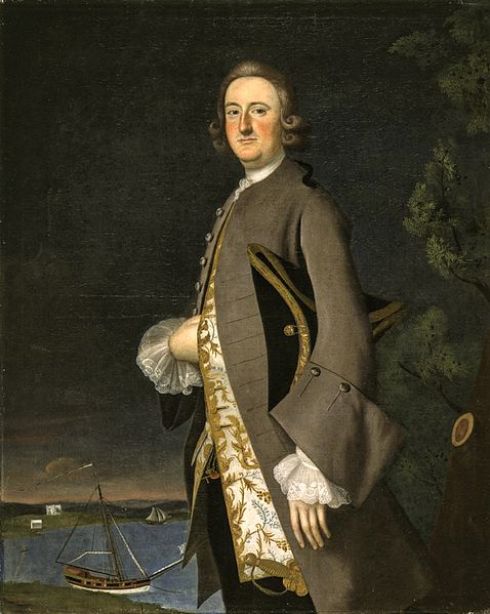
Pre-Napoleon in-vested sea captains (+ General Washington): Joseph Blackburn, Portrait of Captain John Pigott, c. 1752, LACMA; John Durand, Portrait of Young Mariner, ca. 1768–1772, collection of John and Judith Herdeg; Charles Willson Peale, General George Washington, 1776, Brooklyn Museum of Art; Chinese-export Reverse Painted Mirror of Captain John Cranstoun, c. 1785, Bonhams; Spoilum, Portrait of Western Merchant, c. 1785, “Envisioning Cultures at MIT; Portrait of an American Ship Captain (Purported to be Captain John Thompson of Philadelphia who engaged in the China trade), c. 1785, Sotheby’s + in the basement of the Peabody Essex: what a treat!


Black Ships

My title is literal, or descriptive. While the phrase “Black Ships” has a larger historical and cultural meaning, as a term used by the Japanese to refer to western vessels approaching their shores in the sixteenth and nineteenth centuries (with a long stretch of relative isolation in between), in my typical materialistic fashion I’m referring to my latest collection obsession: reverse glass painted silhouette ships. It’s a potential collection, because I haven’t actually collected anything yet, but a particular Salem example has captured my fancy, so who knows what else I might find?

Black SHip Salem 1st dibs

Perseverance Crop19th Century Reverse-Painted Ship Silhouette on Glass Maple Frame, circa 1840, Trinity Antiques & Interiors, 1stdibs.

Love this. I’ve seen lots of reverse glass paintings before, mostly on clocks and mirrors, but this silhouette version is more striking and timeless—I’m going to need to see more. There were two Federal-era Salem ships named Perseverance: one was shipwrecked off Tarpaulin Cove, Naushon Island in Vineyard Sound in 1805; the other had a later (and longer) life sailing to Sumatra. The former ship was memorialized by Italian-born Salem painter Michele Felice Corné in his 1805 painting Perseverance Wrecked near Tarpaulin Cove, and the dashing Salem sea captain Richard Wheatland has a connection to both vessels: he was master of the first Perseverance, and part-owner of the second. I’m not sure which ship is portrayed in “my” painting: obviously the lighthouse is a prominent feature, leading one to assume that this is the first Perseverance, but the lighthouse on Naushon Island was not built until 1817 (but this is an 1840 perspective, perhaps creative license is being taken?)

Black Ships Corne_PerserverenceWrecked

Perseverance Richard Wheatland Salem Michele Felice Corné’s Perseverance Wrecked (1805), and a portrait of Captain Richard Wheatland by the Chinese artist Spoilum (Guan Zuolin), from MIT’s “Visualizing Cultures” site.

I found some super-tacky ship silhouettes from the twentieth century, and some elegant Victorian examples: there seems to be no in-between. I’ll spare you the former, and here are some of my favorites of the latter category, nearly all of them from auction archives, and well-beyond my price range. I think my “collection” might end up being more virtual than tangible!

Black SHip Victory

Black Ship Royal Albert

Black Ships collageH.M.S. Victory, H.M.S. Royal Albert, H.M.S. Foudroyant, another Victory, and View from the Coast of H.M. Ships MarlboroEuryalus.


Bring Back Bicycle Wheels….and Wooden Teeth

One of my favorite photographs of a Salem street shows a block of Essex adjacent to North in the 1890s: the three buildings in the picture are vastly preferable to those that occupy the space now, but what I really admire are the signs, particularly that single bicycle wheel sign in front of Whitten’s Bicycle Shop. Signs were just so much better then; I don’t know what happened. Well, probably cars, along with plastic and neon.

Essex Street Signs

Signs Essex Street Ugh.

Actually I kind of like that Bonchon building, and if you can see (it’s pretty small), this business features not only the standard facade or wall sign but also a small projecting blade sign—an absolutely necessity in the “walking city” that Salem claims to be. Salem does have some really nice blade signs, commissioned by creative and civic-minded business owners who are investing in the look and feel of the city as well as their own enterprises. But there are also too many plastic facade and sandwich board signs scattered about, projecting the message: we’re just here for the Halloween season. Washington Street is lined with blade signs, as is Front, but ye olde Essex—the ancient “highway” of Salem– could do a lot better, in my humble opinion.

Sign Merchant

Signs Front Street

Signs Emporium

I suppose I am a sign snob: trade signs from a century or more ago just seem more creative to me in both their typography and their imagery. I particularly like symbolic signs in which bicycle wheels, keys, watches, boots, glasses, hats, and mortars & pestles advertise bicycle shops, locksmiths, jewelers, shoemakers, opticians, hatters and apothecaries. Key signs seem to be in every antique shop I go into, so they must have been a universal sign for that profession. I’ve seen lots of double-sided clock signs too, but the one below is particularly stunning.

sign key

bicycle collage


Sign Jeweler

Sign Hat Northeast

Competition

Wouldn’t a big white wooden tooth look great hanging from or instead of this Essex Street Dentist’s sign? (maybe the one of the left is a bit scary).

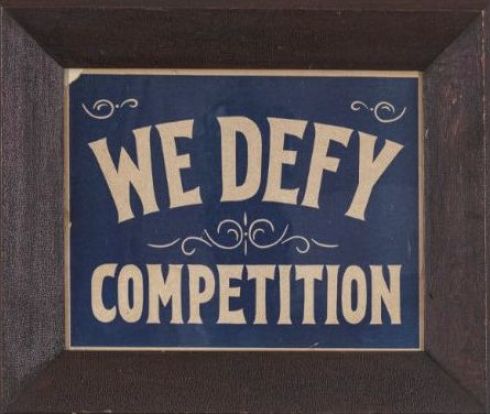
Sign collage 1Nineteenth-century trade signs from Skinner Auctions (key, bicycle wheel, smaller tooth); Architectural Anarchy at 1st Dibs (clock); Northeast Auctions (Hat and “We Defy Competition sign); and the American Folk Art Museum (large tooth).


It began with a Fan

The story of my great-grandparents’ courtship could be more accurately titled “it began in East Boston”, but my point of entry into their relationship is a fan given by Joseph W. McIntyre to Katherine G. Wall in 1896. Their daughter, my grandmother, died a few months ago at age 104 and I came into possession of some of her personal effects, including a box labeled “A. Stowell, 24 Winter Street, Boston” containing a silk and ivory fan with gold accents. Written in the very recognizable script of her sister, my great aunt Margaret (the family historian), is a note indicating that the enclosed was a courtship gift from their father to their mother. I’m sure it was packed away years before Margaret wrote this note, and years afterward. And now here it is in the light of day.

fan-pic-3

fan-pic

fan-pic-5

There’s just one tear in the middle–no telling how that happened–otherwise the fan is in perfect, clean condition. I put it right back in its box after I took these photographs. The cursive script on the box is almost abstract, so at first I thought it read A. Powell, but a little digging revealed that the name of the business was in fact A. Stowell, a prominent jeweler in downtown Boston, which issued a series of trade cards in the shape of a fan advertising its stock of an “elegant variety of fans, constantly on hand and arriving by every steamer from Europe”. every steamer: apparently this was the place to buy a fan in Boston in the 1890s.

fan-stowell-tc-boston-athenaeum

valentines-day-fan

It is not noted by Margaret on which exact day my great-grandfather gave my great-grandmother her fan (Valentine’s Day?) but on October 26, 1896 (the date my grandmother chose for her own wedding) they were married at East Boston’s stately Church of the Most Holy Redeemer. At the time of Joseph’s and Katherine’s marriage, the streets on which they grew up (both named for European ports : Liverpool for her, Bremen for him) were home not only to the predominantly Irish families with whom they were raised but also to more recently-arrived Canadians, Italians and Eastern Europeans. Joseph and Katherine were both born in the United States, but their parents, John McIntyre and Anne Harkins, and John Wall and Margaret Murphy, had all emigrated from Ireland individually and married in East Boston in the 1850s. I like to think of them all hobnobbing with the Eastie great-grandparents of John F. Kennedy, Patrick and Bridget, but I’m sure they were all too busy working (and I’m not sure this image would have pleased my Republican grandmother).

fan-east-boston

East Boston in 1838, after it was assimilated into Boston, and before its explosive growth in the later nineteenth century.

While his father John was a “laborer”, Joseph McIntyre was a bookkeeper for a wholesale grocery in Boston at the time of his marriage to Katherine in 1896: within the next decade he would own his own wholesale business. Katherine and he made the move out of the old neighborhood slightly north to the coastal town of Winthrop, where they would raise four children: Margaret (at left), Joseph Jr., Katherine Jr., and my grandmother Anne (the baby): all pictured below in 1914.

mcintyre-family-1914

The McIntyre Family of Winthrop, Massachusetts, 1914.


The Broomstick Brand Emerges

I was working on two things concurrently yesterday and they merged (sort of): a presentation on emerging civic identity in Renaissance Florence for my grad class and a post on yet-another batch of Salem trade cards from the eighteenth, nineteenth, and twentieth centuries. A lot of time-traveling, but a common theme of projection. Actually the post was supposed to be about candy; I thought I might be able to parlay one lovely colonial trade card into a whole series of Salem-made confections for Valentine’s Day. But no, not enough chocolate and Salem gibraltars are not particularly romantic. So instead I just looked at the emblems on my run of cards and saw an emerging brand and identity for Salem: from a maritime center in the nineteenth century to Witch City in the twentieth, with a few horses interspersed among the ships and broomsticks. This is much too selective a sample to prove anything, but at the very least it illustrates two hypotheses I have about the development of “Witch City” as Salem’s primary civic identity: it came about because of commercial factors more than cultural (or historical) ones, and it really intensified in the 1890s, coincidentally with the commemoration of the bicentennial of the Witch Trials in 1892. Apart from ascribing any wider meaning to this ephemera, I just love to look at it; there’s something about the inclusion of such artistic images and lettering on such everyday items as trade cards and billheads that impresses me: if only our disposable, digital age was interested in leaving as lasting an impression.


A century and a half of Salem commercial ephemera: from seaport to Witch City.

ephemera-1

ephemera-2-1790

ephemera-3

ephemera-4

ephemera-11-1874

ephemera-12-1874

ephemera-13-closeup

ephemera-14-1870s

ephemera-9-1889

ephemera-10-1897

ephemera-8

ephemera-7

ephemera-6

Salem trade cards and billheads via American Broadsides and Ephemera and Salem State Archives and Special Collections.


Salem Interiors, 1896

I came across a book I had never seen before the other day at the wonderful Digital Library for the Decorative Arts and Material Culture (beware, serious rabbit-hole potential here) at the University of Wisconsin, Madison: Newton Elwell’s Colonial Furniture and Interiors, published in 1896. I was doing something rather tedious so of course I put that aside and dug in. The book is not great in terms of information, and there were some pretty serious flaws that even an mere buff such as myself could spot immediately (such as referring to Samuel McIntire as James) but it is a treasure trove of plates, including many photographs of Salem interiors I had never seen before. These photographs are fascinating to me because many of them feature rooms decorated in a mishmash style that preceded the pure period room. Look at the east parlor of the Peirce-Nichols house below, for example: looking quite cluttered and Victorian rather than serenely Federal, with the exception of that beautiful fireside chair. Elwell wants to focus on the period furniture, but his photographs can’t always hide all the contemporary details of its setting.

salem-interiors-1896-east-parlor-pn

salem-interiors-1896-west-parlor-pn

salem-interiors-1896-sideboard-and-chair

salem-interiors-1896-furniture

salem-interiors-furniture-17thc

The sheer (and quite casual) display of Salem furniture from the seventeenth, eighteenth and early nineteenth centuries is a little overwhelming: some of the pictures seem to be taking us into attics (or the storage area of the Essex Institute) where tables and sideboards are lined up in a random fashion. The chair that is featured in the second photograph above, of the mantel of the west parlor of the Peirce-Nichols house, is one from a set of eight crafted by McIntire, one of which sold at a Christie’s auction last week for $15,000 (which seems like a bargain to me, no?) But the 1890s was a key decade in the development of a Colonial Revival consciousness that was both very national and very local: a key decade for the identification of  “Olde Salem”. Consequently along with the eclectic vignettes which mix periods and styles, there are also some “typical colonial” Salem rooms in Elwell’s book, forerunners of the period rooms of the next decades.

salem-interiors-1896-colonial-corner

salem-interiors-1896-typical-colonial-chamber

Plates from Newton Elwell’s Colonial Furniture and Interiors, 1896.