Tag Archives: Anniversary History

A Big Salem History Project, 1952!

I receive gifts from readers of the blog from time to time and they are all very special and much appreciated. A reader sent me a slim, illustrated and bound History of Salem prepared by a “committee of students and teachers of the Salem Public School System” in 1952 several years ago, and I was immediately charmed by it but not quite inspired to post about it. But yesterday I woke up and it was the first thing on (in?) my mind. I think I’m inspired by the end of the academic year and the completion of academic projects, by my own local history project, and by the Salem Quadricentennial planning, or lack thereof. The City has not put a lot of resources or time into planning for Salem’s 400th anniversary in 2026, and there have been meetings only for invited “stakeholders” rather than the general public. A dedicated website went live only last week, and the dedicated coordinator seems largely on her own. I was getting quite depressed about this, especially the lack of public engagement, but last week we came up with a neat (public) initiative at Salem State, so my depression turned into excitement—-and then I thought of this little book.

This little book has a strong voice, and it is a voice from 1952. It really captures the perspective of that year, that moment. Of course, there is the “White Man” and there are the “Indians” and they seem to have a very Thanksgiving-esque relationship. There are entire chapters on civic responsibilities (including a relatively long discussion of TAXES) and “Salem’s Contributions to our Country’s Call.” There are no women, and no one with anything but a very Anglo name, included in the chapter on “Famous Citizens of Salem.” It’s pure unbridled mid-century optimism, but from more of a working-class than privileged perspective. Students from the Salem Vocational High School contributed to this volume (including the great illustrations which I am including here—trying not to crop the names of the illlustrators), along with those from the Salem Classical and High School and the Phillips, Pickering, and Saltonstall Schools. This history portrays a city to which many visitors come to see the architecture, but is not yet Witch City. The Salem Witch Trials get a few pages; the Revolution gets more—even the Civil War gets more (we read about all the Union generals that visited Salem and that in 1866, “111 applications for financial assistance were received by the Naumkeag Army and Navy Relief from Civil War veterans and their families.” Details, details!)  The Salem Fire seems like a very, very recent memory: their parents and grandparents must have impressed it upon them.

And of course, World War II is a much more recent memory, even their memory. At the end of each chapter, there are “suggested activities” for students and two such activities were to “talk with relatives and friends and learn their reaction to the Pearl Harbor affair on December 7, 1941”  and to “bring in any decorations that your relatives have earned.” Pride characterizes this activity and this chapter, but really the tone throughout the entire text is one of pride, pride in Salem because it is an “important” city characterized by beautiful architecture and busy mills (not a contradiction in their representation) and its citizens have made “important” contributions to the nation. The students feel sure that [their readers] will be proud to say “I live in Salem, a city rich with dramatic reminders of the past, a city which with its great industrial power offers me a bright and promising hope for my future.” 


Salem Women’s History Month 2024

As kind of a follow-up to that big commemorative year of 2020, during which I focused on Salem women’s history every Saturday in commemoration of the centennial suffrage anniversary, I have spotlighted notable Salem women on social media every day during this Women’s History Month of March. So this is a summary post of that effort as we near the month’s end. My primary motivation was to feature women who are seldom featured on social media because there is no visual image attached to them: no photograph, no portrait, not even a romantic Victorian illustration. Social media is of course a very visual medium, so a lot of people from the past, women and men, get left off and out. My impression, however (and it is just an impression, not a scientific survey), is that there are 10 photos of men for every 1 of women once we get into the photographic age, however, so I think women get left out more than men. Before photography, all bets are off, but visual depictions are likely a bit more gender-neutral as only the elites get “pictured”. I think about this lack of visualization, mostly because I see the same images of Salem women popping up all the time, mostly illustrations from books or from English pamphlets of the poor women accused of witchcraft in 1692. These women seem to be the exclusive representatives of Salem women in the seventeenth century, so I was also motivated to feature some some Salem women from that century who actually had nothing to do with the Salem Witch Trials. To represent women who have no visual representation, from that century and after, I had to be a bit creative: essentially I created “silhouettes” from prints or photographs of contemporary women. There was a lot of image doctoring, I admit freely! I just wanted to get these women’s stories out there. Below are some collages of my posts as well as a few individual ones: they were accompanied by relatively short narratives and I really want to dig deeper into some of these women’s stories here. I’d love to hear who intrigues you, and who is missing!

I don’t know what the very impressive chairwomen of the Salem Sanitary Society, who worked tirelessly to collect and send supplies to Salem soldiers at the front(s) during the Civil War, really looked like, nor Salem High School student Margaret Tileston, whose great diaries at Harvard really capture schoolgirl life in the 1880s. But we there are extant images of Salem Normal School’s (now Salem State University) first Japanese student, Kin Kato, and the extraordinary Anna Northend Benjamin, the first female war photojournalist in American history: I can’t believe these women, and so many women, have been lost to (in) history. After more than a decade of blogging and an entire manuscript on Salem history, I thought I knew a bit about it, but no, there’s always much more to learn.


Glover Squad

With my February 1 deadline constantly in mind, I worked intently on the Salem book all weekend with the exception of Saturday afternoon and early evening, when my husband and I drove over to Marblehead for a tribute to Revolutionary War Brigadier General John Glover. Well, two tributes really: the revelation of the acquisition of a letter to Glover signed by General Washington by the Marblehead Museum, and then a walk from the Old Town to Burial Hill following Glover’s Regiment to mark the anniversary of the General’s death (which is actually today). Glover was a native son of Salem, but you’ll never hear boo about him here, and I knew the Marblehead commemoration would be poignant. And it was. The link between the big reveal and the cemetery commemoration is Glover’s Marblehead Regiment, a reenactment unit which takes its role as “custodian” of Glover’s revolutionary role and life in and out of Marblehead very seriously: its members funded the acquisition of the Washington letter and led us up the hill. I’ve been thinking about Glover for the last few months, ever since the beginning of a campaign in adjoining Swampscott to save the eighteenth-century house to which he retired after the war. They take their history seriously there too. Huzzah to all of the historians and preservationists and “pastkeepers” in Marblehead and Swampscott and to General Glover!

Our hero: Brig. General John Glover. It’s hard to overestimate his heroism. He and his regiments performed essential and  exemplary service both ferrying and fighting. I like this account of his military career, which illustrates why Washington didn’t want to let him go (as stated in the newly-aquired letter).

The events of the day and night in Marblehead, and things that caught my eye along the way.

Marblehead Museum Executive Director Lauren McCormack with members of Glover’s Marblehead Regiment; the letter; more members of the Regiment.

Glover’s “town” house in Glover Square; a great plaque, the March to Burial Hill and back to Glover’s house for another tribute.


The Salem Tercentenary, 1926

As I’ve been finishing up the manuscript of our 4o0th anniversary volume, Salem’s Centuries, I’ve been writing and thinking about Salem’s 300th anniversary quite a bit. For some reason I thought that I had already posted about this big event on this unwieldly blog, but I haven’t. Quite a lot is out there—the archivists at the Salem State University Archives and Special Collections oversee an ever-larger collection of historical photographs of Salem, many of which they have uploaded to Flickr, and among them are some great Tercentenary views. This is really the best place to go for local history, including an array of blog posts which put their collections in context. So maybe, in my writing-and-teaching-brain-fog, I confused their output for mine? I don’t know, but there’s certainly no Tercentenary post here so I thought I’d pull one together. I’m quite impressed by the activity of the 1926 Tercentennial but it was certainly more celebration than reflection. This was not a moment to be at all critical about the city’s past; this was a party! Beginning on July 3, 1926 and commencing on the 10th, city residents were feted by parades, street parties, reunions, balloon ascensions, a big ball, a field day, a firemen’s muster, a bonfire, various illuminations, and concerts, concerts, and more concerts. Many people were involved in the planning, at least hundreds if not more. Starting in 1924 a general committee came together, followed by the appointment of chairs of the various subcommittees: the bonfire, music, fireworks, the horribles parade, sports, the military, civic, and historical parade, historical exercises, banquet, costume ball, floral parade, firemen’s muster, entertainment and publicity. Then the work began and there were some alterations: a “great” civic and military parade was severed from the floral and historical parade when it became apparent that the consolidated parade would be very, very long and that the guest of honor, Vice-President George Dawes, could be in Salem only for a short period of time. (President Coolidge was invited to the Tercentenary shortly after his election and I have no idea why he couldn’t turn up—it seems like a slight, as didn’t he summer in Swampscott?) The planning seemed to go smoothly but I have no real insights into subcommittee deliberations—I’m not sure where the meeting meeting minutes are, or if there were any. But they seem to have thought of everything, including a temporary “hospital” installed in the Phillips School overlooking Salem Common. The one big pre-celebration problem that surfaced was in relation to one of the big arches erected at the entrances to the city, specifically the arch at the Salem-Beverly Bridge. Once completed, a furor arose: it said “Greetings” rather than “Welcome” and on the wrong side! Greetings was simply not welcoming enough, and people leaving the city and crossing over to Beverly were being greeted! It cost the princely sum of $700 to fix this arch sign but it had to be fixed and so fixed it was.

I think that was it for the missteps, and then came July, and they were off! Here’s the schedule:

Sunday the 4th: Bells ring all over the city, followed by religious services, and then a huge band concert on the Common. Presumably this is what the brand new bandstand was built for, but as the band consisted of “300 pieces” I don’t think all those musicians could have fit in there. In the evening, a 100-foot bonfire was set ablaze (we are right in the midst of Salem’s big July 4th bonfire craze at this time).

Monday the 5th: The “Grotesque, Antiques & Horribles Parade” featuring Salem schoolchildren in costume competing for prizes (this is another Salem/North Shore July 4th tradition).

We are the Freaks Float, Nelson Dionne Salem History Collection, Salem State University Archives and Special Collections, Salem, Massachusetts.

Tuesday the 6th: Tours of old Salem homes open for the occasion, many, but not all, on Chestnut Street, and an exhibition of “treasures brought to Salem by the sea captains of old days.” In the evening, a balloon ascension at Salem Willows and an “illumination” of US Navy vessels in Salem Harbor.

Wednesday the 7th: the “Great” Parade, with Vice-President Dawes in attendance. This was followed by an historical address on Salem Common, another band concert, and fireworks.

Vice President Charles G. Dawes, Mayor George J. Bates, Governor Alvan T. Fuller, and Congressman William M. Butler; Nelson Dionne Salem History Collection, Salem State University Archives and Special Collections, Salem, Massachusetts.

Thursday the 8th: Family reunions for “Old Planter” families; I’m not sure about everyone else. The first Chestnut Street Day, which was quite the event, and a field day on the Common. The Tercentenary Ball was held that evening at Salem Armory.

Friday the 9th: The other parade, the “Floral and Historical Parade.” (I just love the idea of this– flowers and history!)

Floral Float No. 9, 1926 and Brig Leander Float, Leland O. Tilford photographs, Salem News Historic Photograph Collection, Salem State University Archives and Special Collections, Salem, Massachusetts.

Saturdy the 10th: A huge firemen’s muster on Salem Common, yet another parade and band concert, and fireworks on Gallow Hill.

Quite a success I think, and there were some cultural consequences too. One thing I’m curious about is Salem artist Phillip Little’s “huge” painting of Derby Wharf at the beginning of the nineteenth century: it was commissioned by the Naumkeag Steam Cotton Company for a big home exposition in the spring of 1926 and supposedly shown in Salem for the Tercentenary, but I’m not sure where or when. And where is it now? I want to see it! Since I have not seen it, I have to say that my favorite Salem Tercentenary painting remains Felicia Waldo’s impressionistic view of the first Chestnut Street Day.

Felicie Waldo Howell, Salem’s 300th Anniversary, 1926, Christies.

These civic celebrations can seem frivolous on the surface, but they also reveal a lot about the communities which are putting them on. Much of these activities would have been very familiar to Salem people in 1926: they were used to parades, and old home days, bonfires and annual field days, in which children from every neighborhood competed against each other in a variety of athletic activities on Salem Common. It’s a huge generalization which deserves much more documentation and explanation, but Salem seems much more focused on its residents than its visitors at this time, and for much of the twentieth century. The comments and the coverage from 1926 indicate that what was really new about the Tercentenary were the open historic houses throughout the City, and on Chestnut Street in particular. The national house and garden magazines went crazy with the coverage! Chestnut Street Day was so successful that it was repeated on four more occasions, with the last one occurring in 1976 (there are some great Samuel Chamberlain photographs of later Chestnut Street days from the Phillips Library at Digital Commonwealth and here). And there was nary a witch in sight in 1926, certainly not on the official Tercentenary medal.


2024: the Anniversary Year

Happy New Year! I’m a firm believer in “anniversary history” and I like to start out the new year previewing (or guessing) what commemorations we might see. This past year was a busy one with the 400th anniversary of two major ports in our area, Gloucester and Portsmouth, as well as Rye and Dover, New Hampshire. I was really impressed with Gloucester’s year-long commemoration, especially its 400 Stories project, which will be a lasting legacy. Salem’s 400th is coming up in 2026, and I’ve been working on a book though all of last year and part of 2022 for that big anniversary: I’m handing it off to the publisher this month and eager to work on some other projects. 2024 looks a bit quiet in comparison with some other years but I’m sure there will be several Revolution 250 events. Salem was very much the center of the action in 1774 so I hope our city can rise to the occasion. Here’s where I think/know/hope we will see some reflective/commemorative activity:

Indigenous History: It seems to0 large a concurrence to me to have the 100th anniversary of Indian Citizenship Act occur in 1924 and the 200th anniversary of the establishment of the Bureau of Indian Affairs not to have a major reflective moment, especially given the current and intensifying historiographical interest in Native American history. We certainly need one (or two or three or…….) moments of reflection. Again, NOT an American historian, so a bit shocked that unqualified citizenship was not granted to Native Americans until 1924 (actually, I don’t think I can use the word unqualified) and their voting rights were still challenged after that!

Essay on citizenship by a student at the Leech Lake Indian School, 1917-1920, Records of the Bureau of Indian Affairs, Record Group 75. “the ones who steal or TELL LIES are not good citizens.” (capitalization mine)

Winter Olympics (on a much lighter note): the first Winter Olympics was held in 1924 in Chamonix, France, and in the following year the International Olympic Committee voted to make it a regular event every four years. Now of course the summer and winter Olympics are staggered, and as this summer’s games are in Paris I think there will be some kind of recognition of the centennial from a cultural and/or French perspective.

Courtesy Swann Auctions

Impressionism: Speaking of France, the first impressionist exhibition happened in Paris in 1874, and this cultural watershed will be marked with a major exhibition at the Musée d’Orsay that will travel to the US later in the year. 130 works will be featured, including paintings by Monet, Renoir, Degas, Morisot, Pissarro, Sisley and Cézanne and some of their lesser-known contemporaries, as well as an “immersive expedition in virtual reality” entitled “Tonight with the Impressionists.” Looking over all the previews for this commemoration, I realize that I’ve never appreciate how radical the Impressionist movement was—looking forward to this spring.

Claude Monet, Impression, soleil levant (détail), 1872-1873, musée Marmottan Monet, Paris © RMN-Grand Palais

Lafayette’s American Tour: Moving back 50 years to another big French cultural moment, but an even bigger American one: Lafayette’s tour of the United States in 1824. I know that this bicentennial will be big, as there are several initiatives which have been in the planning stages for quite some time. A “Lafayette Trail”, signalled by red, blue and white markers erected in many of the towns and cities he visited—over 40 in New England alone—has been created, and  Lafayette 200 has coordinated hundreds of events to commemorate the General’s tour. You can check out all the events here: the kick-off is in August, the month in which Lafayette arrived. He visited Salem, Beverly and Ipswich on August 31, and it looks like Historic Beverly will be sponsoring an event on that day.

Salem as center of pre-Revolutionary activity: 1774 was a big year for Salem in terms of Revolutionary activity. Royal Governor Thomas Gage moved the location of the Massachusetts General Court from Boston to Salem, where he hoped it would be “more inclined to comply with the King’s Expectations,” in June but compliance was not forthcoming. Not at all.  The Salem assembly would not comply or even be disbanded after Gage’s order, instead resolving to endorse “a meeting of Committees, from the several Colonies on this Continent … to consult upon the present state of the Colo¬ nies, and the miseries, to which they are, and must be reduced, by the operation of certain Acts of Parliament respecting America ; and to deliberate and determine upon wise and proper measures to be by them recommended to all the Colonies, for the recovery and establishment of their just rights and liberties.” This “meeting of Committees” became known as the Continental Congress. Later in the summer, after Gage prohibited town meetings without his prior approval, Salem held one which drew over 3000 attendees, and in the fall a Salem “tea party” on October 3 was followed by a de facto declaration of independence. After yet another Gage cancellation, of a meeting of the Massachusetts General Court, its members met anyway on October 5 and voted “to resolve themselves into a Provincial Congress” which was not answerable to London.


Salem and the Boston Tea Party

I’m excited about this weekend’s commemoration of the 250th anniversary of the Boston Tea Party: while the regional Revolution 250 initiative has been geared up for some time, I think that the countdown to the semiquincentennial of the beginning of the American Revolution will really intensify now. 2026 is going to be an interesting year in Salem, with both the 400th anniversary of its European settlement and the 25oth anniversary of the Revolution (though I have no doubt that Halloween will crowd both of those commemorations out). Leading up to the Tea Party anniversary, participants have been recognized through the Boston Tea Party Particpant Grave Marker Project overseen by the Boston Tea Party Ships and Museum and Revolution 250, and ceremonies were held for two Salem men: the Reverend John Prince and William Russell. These two guys do not represent the best Salem connection to the Tea Party, however: the Reverend was a witness rather than a particpant, and Russell, a true Revolutionary hero, wasn’t even from Salem—he was likely buried here because of his son’s residence. The best Salem tie to the Tea Party is rather the fourth ship (or the seventh, depending on your perspective). In late September of 1773, seven ships left London laden with East India Company tea bound for the colonies: four were bound for Boston (the Eleanor, Dartmouth, Beaver and William), while the Nancy was destined for New York, the Polly for Philadelphia, and the London for Charleston. The Eleanor, Dartmouth and Beaver became the “tea party ships” but the William never made it to Boston, as it was wrecked on Cape Cod. And that’s where Salem comes in. Here’s how the story played out in the newspapers.

The William was on the rocks in Provincetown, most of its barrels of East India tea intact and ready to be destroyed or salvaged. The revolutionaries back in Boston hoped that their Cape comrades would follow their example and ditch the tea, but that didn’t happen: it was succesfully salvaged and transported to Boston on the Salem schooner Eunice, captained by John Cook and owned by George Bickford. Both Cook and Bickford were called to task and eventually excused by their fellow Salem residents weeks later, only after the latter was paid a visit by “a company of natives, dressed in the Indian manner, armed with hachets, axes &” in Salem’s brand new smallpox hostpital. The shipowner and his captain were excused with a judgement of “mere inadvertence” but the town’s freeholders took the opportunity to condemn the “detestable tea” yet again, and form a standing committee of nine to ensure that it was repelled from Salem ships and shores forever, as it represented nothing less than “an open attempt to enforce the Ministerial Plan, and a violent Attack upon the Liberties of America.”

Essex Gazette, 25 January 1774.

So that was that: Salem would have its own “tea party” in October of 1774 but it was very much part of THE big party of December 1773, as were so many communities in eastern Massachusetts and beyond. “Essential” commodities have power, both in the past and the present, as the words above illustrate so well. The East India Tea was a rallying commodity, and the Boston Tea Party was a rallying event in its time and after. Its symbolism and choreographed imagery made it so, and it lived on in both American political and popular culture. An event that can be captured visually and displayed on everything from the French scenic wallpaper gracing the walls of the White House to a Currier & Ives print bearing pride of place in a humble parlor is a powerful one, especially as its name evolved from the “riot” (Governor Thomas Hutchinson’s term) to “party” (first used in the Salem newspapers in 1826–before that, it was mostly “the destruction of the tea.”)

Nathaniel Currier, The Destruction of the Tea in Boston Harbor (1846, one of Currier & Ives’ most popular prints); Zuber Boston Harbor/ Boston Tea Party wallpaper, 1852; The Tea Riot, from Jacob R. Neff, Thrilling incidents of the wars of the United States (1853); The Boston Tea Party-Destruction of the Tea in Boston Harbor, December 16,1773, Ballou’s Pictorial (1856); a 1920s postcard, 20th century folk art diorama and 1940s Wedgwood plate; graphic from the 200th anniversary commemoration.


Anniversary History: Local Edition 2023

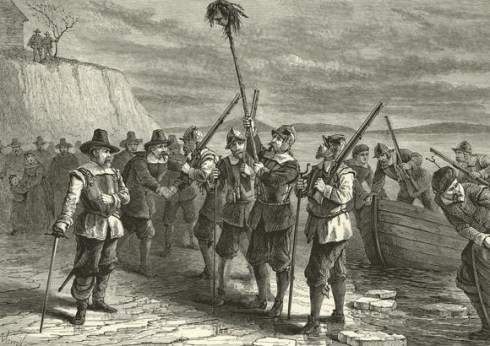
Looking ahead to the new year from a local history perspective, there are commemorative moments for at least six events: five European settlements and a tea party, the 250th Anniversary of the Boston Tea Party, to be precise. A century and a half earlier, there were settlements at Gloucester, Massachusetts and Portsmouth, Rye (the Pannaway Plantation) and Dover (the Cocheco Plantation), New Hampshire. The ill-prepared and -fated Wessagusset Colony was established in Weymouth, Massachusetts in 1622 but its demise came the following year after the brutal Wessagusett “Incident,” more appropriately referred to as a massacre. Commemorative history should acknowledge both the good and the bad, the heroic and the tragic, the kind and the cruel, and so the Wessagusett Massacre of March 1623, a veritable “red wedding” which harmed relations between Native Americans and English settlers for years to come, demands a spotlight. Like the first Gloucester settlement by the Dorchester Company, Wessagusett was decidedly not a plantation in the seventeenth-century sense, but rather a fishing and trading station of 60+ men financed by London merchant Thomas Weston. “Weston’s Men” were completely unprepared for the New World and by the winter of 1622-1623 they were starving, and altogether dependent on both Plymouth and the Native Americans in the region. But foodstuffs were scarce for everyone that winter, and everyone was anxious. Rumors of an impending Native American raid on both settlements drove the Wessagusett men to seek aid from Plymouth, and militia leader Myles Standish and eight men sailed a shallop to the northern settlement and issued an invitation to Massachusett tribal leaders Pecksuot, Wituwamat, and others to attend a summit during which commenced a slaughter just as they all sat down to dinner. I’m going to let Charles Francis Adams tell the tale, as he presented it in his anniversary address on the occasion of the 250th anniversary of Weymouth: the savages were taken by surprise, but they fought hard, making little noise but catching at their weapons and struggling until they were cut almost to pieces. Finally Pecksuot, Wituwamat and a third Indian were killed; while a fourth, a youth of eighteen, was overpowered and secured; him, Standish subsequently hung. The massacre, for such in historic justice it must be called, seeing that they killed every man they could lay their hands on, then began. There were eight warriors in the stockade at the time,—Standish and his party had killed three and secured one; they suddenly killed another while the Weston people despatched two more. Only one escaped to give the alarm, which spread rapidly through the Indian villages. Interesting language for 1873: savages is employed, but Adams does not refrain from calling this slaughter a “massacre” unlike many of his contemporaries who labeled it a pre-emptive strike. Several Wessagusset men also died during the massacre, and the rest opted to abandon the settlement; Standish returned to Plymouth with the head of Wituwamat on a pike in ancient English warrior fashion, “to ornament the Plymouth block-house as a terror to all evil-disposed savages” in the words of Adams. This massacre seems worthy of a bit more commemorative reflection, at least a fraction of what the Boston Massacre receives continuously.

“The Return of Myles Standish from Wessagusset,” from Pioneers in the settlement of America: from Florida in 1510 to California in 1849 by William August Crafts, 1876. Ironically, nearly 300 years later (299!) Myles Standish lost his head when the Standish monument in Duxbury was struck by lightning: according to this post by Carolyn Ravenscroft, archivist of the Duxbury Rural and Historical Society, his replacement head was too heavy for the damaged “body,” so an entirely new Standish was created by Boston sculptor John Horrigon, pictured here in 1930.

I’m not sure what the plans for the commemoration of the Wessagusset Massacre are but all the early settlements have been planning their 400th anniversaries for quite some time, particularly Gloucester, which has assembled a multi-layered calendar of commemorative initiatives and offerings focused overwhelmingly on the city’s social history. I’ve been so impressed with the “400 Stories” project, which aims to collect, present and preserve stories from 400 of Gloucester’s residents from 1623 to 2023, thus connecting the past to the present. There are books, an artistic competition for a new commemorative medal, walking tours, festivals, and a gala: the evolving celebratory schedule is at Gloucester 400.

Portsmouth is all geared up too, although its big reveal party is on January 6 so I don’t know all the details. The PortsmouthNH400 site is here, and so far its signature product is a lovely bookA History of Portsmouth NH in 101 Objects, to which both my Salem State History colleague Tad Baker and alum Alyssa Conary have contributed. There’s an ongoing speakers’ series and exhibition based on the book, and on January 6 Portsmouth’s Memorial Bridge will be illuminated in blue, PortsmouthNH400th’s commemorative color. Like Gloucester, Portsmouth is also collecting stories (of 400 words) from its residents, to be compiled in a commemorative book designed to update its 350th anniversary history. Rye and Dover also have their 400th anniversary committees and calendars, derived from considerable public participation: the mission of Dover400 is “to honor our past, celebrate our present, and to inspire our future through meaningful and creative community engagement.”

The 250th anniversary of the Boston Tea Party is going to be big: after all, from the Boston perspective, it was “the single most important event leading up to the American Revolution.” I’m excited about all of the offerings by Revolutionary Spaces at the Old South Meeting House and the Old State House, including an exhibition on the power of petitions, an “immersive theatrical experience,” and various programs on the nature and expression of protest. Of course the Boston Tea Party Ships & Museum has plans as well, and is already counting down to the big reenactment on December 16, 1773. And there will be merch, including lots of commemorative tea.

Teas from Elmwood Inn & Oliver Pluff & Co.


Recovering Salem’s Hispanic Heritage: a Revolutionary View

September 15 commenced Hispanic Heritage Month here in Salem; as I walked by the flag-raising in Riley Square the other day I wondered, what now? How are we going to recognize Hispanic Heritage Month? And given that Salem has an increasing population of Latino Americans, how are we going to expand “Salem history” to include their stories going forward? If I could offer a suggestion (which I am prone to do), why don’t we take advantage of two dynamic historiographical trends connecting Salem and the Iberian world in the eighteenth-century: the renewed focus on the codfish trade which generated so much wealth (and so many connections) on the North Shore in the eighteenth century and new perspectives on Spain’s role in the American Revolution? The importance of the codfish trade between New England and southern Europe has been emphasized by academics for quite some time (this particular study has been very influential) but I don’t think it has trickled down (or out) to a more general audience. My department co-sponsored an afternoon symposium along with the Salem Maritime National Historic Site, the Marblehead Museum, and Historic Beverly in 2019 entitled Salt Cod for Silver: Yankees, Basques, and the North Shore’s Forgotten Trade organized by the independent scholar Donald Carlton, but I think the trade remains relatively “forgotten,” and overshadowed by the China Trade which flourished after the Revolution. Actually I think the codfish trade is paradoxically both forgotten and taken for granted: the symbolism of the cod is everywhere in late eighteenth century Massachusetts and if not for this lucrative and expansive trade how else could both Salem and Marblehead appear on the list of the ten most populous American towns in the first census of 1790? To its credit, Salem Maritime has been stressing the importance of the pre-revolutionary fish trade almost since its founding, and in myriad ways: the map below is from its Spring 1940 Regional Review (I know it’s a bit hard to read, but Bilbao is definitely in the center of the world) and the “flying fish” from the site’s 2017 virtual reality “exhibition” (experience?) The Augmented Landscape

But neither fish or trade are particularly “sexy” or accessible topics of historical interpretation, especially historic interpretation for a general audience. Believe me, I know, I’ve been teaching pre-modern world history, which is very much about cross-cultural trade, for years: I’ve seen my students’ eyes glaze over many, many times even as I’ve tried all sorts of tricks to keep their attention. You need people, particularly individual stories, and you need a war (or some sort of conflict). So that’s why I’d like to see an interpretive focus on the relationships that were fostered by and through this long and lucrative trade and their eventful revolutionary impact. Material manifestations are helpful too: these are a major hook of the China Trade are they not? I’m not sure that the Iberian Peninsula can compete in this realm, but there was certainly a range of goods with the label “Bilboa” (the 18th century spelling) attached to them which were in demand in the later eighteenth century: most importantly Bilbao handkerchiefs, Bilbao yarn and caps, and Bilbao mirrors, which might or might not have been manufactured on the Iberian Peninsula.

A very typical 1770s shipping report in the Essex Gazette; of course the destinations listed point to the intersection of the fish and slave trades in the Atlantic system; Advertisements from the Salem Gazette, and a “Bilbao Mirror” from Bonhams Skinner. I should say that the only references that I found for “Bilbao caps” in the pre-revolutionary newspapers were in runaway slave advertisements.

The stories of the Salem men (sorry, they were all men when it comes to the maritime trade; manufacturing, processing and retail by-products I just don’t know) who dominated this trade can all be found in the papers of the Peabody Essex Museum’s Phillips Library in Rowley: Samuel Browne early in the eighteenth century, the Derbys, the Ornes, the Cabots, and others later (and there are very helpful appendices to the finding aids for these papers along with a recently-digitized collection of logbooks). These later men, like their counterparts in nearby Marblehead, Beverly, Gloucester, and other New England ports, dealt with Diego de Gardoqui Y Arribuibar, the head of an eminent family merchant house in Bilbao, Joseph Gardoqui & Sons. The Gardoqui firm had been importing salted codfish from the British American colonies since 1763, and because of stiff competition with other Iberian ports, its increasing focus in commercial relations was on the merchants of the North Shore of Boston. Diego de Gardoqui developed relationships with the Marblehead merchants Jeremiah Lee and Eldridge Gerry, and also with members of the Cabot family based in Beverly and Salem and the Derbys of Salem. When the Revolution began, these connections resulted in the Gardoqui firm suppling the Americans with arms, gunpowder and other supplies even before Spain entered the war on the side of America and France in 1779; the first foreign rifles supplied to the colonists were sent from Bilbao to Massachusetts in 1775. Gardoqui committed to the Colonies personally and then officially, assuming the role of a Spanish government official tasked with overseeing military aid during the Revolution and Spain’s first Ambassador to the United States afterwards. He was present at the inauguration of George Washington in 1789. Diego de Gardoqui appears like an Iberian Lafayette to me, and I am not the only one: recent historiography and initiatives (like these sponsored by global utility company Iberdrola, which actually built our new power plant in Salem and recently emerged victorious from a major lawsuit brought by its owner/developer) seek to re-center Spain in the history of the American Revolution, right alongside France. Salem and its region are part of that re-centering story, and could look eastward for inspiration as it approaches the anniversaries of both its founding and the Revolution in 2026. In an interview explaining the Iberdrola project and its mission, the historian José Manual Guerrero Acosta asserted that “I believe that millions of Hispanic people living today in the US are entitled to recognition of the fact that the Hispanic world and its forebears, which made up part of the Spanish crown territories in America, were present in a significant way at the birth of their country.”

Two recent titles, including a stirring study of the namesake of Galveston, Texas, Bernardo de Gálvez; Diego de Gardoqui, Ca 1785. Courtesy Family Cano Gardoqui.

Bilbao was a bit of a free port in the eighteenth century, owing to its customary fueros granting exemption from Spanish taxes and its role as a haven for privateers, including those from Salem. Just offshore in June of 1780, Captain Jonathan Haraden, the “bravest of the brave” and “Salem Salamander,” fought his most spectacular engagement with the British privateer Achilles, ostensibly to cheering crowds in port. The Gardoqui firm reported Haraden’s exploits to Benjamin Franklin, then Minister Plenipotentiary, and Franklin replied on July 4: “Captain Haraden–whose bravery in taking and retaking the Privateer gave me great pleasure.” Haraden is such a hero in nineteenth-century naval histories and twentieth-century boys’ magazines, and currently in Eric Jay Dolan’s Rebels at Sea. Privateering in the American Revolution, but in Salem both he and his profession seem truly forgotten. Cape Cod pirates, some real, some not, rule while Salem’s very real privateers languish in the dusty recesses of Salem’s ever-dimming historical consciousness. We seldom hear of them, despite the facts that 158 privateering vessels originated from Salem during the Revolution, capturing 458 prizes, the largest prize tonnage of any single American port. Perhaps a revolutionary re-focus, inspired by the need to expand our city’s history to include as many of our residents as possible, might also forge a reaquaintenance (and/or re-evaluation) with some previously-aclaimed dead white men too! There’s a lot of ground–or should I say ocean—for exploration, inspiration, and revelation.

Top: Nowland Van Powell’s depiction of Captain Haraden’s engagement with the Achilles, which had stolen his prize, the Golden Eagle, off Bilbao, Eldred’s Auctions.

APPENDIX: Those of you who are familiar with my blog know that I’m not exactly a fan of Salem’s “heritage management,” so I can’t resist this comparison of two Bilbao-connected plaques: one featuring Diego de Gardoqui prominently placed in front of the Jeremiah Lee Mansion in Marblehead and another marking Jonathan Haraden’s very public victory over the Achilles, which is located inside a Korean barbeque restaurant on Essex Street in Salem. Seriously! BonChon, the restaurant in question, was one of my major pandemic take-out spots (it still is actually, as I adore their fried rice) so I became quite familiar with Haraden’s plaque during that time. The plaque was installed by the Sons of the American Revolution in 1909 on a house where Haraden once lived which was later demolished. I seem to recall that its replacement structure had the plaque on the exterior, but when that building was demolished and another built in its place a few years ago it ended up inside—not exactly sure why, but very Salem.


What About Fort Pickering?

I love commemorations: I have posted about them often here, particularly at the beginning of a new year like 2020, during which the long-planned commemorations (of the achievement of women’s suffrage, the Mayflower voyage, and the bicentennial of the state of Maine) didn’t quite go off as planned, obviously. As I spend much of my time thinking about the past, I relish any moment in which a more collective present is so engaged. In four years’ time, Salem is going to be thrust into a big commemorative year, even bigger than 2020 and hopefully more celebratory and reflective: 2026 will mark the 250th Anniversary of the beginning of the American Revolution and the 400th anniversary of the first European settlement in Salem. Revolution 250 has been planning the regional observance of the Revolutionary anniversary for quite some time in a collaborative and dynamic manner, because “commemorations bring people together.” I think there is some Salem participation in this effort, but I’m really not sure. I’m even less sure about what is being planned for Salem’s 400th anniversary: when I look at the organizing that has been going on in two other cities facing big anniversaries, Portsmouth and Gloucester, I see much more organization than is in evidence here in Salem, but then again these cities’ 400th anniversaries are next year so they better have their acts together! Salem certainly has time, but from what foundation and inspiration will it proceed? Who is in charge and who is involved? What will “Salem 400” entail and hope to achieve? I google that term from time to time but all I get is this. Without a professional historical society or heritage commission to shepherd such an initiative, there is no doubt that the 400th anniversary of Salem’s founding will be a much more “top-down” initiative than that of its sister cities, or even its own Tercentenary, which inspired a multi-layered calendar of commemorative events and expressions, including a parade of 10,000 participants, pageants and performances, musters and medals, open houses, bonfires, and headlines in national newspapers.

Official Tercentenary Program, 1926: you can see some great photographs of the events here.

I can’t imagine 10,000 people turning out for a Quadricentennial parade in 2026! The past century has transformed history into a product in Salem, something to be exploited rather than contemplated or celebrated. A singular focus on 1692 seems to have deadened the city’s interest in nearly everything else, save for the occasional nod to the military or the marginalized. I’m not sure how anyone can engage in history in Salem, save for nostalgic facebook postings. The few references to plans and goals for 2026 seem to acknowledge this by emphasizing places over people, and the present over the past: foremost among them is Mayor Kimberley Driscoll’s “Signature Parks Initiative,” which is “focused on planning and carrying out improvements and preservation work in six of Salem’s busiest and most beloved public parks and open spaces, ensuring that they will remain available and enjoyable for future generations to come: Forest River Park, Palmer Cover Park, Pioneer Village, Salem Common, Salem Willows and Winter Island.” Certainly this initiative is welcome, and will be beneficial to Salem’s residents (as will more trees, also a part of “quadricentennial planning”) but is it commemorative? Is it engaging, inspiring, and challenging the public, as opposed to simply providing for them? Maybe it is for some, or even many, but not for me: I want more history—and more humanity—in my quadricentenary. Compare Mayor Driscoll’s Signature Parks Initiative with the centerpiece of the Gloucester 400 commemoration: the 400 Stories Project, “a citywide undertaking whose goal is to collect, preserve, and share 400 stories of Gloucester and its people” from 1623 until 2023. The Project’s administrators invite Gloucester residents to “help us make history” by sharing their stories. This is a pretty sharp commemorative contrast between these two old Essex County settlements.

“Our People, Our Stories”: I wonder what the tagline of Salem’s Quadricentenary will be?

So far the most conspicuous work of the Signature Park Initiative in Salem has been in evidence at Forest River Park in South Salem: one end of the park now features new public pools and trails along with an enlarged and renovated bathhouse while the other is slated for a dramatic alteration revolving around the exchange of the Colonial Revival reproduction “Pioneer Village” currently situated there with the YMCA camp formerly located at Camp Naumkeag in Salem Willows. The writing has been on the wall for Pioneer Village, built for the Massachusetts Tercentenary of 1630, for quite some time as the City has neglected its buildings and landscape for decades and expanded the adjacent baseball field more recently. However, the exchange plan has hit a snag recently, as the City had to apply for a waiver of its own demolition delay ordinance before its own Historical Commission in order to remove the buildings at Camp Naumkeag, which was first established as a tuberculosis camp over a century ago. So far this waiver has not been granted, and a notable resistance to both the destruction of Camp Naumkeag and the relocation of Pioneer Village has emerged. I wrote about Pioneer Village at length last summer, and I have been rather ambivalent up until last month, when several admissions shifted me into the wary and possibly-even-opposed zone: I’m still thinking about it as I find it a particularly vexing public history problem! This is an ambitious plan: Pioneer Village is not simply going to be relocated but rebuilt and re-interpreted with the addition of a visitors’ center and a new focus on the relationship between the European settlers and the indigenous population of pre-Salem Naumkeag. This is an admirable goal for sure, but to my ears, the new interpretive plans sound vague, simplistic and ever-shifting, and above all, lacking in context. They are supposedly the work of the numerous consultants who have worked on the project, paid and unpaid and including several people whom I admire, so it might just be a matter of presentation, but there are several statements that I find concerning. In the first Historical Commission hearing, one consultant responded to the argument that Camp Naumkeag was itself an important historical site because of its role in public health history with an assertion that that role would enhance the new Pioneer Village’s focus on the virgin soil epidemic which devastated the indigenous population even before settlement, as if infectious diseases were interchangeable and detached from time and place! [“Pioneer Village Complicated by History,” Salem News, September 16, 2021] Several months later, the City posted its plans on its website, with this all-encompassing but yet incomprehensible statement of goals: increased access and visibility to the breadth of Salem’s history as represented by the breadth of the site’s history, including Salem Sound’s natural history, the original inhabitants, Fort Lee and the Revolutionary War, the Willows, Camp Naumkeag, and the Pioneer Village. So now it seems as if the newly-situated Pioneer Village will be utilized to interpret almost the entirety, or breadth, of Salem’s history, and in a space which the accompanying plan revealed will have parking for only ten cars. In terms of both interpretation and logistics, this is a flawed plan as presented: its reliance on the seasonal trolley for access is confirmation of its orientation to tourists over residents as well as its seasonal status, in contradiction to the breadth of its stated goals and costs.

The current Plan for the new Pioneer Village on Fort Avenue, on the site of the present-day Camp Naumkeag.

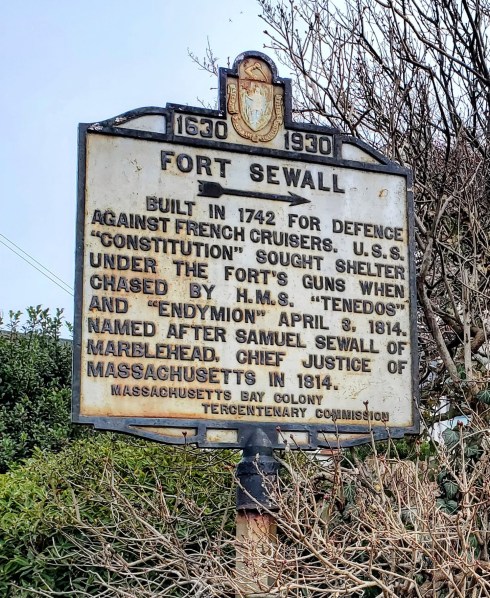
While at face value the inclusion of yet another long-neglected Salem historical resource, Fort Lee, looks like a good thing, I find it concerning. Why should Fort Lee be included in the interpretation of the faux Pioneer Village and not its very authentic (and far more important) neighboring fort on Winter Island, Fort Pickering? This is the guiding principle of the the 2003 study commissioned by the City and the Massachusetts Historic Commission, the Fort Lee and Fort Pickering Conditions Assessment, Cultural Resources Survey, and Maintenance and Restoration Plan: that the forts should be “restored, maintained and interpreted together [emphasis mine] as part of the Salem Neck and Winter Island landscape for enhanced public access.” To its credit, the City has begun a phased rehabilitation of Fort Pickering, but I see much less energy and far fewer resources committed to it than to the Pioneer Village project, which is perplexing given its authenticity and historical importance. Winter Island has served successively as a fishing village, a shipbuilding site, and in continuous military capacities from the very beginning of Salem’s settlement by Europeans to the mid-twentieth century.  The storied fortification which became known as Fort Pickering in 1799 was built on the foundation of the British Fort William, part of a massive effort by the new American government to fortify its eastern coastline beginning in 1794 under the direction of French emigré engineer Stephen Rochefontaine. Fort Pickering was manned, and rebuilt, on the occasions of every nineteenth-century conflict, and was especially busy during the Civil War. Another regional Rochefontaine fort, Fort Sewall in Marblehead, shines under the respectful stewardship of that town. Salem is so fortunate to have so much built history:  why can’t we focus our energies and resources on preserving and re-engaging with authentic sites, rather than creating new ones? (And could someone please find our SIX Massachusetts Tercentenary markers? Every other town in Massachusetts seems to have held on to theirs).

Talk about a site that can illustrate the BREADTH of Salem history: Winter Island was an early site for fishing and fish flakes (and even more substantial “warehouse” structures) as well as the location of Salem’s first fort William/Pickering. The Salem Frigate Essex (depicted by Joseph Howard) was built adjacent to the Fort in 1799, and Winter Island also served as the site of Salem’s “Execution Hill” in the later eighteenth and nineteenth century and of a Coast Guard air station from 1935-70. Members of the US Coast Guard Women’s Reserve, or SPARS, were stationed on the island during World War II. Rochefontaine’s 1794 plan and block house sketches and Frank Cousins’ photographs of the island and fort in the 1890s, Phillips Library of the Peabody Essex Museum. Marblehead’s Fort Sewall on the last day of December, 2021.


Villages out of Time and Place

So this is going to be one of those posts in which I ask a lot of questions and have no answers (I think; maybe I will get to some). I’m trying to work out my own thoughts about a particular place and what it means: writing is one way to do that, as is solicitating the views of others, so blogging is a means to get to meaning. The place in question is Pioneer Village: Salem in 1630, a cluster of structures situated in Forest River Park which was built under the auspices of “architect-antiquarian” George Francis Dow as a representation of first-settlement Salem for the Massachusetts Tercentenary of 1630. The very engaged agricultural entrepreneur, Harlan P. Kelsey, a strong advocate for more energetic urban planning in Salem, undertook the landscape design. There was a grand historical pageant performed at the village, and then another recreation, of the ship Arbella of the Winthrop fleet, set sail for Boston. Pioneer Village was supposed to be a temporary installation, but it was such a popular regional attraction that it became a more permanent one, at the vanguard of outdoor “living history” museums in the United States: its claim to be the first of such museums is based more on interpretive practice than date, as Henry Ford’s Greenfield Village opened up in 1929 and the Storrowtown Village Museum in Springfield, Massachusetts also dates to 1930. Over the next few decades, a succession of outdoor history museums opened up across the country, including Colonial Williamsburg and Old Salem in North Carolina (1932 & 1950, respectively) and three additional institutions in Massachusetts alone:  Old Sturbridge Village (1947), Historic Deerfield (1952) and Plimoth Plantation (1957; now Plimoth Patuxet Museums).

Pioneer Village today and in its heyday, in the 1930s and 1940s, Historic New England and Digital Commonwealth photographs.

So if you have visited any of these museums as well as Pioneer Village you will immediately notice a dramatic difference in terms of size, scale, and apparent resources and mission. The former are all administered as foundations or corporations with large staffs and budgets; Pioneer Village has for the most part been a municipal initiative run by the City of Salem’s Park and Recreation Commission with the exception of recent brief periods when it was administered by several collaborations of local history and preservation professionals, the House of the Seven Gables, and a local college (not Salem State University, which is located nearby, but rather Gordon College in Wenham). Judging from the succession of newspaper stories dating from the 1930s into the 1960s, Pioneer Village might have been able to sustain itself on proceeds from the gate: it was quite a busy place. But as the popularity and practice of “living history” interpretation began to decline in the later 1970s, it lost its base, perhaps even its rationale. As it has always been a seasonal attraction, the Village has been vulnerable to deterioration and destruction by neglect, weather, fire and vandalism: I believe only about half of the original structures are still standing. The Arbella (which returned to its home “port” after the Boston celebrations) was severely damaged by a hurricane in 1954 and the only period structure, the Ruck House, was destroyed by fire in the 1960s. In 1985, the Park and Recreation Commission voted to dismantle the Village, but the first of a series of restoration and reactivation efforts reopened the site in 1988. From that point on, it has been a case of good intentions but insufficient resources, and now the City has proposed a rather radical plan to “save” Pioneer Village by exchanging its site with that of the turn-of-the-century tuberculosis Camp Naumkeag at Salem Willows. The rationale behind this proposed move is sound on paper—the Salem Willows is on the trolley route and the ballpark and other recreational spaces at Forest River are definitely expansive—but I am wondering if a Salem Willows Pioneer Village will still be Pioneer Village. And I am also wondering what Pioneer Village is. As I said at the outset, I’ve got a lot of questions, but these are the big three:

  1. What is the historical and cultural significance of Pioneer Village?
  2. Is Pioneer Village worth “saving”?
  3. If Pioneer Village, such as it is, is moved to another site, will it still be Pioneer Village, whatever that is?

Significance: To tell you the truth, I’ve never given Pioneer Village much thought. I teach seventeenth-century history, and this site has been in walking distance from my classrooms over my entire career: have or would I ever use it as a teaching resource? No. It was seldom consistently accessible and never in very good shape, and now I have all of the digital teaching tools that I need. I always thought that the Village represented a moment in place and time, and that moment was Salem 1930 rather than Salem 1630. As someone who has dabbled in Salem history here over that last decade or so, Pioneer Village looks to me like the culmination of a long period of overtly sentimental celebration of Salem, commencing with the Centennial of 1876. Generally it is seen as an expression of Colonial Revival culture, and I agree with that, but I also see it as an example of civic pride. Before Salem became Witch City, its leadership and residents were much more focused on productivity than infamy, and I think the Village still represents the former for those who wish the “Salem story” was a bit less focused on the Witch Trials. I like the terms “architectural museum” and “restoration village” used by the architectural historian Edward N. Kaufman, who traces the origins and inspiration for Pioneer Village and its successors to the big nationalist expositions of the nineteenth and early twentieth century, commencing with the Crystal Palace Exhibition of 1851 and the Paris International Exposition of 1867: the latter had several recreated villages, like the “Austrian” and “Russian Peasant”  Villages  below. Like Pioneer Village, these were exhibits built for a specific event. Unlike Pioneer Village, they were dismantled after that event. Americans, including residents of Salem and its region, wanted their “history” stay around for longer.

Austrian and Russian Villages, International Exposition of 1867, Paris.

When you look at Pioneer Village as something that was built (and rebuilt) as an expression of civic pride it takes on the cast of a monument rather than a historical resource, at least for me. Another perspective relates to the history of preservation (or preservation technology in particular), one in which I had never explored before in relation to Pioneer Village. Apparently it was very consequential in demolishing the “Log Cabin Myth” which held that every seventeenth-century European arrival lived in a log cabin à la Lincoln. In his classic book of the same name, Howard Shurtleff observed that the myth was “an American belief that is both deep-seated and tenacious” and credited Dow for refuting it: Mr. Dow included in his reconstructed Salem a number of small framed cottages, each provided with a brick or “catted” chimney, and roofed with thatch. Some were walled with weatherboarding, sheathed with material boards, and the intervening space filled with “nogging”—clay, chopped straw and refuse bricks; others were walled with wattle and daub. This “Salem Pioneer Village” still stands (in 1939, when Shurtleff was writing and 20 years later, when his landmark book was reissued) and has proved far more effective than books in refuting the Log Cabin Myth. All of the contemporary commenters on Pioneer Village really emphasized its traditional, “authentic” construction, and this became another point of civic pride as Salem businesses made comparisons between their own productivity and that of their colonial predecessors in annual programs such as “Early American industries portrayed at the Pioneer’s Village, Salem, Mass.” In 1936, the Hygrade-Sylvania company presented an exhibit on early illumination, while the Naumkeag Steam Cotton Company sponsored a demonstration of flax weaving and culture and local druggist John E. Heffernan highlighted seventeenth-century herbal medicines. The theme was very much see how far we have come in the midst of the Depression. The national Chronicle of Early American Industries, founded in 1933 and still in print, referenced Pioneer Village in nearly every issue.

Ok, now I’ve hit academic cruise control and could go on for quite some time: but this isn’t a journal article, it’s a blog post. So I’m going to start wrapping up in relation to my questions.

Significance conclusions: clearly Pioneer Village was significant in its time (1930) and for at least two decades thereafter. I think it’s still significant as an example of how a city uses its history, but I do not think it is an educational resource (bear in mind, I teach college students; early childhood educators might have a different opinion). I really think it’s a monument, like the Bewitched statue downtown, but much, much better in the sense that it seeks to highlight achievement and industry rather than exploit tragedy. I don’t have enough information to comment on its current state of repair and whether the original 1930 buildings could even make the move: because the City of Salem has “preserved” the Village it is now an historic artifact and will be subject to review by the Massachusetts Historical Commission. If the move is undertaken, I hope an expert in preservation technology and/or an architectural historian is consulted.

Should it be saved: yes, but with a clear understanding of what it is and what is it supposed to do. I only see logistical rationales for the move in the public discourse.

Will it still be Pioneer Village in Salem Willows? No. It will be something else entirely: a new Pioneer Village. It could be a hybrid Salem: 1630 and Salem: 2026 if the construction integrity of the original structures is preserved through the move, and new structures built utilizing the evidence and knowledge we have gained over the intervening century. The new Village could be a testament to both the Tercentenary spirit of 1930 and the Salem Quadricentenary spirit of 2026. If that was the aim, it would be nice to have Salem craftsmen, architects, and landscape architects involved in creating (rather than recreating) the new Pioneer Village: successors to George Francis Dow and Harlan Kelsey.

What Salem really needs: not a new Pioneer Village, but a new Salem Museum, which would integrate, interpret, and document ALL of Salem’s history: first settlement, Witch Trials, American and Industrial Revolutions, the experience of the Civil and World Wars,  native American, African-American, Irish American, Polish American, French Canadian and American, and everything and everyone between. Enough of this “siloed history!” This of course would be the ultimate Quadricentennial achievement and expression.