Tag Archives: American Revolution

Revolutionary Summer, Part II: Heating Up

Today, part two of my occasional summer series on Salem’s role as provincial capital in the summer of 1774, illustrated by reenactors of the Encampment Weekend at Salem Maritime National Historic Site. Of course, there were no soldiers encamped along Derby Wharf in 1774: this was a busy, busy port, especially since the enforcement of the Boston Port Act. But they were a welcome sight (for those of us in Salem who believe that “history” happened in more years than 1692) in June of 2024, along with various townspeople, deputies to the resident General Court (including John Adams) and busy cooking and crafting women. Congratulation to Salem Maritime on a great event!

So now that we have the setting established, let’s return to the timeline. In Part I, I covered the background to Salem’s new revolutionary role and brought Governer Gage to town. He was followed by representatives from across Massachusetts to the General Court, which had its first Salem meeting on June 7. This session lasted ten days, and it did not go well from the British perspective for several reasons. The Boston Port Act had incited the majority of the representatives, and the dictates of the Massachusetts Government Act (published in the Boston Gazette on June 6) even more so: Governor Gage knew that he would soon be in a position of even more control over the government of Massachusetts, so he was completely reluctant to negotiate on anything: why they were all in Salem, first and foremost. From a local perspective, the Governor’s reactions to two very different addresses he had received upon his arrival in Salem, from the majority the majority Patriots and solid minority Loyalists, represent his point of view quite well. The former, along with their fellow Patriots in Boston and elsewhere in Massachusetts, were quite bolstered by the support from communities up and down the British Atlantic, and focused more on planning for participation in a Continental Congress than doing Gage’s bidding. When a special subcommittee submitted its plans for the Congress to the full assembly on June 17, the doors were locked to prevent any gubernatorial interruptions. Gage dissolved the General Court the same day, but it had already approved sending five delegates to the Congress, as well as a boycott on the purchase and consumption of tea and other imports from Great Britain and the East Indies. And so we move on.

Appendix: a cautionary tale!


Revolutionary Summer

Revolution 250, the initiative to commemorate the 25oth anniversary of the beginning of the American Revolution in our region, has been gearing up for some time, and now we’ve come to Salem’s time to shine: when General Thomas Gage arrived in Boston on May 13, 1774 he brought with him his credentials as the newly-appointed royal governor, and instructions to displace the city as both the chief port of New England and capital of colonial Massachusetts. Everyone knew about the Boston Port Act, a retaliatory measure in response to the Tea Party which mandated that “Marblehead in Salem Harbor” should become the official port of entry, but the Massachusetts Government Act was a more recent Parliamentary passage. These “Intolerable” acts (not a word that was really in use at the time) had the cumulative effect of uniting most of the colonies against Great Britain: donations pored into Boston from far and near, including Salem. While there were those in Salem who expressed some measure of cheer at the city’s elevated status, most (or at least most of the expressions) voiced displeasure: I am particularly interested in the change of tone from May 17 onwards regarding General (Governor) Gage’s residence. At first there is reference to a house in the “upper part of town” (I think this was William Browne’s stately house) and then he is banished to the “King” Hooper mansion in Danvers, presumably by the declaration of certain inhabitants of Salem “that they will not sell, or let an house or lodgings, to any person that will remove (t)hither, in consequence of the passing of the Boston Port Act, they being determined to show their distressed brethren in the capital city, every possible mark of their sincere sympathy.”

Can you imagine the charged atmosphere of those days, 250 years ago? Timothy Pickering was charged by his fellow patriots to relay the sentiments above to Governor Gage, while the town Tories gave him a welcoming address in which they expressed their regard for “his Majesty’s paternal Care and affection for this Province, in the appointment of a person of your Excellency’s Experience, Wisdom and Moderation in these troublesome and difficult times.” They rejoiced that Salem had been “distinguished for that Spirit, Loyalty and Reverence for the laws, which is equally our Glory and Happiness.” Following this warm welcome on June 2, a grand ball was organized for the King’s birthday, two days later! (King George was big on birthday celebrations for both himself and his Queen, Charlotte). I’m trying to imagine the revolutionary spaces, but the problem is that all of the buildings in which these “negotiations” played out are no longer there. Some deliberations were held at the Court/Schoolhouse at the head of Washington (then School) Street (demolished for Salem’s first train tunnel in the 1830s) and others at the royal Town House just down the street, which was summarily destroyed at the end of the Revolution. Gage’s House in Danvers, then called the Hooper Mansion and later the Lindens, was moved to Washington DC in the 1930s, and its interiors ended up at the Nelson-Atkins Museum in Kansas City. But everything was in relatively close proximity and it must have been one hot summer: Governor Gage set the first meeting of the General Court for June 7, and then they were off!

The Salem Courthouse from Massachusetts Magazine, 1790 and Smithsonian Library Collections; I dropped “General Gage” into his drawing room at the Hooper Mansion, photograph from the Nelson-Atkins Museum.

More on Revolutionary Salem all summer long! And next weekend, the British are coming to Salem (again) with an “Encampment Weekend” on June 15 at the Salem Maritime National Historic Site. More information here.


The Road to Mount Vernon

We have spring break this week, so I’m on one of my road trips, loosely following the footsteps of George Washington. I always feel like I need a theme beyond “interesting old houses” but often I find one along the way which replaces my original intention. Not this year though: George has been pretty present! I started out in northern New Jersey, where I visited a house that I’d long wanted to see because I love Gothic Revival architecture and it looked like the ultimate GR cottage, but it turned out to be much older with a Washington connection: the Hermitage in Ho-Ho-Kus. General Washington was headquartered here following the Battle of Monmouth and during the court martial of General Charles Lee in the summer of 1778, in the company of his aide Alexander Hamilton and the Marquis de Lafayette. Aaron Burr was there too, and a secret romance was initiated between the future Vice-President/duelist and the lady of the house, Theodosia Prevost, who happened to be married to a British officer. At the close of the war and after the death of Theodosia’s husband, the two were married. Decades later this very strategic house was “gothicized” and acquired its present appearance.

Not too far away is a house where Washington and his men spent much more time: the Dey Mansion in Wayne, New Jersey, which served as the General’s headquarters for several months in 1780. This is a beautiful property, maintained and interpreted by Passaic County, which acquired the house in 1934 after which it underwent an extensive restoration. A very knowledgeable guide took me all around the house, even into the atttic, which was absolutely necessary as I couldn’t understand how so many people could have lived in this house during the General’s residence: the Dey family did not vacate! You’re not going to see the house’s gambrel-esque roof that accomodates all this space because I didn’t have a drone with me, but check out the website. It’s a stately house for sure, but the spacious attic made everything clear. Washington, of course, was given the two best rooms, a large parlor/office on the first floor and a bedroom just above, by the master of the house, Colonel Theunis Dey.

The Dey Mansion: the first photos above—all the way down to the blue parlor—are rooms used by George Washington and his aides, including Alexander Hamilton. Then there’s the semi-detached restoration kitchen, and the spacious attic.

So at this point and place, if you really want to do the Washington tour, you should probably drive to Morristown, Trenton, Princeton, east to the Monmouth Battlefield, west to Valley Forge. But I’ve been to all those places several times, so I drove to the General’s last Jersey and last period headquarters in Franklin Township, a rather isolated farmhouse called Rockingham. No Pennsylvania for me; I headed south into Maryland to Annapolis, where Washington resigned his commission at the beautiful State House (obviously my chronology is all over the place, but these two stops did dovetail). I just really wanted to go to Annapolis in any case; George was just an excuse.

Rockingham: Washington’s last headquarters—and on to Annapolis.

A bronze George in the old Senate Chambers of the Maryland State House (Harriet Tubman and Frederick Douglass are just across the way); Hammond-Harwood, Shiplap and row houses in Annapolis.

On to Alexandria, where Washington touchstones abound, given its proximity to Mount Vernon. Like Annapolis, but MORE, Alexandria is full of beautiful townhouses: I started in the center of the Old Town and made my Washington stops—his church, his townhouse (actually a reproduction thereof) his pub—and then walked the streets taking photographs of doorways and wreaths, myriad details, spite and skinny houses. A bright sunshiney day: you almost can’t see this bronze Washington, sitting on a bench outside Duvall’s Tavern, where he was feted after his great victory.

From my parking place on North Washington Street, I drove straight out to Alexandria to Mount Vernon, mere miles away, along the George Washington Memorial Parkway. It definitely felt kind of like a pilgrimage at this point! I have been to Mount Vernon before, but have no vivid memories—an obligatory school trip, I think. It’s one of those houses that looks much bigger on the outside than the inside: it feels quite intimate within, especially as one side was closed off for renovations. I signed up for the “in-depth” tour so I could get some interpretation–and up into the third floor. While the mansion is a must-see, I think you can actually learn more about Washington from the many outbuildings on the estate: he was “Farmer George” and for all of his heroism he was also a slaveowner who seemed to have no regrets in that capacity. There are a lot of Washington contradictions, and there are a lot of Mount Vernon contradictions: while the subject of slavery is addressed up front the overall impression—reinforced especially at the museum adjacent to the orientation center—is of a “great man.” It was a bit too ra-ra for me, but I’m still headed to Yorktown for the last leg of my trip.

Mount Vernon: a house with 10 bedrooms and no bathrooms: the white-canopied bed is in the bedroom where Washington died. The presidential desk, parlor and dining room, key to the Bastille (a gift from Lafayette), greenhouse and garden, and view of the Potomac from the porch.


History by Hancock

I’m always attracted to mid-century messaging; advertising seems to explode around that time and much of it reflects contemporary society, for better or worse. I came across some “historical” ads by John Hancock Insurance a couple of years ago, and since then have been assembling a small “collection.” These full-page ads ran in national magazines from the 1940s to the early 1960s, and while they start with the traditional founding fathers they also include a range of historical figures representing technology and innovation (first and foremost), sports and entertainment, industry and agriculture, literature, medicine, explorers, presidents. Most of the ads feature real people, but there are also some fictional representatives of certain essential services: roadbuilders, nurses, small shopowners, judges and juries, ministers, teachers, “John Smith,” the minuteman who answered Paul Revere’s call, the oil men who “freed black sunshine from an ancient dungeon,” fallen soldiers and reporters. We can easily ascertain what’s important in terms of values and accomplishments by those featured and their captioned roles, past and present. It’s unfortunate that there are very few women (Clara Barton, Amelia Earhart, an anonymous teacher and nurse), and NO minorities that I could find. Some of the men featured are new-to-me and seem a bit obscure from my perspective. Elizur Wright, Massachusetts insurance commissioner, really? (close to home for the John Hancock, I guess). The captions and stories seem to indicate that all of these people saved democracy in their very different ways: we need them now!

P.S. There are a couple of Salem-related ads: Hawthorne in an early black-and-white variation, Alexander Graham Bell (above) and Nathaniel Bowditch, who is not featured as himself but rather as a salty sea captain who is in debt to him. 


Glover Squad

With my February 1 deadline constantly in mind, I worked intently on the Salem book all weekend with the exception of Saturday afternoon and early evening, when my husband and I drove over to Marblehead for a tribute to Revolutionary War Brigadier General John Glover. Well, two tributes really: the revelation of the acquisition of a letter to Glover signed by General Washington by the Marblehead Museum, and then a walk from the Old Town to Burial Hill following Glover’s Regiment to mark the anniversary of the General’s death (which is actually today). Glover was a native son of Salem, but you’ll never hear boo about him here, and I knew the Marblehead commemoration would be poignant. And it was. The link between the big reveal and the cemetery commemoration is Glover’s Marblehead Regiment, a reenactment unit which takes its role as “custodian” of Glover’s revolutionary role and life in and out of Marblehead very seriously: its members funded the acquisition of the Washington letter and led us up the hill. I’ve been thinking about Glover for the last few months, ever since the beginning of a campaign in adjoining Swampscott to save the eighteenth-century house to which he retired after the war. They take their history seriously there too. Huzzah to all of the historians and preservationists and “pastkeepers” in Marblehead and Swampscott and to General Glover!

Our hero: Brig. General John Glover. It’s hard to overestimate his heroism. He and his regiments performed essential and  exemplary service both ferrying and fighting. I like this account of his military career, which illustrates why Washington didn’t want to let him go (as stated in the newly-aquired letter).

The events of the day and night in Marblehead, and things that caught my eye along the way.

Marblehead Museum Executive Director Lauren McCormack with members of Glover’s Marblehead Regiment; the letter; more members of the Regiment.

Glover’s “town” house in Glover Square; a great plaque, the March to Burial Hill and back to Glover’s house for another tribute.


2024: the Anniversary Year

Happy New Year! I’m a firm believer in “anniversary history” and I like to start out the new year previewing (or guessing) what commemorations we might see. This past year was a busy one with the 400th anniversary of two major ports in our area, Gloucester and Portsmouth, as well as Rye and Dover, New Hampshire. I was really impressed with Gloucester’s year-long commemoration, especially its 400 Stories project, which will be a lasting legacy. Salem’s 400th is coming up in 2026, and I’ve been working on a book though all of last year and part of 2022 for that big anniversary: I’m handing it off to the publisher this month and eager to work on some other projects. 2024 looks a bit quiet in comparison with some other years but I’m sure there will be several Revolution 250 events. Salem was very much the center of the action in 1774 so I hope our city can rise to the occasion. Here’s where I think/know/hope we will see some reflective/commemorative activity:

Indigenous History: It seems to0 large a concurrence to me to have the 100th anniversary of Indian Citizenship Act occur in 1924 and the 200th anniversary of the establishment of the Bureau of Indian Affairs not to have a major reflective moment, especially given the current and intensifying historiographical interest in Native American history. We certainly need one (or two or three or…….) moments of reflection. Again, NOT an American historian, so a bit shocked that unqualified citizenship was not granted to Native Americans until 1924 (actually, I don’t think I can use the word unqualified) and their voting rights were still challenged after that!

Essay on citizenship by a student at the Leech Lake Indian School, 1917-1920, Records of the Bureau of Indian Affairs, Record Group 75. “the ones who steal or TELL LIES are not good citizens.” (capitalization mine)

Winter Olympics (on a much lighter note): the first Winter Olympics was held in 1924 in Chamonix, France, and in the following year the International Olympic Committee voted to make it a regular event every four years. Now of course the summer and winter Olympics are staggered, and as this summer’s games are in Paris I think there will be some kind of recognition of the centennial from a cultural and/or French perspective.

Courtesy Swann Auctions

Impressionism: Speaking of France, the first impressionist exhibition happened in Paris in 1874, and this cultural watershed will be marked with a major exhibition at the Musée d’Orsay that will travel to the US later in the year. 130 works will be featured, including paintings by Monet, Renoir, Degas, Morisot, Pissarro, Sisley and Cézanne and some of their lesser-known contemporaries, as well as an “immersive expedition in virtual reality” entitled “Tonight with the Impressionists.” Looking over all the previews for this commemoration, I realize that I’ve never appreciate how radical the Impressionist movement was—looking forward to this spring.

Claude Monet, Impression, soleil levant (détail), 1872-1873, musée Marmottan Monet, Paris © RMN-Grand Palais

Lafayette’s American Tour: Moving back 50 years to another big French cultural moment, but an even bigger American one: Lafayette’s tour of the United States in 1824. I know that this bicentennial will be big, as there are several initiatives which have been in the planning stages for quite some time. A “Lafayette Trail”, signalled by red, blue and white markers erected in many of the towns and cities he visited—over 40 in New England alone—has been created, and  Lafayette 200 has coordinated hundreds of events to commemorate the General’s tour. You can check out all the events here: the kick-off is in August, the month in which Lafayette arrived. He visited Salem, Beverly and Ipswich on August 31, and it looks like Historic Beverly will be sponsoring an event on that day.

Salem as center of pre-Revolutionary activity: 1774 was a big year for Salem in terms of Revolutionary activity. Royal Governor Thomas Gage moved the location of the Massachusetts General Court from Boston to Salem, where he hoped it would be “more inclined to comply with the King’s Expectations,” in June but compliance was not forthcoming. Not at all.  The Salem assembly would not comply or even be disbanded after Gage’s order, instead resolving to endorse “a meeting of Committees, from the several Colonies on this Continent … to consult upon the present state of the Colo¬ nies, and the miseries, to which they are, and must be reduced, by the operation of certain Acts of Parliament respecting America ; and to deliberate and determine upon wise and proper measures to be by them recommended to all the Colonies, for the recovery and establishment of their just rights and liberties.” This “meeting of Committees” became known as the Continental Congress. Later in the summer, after Gage prohibited town meetings without his prior approval, Salem held one which drew over 3000 attendees, and in the fall a Salem “tea party” on October 3 was followed by a de facto declaration of independence. After yet another Gage cancellation, of a meeting of the Massachusetts General Court, its members met anyway on October 5 and voted “to resolve themselves into a Provincial Congress” which was not answerable to London.


Salem and the Boston Tea Party

I’m excited about this weekend’s commemoration of the 250th anniversary of the Boston Tea Party: while the regional Revolution 250 initiative has been geared up for some time, I think that the countdown to the semiquincentennial of the beginning of the American Revolution will really intensify now. 2026 is going to be an interesting year in Salem, with both the 400th anniversary of its European settlement and the 25oth anniversary of the Revolution (though I have no doubt that Halloween will crowd both of those commemorations out). Leading up to the Tea Party anniversary, participants have been recognized through the Boston Tea Party Particpant Grave Marker Project overseen by the Boston Tea Party Ships and Museum and Revolution 250, and ceremonies were held for two Salem men: the Reverend John Prince and William Russell. These two guys do not represent the best Salem connection to the Tea Party, however: the Reverend was a witness rather than a particpant, and Russell, a true Revolutionary hero, wasn’t even from Salem—he was likely buried here because of his son’s residence. The best Salem tie to the Tea Party is rather the fourth ship (or the seventh, depending on your perspective). In late September of 1773, seven ships left London laden with East India Company tea bound for the colonies: four were bound for Boston (the Eleanor, Dartmouth, Beaver and William), while the Nancy was destined for New York, the Polly for Philadelphia, and the London for Charleston. The Eleanor, Dartmouth and Beaver became the “tea party ships” but the William never made it to Boston, as it was wrecked on Cape Cod. And that’s where Salem comes in. Here’s how the story played out in the newspapers.

The William was on the rocks in Provincetown, most of its barrels of East India tea intact and ready to be destroyed or salvaged. The revolutionaries back in Boston hoped that their Cape comrades would follow their example and ditch the tea, but that didn’t happen: it was succesfully salvaged and transported to Boston on the Salem schooner Eunice, captained by John Cook and owned by George Bickford. Both Cook and Bickford were called to task and eventually excused by their fellow Salem residents weeks later, only after the latter was paid a visit by “a company of natives, dressed in the Indian manner, armed with hachets, axes &” in Salem’s brand new smallpox hostpital. The shipowner and his captain were excused with a judgement of “mere inadvertence” but the town’s freeholders took the opportunity to condemn the “detestable tea” yet again, and form a standing committee of nine to ensure that it was repelled from Salem ships and shores forever, as it represented nothing less than “an open attempt to enforce the Ministerial Plan, and a violent Attack upon the Liberties of America.”

Essex Gazette, 25 January 1774.

So that was that: Salem would have its own “tea party” in October of 1774 but it was very much part of THE big party of December 1773, as were so many communities in eastern Massachusetts and beyond. “Essential” commodities have power, both in the past and the present, as the words above illustrate so well. The East India Tea was a rallying commodity, and the Boston Tea Party was a rallying event in its time and after. Its symbolism and choreographed imagery made it so, and it lived on in both American political and popular culture. An event that can be captured visually and displayed on everything from the French scenic wallpaper gracing the walls of the White House to a Currier & Ives print bearing pride of place in a humble parlor is a powerful one, especially as its name evolved from the “riot” (Governor Thomas Hutchinson’s term) to “party” (first used in the Salem newspapers in 1826–before that, it was mostly “the destruction of the tea.”)

Nathaniel Currier, The Destruction of the Tea in Boston Harbor (1846, one of Currier & Ives’ most popular prints); Zuber Boston Harbor/ Boston Tea Party wallpaper, 1852; The Tea Riot, from Jacob R. Neff, Thrilling incidents of the wars of the United States (1853); The Boston Tea Party-Destruction of the Tea in Boston Harbor, December 16,1773, Ballou’s Pictorial (1856); a 1920s postcard, 20th century folk art diorama and 1940s Wedgwood plate; graphic from the 200th anniversary commemoration.


Before, During and After the Revolution

I have been thinking about Salem during the American Revolution quite a bit over the past few months. It’s yet another era in Salem’s history which is tragically under-represented, and we’re going to try to correct that with our forthcoming book. We have one whole chapter on the Revolution, and a shorter piece on privateers, but Salem really deserves an entire book on its revolutionary role. And why our city has a “real pirates” of Cape Cod museum and no exhibition on privateers when Salem supplied more sailors and ships than any other American port remains inexplicable to me. In any case, our chapter on the Revolution, written by Hans Schwartz, is really interesting: his thesis is that the Revolution was revolutionary for Salem, which sounds simplistic but is not. He examines the social changes in Salem during and after the Revolution, using houses and neighborhoods as one way to illustrate transitions. I didn’t agree with all of his analysis (which is presumptuous of me since he knows far more about this era than I do, but I guess editors need to be presumptuous), but it certainly got me thinking about houses built in Salem in the Revolutionary era. I decided to take a little tour of before, during and after. Federal Street seemed the best place to start.

The first three houses illustrate a pre-revolutionary style: two-story boxes, square or rectangular. They get additions and embellishments later on, but they are stalwart, well-built houses from the pre-Revolutionary era. They make me wonder: what were their builders thinking? Oh, this will all blow over? Obviously building a house is an expression of hope and confidence, or maybe I’m just projecting too much of a modern mindset. And when the war is not quite over, we start to see the Salem Federals built: larger three-story buildings that just exude confidence—we’re winning (lots of houses built in 1782, including the Peirce-Nichols House below) or we’ve won. 

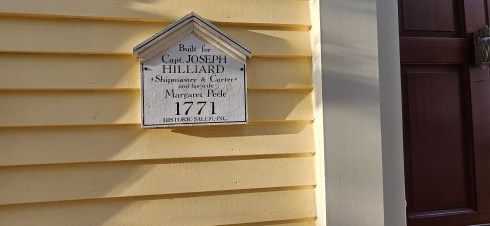
Does style follow politics? I’m just not certain: I think fashion might, but architecture? Most of the characteristic Federals for which Salem is famous were built at the beginning of the nineteenth century, not the tail end of the eighteenth. And if you widen your search for Revolutionary-era houses to all of downtown Salem, an architectural conservatism is immediately apparent: the first house below, on Turner Street, was built in 1771, but it’s similiar to the two yellow houses off the Common and Derby Street built ten and twenty years later. And before the Revolution, before the laying out of Chestnut Street in 1805 really, there is no housing segregation, so we are left with an interesting mix of architectural styles: so very evident along Essex and Derby Streets.

Building in 1779-1780: now that’s confidence. Elias Hasket and Derby began construction on Salem’s Maritime’s Hawkes House in the latter year, as their family had outgrown the Derby House next door.

I’m off to Scotland on Friday so no posts for a few weeks: “see” you after Thanksgiving! In the meantime, if you’re interested in Salem architecture, tickets for Historic Salem’s Christmas in Salem tour on December 2-3, featuring houses in the Salem Common neighborhood, are available here.


It Happened in Town House Square

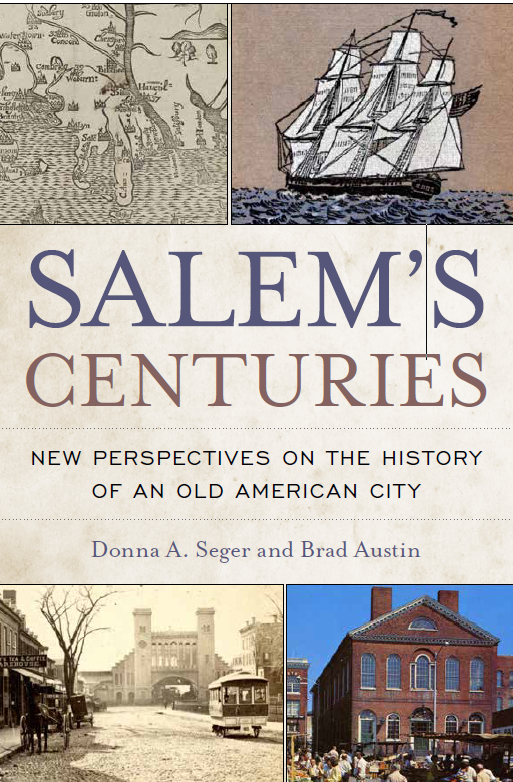
I didn’t expect to be posting on Salem for a while as I’m on my way to Maine to escape the Halloween Hordes (haven’t quite broken away yet!) but I’m in the midst of writing the last chapter for Salem’s Centuries and I thought posting would help. It’s why I started this blog in the first place, so long ago, to indulge my curiosity about Salem’s lost history and free up my writing from its academic constraints! This last chapter is on the long history of Salem’s center, Town House Square, and I’m just kind of enraptured with everything that happened there, but also haven’t figured out the meaning of it all. I’m trying to use the chapter to summarize the book Salem’s Centuries and also Salem’s centuries by using the Square as kind of a “stage” (at least that’s the word I’m using now). So this will be kind of a sketchy post as it is a work in progress and I welcome all comments and corrections.

I’m happy with my opening paragraph:

A crowd filled Town House Square on a sunny day in June of 2005, cheering and jeering the unveiling of a bronze statue of the actress Elizabeth Montgomery in character as Samantha Stevens of the television series Bewitched. The rationale for the statue was the filming of a few episodes of the series in Salem in 1970, commencing a successful intensification of witchcraft-focused tourism in the view of those who cheered, while less-enthusiastic attendees noted the impropriety of installing a fictitious witch within view of the sites where the victims of 1692 were accused and tried. The Reverend Jeffrey Barz-Snell, 31st pastor of the First Church of Salem, which stood across the street for centuries, was among those who had urged the Salem Redevelopment Authority to reject the statue weeks before“in due deference to our history”and its location: “we must object to this statue being sponsored by the city of Salem, less than twenty yards away from site where we committed, arguably, one of the worst…..crimes in the history of this city.” This argument was countered by the majority opinion, expressed succinctly by Salem City Councilor Thomas Furey: “Salem is the Witch City. I think we all need to lighten up, take a breath, and let Salem have fun.” This moment in time and place is representative of the continuous significance of a small parcel of land, more of an intersection than a square, over Salem’s centuries. The crowd, the expression of civic identity, representations of church, state and commerce: all have had their role to play in Town House Square.

Then I go back to the seventeenth century and start with the English settlement of Salem from 1626, including a brief discussion of how the topography shaped the town and its center at the intersections of its two main thoroughfares, later called Essex and Washington Streets. This became known as Town House Square in the 18th century, and that’s still its place-name, although I wonder how many Salem residents (much less tourists) know it as such today. Then it’s all about meeting houses—-four on the same site: it really took a lot of time to figure out all that building history. First there was a small meeting house built in 1634 which was long thought to be the small building you can see in the rear of Plummer Hall on the Peabody Essex Museum’s campus, a larger though still quite simple structure built around 1670, the first “churchly” meeting house with a belfry, built in 1718, and finally the present building (1826) which long served as the Daniel Low & Co. store after the First Church departed to its present building further along Essex Street. Salem’s meeting houses are confusing, both before and after the First Church splits up into successor congregations: East, North, South and Tabernacle. Thank goodness I don’t have to go into the theological and factional disputes: I’m sticking to Town House Square.

So, once I set the stage, action will begin: here’s what happened in Town House Square, with an emphasis on the public. Obviously lots of other things happened in this vicinity over 400 years but why do some leave a mark or record and others not? And do the happenings in the Square reveal its public nature and role? Just questions I’m asking myself as I am writing.

  1. Lots of Quaker resistance: holding their own meetings right next to the First Church/Meeting House, wearing their hats into the latter, and then in 1662, Quaker Deborah Buffum Wilson, accompanied by her mother and half-sister, walked “naked for a sign” down Washington Street in imitation of an Old Testament episode (Isaiah 20.2-3) and in denunciation of the spiritual “nudity” of those who condemned them. Yes, a NAKED QUAKER walked down Washington Street. This resistance was met with an equal (or larger) measure of persecution, especially by the William Hathorne, who lived right on the Square.
  2. Anti-Royalist protests: by the same William Hathorne, who as Major of the Salem Militia, assembled his armed soldiers in Town House Square for his impassioned speech against the Royal Commissioners present in Massachusetts in 1664, after which he himself was summoned to England on the charge of refusing to submit to royal authority.
  3. The Salem Witch Trials: also happened in Town House Square once the judicial proceedings moved from Salem Village to Salem Town. Close quarters! Judge John Hathorne, son of William, lived right there, as did the Reverend Nicholas Noyes, and victim Bridget Bishop. The combined courthouse/schoolhouse at the northern end of the Square, made of the framing of the 1634 meeting house, separated the properties of Noyes and Bishop, and High Sheriff George Corwin resided at the southern end of the Square.
  4. Salem’s first July 4th: came before the Revolution! There was a huge party at the Town House (sometimes called the provincial Court House, sometimes even the State House—think of the old State House in Boston) to celebrate Sir William Pepperrell, the hero of the Siege of Louisbourg, in 1746. The cannons surounding the Town House were fired after every toast, and there were many.
  5. Big Town Meeting Protests: against British taxation, commencing with the Stamp Act (1765), at the Town House. (But less than 20 years earlier they were celebrating the hero of a war they were not willing to pay for–just a British historian’s perspective.)
  6. Salem’s “Tea Party”: a crate of tea from Boston is seized and burned in Town House Square on October 4, 1774, “in the presence of several hundred spectators.”
  7. Last meeting of the Massachusetts Provincial Assembly: against the orders of Governor Thomas Gage, electing delegates to the new Provincial Congress which met in Concord on October 7, 1774.
  8. Colonel Alexander Leslie and his regiment passed through Town House Square on their way to the North River to recover rumored cannon, and back again on their retreat, February 1775.
  9. Presidential Parades: George Washinton in 1789, and Theodore Roosevelt in 1912.
  10. Salem’s “big digs”: the first railroad tunnel built in 1839, and rebuilt in the later 1950s.
  11. Nathaniel Hawthorne’s romanticized view of colonial history set against Town House Square in two stories: A Rill from the Town Pump and Endicott and the Red Cross.
  12. Town House Square Transportation Hub: trains, trolleys, and later, buses.
  13. Daniel Low & Co. established in the former fourth meeting house of the First Church, 1867. A mail order innovator, the store also issued a catalog which projected both Salem and Town House Square to the entire country.
  14. War Bond Rallies: the Square was the center of  “community chest” and war bond events during both World War I and World War II, including one which featured  fake Germans attacking during the former!
  15. Restaurant action: I think this can take me from the second half of the twentieth century into the twenty-first, from the long-running Gerber’s “Little Town Hall” restaurant through various fast-food experiments to today.
  16. And then came Samantha……back where I started. I don’t really believe in historical objectivity, but I know that I can’t even try to write about that awful statue in a balanced way, so I better close with a reprise of Reverend Barz-Snell’s and Councillor Furey’s statements.

John Smibert’s portrait of Sir William Pepperrell, Peabody Essex Museum; the “Salem Tea Party” of October 4, 1774; there are great historic placques in Town House Square but I don’t think the tourists are really interested. Where can I Get a Car?, 1894; The Story of a Store, 1926. Boy, what a devolution of opponents: from King George to Burger King. Town House Square today, or yesterday: it’s Samantha’s neighborhood.


Lafayette, You are Here!

I’ll drive down to Newport, Rhode Island for any occasion, and Bastille Day seemed like a good one as French expeditionary forces landed there in 1780 as part of their formal and personal commitment to the American Revolution, a commitment that is honored today by the “French in Newport” festivities on the second weekend of July. From the Rhode Island perspective, the French “occupation” of Newport is the beginning of the end, the road to Yorktown and independence started there. A friend had lent me the Newport Historical Society’s Winter/Spring 2023 issue of its journal, Newport History, which is entirely focused on the French in Newport, so I was well prepared by articles on “The Washington Rochambeau Revolutional Route National Historic Trail,” (from Newport to Yorktown of course), “Forging the French Alliance in Newport,” and “A New Look at how Rochambeau Quartered his Army in Newport.” I arrived just in time for the comte de Rochambeaut’s proclamation, wandered about checking in on my favorite Newport houses and others in which the French were quartered, and then returned to Washington Square to hear the Marquis de Lafayette give an amazing little talk on how he was inspired to cross the Atlantic and join the American ranks. I was quite taken with the Marquis, and as he was speaking an extremely precocious boy yelled out of the window of a passing car “Lafayette, you are here!”

 Print depicting the arrivl of Rochaembeau’s troops in Newport in July 1780, Daniel Chodowiecki, The Society of the Cincinnati, Washington, DC.

Rochambeau and General Washington got on very well, and had lots of planning to do during that fateful year, so Washington was in Newport too for a bit, staying, I believe, at the Count’s headquarters at the William Vernon House. George Washington 2023 was not in Newport, but a replica of his field tent was, as part of the Museum of the American Revolution’s “First Oval Office” initiative. It was rather intimate to go in there—I’ve really got to go and see the real thing, the ultimate “relic” of the Revolution—in Philadelphia. While the French rank and file seemed to be on duty, the officers were relaxed and conversational, underneath their own tent on in the Colony House nearby, wearing light floral banyans when not in uniform. I had not been in the Colony House for a while and had forgotten how grand it is. Certainly worthy of Newport.

A cool (actually very hot) bakehouse on site with an enormous clay (???) oven in back from which you could buy a toasted slice of bread with salt pork butter………

The Colony House, a private home on Spring Street where Francois-Jean de Chastellux, the liasion officer between Washington’s and Rochambeau’s armies, lived while in Newport, one of my favorite Newport houses which must go into every Newport post, and the tricolore.