Turnip Ghosts

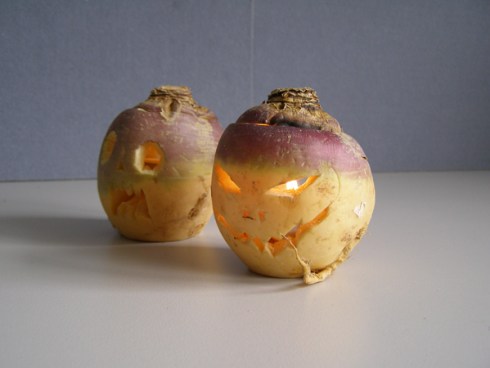
There is a great quote from the prolific and eminently quotable British writer G. K Chesterton about ghosts–or really belief– in general which references turnip ghosts in particular: I am quite ready to believe that a number of ghosts were merely turnip ghosts, elaborately prepared to deceive the village idiot. This is from a column in the Illustrated London News in 1936: the assumption is that his audience would immediately understand the phrase “turnip ghost”, and as they were British, they probably did. An American audience would and does require some translation. A turnip ghost refers literally to a Jack o’lantern made out of a turnip (but I would also include turnip-headed scarecrows)–something out there in the fields that was not a real ghost but that could create fear–a bugaboo (the best word ever). Old World turnips predated New World pumpkins as the material of choice for All Hallows Eve Jack o’lanterns, and remained predominate for some time, both in the British Isles and on the Continent. And you can easily see why: turnips are scary.

OLYMPUS DIGITAL CAMERA

Turnip Seed Packet Ghosted

Turnip Jack o’ lanterns from Work of Fiction (+directions); my own ghosted turnip seed packet.

The turnip-headed scarecrows are equally eerie: they turn up on Halloween postcards from the early twentieth century in both the United States and Europe, but are not exclusively tied to the holiday. Turnips just easily lend themselves towards anthropomorphic expressions.

Turnip Halloween Card

Turnip Head Howl's Moving Castle

Turnip Head Shakers

Vintage Halloween card, c. 1920; the Turnip-head scarecrow from  Hayao Miyazaki’s Howl’s Moving Castle; Vintage salt & pepper shakers available here.

I bought some turnips the other day–larger ones from a farm up north and smaller ones at our farmers market–with the intent to carve them into something scary, but I’m not sure I can do it–even with Martha Stewart’s assertive advice. They don’t have the soft insides of a pumpkin, and they are much more diminutive. I might chicken out and merely draw on them, because I’m not sure that I want to put in the time and effort: every single time I’ve carved out a pumpkin it has been stolen days before Halloween, and I’m sure my little turnip lanterns would be even more vulnerable!

Turnips 093

Martha Stewarts Turnips

My turnips and Martha’s creations: I might just settle for the turnips (and radishes) in a dish decoration, lower right. See a very scary traditional turnip Jack o’lantern here.


The Town Dyer’s House

My interest in Salem’s historic architecture has been narrowed down over the past few years that I’ve been writing this blog: while I still appreciate most of our city’s older (let’s be generous and say pre-World War II) structures, I’ve become increasingly fascinated with its oldest buildings in general and those that were demolished in particular. I’ve developed a somewhat peculiar fascination with “lost” houses, a demolition expert of sorts!  I’m constantly wondering why some houses are deemed too important to be swept away and others were leveled with little comment. My focus in this post is a house that was almost as famous a “Witch House” as the actual “Witch House” that still stands at the turn of the last century, yet it was demolished with little or no opposition that I could detect. The Samuel Shattuck House, built by 1680 just a few steps away from the Jonathan Corwin/”Witch House” on Essex Street, actually had a more direct tie to the Trials that the latter: the accusations and testimony of its occupants, a dyer named Samuel Shattuck and his wife Sarah, led directly to the conviction and execution of the first victim of 1692: Bridget Bishop. This poor widow, not quite as notorious as depicted by a succession of historians who confused her with the tavern-keeping Sarah Bishop, nonetheless had several encounters with the Shattucks, bringing them oddly-sized scraps of lace for dyeing–perhaps for a poppet? The affliction of their son convinced them that she was up to some mischief, and so they testified with considerable detail and vehemence, even though these encounters had occurred twelve years previously. Bridget Bishop was executed on June 10, 1692, despite her consistent affirmations of innocence.

Jump forward two hundred years later, when the Bicentennial of the Trials was stirring up a cauldron of commemorative and commercial products: witch spoons, postcards and plates. Contemporary Salem guidebooks typically featured several Trial-related sites at this time:  the Witch House, supposedly the site of interrogations, Gallows Hill, the site of the executions, and the Shattuck House, a “scene of the crime” as well as the source of allegations. My major window into the world of lost Salem houses, photographer Frank Cousins, marketed his print of the “olde” Shattuck House with the label it was through evidence of the Shattucks that Bridget Bishop was convicted as a witch.

Cousins Shattuck House DUKE

Shattuck House and Gallows Hill

Shattuck House Salem BPL

Frank Cousins photograph of the Shattuck House, 315-317 Essex Street, in the 1890s and the same photograph in The Visitors’ Guide to Salem, Essex Institute, 1895; another late nineteenth-century view, Boston Public Library.

It was so notable in 1895, and 1897, and 1900, but by the end of 1902 it was gone, demolished to expose to view only the two huge chimneys….showing the clam shell clay in which the brick was laid before the days of stone and mortar according to the brief notice in the Boston Evening Transcript on October 30, 1902. No notice at all that I could find in the Salem papers! And so despite its Witch Trial connections, the Shattuck House passed quietly in the night (like the Hunt House, the Parkman House, and the Ruck House before it), only to be replaced by an indistinct Colonial Revival structure that served in a variety of capacities (Gainsborough’s Photography Studio when I came to town) before it succumbed to condo-izaton.

Shattuck House Salem

Boston Evening Transcript clip, October 30, 1902; sketches of the Shattuck House from Nooks and corners of the New England Coast by Samuel Adams Drake (1905) and The Romance of Old York by Herbert Milton Sylvester (1909).


Witch Houses

Central to Salem’s evolution as the Witch City was the Witch House, a first-period structure that was the residence of one of the Trials’ judges, Jonathan Corwin. It was referred to as the Witch House back in the nineteenth century, when it housed a number of businesses–a longstanding drug store, later an antiques shop–and looked quite different than it does today, but it really became the Witch House when its evolving image was published on variant postcards from around 1900 on. The Corwin House acquired its seventeenth-century look in the middle of the twentieth century through a “restoration” under the direction of Boston architect Gordon Robb, and was opened to the public as the official “Witch House” by the city of Salem in 1948. As I’ve written about this House and its history before, I want to widen its context today by featuring some other Witch Houses, near and far, past and present, material and immaterial. There are at least two other houses in Essex County which were identified as such on postcards from a century ago, a time when there was a limited effort to turn the entire region into “Broomstick Country”. This was historically correct–the “Salem Witch Trials” were indeed a regional phenomenon–but commercially tricky, so Salem eventually claimed its exclusive title as the one and only “Witch City” with the Witch House.

The Old Witch House--Scene of Examinations at Salem. Illustration from Columbus and Columbia (Manufacturers' Book Co, c 1893).

Witch House Salem 1905

Witch House Danvers

Witch House Rockport 1910

Salem’s “Witch House” in 1893 (Columbus and Columbia Manufacturers’ Book Co, c 1893) and 1905: the George Jacobs “Witch House” in Danvers in 1907 (located in what was then Salem in the seventeenth century) and Rockport’s “Witch House”, also known as the “Old Garrison House” and still standing, in 1910. Supposedly two brothers from Salem built this house as a refuge for their accused sister or mother (depending on the source).

Farther afield, Witch Houses don’t have anything to do with witch trials: they just look like the sort of gothic structure that a romanticized witch might inhabit, like the Spadena “Witch’s” House in Beverly Hills, California, a storybook-style house built in 1921, or the famous Carl Van Vechten photograph of a long-lost “Witch House” in rural Maine during the Depression. The fairy-tale witches of the nineteenth century had created a more whimsical images of their houses in the twentieth, and clearly gables were seen as integral architectural details, so it is quite suitable that Salem’s Witch House would soon be enhanced with several.

witchshouse1

Witch House Van Vechten

Witch House Pyle 1887

Witch House Key Nielsen 1921

The California “Witch’s House’ in its original Culver City location, courtesy Beverly Hills Heritage; Carl Van Vechten, “Witch House”, 1936, Library of Congress; the Prince visits the Witch’s House in Howard and Katharine Pyle’s The Wonder Clock: or, Four & Twenty Marvelous Tales, Beind One for Each Hour of the Day (1887); The Witch’s confectionary cottage from Hansel and Gretel, by Kay Nielsen (1921).

Even farther afield in terms of both space and time is the woodcut print of a Witch House from the later sixteenth century by an anonymous English artist. This image, quite unusual as witches were generally depicted outside, in the wild, at this time, is often cited as appearing in the Swiss theologian Thomas Lieber (Erastus)’s Two Dialogues Concerning the Power of Witches (1579), but as Charles Zika points out in The Appearance of Witchcraft. Print and Visual Culture in Sixteenth-century Europe, the image appears to have been simply inserted into a 1579 English edition. Another fantasy house, although in this case it’s more about the exit than the architecture!

Witch House 1590


The Pumpkin Pouncer

Even though we have all lived together for several months, we are still adjusting to our newest cat, Trinity, and she to us. She’s either in constant motion or a state of complete collapse, like a youngster, which she is. She had a litter out in the wild before she was even a year old, and they were all rescued by our local shelter: the kittens were adopted first and then she came to us in late June, newly-fixed, and still very much a mother, in nesting mode. Not a scrap of fabric was safe in the house all summer–clothing, dishtowels, throws, even pillows—were carried up to my husband’s closet. If the door was closed, she would simply make a pile until it was open. Her beloved pink blanket, brought with her from the shelter, was always in close proximity. About a month ago, the fixation on fabric seemed to dissipate, but now she has a new focus:  pumpkins. Not real pumpkins, velvet ones, which I have been collecting for some time (before they became fashionable). Large or small, wherever they happen to be situated, she pounces on them, tears at them, carries them upstairs and then drops them from the second-floor landing to the entrance hall below, and scatters their insides (rice) on the floor, furniture, and even the dining-room table. At least she’s moved on from her fabric/kitten fixation (either that or she was a very bad mother).

Pumpkin Pouncer 030

Pumpkin Pouncer 048

Pumpkin Pouncer 035

Pumpkin Pouncer 044

Pumpkin Pouncer 046

Pumpkin Pouncer 051

Pumpkin Pouncer


Pyewacket

Pyewacket: lots of cats named “Pye”, why? If you’re of a certain age (born in the 60s at the very least) you might associate this name with the 1958 Jimmy Stewart/Kim Novak film Bell, Book and Candle, in which the modern sexy witch Novak had a Siamese familiar named Pye OR the children’s book by Rosemary Weir titled Pyewacket published a decade later. The origin of this name goes way back to the seventeenth century, when the notorious and self-proclaimed “Witchfinder-General” Matthew Hopkins tried several women for witchcraft (among many others) who claimed to have a number of “imps” or familiars in their service, including Holt, Ilemauzar, Pyewackett, Pecke in the Crowne, Grizzedl Greedigutt, Jarmara, Sacke & Sugar, Newes, and Vinegar Tom. All of Hopkins’ “discoveries” are proudly proclaimed in the 1647 pamphlet THE Discovery of Witches: IN Answer to severall QUERIES, LATELY Delivered to the Judges of Assize for the County of NORFOLK. And now published By MATTHEVV HOPKINS, Witch-finder. FOR The Benefit of the whole KINGDOME.

Pyewacket Life

Pyewacket finally

Pyewackett Hopkins 2

The pamphlet reports that in March 1644 there were some seven or eight of that horrible sect of Witches living in …. a Towne in Essex called Maningtree, with divers other adjacent Witches of other towns, who every six weeks in the night (being alwayes on the Friday night) had their meeting close by his house, and had their severall solemne sacrifices there offered to the Devill, one of which this discoverer heard speaking to her Imps one night, and bid them goe to another Witch, who was thereupon apprehended, and searched by women who had for many yeares knowne the Devills marks, and found to have three teats about her, which honest women have not: so upon command from the Justice, they were to keep her from sleep two or three nights, expecting in that time to see her familiars, which the fourth night she called in by their severall names, and told them what shapes, a quarter of an houre before they came in, there being ten of us in the roome. Holt appeared “like a white kitling”, then Jarmara, “who came in like a fat Spaniel without any legs at all, she said she kept him fat, for she clapt her hand on her belly, and said he suckt good blood from her body”. Next was Vinegar Tom, “who was like a long-legg’d Greyhound, with an head like an Oxe, with a long taile and broad eyes, who when this discoverer spoke to, and bade him goe to the place provided for him and his Angels, immediately transformed himselfe into the shape of a child of foure yeeres old without a head, and gave halfe a dozen turnes about the house, and vanished at the doore”. Sacke & Sugar appears like a black rabbit and Newes, a polecat, and the rest of the imps, including Pyewacket, are not identified, so among them we only have one cat, Holt (kitling is an old form of kitten). I have searched in vain for Pyewacket references in the eighteenth and nineteenth centuries and found none: the author of the 1950 play on which Bell, Book and Candle was based, the English playwright John van Druten, must have plucked Pyewacket out of semi-obscurity and associated the name with a cat, because by that time, everyone knew that familiars were feline.


Wakefield the Watcher

There’s definitely a dark side to Nathaniel Hawthorne, manifest in many of his works. After browsing through a recent bilingual edition of his short story “Wakefield”, included in the first edition of Twice-Told Tales in 1837, I think that would be my candidate for most haunted Hawthorne tale. It’s not just that the story–about a London husband who walks away from his wife and home only to take a flat one street over from which he can stalk (or “haunt” in Hawthorne’s words) her for twenty years–is a bit eerie, the illustrations in this particular edition are extremely evocative. They are the work of Spanish illustrator and artist Ana Juan, whose award-winning work has graced books for both juvenile and adult audiences as well as more than twenty covers of The New Yorker.

wakefi1

Wakefield

Juan’s images accentuate the creepiness of the story but you can only grasp Wakefield’s self-imposed alienation–Hawthorne calls him the “Outcast of the Universe” –by reading the text, which is very short, more of a sketch than a story. It would be nice if we could “see” things from Wakefield’s perspective (outside the home, just as Juan gives us a view of his impact inside the home), but Hawthorne won’t go there: the outcast is just wandering around, apparently unmotivated, except when he spies on his “widowed” wife. Consequently he emerges as a soul-less Peeping Tom, “spell-bound” in Hawthorne’s estimation, essentially a ghost as “the dead have nearly as much chance or revisiting their earthly homes as the self-banished Wakefield”. But in a completely “unpremeditated moment” Wakefield does decide to return home (probably because he’s standing outside in the rain and it looks warm inside) and we are robbed of his reception: I wish that either the author or the illustrator had show us that, but Hawthorne proclaims that “we shall not follow our friend across the threshold”.

Wakefield Streets Ana Juan

Wakefield Ana Juan illustration

Wakefield Ghost Ana Juan

Wakefield Watches

Wakefield Juan


Broken Brooms?

Besides dodging the crowds (and zombies) here in Salem on this past (absolutely beautiful) Columbus Day weekend, we went up north for a bit. Just off the highway in my hometown of York, Maine, I became fixated on an installation of witches on bicycles at the entrance to Stonewall Kitchen: as if I didn’t have enough witches in Salem! Of course, they resonated with me not just because they were witches (on bicycles) but because of the Wizard of Oz visual reference: few things were scarier in my childhood than the transformation of Miss Almira Gulch into the Wicked Witch of the West during the terrifying tornado. The fact that I have this very vivid image seared into my brain is one of the reasons that I’m glad I was born in the ’60s (although I think the ’70s would work too): every year when the Wizard of Oz came on we were glued to the screen and each scene made at impression because we would have to wait the entire year until we could see it again: we couldn’t just rewind a DVD or access a YouTube clip. So we remember.

Witches on Bikes 1

Witches on Bikes 3

Witches on Bikes 4

Witches on Bikes 007

Witch on Bicycle Wizard of Oz

Witch transformation wizard of Oz

Witch Oz


Zombies on the Streets of Salem

A pack of zombies infiltrated Salem on this past Saturday, “landing” at Collins Cove and making their way through downtown, along the Common and Essex Street, into Derby Square to Derby Wharf. It wasn’t quite an invasion, but more of a parade: they had a police escort (as well as a hearse and banner) and did not really proceed in that distinct zombie shuffle (?): I suppose that would have taken too long, so they just walked. I really don’t mind zombies: even though they are often disgusting, at least they are creative, and they’re not out to make a quick buck like all the witches around town (of course they have no zombie “forbears”–that we know of–on whom to capitalize). One little stroll on a sunny Saturday and they’re gone, although a few will, no doubt, linger until the end of the month.

Zombie Arrival

Zombies 1

Zombies 2

Zombies 051

Zombies 062

Zombies 073

Zombies 066

A little scuffle at the corner of the Common, but most of the zombies were peaceful paraders, like the lovely family above. Derby Square in the clear.


Handsome Heifers and Copious Carrots

Harvest time is Fair time, and in our region that means the Topsfield Fair, which advertises itself as the country’s oldest and dates its origins to a cattle show sponsored by the newly-formed Essex Agricultural Society in 1820. I found an interesting pamphlet (An Address Delivered Before the Essex Agricultural Society: at the Agricultural Exhibition in Danvers [and]  The Trustees’ Account of the Agricultural Exhibition at Danvers, October 16 and 17, 1821) about the fair’s second occasion that lists its award-winning cultivators, crafters, and exhibitors and was surprised to see quite a few Salem names among them. Then as now, Salem was pretty urban in comparison to the surrounding communities, but its northern and southern jurisdictions were still “fields”, so I suppose there was still sufficient acreage to compete with farmers from the more rural communities of Essex County.  Here are the big Salem prizewinners of 1821:

Animals:

Breeding Sows: Mr. Elias Putnam of Danvers won best ($8) but Mr. Jonathan Osborne of Salem won second best ($5).

Bulls: Mr. Ezekiel Hersey Derby, Esq. awarded first prize ($15) for his “deep red bull of two years old”. Noted also are his “very handsome” heifers.

Cows: Mr. John Barr, Esq. awarded first prize ($15) for his seven-year-old “bright red cow”; Mr. Aaron Waitt, Esq. awarded third prize ($5) for his six-year-old “light red cow”.

Domestic Manufactures: (Salem residents dominated in this category, I must say, although it seems to have been an exhibition rather than a competition).

Imitation Beaver Hats: from Major Samuel Mansfield’s Factory, Salem: water-proof, highly recommended for beauty and economy:  “they exhibit an admirable imitation, formed by the skillful use of cheap materials–the nap of muskrat is laid upon lambswool bodies, which are stiffened with gum shellac”.

Imitation Merino Shawls: by Mrs. Thompson of Salem. Cotton and wool carded together, rich colors, exhibiting “great taste and skill”.

Imitation Leghorn Bonnets: from Miss Mary Raymond of Salem “the happiest imitation in point of color”.

Beautiful specimens of Vitriol and Alum” : from the Salem Laboratory (must research this).

Carpeting: “a well-executed piece of Venitian carpeting” from Mrs. Dwinnel of Salem and “Gobelin-worked Crickets” by the young Misses Page of Danvers are praised–what are Gobelin-worked Crickets????????????

The Ploughing Competition: this seems to have been the highlight of the exhibition, but the root vegetables (see below) received much commentary as well. Benjamin Savory of Newbury won, but Mr. Ezekiel Hersey Derby came in second, with his team of oxen driven by Henry Barrich, ploughman, who ploughed 36 furrows, 6 inches deep, in 70 minutes, “very handsomely”.

Crops: here the Salem farmers seem to be disadvantaged, but John Barr won the barley competition, and Salem dominated the exciting carrot competition:

First Prize ($15) to Mr. John Dwinnel of Salem: 360 bushels raised on a half-acre. Mr. Dwinnel also received second prize for his potatoes.

Second Prize ($10) to Mr. James S. Cate of Salem: 276 bushels raised on a half-acre.

Fourth Prize ($5) to Mr. Ezekiel H. Derby, Esq. of Salem: 256 bushels raised on a half-acre.

There seems to have been intense interest in root and fodder crops at this time, so there were also “claims” or documented harvests of certain crops including rutabaga and “mangel wurtzel”, a kind of beet. Mr. Derby submitted a claim for the latter: reaping 287 bushels of the crop from a half-acre of land, “twice-ploughed and received a slight dressing of manure”, along with Russian radishes and Swedish turnips. The seed was sown on May 23, 1821, and the crop harvested between October 27 and November 3rd. The Salem surveyor came out to verify the claim.

Such information in this report! It makes me want to abandon my ongoing exploration of cultural and social history and become an old-fashioned agricultural historian! It’s no surprise to any Salem historian to see Ezekiel Hersey Derby so oft-mentioned in this account, however, as there is an amazing painting of his family farm in South Salem by the Salem émigré artist Michele Felice Corné dated from about 20 years earlier in the collection of Historic New England. I walk by the former site of this farm (basically Lafayette and Ocean Streets) on my way to work, and generally I think about what it looked like before the Great Salem Fire of 1914, but now I have an entirely new pastoral perspective.

Corne Derby Farm 1800

Cornè, Michele Felice (1752-1845) Ezekiel Hersey Derby Farm, c. 1800, Cogswell’s Grant, Historic New England. This painting is also notable as it represents the artist and his friend, Salem’s famed architect and woodcarver Samuel McIntire, in the lower left-hand corner adjacent to the fence.

The Little Locksmith

Several years ago, one of my favorite readers, and bloggers, told me about a book written by a Salem author called The Little Locksmith, but for some reason I didn’t pick up a copy until just this past week–and I spent the cold and windy weekend reading it. This was quite an experience, as this is a memoir that puts our indulgent modern memoirs to shame in its ability to present an engulfing narrative of suffering (or perhaps I should say not suffering) and survival. The Little Locksmith was published in 1943, several months after the death of its author, Katharine Butler Hathaway, who was diagnosed with spinal tuberculosis right here in Salem in 1895, when she was five years old. For the next ten years, she was confined to her bedroom and strapped to a board “like a specimen butterfly” in the hope that her spine would grow straight. She emerged not only hunchbacked, like the little locksmith that used to come to her Salem home (on Lafayette Street, sadly swept away by the Great Salem Fire of 1914), but also severely stunted, a very wise young woman in a child’s body. One would imagine that she would look back on this childhood with horror, regret, and even anger, but she does not, instead we read of “joyous” days:  Though my back was imprisoned, my hands and arms and mind were free. I held my pencil and pad of paper up in the air above my face, and I wrote microscopic letters and poems, and made little books of stories, and very tiny pictures, I sewed the smallest doll clothes anybody had every seen, with the narrowest of hems and most delicious little ruffles. I painted with watercolors and made paper dolls and dollhouse furniture out of paper. Paper was the nearest thing to nothing in the way of material, and yet it was possible to make it into something that people would exclaim over and fall in love with. It was something precious made of nothing.” 


Little Locksmith Katharine Butler Hathaway

Little Locksmith cover

Little Locksmith House Pen

Katharine Butler Hathaway (1900-42): from the Schlesinger Library at Radcliffe, where her papers are located; a first edition of The Little Locksmith (1943); the Mark Hatch House in Castine, where she lived from 1921-1931, Penobscot Marine Museum.

This ability to discern, appreciate, and make things that are precious stayed with her for the rest of her life. After she emerged from her Salem bedroom at aged 15, her “horizontal life” leaving her misshapen yet somehow also enchanted, she was off to Radcliffe, New York City, Paris, and Castine, Maine, where she found a neglected old house which she crafted into a precious touchstone. The Little Locksmith is really about this house and what it means to her more than anything else, which makes it even more fascinating for materialistic me. Her ability to describe places and what they mean to her is captivating: the chapter where she describes her family’s return to a sultry September Salem from their summer residence in Vermont is probably my favorite, as the sounds of crickets and steps on the brick sidewalks of Salem are the sounds that I always notice when I return home from up north. Upon her marriage to Daniel Hathaway of Marblehead, she is forced to sell her beloved Castine house, but they move on to settle in an old brick house in Blue Hill, Maine, which becomes yet another charmed setting for her, unfortunately her last.

