
As if it is not enough to bury the archives of a historical seaport in an inland warehouse 45 minutes away, rumor has it that one of the prominent symbols of Salem’s maritime heritage will also be removed: the large anchor that stood sentinel in front of the East India Marine Hall for over a century. I don’t like to trade in rumor, but given the leadership of the Peabody Essex Museum’s propensity to avoid announcements until their intended actions have become faits accomplis, I think I should. We’re all scrambling to save as much of Salem’s historic fabric as we can. But I have a question mark in my title and am ready, indeed eager, to issue a retraction. Looking at the latest renderings for the addition that is rising on the western side of hall, however, I fear that that won’t be necessary.


 East India Marine Hall and its milieu, 1912-the near future? As you can see, the anchor—clearly maritime kitsch that would spoil the sleek streetscape envisioned—is not there. Below we have a livelier, anchor-centric rendering from Rich Mather Architects: unfortunately Mather died and the PEM looked elsewhere, although his colleagues and successors at MICA Architects carried on with the rest of his commissions.

To be fair, the anchor has not been in front of the East India Marine Hall from the date of its erection, but only since 1906. It was a gift from Theodore Roosevelt’s short-lived Secretary of the Navy Charles Bonaparte, of the “American Bonapartes” descended from the little Emperor’s younger brother Jerome. Secretary Bonaparte seems to have been a remarkably tone-deaf official, as almost immediately upon his appointment, in response to solicitations for funds to restore the venerable USS Constitution, he asserted that Old Ironsides should be towed out to sea and used as target practice! This caused an uproar in Boston, as you can imagine: the Boston Transcript opined that “to New England sailors, firing on the Constitution would be almost as offensive as bombarding Bunker Hill Monument or Plymouth Rock” and the national press ran stories under the headline “Secretary Bonaparte’s Collision with New England Patriotism”. There were Save the Constitution fairs and petitions, as the combined forces of the Daughters of the War of 1812 and the Massachusetts Historical Society shepherded a movement which forced Bonaparte to back down. He wisely did so, and in his second (and last) annual report he called for patriotic celebrations in Massachusetts’ seaport towns, in recognition of the Bay State’s maritime heritage. This was the compensatory initiative that brought a hand-forged c. 1820 anchor to rest before the East India Marine Hall in 1906. As long-time Peabody Museum treasurer and trustee John Robinson noted in his 1921 pamphlet The Marine Room at the Peabody Museum of Salem,“as an anchor is the emblem of the Salem East India Marine Society, for whom the building was erected in 1824, the placing of this large, old-time anchor at its front is very appropriate”. Apparently not now.

 Two perspectives on the Peirce-Nichols House: Cousins and Chamberlain.


 Essex Street, Church Street, the rear of the Andrew Safford House, the Retire Becket House, the Derby House, Federal and Chestnut Streets from Samuel Chamberlain’s Historic Salem in Four Seasons (1938). Both


 You can
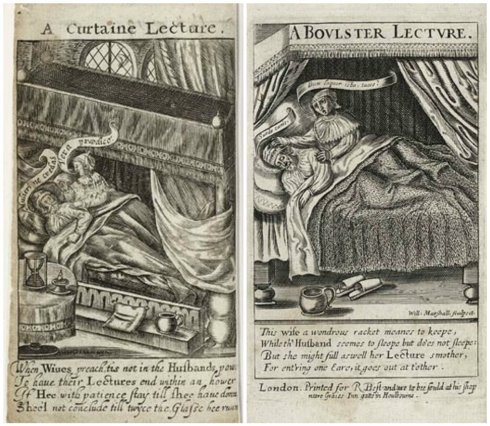


 A Curtain Lecture pub. by J. Lewis Marks, 1824, British Museum; illustrations by John Leech for the first edition of Mrs. Caudle’s Curtain Lectures, 1845; Mrs. Caudle Card (with real hair!), Victoria & Albert Museum; 1907 stereoview from the Library of Congress; postcards, c. 1900-1910.
 Compare the PEM’s online


 The very interesting house of Edward Sylvester Morse on Linden Street in Salem; the Account Book of the Thomas Perkins of Salem (pictured above from the Essex Institute’s Old-Time Ships of Salem, 1922) is included in Adam Matthew’s China, America, and Pacific database.
 The interior of the East India Marine Hall past and present, and before the installation of the PEM’s newest
 The Collections of the Essex Institute in the Phillips Library Reading Room, 1980, and the library collections reinstalled, 2008,


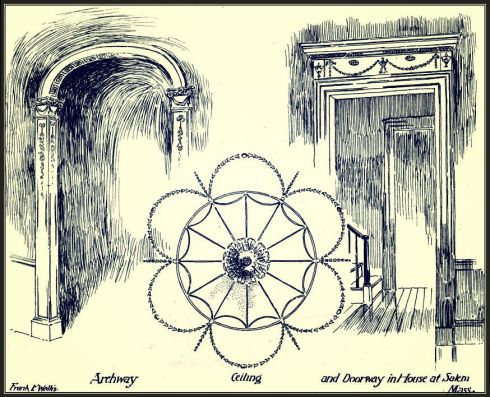
 And I really fear I’ll be too reliant on the detailed-yet-romantic work of Maine-born architect Frank E. Wallis, whose reverence for Salem is all too apparent! Plates from Frank E. Wallis,


 Mr. Monroe at the PEM forum last night.
 The shuttered Phillips Library.


 Flyer for the 1/11 forum, position letter of newly-revived “Friends of Salem’s Phillips Library”(which is so new that it is homeless but I think it is going to wind up
  One of my very favorite photographs from the Phillips collections that I’ve found while DREDGING every and all online sources this month: from the anniversary of the Children’s Friends & Family Services, Inc. (Phillips MSS 447), 1839-2003, which began life as the Salem Seamen’s Orphan Society and has 54 boxes of records on deposit in the Phillips.






