Houses are History

Last week I was thinking about all the things that annoy or concern me about Salem now, and the list seemed endless, which depressed me, and then I suddenly thought, why don’t I focus on the things that I love about Salem so I won’t be so depressed? This seemed like a good idea, and an easy realignment. Why did I move to Salem? Architecture. What do I love about Salem? Architecture. So I’m going to go back to the foundations of my own Salem story and getting back to architecture with an occasional series here and on social media (#salemhistoryhouses) looking at individual houses in the present and past as a means of telling more Salem stories. Just one house can open a wide window into the city’s history, American history, even world history, as Salem has always had a global orientation. This is not a novel observation, but somehow as I pursued a range of Salem topics here and in our forthcoming book Salem’s Centuries I lost sight of one of the most basic expressions of cultural achievement: houses. Besides the inspiration of merely pursuing my own happiness, I am also motivated by the efforts of two people who I’ve written about a lot here and also in Salem’s Centuries: Frank Cousins and Mary Harrod Northend. These two contemporaries dedicated a good part of their lives to highlighting Salem architecture in print and image. Both wrote books and magazine articles and established photographic publishing companies which distributed images of Salem houses nationwide. They were both particularly keen to emphasize that all not was lost with the Great Salem Fire of 1914, and that much of Salem’s architectural heritage remained; a decade later both were intent on celebrating that heritage during Salem’s Tercentenary in 1926. Cousins died the year before; Northend in that very year. I’ll feature a lot of their work in my series, as preserved and digitized by the Phillips Library (via Digital Commonwealth), the Winterthur Library, and Historic New England, as well as the large collection of images available at the Salem State University Archives and Special Collections. So there you are, or there I am: one of the things that annoys me about Salem is its lack of a professional historical museum, but all these institutions, and more, are in fact collecting, preserving, and sharing Salem history.

My first social media post is a great example of how just one house can lead you in all sorts of directions. The Eden-Browne has was built in 1762 by Captain Thomas Eden as a warehouse, and then converted into a (very elegant) residence by Benjamin Cox in 1834. Captain Eden was a trader in the codfish rectangular trade between Salem, southern Europe, and the West Indies, and the very first member of the Salem Marine Society: his grandaughter, the artist Sarah Eden Smith, lived and died in the house. Her other grandfather, Jesse Smith, was an officer in General Washington’s First Horse Guards, and she herself was a professional artist and instructor who spent several years at the Hampton Institute (now University) teaching Native American students. Miss Smith, “the last of her family,” was also the author of a lovely little pamphlet on the history of the Second Church of Salem, visible below in the top photograph, which obviously dates from before it was demolished by fire in 1903. So that’s a lot of history tied to just one Salem house!

A house that both Cousins and Northend adored (both really seem to have preferred Salem’s 18th-century houses) is the Dean-Sprague-Stearns House on the corner of Essex and Flint Streets. It was built in 1706 and acquired a portico by Samuel McIntire a century later. It has a connection to Salem’s most notable Revolutionary event, Leslie’s Retreat, through the residence of distiller Joseph Sprague, a major participant in that resistance, and it was operated as an inn named the East India House in the middle decades of the twentieth century. I love the description of this house in Samuel Chamberlain’s Open House in New England: “the EAST INDIA HOUSE  contains a wig room, two powder rooms and a Tory hide-out in one of the chimneys. A quadrille was given here for General Lafayette in 1824.” TORY HIDE-OUT.

Top photograph from the Frank Cousins Collection of Glass Plate Negatives at the Phillips Library, via Digital Commonwealth.

Talk about going back to Salem houses: One Forrester Street was one of the first house reports I researched and wrote for Historic Salem, Inc., way back in the 1990s! I was in graduate school, and this was my way of “learning” Salem. These are another great resource (and mine are far from the best!), as members of the Salem Historical Society digitized them several years ago. These house histories, in addition to the Massachusetts Historical Commission’s MACRIS database, represent accessible information about hundreds of Salem houses. I remember being very excited about researching One Forrester as it’s such a great house, with a distinctive profile right on Salem Common. Though built by a tanner named John Ives, the house was kept in the Webb family for quite some time, I think, almost two centuries. In the northwest corner of the house is a “cent shop” straight out of the House of the Seven Gables; it might even have been Hawthorne’s inspiration.

Stereoview (top) from the 1860s, and the  Nelson Dionne Salem History Collection at Salem State University.

There were many Webbs in Salem and it is quite a challenge to keep them straight! Sea captains in the 18th century, entrepreneurs in the nineteenth. Another Webb house is one of my favorite brick-sided houses in Salem, adjacent to what was long a Webb apothecary shop on Essex Street. These buildings are 52 (house) and 54 (shop) Essex Street, and they represent what were probably hundreds of attached or adjacent residences and shops which once existed in Salem.

Stereoview from the Dionne Salem History Collection, Salem State University Archives and Special Collections.

I’ve decided that I’m not going to feature lost houses in my little series, as I am engaged in the pursuit of happiness. But I’m definitely going to feature houses that were moved, because there are so many, and also because I love these examples of nineteenth-century (and a bit of twentieth-century) sustainability. One house that was moved from Salem’s main street, Essex, to a nearby side street is Five Curtis Street, which is featured prominently in one of my favorite architecture books, John Mead Howells’ Lost Examples of Colonial Architecture: Buildings That Have Disappeared of Been so Altered as to be Denatured: Public Buildings,Semi-Public Churches, Cottages, Country Houses, Town Houses, Interiors, Details (1931). It is indeed one of my favorite books, but I also realize that Howells makes a lot of mistakes, so I always check him. He indicates that the house was moved in 1895, which does check out, and refers to the house as the Joseph J. Knapp House. More recent researchers refer to the house as the the John White House, and I think this is correct: White, a mariner, built the house around 1802 and sold it to Knapp, another mariner (a loose term which generally means merchant and maybe captain but more likely owner of shares in a ship at that time) six years later. The house remained in the Knapp family until 1848, which means that this house has a connection to the most notorious murder in nineteenth- century Salem. Joseph J. Knapp’s two sons, John Francis (Frank) and Joseph Jenkins Jr., hired Richard Crowninshield to murder their wealthy uncle Captain Joseph White in 1830 and all three met their deaths before the end of that year. Mr. Knapp Sr. had already decamped for Wenham before these events, and he remained there until his death in 1847.

Frank Cousins photograph of the Knapp House in its original location on Essex Street (on the corner of Orange), John Mead Howells, Lost Examples of Colonial Architecture (1931). 


Fall Reading 2025

The stars seem to have aligned and I am all set for a fall full of reading. Salem’s Centuries is in production (and out on January 6), my new saffron project hasn’t taken flight yet, and I have a course release for the semester. I’ve written two books in five years and now is the time to ingest. Escaping into book worlds is another way of avoiding my least favorite season in Salem as well. So I have a long list, already about a quarter devoured. As usual with my book lists, it’s very light on fiction, heavy on history, and reflective of the odd ephemeral interest. So let’s go: it will be interesting to see how I group these rather disparate texts.

I think I’ll start out with broad, cultural histories as they might have the most general appeal: I’m always reading “commodity histories” and this year will be no exception, but I have to tell you that Robert Hellyer’s Green with Milk and Sugar has a bit more depth and dimension than most books about tea—and there are a lot of books about this particular commodity. I had the difference between black and green teas down, but did not discern between different types of the latter (and their impact) until I read this very interesting book. Another important global commodity, sugar, has also received quite a bit of attention from scholars (beginning with Sidney Mintz’s classic Sweetness and Power) but the latest effort, the Dutch economic historian Ulbe Bosma’s World of Sugar, is supposed to be particularly comprehensive. I bought it last year but haven’t delved into it yet. Super excited to read Catland: how can it not be amazing? I’m not sure where to put Chanterelle Dreams, Amanita Nightmares, a book I discovered in the gift shop of the Coastal Maine Botanical Garden a few weeks ago solely for its title (+ lore), in this post so I guess I’ll put it here: it is kind of a broad cultural history of human perceptions of muchrooms. It’s also very much a “pick up and read a bit” book.

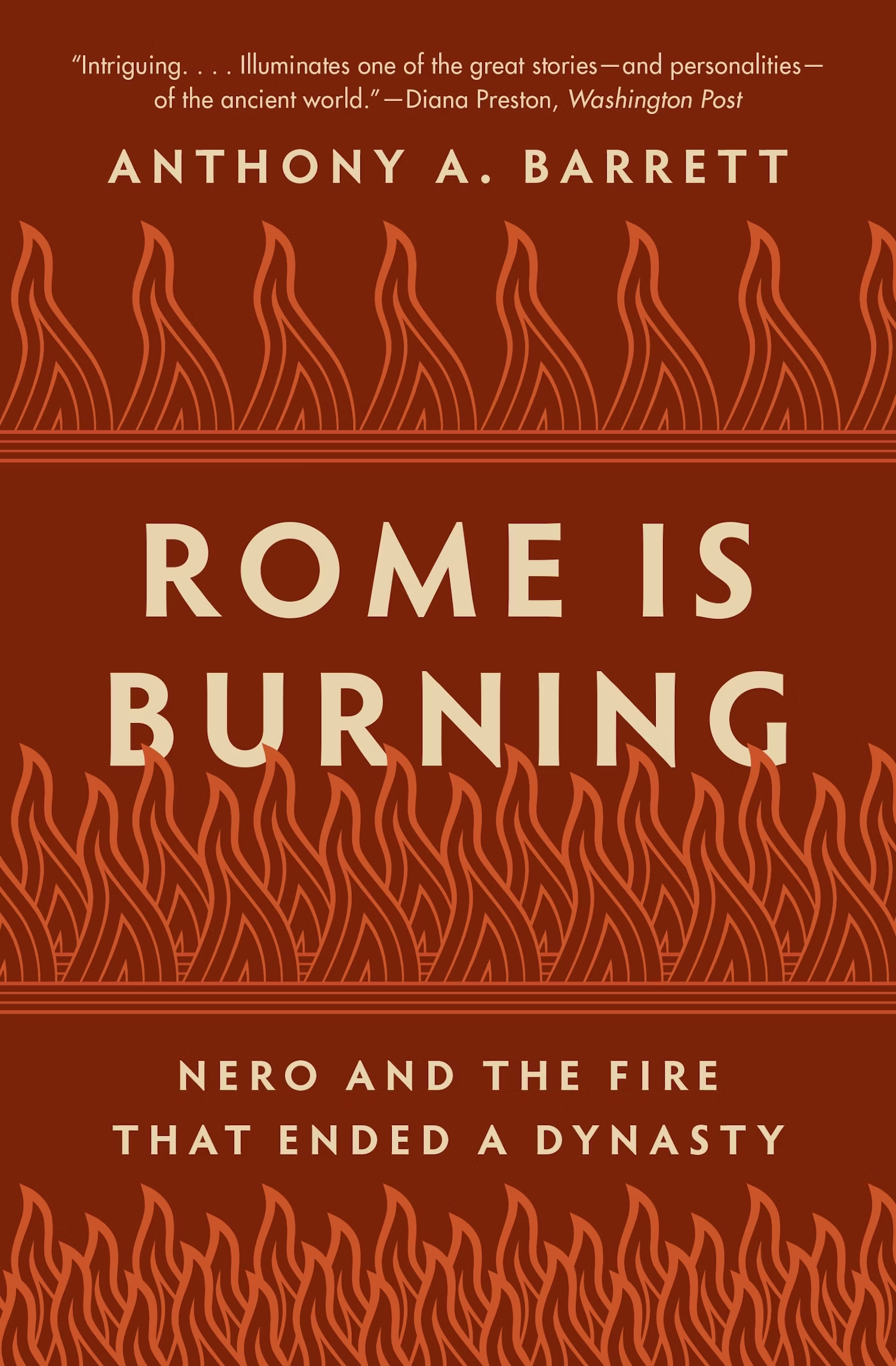
I find that I am reading new books on the Atlantic Slave Trade regularly because we are in the midst of a golden age of research into the history of this terrible trade and provocative analyses of its cascading impacts are published every year.  Traders in Men and Plantation Goods are on my fall list but I should have read them this summer, in advance of teaching my Introduction to European History course. Instead, I had a “Roman interlude” prompted by a re-reading of Suetonius’s Twelve Ceasars last spring. So two half-read Roman books are on my fall list too: a very accessible history by Anthony Barrett about Emperor Nero and the burning of Rome and a book by Roland Mayer about Roman ruins which is more about later perceptions of Rome than Rome itself. The Mayer book probably belongs with the broad cultural history books above. I have started Traders in Men and Plantation Goods (as you will discern by now, I read books in phases, concurrently with other books, a habit I’ve been trying to break but cannot) and my assessment so far would be: both very important and well-sourced studies, with Plantation Goods probably more accessible as it focuses on the basic. It is very much a “material history.”

There are several books which were recently published in my scholarly fields which now sit beside my bed in a stack: first up is Inventing the Renaissance and then we have two books on major late Tudor/Jacobean players: George Villiers, the Duke of Buckingham, and Robert Cecil. I’ll read these for myself, but also to discern whether or not I’ll assign them to students. Stephen Alford (author of All His Spies)’s previous book, London’s Triumph, was a big hit among my grad students this past summer. I suspect that Palmer’s Inventing the Renaissance will be great for historiographical discussions in both undergrad and grad courses. And because it was set in my period and in an interesting period in Mary, Queen of Scots’ life, I actually read a novel all the way through this summer: Flora Carr’s The Tower.

Finally, books on more topical interests which are preoccuping me constantly and/or currently. I’m always interested in architecture, and I read one book this summer which I loved: Thomas Heatherwick’s Humanise (it’s spelled Humanize in its American edition but I prefer the British one’s cover). I don’t think many architects like this book as it is quite critical of contemporary architecture not so much on the basis of design but of craftsmanship. Heatherwick has provoked a reaction among architects in the UK (I’m not sure about here) as he is not an architect himself and does not hold back on characterizing much present-day building as both soul-crushing and soulless (generally because it is so boring) and has launched a campaign to bring joy and craftsmanship back to construction. He’s a real crusader! I’ve been interested in the urban planning idea of the “15-minute city” for a while, so I picked up Shrink the City to learn more about it. The whole idea of meeting all your needs within a 15-minute radius could work for a city with the infrastructure of Salem, but not if we continue our comprehensive commitment to witchcraft tourism, which has resulted in a multitude of witch shops replacing those selling clothing and groceries. As this past year I seem to have become preoccupied with symbols and emblems, first because of the ongoing discussion over the Salem city seal and more recently by the dumbing-down of the Massachusetts state seal and flag, I’ve really been searching more insights into visual culture and graphic design. It’s like another language which I don’t understand. One book that has really helped me is the classic Megg’s History of Graphic Design, but I welcome suggestions. I have yet to find a thoughtful or even interesting book on vexillology.


Up North for a Spell

Sorry for the longer time between posts; I generally try (and succeed!) to post once a week but I was on vacation up in Maine and forgot my power cord, which might have been a good thing. I had my Fall Reading List all ready to post, but now I think I’ll save that for next week and just post my Maine pictures this week. We were based in East Boothbay on the Mid Coast, where we have been very casually house-hunting for a summer house. That was supposed to be the mission of this week as well but really it was just a family vacation as both my parents and my brother and brother-in-law joined us, along with a friend from Salem. We had a big beautiful farmhouse right on the water with spectacular sunsets each night. Great New England Summer weather; none of the swampy heat we’ve had in Massachusetts for most of the summer. I had my very first visit to Monhegan Island, which as inspired artists for generations. The other highlight, at least for me, was a visit to one of the National Park Service’s newest monuments, the Frances Perkins homestead in Newcastle. And the capstone was a oyster farming tour of the Damariascotta River given by my stepson Allen, who works at Muscongus Bay in nearby Edgecombe. Just a great week! Posting vacation pictures is definitely low-effort blogging, but I hope you’ll forgive me as I am now in the dreaded syllabus week before the beginning of the semester.

“Our” House with view and sunsets; around East Boothbay.

I could not resist putting my husband John’s lobster pasta in here as he seems to be on a lifelong quest to create the perfect lobster pasta and this was very good!

The Frances Perkins National Monument in Newcastle, with the sign that greeted us in the parking lot!

Maine is very intertwined with Canada, and I heard concerns about few Canadian visitors everwhere I went: given the hostile rhetoric from our President, it was nice to see this welcoming sign. Frances Perkins was a fierce social justice warrior and the first female cabinet member in U.S. history who served as President Franklin D. Roosevelt’s Secretary of Labor throughout his terms. She was integral to the passage of Social Security. This house along the Damariascotta River was in her family for over 250 years: though she was not raised here (her father moved south to Massachusetts for more opportunities, leaving her uncle to carry on the farm) she visited it often. It became a National Historic Landmark in 2014, and President Biden signed its official designation as an NPS Monument in December of 2024. It was quite poignant to visit this place given events recent and past, and there were quite a few people there—-hopefully Americans and Canadians! After we left the Perkins homestead, we drove out to Pemaquid Point, and this is the best picture I have ever taken of that locale so I had to include it.

Monhegan Island. I can’t believe I have never been there but now I have.

Monhegan is just one of thousands of Maine islands, but it is very storied. About ten miles and an hour and a half off the mainland, it’s about a mile in acreage, divided into a small village and lots of forest. Except for an unfortunate experience with sheep, the islanders seem to have been very intent with their land and pursuits, and the result is a very pictorial islandscape which has been captured by a succession of artists for more than a century. I absolutely loved the Monhegan Museum of Art & History, which blended art and history in nearly every exhibit: seemingly there was always an artist around to create posters for lighthouses (Alexander Parris), tea gardens, and baseball games (Frederic Dorr Steele), along with door panels (Karl Schmidt) and tea cups (Rockwell Kent). I could not leave out the lobster claw composition.

Oyster Farming on the Damariascotta River:

My stepson Allen got permission from his boss at Muscongus Bay Aquaculture to take us on a river tour at their Newcastle farm–just down the road from the Frances Perkins Homestead. It was fascinating, and this is seems like such an important industry for Maine (and all of coastal New England I think) right now: the neighboring Glidden Point farm was just featured in an article in the New York Times, and an oyster farmer is running against Senator Susan Collins in the upcoming election. I captured several “oystermobiles” as I drove around, but the one on Georgetown Island in the last photo above is the best.

Coastal Maine Botanical Gardens in Boothbay. The one cloudy day we had was perfect for pictures.

Lots of late summer color and the famous trolls–very popular but I did manage to get a few alone.


Cardboard & Chrome

Last week was a little challenging here in Salem, with news of two local businesses closing: one decades old, the other an extremely popular retail shop which caters to residents rather than tourists. Such businesses seem fewer and fewer present along the streets of Salem, and it’s a bit disheartening. The slide towards all-year-long Halloween seems relentless, at least to me, and you can see little black witch hats everywhere you walk even on the hottest days of summer. So it was nice to have two more traditional events this past weekend: the Maritime Festival at the newly-designated Salem Maritime National Historic Park (as opposed to Site, its prior designation) and the Phillips House Car Meet. These events have been going on for decades—the Maritime Festival took a break but was revived several years ago with a new marquis event, a cardboard regatta which is really fun to watch and the Car Meet just gets bigger and better every year. I saw lots of old friends on both days and met quite a few new among the old cars as I was greeting guests at the Phillips House. And I saw only ONE stupid little witch hat on both days! I took lots of pictures, so here they are:

Maritime Festival & Cardboard Regatta at Salem Maritime National Historic PARK on Saturday: the boats were largely family or organization constructions with lots of young sailors aboard and some were very seaworthy while other sank pretty quickly. But everyone paddled as best they could! Lots of entries this year, and the awards were very creative.

They’re still working on her as you can see, but it’s been nice to have the Friendship back at Derby Wharf this summer too. And it was lovely to be able to go into both the Custom House and the adjoining Derby House—I hadn’t been in the latter for at least a decade; I can’t really remember when I was last in there, actually. It looks great.

Love the scale of these rooms!!!

The 23rd Annual Phillips House Car Meet on Sunday: as you can see from my photos, what I like is the juxtaposition of old houses and old cars. This event started out with maybe 15 cars, and now there are cars lining both sides of Chestnut Street so almost every house has its own car! The lower end of the street, where I live, is excluded, as it is narrower and traffic has to flow somewhere so my house does not get its own car. In years past when I was not working this event, I would find out all about the cars but I didn’t have time to do that this year as I just took some snaps during a break. 

And then they were gone….leaving no tracks.


Massachusetts Menus

I had a more substantive post planned for this week but I took a little detour and so here I am with menus. I started to write about my experience as a tour guide at the Phillips House of Historic New England, as I’m in my second year and I thought it was time for some reflection. But in doing so, I became fixated on a moment during my tour (well during all of my colleagues’ tours, I’m sure, as it’s definitely a great device) when I show our guests a menu from July 1919 in order to interpret both the dining room and one of the ways in which the household worked. Everyone loves this menu: adults, children, southerners, northerners, midwesterners, westerners, visitors from other countries, Salem residents. There is one particular item on this menu that captures everyone’s attention without exception: Orange Fairy Fluff!

So I thought that before I delved into my reflective post about what I have learned as a tour guide, I should discover the origins of Orange Fairy Fluff, and this took me down a road of restaurant history marked by menus. And then I went down my own memory lane of menus, and so here we are with menus from storied Massachusetts restaurants. The restaurant most closely associated with Orange Fairy Fluff is the famous Toll House Inn in Whitman, Massachusetts, the birth place of chocolate chip cookies. I think the timing is a bit off, however, as the menu above is from 1919 and the Toll House didn’t open until the 1930s, but an earlier (1916) Sunkist cookbook published a recipe before the Toll House owner Ruth Wakefield’s popular “Tried and True” cookbook. The Toll House menu is a perfect example of the “mid-century Colonial” aesthetic I’m so fond of, as are those of its competitors in the 1940s and 1950s.

I’ve been to, or driven by, all of these restaurants, with the exception of the Adams House in Marblehead. I just like its menu and “shore dinners” evokes the restaurant of Salem Willows. I never went to the Towne Lyne House in Lynnfield, but it was a “landmark” on the drive along Route One to and from Boston from Maine, along with “The Ship” restaurant on the other side of the road. All menus above from the Culinary Institute of America’s Menu Collection.

I have very warm memories of Filene’s, in truth the Basement more than the restaurants, but I do like the map menu below—although it doesn’t have Salem on it! Seeing the House of the Seven Gables front and center on the 1940s menu mollified me a bit, as did a menu for St. Clairs Restaurant from Historic New England’s collections which also features the Gables prominently on the cover. I also have childhood and teenage memories of meals at Locke-Ober, the Union Oyster House, and Cafe Marliave in Boston—and the Parker House, of course. The last time I went there—maybe just before Covid?—-it was looking a bit dowdy so I was pleased to hear that it’s going through a big refresh this year. (I wonder if they will keep the worst portrait ever of Nathaniel Hawthorne?)

The CIA collection has a few menus from Salem restaurants, including one from the famous Moustakis “palace of sweets” on Essex Street.When I look at this menu, I think that Salem could use an ice cream parlor today, especially one which offered up Moxie floats (!!!) and College ices (???), but I am also aware that Moustakis was no mere ice cream parlor. A half-century after its founding, it functioned as important gathering place for Salem businessmen according to the 1956 sociological study Community Organization: Action and Inaction by Hunter Floyd:

Other prestige groups observed during the process of study now may be briefly mentioned. There is no athletic club in Salem, nor any downtown men’s club that can serve as a luncheon meeting place. There is, however, a loose tradition that has grown up for various businessmen to eat in a restaurant owned by a Greek named Moustakis. At a rear table of the restaurant, six or eight men can be seated comfortably at a time. During the lunch hour there is a tendency for some of the well-known merchants on “The Street,” as Essex or the main street is called, to gather at this table. As the lunch hour proceeds, professional men, lawyers, accountants, real estate men, and finally bankers may join the group or take the places of men who have finished eating. There is a shifting pattern of membership of this group, but through habit on the part of members, the key pattern is relatively stable. Not all men, by any means, who represent the commercial and professional interests of the community eat at Moustakis’. The restaurant is, however, recognized as a place where gossip is exchanged and an eye is kept on important happenings. Other restaurants serve a similar function, of course, but none are quite as well known as the Moustakis’ “clearing house.”

Menus from the Culinary Institute of America’s Menu Collection and Historic New England’s Collections Access.

And finally, menus from two very different Salem restaurants: the House of the Seven Gables Tea Room (squash pie!) and China Sails, which is still with us, in its original location on Loring Avenue near Vinnin Square. These China Sails menus look like they date from a bit later, and only the Salem location survives (though I don’t think Dave Wong is still in the picture).


I’m Confused by Pineapples

This is one of those “writing it out” posts. It starts out with confusion in the hope that I can work it out, but I may not so it might end in confusion as well. I’m confused about the symbolism of pineapples. Of course everyone knows that pineapples represent “hospitality,” but do they really? What else might they represent? I started out with the question as to whether pineapples are Colonial or Colonial Revival, and it seems that that they are both. I’m also wondering if there are differences in what they represent in the northern US as opposed to the south, and between the US and the UK. My wonder is prompted by recent road trips down south, where I saw a lot of pineapples, as well as an interest in symbolism in general prompted by the recent discussions here in Salem over our official city seal, which some see as stereotypical and rascist and others see as evocative of a proud global maritime heritage. I always find that a historical perspective helps with understanding both images and events; apparently the members of the Task Force charged with examing the seal do not. In any case, there’s always a personal and arbitrary angle: it’s so interesting that different people see very different things in the same image. And that is true of pineapples too: while for the most part they seem to convey a sense of decorative hospitality, they also have associations with exoticism and exclusivity and excess, colonization, plantations (both in the West Indies and Hawaii), coerced labor and ultimately slavery. I am always interested in Salem’s famed “Pineapple House,” a Georgian structure first located on Brown Street and then removed to Brown Street Court which was demolished by 1911 with only its pineapple-pedimented door preserved, first in the Essex Institute and now in the American galleries at the Peabody Essex Museum. I’ve written about it before, but I know more now: its pineapple was not a local creation but rather a British import and its importer, Captain Thomas Poynton, became one of Salem first Loyalistist refugees, leaving his house (and his wife!) for England in 1775. That conspicuous (always gilded by all accounts) pineapple might have had Tory associations in Revolutionary Salem, but nevertheless it became the inspiration for one of Salem’s most important Tercentenary expressions, the band stand on Salem Common erected in 1926.

There are pineapple motifs on New England furniture and wallpapers from the 18th century through the mid-twentieth, but in terms of conspicuous architectural detail I think the best examples are the Hunter House in Newport, RI and the Wentworth-Gardner House in Portsmouth, NH (after Salem’s Pineapple House, of course). The Hunter House was also owned by a prominent Loyalist, and a recent article on its new Orientation Gallery describes its current interpretation as a  “paradigm shift”: Here visitors can examine a historic photograph of the house’s pineapple pediment alongside a silver coffee pot and a pair of covered baskets adorned with pineapple finials. The display discusses the tropical fruit as a product of colonization and slavery as well as a symbol of wealth and hospitality in colonial Newport. For the Preservation Society, which long ago adopted the pineapple as part of its logo, this analysis represents a paradigm shift. It’s been a few years since I’ve been on a tour, but I don’t think this kind of deep dive is offered up at the Wentworth Gardner House in Portsmouth, which was restored by none other than Colonial Revival evangelist and entrepreneur Wallace Nutting in 1916-18. And there’s no need, as Nutting added the pedimented pineapple, and the entire entrance surround to the house. This very Colonial Revival pineapple anticipated the ever-present fruit emblems at another prominent Colonial-esque institution: Colonial Williamsburg.

And down south, it’s the same thing: there are eighteenth-century pineapples and then there is a twentieth-century pineapple revival. Virginia’s oldest plantation, Shirley, has a very prominent three-foot-tall pineapple right at the apex of the roof of its main house, which was built around the same time as the Poynton House in Salem and the Hunter House in Newport.  Installing a pineapple on the pinnacle of one’s roof must have been a James River Plantation thing, as Brandon Plantation has one as well. Another interesting transatlantic pineapple connection relates to the last Colonial Governor of Virginia, John Murray, the fourth Earl of Dunmore, who commissioned a stone-carved pineapple summerhouse for his Scottish estate in 1761, likely the most famous pineapple construction in the world. The pineapple is very prominent in Charleston, of course, with the pineapple gateposts (which I think were supposed to be pinecones?) of the Simmons-Edwards House dating from around 1816 and the famous pineapple fountain dating from 1990.

Shirley and Brandon Plantations in Virginia; The Dunmore Pineapple, Stirlingshire, Scotland via the National Trust for Scotland; Gate at the Simmons-Edwards House at 14 Legare Street, Charleston, built 1816, from the lovely site Glimpses of Charleston; some pineapple images from one of my favorite books, Charleston Style, by Susan Sully with photographs by John Blais.

Pineapples on the gatepost (and I suppose by extension the very popular pineapple doorknocker) are said to be visual “traditions” based on the practice of ship captains returning from exotic realms displaying pineapples on their properties to indicate that they were home, and ready to receive visitors. This story is repeated again and again and again, but I don’t seem to find any references to it before the early twentieth century. I think it’s more Colonial Revival romance. Pineapple stories just keep getting repeated with very little insight, analysis or research, at least over here. With the exception of the Newport Preservation and a Smithsonian blog post about the “prickly” history of the pineapple, these storied fruits (and their visualizations) don’t have much cultural depth over here in the US: and if they are in fact emblems I think they should have more. But in the UK, wow! Here’s a great History Workshop piece with all sorts of associations, and very recently, a “sinister history of the pineapple” student project at the University of Southampton in collaboration with Royal Botanic Gardens at Kew was featured in DezeenMy research for this post exposed me to yet another pineapple association: apparently an upside-down pineapple sign on a door means means there are swingers within! That’s a long way from friendly sea captains, and obviously there’s much more to pineapples than meets the eye (but I’m still confused).

Dezeen Magazine, July 26, 2025: A “Sign of Status” by Jas Jones, who concludes “the pineapple is no innocent fruit.”


Happy Birthday Hawthorne Hotel

This week marks the 100th anniversary of the opening of the Hawthorne Hotel, which has been at the center of so much of Salem’s social and civic life for a century. One thinks of a hotel as a place for visitors, and I suppose that has been the Hawthorne’s primary function, but its hospitality has long been extended to Salem residents as well through its many public spaces and busy calendar. I really can’t think of any other space/place in Salem where residents and tourists intersect so often and so naturally, except for perhaps the adjoining Salem Common. I was thinking about my own personal connection to the Hawthorne and I came up with an impressive list: in addition to attending many events there (including weddings, political debates, annual meetings, lectures, department retreats), I met my husband there! And more recently, I attended a memorable meeting over which then Attorney General (now Governor) Maura Healey presided, with then Mayor (now Lieutenant Governor) Kim Driscoll seated on her left, in which the fateful location of Salem’s archives was discussed. I could go on and on: I’m sure every Salem resident has their own Hawthorne Hotel list. The connection between Salem people and the Hawthorne has been strong from the beginning, as the Hotel was a Chamber of Commerce initiative with subscribed funding by more than 1000 residents, who turned out in force for its opening on July 23, 1925. For the 100th anniversary on this coming Wednesday, the Hotel is asking for public participation yet again: to recreate this first photo for 2025. I’m so happy about this idea, a rare example of Salem’s history actually being made public.

First photograph: Henry Theriault Collection, Salem State University Archives and Special Collections, Salem, Massachusetts; 2nd and 3rd, Nelson Dionne Salem History Collection, SSU Archives and Special Collections. SSU Archives and Special Collections maintains a Flickr album of Hawthorne Hotel images.

The Hotel got a HUGE response upon its opening. Headlines in all the local papers, including the society rag The North Shore Breeze which praised its Colonial decor and its multitudes of bathrooms and public spaces. The Breeze had a very elite “Gold Coast” perspective, so Salem only pops up in advertising for its many shops generally, but in the late July 1925 issue there was even a poem (or “picture-dream”) inspired by the Hawthorne!  A few years later, Architectural Forum published a portfolio on the hotel, formally credited to the architectural firm of “Smith & Walker and H.L. Stevens and Co., Associates” but widely acknowledged to be the work of Philip Horton Smith, who was putting his Colonial Revival stamp all over Salem in the 1920s. Of course the Salem Marine Society “club cabin” installed on the hotel’s top floor received rave reviews everywhere. The historical context is important for both the creation and reception of the new hotel: this was a decade after the Great Salem Fire, and the year before Salem’s much-anticipated tercentenary: the new hotel seemed to signal the message we’re back and we want you to come celebrate with us.

July 21-24, 1925 headlines in the Boston Glove and Lynn Daily Item; Flag-raising photo from the Hawthorne Hotel Collection at the SSU Archives and Special Collections & poem from North Shore Breeze, July 1925; Architectural Forum, December 1929.

In terms of marketing, the Hawthorne emphasized COLONIAL above all until the late twentieth century, but it’s interesting to survey other advertising adjectives. There was definitely an early emphasis on fire safety, given the experience and impact of the Fire. To be fireproof, a structure had to be modern, so the Hawthorne was deemed modern and colonial at the same time: one advertisement labeled it “the most modern hotel between Boston and Portland.” Even in its opening decade, the Hotel was appealing to motorists more so than train passengers, and it emphasized its “ample parking.” It was comfortable, convenient, and a the “centre of historic interest and famous traditions.” While there was a general colonial aura to its exteriors and interiors for decades after its opening, the Hawthorne clearly associated that word with Salem’s golden era of overseas trade, and it emphasized that connection in multiple ways, from the names of its public spaces (the “Main Brace” bar, the “Calico Tea House” restaurant, and the Zanzibar grillroom) to the “historicards” it sold in its lobby, created by Johnny Tremain author Viginia Grilley. I love these old menus—they are almost like reference works!

There is a marked subtlety in references to the Witch Trials in contrast to other Salem institutions, but that changes a bit after Bewitched came to town in 1970, which you can easily understand, as Samantha and Darren Stephens stayed at the Hawthorne, or the Hawthorne Motor Hotel, as it was called at the time. There are periodic name changes: I think the progression is Hotel Hawthorne, the Hawthorne, Hawthorne Motor Inn, Hawthorne Inn, Hawthorne Hotel, but I could be wrong. Like any professional and profitable hostelry, the Hawthorne has to welcome everyone, and so it seems that witches have overtaken mariners over these past few decades. The weddings, annual meetings, and convention continue, however, as does the hotel’s seemingly timeless appeal, enhanced by advantageous associations (particularly the Historic Hotels of America registry), interior updates, clever marketing, and that still-strong public connection. I dipped into one of the hospitality and tourism databases available to me at Salem State and found Hawthorne references to its impressive visitor stats, its haunted character (I’m not going there), its generous pet policy, and its rooftop ship’s cabin. The more things change the more things remain the same, and Salem’s now-venerable hotel seems poised for another busy century.

The Hawthorne from the 1920s through the 1990s: all images from the Hawthorne Hotel Collection at SSU Archives except for the 1930s (Visitor’s Guide to Salem, 1937) and 1950s (Phillips Library); a feature on the Salem Marine Society’s recreated ship’s cabin on the top floor of the Hawthorne in Yankee Magazine, 2015 (photo by Carl Tremblay); the Hotel’s 60th Anniversary celebration in 1985.

Hawthorne Hotel Birthday Block Party on July 23, 5:30-7:30: https://www.hawthornehotel.com/event/hawthorne-hotels-100th-anniversary-celebration/


Stone Enders

I met several work deadlines last week so now it’s officially summer road trip season: about time! So yesterday I drove south to Rhode Island to see a very distinct form of its early architecture: stone enders. This is a very descriptive term: stone enders are late 17th century houses which feature one exterior and interior wall consisting entirely of an expansive side chimney. They are rare because they are so old, but also because in several documented cases the chimney walls were assimilated into an expanded house, rendering them central: stone enders were and could be hiding in plain sight! Often there are interesting house detective stories associated with stone enders, and for those that do survive, there is always a restoration story. Both cases were true with the two stone enders that I visited, the Clemence Irons house (1691) in Johnston and the Eleazer Arnold house (1693) in Lincoln, both owned by Historic New England.

Clemence-Irons (top) in Johnston and the Arnold house in Lincoln.

The Arnold House, one of Historic New England’s (then the Society for the Preservation of New England Antiquities) earliest acquisitions in 1918, survived through adaptation and expansion in the back with its chimney wall always exposed but still there were mysteries to solve about its original appearance. It went through several restorations, which are discussed in a great little article that Abbot Lowell Cummings wrote for the magazine Antiques in 1960:

  • The Eleazer Arnold is one which students have loved for its persistent puzzles, not all of which were entirely solved by laying bare nearly every scrap of structural evidence the house had to offer. As early as 1895 Norman M. Isham (in his Early Rhode Island Houses) was concerned about both the original plan and the window arrangement. From what he could then see of the structure he assumed that the house had originally been built, as the rear slope of the stone chimney indicates, as a two-story house with lean-to and with its present full length, providing for two rooms at the front on the ground floor and two rooms behind them in the lean-to. The roof had been finished with an impressive facade gable, the valley rafters of which remain in the attic (though not restored). Without having full knowledge of evidence concealed in the frame of the house, Mr. Isham suggested the possibility of single casement openings in the front or south wall. By the time his Early American Houses was published in 1928 he had had a chance to explore enough of the hidden frame to know that the pattern of original wall studs there confirmed his supposition about these windows.

The Isham restoration is characterized as one of “exploration and stabilization” while the later restoration was far more ambitious, focused on returning the house to its seventeenth-century appearance, however, apparently “inauthentic fenestration” was introduced at this time. As Isham was also involved with the Clemence-Irons house, I went off on a midnight deep dive into some of his books, and I have to say that Early Rhode Island Houses is absolutely charming with its wonderful architectural drawings by Albert Frederic Brown. The later book, Early American Houses, is less charming as no Brown but it does have several photographs and some discussion of Salem houses.

I had a very detailed tour which focused on the Arnold family and the evolving roles of the house before taking us inside to examine its interiors from ground floor great room to the garret, where a succession of contractors signed their names on its beams. Obviously, one (or two or three) conspicuous interior detail of a stone ender are its expansive hearths. The Arnold house is pretty large for a stone ender, and became larger still over time, and its scale and convenient location along the Great Road in Lincoln made it a logical choice for a tavern and it still felt very taverny to me.

The Clemence-Irons house is about a twenty-minute drive south from Lincoln, but I realized that there was actually another stone-ender in town, the Valentine Whitman house (1696), which was not only currently for sale but had a scheduled open house in my window of opportunity between Historic New England tours! So I popped right over there, of course. This house was restored under the auspices of Preserve Rhode Island several years ago, and I was quite impressed by its combination of modern livability and traditional details. It’s even bigger than the Arnold house—at one point it was actually a four-family house. Beautiful lot too, further along the Great Road. I admitted that I wasn’t going to buy it to the listing agent, and she was really nice and said that I could take as many pictures of the interior as I liked but she wanted to request permission from the owners before I posted them. I promptly lost her business card, so I couldn’t ask permission, but the listing is here if you want to peek inside.

So then I was off to Clemence Irons in Johnston, where I had a very informative tour (along with two ladies from the Arnold tour—it’s a great idea to do these together, and not just because of their proximity) from a guide who was a historic preservationist. Clemence Irons is interpreted a bit differently than the Arnold house, more as a 1930s restoration of a seventeenth-century house than a seventeenth-century house. After the last owner/occupant of the house, Nellie Irons, died in 1938, it was sold to a trio of wealth Rhode Island siblings who wished to restore it to its original appearance and operate it as a museum. They hired Norman Isham to supervise the restoration, and he oversaw a great stripping of the structure down to its studs, following by a rebuilding with original materials as well as newly-sourced ones. The result is a bit of reverential and romanticized Colonialism, in keeping with the Colonial Revival era: Isham also fashioned seventeenth-century furniture for the museum, a practice that began by George Francis Dow right here in Salem when he created the first “Period Rooms” for the Essex Institute. I love the photograph of the house circa 1910 below: I think it’s the first “adulterated” house which I find aesthetically pleasing but it became even cuter after its restoration/recreation. The house was gifted to Historic New England in 1947, and it represents an important acquisition not only because it is a stone-ender, but also a well-documented example of mid-twentieth century restoration theory and practice.

There are more stone enders to see in Rhode Island: Preserve Rhode Island estimates fourteen in all though more may be hiding in plain sight. But I was focusing so hard on all of the architectural details of these two houses that I was exhausted by the middle of the afternoon so I headed north towards home. But I’m going back!


Two Visions for Salem

I’m in the history business, so I rarely dwell on visions, unless they are in the rear-view mirror. But last week I happened to take two photographs while running around in downtown Salem, and when I looked at them later on my phone I realized that they represented two visions for Salem, at least to me. Here they are and then I’ll explain.

The first (top) one is a photograph of recent changes to Washington Street, the key north-south corridor in downtown Salem forever. Vehicle traffic has been limited to just one lane now, with parking alongside and an expanded sidewalk and hot-top bikelane. The present administration LOVES bike lanes and wants to install as many as possible anywhere and everywhere, even in this case at the expense of safety (how can an ambulance or fire truck possibly get through with one lane, especially during peak tourist time?), aesthetics, and congestion (look at all that parallel parking—that takes time–even for those who know how to do it!)

The second (bottom) photograph shows Salem’s 157th t-shirt shop, now installed in a very prominent building on the corner of Essex and North Streets, just across from the Witch/Corwin House. Just rows and rows and rows of t-shirts.

For me, the first photograph represents the City’s attempt to take back territory ceded to cars over the past century or so, in terms of both parking and driving. This is certainly a laudable goal with which I have no problem (except with the implementation—there’s just too much ugly concrete going in downtown in my opinion) but I think a corollary of that vision is one of a “15-minute city” in which residents can obtain all essential goods and services within a 15-minute walk or bike ride in any direction.The 15-minute city concept has been popular among planning professionals for the last decade after being introduced by Carlos Moreno, an urban studies and business professor at IAE Paris – Panthéon Sorbonne University. I actually think that Salem could be a 15-minute city, BECAUSE IT WAS, but not now—as that goal is completely incompatible with its current status as mecca for witchcraft tourism. I’m sorry, but I don’t think droopy or pointy witch hats are an essential good, nor palm readings an essential service. I live in downtown Salem, or right on the edge of it, and I know that I must drive to purchase shoes or go to the dry cleaner or the doctor. I’m not sure the concept of the 15-minute city is compatible with any city centered on tourism, unless it’s a big city, like Paris. But smaller cities have to make a choice, and to me, it seems like Salem has chosen tourists over residents. As evidence of that choice let me offer up another photograph that I took this past week, of the bump-out and bollards in front of the Ropes Mansion. Because of Hocus Pocus rather than history, this historic house is a popular walking tour and selfie destination, and unfortunately a car-on-pedestrian accident happened a few years ago. To accomodate and protect the crowds, the city expanded the sidewalk and installed many shiny black bollards, just another example of how Salem’s streetscape is being shaped not by the rhythms of daily life for its residents, but the demands of larger and larger crowds of tourists.

I’ve been thinking about the 15-minute city concept for quite a while, after discovering (actually being shown) an amazing map of downtown Salem in 1946 at the Salem State Archives and Special Collections. It’s a real estate map with a focus on businesses, incredibly detailed and revealing very clearly a 15-minute city in which everyone could buy or do anything within that radius. The variety of shops was just amazing: just place little witch hats on one part of one street on the sites of buildings  that were formerly shoe shops, druggists, stores selling fruit, paint, rubber, hats, and draperies, dry cleaners, and “Topsy’s Chicken Coop,” and you have the visual history in a nutshell. The SSU Archives has tons of busy street scenes on their Flickr page but I thought I would feature some more focused street scenes from a newish and loose collection of “Salem Streets” images from the Phillips Library as I have become enraptured by them! So yes, even though I started and titled this post with “visions,” I have reverted to form and am looking back. I just can’t help it: the future is a bit scary.

The incredibly detailed Nirenstein Realty Map of the “Business Section of Salem,” 1946, Salem State Archives and Special Collections and Dockham’s Salem Business Chart, n.d., Phillips Library Broadsides, above.

Views of Central Street, 1880s-1932, from the Phillips Library Salem Streets collection:

Brown Street, c. 1910, Phillips Library Salem Streets Collection.

A very old shop on Mill Hill (Washington Street) before the Great Salem Fire of 1914, Phillips Library Salem Streets collection.

And the cutest cobbler shop ever on Broad Street (of course there was no comprehensive zoning before the 1930s either—so the home/work/shopping radius could be very small indeed). Phillips Library Digital Collections.


“A Country by Itself”

A mayoral task force commission has been meeting for the past few months, called to contextualize charges that Salem’s City Seal is demeaning to Asian Americans and explicity rascist. The image in question depicts an apparent native of Sumatra’s westernmost province of Aceh in the foreground, with a pepper plant alongside and (an apparent) Salem ship in the background: a rare 19th century acknowledgement that a western society’s (Salem) prosperity was tied to its trade with the East. I posted about this issue back in the fall of last year, when my stance was generally supportive of the 1839 seal but open to a community dialogue. I’m doing so again because I’ve watched (there is no other way to “participate” besides a form you can send in) four of the Task Force’s meetings and after looking at images of the Sumatran figure presented alongside Sambo images as “proof” of racism and hearing an assertion that the seal is the equivalent of the Confederate flag I am convinced that this is not a serious inquiry. The Task Force has scheduled a listening session for July 14 and one member who is a Salem native and expert in Indonesia’s history and culture has yet to make an appearance so perhaps things will get a bit more substantive but I don’t have high hopes at this point. That a tradition of such longstanding should be given such short shrift is unfortunate—actually more than unfortunate, unsettling.

Salem’s City Seal was adopted as the insignia of the City in March 1839, and it was a rather “flexible” image for the next fifty years or so: the central figure even changed from a man to a woman!  In 1888, artist Ross Turner was commissed to paint the orginal seal (bottom left) and it was pretty much standardized after that. For the 1926 Tercentenary of the founding of Salem, the City produced Seal medals (bottom right). There has been no attempt by the Task Force as of yet to place this image—or its evolution—in any historical context; the assumption seems to be that the existence of an 1839 rendering of an Acehnese Native is without question objectionable and the best way to modify the Seal is simply to remove said Native and have a lovely Sumatran scene sans person. The City motto, “Divitis Indiae usque ad ultimum sinum” – “To the farthest port of the rich East” – never changed and doesn’t appear to bother the Task Commission. It has inspired a number of artistic creations: the piece below is quilted fabric but I’ve seen the same in tile and as a painting and print.

I really don’t want to watch these meetings anymore.; I come away from them feeling quite sad. I know why Salem people are troubled by the prospect of an altered seal because I’ve heard from some: for some civic service or upon retirement fathers and mothers and brothers and sisters received a seal from the Mayor of the moment as a photograph was taken and a memory made. It’s not so personal for me, but I do have a somewhat-related memory from around the time I first moved to Salem. I was still in graduate school, working on my dissertation, and I used the purchase of my first house and the move as a rationale to procrastinate as much as possible from working on it: I had four new (old) fireplaces and suddenly it was really important to deck them out with andirons and everything—even though it was June! So I drove around the North Shore, poking around every antique shop that I came upon. In Essex (most definitely the antique capital of the North Shore) I got into a really nice discussion with a man who told me (I’m paraphrasing from memory here) that in its heyday Salem was so prosperous and Salem ships so numerous that all of its trading partners in the East Indies thought it was “a country unto itself.” To them, Salem was the United States or the United States was Salem. I was looking at maps in his shop (because of course I had to have antique maps all over my new walls) and he said something like—and there’s a map somewhere, with Salem depicted as the United States. Well, for the next decade or so, I was looking for that map. I thought it would look something like this:

Well maybe a less strident SALEM but you get the point. Of course I never found this map, because it never existed! Once I started reading about Salem history (which was pretty much when I started this blog) I soon realized that my antique dealer had it wrong or I had it wrong: but the perception behind the nonexistent map was very, very real. It is expressed generally in all the maritime histories of the nineteenth century, as well as texts that probe the cultural history of America’s encounters with the East. Samuel Eliot Morison gives the most detailed description in his Maritime History of Massachusetts: While Boston ships followed Magellan westward around the Horn, Salem sent her vessels eastward to the Dutch East Indies, Manila, both coasts of Africa and the smaller islands of the Pacific, and so thoroughly did they pre-empt this trade that as late as 1833 Po Adam, the wealthiest merchant of Quallah Battoo ‘‘believed Salem to be a country by itself, and one of the richest and most important sections of the globe.” I’m not sure Po Adam was the wealthiest merchant of Quallah Battoo (Kuala Batu), the major pepper port in Aceh, but he was a well-known friend of the American traders who disembarked there, warning Captain Charles Endicott of the impending attack on his ship Friendship in 1831 which resulted in the retaliatory attack by the U.S. Naval Frigate Potomac in the following year. In his account, Endicott called him “my old and tried friend” and captains for the ships owned in part or whole by Salem’s largest pepper trader, Joseph Peabody, expressed the same sentiments. Trade is always about human relationships, for better or for worse, and I think that’s why Joseph Peabody’s son George, the Salem alderman who is universally credited with the conception and depiction of the Salem Seal in 1839, placed a person in the center of it. And when that figure is stripped from Salem’s seal, inevitably it seems at this point, all we will have left is a commodity (like a Witch here in the Witch City).

Drawing of Po Adam from James Duncan Phillips, Pepper and Pirates, 1949; George Peabody by John Singer Sargent, Museum of Fine Arts, Boston.