Slug Slayers

We’ve been fortunate to have had quite a bit of rain here in the Northeast, consequently the soil is moist and the plants are green.  The garden looks pretty good for late August, except for the slug bites evident on many of my leafy plants.  It is definitely slug season out there:  every morning I awake to slime on my brick paths and pockmarked plants, evidence of their nocturnal feeding frenzy.  I didn’t turn over the soil enough in the spring (to disrupt their larvae), I didn’t encircle my hostas with copper wire over which the slugs cannot slither past; I let them in and now there are really there.  Now my only hope is beer (or better yet, stout) traps placed throughout the garden, as the salt method is a little too intense (face to face) for me.

Garden Pests (including slugs) from Joris Hoefnagel's Archetypa studiaque patris (1592)

More slugs and pests: the entire Archetypa is at the University of Strasbourg's Digital Library

Or is it?  I hunted for some good slug-slaying advice and found plenty in my stack of gardening books and on the web. I particularly like the “Slug Fest” post from The Medieval Garden Enclosed, the Cloisters Museum and Gardens’ blog, and this article contains a great description of the effectiveness of nematode worms. They sound great, but do I want even more slimy things in the garden?  I like to seek solutions to practical problems in the past, so I also turned to my treasure trove of early modern gardening texts.  For the past few years, I’ve been writing a book on practical expressions of Renaissance culture in England, and have found that “how-to” gardening guides really exemplify the spirit of what I am trying to capture.  Three authors in particular, Thomas Hill, Leonard Mascall, and William Lawson, have something to say about garden pests in particular and slugs in general.

None of these guys are offering new and original advice; in typical Renaissance fashion, they borrow heavily from classical authors and their continental counterparts, but they are all very practical, offering step-by-step instructions on how to plant, cultivate, and harvest a garden. They claim to be exposing long-lost horticultural “secrets” via the new medium of print.  Hill, born about 1528, is the earliest of the authors, and his two garden books, The Profitable arte of gardening (first published in the 1560s) and The Gardeners Labyrinth (1577 and after) are among the most popular of all English books in the sixteenth century.

Hill proposes a multi-phased defensive plan against slugs and other “creeping things”.  Seeds should be soaked in various herb waters  in the shell of a snail, dried in the shell of a tortoise, then planted.  Young plants in the garden should be protected by the presence of plants that repel creeping things, including mint, fitch (not sure what this is, but it is always referred to as “the bitter Fitch”), rocket, garlic (vampire slugs!) and onions.  If the slugs still appear, Hill recommends applications of ashes (preferably from a fig tree), and a pungent mixture of Ox or Cow urine mixed together with the “mother of oyle Olive”.  As a last resort, the gardener should “fix river crevisses with nails in many places of the Garden”.  Impaling slugs sounds like an icky, though satisfying, option.

Leonard Mascall disappointed me with his slug solution, which basically amounted to hand-picking slugs off the plants in the very early morning before they go into their dark hiding places for the day.  I was disappointed because Mascall is becoming the hero of my book due to the sheer diversity of practical information he dispensed in the latter part of the sixteenth century:  he published tracts not only on horticulture but also on animal husbandry, fishing, health, and even stain removal. It was his Booke of  Engines and trappes to take polcats, buzzardes, rattes, mice, and all other kindes of vermine and beastes whatsoever (1590) that gave me hope that he might have some sort of secret weapon against slugs, but no.  Apparently slithering creatures are difficult to catch in traps.

In the seventeenth century, William Lawson’s popular New Orchard and Garden, with its companion volume (and one of the first gardening manuals to be addressed specifically to women), The Country House-Wifes Garden, recommended coal ashes and “sharp gravel” as slug preventatives; Lawson clearly did not want his “house-wifes” to get their hands dirty.  So that’s it for my Renaissance experts:  it is not until the next century that lime and the “cabbage method” (slugs love cabbage leaves, so lay them out at night for the slugs to “pasture” on, then scoop them up in the morning) appear, and much more toxic methods in the centuries that followed.  I think I’ll stick with the beer.


Ivy House

Just a quick post today: a stately brick house in the winter, on a street not far from Salem Common, becomes a lively ivy house in the summer.


White Hydrangeas

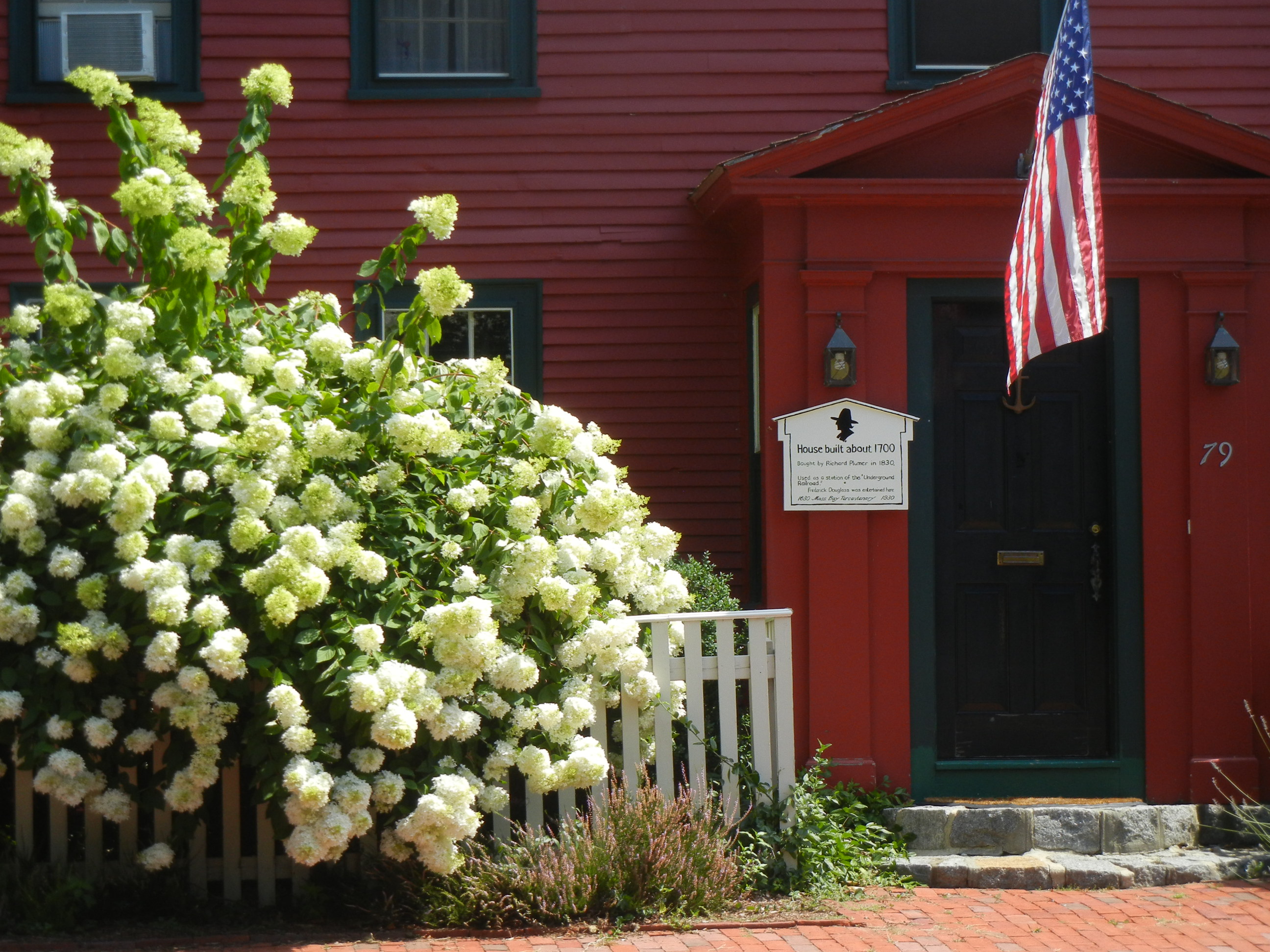
It’s been an endless summer of blue hydrangeas; I prefer white myself, although I’m not much of a hydrangea fan, I must admit. They’re a bit too ostentatious, conspicuous, fluffy, Victorian, much for me.  They don’t have a particularly interesting history, they’re not very practical, and they don’t really belong in colonial gardens. They seem to be much more of a colonial revival plant than a colonial one.  I have this silly rule in my head that hydrangeas, even blue hydrangeas, are fine for coastal shingle cottages (probably because I grew up in one) but that clapboard houses in old towns, large and small, must do without or at the very least have white hydrangeas.

Despite my disdain for the blue, I couldn’t help but be impressed by the blue hydrangeas at my parents’ house in York Harbor this summer; the bush below, which appears to be producing two varieties of blooms, is in fact (of course) two conjoined plants.  As you can see, the more violet of the two blooms are HUGE.

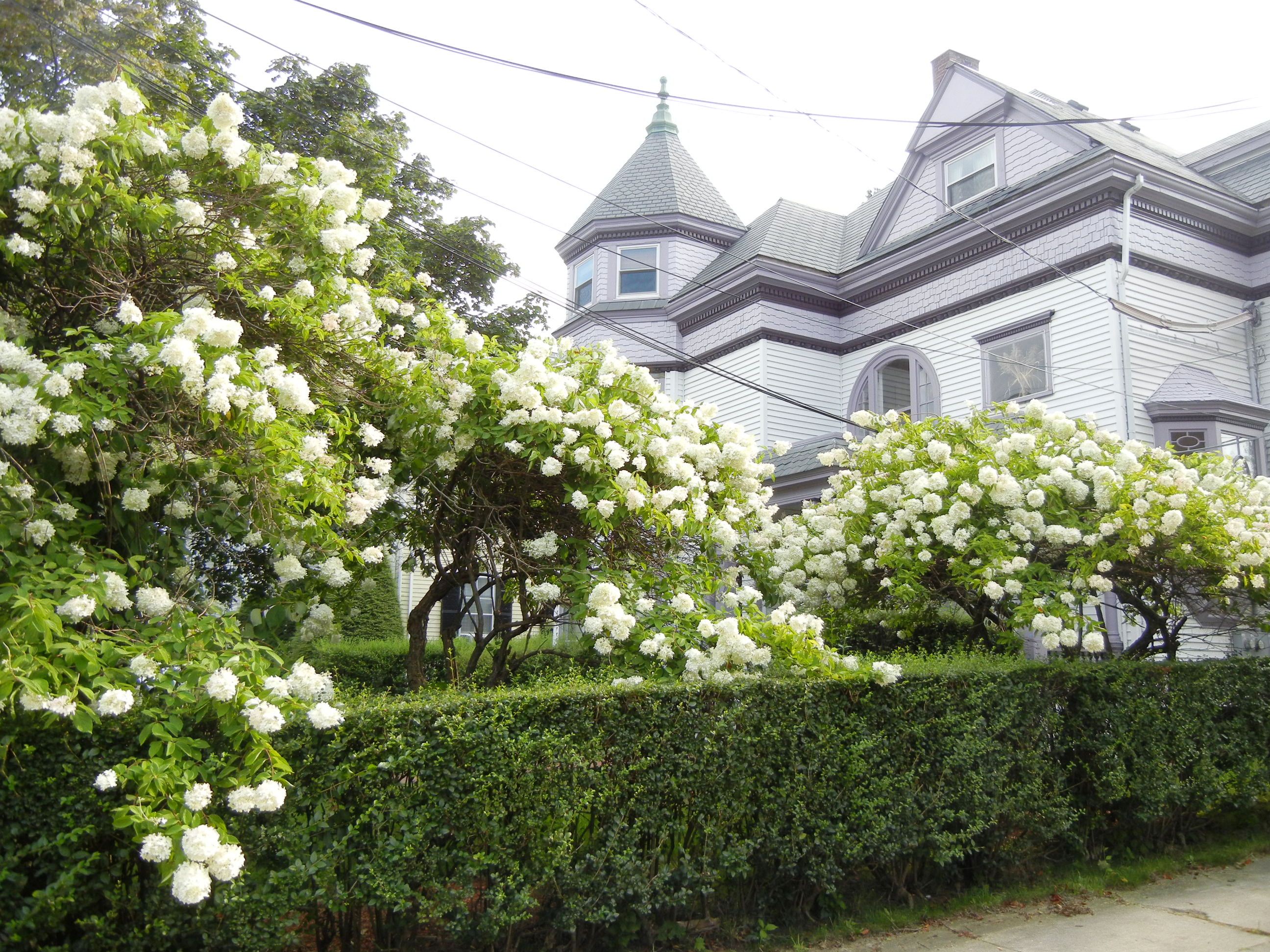
Impressive, but still blue.  Back in Massachusetts, I tried to capture some white hydrangea shrubs/trees that impressed me, many of them apparently quite old.  I do like hydrangeas that spill over fences, like the first two photographs below, the first taken in Newburyport, the second in Salem.

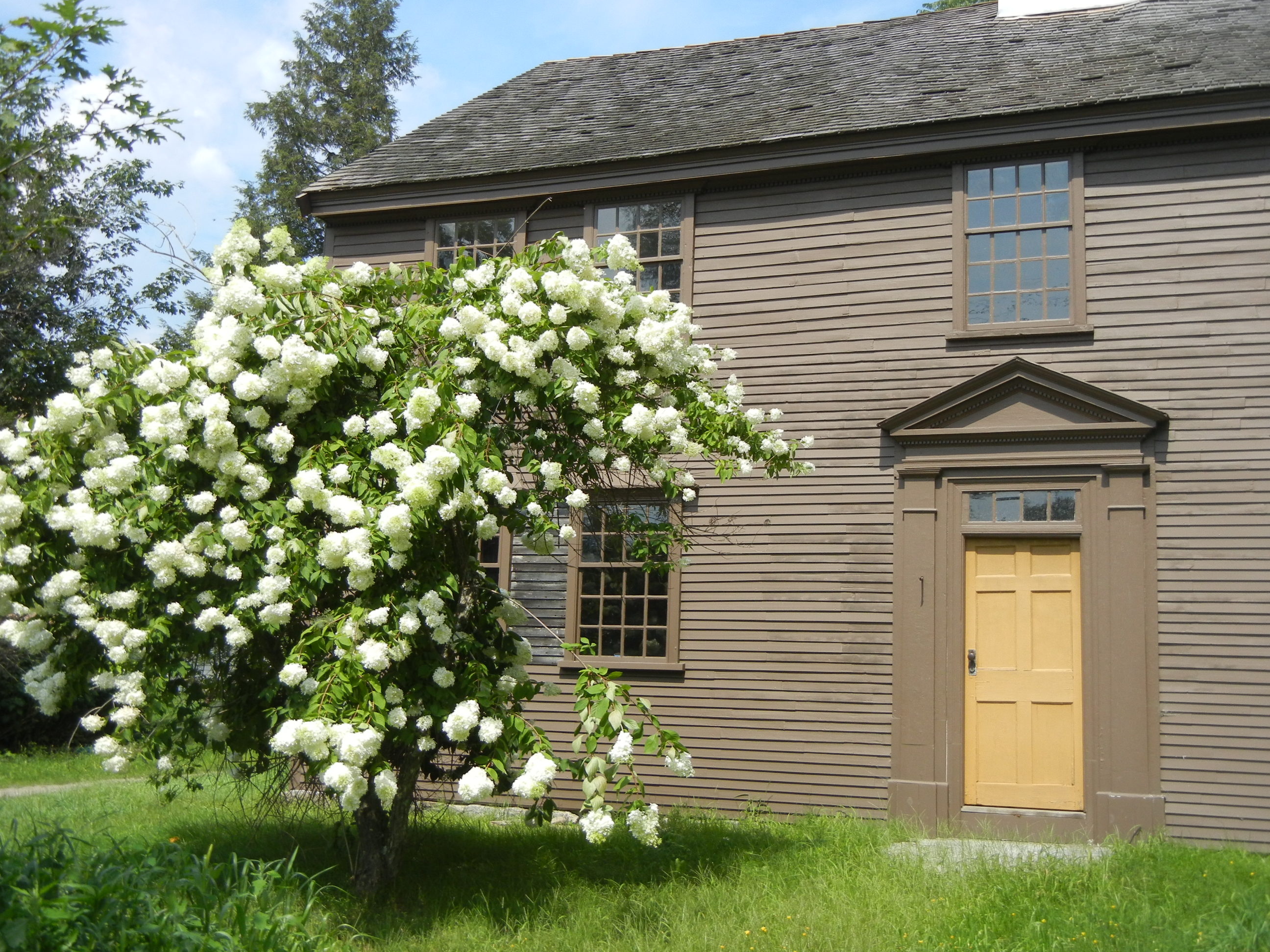
I also like the older shrubs that have turned into little trees, as illustrated by photographs of a Concord house along route 2A and Lafayette Street in Salem.

Two century-old photographs for some historical context:  the first is a Detroit Publishing Company postcard entitled California Hydrangea, the second, by the pioneering Canadian-American photographer Jessie Tarbox Beals, is a portrait of Kate Douglas Wiggin (author of Rebecca of Sunnybrook Farm and other children’s books) on the white hydrangea-bordered steps of her Maine house in the first decade of the twentieth century (Schlesinger Library, Harvard University).


Urban Cottages

Inspired by one of my favorite blogs, An Urban Cottage, the relative popularity of one of my posts, “Diminutive Dwellings”, as well as by the houses themselves, I’ve gathered some photographs of  some Salem cottages, most of which were built in the early and mid-nineteenth century.  One of the best things about living in a small city is the sheer variety of architectural styles, as well as the presence of buildings of very different sizes, sometimes even adjacent to one another.  Salem is renowned for its grand Federal mansions, but it certainly has its share of smaller-scaled houses, many of which are equally impressive, in an altogether different way.  In fact, it was difficult for me to narrow down my choices; I think I will need at least a part two, and maybe a three and four.  I tried to include structures from a variety of neighborhoods, but have left some notable ones out, at least for now.  It was also difficult to discern exactly what a “cottage” is, beyond just a small house, so basically I just chose small houses that I liked in a very arbitrary manner.

First up, some “mini mansards”.  There are lots of big Victorian houses with mansard roofs in Salem, particularly along Lafayette Street, but there are also several cottages with these roofs, located primarily outside the city center, in North and South Salem.  This first house is impressive down to the smallest detail, including its great flower boxes.

Two South Salem mansard cottages are below.  The first is a favorite of nearly everyone I know, for its prime harbor-front location (which you unfortunately can’t see from my photograph) , its cupola, and its overall cuteness. It was also featured in the early 90s Bette Midler-Sarah Jessica Parker film Hocus Pocus quite prominently (if I remember correctly).

In the historic center of Salem, there are lots of Georgian colonial cottages, most with gambrel roofs.  These little houses are colonial in style, but several of them were built well after the Revolution, as late as 1830; they must have looked quite antiquated when the Greek Revivals started popping up.  The houses below are all located on streets running off the Common and Derby Street.

This last group of cottages cannot be tied together by a common architectural style; they represent the variety I referenced above and are all just adorable.  There are Greek and Gothic Revival cottages in North Salem, a pair of shingled cottages on Derby, both former stores and connected by their owner by landscaping and paint, and an eighteenth-century cottage moved to its present location on Orne Square after the great fire of 1914.


New Life for an Old Salem Church

Salem has been the scene of almost-continuous construction projects since I’ve lived here; some have changed the streetscape for the better, some for the worse (in my humble opinion).  One of the largest is nearing completion this summer:  the construction of a brand new “Judicial Center” on Federal Street adjacent to the previous courthouses, all sadly decommissioned.  This location is certainly appropriate, as this stretch of Federal Street is judicial Salem’s legal row, but it begs comparisons between the new center and the older courthouses.  Probably the architects (Goody Clancy) knew this, and certainly they received pressure from the preservationist community to retain something of what was on the site, especially as three nineteenth-century domestic buildings were taken down to make way for the HUGE boxy central building.  Consequently one building was retained and moved to serve as a link between old and new and a reminder of those days when architectural proportion ruled:  the former First Baptist Church of Salem.  Here is the church (now reconfigured as a law library) on the corner with the new complex behind and beside it.

The original location of the church was to the right and back a bit, where you see the large curtain wall now.  When it was moved several years ago (there’s a picture in an earlier post), it was not only moved forward but repositioned on a slight angle, following the lines of Federal Street.  This is one of the few concessions the entire project has made to the pre-existing streetscape.  Though the jury is still out for me on the entire complex, I think that  church/library is an important component, not only filling a gap but softening the transition between old and new, human-scaled and HUGE.  Below is the current streetscape on a recent rainy day.

From the foreground to the background we have the church/library, the new judicial center, which is comprised of the huge building behind the curtain wall (very imposing as you come into Salem along Route 114; I’m going to spare you a view for now) and the adjacent building with glass and columns, which (I guess) is supposed to effect another transition to the former Colonial Revival Probate Court, and then the Romanesque and Greek Revival court houses beyond. Below are some century-old shots of these court houses from the Library of Congress.  I’ve always found the Greek Revival one in the second picture to be really beautiful, and its the Romanesque neighbor has an amazing interior, including (of course) a law library.  I worry about these buildings’ fates.

It’s quite a succession of architectural styles, and then you get to the new complex, anchored by the old church/library.  The contractors not only repositioned the building, they repointed it and repaired its trim, revealing some beautiful details that I had never noticed before.  When I did look at this building before its big move, it did not strike me as particularly church-like, which is understandable given that it was stripped of its impressive steeple some time ago (in 1926, according to Bryant Tolles, Architecture in Salem).  Fortunately there are lots of accessible images of the church in its earlier form, making it all to obvious that this is a structure that has gone through several transformations in its two-hundred-year lifetime.

Photography credits:  a beautiful Frank Cousins photograph in the Urban Landscape collection at the Duke University Library, two undated postcards which I believe are from around the turn of the twentieth century, and two nineteenth-century stereoscopic cards from the New York Public Library Digital Gallery.


Cars on Chestnut

From two wheels to four: another annual event tied in with Salem’s Heritage Days in August is the Phillips House‘s Antique Car Meet, held yesterday right here on Chestnut Street.  Though not as large a gathering of antique automobiles as that sponsored by its sister Historic New England property, the Codman House, earlier this summer, the Phillips Meet is a bit more intimate and engaging because the cars are parked on the street,where they belong, as opposed to out in a field.  The first floor of the house was open for tours, as was the carriage house out back, home to two rare and HUGE Pierce Arrows and a nice assortment of horse-drawn carriages.

The last car above is a powder pink Edsel!  Below, what looks like a surrey with a fringe on top in the Carriage House, and peaking through at one of the Pierce Arrows.

Just another old car parked on the street, yesterday, and one of similar vintage traveling down (or up) the street in its own time, below.  Chestnut Street is one-way in the other direction now, so this car looks odd to me:  I want to say, turn around, you’re going to crash into someone to the long-dead driver.  Finally, an amazing photograph courtesy of my friend Martha, a North Shore caterer extraordinaire (Lantern Hill ) with deep Chestnut Street roots who has been making some of her old family photographs available to the public.  Pictured is Mrs. Mary Northey Wheatland out for a drive on what looks like nearby Essex Street, in the winter of 1904.


Salem Scorchers

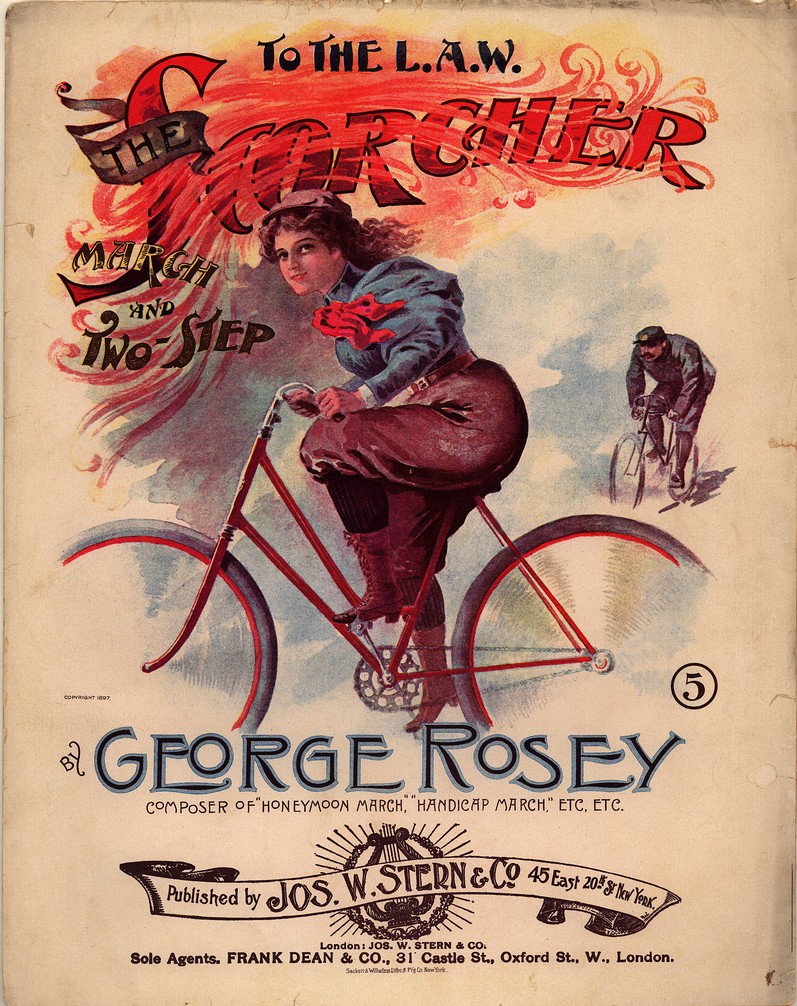
Salem is in the midst of a big bicycle week, with the Witches Cup race this past Wednesday and the Salem Seersucker Social this coming Sunday, both part of an extended schedule of Salem Heritage Days events.  So I thought it was time to showcase this vintage bicycle advertisement from the golden age of bicycling at the turn of the last century.  R.H. Robson, with two locations in Salem, was a major dealer in high-wheel (penny farthing) bicycles in the 1880s and quickly dominated the North Shore market for “safeties” in the next decade.  This ad promotes two of their most popular models, the “Salem Witch” and “Witch Scorcher”:

Apparently scorcher had two meanings in its contemporary context:  a really fast bicyclist, who menaced pedestrians and horses alike in what must have been very chaotic streets, and the actual bicycle on which this speed demon rode. After urban police departments began employing their own “scorcher squads”, the term became a lot less menacing and all sorts of cultural references began to appear, including the title of this popular march, yet another reminder that bicycles and women’s  liberation go hand in hand.

While the riders of Wednesday’s Witches Cup were scorchers, those that participate in  Sunday’s Seersucker Social will probably cycle along at a more leisurely place, in emulation of the genteel (anti-spandex) “tweed rides” that have been happening in urban centers all over the world in the last few years.  Salem is fortunate to have two bike shops, Salem Cycle and the Urbane Cyclist, and the latter is the sponsor of the Sunday event.  Those who want to ride along should convene at the shop (144 Washington Street) at 11:00 am, wearing “historically sporty” (non-spandex) attire, for the 7-mile ride.  With apologies to the Urbane Cyclists, I’ve reproduced their poster from last year (modified with my own very obvious corrections) just because I like it so much.


Edible Art

While up in York for a long weekend I went to the Stonewall Kitchen company store to get some ingredients for a recipe and ran into a huge crowd of people and some absolutely stunning display gardens.  The gardens are always beautiful at Stonewall, but this time they were particularly impressive:  unusual combinations of colors and textures, perennials and annuals, vegetables and flowers.  There were also screen-printed banners, indicating the tie-in between the Stonewall gardens and an ongoing art exhibit at the nearby George Marshall Store GalleryFrom the Garden to the Kitchen.  Part One of  the exhibit was on display earlier in the summer; Part Two is on view now.  So here we have another two-part (digital) exhibition:  first the gardens, then the gallery.

Lots of Clary Sage, a very under-utilized grey garden plant.

A close-up of one of the banners in the gardens, depicting “Purple Podded Peas”, an archival pigment print in Lynn Karlin’s Pedestal Series.  Below, more prints in the series, displayed at the George Marshall Store Gallery, and exterior and interior views of the Gallery.


The George Marshall Store is a Victorian building located on the York River, adjacent to the John Hancock Wharf and Warehouse.  Both properties belong to the Museums of Old York, though the Marshall Store functions as an independent art gallery.  I vaguely remember it operating as some sort of “ye olde” shop when I was a little girl, and today, the combination of river, old building and modern art makes the gallery a nice afternoon destination.  Here are a few of my favorites from the current exhibition, although I definitely could have included many more pieces.

  James Aponovich, Trasimeno Artichoke

  Tina Ingraham, Rainier Cherries and The Grocer

  Carey Armstrong-Ellis, When Vegetables Go Bad

  Susan Wahlrab, Unfolding Fiddleheads

  Rosalind Fedeli, Nine Bright Persimmons

Stonewall Kitchen Company Store gardens by JNL Inc. Landscaping:  jnlinc.com; George Marshall Store Gallery, 140 Lindsay Road, York, Maine 03909.  207.351.1083


Mr. Allen’s Amazonian Lily

In the summer of 1853, an Amazonian water-lily blossomed in Salem, the second to be cultivated in North America, under the careful watch of amateur botanist John Fisk Allen (1807-76).  Descended from several Salem shipping families, Allen had the means to pursue various horticultural pursuits, and he maintained a greenhouse on Flint Street (not far from his Chestnut Street residence) where he cultivated several varieties of grapes as well as tropical flowers.  He is part of what I am realizing was an active and influential botanical circle in nineteenth-century Salem, with Nathaniel Hawthorne’s uncle, Robert Manning, right in the center. Allen wanted to share his success with the world, or at least his world, so he commissioned America’s first chromolithographic printer, Boston-based William Sharp, to produce six detailed plates of the lily for inclusion in his account of  its cultivation, Victoria Regia; or The Great Water Lily of America (Boston, 1854).

I have seen a really nice edition of this volume in person, and the plates below (from the Internet Archive digital edition) do not do justice to the real thing.  They are really stunning, but apparently Sharp also took a bit of artistic license.  Allen’s text is interesting as well, as he follows the rules of strict scientific observation and tells his readers everything the lily was doing that Salem summer long ago, down to the minute.

The first two cycles of the plant’s growth:

From first flowering through full bloom:


Royal Roses

I am a very casual collector of early and mid-nineteenth-century pottery, and have gone through different phases of interest and intensity of interest over the years:  simple white ironstone, creamware, red (pink) transferware, children’s plates.  I still have some of the latter, but have sold or given away everything else.  Along the way, the one type of pottery that I have not tired of are painted pearlware pieces in the “King’s Rose” or “Queen’s Rose” pattern, made in England in the first half of the nineteenth century for the American market.  Another variation, red and green without the lustre band, is called “Adams Rose” after the manufacturer, and sometimes these patterns are referred to as “Gaudy Dutch” or “Gaudy Welsh” as well.  I like these pieces (mostly plates) because they are painted, as opposed to transfer-printed; this makes them somewhat less common, but much more difficult to preserve.  I rarely come across one with perfect paint and when I do its price is more than I am willing to pay.  In their day, however, I think that they were basic dinnerware:  when I was digging out an herb garden behind my kitchen ell a decade ago I uncovered shards of the same patterned plates I had in my china cabinet!

So here are some of my pieces, which are generally tucked away on shelves and in corners; these plates are yet another floral motif that my husband only tolerates.

And here are some pieces that I do not possess but would like to:  two coffee pots, one in the King’s Rose pattern (which sold at Christies several years ago) and another in the more delicate Queen’s Rose pattern, along with a very exuberant teabowl and saucer from Patrician Antiques.