Olmsted Central

I have felt vulnerable all summer long, while working on my contributions for our Salem book: my chapters relate to academic fields for which I have no professional preparation, including African-American history (John Remond), art history (the Colonial Revival) and urban planning (Salem’s 20th-century development). I read widely and had support from my colleagues, and all the chapters will be peer-reviewed, so I don’t think I’ll embarass myself in the end, but I’m still a bit anxious. I’m co-writing the last referenced chapter, on Salem’s development from the Great Salem Fire of 1914 to the present, with my co-editor for the entire book, and after I plowed through rebuilding and urban renewal I simply dumped it on him, just done with it! It wasn’t fun to write and I needed some distance to reflect. So that’s what I have been doing for the last two weeks or so, trying to read histories of urban planning for pleasure. This is a field that intersects with the history of landscape design and garden history—and as the latter is more familiar to me I found a comfort zone. So I got some grounding and feel ready to go back into this chapter with some different perspectives and questions. I also realized I needed to cap off my weeks of reading with a visit to what must be the Mecca of landscape history: the Frederick Law Olmsted National Historic Site in Brookline, Massachusetts.

So Chestnut Hill, a beautiful section of Brookline which extends over into Newton, was my weekend destination. This is where Boston Brahmins established their country seats in the later nineteenth century, and because of these considerable investments in land the area still retains its pastoral feel despite its proximity to Boston. At the height of his pathfinding career in 1883, Frederick Law Olmsted purchased an early 19th century farmhouse and several acres of land from two elderly spinster sisters who were reluctant to move: he built them a house next door. Another neighbor was Isabella Stewart Gardner, whose “Green Hill” summer house was built by Salem ship captain Nathaniel Ingersoll earlier in the century. Olmsted did not intend for his new house, named Fairsted, to be a seasonal showplace: it became the center of his business and his practice, as well as a center for the emerging new discipline of landscape architecture. This is the focus of the site’s interpretation: on the practice rather than the personal. The farmhouse was expanded in all directions, most conpicuously in the office addition which served as the headquarters of the Olmstead Brothers after the Frederick Law’s retirement in 1895. The firm endured (as the Olmsted Associates) until 1980, the same year that the National Park Service acquired Fairsted. As you can see from the photographs above, the orginal farmhouse its garden addition are not in the best shape: a planned and funded restoration has stalled due to the quality of the workmanship, and is delayed until the next funding process (but private donations can be made here). The interior of the farmhouse is pristine, and (again) dedicated to telling the story of the Olmsted practice. The office addition is like a time capsule of a 1920s-1930s architecture firm: with a drafting room, a photography room, a blueprint-printing room, a shipping room, and a vault, where all the Olmsted plans are archived.

In the main house: very few personal items, it’s all about the firm. I was primarily interested in the urban planning inititatives of the Olmstead firm as my chapter on Salem’s 20th century development begins with Harlan Kelsey’s 1912 City Plans Commission report. Because the Olmsted projects are so extensive, both in sheer number and geographically, the firm’s archives are always in demand and consequently the NPS has completed a major digitization project and also furnished researchers with an invaluable research guide to the collections. I found five Salem projects, the most important of which is the subdivision of the famous Pickman/Loring farm c. 1900: this was Salem’s first planned neighborhood, and I didn’t include it in my draft chapter (but I’m certainly going to do so now)!

The Olmsted site offers two tours, both of which were given by enthusiastic and articulate interns: one on the cultural landscape, the other on the office and practice. In the first, we learned all about Olmsted’s design philosophy (naturalistic and anti-Victorian, not particulaly interested in PLANTS, “borrowed view”) and the second focused primarily on how the firm was run during the era of the Olmsted sons/brothers. I just loved the office tour: forget AI and digital “reality”: this was immersion!

The Olmsted office wing: photography library with project #s (all materials are preserved in the vault now), drafting room, planting specifications, blueprint-printing room (and a very strange blueprint drying machine), shipping room, little cubbyhole office outside the vault.


The Last Weekend in July

I could have named this post “boats and blooms” because that’s about all I have to offer: this has been a working summer and I am running out of steam so no controversies, critiques or deep dives today. Just boats and flowers. We were up in York Harbor for the weekend and as usual, I bypassed the beach for Portsmouth. I just can’t stay away from that city: it was always the perfect place for me when I was growing up and I moved to Salem because it reminded me of Portsmouth but was a bit closer to Boston. Now it has become my anti- or ideal Salem: without witch kitsch and with smooth brick sidewalks. This year, Portsmouth is particularly festive because it is celebrating its 400th anniversary, and there were tall ships in the harbor, along with the usual display of exuberant gardens, shops, and architecture.

Back home, my father’s plentiful display of bee balm was kind of picked-over by all the hummingbirds it attracts, but still deserves honorable mention. And I never miss the gardens at Stonewall Kitchen’s flagship store in York.

And now for the boats! Something absolutely wonderful happened as Saturday night turned into Sunday morning: a windy storm came in and blew away all of the humidity that we’ve been living with for the past month. I know it’s nothing compared to the extreme conditions that other parts of the country are experiencing, but wow, Sunday felt like a whole new world. We decided to celebrate by going out on a sunset cruise of Portsmouth Harbor on the Piscataqua, a reproduction of a nineteenth-century gundalow, a coasting barge with a distinctive lanteen sail: it always looks medieval to me in the harbor! We sailed past the visiting NAO Trinidad, the Portsmouth Naval Shipyard (which is in Kittery, Maine), Fort Constitution in NH, Fort McClary in Maine and out to Wood Island, with a companion privateer, the Mystic, for the last leg.


Preservation Polaroids

I have heard, and read about, Salem’s experience with urban renewal many times, including first-hand accounts, so I thought I understood its causes, course and impact pretty well, but when you write about something, you have to engage on another level and come to your own understanding in order to explain it to others. It’s the same with teaching. One of the chapters for Salem’s Centuries that I’ve been working on this summer is about the city’s development over the twentieth century and so I really had to dig deep into urban renewal. I decided to start fresh with primary sources, so I went through all the records of the Salem Redevelopment Authority (SRA) located up at the Phillips Library in Rowley (these are public records, which should be in Salem, but I’m actually glad they are in Rowley because the City’s digitized records are impossible to search and I don’t know how one might access the paper). The SRA was the agency created to oversee urban renewal in Salem’s downtown and it still has jurisdiction: its composition was incredibly important and remains so. I’m going to be quite succinct here, because the narrative is rather complex and therefore quite boring to read or write about, but here’s the gist of what happened: after conducting a comprehensive study in the early 1960s the City created the SRA and put forward a very ambitious urban renewal plan which was overwhelmingly focused on clearance, including the demolition of between 120-140 buildings in Salem’s downtown area. The goal was to create a new pedestrian shopping plaza, to compete with the new Northshore Shopping Center just miles away in Peabody. The focus was on Parking, Parking, and more Parking. What I did not know before I delved into this research was that at the same time that this plan was brewing, Salem also had another committee looking at the downtown: an Historic District Study Committee, which was surveying all of central Salem’s buildings for inclusion in potential historic districts. What a clash! The “before” photos that you see below, candid polaroids, were taken by members of the Study Committee in 1965, the same year that the SRA was rolling out its demolition plan. Among the SRA records up in Rowley, there is a mimeographed document entitled a “Do it Yourself Walking Tour” prepared by John Barrett, Executive Director of the SRA, for Historic Salem, Inc., Salem’s preservation organization, then and now. It’s a remarkable document, because Barrett basically takes the Study Committee’s inventory and turns it into a hit list: this is what we’re going to demolish! Take a tour and see for yourself! There were 119 building slated for demolition, a number that would expand to over 140 over the next few years. The polaroids represent buildings that Salem’s preservationists were trying to save: they were successful in some cases, but not in others. Their resistance resulted in a far less destructive approach to “renewal”, however, which focused more on rehabilitation than destruction, as these images illustrate well.

This doesn’t line up perfectly, but what a great restoration +addition by Salem architect Oscar Padjen: very representative of the creativity of  “Plan B”!

As these photos also illustrate, once rehabilitation became an objective, several key buildings were restored in exemplary fashion, by local Salem architects and utilizing the new means of facade easements. If you compare past facades of these building with the present, urban renewal looks great, particularly with the hardscaping design of landscape architect John Collins of Philadelphia, whose work is also representative of the “Plan B” approach. What is more difficult to illustrate are the great wide swaths of buildings that were taken down, principally on the main Essex and Federal Streets but also on St. Peter and Brown Streets, while Plan A was still operational. We can never see these buildings restored, they were just swept away. What remains are parking lots and ghastly modern buildings. I’m not a fan of what was called the East India Mall in its orginal incarnation, but its colonnaded side entrance (not quite sure what to call it???) was quite distinctive, and it was butchered under the auspices of the SRA in the 1990s so now we have the Witch City Mall. I think Front Street (below) it probably the most perfect example of Plan B, along with Derby Square, but Central Street (just above) is pretty representative too.

Washington Street was the boundary of “Heritage Plaza East,” where most of the renewal activity happened in both phases, but it did not experience as much demolition as it had already weathered a major tunnel project just a decade before. That’s another realization for me: I somehow never put Salem’s “Big Dig,” during which its railroad tunnel was constructed and depot demolished in the 1950s, in such close chronological proximity to its experience with urban renewal in the 1960s. This generation of Salem residents weathered a lot of construction and dislocation: as always, past experiences temper the present. If you shift the perspective even further back, to the 1930s, when the new Post Office was built after an entire neighborhood was cleared out, you can understand why there is so much concern about the lack of housing downtown today: 51 buildings gone in the 1930s, 87 in the 1960s. Salem’s long “plaza policy” certainly took its toll, but I remain grateful to those residents who persevered in their preservation efforts for what remains.

Strking transformations on Washington Street.

NB: I’m confident in most of these past-and-present pairings, but not all, because streets numbers can change—not quite sure about the Subway market on Front Street for example……….


Lafayette, You are Here!

I’ll drive down to Newport, Rhode Island for any occasion, and Bastille Day seemed like a good one as French expeditionary forces landed there in 1780 as part of their formal and personal commitment to the American Revolution, a commitment that is honored today by the “French in Newport” festivities on the second weekend of July. From the Rhode Island perspective, the French “occupation” of Newport is the beginning of the end, the road to Yorktown and independence started there. A friend had lent me the Newport Historical Society’s Winter/Spring 2023 issue of its journal, Newport History, which is entirely focused on the French in Newport, so I was well prepared by articles on “The Washington Rochambeau Revolutional Route National Historic Trail,” (from Newport to Yorktown of course), “Forging the French Alliance in Newport,” and “A New Look at how Rochambeau Quartered his Army in Newport.” I arrived just in time for the comte de Rochambeaut’s proclamation, wandered about checking in on my favorite Newport houses and others in which the French were quartered, and then returned to Washington Square to hear the Marquis de Lafayette give an amazing little talk on how he was inspired to cross the Atlantic and join the American ranks. I was quite taken with the Marquis, and as he was speaking an extremely precocious boy yelled out of the window of a passing car “Lafayette, you are here!”

 Print depicting the arrivl of Rochaembeau’s troops in Newport in July 1780, Daniel Chodowiecki, The Society of the Cincinnati, Washington, DC.

Rochambeau and General Washington got on very well, and had lots of planning to do during that fateful year, so Washington was in Newport too for a bit, staying, I believe, at the Count’s headquarters at the William Vernon House. George Washington 2023 was not in Newport, but a replica of his field tent was, as part of the Museum of the American Revolution’s “First Oval Office” initiative. It was rather intimate to go in there—I’ve really got to go and see the real thing, the ultimate “relic” of the Revolution—in Philadelphia. While the French rank and file seemed to be on duty, the officers were relaxed and conversational, underneath their own tent on in the Colony House nearby, wearing light floral banyans when not in uniform. I had not been in the Colony House for a while and had forgotten how grand it is. Certainly worthy of Newport.

A cool (actually very hot) bakehouse on site with an enormous clay (???) oven in back from which you could buy a toasted slice of bread with salt pork butter………

The Colony House, a private home on Spring Street where Francois-Jean de Chastellux, the liasion officer between Washington’s and Rochambeau’s armies, lived while in Newport, one of my favorite Newport houses which must go into every Newport post, and the tricolore.


Sedgwick Sanctuary

Yesterday I learned a new word, drumlina long, flat-topped hill formed by glaciers, during my visit to the appropriately-named Long Hill in Beverly, one of the properties of the Trustees of Reservations. At the top of this drumlin, away from the “gold coast” where many of their Boston friends summered, Ellery and Mabel Cabot Sedgwick built a Federal Revival House with bricks harvested from an Ipswich mill and detailed woodwork crafted by enslaved workers from a Charleston mansion. They planted a copper beech tree to mark the spot of their new summer home, and after it was built, kept on clearing and planting, crafting a series of inter-connected gardens around it, designed to frame the home and also blend in with the 100+ acres of woodland and meadows beyond. It’s a spectacular site in so many ways: I’ve visited it many times and posted it about here too, but the Trustees have been engaged in a garden revitalization initiative for their properties, and so I wanted to give Long Hill another look. I took a proper tour rather than just wandering around (highly recommended: it was particularly important for me as I know quite a bit about plants but nothing about trees, and Long Hill has some very unsusual specimens) and now I have a whole new appreciation for this amazing space, and the amazing women who created it.

When Ellery and Mabel Cabot Sedgwick purchased the Long Hill property in 1916, he was in the first phase of his long and successful run as owner and editor of the Atlantic Monthly, which extended to 1938. But she was pretty famous too, having published a popular (and still very useful) gardening guide entitle The Garden MonthByMonth in 1907. The pull-out color chart from The Garden graces Long Hill’s library, framed by silhouettes of Mabel and the second Mrs. Sedgwick, the former Marjorie Russell, who was also an accomplished plantswoman. Together, in succession, they built the spectacular Long Hill gardens, Mabel establishing the integrated “garden rooms” format and Marjorie adding more exotic varieties of plant material—and also focusing on plant propagation and experimentation, often in collaboration with Harvard’s Arnold Arboretum. The property served as the summer retreat for the the entire Sedgwick family, including the four children of Mabel and Ellery and their children, until the death of Marjorie Sedgwick in 1978, after which Theodore Sedwick Bond, Henrietta Sedgwick Lockwood, S. Cabot Sedgwick, and Ellery Sedgwick, Jr. donated Long Hill to the Trustees. It still feels a bit like a family house, even with an event tent on site: accessible rather than stately.


One way the Trustees has enhanced the accessibility of the property is to emphasize the fact that it is a place of activity, still a work in progress as it was under the administration of the two Mrs. Sedgwicks. There’s a cutting garden, a greenhouse and horticultural center, cold frames, ongoing plant propagation, workshops, and for those that don’t want to get their hands dirty, the horticultural library in the house. There are also trails for those who want to explore the rest of the 114-acre property, the “world” beyond cultivation. The overall message is appreciate and act.

plant propagation in action for those who don’t recognize it—like me!

I’m going to conclude with some of the spectacular trees on the property, just a sampling for sure. I’m just starting to look at trees after a lifetime of being unblissfully unaware, and this is one of the reasons I wanted to revisit Long Hill and will continue to do so. There’s a lot to learn, but yesterday I was just kind of awestruck by some of the textures and colors of the bark, let along the flowers and leaves. It got increasingly humid as we made our way through the garden(s), and so a weeping hemlock was a welcome rest stop, as it was 10 degrees cooling under its dense branches.

These last two amber trees are a Tall Stewartia and a Paperbark Maple.

A few last photos: the house is beautiful, but it’s really just an orientation center for the garden now—-BUT I want you to see this beautiful wallpaper in the center hall, purchased by the Sedgwicks in London during their house furnishing tours in the 1920s, as well an example of “enslaved craftsmanship,” a mantle from the Isaac Ball House in Charleston.


Colorways: a Parade of Portsmouth Doors

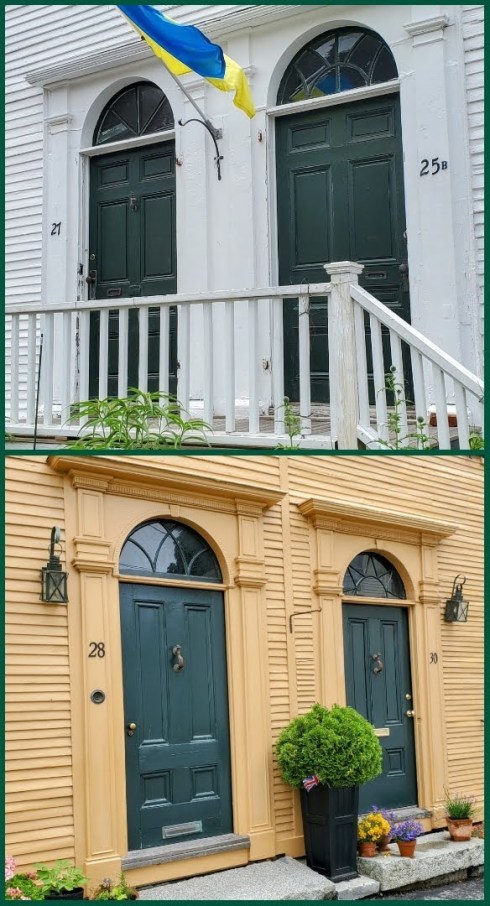
I’ve been in York Harbor all June and just returned to Salem. It was a very productive month removed from daily tasks and diversions, but I missed certain things and people: my husband (I brought the cats), my garden, my street. Certainly not the tour guides and groups though: they were in part what drove me away. Of course I found the usual Dunkin iced-coffee cup propped up on my stoop the moment I got home. Salem is busy and festive all year long now it seems; while the incessant witch tourism annoys me the other celebrations are great, and June is a particularly festive month with its mix of private and public celebrations: weddings and graduations, Juneteenth and Pride. Salem goes all out for Pride and  I missed that, and definitely craved some color amidst our rainy and foggy weather, so I took off for Portsmouth late last week seeking flags but finding doors. When I was growing up across river, Portsmouth was a much shabbier place: now you are hard-pressed to find an old house that is not in perfect condition. I expanded my usual downtown walk to include neighborhoods a bit more outlying like that bordering Christian Shore and the South End, and found so many lovely houses, all with very colorful entries. Red was an exotic front-door color before; now there is a veritable rainbow of Portsmouth doors. And I’ve got some flags here too.

Ok, I think I have the whole spectrum represented! It was surprisingly difficult to find white doors: as you see, one is hiding behind a tree. I wasn’t sure where to put taupe, so I paired it with brown. There are no painted brown doors, just various shades of natural woodwork. Not too many black doors either, but lots of green, and lots of yellow. Do not tell me that one of my purple doors is blue; it is purple. Portsmouth is the best walking city ever: beautiful neighborhoods, dynamic downtown, tons of historical markers, pocket parks, well-maintained sidewalks. More rainbows are there for the making!

Some singular Portsmouth doors: two-tone green and Happy Fourth!


A Big Move

No, not me: the Crowninshield-Bentley House! Visiting Louise DuPont Crowninshield’s former garden in Marblehead last week prompted me to reconsider her impact on Salem as a preservation advocate and philanthropist as it is considerable. At least two institutions in Salem, the Salem Maritime National Historic Site and the Peabody Essex Museum, reflect her commitment to the preservation of Salem’s material heritage which was manifested both by her direct involvement and her inspiration. The best example of the latter is one of the Peabody Essex Museum’s historic houses, the Crowninshield-Bentley House, which was moved by the Essex Institute from a rather precarious position on Essex Street to its current location in 1959. This early Georgian house, home to generations of the Crowninshield family as well as Salem’s pre-eminent diarist the Reverend William Bentley, was originally located at 108 Essex Street. In 1958 the Hawthorne Hotel donated the house to the Essex Institute with the condition that it be removed to make way for a parking lot. The move to its new site adjacent to the Gardner-Pingree House and across the street from the Hotel, was preceded by the demolition of a venerable commercial building and succeeded by a comprehensive restoration to its 18th century form under the direction of Abbot Lowell Cummings as a tribute to the “work and memory of preservationist Louise DuPont Crowninshield.” The Crowninshield-Bentley House became the cornerstone of the Essex Institute (now Peabody Essex Museum)’s main “campus” of historic structures, and to complete the vision, gardens also dedicated to the legacy of Mrs. Crowninshield were installed in its midst. Another reason I wanted to post on this big move today is the great visual documentation by Essex Institute President Albert Goodhue, Jr., who snapped photographs of the the entire process over what must have been several days (weeks???) in 1965. These are among some great sources at the Phillips Library in Rowley documenting Salem’s ever-evolving streetscape, one of the major topics we’ll be covering in our upcoming book Salem’s Centuries.

Washington Square West and Essex Street, Salem (Mass.) Photographs, MSS 0.1619. Courtesy of Phillips Library, Peabody Essex Museum, Rowley, MA.

Amazing!!! I love the nonchalance of the pedestrians, and not a police detail in sight. Everyone is just going about their business while the walls are tumbling down! The building being demolished was quite a storied commercial building, also an 18th century structure (I think) but altered and extended considerably. There were some very notable apothecary and stationary shops located within, and Salem architect/artist William Henry Emmerton made an iconic image of it in 1850 when it was his cousin’s apothecary shop (Emmerton was a great draftsman, and the Phillips Library has digitized the records of his architectural firm, Emmerton, Foster & Putnam, so you can see more of his work here). Those big storefront windows were apparently the second of their kind installed in Salem, and the Paracelsus bust trade sign was pretty conspicuous too. After the move and restoration was completed, the Crowninshield-Bentley House received a lot of attention in both academic and popular publications: there are both feature articles and cover stories throughout the 1960s into the 1970s and even the 1980s. The more scholarly pieces tend to focus on the detailed 1761 probate inventory of Capt. John Crowninshield as a primary source for the restoration (which includes references to “a Negro man” valued at £66.13.4 and a “Negro woman” valued at £40 about whom I’d like to know more)§ while trade periodicals seem to focus overwhelmingly on the kitchen. There’s a big spread on the interior of the house in the July 1987 Colonial Homes, part of feature on Salem as the “showcase of early America,” which it was, then.

William Henry Emmerton, Apothecary shop of James Emerton in Salem, c.1850 (pen & ink and sepia wash on paper), Peabody Essex Museum; the Crowninshield-Bentley House on the cover of Americana, September 1973; the kitchen as photographed by Samuel Chamberlain (1970, Phillips Library via Digital Commonwealth) and in House and Garden, January 1974; Frank Cousins photograph of the house in its original Essex Street location, 1890s, Phillips Library via Digital Commonwealth. The House today.

§ The Phillips Library has also digitized all of the booklets in the Essex Institute Historic House Booklet Series, including The CrowninshieldBentley House, Essex Institute historic house booklet series, no. 2, by Abbot Lowell Cummings, Dean A. Fales, Jr., & Gerald W.R. Ward, which you can access here. “An Inventory of the Estate of Capt. John Crowninshield Late of Salem and Apprized by Us the Subscribers at Salem November 10th 1761” is included as an Appendix.


No Filter: A Magnificent Marblehead Garden

Today’s post is a special treat courtesy of the owners of a beautiful property on Peach’s Point in Marblehead, who graciously opened their garden to visitors as a benefit for the Marblehead Museum this past Saturday. I understand that this kind of generosity is a pattern for them, and I feel privileged to have spent some time in this beautiful space, even (actually especially!) though it was cloudy and rainy. I came down to Salem for several events, a few of which were washed out the by the rain, but not this one, and I’m so glad: the garden was a green seldom seen, and all of its flowering plants popped to perfection. I swear: I have used no filter on the photographs below taken with my trusty old Samsung (and if things look a little filmy, my lense was fogged up). I have long wanted to see this garden, as it is a restoration/recreation of the garden which was part of the estate of Louise DuPont Crowninshield, one of my personal preservation heroes, and her husband Francis Boardman Crowninshield. The Crowninshield House is no longer standing, but the present owners of the property have built a lovely modern Colonial Revival Home which is well-situated on the Point, looking back at the town of Marblehead and out to its outlying islands and open sea. And then, an allee to the side which leads you to the formal gardens in a more protected space: a rose garden, a knot garden, lots of little garden nooks enclosed by topiaries, lovely (warm) brick enclosure tying everything together. Finally you come to a pool and a gorgeous greenhouse/garden house, in that same warm brick. I’m going to give you the tour the same way I walked it in the rain.

Approaching the property; encircling the house.

And on to the Gardens and Garden House……………

It’s not a poolhouse, it’s a garden house (or building): while this expansive garden is obviously the work of professionals (Doug Jones and Rick Elder), clearly the homeowners (Brian and Nancy McCarthy) were and are involved intimately in its creation and maintenance. There were personal touches everywhere you just don’t see in purely professional gardens, principally the mature houseplants, brought out of the garden house for the summer to embellish further several garden “rooms”.  And towering over everything was a very obvious sign of respect for what was there before: a HUGE and ANCIENT copper beech tree.


The Elizabeth Perkins House

One of the chapters I’m working on for Salem’s Centuries this summer is about Colonial Revival Salem, or should I say, a group of antiquarians who lived and worked in Salem from about 1890-1930 who were dedicated to preserving and promoting any and everything about Colonial-era Salem in their time and for the future. Our book is a work of social history, so our focus in on Salem people. But when it comes to the various expressions of the Colonial Revival movement, if you can call it that, I’ve always found that individuals and their often-passionate attachments to the past are so important, and this is particularly true in the case of the Elizabeth Perkins House, one of the Old York Historical Society’s  properties that has recently been reopened. For some reason, this is the one Old York house that I’ve never been inside, and I’d always heard that it was a perfect example of Colonial Revival influence in this region, so I was pretty eager when I showed up for my tour this past Friday.

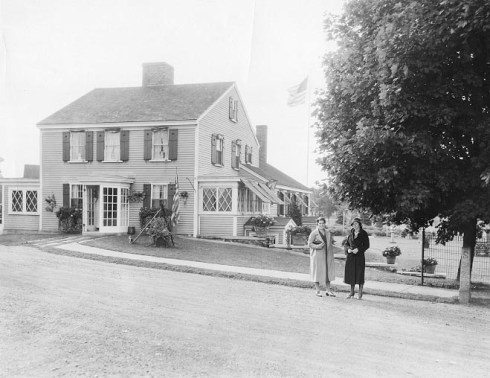
The Elizabeth Perkins House of the Old York Historical Society, looking over the York River, Sewall’s Bridge and the Hancock Warehouse beyond. Its restorers, expanders and occupants: Mary Sowells Perkins and Elizabeth B. Perkins (photo on right from Old York Historical Society as featured in a very helpful Willaim & Mary 1988 thesis by Melisssa Mosher shows Elizabeth Perkins in front of the house).

This house is absolutely central to the preservation history of York as its early 20th century occupants, Mary Sowles Perkins (1845-1929) and her daughter Elizabeth B. Perkins (1869-1952) contributed it and several other structures (the Old Gaol, Jefferds Tavern, the old Schoolhouse, and the John Hancock warehouse) to what would eventually become the Old York Historical Society as well as encouraging other preservation efforts. So it seems right that Old York’s administrative offices have been relocated to this site as well. There was a whirlwind of restoration, expansion, embellishment and entertaining after the Perkins family purchased the house in 1898: they were from New York, and seem to have known everyone. Mark Twain came over from his summer rental across the river to use their telephone, the first one in York, and in 1905 they hosted the grandest party of the era: a Japenese-themed fête to celebrate the conclusion of the Portsmouth Peace Treaty ending the Russo-Japanese War of 1905 with over 700 guests in attendence. The tour really focused on their house, so much so that I’m not really sure of its pre-Perkins history. Old York is dating the house to around 1730 now, which seems about right to me, but I have postcards from my childhood (showing the house exactly as it looks now and at the time of Perkins’ death in 1952) bearing the date of 1680. The one below of the dining room shows the very “colonial” room that the Perkins created but also one of its most off-putting features for me—the electrified girondoles along the back wall.

Postcard of the dining room from 1960s or 1970s? I think it is a rule that every Colonial Revival house must have Hessians!

At first the house seemed to me like one of those sprawling recreations/creations which Mary Harrod Northend, one of the Colonial Revivalists in my Salem chapter, showcased in her Remodeled Farmhouses (1915) and I immediately wanted to know if Harrod knew either of the Perkins women–the two Marys were of the same generation. But inside, besides the dining room, it felt a little different to me than standard Colonial Revival: I guess there is no standard Colonial Revival because it is often an individual expression. The parlors of the Perkins house felt very traditional to me, but also more cosmopolitan, more worldly, more lavish, more of a mashup between past and present than a “period rooms”. A case in point would be this wonderful 20th century copy of an earlier portrait: this modern woman dressed in period costume just like Elizabeth Perkins above (well, a bit more elegantly). I love this portrait!

Hooked rugs abound of course, but the Perkins ladies were great travelers so that accounts for the worldliness of their rooms and all the interesting assemblages. Now I’m wondering about comparative Colonial Revival settings: if you’re trying to create and preserve a “colonial” home in the country it’s a different experience than in the city, where change is so much more apparent—and threatening. My Salem people, including Harrod, Frank Cousins, George Francis Dow, Caroline Emmerton and Daniel Low, are living and working in an environment of constant development, fire, pollution, and immigration: it seemed like things were being swept away. The Perkins ladies were facing none of that in York, so I’m thinking that they didn’t have to be quite so strident in their pusuit and preservation of the Colonial. Just a thought.

Front parlors and a very traditional entry; love the 17th century “open-back” ??? chairs.

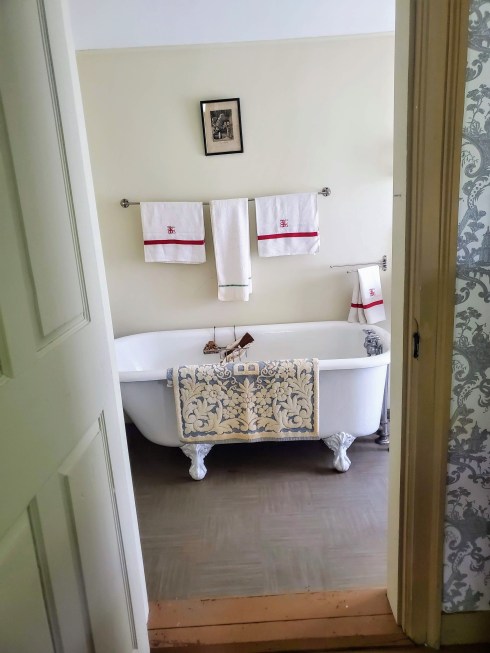
Loved the Currier & Ives presidential prints in the guest bedroom, which also has an en suite bathroom. The other bedrooms, including that of Mrs. Perkins above, have that “just left”/ I was just reading……. feeling, which is very Colonial Revival too: George Francis Dow pioneered the use of the folded-newspaper-by-the-gentleman’s chair motif in his period rooms in Salem, I believe.

Tours every Friday and Saturday available here.


One Hero and 17 Rescinders

I am staying in my family’s house in York Harbor for the month of June, mostly writing with occasional breaks for gardening and sightseeing. But you know me: I can never really get away from Salem! On this past Saturday, a single word was uttered which provided me with a connecting link between my hometown and my principal place of residence: rescinders. This is not a word you come across often, but within a couple of days I did, quite by happenstance. I love it when that happens, so here’s the context and the connection, starting with yet another preservation challenge back in Massachusetts concerning a structure associated with Revolutionary War Brigadier General John Glover. Glover is associated with two standing structures, a landmark house not far from Marblehead Harbor and a “retirement” home located on the Marblehead/Swampscott/Salem line which had a long and varied history following his death in 1797. “Glover Farm” was most recently the “General Glover House,” a restaurant owned and operated by Anthony Athanas of Pier 4 fame, but the entire property, including the 1762 house in which John Glover lived and died, has been left to deteriorate following its closure in the 1990s. While various officials of the town of Swampscott have proclaimed the property “blighted,” the Swampscott Historical Commission (which seems to be 10x more proactive than its counterpart in Salem) voted to issue a demolition delay and is seeking ways and means to save it in collaboration with the Swampscott Historical Society and local preservationists and any- and everyone who is interested in material heritage.

Glover Farm as the General Glover Inn, part of Sunbeam Farm, 1920s-1930s, Swampscott Public Library. Anthony Athanas opened the General Glover House in 1957 and here are menu covers and ads from the 1950s, 1960s and 1970s from guidebooks of those eras. It looks like the perfect “ye olde” restaurant: I wish I had went!

General Glover was a true American hero, outfitting his own ships as privateers, ferrying General Washington across the Delaware on that fateful Christmas night in 1776 and serving at Saratoga, Newport, and the Hudson River highlands successively between bouts of ill health on his part and returns to Marblehead to attend to his ailing wife. He sought retirement at the close of the Revolution, and General Washington notified him of Congress’s approval in a letter dated July 30, 1782, closing with wishes for a restoration of health, attended with every happiness in your future walks of life. Apparently Glover found that happiness at the rural farm some distance from Marblehead’s busy docks, in a house that its still standing despite decades of active development all around it. I started digging into this particular Glover House when my friend and former colleague, Nancy Lusignan Schultz, brought it to my attention: as chair of the Swampscott Historical Commission, she is right at the center of the preservation efforts (which you can learn much more about in this podcast). But as soon as I realized who built the house, I was caught, or caught up: it was William Browne, Salem’s richest and most notorious Loyalist, whose considerable properties were confiscated after he fled to Britain in 1776, eventually ending up as the colonial Governor of Bermuda. Browne deserves much more scrutiny than I can give him here, but he was a powerful man in Salem and Massachusetts, whose fall from grace came when he became one of the 17 “Rescinders” who were described by John Adams as Wretches, without Sense or Sentiment after they voted to rescind the Massachusetts Circular Letter which had been drafted by the provincial Assembly in response to the Townshend Acts in 1768. The Letter called for resistance, and was sent to all of the other colonies, prompting the protest of Governor Francis Barnard on behalf of London. Bernard ordered the Assembly to rescind the letter, and the Assembly put the matter before a vote: 92 nays and 17 yeas, with Salem’s representatives Browne and Frye loudly voting YEA. This lead to one of the most important moments in Salem’s political history, a town meeting assembled to vote for replacements for Browne and Frye which exposed the deep divisions of the day, and about 30 Salem Loyalists. Browne and Frye and their 15 fellow wretches were “memorialized” by the ever-ready Paul Revere in his adaptation of a British broadside entitled The Scots Scourge issued under the title A Warm Place—[in]Hell and Boston merchant John Rowe noted the names in his diary, “for my own satisfaction.”

A Warm Place—Hell by Paul Revere, American Antiquarian Society.

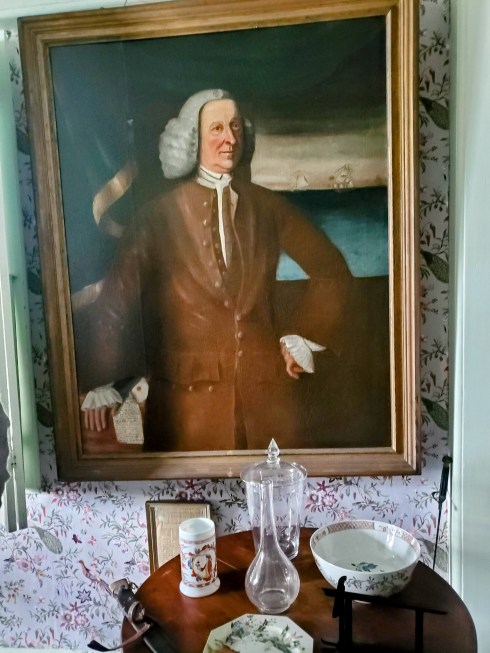
How I love Rowe’s sentiment: I record the 17 yeas, that were so mean-spirited to vote away their Blessings as Englishmen, namely their Rights, Liberties and Properties and how lovely that one of Browne’s properties should go to such a self-sacrificing patriot as General John Glover. But this is not the end of my rescinder rap. I was so focused on Frye and Browne and Salem that I did not take note of all the names on Rowe’s list immediately. I drove up to York on Friday and went to an open house at our local Historic New England property on Saturday: the Jonathan Sayward House, where I interned in college. As soon as I stepped in the parlor, I remembered: he was a rescinder too, and there he is on Rowe’s list, just above Browne (Maine was of course part of Massachusetts until 1820). Sayward did not suffer as much loss as Browne, who I believe was a much bigger fish: no exile (just confinement to this very home), no confiscation, and reconciliation after it was all over. George Washington and King George III share wall space in the Sayward House today.

Portrait of Jonathan Sayward, Rescinder, in his family home, anonymous artist, and the right parlor, above. Below, our hero, Brigadier General John Glover: a study by John Trumbull drawn while Glover was living at his farm, 1794. Yale University Art Gallery.