Category Archives: Travel

The Lollipop Cemetery

Such an undignified name for such a solemn place: the Shaker cemetery in Harvard, Massachusetts, one remnant of the industrious community of Shaker non-genealogical families that resided in this beautiful Massachusetts town from 1769 until the First World War. But that’s what people call it. I had a hankering to see it the other day, and so I drove to Harvard and asked for directions, because it’s a bit off the beaten path (I never use my phone for navigational purposes on a road trip; that would defeat the whole point for me–it’s either wander or inquire): oh, the Lollipop Cemetery? Just drive towards Ayer and take a right on South Shaker Road. And so I did and there it was.

Shaker Cemetery Sign

Shaker Cemetery Stone

Shaker Cemetery markers crop

Shaker Cemetery Markers

The gate was locked, and I didn’t want to trespass on this sacred ground, but I think you can comprehend the lollipop characterization of these cast iron markers, which replaced the original stones from 1879. Here is a close-up of an individual marker from a wonderful site where you can research both the cemetery and its inhabitants, as well as a rather haunting photograph from Clara Endicott Sears’ Gleanings from Old Shaker Journals (1916). The Harvard Shaker community closed down in the following year, and the cemetery was deeded to the town of Harvard in 1945.

Shaker Marker

Shaker Cemetery gleaningsfromold00sear_0375

Boston patrician (with Salem roots) Clara Endicott Sears (1863-1960) became devoted to preserving the memory and material of the Harvard Shakers as their numbers dwindled to single digits. She had already established one of America’s first outdoor museums adjacent to her summer home on Prospect Hill a few miles down the road after she realized that a farmhouse on her property had been the site of Bronson Alcott’s short-lived Transcendentalist experiment when the few remaining Shakers in Harvard began selling their buildings.Clara bought the original 1794 office building and moved it to her hilltop museum, uniting Transcendentalist and Shaker visions (and later those of Native Americans and Hudson River Valley artists). Following this path, I drove over to the Fruitlands Museum, passing a few more Shaker structures along the way.

Shaker Old Stone Barn

Shaker Building Harvard Ruins of the Old Stone Barn and the South Family Building, Harvard Shaker Village.

The interpreters at Fruitlands emphasized “community” as the theme tying Transcendentalists and Shakers together rather than any Utopian dream, which seems appropriate to me, especially as the latter were entrepreneurial workers and the former were idealistic intellectuals. The relocated Shaker office is a testament to the aesthetic and industrious pursuits of the brothers and sisters; I came away overwhelmed by the sheer drive of young seedsman Elisha Myrick, who left the Harvard community, like many of his brethren, around the time of the Civil War. I just felt sorry for the Alcott children, who had to endure a cold and hungry 6 months in the farmhouse just down the road.

Shaker Boxes

Shaker Ads

Shaker Cloak

Shaker Industry

Fruitlands Farmhouse

Fruitlands Fruit

At Fruitlands: Shaker artistry and industry, the Alcott Farmhouse, and artist-in-residence Carolyn Wirth’s 3D take on Shaker gift drawings, installed in a grape arbor.

Driving out past the town common, I was waylaid by some beautiful houses: Harvard is really gorgeous, and calm. I drove back to Salem thinking (not for the first time) that perhaps it was a little too busy (and loud!). I hope I’m not turning into my great-great-great? grandfather, who sold everything (including a beautiful Tudor house), and left his family and friends in England for America, and the Shaker community of New Lebanon, New York.

Harvard Tavern

Harvard Colonial House

Harvard Brick House

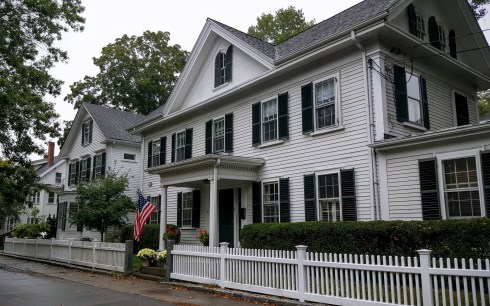
Just a few Harvard houses: this first one was once a tavern, I presume.


Random Scenes of Summer

The only unified themes of today’s post are the season and the necessity of cleaning out the photograph folders on my phone, camera, and computer: everything seems very vivid this time of year so I snap, snap, snap away and now I must purge! There’s always something to see in Salem, and then we ran up to my hometown of York Harbor to escape the heat–but the heat was there too. I am not a beachgoer, so I spent the hot days in the “cottage” (which was supposedly built for precisely such weather) indoors and the cool day (we had three successive days of 95 degree-70 degree-95 degree weather) walking around looking at other cottages. Even though I grew up in York,  I still see something new every time I take a walk–as in Salem. I missed the annual vintage car show while up in Maine, but before I left I checked out two of the city’s newest enterprises: Waite and Pierce, the new shop on the grounds of the Salem Maritime National Historic Site, and Notch Brewery & Taproom, a beautiful space crafting for drinking in good company, with no obtrusive televisions and bad food (just big soft pretzels, for now).

Mid-August, Salem: the scuttelaria are out in my garden (along with the phlox), Java Head window exhibition at Salem Maritime’s West India Goods Store (curated by an SSU History student who did much more research than I did for my post), goods at Waite and Pierce, and the Notch experience.

Summer 4

Summer 5

Summer 1

Summer 2

Summer 3

In York and York Harbor: gardens at the Stonewall Kitchen company store; antiquing (the watercolor below, which was quite expensive, is supposedly a Salem street scene–not sure where–maybe Sewall Street before it became a parking lot for the YMCA?), York Harbor map (1910) and cottages present and past (on this particular stroll I was taken by the older, smaller, mostly-white cottages on the Harbor side), our family house (brown) and the Elizabeth Perkins House (red) and garden on the York River.

Summer 6

Summer 7

Summer 8 Sewall Street

Summer 13

Summer 14

Summer 17 the Samuel Donnell Garrison today and on the left in the older photograph–across from the entrance to the Harbor beach

Summer 10

Summer 12

Summer 11

Summer 9 an ongoing–and ambitious– restoration by a family: it was fun to see them working together……..

Summer 15

Summer 19

Summer 18.jpg goldenrod time at the Elizabeth Perkins House garden

An appendix:  While hiding from the heat indoors, I browsed through several old photographic books of York, and became intrigued (for the fourth or fifth time) with “The Comet”, an odd contraption featured at Short Sands Beach in York Beach a century ago, in which tourists were carried out onto the sea on a track: has anyone seen such a thing anywhere else? Was this a contemporary seaside fad or a unique York Beach attraction?

Comet Collage The Comet in action

24 Hours in Richmond

Just back from an abbreviated visit to Richmond, Virginia for a family event: shortened by the wild weather down there which grounded us in Boston on the evening of our departure. So everything was compressed: family time, touring time, time in our amazing hotel, The Jefferson, a monumental Italianate (its style is described alternatively as “Spanish Baroque” and eclectic; it seemed Italianate to me) palace in the heart of the city. Designed by the well-known architectural firm Carrere and Hastings, it opened in 1895 with all the modern conveniences, including complete electrical, heating, and plumbing systems for all of its 324 rooms, service telephones, and elaborate lobbies for both ladies and gentlemen. Alligators roamed these lobbies as late as 1948. The Jefferson is nearing completion of an extensive renovation: there was still scaffolding in the gentlemen’s lobby but our room was lavishly luxurious. I was particularly impressed by its scale and furnishings; while my husband was wowed by the television embedded in the bathroom mirror! I ran around and took pictures in my limited time, and then spilled out into the neighborhood the following morning: very early, before it got too hot.

Richmond Lobby

Richmond 1

Richmond 4

Richmond 13

Jefferson Collage

Richmond 12

Richmond 11

Richmond 33

Richmond 31 Main St Entrance

The Jefferson Hotel, Richmond: main lobby with statue of Thomas Jefferson by Edward V. Valentine and lobby ceiling; the gentlemen’s lobby from two perspectives; memorabilia; Franklin Street entrance day and night with alligator statue; Main Street entrance to the gentlemen’s lobby. 

Snapshots which comprise a literal snapshot of one small section of Richmond are below: historic preservation is definitely a priority, but I also got the impression from my quick tour of downtown that the city is open to more modern structures as well. Preserved row houses in that soft brown Virginia brick co-exist with more colorful and stark structures: I saw none of the boxy pastiches now plaguing Salem in this particular section of Richmond! I was also struck by how well Virginia Commonwealth University was integrated into the city: such a lost opportunity for Salem that Salem State is confined to a residential section into which it doesn’t quite fit. I’m really looking forward to returning to Richmond so that I can explore the designated historic districts…and more: I picked up a copy of Garden and Gun (a great magazine, but kind of an incongruous name, no?) to read on the plane ride home which featured an article on an ongoing community effort to rescue the overgrown African-American cemeteries of the city and now I must see these too.

Richmond 25

Richmond 26

Richmond 22

Richmond 19

Richmond 18

Richmond Collage

Richmond 14

Richmond 30

Richmond 29

Richmond 20

Richmond 21

Richmond 27

Richmond Crozet House 1814

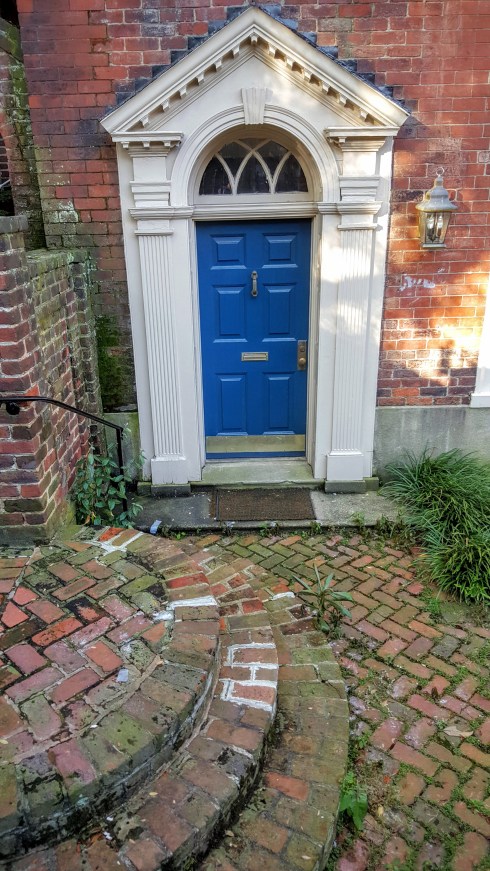
A short walk on a few streets of downtown Richmond on a hot July morning: LOVE these last two houses with their amazing entrances and windows: the latter one is the Crozet House, built in 1814.


The Salem “Heritage” Trail needs more…..Heritage

It is pretty well-known here in Salem that the Red Line that runs though downtown, the official “Heritage Trail”, is more representative of commerce than history. It encompasses heritage sites like the House of the Seven Gables, the Corwin (“Witch”) House and the Salem Maritime National Historic Site, but also more dubious enterprises like the Salem Witch Museum, the Salem Witch History Museum, and the Salem Witch Dungeon Museum, with no discernment. There are no standards along the Heritage Trail: the Peabody Essex Museum with its vast collections, blockbuster exhibitions, and professional staff and the Witch History Museum, a storefront shop which lacks collections, curators, and content, have equal status in terms of their roles as provisioners of “heritage”.  According to the American Alliance of Museums (AAM), a museum is a nonprofit institution, which maintains, interprets, and exhibits its collections for the public good. As Salem’s witch museums are for-profit enterprises, which maintain no collections and offer their performances and “exhibits’ exclusively for their private gain, I don’t think they qualify as museums under the professional definition: I prefer to refer to them as “experiences”.

Museum Collage A Tale of Two Museums; Alvin Fisher’s View of Salem from Gallows Hill, 1818, Peabody Essex Museum, and the Gallows Hill exhibit at the Witch History Museum (Of course now we know that the victims of 1692 were hanged at Procter’s Ledge rather than Gallows Hill).

Of course, people are free to choose whatever experiences they would like, but if tourists stick to the Red Line they are going to be missing out on much of Salem’s heritage. And they do stick to the Red Line, believe me: I followed several groups of tourists the other day (on the hottest day of the year) as they walked along it with great dedication, all the way from the Salem Witch Museum to the Salem Witch Dungeon Museum, bypassing several sites which are related to the real history of the Witch Trials: St. Peter’s Church, under which the body of Philip English lays, the Howard Street Cemetery, adjacent to where Giles Corey was pressed to death, the former sites of Bridget Bishop’s house and orchard, the Salem Jail and Court House where the accused witches were held and tried. The Salem Witch Dungeon Museum removed the plaque which marked the spot of the original jail and affixed it to their building, so now they “own” that history. The imprimatur of the Red Line makes it official.

lynde-street-076

Plaque on the Witch Dungeon Museum along the Red Line; the second, smaller plaque was added a decade later than the first.

The problem with the existing Red Line/Heritage Trail is not just its presentation of an incomplete and often-shoddy history of Salem. Because it is so obviously inadequate, it has led to a form of cultural “segregation”: other organizations, chiefly the National Park Service in collaboration with local groups, developed alternative walking trails to fill the gaps: architecture tours, a maritime tour, a tour featuring sites related to Salem’s African-American history, and a Hawthorne tour (you can download all the brochures here). There are also a wide range of commercial tours, which seem to have multiplied dramatically over the past few years. Visitors to Salem can have quite a different experiences depending on their degrees of preparation, resourcefulness, and curiosity. I also think that Salem’s reputation has suffered by comparison with the other Red Line (what I have often heard called the real Red Line), Boston’s Freedom Trail, which does not include commercial sites.

Salem has been a tourist destination for a long time, over a century, and we could learn from our past projections. The map included in my favorite old guidebook, What to see in Salem (1915) projects a route that is not dissimilar from today’s Heritage Trail in terms of geography, but exhibiting very different priorities: public places rather than private enterprises, an integrated city of real museums, sites associated with Hawthorne and the Revolutionary War as well as the Witch Trials, colonial and Federal houses and gardens. The problem with the 1915 route is immediately apparent, however, especially if you compare it with the current Heritage Trail map: no one stood to make any money.

What to see in Salem map 1915

What to see in Salem text 1915

Red Line Map 2016

Map and Key from What to see in Salem (1915) and current Heritage Trail Map, available here–all the numbers refer to local businesses and the museums, real and faux, are in text. Judging by font size, the Gallows Hill Museum/Theatre looks like the place to go! (But it’s never open, except in October).


A Galleon in Port

Our anniversary falls on Memorial Weekend so this past Friday we celebrated it with drinks and dinner in Newburyport, after which we walked around the foggy old town and came across a pirate ship, with a party on board. This was El Galeón, a Spanish reconstruction of a sixteenth-century galleon, which is apparently sailing up and down the eastern U.S. coast this summer. Somehow we didn’t know she was going to be in Newburyport, but there she was, and quite a sight to see. This is a ship from my period, so I was thrilled, and determined to make it back to see her in daylight. The weekend was busy, and so I didn’t manage this until late yesterday. In broad daylight El Galeón was still pretty impressive in its details, and bigger than I thought such a ship might be, but perhaps not quite as magical as she appeared on Friday: much less fog, no costumed party-goers on board, and I suppose alcohol might have colored my previous view a bit. But I had wanted to head north to Newbury and Newburyport anyway, to explore some Moses Little territory as a follow-up to my last post, and these towns are so packed with beautiful old houses they are always worth a trip, even on a busy holiday weekend.

Newbury cemetery

Newbury Short House Memorial Day Weekend

Newbury Short House Memorial Day Weekend2

Driving through Newbury, I always stop to admire the Knight-Short House (built c. 1723) with its brick sides.

Newburyport Galleon 4

Newburyport Galleon3

Newburyport Galleon2

Newburyport Galleon Night

Newburyport Galleon

Newburyport

El Galeón in port, day and night. Then I was off to see more houses.


Little British Books

I have a particular predilection for small decorative books published in collectible series, which British publishers are particularly good at producing. I have posted about two of my favorite series before, Britain in Pictures and King Penguins, and on this recent trip I encountered some more! The very traditional and well-stocked Daunt Books, which in addition to selling books has its own imprint, had several series on display in their main store on Marylebone High Street in London, and Waterstones (now managed by James Daunt) had a beautiful display of the new Penguin Monarchs series AND two big bookcases full of classic Penguins. The British love their Penguins, and who can blame them?

Daunt Books London

Daunt Books

Daunt Books Display 2

Candlewick Press Collage

Daunt Books Display

All sorts of books at Daunt including pamphlets: the Candlewick Press “Poetry Pamphlets” are marketed with the pitch phrase “instead of a card”; the “Little Black Classics” were issued in a series of 80 volumes last year to commemorate Penguin’s 80th anniversary.

Penguins Orange

Penguins Blue

Penguin Monarchs

Penguin Monarch Charles II.

Over at Waterstones on Gower Street, there were vintage paperback Penguins in orange and blue, and the new Penguins monarchs series, “ short, fresh, expert accounts of England’s rulers in a collectible format” with commissioned covers. I want all 45 of them (44 kings and queens + Oliver Cromwell, of course).


Ghostly Courtiers

I’ve just got a few more English posts before I get back to the actual streets of Salem: I just took so many great pictures over there if I do say so myself! I’m going back to Hampton Court today–the other side of Hampton Court, which if of course a bilateral palace, with a Tudor side and a Baroque/Georgian one, the cumulative work of Sir Christopher Wren and Sir John Vanbrugh who were commissioned by the last Stuarts and the first Georgians to remodel the entire castle in a more modern (and presumably comfortable) style. If completed, this modernization plan would have resulted in the complete demolition of the Tudor palace but lack of funds and the shifting preferences of monarchs determined that it was (fortunately) not. I far prefer the Tudor palace, inside and out, but I really enjoyed the furnishings, paintings, and overall interpretation of the “Secrets of the Royal Bedchamber” exhibit in the royal apartments on the other side, populated by courtiers all draped in white Tyvek.  Like any old place touched by tragedy, there are rumors of ghosts at Hampton Court Palace, and it as if you are walking among them in these rooms.

20160315_111841_Burst01~2[1]

London 735.jpg

London 724

London 726

London 728

London 727

London 725

London 731

London 730

London 732

Baroque facades–with the Tudor roofline peaking out behind, dining rooms and courtiers; Below, the “Grey Lady” ghost, Sybil Penn, wandering through the palace.

Grey-Lady-low-res


Hooked on Hawksmoor

Well, I am very late to this party but I became absolutely obsessed with the works of British Baroque architect Nicholas Hawksmoor (1661-1736) on my recent trip to London. Hawksmoor’s professional reputation was overshadowed in his own time–and long afterwards–by his association with two more prominent “gentlemen” architects, Christopher Wren and John Vanbrugh, but in the last few decades he seems to have emerged from their shadow. His oeuvre is impressive: under Wren he worked on St. Paul’s Cathedral, the naval buildings at Greenwich, several buildings at Oxford University, Hampton Court and Kensington Palaces and Westminster Abbey, the west towers of which were constructed according to his own design during his tenure as Surveyor General, and he collaborated with Vanbrugh on both Castle Howard and Blenheim Palace. I’ve been to all of these places, but I never associated any of them with Hawksmoor, or thought about Hawksmoor at all, until I saw his Christ Church, Spitalfields, early last week. From that point on the week belonged to Hawksmoor: I scouted out his six surviving London “Queen Anne” churches commissioned by the New Churches in London and Westminster Act of 1710, really looked at the Abbey’s west towers for the first time, and looked on the stately buildings of the Royal Naval College at Greenwich with a new appreciation.

Christ Church Spitalfields

Hawksmoor 1

Christ Church Spitalfields 1950s

Christ Church Spitalfields 1909

21. Christ Church, Spitalfields, London: by Nicholas Hawksmoor 1964 by John Piper 1903-1992

Christ Church, Spitalfields, shining like a beacon at the end of very busy Brushfield Street, afternoon and early evening (after its long restoration, completed in 2004), and in the 1950s and 1909; John Piper, Christ Church, Spitalfields, London: by Nicholas Hawksmoor, 1964, Presented by Curwen Studio through the Institute of Contemporary Prints, Tate Britain.

I just can’t stop looking at Christ Church! And I’m not alone: it has inspired scores of artists and photographers, and authors such as Iain Sinclair, Peter Ackroyd, and Alan Moore. In the poem Lud Heat (1975), which inspired Ackroyd’s (crime? suspense? mystery? not sure how to categorize it) novel Hawksmoor (1985), Sinclair envisions a “psychogeographical” alignment between all of the Hawksmoor churches, and later calls them “eternal” as opposed to the “shimmering trash” of the Docklands (in this great video). Sinclair is absolutely right; these churches do stand out, all of them, not just because of their stature and their distinctive spires but also because they present a rather odd combination of classical austerity and weight.You also have the sense that Hawksmoor was building temples rather than churches: these houses of worship don’t look precisely Christian! One of his six surviving London churches, St. George’s, Bloomsbury, is essentially a classical temple with a steeple on the side rather than the center, at the top of which is not Saint George but King George (I–in Roman dress, presumably he is the Saint), accompanied by a lion and a unicorn. It’s no wonder that our modern secular age admires Hawksmoor, the architect and the Freemason.

Hawksmoor St. Georges

Hawksmoor St. Georges 2.jpg

Hawksmoor St. Georges 3

Hawksmoor’s St. George’s Bloomsbury, completed in 1730; restoration completed in 2006.

Well, I do believe St. George’s was Hawksmoor’s last London church; his earlier ones do appear a bit more traditional/ecclesiastical but still display that distinctive Hawksmoor edge of composition and detail. Here are the rest of his churches, plus two more that he collaborated on with John James: St. Luke’s Old Street in Islington (which features an obelisk steeple!) and St. John’s Horsleydown in Bermondsey, which was demolished after sustaining bomb damage during World War II.

Hawksmoor St Alfrege

Hawksmoor St. Alfrege

Hawksmoor St. Alfrege 3

St. Annes Limehouse

St George in the East

St George in the East rendering BL

Hawksmoor St Mary Woolnoth City

450px-St_Lukes_Islington Hawksmoor

Hawksmoors lost church Bermondsey

St. Alfege Church, Greenwich, 1712-1714 (with window details); St. Anne’s Limehouse, 1714-27 (on the grounds of which there is a pyramid); St. George in the East, Wapping, 1714-1729 (I did not have time to make it out to Wapping, so I have “borrowed” a picture from here and a drawing of the facade from the George III topographical collection at the British Library. Next time!); St. Mary Woolnoth, 1716-27, right in the center of the City of London (very wide and narrow steeple); Two collaborations with John James, 1727-33: St. Luke’s, Old Street and St. John’s Horsleydown, demolished after World War II (from the Collections of the Metropolitan Archives of London). Similar fluted spires, but St. John’s had a comet on top!

So we have all sorts of classical elements, combined with more whimsical ones: columns, pyramids, obelisks, unicorns, comets. Mathematical precision and clocks. I don’t think this adds up to anything particularly pagan, much less sinister (somehow Hawksmoor acquired the moniker “the Devil’s Architect”–I’m not sure if this is a creation of his time or ours): I just think he was a man of his time, which was of course the Enlightenment. Quite a modern man, who ascended to the heights of a gentleman’s profession on his merits alone and worked primarily for institutions rather than patrons. He was impressive and his work remains impressive. I’m not precisely sure what his creative contributions were relative to those of his mentor, Christopher Wren, but I really felt Hawksmoor’s presence at Greenwich, almost as much as Christ Church, Spitalfields: maybe I’m getting a bit “psychogeographical” myself! Unfortunately we don’t seem to have this particular field of inquiry in the States: we’re just not that attached to our built environment to get that introspective about it.

Hawksmoor Greenwich

Hawksmoor Greenwich 2

So now I’m home, with only a few Hawksmoor books to sustain me. I need more: so now I’m going about collecting more texts, and some images that rival, or at least capture, the magnificence of Hawkmoor’s buildings. I really like the work of Andrew Ingamells, who has rendered several of Hawksmoor’s churches in aquatint etchings, and I would almost kill for Pablo Bronstein’s Four Alternate Designs for a Lighthouse in the Style of Nicholas Hawksmoor (Bronstein also designed and commissioned the construction of an actual Hawksmoor beach hut in the form of a lighthouse at  Folkestone, which you can see here).

Ingamells Hawksmoor Collage

Hawksmoor Collage2

Hawksmoor Pablo Bronstein

Hawksmoor books

Trinity and Hawksmoor

Aquatint etchings of Hawksmoor churches by Andrew Ingamells, from a selection here; Pablo Bronstein’s “Four Alternate Designs”, Herald Street Gallery;  Architectural and historical analysis from Owen Hopkins and Mohsen Mostafavi and beautiful black and white photographs by Hélène Binet; just finishing up Ackroyd’s engaging Hawksmoor this morning!


Tudor Texture in London

Besides far superior public transportation systems and many more public smokers, I think the thing that Americans notice the most when they travel to Europe is texture: a built environment that looks comparatively embellished, nuanced with symbolism, and venerable. Despite London’s dynamic growth over the past twenty years or so, there is still a lot of historic fabric in the city–but much of it is deceptively and relatively “modern”, i.e., Victorian. The Houses of Parliament are probably the best example, but scattered around the city are myriad buildings that “look” older than they really are: especially pubs! I was charged with finding Tudor sites in London on this trip: a task that was not as easy as you might think. The successive catastrophes of the Great Fire of London and the Blitz obliterated much of the city’s pre-modern fabric and in between there were those “improving” Victorians! So what remains of Tudor London? Lots of things, primarily to be found in the National Portrait Gallery, Tate Britain, The Victoria & Albert Museum, and the Museum of London. Several places, namely the Henry VII Chapel at Westminster Abbey, St. Margaret’s Church nearby, Lambeth Palace just across the river, and the Tower of London and the sister churches of St. Helen’s Bishopsgate and St. Andrew Undershaft in the City. There is also the Staple Inn of my last post, whose very Tudor appearance probably owes much to an early twentieth-century “restoration”, and St. Bartholomew’s Gatehouse and the oldest residence in London, located on the picturesque City street of Cloth Fair. To the west, Hampton Court Palace, and to the east, Sutton House in Hackney, which was one of the highlights of my recent tour. You can’t quite immerse yourself in the Tudor era in modern London–but you can come close, for an hour or two, if you find the right spot.

Tudor Texture windows

Tudor Texture Queen's

Tudor Texture Sutton Windows

Tudor Texture Sutton Window

Hampton Court 4

Windows into the Tudor era: exterior of the Chapel Royal at Hampton Court (where we attended a service!), featuring the Tudor emblems of the portcullis and rose; looking out from the Tower towards the Queen’s apartments, built c. 1530 for Anne Boleyn; windows at the Sutton House, c. 1535; one of many impressive oriel windows at Hampton Court Palace.

Henry VIII at Hampton Court

NPG 4618; Catherine Parr by Unknown artist

Tudor Texture tomb_margaretcountessof lennox

Tudor Texture Holme Family

Tudor People: Henry VIII at Hampton Court; my favorite of his wives, Katherine Parr at the National Portrait Gallery; the tomb of  his niece (and the grandmother of King James VI and I) Margaret, Countess of Lennox, in the Henry VII Chapel at Westminster Abbey; not quite Tudor-era people but I love this triptych portrait of the Holme family in the Victoria & Albert Museum, c. 1628.

Hampton Court

Hampton Court 2

Hampton Court 5

Sutton House

Sutton House 2

Sutton House 4

Gherkin and St. Andrews

Hampton Court courtyards and Sutton House and its central courtyards in Hackney; St. Andrew Undershaft in the City of London dwarfed by the Gherkin (my photograph didn’t turn out so well as the Gherkin wasn’t so textured; this is one credited to Duncan which I found here. It’s a pretty classic composition now, as you can imagine!)

So now finally for some real interior texture: the Tudors could not bear an unembellished surface and were particular fond of tapestries and wood paneling for their interiors. At Hampton Court, the private Tudor apartments were demolished to make way for the Baroque “restoration” of William and Mary’s reign, but the Great Hall of Henry VIII’s time remains, with its decorated hammer-beam roof and walls lined with The Story of Abraham tapestries. On the day that I was there last week, this room was full of English schoolgirls (in the best uniforms ever) drawing details from the tapestries in close consultation with their teachers, so it was hard for me to get a clear shot of the interior details (plus I was very taken with these uniforms–fortunately there are lots of pictures of the Great Hall online). Later in the week, at Sutton House, I walked around the house in complete isolation and marveled at each and every surface: it was like stepping back in time in some rooms, while in others the National Trust’s conservation/interpretation approach enabled one to look beyond the decorative facade into the bones of the house, which is a must-see for any Tudor fan.

Hampton Court Great Hall

Great Ware Bed.jpg

Sutton House Door

Sutton House doorway

Sutton House Linenfold Paneling

Sutton House plain paneling

Sutton House paneling

Sutton House Details

Sutton House upstairs

Schoolgirls in the Great Hall at Hampton Court; The very famous “Great Ware Bed”, c. 1590, at the Victoria & Albert Museum (this item could have a post of its own); The National Trust’s Sutton House in Hackney: front door, doorway, paneling, details from fireplace surround & hops woodcarving; upstairs drawing room.        


Off to London, Leaving Links to Salem Ladies

I’m off to London for Spring Break so will not be posting for a while, but I wanted to leave some links to some of the posts I’ve written on Salem women to fill in for me in my absence. It is Women’s History Month after all, and some of these ladies did not get the love and attention that I feel they deserved! Finding these ladies was an exercise that convinced me that I need to figure out how to develop an index for this compendium when I get back.

I know London is not the typical Spring Break destination, but it is always my favorite destination: for this particular trip (on which I will be accompanied by students!!!!) I have the Botticelli Reimagined exhibition at the Victoria & Albert Museum on my agenda as well as Samuel PepysPlague, Fire and Revolution at the National Maritime Museum, and I really want to visit Sutton House in Hackney, as Tudor structures are relatively rare in London. Then all (or some) of the usual places. I know London pretty well but am open to suggestions (particularly for food–I never know where to eat) so comment away: I am not bringing my laptop but will check in with my phone.

Botticelli London Vand A

Pepysp

Sutton House Hackney

A Botticelli variation, a Pepys poster, and a drawing-room in Sutton House, Hackney.

So here are some links that will lead you to Salem ladies, if you are so inclined. Despite years of blogging, I’ve hardly scratched the surface when it comes to interesting and notable Salem women, as I have sought to expose those whose stories don’t get told again and again and again. I seem to be drawn to artists, but there are lots of entrepreneurs and activists and just interesting women whom I have yet to “cover”–some men too!

Colonial women: A Daring Woman; Ann Putnam; The Pardoning of Ann Pudeator; Four Loves; Minding the Farm.

Authors:  A Scribbling Woman from Salem; The Little Locksmith; Mary Harrod Northend; Mrs. Parker and the Colonial Revival in Salem (could also go under “artists”); Tedious Details.

Artists:  Painting Abigail and Apple Blossoms; Fidelia Rising; Miss Brooks Embellishes; Salems Very Own Wallace Nutting;Paper Mansion.

Uncategorized:  The Mysterious Miss Hodges; A Salem Suffragette; The Woman who Lived in my House;  Ladies of Salem; A Salem Murder Mystery; The Hawthorne Diaries; Factory Girls and Boys; Little Folks and Black Cats; Bicycle Girls.