I have just returned from Raleigh, NC where I attended my stepson’s graduation and made my usual mad dash around the city’s historical sites and streets when not attending attendant graduation festivities! I’ve been to the Raleigh-Durham area many times, but I’ve never really focused on the downtown area of the capital city, so this time I was determined to do so. This region has seen dynamic development for quite some time, and prior visits had given me an impression of sprawling suburbia (apart from the college campuses) which I knew wasn’t entirely accurate. So I spent some time downtown, in the historic Oakwood neighborhood, and at a few historic house museums. In the city center, the attempt to preserve and blend older and new architecture was very apparent, but more than anything I was impressed by the historic markers which are everywhere. At the moment, I’m obsessed with Salem’s inconsistent signage, which is probably one reason Raleigh’s uniform and comprehensive signage was so noticeable to me, and to complete the comparison, I also noted two other essentials of Raleigh’s public history presentation not present in Salem: 1) historic walking tours; and 2) a really great little city historical museum: the City of Raleigh (COR) Museum. Once again I am struck by the amazing commitment that other towns and cities have made towards protecting and presenting their unique heritage, which we seem to take for granted here in Salem.


 Signs everywhere in Raleigh, which has held on to its state heritage markers (even for sites that no longer exist) and added lots more.
I loved the historic Oakwood neighborhood with its mixture of low-slung embellished bungalows and high-style Victorian mansions, but there are some preserved nineteenth-century residences in the immediate downtown as well, several converted to commercial or government uses. The Oakwood neighborhood is apparently not only Raleigh’s largest historic residential district, but North Carolina’s largest “intact 19th century residential neighborhood”, so it’s pretty special. Every house and garden seemed to be in pristine condition; every porch perfectly positioned. Beyond the Oakwood neighborhood is the historic Oakwood cemetery, which I only had time to run through, and there is a slightly more modest neighborhood of shotgun houses (including some interesting new construction) running alongside that.
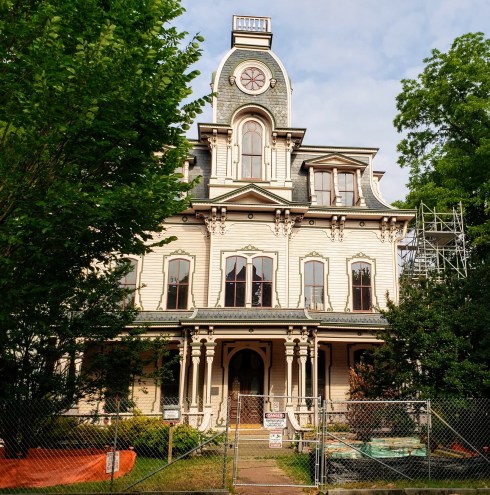


 The Heck-Andrews House (under renovation), Polk House, and Executive Mansion in the city center, and Oakwood beyond—and beyond Oakwood.
The oldest houses in Raleigh are two eighteenth-century houses which are now house museums: the Joel Lane House (1769; owned and operated by the National Society of the Colonial Dames of America) and the Mordecai House (1785, owned and operated by the City of Raleigh). They are connected, because Joel Lane, a very important figure in the foundation of Raleigh, built the Mordecai (which is pronounced MordeKEY down there) house for his son Henry. There were interesting interpretations in both houses, with domestic life as a primary focus in both, but as the Mordecai House was situated in the midst of an extensive plantation there was more consideration of both slavery and the estate’s role in the development of Raleigh in the later nineteenth and twentieth centuries. The Mordecai House is now in the midst of a city park, and additional historic structures have been moved to the site, including the birthplace of Andrew Johnson, about whom I learned a lot. He is one of the the three presidents “claimed” by North Carolina, along with James K. Polk and Andrew Jackson (what a trio! I can’t help but be a bit more proud of the Adamses and JFK from Massachusetts). While I love the Colonial Dames, I do think they tend to be a bit too dependent on plastic food in their houses, and I am remain a bit confused about the Mordecai family’s connections to the small Jewish community in early nineteenth-century North Carolina.


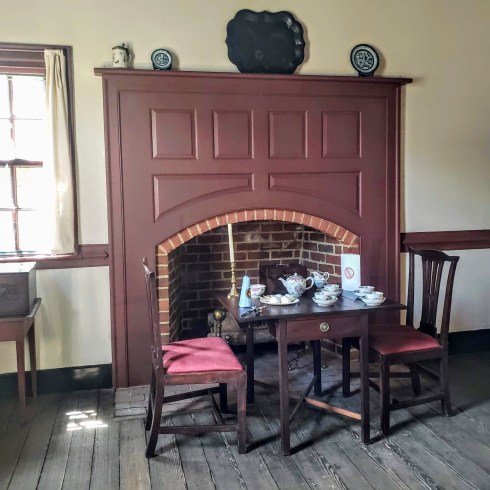


 Exteriors and Interiors of the Lane and Mordecai Houses + their gardens and the Andrew Johnson birthplace, adjacent to Mordecai.
I really want to give a shout-out to the City of Raleigh Museum, which presented the city’s history in professional and creative ways while focusing on the connections between the past, the present, and the future. It is: right downtown, in the center of everything, free, designed beautifully, completely engaged and engaging. If it were possible, I would love to entice our Mayor and City Council down there so they could see how powerful a real museum of Salem history could be! The museum utilized several different interpretive strategies and media in its presentations: permanent installations which presented an overview of Raleigh’s history around different themes with objects, texts and videos, a revolving spotlight on collection items, and temporary exhibits on topical themes connected to what is going on in Raleigh right now. I was so impressed, and am very envious.


 The City of Raleigh (COR) Museum: a must-visit spot; this last question is existential!
And finally, a food footnote, because food seems to be at the center of every thriving city, and Raleigh is no exception. I am no foodie (although I do appreciate a well-crafted cocktail), but even I was blown away by my meal (and my drinks) at one of Ashley Christensen’s four (soon to be five) Raleigh restaurants: Death and Taxes. Christensen is this year’s James Beard award winner for outstanding chef, and just based on this one experience, I can see why: beautiful restaurant, beautiful food. The food trucks were lined up along Fayetteville Street for the monthly Food Truck Rodeo yesterday, ending our visit on a very lively note.
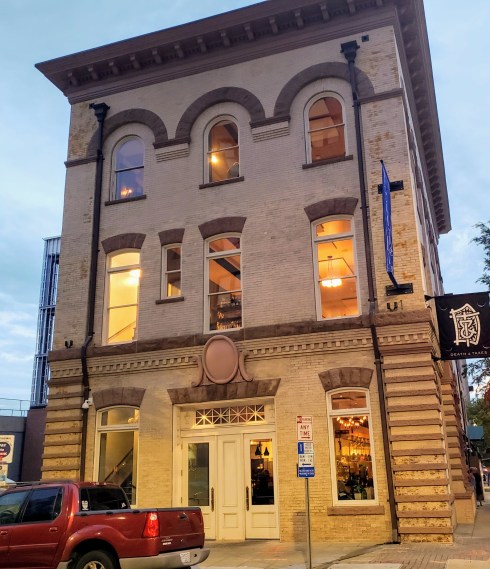


 Death and Taxes and my companions’ food truck choices, including meatloaf-on-a-stick!



 How perfect is Lambertville? Clean, every storefront filled, an interesting array of houses, perfect SIGNAGE, and city-council candidates who run on a platform of stopping overdevelopment!


 Still in New Jersey, heading north on 29 past the John Prall House and Mill, now a wonderful public park, into Frenchtown.


 Route 32 in Pennsylvania, past the Thompson-Neely House, where Washington’s troops waited to cross over the river prior to the Battle of Trenton, into Upper Makefield, site of the Washington Crossing Historic Park, ending up back in Jersey at the Johnson Ferry House. Obviously there was a lot more to see in Buck’s County, but I had to make it back to the Shore for dinner!


 An abandoned farmhouse on Old Dana Road, and the Quabbin Reservoir.

 Trade Card from the Remond Family Papers, Phillips Library, Peabody Essex Museum.







 All historical photos, Easton Historical



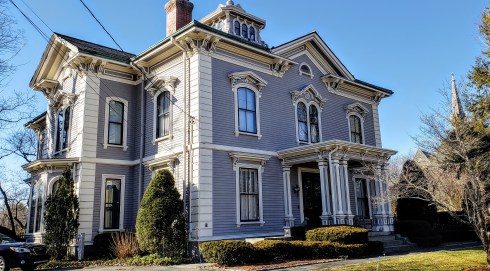


 A dreamy house—and former tavern—in Montague Center: listing


 All around Montague Center: house & barns, the Book Mill, Valley cats, Viennese heirlooms, the Homestead.


 Turners Falls, 1877, Digital Commonwealth ( I don’t think all of those streets were filled out!); the fast-flowing river after the Falls; workers’ housing. On the way home, the French King Bridge over the Connecticut River.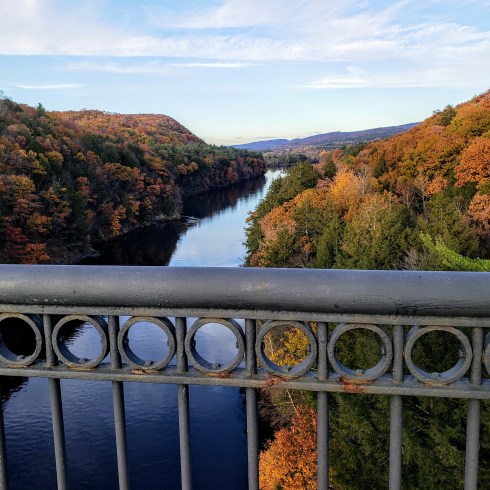


 Boston Street in the 1890s from the Frank Cousins Collection of Glass Plate Negatives as the Phillips Library, via Digital Commonwealth; the Trask Homestead/Black Horse Tavern on Boston Street—exterior and interior—in 1901, New England Historical and Genealogical Register Volume 55; the Symonds Chest which was once in the front parlor of the Trask homestead/Black Horse Tavern, Yale Digital Collections; 94-95 Boston Street, once Frye’s Tavern, now partly a tattoo parlor.


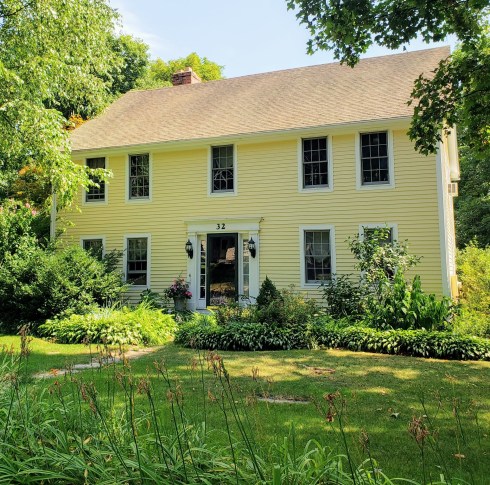


 The Hearse House in Marlow, New Hampshire.


 The McDermott Covered Bridge in Langdon (1864); the Meriden Bridge in Plainfield (1880); the Cilleyville (or Bog) Bridge in Andover (1887); the Keniston Bridge, also in Andover (1882); just two of Cornish’s FOUR covered bridges: somehow I missed the “Blow Me Down” Bridge and the Cornish-Windsor Bridge over the Connecticut River is


 Salisbury & Fremont, New Hampshire.
 Salem Register, August 19, 1841.