
We have spring break this week, so I’m on one of my road trips, loosely following the footsteps of George Washington. I always feel like I need a theme beyond “interesting old houses” but often I find one along the way which replaces my original intention. Not this year though: George has been pretty present! I started out in northern New Jersey, where I visited a house that I’d long wanted to see because I love Gothic Revival architecture and it looked like the ultimate GR cottage, but it turned out to be much older with a Washington connection: the Hermitage in Ho-Ho-Kus. General Washington was headquartered here following the Battle of Monmouth and during the court martial of General Charles Lee in the summer of 1778, in the company of his aide Alexander Hamilton and the Marquis de Lafayette. Aaron Burr was there too, and a secret romance was initiated between the future Vice-President/duelist and the lady of the house, Theodosia Prevost, who happened to be married to a British officer. At the close of the war and after the death of Theodosia’s husband, the two were married. Decades later this very strategic house was “gothicized” and acquired its present appearance.


Not too far away is a house where Washington and his men spent much more time: the Dey Mansion in Wayne, New Jersey, which served as the General’s headquarters for several months in 1780. This is a beautiful property, maintained and interpreted by Passaic County, which acquired the house in 1934 after which it underwent an extensive restoration. A very knowledgeable guide took me all around the house, even into the atttic, which was absolutely necessary as I couldn’t understand how so many people could have lived in this house during the General’s residence: the Dey family did not vacate! You’re not going to see the house’s gambrel-esque roof that accomodates all this space because I didn’t have a drone with me, but check out the website. It’s a stately house for sure, but the spacious attic made everything clear. Washington, of course, was given the two best rooms, a large parlor/office on the first floor and a bedroom just above, by the master of the house, Colonel Theunis Dey.


The Dey Mansion: the first photos above—all the way down to the blue parlor—are rooms used by George Washington and his aides, including Alexander Hamilton. Then there’s the semi-detached restoration kitchen, and the spacious attic.
So at this point and place, if you really want to do the Washington tour, you should probably drive to Morristown, Trenton, Princeton, east to the Monmouth Battlefield, west to Valley Forge. But I’ve been to all those places several times, so I drove to the General’s last Jersey and last period headquarters in Franklin Township, a rather isolated farmhouse called Rockingham. No Pennsylvania for me; I headed south into Maryland to Annapolis, where Washington resigned his commission at the beautiful State House (obviously my chronology is all over the place, but these two stops did dovetail). I just really wanted to go to Annapolis in any case; George was just an excuse.

Rockingham: Washington’s last headquarters—and on to Annapolis.


A bronze George in the old Senate Chambers of the Maryland State House (Harriet Tubman and Frederick Douglass are just across the way); Hammond-Harwood, Shiplap and row houses in Annapolis.
On to Alexandria, where Washington touchstones abound, given its proximity to Mount Vernon. Like Annapolis, but MORE, Alexandria is full of beautiful townhouses: I started in the center of the Old Town and made my Washington stops—his church, his townhouse (actually a reproduction thereof) his pub—and then walked the streets taking photographs of doorways and wreaths, myriad details, spite and skinny houses. A bright sunshiney day: you almost can’t see this bronze Washington, sitting on a bench outside Duvall’s Tavern, where he was feted after his great victory.


From my parking place on North Washington Street, I drove straight out to Alexandria to Mount Vernon, mere miles away, along the George Washington Memorial Parkway. It definitely felt kind of like a pilgrimage at this point! I have been to Mount Vernon before, but have no vivid memories—an obligatory school trip, I think. It’s one of those houses that looks much bigger on the outside than the inside: it feels quite intimate within, especially as one side was closed off for renovations. I signed up for the “in-depth” tour so I could get some interpretation–and up into the third floor. While the mansion is a must-see, I think you can actually learn more about Washington from the many outbuildings on the estate: he was “Farmer George” and for all of his heroism he was also a slaveowner who seemed to have no regrets in that capacity. There are a lot of Washington contradictions, and there are a lot of Mount Vernon contradictions: while the subject of slavery is addressed up front the overall impression—reinforced especially at the museum adjacent to the orientation center—is of a “great man.” It was a bit too ra-ra for me, but I’m still headed to Yorktown for the last leg of my trip.


Mount Vernon: a house with 10 bedrooms and no bathrooms: the white-canopied bed is in the bedroom where Washington died. The presidential desk, parlor and dining room, key to the Bastille (a gift from Lafayette), greenhouse and garden, and view of the Potomac from the porch.


 How and when my Salem house was built.


 First up in my neighborhood, I wanted to showcase these two houses whose owners have invested in a lot of work! Kudos to them! Both are on Chestnut. As you can see, the first house has a way to go, but its very impressive entrance was just re-attached. It’s such a great house, with an amazing garden. Nathaniel Hawthorne lived briefly in the blue house. A rare Salem front garden on Essex—and this house has been thoroughly renovated as well. Besides the Witch House and the House of the Seven Gables, the only historic house that Salem tourists seem interested in these days is the Ropes House, because it was featured in Hocus Pocus of course. The Ropes Garden is consequently very crowded in the fall, but I caught it during a relatively calm time: more ropes in the Ropes Garden than ever before. This gate on Federal Court started off my iron hunt–I’m obsessed with it.


 Downtown is quite a vibrant shopping scene with more than occasional bones and bats, and porta-potties, of course. There are some very well curated shops amidst the general kitsch, particularly
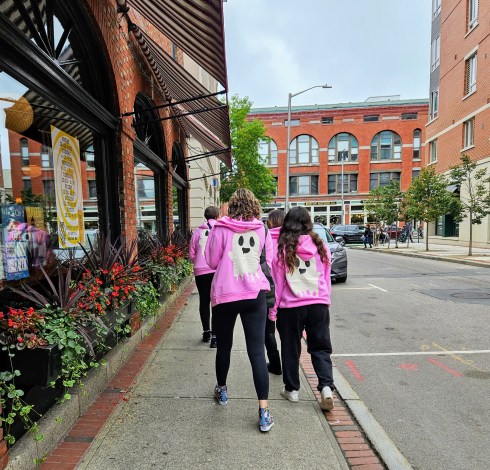


 Ghosts might trump witches this year eveywhere but Salem, of course. The ironwork at the Peabody Essex’s Gardner-Pingree House (which is never open) is simply astounding! A very busy Common, as the annual Food Truck Festival was underway, but once you get into the realm of Salem Maritime along Derby Street, not so busy. I still haven’t been in the Derby House even though it has been open this summer. The last photo just above is to remind me that I want to plant that particular variety of clematis next year!
 I finished up my walk on Charter Street, where the Witch Trial Memorial and Burying Ground is located. As soon as I entered the latter, I was confronted by these strange mannequins, propped up right against the Cemetery’s gate and stones! So Salem: the juxtaposition of the sacred and the tacky, remembrance and exploitation, enduring and ephemeral.


 So, much of this seems fine, certainly the themes are great (more on them below), and the criteria professional. I’m having some difficulty envisioning the logistics of the vetting process, but will leave that to the experts. What does concern me, however, is the disassociation of “site” and “building” as referenced in #3 on. As you see in my graphic above, the Salem Witch Museum, the most profitable of the for-profits, is referred to as the former East Church, which is presumably how it made the cut. Why the East Church is deemed “historic” is beyond me, aside from its imposing Gothic Revival style: certainly it is no more historic than the nearby houses of ultra-philanthropist George Peabody and Supreme Court Justice Joseph Story, or the birthplace of the illustrious Benson brothers across the Common. When I asked why and how the Salem Witch Dungeon Museum, also located in a former church (built by the Christian Scientists and not the East Church parishioners), was included on the trail, I got this response from the Executive Director of Destination Salem: The Witch Dungeon Museum and Lynde Street are the site of early fortifications. English settlers knew that their presence in Salem immersed them in a web of global conflicts. Fearing reprisals from the indigenous people they were displacing and attacks from other colonial powers, the colony of Massachusetts erected a fort near this spot in 1629. Samuel Sharpe came from London with cannons to assume command of the militia. The first fort was probably made of tall wooden palisades, with extensions jutting out to prevent flanking. In the following decades, further fortifications were built along the Salem coast and a palisade was built along the western end of town. The early, feared attacks never happened. The East Church built a chapel on Lynde Street in 1897 and The Witch Dungeon Museum opened in the building in 1979. Visitors can watch a live-action reenactment of a witch trial and tour a recreation of the grim prison where the accused were kept. So basically: because a long-gone fort was once on the site of the Salem Witch Dungeon Museum, it qualifies for the trail? I don’t think I need to spend too long discussing the implications of this “standard.” In a city as old as Salem, every structure downtown was built on the site of something else: there are layers and layers and layers. The Witch Dungeon Museum’s storefront sister “museum” on venerable Essex Street, the Salem Witch History Museum, could claim that it sits on the site of Salem’s first printing house or any number of historic structures and thus qualify for the new Heritage Trail. Perhaps the cumulative criteria above could mitigate against this, but it does not appear to have done so with the Salem Witch Dungeon Museum: I think we need to be honest about where we are leading people—and why.
 Mannequin City: mid-20th century interpretive “technology” reigns in Salem’s for-profit witch “museums” which have no incentive to innovate, as the City delivers visitors right to their doors; Witch Dungeon Museum hanging mannequins.


 Salem tourism brochures from the 1950s through the 1980s: not until the last decade was the Heritage Trail restricted to downtown and the “story” increasingly restricted to witches. Love the sentiment of “traveling through history in Salem.”
 Higginson Square, 1893, Nelson Dionne History Collection, Salem State Archives and Special Collections. A big flatiron to highlight Asheville’s Flatiron building. It begs the question: no Parker Brothers site for Salem’s new Heritage Trail?






