Category Archives: Salem

May Day Weather

May Day is a day with many associations and representations: an “olde” festival with attendant Green Man and maypoles, a cross-quarter celebration of spring and surviving the winter, a day to celebrate and demonstrate the power of workers everywhere, a signal of alarm. In between its folkloric and political roles, however, it appears to have taken on the more mundane role of annual weather check. I went through some Massachusetts newspapers published in the nineteenth century to see how May Day was celebrated, if at all, and while there were occasional references to May Queens and lots of bad poetry, I found many more assessments of what’s in bloom and how present May Days compared to the past in terms of flora. Actually it was often more about the climate than the weather. Here’s a great evaluation from the Newburyport Herald in 1837: On the whole, we may consider ourselves as gainers in regard to climate. We enjoy longer summers, milder autumns and shorter winters than our ancestors enjoyed. Spring is the only season in regard to which we are losers. The celebrated season of “ethereal mildness” seems to be entirely degenerated — it is nothing but a constant alternation of summer and winter weather. Spring losers!

Dwight William Tryon, Early Spring in New England, 1897. Smithsonian Institution, Freer Gallery of Art. Gift of Charles Lang Freer.

The Salem papers presented poetry for May Day in the earlier decades of the nineteenth century but then switched to more wary but still hopeful assessments of the day and the weather at mid-century. In their stories on the first heralds/flowers of spring, one is immediately struck by the lack of references to tulips and daffodils: bulbs must have been a later thing?  It’s all about woodland natives, found in the “Great Pasture” off Highland Avenue. The Salem Gazette heralded a “May Morning Bouquet” in 1849, noting that May comes to us this year out of the atmosphere of an iceberg, as it were, but it may prove as pleasant a month as the poets avow it to be in less fickle climes. Five plants made up this bouquet: hepatica (which was generally called liverwort), Sanguinaria canadensis (bloodroot), anemones, mayflowers (trailing arbutus), and violets. These hardly flowers “will amply reward a search on May morning amongst the thickets and rocks in the neighborhood. But then it may rain, or freeze, or snow!”

Liverwort and Bloodroot in Charles F. Millspaugh’s Medicinal plants : an illustrated and descriptive guide to plants indigenous to and naturalized in the United States which are used in medicine, their description, origin, history, preparation, chemistry and physiological effects fully described (1892).

Anemone from William B. Barton’s Flora of North America (Volume 2), 1821.

Arbutus (also called Epigaea repens or Mayflower) in Jacob Bigelow’s American medical botany :being a collection of the native medicinal plants of the United States, containing their botanical history and chemical analysis, and properties and uses in medicine, diet and the arts (1817).

Violet from Jacob Sturm’s Deutschlands Flora in Abbildungen nach der Natur mit Beschreibungen (1798).

These are lovely little wildflowers: I have bloodroot in my garden and (unfortunately) violets too, but a bouquet? I think not, we need more robust flora for that. And please, I would prefer to stroll in a sunny green pasture rather than among the “thickets and rocks.” Maybe we should not have abandoned our devotion to the Green Man over here in Puritan New England: we have consequently become spring losers! 


Dorothy Talby

I’m starting out Women’s History Month with a Salem tragedy of the seventeenth century, and gratitude that this story popped into my mind at this time, better late than never. I wrote about Hugh Peter, the fourth pastor of Salem’s First Church and later Oliver Cromwell’s chaplain and thus a doomed regicide in England, for our forthcoming book and I tried to give him a comprehensive, current, and critical treatment even though my piece is one of our shorter “interludes.” I included his slave-holding, documented in Harvard’s recent Harvard & the Legacy of Slavery report, and did a deep dive into the recent historiography of the English Revolution. I thought I had Peter all buttoned up, but then I woke up in the middle of the night last week and thought “Dorothy Talby!” Dorothy became the first entry of a social media series on lesser-known women in Salem’s history on this past Friday and I researched her all weekend, so I could tell her story here and in my revised piece on Peter, once it comes back from peer review.

I don’t know what Dorothy Talby looked like: I’m making “silhouettes” from contemporary sources to depict the women I’m featuring on social media this month and I’m sure several will end up here. There’s a real picture problem with pre-modern women: either they are not pictured at all or they are pictured by romanticized images from the last century or so. I used one of Wenceslaus Hollar’s wonderful images from the collection at the University of Toronto for Dorothy’s “silhouette”.

Like everyone in Salem in the 1630s, Dorothy Talby was an emigré. She and her family arrived from Puritan-centric Lincolnshire in 1635, apparently following the popular pastor John Cotton. The Talbys (spelled Taulbee earlier and in variations in Massachusetts), including Dorothy, her husband John, and their five children, arrived in Salem at a rather anxious time, as several settlers—mostly women—were quite vocal in their support of the expelled Roger Williams and and critical of his replacement by Peter. And down in Boston, there was another woman stirring up schism: Anne Hutchinson and her Antimonian challenge. There’s a happy reference to Dorothy in October of 1636 when her sixth child, a daughter named Difficulty, was baptized, but after that it’s all trouble. She fell in and out of troublesome states when she was violent towards her husband, for which she received public admonishments, whipping, and eventually a sentence of being bound and tied to a stake on one of Salem’s main streets. Judge William Hathorne’s summary order used language a bit less condemning than that in his judgements against Salem’s Quakers several decades later:

Whereas Dorethy the wyfe of John Talbie not only broak that peach & love wch ought to have beene both betwixt them, but also hath violentlie broke the kings peace, by frequent Laying hands upon hir husband to the danger of his Life, & Contemned Authority, not coming before them upon command, It is therefore ordered that for her misdemeaner passed & for prvention of future evills that are feared wilbe committed by hir if shee be Lefte att hir Libertie. That she shall be bound & chained to some post where shee shall be restrained of hir libertye to goe abroad or comminge to hir husband till shee manefest some change of hir course….Only it is pmitted that she shall come to the place of gods worshipp, to enjoy his ordenances.

Dorothy’s course stilled for a spell or two, but it did not change: she strayed intently towards “future evils” as she seeemed to believe that it was her duty to remove her entire family from their earthly misery. In December of 1638, she strangled her youngest child, Difficulty, and confessed to the crime after being threatened with peine forte et dure. She was executed days later in Boston, requesting beheading but denied, stuffing the mask given to her into her collar, swinging her legs towards the ladder until she died. We don’t hear the word “revelation” from Dorothy herself, but we do from John Winthrop’s journel entry (a “revelation from heaven”) as well as from Peter, her pastor, who cautioned the attendees of her execution not to lean into “imaginery revelations”. Both men seem to be throwing Dorothy in with Anne Hutchinson and her immediate revelations, then threatening their church. Winthrop does use the m[elancholy] word; Peter does not. Melencholy was an ancient term, experiencing a revival in early modern health manuals and most especially Robert Burton’s popular Anatomy of Melancholy (1621), yet there was little effort to apply any of its old/new theories to Dorothy Talby; she was in the hands of God only in New England.

A more radical intervention of the age: itinerant surgeon extracting stones from a woman’s head; symbolising the removal of her ‘folly’ (insanity). Line engraving after N. Weydtmans after himself, 17th century. Wellcome Collection.

Centuries later, Dorothy Talby was a useful anecdote for those who wanted to shade the Puritan past, or recount “cruel and unusual punishments of bygone days.” Nathaniel Hawthorne, always ready to mine his family’s past for his own benefit, pictured Dorothy in his Main-Street:”chained to a post at the corner of Prison Lane, with the hot sun blazing on her matronly face, and all for no other offence than lifting her hand against her husband, while Oliver Wendell Holmes judged her “mad as Ophelia.” It’s so easy to diagnose the dead!


The Salem Tercentenary, 1926

As I’ve been finishing up the manuscript of our 4o0th anniversary volume, Salem’s Centuries, I’ve been writing and thinking about Salem’s 300th anniversary quite a bit. For some reason I thought that I had already posted about this big event on this unwieldly blog, but I haven’t. Quite a lot is out there—the archivists at the Salem State University Archives and Special Collections oversee an ever-larger collection of historical photographs of Salem, many of which they have uploaded to Flickr, and among them are some great Tercentenary views. This is really the best place to go for local history, including an array of blog posts which put their collections in context. So maybe, in my writing-and-teaching-brain-fog, I confused their output for mine? I don’t know, but there’s certainly no Tercentenary post here so I thought I’d pull one together. I’m quite impressed by the activity of the 1926 Tercentennial but it was certainly more celebration than reflection. This was not a moment to be at all critical about the city’s past; this was a party! Beginning on July 3, 1926 and commencing on the 10th, city residents were feted by parades, street parties, reunions, balloon ascensions, a big ball, a field day, a firemen’s muster, a bonfire, various illuminations, and concerts, concerts, and more concerts. Many people were involved in the planning, at least hundreds if not more. Starting in 1924 a general committee came together, followed by the appointment of chairs of the various subcommittees: the bonfire, music, fireworks, the horribles parade, sports, the military, civic, and historical parade, historical exercises, banquet, costume ball, floral parade, firemen’s muster, entertainment and publicity. Then the work began and there were some alterations: a “great” civic and military parade was severed from the floral and historical parade when it became apparent that the consolidated parade would be very, very long and that the guest of honor, Vice-President George Dawes, could be in Salem only for a short period of time. (President Coolidge was invited to the Tercentenary shortly after his election and I have no idea why he couldn’t turn up—it seems like a slight, as didn’t he summer in Swampscott?) The planning seemed to go smoothly but I have no real insights into subcommittee deliberations—I’m not sure where the meeting meeting minutes are, or if there were any. But they seem to have thought of everything, including a temporary “hospital” installed in the Phillips School overlooking Salem Common. The one big pre-celebration problem that surfaced was in relation to one of the big arches erected at the entrances to the city, specifically the arch at the Salem-Beverly Bridge. Once completed, a furor arose: it said “Greetings” rather than “Welcome” and on the wrong side! Greetings was simply not welcoming enough, and people leaving the city and crossing over to Beverly were being greeted! It cost the princely sum of $700 to fix this arch sign but it had to be fixed and so fixed it was.

I think that was it for the missteps, and then came July, and they were off! Here’s the schedule:

Sunday the 4th: Bells ring all over the city, followed by religious services, and then a huge band concert on the Common. Presumably this is what the brand new bandstand was built for, but as the band consisted of “300 pieces” I don’t think all those musicians could have fit in there. In the evening, a 100-foot bonfire was set ablaze (we are right in the midst of Salem’s big July 4th bonfire craze at this time).

Monday the 5th: The “Grotesque, Antiques & Horribles Parade” featuring Salem schoolchildren in costume competing for prizes (this is another Salem/North Shore July 4th tradition).

We are the Freaks Float, Nelson Dionne Salem History Collection, Salem State University Archives and Special Collections, Salem, Massachusetts.

Tuesday the 6th: Tours of old Salem homes open for the occasion, many, but not all, on Chestnut Street, and an exhibition of “treasures brought to Salem by the sea captains of old days.” In the evening, a balloon ascension at Salem Willows and an “illumination” of US Navy vessels in Salem Harbor.

Wednesday the 7th: the “Great” Parade, with Vice-President Dawes in attendance. This was followed by an historical address on Salem Common, another band concert, and fireworks.

Vice President Charles G. Dawes, Mayor George J. Bates, Governor Alvan T. Fuller, and Congressman William M. Butler; Nelson Dionne Salem History Collection, Salem State University Archives and Special Collections, Salem, Massachusetts.

Thursday the 8th: Family reunions for “Old Planter” families; I’m not sure about everyone else. The first Chestnut Street Day, which was quite the event, and a field day on the Common. The Tercentenary Ball was held that evening at Salem Armory.

Friday the 9th: The other parade, the “Floral and Historical Parade.” (I just love the idea of this– flowers and history!)

Floral Float No. 9, 1926 and Brig Leander Float, Leland O. Tilford photographs, Salem News Historic Photograph Collection, Salem State University Archives and Special Collections, Salem, Massachusetts.

Saturdy the 10th: A huge firemen’s muster on Salem Common, yet another parade and band concert, and fireworks on Gallow Hill.

Quite a success I think, and there were some cultural consequences too. One thing I’m curious about is Salem artist Phillip Little’s “huge” painting of Derby Wharf at the beginning of the nineteenth century: it was commissioned by the Naumkeag Steam Cotton Company for a big home exposition in the spring of 1926 and supposedly shown in Salem for the Tercentenary, but I’m not sure where or when. And where is it now? I want to see it! Since I have not seen it, I have to say that my favorite Salem Tercentenary painting remains Felicia Waldo’s impressionistic view of the first Chestnut Street Day.

Felicie Waldo Howell, Salem’s 300th Anniversary, 1926, Christies.

These civic celebrations can seem frivolous on the surface, but they also reveal a lot about the communities which are putting them on. Much of these activities would have been very familiar to Salem people in 1926: they were used to parades, and old home days, bonfires and annual field days, in which children from every neighborhood competed against each other in a variety of athletic activities on Salem Common. It’s a huge generalization which deserves much more documentation and explanation, but Salem seems much more focused on its residents than its visitors at this time, and for much of the twentieth century. The comments and the coverage from 1926 indicate that what was really new about the Tercentenary were the open historic houses throughout the City, and on Chestnut Street in particular. The national house and garden magazines went crazy with the coverage! Chestnut Street Day was so successful that it was repeated on four more occasions, with the last one occurring in 1976 (there are some great Samuel Chamberlain photographs of later Chestnut Street days from the Phillips Library at Digital Commonwealth and here). And there was nary a witch in sight in 1926, certainly not on the official Tercentenary medal.


Special Little Places: Closes, Corridors and Courts

Still basking in my Edinburgh afterglow as we finish the last week of classes of the Fall 2023 semester: at home, as a deficient boiler has rendered Salem State’s North Campus an uninhabitable place. Shades of 2020-2021 for sure! I’m actually teaching two online classes by choice next semester, but I was not expecting to be back on Zoom so soon. I had a bit of time to think about some themes I wanted to emphasize about my Scotland trip, and one is “special little places”: I find that in most (not all) European cities that I have visited there are urban spaces which preserve a bit of the past, off the beaten path. Little courtyards and lanes and ways. Off the Royal Mile in Edinburgh there are so many “closes”! It’s quite extraordinary really–some access other ways, some are closed-off, all seem to transport you off a busy street into somwhere else. Here are just a few: Riddell’ss Close AND Court, Advocate’s Close, Tweeddale Court and Bakehouse Close: the latter two arre Outlander locations, and I encountered an Outlander tour just after I took these pictures!

There are some special places in Edinburgh’s 18th century “New Town” as well, but not as many: it was laid out for breadth, perspective, and movement, just like an American city (well, at least the latter). There are places and lanes that give you a bit of that enclosure within the larger city feeling, like Circus Lane below, and the spectacularly picturesque Dean Village. You can still get away, or get back, in the New Town.

There are a few places in America where you can get this out-of-time experience. Beacon Hill in Boston is like that for me. Neighborhoods in Charleston, Alexandria, Annapolis, Newport and Nantucket. Salem used to have lots of little ways and squares, but it has always evolved, and most have disappeared. Everybody’s favorite little street is actually a court, Bott’s Court between Chestnut and Essex, and I can spot a really special little way on a 1916 map of Salem: (the) North Pole! I’m not sure where that place went, but it’s definitely no longer here.


Before, During and After the Revolution

I have been thinking about Salem during the American Revolution quite a bit over the past few months. It’s yet another era in Salem’s history which is tragically under-represented, and we’re going to try to correct that with our forthcoming book. We have one whole chapter on the Revolution, and a shorter piece on privateers, but Salem really deserves an entire book on its revolutionary role. And why our city has a “real pirates” of Cape Cod museum and no exhibition on privateers when Salem supplied more sailors and ships than any other American port remains inexplicable to me. In any case, our chapter on the Revolution, written by Hans Schwartz, is really interesting: his thesis is that the Revolution was revolutionary for Salem, which sounds simplistic but is not. He examines the social changes in Salem during and after the Revolution, using houses and neighborhoods as one way to illustrate transitions. I didn’t agree with all of his analysis (which is presumptuous of me since he knows far more about this era than I do, but I guess editors need to be presumptuous), but it certainly got me thinking about houses built in Salem in the Revolutionary era. I decided to take a little tour of before, during and after. Federal Street seemed the best place to start.

The first three houses illustrate a pre-revolutionary style: two-story boxes, square or rectangular. They get additions and embellishments later on, but they are stalwart, well-built houses from the pre-Revolutionary era. They make me wonder: what were their builders thinking? Oh, this will all blow over? Obviously building a house is an expression of hope and confidence, or maybe I’m just projecting too much of a modern mindset. And when the war is not quite over, we start to see the Salem Federals built: larger three-story buildings that just exude confidence—we’re winning (lots of houses built in 1782, including the Peirce-Nichols House below) or we’ve won. 

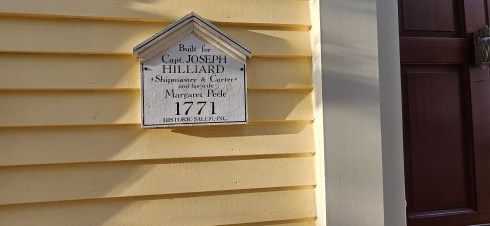
Does style follow politics? I’m just not certain: I think fashion might, but architecture? Most of the characteristic Federals for which Salem is famous were built at the beginning of the nineteenth century, not the tail end of the eighteenth. And if you widen your search for Revolutionary-era houses to all of downtown Salem, an architectural conservatism is immediately apparent: the first house below, on Turner Street, was built in 1771, but it’s similiar to the two yellow houses off the Common and Derby Street built ten and twenty years later. And before the Revolution, before the laying out of Chestnut Street in 1805 really, there is no housing segregation, so we are left with an interesting mix of architectural styles: so very evident along Essex and Derby Streets.

Building in 1779-1780: now that’s confidence. Elias Hasket and Derby began construction on Salem’s Maritime’s Hawkes House in the latter year, as their family had outgrown the Derby House next door.

I’m off to Scotland on Friday so no posts for a few weeks: “see” you after Thanksgiving! In the meantime, if you’re interested in Salem architecture, tickets for Historic Salem’s Christmas in Salem tour on December 2-3, featuring houses in the Salem Common neighborhood, are available here.


Salem’s Bêche-de-mer Boom

Back in Salem until I take off for Scotland at the end of next week. I’ve got lots of teaching, writing, and organizing to do, but I ignored all of my obligations last weekend and read a fascinating book about early American trade in the South Pacific: Nancy Shoemaker’s Pursuing Respect in the Cannibal Isles. I couldn’t put it down! It gave me all sorts of insights into a very particular and profitable trade dominated by Salem merchants and sea captains in the 1830s and 1840s: in bêchedemer or sea cucumbers, highly sought after in China for medicinal and culinary uses. Trepang (the primary eastern term) were and are sea cucumbers (often called sea slugs in the 19th century) which were processed in a special way, still in use today: boiled in sea water, placed in baskets and washed again, then dried in smokehouses. A Pacific example of the importance of dried seafood in world history, the bêche-de-mer trade was characterized by boom and bust phases over its long history due to overfishing in response to the sustained demand, but in the 1830s and 1840s Salem traders were very dominant. Shoemaker provides her readers with an appendix of Salem ships engaged in the trade, from ship Clay in 1827 to bark Dragon in 1857, with all sorts of familiar Salem names on board. William Driver, of Old Glory fame, then second mate on the Clay, claimed that he was the first “white man” (not westerner, or American, or Salemite) to execute the bêche-drying process sucessfully, thanks to the instruction of a band of pirates from Manilla. This trade has it all, believe me: daring captains working for equally-daring shipowners engaged in a risky trade that was potentially lucrative but also completely dependent on native “cooperation,” profit-seeking pirates and bureaucrats, a range of nineteenth-century ethnographic attitudes, tales of cannibalism and violence, big money.

Still very much in demand: bêche-de-mer at a Hong Kong market, photo by G. Clayden

My colleague Dane Morrison works in the field, and I can understand why he finds it so enticing: the stories and the sources are amazing, lending great narratives to important historical analyses of trade, imperialism, and cross-cultural influences and interaction. Using a micro-historical approach, Shoemaker explores American-Fijian encounters through the lives of three people: David Whippy, a Nantucket whaler who remained in Fiji and became an extremely important intermediary, Mary D. Wallis, the wife of Salem sea captain Bejamin Wallis who accompanied her husbanad to Fiji in the 1840s and later wrote about her experiences (as an anonymous “Lady”) there in Life in Feegee. Five Years Among the Cannibals (1851), and John B. Williams, son of a prominent Salem commercial family who tried to make his own fortune in the islands through a more bureaucratic route. So we have quite a Salem focus here: it’s another reminder that the historical Salem experience is played out in Salem and abroad. Williams in particular offers a very interesting perspective: born into money and raised on Chestnut Street (at #19) he was desperate to make his own fortune, beause “to go home poor its a curse in Salem.” These stories of Massachusetts men (and one woman) abroad illustrate how the entire bêche-de-mer trade was dependent on Fijian labor, coerced by native elites with whom the Salem traders negotiated and paid off. So many interesting anecdotes emerge from Shoemaker’s analysis of the exploitative yet intimate relationships tied to this trade: a powerful chieftain named Cokanauto whom Salem captain John Eagleston nicknamed Phillips after his employer Stephen C. Phillips back home (apparently it stuck), a young native woman named Phebe who became the servant (slave???) of Mrs. Wallis, a “Feegee dwarf, about four feet in height, —- said to have been a man of some distinction at home,” transported to Salem on the ship Eliza. (Shoemaker tells us that he made it back home). Captain Eagleston, who made four voyages to Fiji (on the Peru, Emerald, Mermaid, and Leonidas) from 1831-1841, called “his” bêche-de-mer operations “our little city.”

Cokanauto in Charles Wilkes’ United States Exploring Expedition (1845): 3:122.

The Zotoff (1922 lithograph) and  Emerald returning to Salem, (c. 1950 postcard issued by the Salem Chamber of Commerce).

Shoemaker’s focus is appropriately on Fiji, but it would be nice to explore the impact of this trade on Salem: the sources are numerous as many participants, Eagleston among them, memorialized their particpation in logs, journals, and reminiscences. I’m always looking for narratives to counter Salem’s storied post-1820 decline, as it seems to imply that merchants and seafarers just sat on their hands looking at empty wharves like Nathaniel Hawthorne. I’m not digging into the economics here, but Shoemaker does, and the fortunes that could be made from this trade were astounding! We can see the material legacy of the trade among the Oceanic collections at the Peabody Essex Museum here in Salem, as all of the bêche-le-mer traders were members of the East India Marine Society and thus brought stuff home, but I want to know more.

Bure Kalou (Spirit House), Fiji. Peabody Essex Museum. Gift of Joseph Winn Jr., 1835. 


Salem in the Press, 2023 Halloween Edition

Since I’ve been living outside of Salem for the past month, only coming in for classes and shooting right back to Maine on my (not-so) secret routes, I followed the press coverage on seasonal tourism a bit more closely than in years past. I set up a google alert and got notifications nearly every day. There are always a lot of what I would call obligatory articles about Salem at this time of year focusing on crowds and traffic but it struck me that in this particularly year the coverage was a bit more negative, though as you know, I’m not a Haunted Happenings fan, so I could have been reading what I wanted to read. I will be the first to admit extreme bias in this realm, but I tried to read every article which came my way several times, and there was definitely an underlying tension in several, between the “success” of Salem’s tourism and its costs, whether they were traffic, trash, or exorbitant short-term rentals. For me, the tone seemed to be set in late August, when the Salem Witch Museum was identified by as the #2 tourist trap in the entire world by USA Today: this generated more stories in the regional press, concluding with the recent “visit” of the Boston Globe to the “Museum.” This article is not especially probing in its exploration of either a for or against position on the attraction’s rating, and gives a rather blase tourist the last word: “you have to expect it to be a tourist trap. It’s Salem in October. Isn’t that kind of the whole point?” Indeed.  The Globe featured a stronger, more focused article in mid-October on the skyrocketing prices of Salem airbnbs, which was no surprise to anyone who lives in Salem. They’re everywhere, even though municipal regulations attempted to limit their number a few years back. The article quoted Mayor Dominick Pangallo as asserting that there are “250 t0 300 airbnbs” in Salem, while the rental website listed considerably more units in October.

Of course the victims of 1692 were NOT witches, but Airbnb puts a special focus on “haunted” or themed Salem rentals in October, like this one featuring a “100% that witch” bedroom./Airbnb

This year’s offering from the Washington Post is longer than the Globe pieces, but nevertheless manages to say very little. I don’t understand its title, “Salem bet big on spooky season. Now witch girlies are everywhere,” nor do I discern anything close to a theme or thesis. It’s all over the place with lots of quotes from locals, including my colleague, the president of our preservation organization, and several Salem shopkeepers. But none of the quotes seem to have much context, including one which made me see red after (apparently) confining twentieth-century Salem to the simplistic characterization of a “horrible factory town.” This is the tourist industry’s party line: witchcraft tourism saved Salem. After a summer of reading and writing about the past century for our book, I just can’t stand to hear it anymore–it erases the hopes, dreams, activities and achievements of generations. It’s a falsehood, but also a quote out of context according those who offered this characterization. So now I’m wondering what it, and the entire article, means. I can tell that my colleague is presenting an argument here—about the balance of history and entertainment, the need to discern the authentic from the fake, and tourism’s toll on Salem’s residents, but his quotes are so strung out that I couldn’t quite grasp it–and I know him! And then there are the captions, like the one for the photo below: “people dress up in Salem in late October.”  Wow, really? I have news for you, Washington Post, people dress up in Salem in late July.

Washington Post

The Wall Street Journal’s Salem story, “Living in the Middle of Halloween Central is Not Wicked Fun,” is much tighter and much better. And as you can tell from its title, more negative with its focus on the experience of residents. It’s far more historical in its analysis of how Salem evolved from shame to exploitation in its attitude to the trials, with one Salem tour guide furnishing a very interesting anecdote about Southern slaveholders taunting Salem abolitionists for “burning their grandmothers” and yet another referencing Joey Buttafuoco and Amy Fisher (the spectrum of Salem tour guides never ceases to amaze). And then there is the suggestion of a Florida (of course) tourist, who wants to see “a life-size wooden replica of the gallows where they hung the witches,” in order to “give a real sence of how intense it must have been.” A wary Salem social worker worries that “we’re commercializing a tragedy” and yes, her use of the word “we’re” is spot on: Salem’s exploitative and ever-encroaching tourism not only impacts but also reflects upon all of its residents. The WSJ article was my pick of the litter until a late-season entry appeared on my screen just two days ago: “Salem’s Unholy Bargain” by Lex Pryor, a writer for the sports and popular culture website The Ringer. A BRILLIANT writer: just read this one paragraph, and you’ll be hooked, like me:

It is awesome, financially beneficial, and out of control. In Salem, Halloween is a monthslong beast with an unquenchable appetite. It gobbles late-summer weekends and the first-of-winter snows. There are people who welcome it and people who flee it, but everyone feels it. And though by lineage this creation is at best rarely theirs, by geography and the inalterable stain of days gone by, they are full inheritors of its weight. Because of history—its burdens and allure—a community is held in a periodical and self-imposed state of bedlam. Look beyond the hoopla and you’ll see in Salem a storm, age-old as it is modern, that manages to unmask the knotty, innermost contents of the place and the folks who frequent it.

And one more: a brilliant quip involving bratwursts: the morbid nature of Salem’s appeal isn’t that uncommon among travel destinations. Millions visit the Colosseum every year. Same with Hiroshima and Nagasaki. I have never been to Auschwitz, but I am wholly certain that someone is selling something like bratwursts somewhere nearby. Salem is Salem because, unlike those sites, in Salem a plurality of people come for the bratwursts. They arrive in spite of the history, and they have no shame in this.

THEY COME FOR THE BRATWURSTS! And we can’t get away.

Well I could keep quoting this brilliant piece, but you can read it for yourself: you should read it for yourself if you’re interested in what Salem has become. I was going to conclude with the New York Times’ Salem article for this year but it is quite literally so small by comparison with Mr. Pryor’s piece in its focus on the plague of nip bottles on the streets of Salem that I think I’ll just leave you with the link.

NOVEMBER 1!!!


It Happened in Town House Square

I didn’t expect to be posting on Salem for a while as I’m on my way to Maine to escape the Halloween Hordes (haven’t quite broken away yet!) but I’m in the midst of writing the last chapter for Salem’s Centuries and I thought posting would help. It’s why I started this blog in the first place, so long ago, to indulge my curiosity about Salem’s lost history and free up my writing from its academic constraints! This last chapter is on the long history of Salem’s center, Town House Square, and I’m just kind of enraptured with everything that happened there, but also haven’t figured out the meaning of it all. I’m trying to use the chapter to summarize the book Salem’s Centuries and also Salem’s centuries by using the Square as kind of a “stage” (at least that’s the word I’m using now). So this will be kind of a sketchy post as it is a work in progress and I welcome all comments and corrections.

I’m happy with my opening paragraph:

A crowd filled Town House Square on a sunny day in June of 2005, cheering and jeering the unveiling of a bronze statue of the actress Elizabeth Montgomery in character as Samantha Stevens of the television series Bewitched. The rationale for the statue was the filming of a few episodes of the series in Salem in 1970, commencing a successful intensification of witchcraft-focused tourism in the view of those who cheered, while less-enthusiastic attendees noted the impropriety of installing a fictitious witch within view of the sites where the victims of 1692 were accused and tried. The Reverend Jeffrey Barz-Snell, 31st pastor of the First Church of Salem, which stood across the street for centuries, was among those who had urged the Salem Redevelopment Authority to reject the statue weeks before“in due deference to our history”and its location: “we must object to this statue being sponsored by the city of Salem, less than twenty yards away from site where we committed, arguably, one of the worst…..crimes in the history of this city.” This argument was countered by the majority opinion, expressed succinctly by Salem City Councilor Thomas Furey: “Salem is the Witch City. I think we all need to lighten up, take a breath, and let Salem have fun.” This moment in time and place is representative of the continuous significance of a small parcel of land, more of an intersection than a square, over Salem’s centuries. The crowd, the expression of civic identity, representations of church, state and commerce: all have had their role to play in Town House Square.

Then I go back to the seventeenth century and start with the English settlement of Salem from 1626, including a brief discussion of how the topography shaped the town and its center at the intersections of its two main thoroughfares, later called Essex and Washington Streets. This became known as Town House Square in the 18th century, and that’s still its place-name, although I wonder how many Salem residents (much less tourists) know it as such today. Then it’s all about meeting houses—-four on the same site: it really took a lot of time to figure out all that building history. First there was a small meeting house built in 1634 which was long thought to be the small building you can see in the rear of Plummer Hall on the Peabody Essex Museum’s campus, a larger though still quite simple structure built around 1670, the first “churchly” meeting house with a belfry, built in 1718, and finally the present building (1826) which long served as the Daniel Low & Co. store after the First Church departed to its present building further along Essex Street. Salem’s meeting houses are confusing, both before and after the First Church splits up into successor congregations: East, North, South and Tabernacle. Thank goodness I don’t have to go into the theological and factional disputes: I’m sticking to Town House Square.

So, once I set the stage, action will begin: here’s what happened in Town House Square, with an emphasis on the public. Obviously lots of other things happened in this vicinity over 400 years but why do some leave a mark or record and others not? And do the happenings in the Square reveal its public nature and role? Just questions I’m asking myself as I am writing.

  1. Lots of Quaker resistance: holding their own meetings right next to the First Church/Meeting House, wearing their hats into the latter, and then in 1662, Quaker Deborah Buffum Wilson, accompanied by her mother and half-sister, walked “naked for a sign” down Washington Street in imitation of an Old Testament episode (Isaiah 20.2-3) and in denunciation of the spiritual “nudity” of those who condemned them. Yes, a NAKED QUAKER walked down Washington Street. This resistance was met with an equal (or larger) measure of persecution, especially by the William Hathorne, who lived right on the Square.
  2. Anti-Royalist protests: by the same William Hathorne, who as Major of the Salem Militia, assembled his armed soldiers in Town House Square for his impassioned speech against the Royal Commissioners present in Massachusetts in 1664, after which he himself was summoned to England on the charge of refusing to submit to royal authority.
  3. The Salem Witch Trials: also happened in Town House Square once the judicial proceedings moved from Salem Village to Salem Town. Close quarters! Judge John Hathorne, son of William, lived right there, as did the Reverend Nicholas Noyes, and victim Bridget Bishop. The combined courthouse/schoolhouse at the northern end of the Square, made of the framing of the 1634 meeting house, separated the properties of Noyes and Bishop, and High Sheriff George Corwin resided at the southern end of the Square.
  4. Salem’s first July 4th: came before the Revolution! There was a huge party at the Town House (sometimes called the provincial Court House, sometimes even the State House—think of the old State House in Boston) to celebrate Sir William Pepperrell, the hero of the Siege of Louisbourg, in 1746. The cannons surounding the Town House were fired after every toast, and there were many.
  5. Big Town Meeting Protests: against British taxation, commencing with the Stamp Act (1765), at the Town House. (But less than 20 years earlier they were celebrating the hero of a war they were not willing to pay for–just a British historian’s perspective.)
  6. Salem’s “Tea Party”: a crate of tea from Boston is seized and burned in Town House Square on October 4, 1774, “in the presence of several hundred spectators.”
  7. Last meeting of the Massachusetts Provincial Assembly: against the orders of Governor Thomas Gage, electing delegates to the new Provincial Congress which met in Concord on October 7, 1774.
  8. Colonel Alexander Leslie and his regiment passed through Town House Square on their way to the North River to recover rumored cannon, and back again on their retreat, February 1775.
  9. Presidential Parades: George Washinton in 1789, and Theodore Roosevelt in 1912.
  10. Salem’s “big digs”: the first railroad tunnel built in 1839, and rebuilt in the later 1950s.
  11. Nathaniel Hawthorne’s romanticized view of colonial history set against Town House Square in two stories: A Rill from the Town Pump and Endicott and the Red Cross.
  12. Town House Square Transportation Hub: trains, trolleys, and later, buses.
  13. Daniel Low & Co. established in the former fourth meeting house of the First Church, 1867. A mail order innovator, the store also issued a catalog which projected both Salem and Town House Square to the entire country.
  14. War Bond Rallies: the Square was the center of  “community chest” and war bond events during both World War I and World War II, including one which featured  fake Germans attacking during the former!
  15. Restaurant action: I think this can take me from the second half of the twentieth century into the twenty-first, from the long-running Gerber’s “Little Town Hall” restaurant through various fast-food experiments to today.
  16. And then came Samantha……back where I started. I don’t really believe in historical objectivity, but I know that I can’t even try to write about that awful statue in a balanced way, so I better close with a reprise of Reverend Barz-Snell’s and Councillor Furey’s statements.

John Smibert’s portrait of Sir William Pepperrell, Peabody Essex Museum; the “Salem Tea Party” of October 4, 1774; there are great historic placques in Town House Square but I don’t think the tourists are really interested. Where can I Get a Car?, 1894; The Story of a Store, 1926. Boy, what a devolution of opponents: from King George to Burger King. Town House Square today, or yesterday: it’s Samantha’s neighborhood.


Bewitched, Bothered and Bewildered

Love that song, although I never realized its lyrics were so risque (“horizontally speaking”)! The title is how I feel living in Salem most of the time now, especially bewildered. I don’t understand why our local government is trying to impose out-of-scale and ugly buildings on this beautiful city, relentlessly. I don’t understand why the city’s roads and sidewalks are maintained so poorly. I don’t understand anything about our tourism industry: its management, messaging and particularly the economic impact it has on our city, which seems shrouded in mystery. I don’t understand why everything in this city is named “witch” when the victims of 1692 were not witches. I don’t understand why two tattoo shops are located right next to each other on Essex Street and two pirate “museums” are located right across from each other on Derby Street. I could go on and on and on. I came here for the architecture decades ago, and I’m really out of it when it comes to all the rest: the bones, the black, the business of selling all things spooky. I’m so alienated that I have become increasingly detached from Salem, to the extent that my husband and I and the cats are moving up to Maine for the month of October. I’m not going for good, however (at least not yet) and I also have an academic-esque interest in figuring out what’s going on: unlike me, it’s clear that many, many people love to come to Salem in the fall and increasingly throughout the year. What are they looking for? Last week was interesting because I took a deep dive into social media to answer that question, intentionally and non-intentionally! The non-intentional dive when I posted a picture of the back of my house on a really nice facebook group called Our Old House. It was a beautful day, and we painted the back of the house this summer so it was looking good! I’ve been following this group for a while because the people on it are so appreciative and lovely: everyone loves their own old house and everyone else’s old houses! No facebook rudeness at all. You can learn a lot too: people share their restoration experiences and knowledge. Our house is such a mish-mash in back that I thought everyone would enjoy seeing the different additions: and they certainly did! Nearly 7000 likes and comments, with a serious thread of people expressing their praise of both my house and Salem: I love Salem, You’re so lucky to live in Salem, We go to Salem every Halloween, I really want to go to Salem (it was funny to read these comments as I was literally packing my bags for our departure next week).

How and when my Salem house was built.

So that was interesting, and even more informative was my dive into one of the many Salem tourist groups on facebook: I picked Things to do in Salem, but there are many others. A couple of weeks ago, USA Today named the Salem Witch Museum the second biggest tourist trap in the world, and I was interested in reading some reactions to that. I found a solid defense of this attraction, based mostly on nostalgia: apparently its interpretation and presentation is so dated that it has become “historical” itself. There’s this relatively new defense of Salem attractions, that they are not and should not be Disney-esque, which is offered up with complete unawareness that it was the Salem Witch Museum that started us down that path. Most people also seemed to believe that the Salem Witch “Museum” presented a straightforward and accurate account of the Trials in a historical and global context and did not want to hear otherwise. I disagree, but this was no place to have a discussion: there is no place in Salem to have such a discussion. The type of information that people are seeking in these groups is perhaps 90% non-historical: how to get to Salem, how long to stay here, where to park, where to eat, the best attractions for kids, all about Hocus Pocus, and whether or not certain attractions are “worth it”? When “history” is referenced, I’m not sure what the meaning is, actually—just a kind of general historical environment or atmosphere? Other forums may yield different results, but I don’t discern a great deal of historical curiosity, and even less interest in architecture (though just like my fellow old house owners, everyone is very excited and enthusiastic). So it seems like the biggest thing I don’t get about Salem is the attraction! Ah well, to each his own, best to retreat to Maine and my academic pursuits. I did take a nice long walk around Salem last weekend so I’ll leave you with some pictures (and annotations) of not-quite calm before the storm. There’s quite a bit of ironwork below as that was my orginal pursuit, but it kind of got crowded out.

First up in my neighborhood, I wanted to showcase these two houses whose owners have invested in a lot of work! Kudos to them! Both are on Chestnut. As you can see, the first house has a way to go, but its very impressive entrance was just re-attached. It’s such a great house, with an amazing garden. Nathaniel Hawthorne lived briefly in the blue house. A rare Salem front garden on Essex—and this house has been thoroughly renovated as well. Besides the Witch House and the House of the Seven Gables, the only historic house that Salem tourists seem interested in these days is the Ropes House, because it was featured in Hocus Pocus of course. The Ropes Garden is consequently very crowded in the fall, but I caught it during a relatively calm time: more ropes in the Ropes Garden than ever before. This gate on Federal Court started off my iron hunt–I’m obsessed with it.


Downtown is quite a vibrant shopping scene with more than occasional bones and bats, and porta-potties, of course. There are some very well curated shops amidst the general kitsch, particularly Diehl Marcus & Co. (great ironwork and a Bulfinch building to boot) and Emporium 32 (in the old Custom House) on Central Street, and I’m so impressed that the owner of the new Silly Bunny and enduring Wicked Good Books (on different blocks of Essex Street) has declined to carry Bill O’ Reilly’s Killing Witches that I’m going to go in and buy a big bundle of books before I leave for Maine. The Peabody Essex Museum has opened a pop-up shop called the Bat Box to highlight its current bats exhibition: it’s a cute shop featuring the works of some local makers, but (once again) I don’t understand the attraction of coasters featuring a famous murder any more than I do witch souvenirs in the location of a series of famous judicial murders of accused witches.


Ghosts might trump witches this year eveywhere but Salem, of course. The ironwork at the Peabody Essex’s Gardner-Pingree House (which is never open) is simply astounding! A very busy Common, as the annual Food Truck Festival was underway, but once you get into the realm of Salem Maritime along Derby Street, not so busy. I still haven’t been in the Derby House even though it has been open this summer. The last photo just above is to remind me that I want to plant that particular variety of clematis next year!


I finished up my walk on Charter Street, where the Witch Trial Memorial and Burying Ground is located. As soon as I entered the latter, I was confronted by these strange mannequins, propped up right against the Cemetery’s gate and stones! So Salem: the juxtaposition of the sacred and the tacky, remembrance and exploitation, enduring and ephemeral.


The Summer of Old Photographs

I worked all summer long on my chapters for Salem’s Centuries and a few other projects, researching and writing, researching and writing, researching and writing. Once I’m on the trail, I’m a pretty steady worker, but I do take breaks: I’ve learned from other writing projects that you have to pause to let your mind absorb and process information. Sometimes the break might be at night when you’re asleep—I got into the habit of leaving a notebook by my bedside when I was writing my dissertation and when I woke up in the morning sometimes I would see notations inside that I didn’t even remember writing! That must have been one of the benefits of a younger mind because it didn’t happen this summer, when all my breaks were conscious. Every time I went up to the Phillips Library in Rowley, I would dutifully call up boring municipal records but also collections which contained old photographs of Salem. I’d pore over them a bit and photograph them for later perusal, and by the end of the summer I had quite a collection. The Phillips has digitized two of its largest collections of Salem photographs: the Frank Cousins and Samuel Chamberlain collections, but there remain many seldom-seen images within collections. Fortunately there are great finding aids to locate such images, but also some very miscellaneous collections which yielded surprises, at least for me! I loved schoolteacher Grace Hood’s shots of the Salem and Massachusetts celebrations in 1926-1930 (PHA 67; including some completely new-to-me views of the opening day of Pioneer Village in 1930) and an unknown photographer’s depictions of a very gritty Salem encased in a large composite collection entitled Photographs of interiors and exteriors of Salem, Mass., circa 1890-1950 (PHA 151). And there’s much more.

Phillips Library PHA 67 & 151.

My favorite collection was the first one I accessed, back in May: a treasure trove of images contained in the scrapbooks of Francis Henry Lee of 14 Chestnut Street, mostly from the 1880s (Phillips Library MSS 128). Lee was the son-in-law of the woman who lived in my house, and a committed architectural antiquarian focused on documenting the history of every house on Chestnut and adjoining streets. He did not rely on hearsay, but sent queries to anyone who ever lived in the neighborhood, and his scrapbooks are filled with detailed responses, some written on black-trimmed stationery indicating that their authors were in mourning. I was familiar with his articles in the Historical Collections of the Essex Institute, but surprised to find his research materials accompanied by so many wonderful photographs.

Some of my favorites: (I filtered those that were really hazy or damaged).

Chestnut, Summer & Norman Streets from two perspectives. I’ll never get over how wonderful Norman Street was!

Riding and looking north on Summer Street, and then south (Samuel McIntire’s house is on the extreme left of the last photograph).

Broad Street, looking west.

Cambridge Street, looking north and south.

Work on Bott’s Court.

Hamilton Street, looking north.

Chestnut Street Houses—what’s going on with that figure at the third-floor level of the third photo above, which I think is #26?

Warren Street, looking towards the “Turnpike” (Highland Avenue).
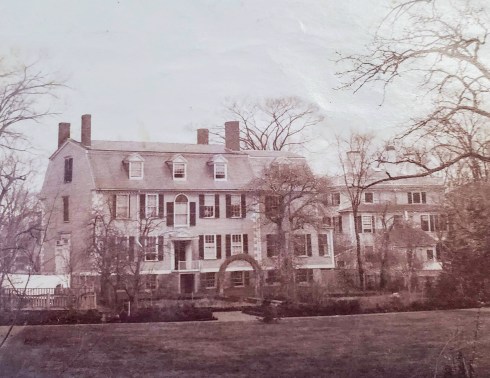
There were several photographs which were especially exciting to see among the Lee papers, including those which show the magnificent formal garden in the rear of the Cabot-Endicott-Low House on Essex Street, which extended to Chestnut before no. 30 Chestnut was built in 1896. This garden was quite famous: it was prominently featured in many horticultural publications and was by all accounts quite the tourist attraction, especially in the spring. A 1904 Boston Globe article on “Beautiful Old Gardens of Salem” reports that for many years the tulip bed was the greatest feature of this garden, and each spring, when these flowers were in perfection, and upper portion of the high fence on Chestnut was removed to enable the public to view the exhibit.

Even more exciting than this lost garden were two photographs of my own house that I had never seen before, including one sans the apartment that was added on in phases between 1890-1910. Our house is the right side of a double house built in 1827: both sides were identifical until the 1850s, when one of our owners expanded the house considerably in back and altered the interior to look more fashionable at the time—round mouldings rather than square ones! The big entrance alteration reflects the changes inside, but I did not know that this guy also put new mouldings over the windows, and disdained shutters as too colonial, I guess. Several owners later, there was a sequential addition on the side of the house: first as an office for a very well-know opthamologist who lived here, and then bedrooms were built above: this is our present-day 7 1/2, a really cute apartment with the best views of Chestnut Street. I assumed that it covered up windows which were on the side of our house, but it looks like there were none. As you can see from all of the other photos of the street, Chestnut was driveway-less in the nineteenth-century: the larger houses had carriage access on Warren or Essex: the property of our house actually wrapped around Hamilton Hall next door and so our carriage house—long- demolished—accessed Cambridge Street.