Category Archives: Salem

Salem Film Fest 2016

CATS, architecture, the Renaissance (or pseudo-Renaissance)…all my favorite topics are featured in documentary films screening at this year’s Salem Film Fest, which opened last night with Curious Worlds: the Art & Imagination of [miniaturist] David Beck. The festival is now a Salem tradition, in its ninth year, and of course a welcome addition to the non-witchy/kitschy calendar. I usually go to one or two films, and regret not seeing more. Even though the slogan of the festival is Come to Salem, See the World, its organizers always include some local productions, so the entire experience has a “glocal” feel to it, which seems appropriate for our city, our time, and this particular medium. This evening we will see Concrete Lovethe Böhm Family, which purportedly “paints an intimate and pointed portrait of the complexity and inseparability of life, love, faith and architecture” through its examination of the life and work of German architect Gottfried Böhm, the patriarch of an architectural dynasty which includes his three sons. This weekend, I’ve got my eye on Projections of America, featuring 26 short propaganda films about America: the people produced for European audiences following the liberation of France in 1944, Kedi, all about the hundreds of thousands of cats that roam the streets of Istanbul, American Renaissance, a short on Renaissance-faire culture (I can’t miss this, as hopefully it will give me all sorts of insights into my students), and The Million Dollar Duck, (not to be confused with the 1971 Disney film of the same name) about the fierce competition among six artists to win the Federal Duck Stamp Contest, the only juried art competition sponsored by the U.S. government. I feel honor-bound to see this last movie, as one of Salem’s most illustrious artists, Frank Benson, was actually one of the competition’s first victors!

Salem Film Fest Concrete Love Poster

Salem Film Fest Poster_Projections_of_America

Salem Film Fest Kedi Still

Salem Film Fest Kedi Cat

Salem Film Fest AMERICANRENAISSANCE_web_1

Salem Film Fest Million Dollar Duck

Duck Stamp

German poster for Concrete Love: the Böhm Family; Projections of America poster;  character cats in Kedi; a “Renaissance” plague doctor in American Renaissance, poster for The Million Dollar Duck, and Frank Benson’s winning design from 1935.


High Street

Generally the “High Street” of a city or town is a main street but this is not the case with Salem’s High Street which was named, I think, because it was literally a relatively high street which looked down towards Salem Harbor. It’s a short cut-through street today, and offers an instructive perspective on Salem’s architectural developments as seventeenth, eighteenth, nineteenth and twentieth-century structures line its sidewalks. There are several really nice Georgian houses, a few Federal houses, and the first-period Gedney House, which is maintained by Historic New England as a study house. High Street was spared the obliteration by development of its neighboring street to the north, Gedney, and the obliteration by fire of its parallel street to the south, Endicott, though you can definitely see that the Great Salem Fire of 1914 cut a swath through its eastern end. Most of the street is remarkably preserved, even though in some cases it is through the fortification of asbestos siding. Unfortunately I only have a shallow understanding of the social history of High Street, but enough to know that it was the center of Salem’s African-American community in the earlier part of the nineteenth century and part of its Italian-American neighborhood a century later. That chatty diarist of the earlier era, the Reverend William Bentley, recalled an 1816 visit to “the square laying between Mill Street, High St., the Pickering Hill burying ground & the Mill Pond vulg[arly] called Roast Meat Hill. It was a mere pasture when I came to Salem. There is now a Twine factory & about 100 huts and houses for Blacks from the most decent to the most humble appearance.” (Bentley, vol 4, pp. 382-383). Less than a century later Salem’s Italian-American community built their own Catholic Church at the foot of High Street, St. Mary’s, which was closed by the Archdiocese of Boston in 2003 (you can see some of its beautiful interior here).

High Street looking up

High Street 1874 Atlas

High Street 10

Looking “up” High Street, the neighborhood in the 1874 Salem Atlas, #10, one of three Georgian Colonial houses on the street.

There are several interesting houses on High Street but I suppose the most “notable” are the aforementioned Gedney House (1665), the neighboring Benjamin Cox House (1775), and the William Fabens House (1804). If you check out the Gedney materials at the Historic New England website (which includes the 1912 photograph of the house below) you can see a gallery of wallpaper samples taken from the house, including a fragment of my favorite “tumbling blocks”. The Cox House was acquired at the same time (1967) as the Gedney by Historic New England (then SPNEA) for use as an overseer’s house and extended to the rear for that purpose. The Fabens house is one of the most unusual in Salem: it has brick sides, each with its own entrance, and a stuccoed front facade—I’m assuming the latter is a legacy of the Great Salem Fire, which passed so close to the street.Not so renown, but impressive nonetheless, is the circa 1820 house at #16, which has been stripped of its Victorian embellishments to reveal a more streamlined Federal facade.

High Street Gedney Facade

High Street Pan

Gedney House 1912 Historic New England

High Street Cox House

High Street Cox House Side View

High Street Fabens

High Street plaque

High Street no 16 collage

Historic New England’s Gedney and Cox Houses; one of the side entrances of the William Fabens House; No. 16 High Street in the 1970s and today.


Colonial and Colonial Revival

Over the years I have encountered people who were opposed to historic districts for a variety of reasons, prominently property rights and the sense that such building restrictions created homogeneous “museum neighborhoods”. I appreciate both arguments: I’m a bit of a libertarian myself and I have lived in historic districts since my 20s primarily because I like to look out the window when I get up every morning and look at historic buildings. But when I walk around Salem’s historic districts, I don’t see homogeneity, I see diversity: of building materials, of size, and even of style. Though Salem is renowned for its Federal architecture, there are many buildings in the downtown historic districts that pre-date and post-date this era, and I am always struck by how many houses were built in the later nineteenth century in styles that are far from “Victorian”: these are Colonial Revival structures melding into the streetscape, for the most part. You definitely notice the differences when you view “Colonial” and “Colonial Revival” side by side–and there are many opportunities to do this in Salem. Everything is a little bigger and bolder in the later houses: windows, window panes, dormers, especially entrances. Of course, the Colonial Revival era is long (most authorities seem to date if from 1880 to 1955) and encompasses several sub-styles (Classical Revival, Georgian Revival, Dutch Colonial), but one particular feature I notice in several of Salem’s more prominent houses built in the last decade of the nineteenth century are semi-circular projecting bays on the front facade–these houses are literally bursting out of line–but still complementary to the older structures surrounding them.

Colonial and Colonial Revival 014

Colonial and Colonial Revival 016

Colonial and Colonial Revival 029

Colonial and Colonial Revival 017

ABOVE: On upper Essex Street in Salem, the Clarence Clark House (built 1894) stands side by side the Captain Nehemiah Buffington House (built 1785) and across the street, the David P. Ives House features a very detailed Colonial Revival facade adhered to a much older (c. 1764) building.

BELOW: just a little further down (or up) Essex Street, I think the Emery P. Johnson house was the inspiration for all these bow fronts! It was built slightly earlier (1853) and thus is more Italianate than Colonial Revival, and was raised up on its mound in the early 20th century. It contrasts quite a bit with its colonial neighbors, but in a good way, I think.

Colonial and Colonial Revival 028

Colonial and Colonial Revival 026

Beckford Street below: the section of Beckford Street between Federal and Essex is a real mash-up of Colonial and Colonial Revival! I love the juxtaposition of the very old and charming Joseph Cook House (c. 1700-1733) with the very high-style Georgian Revival William Jelly House (c. 1905) right behind it–and then the George Beckford House (c. 1764) next to the Jelly House. And there was a cat in a window, too.

Colonial and Colonial Revival 031

Colonial and Colonial Revival 035

Colonial and Colonial Revival 040

And at the end of Chestnut Street, my favorite contrast of Colonial and Colonial Revival:  William Rantoul’s Colonial Revival adaptation of the Georgian Richard Derby House on Derby Street and the Kimball-Fogg House on Flint.

Colonial and Colonial Revival 047

What I difference a year makes! It was a warm day yesterday, nearly 60 degrees when I was taking these pictures. By sharp contrast, this is the same Chestnut-Flint Street corner a year ago:

frozen-february-014


Miss Brooks Embellishes

I am featuring yet another new-to-me Salem artist today, Mary Mason Brooks (1860-1915), who worked primarily in watercolors over her career. Mary’s biography is spare: the obituary in the 1915 American Art Directory consists of only two brief lines: a painter in water colors, died September 20, 1915. She was born in Salem, Mass, studied in Rome and Paris; exhibited in New York and Boston, her home being in the latter city. I can fill in these lines a bit: she was born into an old and well-connected Salem family, grew up on Lafayette Street, and her father was the long-time Secretary of the Essex Institute who also published quite a few antiquarian pieces over his long career. After her training in Europe, Mary returned to Salem briefly and maintained a studio and school in the famous “Studio” at #2 Chestnut Street among her fellow Salem artists, but she was off to Boston and Jamestown, Rhode Island by her early 30s. She had both family and friends in Jamestown, located right over the bridge (then ferry!) from Newport, where an artists’ colony was emerging and where she eventually died, “suddenly”, at age 55. That’s about it for the written record on Mary Mason Brooks: her works are going to have to embellish her character for us. And there are many: it is apparent that Miss Brooks was no dilettante, but rather a professional, working artist. Most are watercolors: some European scenes, lots of flowers and trees, several structures, the occasional (appropriate for a Salem girl) ship. But the most charming–and in many ways most revealing–work of Miss Brooks that I could find is a book illustrated by her after its publication: a one-off edition of Eleanor Putnam’s Old Salem (1886 & 1899). This charming little book is a collection of previous-published Atlantic Monthly articles written by Harriet Leonora Vose Bates, who preferred to use the pseudonym of her ancestor Eleanor Putnam, published posthumously in two editions. It is basically a series of reminiscences about the stuff of old Salem—shops, schools, homes and things–which Miss Brooks illustrates in her special edition.

Miss Brooks Embellishes Old Salem

Miss Brooks Embellishes Old Salem Collage2

Miss Brooks Embellishes Old Salem Collage

I think it’s pretty gutsy to illustrate a book after its publication, and after its author’s death! And to sign your name right there on the title page! Miss Brooks probably thought her special edition would never see the light of day, but it made its way on to ebay, of all places, a century after her own death. I like the marginalia, which transforms a charming but mere book into something else entirely, but I also feel that I should present some of the artist’s more formal works which were represent her public oeuvre. They testify to a life well-lived, if short, in some beautiful places.

Mary Mason Brooks Salem Schooner

Brooks Garden Poppies

Brooks 3 Viewsp

Mary Mason Brooks watercolor Weston Historical Society

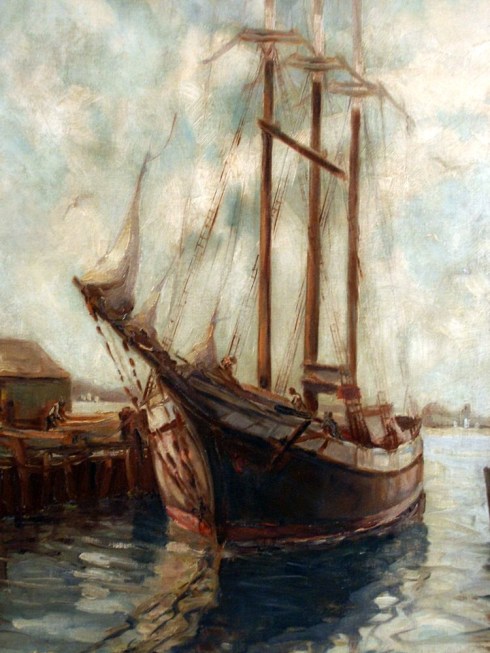
Watercolors by Mary Mason Brooks: Lumber Schooner; Garden of Poppies, Isles of Shoals; Three European Views, Skinner Auctions; and my favorite, a watercolor of the pool at Haleiwa, the Horace Sears Estate in Weston, Massachusetts, Weston Historical Society.


Ever in Transition

The tensions between public and private interests, commercial and residential concerns, and historic preservation and economic growth are nothing new to Salem, which has always been a dynamic city proud of its past and poised for the future. Some eras are more dynamic than others, however, and I think we’re in a particularly dynamic period now, but any city or town or settlement is always in transition, of course. When I hunt for historic photographs I’m always on the lookout for the mix of “ancient” and “modern”, residential and industrial, small-scale and larger, dirt roads and railroad tracks. My very favorite visual chronicler of Salem, Frank Cousins, who was himself living through a very dynamic age, was clearly attracted to that mix as well, as one of the photographs that he submitted as part of Salem’s exhibition at the 1893 Columbian Exposition was that of a divided Derby Street doorway labelled “modern” and “colonial” (A subtle distinction for our modern eyes).

In Transition Cousins 1892 Columbian Exposition

Frank Cousins photograph of a Derby Street doorway, c. 1892, courtesy of Duke University’s digital Urban Landscape collection.

More illustrative of the city in transition, as opposed to a co-joined household, are the many pictures of Town House Square that date from the 1880s to about 1910. There you see predominantly brick multi-story commercial buildings, but if you look closer, there are still some surviving wooden residential structures (although they are probably serving a multitude of uses). For several years, I have had in my possession a stereoview of a building labeled “Ward-Goldthwaite & Co. Salem” which I thought might be one of these structures, only to realize that I had made a rookie historian’s mistake (not questioning a label): the Ward-Goldthwaite Company was located in Chicago, not Salem (even though it was published by the Moulton firm of Salem). Nevertheless, it’s a great image of a city in transition: you know that house isn’t going to last long.

In Transition Cousins Town House Square 1892 LOC

In Transition 1906 LOC

Stereoview Ward Golthwaite Co Salem

Town House Square at the intersection of Essex and Washington Streets, Salem, (Library of Congress) and a stereoview of the Ward Goldthwaite & Company in Chicago published by J.W. and J.S. Moulton of Salem as part of their “American Views” series.

The idea of zoning starts to catch on in Salem after 1900, and it was definitely accelerated by the Great Salem Fire of 1914. But before this momentous event, factories and residences co-existed in close proximity in the Point, Blubber Hollow and even the more residential North Salem, where the large Locke Regulator Company bordered the North River and a line of colonial houses on North Street. Some of the houses are still there, serving mixed uses as they did a century ago, while the Locke factory has been replaced by a junkyard and a car wash. The streets along Salem Harbor have always been among the most densely settled in Salem, but the 1903 photograph seems to show structures which are primarily residential–I’m not sure of the precise vantage point, but I’m assuming these buildings were all swept away by the Fire. The last photograph, from the PEM’s Phillips Library, shows fire bystanders watching the conflagration on Lafayette Street from the roof of a building on Highland Avenue: a view of mixed-used zoning with the new High School, the factory, and residences all in close proximity to one another. Highland Avenue became a preferred location for commercial development over the twentieth century, but as this photograph indicates, residences were built along it as well–and a few older structures, drastically transformed–still stand among the big box stores.

In Transition North Bridge 1890s

Salem 1903 Locomotive's Journal

phillipslibrarycollections.pem.org

Looking north along North Street from the old bridge, 1890s, Boston Public Library; A Perspective on Salem Harbor, 1903, Brotherhood of Locomotive Engineers Monthly Journal, September 1903; Watching the Great Salem Fire from Highland Avenue, 1914, Phillips Library, Peabody Essex Museum


A Bigger Picture for Bridge Street

I have been watching and listening to the public hearings over the proposed redevelopment of the former Universal Steel and Trading Corporation site on Bridge Street with great interest and concern. The site is located adjacent to a distinctive late nineteenth-century factory building owned by the F.W. Webb Company, a large distributor of plumbing supplies, which seeks to abandon this same building and build a new (far less distinctive) showroom and sales facility next door. Objections to the proposed building could be based on its rendering alone–it’s the typical glass and faux-brick generic building that we’re seeing everywhere and anywhere–but there are several other key factors which make this project troubling and controversial. The site is also located adjacent to the northern boundaries of the McIntire Historic District, in close proximity to the well-preserved colonial and Federal houses of Federal and River Streets. The owners of these houses do not want a large commercial building (the actual elevation of the proposed structure is a matter of debate) casting a shadow over their streets, and the intensity of their opposition has been fueled by the fact that they believed that the long planning process resulting in the creation of the “North River Canal Corridor” a decade ago ensured that more creative uses for this area would be pursued. The second factor is the contamination of the site and the costs and consequences of cleaning it up. The property was transferred to the city of Salem after Universal Steel ceased operations, and the city requested aid from both the EPA and the Massachusetts DEP to conduct a partial clean-up, which involved the removal of over 4,000 tons of contaminated soil. After this process, the city paved over the site to create a temporary parking lot while the new MBTA garage was being built. Once that project was completed the city sought a more profitable use for this parcel–and F.W. Webb put forward the only proposal. The new construction will require a more comprehensive clean-up, and the costs and potential health threats of such an invasive process are a matter of concern to everybody, but especially those in the adjacent neighborhood. A third major factor is the transfer of an “ancient way” from public ownership and use to Webb: Beckford Way, in existence from the seventeenth century, which will be transformed from public pedestrian path to private truck access and loading dock. Opponents of the Webb proposal ask (quite logically I think): if the Company is going to abandon its present building altogether, why doesn’t it relocate to a section of Salem that is dedicated exclusively to commercial uses and leave our neighborhood–and our way–intact?

Big Picture Bridge Street

UniversalSteelTradingCorpSite EPA

Bridge Street Salem January

Beckford Way

Aerial view of the site of the proposed new F.W. Webb building, marked by the X; the initial clean-up in 2012, with River Street houses in the background, EPA; these same houses last month (before our recent snow) looking over the temporary parking lot and reflected in the North River; Beckford Way.

You can read a more detailed summary of the project here, and also peruse project documents. The narrative presents a decidedly pro perspective, but you can easily discern the debate in the FAQ section. We’re in the midst of the process: already the City Council has held two public hearings on the project and there are more to come. As I intimated above, I’m very sympathetic to the concerns of my McIntire District neighbors (and believe the present Webb building would make fabulous housing given its proximity to the train station) but am also striving to widen–or elevate–my perspective, inspired by both a phrase I heard repeatedly at the first public meeting—“spot zoning”—as well as one of the more thoughtful observations of the night, expressed by an earnest River Street resident: Salem’s fabulous history and outstanding architecture is constantly at risk from unsound planning. These words resonated with me immediately as I feel that way all the time: our city’s piecemeal planning has led to undistinguished architecture, unlimited accommodations, and unceasing divisiveness, and it will continue to do so until we can all look at a bigger picture. Salem is hardly the only historic city facing myriad redevelopment challenges and opportunities at the moment: why can’t have a more comprehensive and proactive plan rather just reacting, reacting, reacting? Look at the example of our neighboring seaport to the north, Portsmouth, NH, which is pursuing “character-based zoning” (which must surely be the antithesis of “spot zoning”) by plotting out its development goals and proposals in “textured” 3D models that are available to the public on a web portal, so that everyone can see what proposed buildings will look like, in context and as part of a whole. We don’t even seem to know the actual height of the proposed Webb building on Bridge Street, much less how it will look in relation to its neighboring buildings (but I’m thinking, not good).

3DPortsmouthLead_920_557

3DPortsmouth1

Webb building

Plan Portsmouth 3D Model/Developed by Tangram 3DS;  our only view of the proposed Webb building.

Ice Sculptures 2016

This weekend is the annual Salem’s So Sweet Chocolate and Ice Sculpture Festival, sponsored by Salem Main Streets, The Salem Chamber of Commerce, and Destination Salem, as well as all of the downtown businesses which underwrote the installation of ice sculptures on the sidewalks of Salem. It’s such a lovely idea, especially for a city that (in my opinion) has put too many eggs in the one basket of witchcraft tourism. As I walked by kitschy witchy businesses displaying signs on their front doors indicating that they were “closed for the season” (of course they meant the off-season, which is most of the year), it was a pleasure to see enthusiastic picture-takers clustered around ice sculptures of Gustave Klimt’s The Kiss, various sea creatures, and the Mad Hatter, and even imbibing in Rockefella’s amazing ice bar, which must take the prize this year. It was a beautiful day–not too cold–and sunny, so lots of people were out and about and the restaurants looked busy. Last year’s snowmaggedon must have chilled this event a bit (though it was still definitely on) but this year’s weather was perfect–and several of the statues were illuminated at night for the first time.

ice sculptures 009p

ice sculptures 020

ice sculptures 033

ice sculptures 036

ice sculptures 038

ice sculptures 042

ice sculptures 049

ice sculptures 055

ice sculptures 068

ice sculptures 071

ice sculptures 073

Just a few of the ice sculptures downtown this weekend: you can download the map of the rest here.


White on White

We had our first major snowstorm of 2016 yesterday, which paled in comparison with those of last year. I mocked those decision-makers who declared snow emergencies and canceled classes yesterday morning when the streets were merely wet, but by mid-afternoon I had to admit that they were correct: a wet, heavy, continuous snow had developed that would have caused numerous problems if everyone was on the road. Later in the afternoon I heard a sharp crack, and one of the the heavy, long branches of a tree across the street fell into my neighbors’ driveway. There was a strange white sky all afternoon which you will see in the pictures below (some of which I doctored just a bit), so contrast was rather elusive, but our bright yellow house was a perfect background for the broken branch. At the end of the day the white sky turned a beautiful pink, a moment which I completely failed to catch but fortunately my neighbor Bill did–and it looks like blue is back this morning.

White 016

White 018

White 019

White 033

White 035

White 044White 052

Chestnut Street Pink Bill Raye

Chestnut Street February 2016 and below, a similar winter’s day on the street in the 1890s–when McIntire’s South Church was still there.

Chestnut Street in Winter 1890s


The Wayfaring Chapel

To stick with cinema for just a bit, I’ve always believed that those in Salem who favor the maritime over the witchcraft in terms of tourism focus are handicapped a bit because Salem was not a whaling port like New Bedford. Merchants are simply not as dashing and courageous as whalers; there is no Hawthornian equivalent of Moby Dick. When I think of the latter, I must admit that images from the 1956 film come to mind much more quickly and vividly than detailed passages from the 1851 book, and the very first image that comes to mind is the passionate preaching of Father Mapple (Orson Welles) from that amazing pulpit shaped like the bow of a ship in a seamen’s chapel, or Bethel, packed with mariners. Both the preacher and the place were based on reality; in the case of the former, the “Mariner’s Preacher” of the Boston Bethel, Edward Thompson Taylor, and the Bethel was based on that of New Bedford, which is still standing (its original pulpit was not the elaborate one depicted in the film, but a similar one constructed to satisfy the tourists who made their way to New Bedford in increasing numbers due to the popularity of the film–a version of Salem’s Samantha statue).

Bethel

Bethel Collage

Orson Welles in John Huston’s Moby Dick (1956); The New Bedford Bethel or “Whaleman’s Chapel”, exterior and interior.

Like nearly every seaport of a certain size, Salem had a Seamen’s Bethel too, but it was a wandering one. It clearly existed in the early part of the nineteenth century (there is an extant sign, and several references to a chapel at the head of Phillips Wharf), but was reincarnated later on. The French Catholic parish, St. Joseph’s, purchased an old Bethel on Herbert Street in 1873, and then it turns up in two locations on Turner Street: first right on the water in the House of the Seven Gables’ front yard, and then alongside it on the street. A large bequest by Captain Henry Barr funded the construction of this later building in 1890-91, but a decade later newspapers across the country were commenting on Salem’s fading maritime glory, testified to by the fact there were simply not enough sailors in Salem to attend services in this new Bethel; consequently the YMCA took over the building in 1911. By the 1920s it was moved to another location on Turner Street to accommodate the expanding House of Seven Gables Settlement Association, and by the 1930s it was gone. The last picture of the Bethel below, taken by the Boston-based architectural photographer Leon Abdalian in 1929, was probably more notable for the blimp than the Bethel at the time!

Seamen's Bethel Salem on Water

Bethel on Turner

The Salem Seamen’s Bethel, 1914 and 1929, Boston Public Library.


Hex Appeal

A week or so ago when I posted on the Samantha statue in downtown Salem many people voiced their support of this…….(searching for objective word) semblance, most expressing the point of view that Bewitched came to Salem at its low point, after the Northshore Mall had been built and all the Salem shops had left downtown and urban renewal had emptied the city. Samantha symbolizes the full-scale, no-holds-barred adoption of witchcraft tourism as Salem’s key late twentieth- and twenty-first century industry, the equivalent of its maritime trade in the early nineteenth century and its textile and leather industries in the early twentieth. So it follows that this television show is an important part of Salem history, right up there with the Witch Trials, Leslie’s Retreat, the China Trade, the Massachusetts 54th, the Great Salem Fire, and the contributions of Salem men and women to the cumulative national efforts in both World War I and World War II and later conflicts. With this in mind, I feel completely justified in my focus on a rather silly (but nonetheless charming) movie today, just because this particular movie is the precursor/inspiration for the all-important Bewitched. Without this movie, I Married a Witch (1942), there would be no Bewitched, and presumably for some, without Bewitched, there would be no Salem!

Veronica Lake Poster

I’m a devoted TCM fan but somehow I had never seen this classic, so when it aired on Sunday afternoon I gave it my full attention. It definitely paved the way for Bewitched in more ways than one: adorable blonde witch (in this case Jennifer played distinctively by the it-girl of the moment, Veronica Lake), stiff husband (Frederic March), mischievous witch parent (Cecil Kellaway rather than Agnes Morehead), a Hollywood view of the old country (Massachusetts). Here’s a succinct plot summary: Jennifer and her father were burned at the stake after being found guilty of witchcraft in 1672 (not 1692) with stalwart Puritan Jonathan Wooley serving as the key accuser; in return they curse successive Wooleys with bad wives, and we see some brief scenarios from 1770, 1861, and 1904 in which Wooleys are married to shrews. Flash forward to 1942 when lightning strikes the old oak tree in which the witches have been encased: they are liberated as mere wisps of smoke and they venture to a nearby house, where Wallace Wooley (March) is attending a fundraiser in support of his bid for Governor of Massachusetts, shrewish fiancée (Susan Hayward) in tow. Jennifer sets her sights on Wallace–she wants to continue the curse–so they follow him to Boston, still as puffs of smoke. When they see the Pilgrim Hotel, they decide to light it on fire (not quite sure why, except for the PILGRIM name), and Wallace stops to show his concern since he is running for governor. He ends up rushing into the hotel and “rescuing” Jennifer, who now assumes her Veronica Lake form. She seldom leaves his side after that, and concocts a love potion so that he will marry her rather than Susan Hayward. By mistake, SHE drinks the love potion and then all bets are off…….and marriage ensues. The ending suggests that Wallace is going to have an interesting life (like Darren!) from that point on.

Verinca 001

Verinca 003

Verinca 008

Verinca 011

Verinca 026

Verinca 043

Verinca 044

Veronica Lake 2

Veronica Collage

Verinca 091

A few notes on the scenes and the film:  opening shots–Preston Sturges was originally involved with the  film, and Dalton Trumbo was one of the (uncredited) screenwriters! A blurry scene (sorry): but this is where they are selling concessions between witch burnings, which is immediately telling the audience that this is not your standard Salem film. I wasn’t crazy about March in this film and apparently he wasn’t crazy about Lake; “in flight”; the PILGRIM HOTEL before it is set ablaze; from then on, it’s all Veronica: she spends a lot of time curled up kittenishly in the wing chair in Wooley’s “colonial” house in what is presumably Boston, before portraits of his unhappy ancestors. Couldn’t they find an all-black cat? All you see are the white paws and nose as it dashes around. Together at the end, back in “Salem”, Veronica in a beautiful sheer black dress, almost rivaling her hair.