Category Archives: Salem

Color Full Days

A very full weekend in more ways than one: eating, drinking, shopping, gardening, sailing, events all around me. The weather has been nothing short of perfect: sunny in the low to mid-80s without a trace of humidity. We will pay later if we don’t get some rain, but at this point green still reigns, with lots of other colors competing–a veritable rainbow for Pride parade weekend, which was also Cancer Walk weekend and the occasion of countless outdoor activities. I spent much of Saturday at a large outdoor market up in Salisbury and Sunday afternoon sailing with friends, and in between I managed to do tons of yard and deck work (still cleaning up after chimney, roof, and carpentry projects–I think I’ll be picking up shavings of shingles all summer long, maybe for years) effortlessly just because it was so beautiful outside. This Monday morning, I’m sunburned and sore, which are always signs of a good Summer weekend.

The Last Weekend in June, 2016: at the Vintage Bazaar at Pettengill Farm, Salisbury, Massachusetts:

Color 7

Color 6

Color Collage

Color 8

Color 10

Color 4

Pettengill Door

Back in Salem, more colorful than usual:

Salem Door Essex Street

Color 11

Color 16

Color 17

Color 18

One color to avoid while in Salem is RED: the newly-painted red line does NOT take you to historical sites but rather to sites like the Witch Dungeon Museum on Lynde Street, which occupies neither the structure or the location of the original Salem Gaol. Do you think the Red Line is there for the (also newly-painted and looking great) Rufus Choate and Mary Harrod Northend Houses next door? It is not.

Color 12

Color 14

Color 15

Back to more pleasant sites and colors: a beautiful Sunday afternoon sail (with another sailboat passing by VERY closely!), and sunset at the Willows.

Color 19

Color 24

Color 25 Cocktail Cove

Color 26

Color 3

Save


Silken Skirts and Open Houses

On at least five occasions over the last century, residents of Chestnut Street opened their wardrobes and their houses, donning period clothing while giving house tours on a succession of “Chestnut Street Days” celebrating the apparel, architecture, and culture of Salem’s golden age. The first Chestnut Street was in 1926, organized to recognize Salem’s Tercentenary, and the last was sometime in the 1970s: I’m not sure precisely when but I’m assuming it must have been around the Bicentennial? I’ve posted on these occasions before, but just the other day a very nice man sent me a photograph of the first Chestnut Street Day which I’d never seen before, so I thought I would do so again: we have lots of new residents on the street who are probably completely unaware of these happenings. I also delved into the press coverage a bit and was amazed by the number of headlines the 1939 and 1947 Chestnut Street Days generated: my title is derived from my favorite, “Heavy Silken Skirts Rustle Again at Salem’s Chestnut St.Day Preview”, from the May 27, 1947 edition of the Boston Globe.

Chestnut Street Day 1947 Boston Globep

This preview was followed up by no less than seven articles in the Globe over the next month, covering every little detail of the organization and occasion of the 1947 Chestnut Street Day:  Luncheon Waitresses Chosen for Chestnut Street Day in Salem (all Misses, for the luncheon at Hamilton Hall, the beneficiary of this particular Chestnut Street Day), Salem’s Beautiful Old Houses to be Open for Chestnut Street Day (30 that year!), It Took Two Months to Ripen the 4th of July Rum Punch in Salem (no aspect of the life of “Old-Time Sea Captains” was left uncovered by either the organizers of the Day or the press), and finally, on the eve of the big day:

Chestnut Street Day June 24 1947 Boston Globe Headline

There was definitely a big emphasis on the “garb”, for both men and women, some of which still resides on the street in storage at Hamilton Hall but most of which was sold a few years ago, as I recall. Historic New England also has some clothing in their collection–and films of Chestnut Street days–from the Phillips family. Every piece of evidence indicates that no detail was spared: clothing, food, furnishings carriages, games, house flags, flowers. These days were huge undertakings, apparently involving everyone of every age on the street: a real community effort and display of pride of place. Here are some images from a succession of Chestnut Street Days, beginning with the great family photo I just received and proceeding up to 1952. I don’t have any 1970s images: I wish someone would fill me in on that particular occasion and send photos!

Chestnut Street Days 1926 Trumball

Chestnut Street Day 1626 Tom Sanders

howell-painting-1926-chestnut-street-christies-2006-7200

Chestnut Street Day 1926: Family photograph courtesy of Jim Trumball;  Tom Sanders and his horses and carriage courtesy Martha Sanders; Felicie Ward Howell, “Salem’s 300th Anniversary, Chestnut Street, June, 1926”, Christie’s.

chestnut-street-days

Chestnut Streets Days 1939 carriage SSU

Chestnut Street Day 1939 Gibralter Lady SSU

1939: Flyer featuring Samuel Chamberlain’s “Springtime in Salem”; another carriage and team of horses; two ladies buying Salem’s famous Gibralters from Mrs. Mary E. Barker in period dress, Dionne Collections, Salem State University Archives and Special Collections.

Chestnut Street Day 1947 Press Coverage

Chestnut Street Day 1952 Ticket

1947 and 1952: One of MANY photographs and stories about the “famous” Chestnut Street Day in the Boston (and even New York) press, and a ticket to the 1952 Day, which featured 25 open houses.

Save

Save


Bringing back the Borders

I’ve been volunteering at the Derby House garden at the Salem Maritime National Historic Site this month: weeding, pruning, discovering and identifying new/old plants. This is actually a modern garden designed to look like a colonial one, with seven beds (or parterres d’ broderie) filled with herbs and flowers that would have been available in the eighteenth century. Maintenance of the garden has been a bit spotty in years past owing to the reliance on volunteers, so it’s quite a tangle now but has very good bones. My own garden has a similar structure (though it is much smaller), which has led to my obsession with edging, and the Derby garden features two of my favorite edging plants: germander and hyssop. I see my work as defending these hedges from intruding plants which have broken through the neat borders: stand back, viola!  The other benefit of tackling an overgrown garden is the ongoing sense of discovery as you reveal what is within the borders: we found a completely covered lungwort early on and every day we seem to find more European ginger and bits of borders we thought were no longer there. My battle to contain combative comfrey wore me out yesterday, but I’ll soldier on tomorrow.

Derby House

Derby House Garden

Derby Garden 7

Derby Garden Germander.jpg

Derby Garden Hyssop

Derby Garden lungwort

Derby Garden 5

Derby Garden 8

Derby Garden 2

My colleagues Charles and Catie and features of the Derby House garden: hedges, lungwort,  and roses and peonies in bloom.


What She Left Behind

It’s an intriguing challenge to characterize people by what they left behind, and potentially a foolhardy one.Yet sometimes (actually often) I can’t help myself. While cleaning out my study just yesterday I came across one of my favorite little books, Old Salem Gardens, an illustrated historical and horticultural tour of Salem published by the Salem Garden Club in 1946. At its end is a poem: “Invitation to a Certain Garden at 43 Chestnut Street, Salem, For B.H.”: Enter here slowly. Haste has no part or lot/In this so lovely spot, Peace and tranquility/Possess it wholly. Here sunlight falls/ Gently, where branches lean/Over cool walls. Light touches lucent green/ Pure red and mystic blue, Pearl-pink and azure, old/Lavender,—fold on fold, Curve on curve, line on line/Making a pattern of Perfect design……. The poem goes on, and the “B.H.” to whom it is dedicated is the owner and gardener of this “lovely spot”: Bessie Cushman Ingalls Hussey, the “tall and willowy” lady who contributed the Chestnut Street garden history to Old Salem Gardens. More than a decade ago, I wrote an article about the garden at 43 Chestnut Street for the Journal of the New England Garden History Society, but its focus was more on the garden’s designer, the prominent, Olmstead-trained landscape architect Herbert J. Kellaway, than Mrs. Hussey. Yesterday I was looking at my files from this research and found myself a bit more curious about the client. Mrs. Hussey’s biographical facts were relatively easy to find: though born in Canada, she grew up in New Bedford, with many ties to Martha’s Vineyard through her mother’s family. She married into a prominent North Shore family in 1897, and spent the first half of her married life at the ancestral home of her husband, John Frederick Hussey, in Danversport. In 1925 the Husseys sold this large brick mansion, called Riverbank, to the New England School for the Deaf, apparently well below its appraised value, and also established an endowment for the school. They left Riverbank (now condos, of course) behind and moved just down the road to Salem, immediately commissioning Kellaway to design a walled garden behind their new/old house at 43 Chestnut Street.

Hussey House Riverbank

Hussey House 43 Chestnut

Hussey Garden Plan

Hussey Garden 1925-26

Hussey garden rear view 1930s

Hussey Garden 43 Chestnut Street

Riverbank in the 1890s and the House and Garden at 43 Chestnut Street in the 1920s and 1930s from the collection of the present owner and the Trustees of Reservations.

Her contributions to the Salem Garden Club and other local organizations (the D.A.R. and Temperance society among them) testify to Mrs. Hussey’s assimilation into Salem society, and we can get a glimpse inside the house as well as out through some of the items that she purchased from her Edgartown relatives, the Morse family, and others that derived from the North Shore. Several of her possessions appeared as lots in a Northeast auction a couple of years ago, including a Morse highboy and weathervane, and some wonderful etchings by her Chestnut Street neighbor Frank Benson. I love the bookplate! These material mementos of Bessie Ingalls Hussey show that at the very, very least, she had great taste.

Hussey Morse Chest

Hussey Morse Sign

Hussey painting Lester

Hussey Eagle Benson

Hussey bookplate Benson

Northeast Auction lots from the estate of Bessie Ingalls Hussey, 2013, including a Massachusetts highboy c. 1750 from her Morse relatives, a Gabriel weathervane from the Stephen Morse boatyard in Edgartown, a painting of Gloucester Harbor by William Lester Stevens, c. 1921, and two etchings by Frank Benson inscribed to Bessie Ingalls Hussey, 1933.

Save

Save

Save


Genealogical Houses

The practice and study of genealogy is supposed to be about people of course, but some of the genealogical tomes that I have consulted over the years seem to be almost as interested in houses, both family homesteads and the impressive residences of offspring. I’m not over-familiar with genealogical literature (I like a bit more context in my history), so I’m not sure whether this is a unique feature of Salem genealogies or not but many of the nineteenth-century histories of Salem’s venerable families feature plates of houses as well as portraits of the family members who lived in them. The best example, by far, is the weighty genealogy of the Pickering family and its many branches: The Pickering genealogy : being an account of the first three generations of the Pickering family of Salem, Mass., and of the descendants of John and Sarah (Burrill) Pickering, of the third generation by Harrison Ellery and Charles Pickering Bowditch, published in three volumes in 1897. The first volume is a veritable treasure trove of Pickering houses, most of which are still with us, others long gone. The second and third volumes follow the family through the nineteenth century and include lots of photographic portraits but few houses, as if to say we’ve built our houses for generations in true Yankee fashion–or perhaps we don’t like Victorian architecture. It seems to me as if the houses are presented as part of the foundation of the family, its very rootedness, as well as its thrift.

Pickering Houses no longer standing:

Diman House Pickering Genealogy

Haraden House Charter Street

Goodhue House

The James Diman House on Hardy Street, the Jonathan Haraden House on Charter Street, and the Benjamin Goodhue House at 403 Essex Street (I’m not sure of the dates of demolition of any of these houses, but I assume the Goodhue house was consumed by the Great Salem Fire of 1914).

Pickering Houses still standing, with the exception of the Phippen House, all in the vicinity of upper Essex and Chestnut Streets:

Clarke House Pickering Genealogy

Clarke House

Silsbee House Pickering Genealogy

Silsbee House

Cabot House Pickering Genealogy

Cabot House

Barnard House

Pickering Houses

Phippen House 1782

Phippen House

The Clarke, Silsbee, and Barnard Houses on Essex Street, the Pickering double house on Chestnut, and the Phippen House on Hardy and the grounds of the House of the Seven Gables Settlement Association.


17 Lady’s Slippers

I have been paying very little attention to my garden as I’ve been busy, and we are getting a new roof, which involves flying shingles, tarps and ladders and the trampling of plants. I don’t want to look! After the roofers are gone I will assess the damage and dig in, but for now I just gaze out the window or walk quickly through the garden, as if I have blinders on. Then it suddenly occurred to me the other day that I had not seen my lady’s slippers, which are fortunately in the back, out of harm’s way. It’s always a guessing game as to how many slippers this one plant (now about 15 years old) will produce: generally there is an increase of one slipper per year, but last year (perhaps because of our historic winter) their number actually decreased, to thirteen. So with some trepidation, I walked slowly to the back of the garden, behind the ferns, and there they were in full bloom and glory: seventeen lady’s slippers, four more than last year. Amazing! Glorious! Wondrous! And above all, inspiring: now I must get out there to tend to the rest of my (less spectacular) plants.

lady slippers 3

lady slippers 2

lady slippers 5

lady slippers

lady slippers 4

Lady’s Slippers on the first of June, 2016.


A Soldier of the Massachusetts Line

I don’t think Revolutionary War soldiers get the attention they deserve in terms of commemoration–on Memorial Day and every day. There is insufficient or nonexistent appreciation of their suffering and their sacrifice, certainly here in Salem, where our most prominent statues pay tribute to a “planter”, a diplomat, a temperance leader, Hawthorne, and a fictional television witch. There are monuments to those who served in the Civil War and World War I and II, but I’ve always wondered why the Salem men who served in the Revolutionary War have received so little recognition–beyond their individual graves, most of which do not even reference their service. Maybe that’s why. These were men who served and then came back home with little fanfare and recognition: quiet, anonymous men for the most part, with the exception of the perplexing Timothy Pickering and dashing privateers like Jonathan Haraden. Both Pickering and Haraden are buried in the Broad Street Cemetery behind my house, and I walked over there very early this morning to look upon their graves, as well as those of their comrades. By all accounts, there are nine veterans of the Revolutionary War buried in the Broad Street Cemetery, but only Pickering’s and Haraden’s graves are marked with flags.

Memorial Day 4

Memorial Day 7

Memorial Day 11

Memorial Day 10

Memorial Day 9

Memorial Day 6

Not far from the Pickering graves is a single dark stone marking the grave of Joshua Cross, a veteran of the Revolutionary War, and his wife Lydia Derby Cross, both of whom died on May 24: he in 1829 and she in 1837. I have long appreciated this marker: it stands alone, in excellent condition, and it does refer to his service (but still no flag: I have planted one in past years and will this year too). According to his pension application, Cross served in the “Massachusetts Line” for only one year–from January 1776 until January 1777–and did not rise above the rank of Private, but the details of his service indicate that he might have seen some action! Here is his story, in his own words:

I, Joshua Cross of Salem in the County of Essex and Commonwealth of Massachusetts on solemn oath declare that I enlisted into the service of the late United Colonies, in the Revolutionary War, on the Continental establishment, in the month of January in the year of our Lord one thousand seven hundred and seventy six as a private soldier in the Company then under the command of Ensign Gould and called General Lee’s life guard, said company belonging to the____ Regiment of the Massachusetts line, under the command of Col. Little that I continued in the service of the said United Colonies until the month of January in the year seventeen hundred and seventy seven, when my term of service expired, and returned home–I have no recollection of having received my discharge in writing, and believe it was not usual at that time to give such discharges–and further declare aforesaid that from reduced circumstances I need the assistance of my country for support.

This statement gives us enough information to place Cross in Colonel Moses Little’s 12th Continental Regiment, which saw action in the Siege of Boston, on Long Island,  and at the Battles of Trenton and Princeton during his service. It’s a bit confusing, because I think our Joshua has been confused with a “Joseph Cross” in Volume 4 of Massachusetts Soldiers and Sailors of the Revolutionary War. A Compilation from the Archives (1898), and I know that this particular “life guard” of  General [Charles] Lee under the command of Ensign [Benjamin] Gould made it to New York but I’m not quite sure about New Jersey. But it’s quite possible that our humble Salem housewright, with no flag by his grave, served at Trenton and Princeton alongside General Washington. But you think he would have mentioned that!

Memorial Day 13

Memorial Day 5

Memorial Day 12

Broad Street Cemetery, Salem, Memorial Day Weekend 2016


Green and White

Summer has come to Salem over the last few days and everything is very green–and white, the perfect colors of renewal. The viburnum is so dominant this time of year, but so are spirea and white dogwoods, along with azaleas, deutzias and lilacs. And those are just the shrubs and trees: you can look up, down, and over and see a trail of white just about everywhere at this time of year. The Peirce-Nichols garden has a field of pink bleeding-hearts, but just a few steps away at the Ropes Mansion are my favorite white ones (my own, sadly, did not come back this year), along with beautiful border of white irises. I’m off to replace my bleeding hearts (if I can find the white ones–pink are far more plentiful) and look for some new shrubs for the perimeter of my garden, as I am very tired of my boring forsythias as well as a sad espaliered crab-apple tree. I am open to suggestions: not just for white-flowering shrubs, but no pink please!

White flowers 6

White flowers 5

White flowers 3

White flowers 2

White flowers 4

White flowers 1

White flowers 7

White flowers 10

White flowers 8

Green, (black) and white around Salem, late May 2016.


Grads and Hangtags

A very busy day yesterday, with Salem State’s commencement in the morning and the commencement of the Derby Square Flea salvage Art Market in the afternoon. There is very little to tie these two events together besides my attendance (and that of a few other people) but at the end of the day I was left with a lasting impression not only of commencement but also of creativity, on the part of both graduates and vendors! I’m going to spare you all of my graduation pictures but I wanted to showcase just a few of the extremely creative mortarboards on display at the morning graduation ceremony–I’ve really seen the practice of embellishing mortarboards explode over the last few years and this year it seemed like there were more than ever: the usual glitter and flowers and family names but also more inventive and inspirational projections (or recollections?) Below are two creations of new History grads, who I am very partial to of course, but it seemed to me that each and every discipline was well represented by this trend.

Commencement

Commencement 3

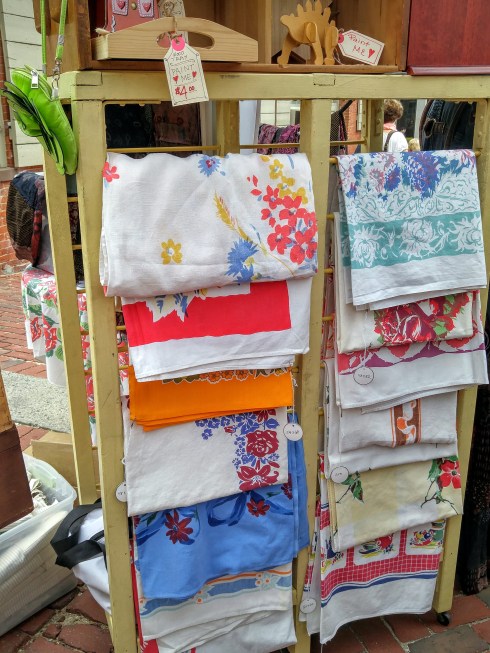
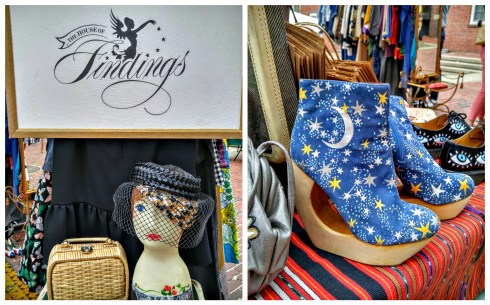
And on to the market…..which was obviously a huge success. Great vendors–lots of vintage collectibles and clothing, art, and up-cycled creations. It seemed to me that there was a lot of quality vintage hardware and textiles–the latter cleaned and pressed to perfection. I was a bit bleary from the morning’s festivities so was not really the purposeful picker that I generally am at these venues, but I did buy a very nice painting and marshaled all of my remaining strength to take some pictures. I’m sure that I will be back to form for the next market: on June 18.

Commencement 5

Commencement Collage

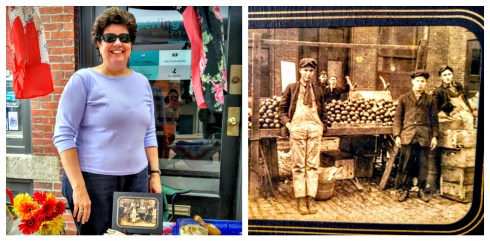
Here we have a proud vendor standing in the very same spot that her grandfather (on the right) had his stall when Derby Square was a food market!

Commencement 6

Commencement 17

Commencement 8

Commencement 10

Commencement 9

Commencement Collage 2

Very eclectic offerings.

Commencement 14

Commencement 18

The cars were not for sale but the books were–WHEN KNIGHTHOOD WAS IN FLOWER! The pioneering tale of romantic Tudorism: I would have picked this up, but I already have four or five copies, I think.


To Market, to Market

This coming weekend several friends of mine, three ladies who are clever and creative and fierce hunter-gatherers all, are launching a new endeavor, the Derby Square FLEA Salvage ART Market, a monthly pop-up venue featuring equally creative vendors of art, vintage and salvaged goods in both original and up-cycled form. The Market will be held every third Saturday from May through September in Salem’s venerable marketplace, Derby Square. For this first Market, there will be 23 vendors, all displaying their wares under perfect white tents, along with music and classic cars, befitting May’s launching theme of rev your engines. If you visit their wonderful website, you will see that each monthly market has its own theme, including July’s bicentennial in recognition of the anniversary of the Derby family’s donation to Salem of the land previously occupied by their majestic Bulfinch mansion (with the proviso that it remain commercial space). So this Market, like the weekly Farmer’s Market and all the enterprises along the adjacent Salem Marketplace across Front Street, honors the city’s past and present.

Derby Square Market Poster

Derby Square Poster

Derby Square Banner Sepia

Derby Square FSA is an invitation-only venture: these ladies have been “shopping” for their vendors for a year! There will be no witch kitsch in Derby Square on these summer Saturdays: think Brimfield rather than Haunted Happenings. Their vendors are listed on the website and the Market’s Facebook page, and I picked out a few representative items for a preview. I was happy to hear that my friend and neighbor Racket Shreve, a noted marine artist, will be selling cards and prints on Saturday, from the back of his 1962 Willys Jeep (most appropriately).Derby Square Market Collage

Derby Square Ashley Procopio Jewelry Packaging

Shreve Studio wall

Vintage handkerchiefs from Verve Design, Globe light from House of Champigny, Chair by 8 by Design (before it got a great seat), Soap from My Sweet Soap, Jewelry maker Ashley Procopio’s perfect packaging, Racket Shreve’s studio.

Like so many events and organizations in Salem (excluding all the witchcraft profiteers, of course), Derby Square FSA is a labor of love for the city and all it has to offer. Of course its organizers (who are again, full disclosure, my friends) are operating an enterprise, but they are also offering a service and a resource. Again, let me direct you to the amazing website which offers up a wealth of information not only about the Market but also about Salem: it should be bookmarked by visitors and residents alike. I’ll let them speak for themselves as they explain their vision for the transformation of Derby Square, the “heart of the city”, into a: a vital marketplace which showcases and connects what Salem is known for around the world–art and beautiful old things in a vintage American city.

Derby Square 1855 Harpers

Derby Square Market PC 1910

Derby Square Salem

Derby Square: 1855 (from Harper’s New Monthly Magazine), circa 1910, and this past weekend.

Derby Square FLEA salvage ART, a monthly pop-up market. Third Saturdays 10-5, May-September, Derby Square, Salem, Massachusetts, commencing MAY21!

http://www.derbysquarefleasalvageart.com/