Category Archives: Salem

A Heightened Sense of Detail

It’s rather jarring to read the lines written by Salem’s chatty diarist, the Reverend William Bentley, about his encounter with the Salem artist George Ropes Jr. in 1804: “Paid G. Ropes’ Bill for head of Curwin, Salem, Minister, the painting by him. He is a dumb boy with Corné. Had receipt. $4.00”.  Bentley had commissioned a portrait copy of the Reverend Samuel Curwen from Ropes, who was then an apprentice of the Italian emigré artist Michel Felice Cornè. George Ropes, Jr. (1788-1819), the son of a Salem sea captain (how many times have I written than?) was indeed born deaf and was by all accounts speechless for all of his relatively short life, but Bentley’s notes upon his early death are more telling: Died of consumption, deaf and dumb, a painter, active, acute, circumspect, and esteemed.”  Ropes had to become the primary breadwinner for his family upon his father’s death at sea in 1807 and so he became a practical  painter of signs and such as well as an artist. While all art is evidence for the historian, I’ve always felt that Ropes’ works are more documentary in their detail, particularly two paintings in the collection of the Peabody Essex Museum, Launching of the Ship Fame (1802) and Crowninshield’s Wharf (1806). I’ve shown it here several times, but I can’t post on Ropes without including his masterpiece, Salem Common on Training Day (1808), which is also in the collection of the PEM. Those poplars! I can never see this painting too many times.

ropes-fame

ropes-crowninshield-wharf

salemcommontraininga

George Ropes, Jr.: The Launching of the Ship Fame, Crowninshield’s Wharf, and Salem Common on Training Day, all courtesy of the Peabody Essex Museum.

My favorite story about Ropes comes from the Pickering Genealogythe source of endless interesting anecdotes about Salem people. In another testimony to his skill and eye for detail, it is noted that on one occasion when the parlor in the house of Jarathmeel Peirce was being papered, it was found that there was not enough, and it being imported paper, more could not be obtained. He undertook to finish it by painting, which he did so accurately that it was impossible to tell where his work began or where it ended. A decorating crisis averted!  Ropes is probably best known for his marine paintings, including a lovely “portrait” of George Crowninshield’s famous luxury yacht Cleopatra’s Barge, and several paintings of the USS Constitution in battle during the War of 1812.The US Constitution Museum has a series of four paintings painted by Ropes (after Corné) depicting the famous engagement with the HMS Guerriere in August of 1812 which earned the victorious American ship the nickname of “Old Ironsides”, and at the end of next month, a Ropes painting of the victory of the Constitution over the HMS Java in December of 1812 will be auctioned off at Dan Morphy Auctions in Pennsylvania. Artistic reportage, and some pretty bold titles, from this silent “signmaker”.

ropes-constitution-vs-guerriere

ropes-constitution-vs-java

George Ropes, Jr., the last of the Constitution and Guerriere paintings, USS Constitution Museum Collection; Constitution vs. Java, Morphy Auctions.


Doorways to the Past

I remain absolutely enraptured with Frank Cousins (1851-1925), Salem’s great photographer-author-entrepreneur and pioneering preservationist, after countless posts on his life and work. Today I want to feature his debut publication, Colonial Architecture, Volume One: Fifty Salem Doorways (1912). The title indicates that there was going to be a Volume Two, but instead Cousins went on to publish The Woodcarver of Salem: Samuel McIntire, His Life and Work (with Phil Madison Riley, 1916) and The Colonial Architecture of Salem (1919) and through his art company, sell his prints to pretty much every architectural author of his era. Fifty Salem Doorways is a large quarto portfolio of Cousins’ photographs of doors representing all the historic neighborhoods of Salem: Chestnut, Essex and Federal, the Common, and Derby Street.There’s very little text, just doors. I’m not quite sure why I’m so fascinated with this volume, but I am: I pick it up and browse through it quite frequently, discovering some new little detail every time. Details of DOORS. Yesterday I was talking to a few of my students in the research seminar that I’m teaching this semester in an attempt to aid them in narrowing down and focusing their very broad topics (this is always a struggle), and I said you need to find a window–or a doorway–into this topic, a point of entry. I was talking about sources, but also perspectives. So maybe that’s why I like Cousins’ doors so much: they give me a point of entry into that Salem of a century ago. And of course it’s always nice to engage in some past-and-present comparisons, which is what I’ve done below.

cousins-1

cousins-2

cousins-29-chestnut

cousins-41-chestnut

cousins-4

cousins-359-essex

cousins-6

cousins-7

cousins-peirce-nichols

cousins-314

cousins-129-essex

cousins-gardner-pingree

cousins-5

cousins-brookhouse

cousins-80-wash

cousins-92-wash

and one that got away: the entrance of the Francis Peabody Mansion formerly at 136 Essex Street (1820-1908).

cousins-peabody-mansion


Go West, Young (Salem) Man

The California Gold Rush began on this day in 1848, when the foreman of workers constructing a sawmill on the American River near Coloma, California uncovered several large pieces of gold: when it was over, more than 300,000 people had gone west, including many from Salem. In the first two years after the strike, two joint-stock mining companies were organized by Salem men (of 124 from Massachusetts alone), and at least seven Salem ships departed for California, filled not only with potential prospectors but also lots of stuff to be sold there: this was an entrepreneurial opportunity in more ways than one! Here again you see Salem’s local history intersecting with a national event: the city’s trading economy had been on the decline for several decades so this would have been a very welcome opportunity as well, for both those who wanted to go west and those who were in a position to transport them there. The news of the strike spread like wildfire, and there seems to have been an immediate effort to retrofit ships as quickly as possible to carry eager passengers to San Francisco. The last of the great Salem ship captains, John Bertram, prepared his bark Eliza for the voyage,and she became the first gold-rush vessel from Massachusetts to sail for California, departing on December 2, 1848 with a cargo of “flour, pork, sugar, dried apples, bread, butter, cheese, rice, figs, raisins, pickles, boots, shoes, stoves, axes, picks, domestics, and a variety of small articles, lumber, a store, and materials for building a boat or scow, for dredging the rivers or on sand bars, together with a small steam engine, a lathe, and tools for repairs” along with passengers.

gold-rush

gold-rush-cartoon-aas

gold-rush-eliza

gold-rush-la-grange-pem

gold-rush-collage

Company certificate, California State Library; a caricature of the eastern “independent gold hunter”, 1849, American Antiquarian Society;  The Bark “Eliza” from a 1920 catalog of paintings in the Peabody Museum; model of the “LaGrange”, Peabody Essex Museum, New York and Boston “Witchcraft” clipper ships, c 1860, Library of Congress.

The Eliza reached San Francisco but never made it back; this seems to have been the fate of most of the Salem gold rush ships: they were sold, dismantled, and/or repurposed. The most dramatic example of a repurposing of a Salem ship was the LaGrange (see model from the Peabody Essex Museum above), which sailed on March 17, 1849 and ended up as a prison ship in Sacramento! We have insights into the financing of gold rush voyages from the diary of Salem forty-niner William Berry Cross, a member of the “Salem Mechanics Trading and Mining Association”, which purchased the ship Crescent for passage to California in 1850. Cross’s diary includes a complete roster of his fellow passengers, an inventory of the cargo, and the revelation that the enterprise was to be financed by the profitable sale of both the cargo and the vessel upon arrival in San Francisco.Over the next decade, celebrated clipper ships like the two Witchcrafts above would sail west and return to their eastern home ports, but these first Salem ships seem a lot more disposable.


Locals Lean In

It seems to me that there has always been a correlation between dissatisfaction with the Federal (or central) government, in general or focused on a particular branch, and action, manifested not only by large protest marches with lots of speeches but also by intensifying local engagement and activity: the latter does not loom as large on the radar screen as the former but is just as important, if not more so. It is these smaller, community initiatives that make me feel hopeful just now, although Salem has been a rather engaging and engaged place for as long as I’ve lived here. The city government is progressive and multi-layered, with the usual planning boards supplemented by committees made of citizens striving to make Salem beautiful, “no place for hate”, bicycle-friendly, and greener. There are venerable philanthropic organizations–mostly initiated and administered by women–that are still alive and well today in Salem, more than a century after their inception. Every cultural and/or historic organization has its dedicated band of volunteers. And then there are the newer, very focused initiatives, oriented for the most part on the livability of the city. Even though Salem is a small city, it’s still a city with visible urban problems, including most prominently litter, traffic, and crumbling hardscape. Even though I’d love to see its historic downtown cemeteries roped off altogether, I still applaud the efforts of the newly-formed Friends of Salem’s Historic Downtown Cemeteries whose mission is to advocate “for the protection and preservation of the Old Burying Point, Howard St and Broad St Cemeteries”. The city of Salem has a Cemetery Commission but it’s not enough; these well-trodden downtown cemeteries need more. Our other public spaces need advocates too, which is why I also applaud the Salem Public Space Project,  a “collective effort to engage residents in understanding and reimagining local public spaces”, and the Collins Society, which focuses on highlighting and preserving the work of Philadelphia landscape architect John F. Collins, who took over after urban renewal was abandoned in Salem in the early 1970s. The Society maintains a lovely website with some great images, and seeks to improve and preserve the urban streetscape (including fountains, plazas, planters and cobblestone paths) of downtown Salem, for “landscape architecture…should be preserved with the same dedicated passion as architecture”. Last but certainly not least, I really applaud the daily efforts of FireballsofSalem to cleanse the city of its constant supply of nip bottles and other annoying forms of litter. Valiant, hopeful initiatives all.

lli-cemetery

lli-lafayette-park

lli-derby-square

lli-derby-square-2

lli-planning

lli-nip

lli-nips

The Old Burying Point on Charter Street and and Lafayette Park, a public space that needs some attention and will be getting it in 2017; The plazas and pathways of John F. Collins in central Salem: why are cars parking on those cobblestones on the left which are clearly not parking spaces? Fireballs are the preferred “fleur de Salem” of the Fireballs initiative but I’ve been finding more of these little green Dr. McGillicuddy bottles recently: I think they were specially priced for the holidays.


Why are there no WPA Murals in Salem?

The various initiatives of the Works Progress Administration made their mark on Salem during the Depression: substantive work on Greenlawn Cemetery and the Salem Armory was completed, wharves and docks were built or rebuilt all around Salem Harbor, and the Salem Maritime National Historic Site was created along Derby Street. Many historic structures in Salem were measured and photographed under the aegis of the Historic American Building Survey, for which I am grateful nearly every day. I’m sure there were more infrastructural improvements implemented with federal funds in Salem in the 1930s, but I don’t have the time or the inclination to lose myself in the massive archives of the New Deal!  There is a conspicuous absence of federally-funded art in Salem however: no murals in the Post Office or City Hall illustrating the city’s dynamic and dramatic history. This absence is conspicuous because Massachusetts in general, and the North Shore in particular, is home to some notable New Deal murals, commissioned by various Federal cultural agencies to embellish public spaces with uplifting, patriotic, accessible American scenes while simultaneously providing unemployement for artists. There are amazing murals in Boston, Worcester and Springfield, and in Natick, Lexington, and Arlington, and here in Essex County, in Gloucester City Hall, Abbot Hall in Marblehead, the Topsfield Public Library, and the Ipswich Post Office. Moreover, there were several Salem artists who painted murals for the WPA elsewhere–but not in the city of their birth or residence. Why?

wpa-mural9-large

wpa-eliot-natick

wpa-lexington-ma-po-mural-1024x512

wpa-mural-gloucester

gloucester-wpa-mural-3

Umberto Romano, “Mr. Pynchon and the Settling of Springfield”, Commonwealth of Massachusetts State Office Building, formerly the US Post Office, Springfield, Massachusetts, photograph by David Stansbury, and Hollis Holbrook,” John Eliot Speaks to the Natick Indians”, US Post Office, Natick, photograph by Thomas Cortue, both part of the joint Smithsonian National Postal Museum and National Museum of the American Indian exhibition, “Indians at the Post Office: New Deal-Era Murals”; Aiden Lassell Ripley, “Paul Revere’s Ride”, US Post Office, Lexington; and Charles Allen Winter’s “Protection of the Fisheries”,  and “Education” , two of 6 murals in Gloucester City Hall that have been recently restored.

I’ve been wondering about this for a while, but this weekend I was engaging in my semi-regular weekend fantasy-shopping-on-1stdibs session and I came across a study painting by Dunbar Beck for a mural entitled The Return of Timothy Pickering which eventually embellished the interior of the Danvers Post Office, where it remains to this day. And I thought to myself: why the hell was the mural commissioned for DANVERSWhy didn’t it come to Salem? Timothy Pickering is one of the most famous native sons of Salem, his house is here, and his mural should be here too. Danvers is the former Salem Village, and was long part of Salem, but still this mural clearly portrays Salem Town and harbor.

pickerings-return

wpa-mural-crop-pickering

Dunbar Beck, Study Painting for the Danvers Post Office mural “The Return of Timothy Pickering”, currently available from Renaissance Man Antiques on 1stdibs.

So, why no murals of Salem’s earliest settlements, famous vessels, lively port, sea captains’ mansions, or Witch Trials on the walls of public building downtown?  Well there would have had to be some visual reference to 1692, and that was hardly an uplifting American episode that could be used to raise spirits during the Depression. That’s the curse of 1692, which manifests itself time and time again. Or maybe there was no place for one in Salem’s relatively new Post Office or venerable City Hall. But I for one would like to see a simplistic scene of North America’s first elephant stepping on Salem soil somewhere around town.


Pope and Pagan; or Nativist Fun

Salem holds almost as prominent a place in the history of board games as it does in the origins of American maritime commerce and Federal architecture, due in overwhelming part to Monopoly, but before the Parker Brothers there were the Ives Brothers, the true pioneers of card-and board-game production. The publishing firm of W. and S.B. Ives was founded in 1823 by William and Stephen Ives, and operated through the mid-1850s, producing the Mansion of Happiness, generally acknowledged as the first American board game, as well as the widely-popular Improved and Illustrated Game of Dr. Busby. The success of the Ives Brothers, (or really William Ives as Stephen seems to have left the partnership relatively early) in effect created an industry by sparking imitation and competition from their fellow Massachusetts manufacturer, Milton Bradley, the McLoughlin Brothers in New York, and ultimately Parker Brothers. The American Antiquarian Society has a large collection of nineteenth-century board games, including many produced by the Ives firm, and while I was browsing around its digital collections the other day (looking for something altogether different) I encountered a rather provocative Ives board game called The Game of Pope and Pagan, or Siege of the stronghold of Satan, by the Christian army which was published in 1844. It’s a simple game, a variant of the perennial Fox and Geese, in which players constituting the “Christian” army lay siege to the “stronghold of Satan” which is occupied by the Pope and pagans: in the words of the game, “this simple amusement exhibits a band of devoted missionaries, attacking the strong-hold of Satan, defended by papal and pagan Antichrist”. I spend a lot of time in seventeenth-century England (I’m assuming the game’s title is derived from Bunyan’s Pilgrim’s Progress) so I’m pretty familiar with strident anti-Catholicism but the more “modern” American offshoot in the nineteenth century shocks me every time I encounter it: what a cauldron Salem must have been at this time with its heady mixture of abolitionists and nativists (with a dash of temperance thrown in)! Apparently there were intersections among these groups but you wouldn’t know it from this game, in which “the white figures represent the missionaries, as white is they symbol of innocence, temperance, and hope…..as heraldic sable denotes grief after a loss, Pope and Pagan are in black, both denote gloom of error, and their grief at the daily loss of empire”.


pope-and-pagan-4

pope-and-pagan-5

pope-and-pagan2

W. and S.B. Ives, The Game of Pope and Pagan, or Siege of the stronghold of Satan by the Christian army, Salem, Massachusetts, 1844, © American Antiquarian Society. 


Nuts-and-Bolts Bankers

I love everything about this little pamphlet I picked up the other day commemorating the 100th anniversary of the Merchant’s National Bank of Salem in 1911: In the Year 1811. The graphics, the format, the paper, the fonts. The whole point of the pamphlet is to show how much changed from 1811 to 1911, and how integral the Merchants National Bank was to that change. Everything is so much better in the latter year, everything is so modern, and to illustrate this modernization, in both words and pictures, the pamphlet privileges the practical side of life over the big political events that shaped the century: transportation, heating, cooking, lighting, clothing, and commerce, of course. There is one sentence referencing the wars of the century, and presidents are referenced only by their age at the time of the incorporation of the bank. 

bankers-5

bankers-3

bankers-11

bankers-12

bankers-14

bankers-heat

bankers-22

There are several references to Salem’s notable architecture, but again, it’s really all about the bank, which showcases its new headquarters on Essex Street, “colonial in architecture and absolutely fire-proof in construction. The walls are of brick; roof and floors of concrete. There is nothing to burn; the city might be swept by a conflagration, and the building of the Merchants Bank would still stand”. Of course this strikes one as a very prescient statement, as Salem would  be “swept by a conflagration” in only three short years: the Great Salem Fire of 1914. The new bank building stood tall, but primarily because the fire did not reach downtown. Samuel McIntire is not mentioned in the pamphlet, despite the fact that 1811 was the year of his death.

banking-collage

The new bank building on Essex Street, the Old Witch House, and a representative Salem porch.

I think the illustrator of most (certainly not all) of the charming sketches in the pamphlet are the work of Salem-born artist George Elmer Browne, based on the illustration of Salem’s first Eastern Railroad depot, which is attributed to Browne elsewhere. Everyone is familiar with the great Gothic Revival structure that was built in the 1840s and unceremoniously demolished in the 1950s, but this was its less imposing predecessor. Now that was a big change!

bankers-20

first_salem_station_by_george_elmer_browne

train-station-pikes

Browne’s illustrations of the First E.R. Depot in Salem, in Francis B.C. Bradlee’s The Eastern Railroad: A Historical Account of Early Railroading in Eastern New England (1917) and the second depot in 1911-12 Report of the Salem Plans Commission.


Trudging Along

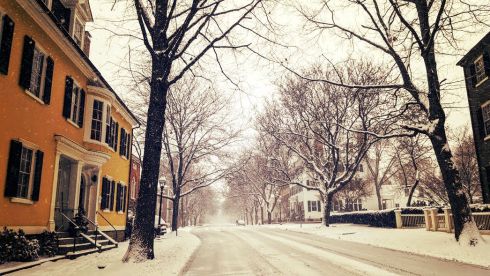
Yesterday was a beautiful winter day with everyone out and about cleaning up after the Saturday snowstorm, which was not as bad north of Boston as it was to the south.The streets of Salem were clear by mid-morning, if not before (I was sleeping in), and people were engaged in their regular Sunday activities. There were Sunday street-hockey players out my front windows, and hungry birds out back.

snowy-chestnut-street-hockey-game

snowy-garden

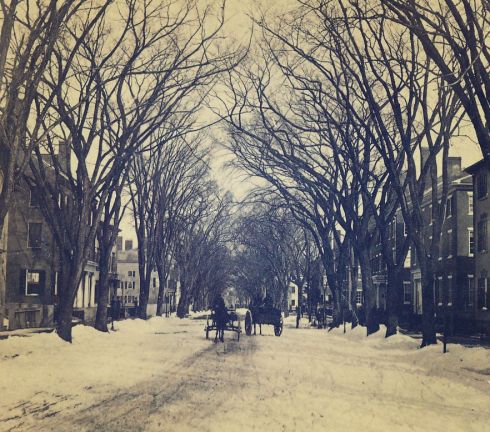
I suddenly became curious about snow removal in the past–mostly because I didn’t want to go out and engage in my own snow removal in the present. I have–and have seen–quite a few historic photographs of winter scenes in Salem in the later nineteenth and early twentieth centuries, but none of them feature snow carts, snow plows, or snow removal. Salem has always been quite urban, and people needed to get around, how did they manage? What was the system then that so preoccupies us now? Both the New York Public Library and the Boston Public Library have quite a few photographs of various methods of snow removal in their collections, from simple shovel brigades to “snow rollers”–I’ve never seen anything like that for Salem: anyone out there have anything?

chestnut-street-in-winter

lafayette-street-in-winter

Chestnut and Lafayette Streets in the 1870s in stereoviews by Charles G. Fogg. Carriages on the snow—not even sleighs! But it’s not too deep here.

snow-chesnut-st-2-harvard

snow-chestnut-street-1899-harvard

Chestnut Street in the 1890s, deeper snow, no signs of plowing–but these carriages do look like they are on blades. I’ve shown these before; they are from a family archive in the Schlesinger Library at Harvard.

My problem is that I don’t have any winter scenes of Washington or Essex Streets with tracks that needed to be cleared: Chestnut was and remains strictly residential. I still think people trudged around a lot more than we do now, however. Look at these two wonderful photographs of students from the Horace Mann “Training School” associated with the Salem State Normal School (now Salem State University, where I teach) and their teacher, visiting historic sites downtown in the snow.Look at her skirt: she’s not troubled by a little snow.

snow-and-students-collage

E.G. Merrill photographs of Horace Mann students, 1904, Salem State University Archives and Special Collections

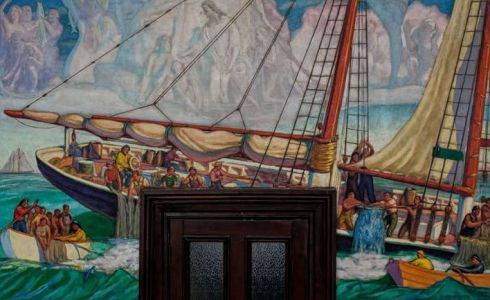
Like everything else, our toleration for snow in the streets changed with the automobile: we won’t settle for anything less than black the day after a snowstorm now. The wonderful book by Marblehead artist, photographer, and author Samuel ChamberlainSalem in Four Seasons (1938) shows winter streets cleared for cars and pedestrians. And he agrees with me: some of Salem’s most beautiful moments are in winter, when few visitors see it (though a lot more now, fortunately).
chamberlain-four-seasons

Plowing Chestnut Street in the 1930s, from Samuel Chamberlain’s Salem in Four Seasons (1938).


Snowy Salem Saturday

A welcome snow day today, imposing calm on everyone–or at least me! I’ve always enjoyed winter, but the SuperWinter of two years ago, in which something like 11 feet of snow was dumped on us in February, tempered my appreciation for this particular season considerably. The snow was all around the house, the snow was in the house, and I plodded to work every day in tunnels of yellow snow. I felt a little vulnerable, especially when I woke up in the morning to see the latest damage inflicted on my plaster ceilings by ice dams. But all of that is fixed now, and we spent last year, with its relatively light winter, rebuilding our chimneys, sealing our windows, and putting on a new roof. Now I feel impenetrable, at least for this first snow storm. I’m sure hardly anyone agrees with me, but I think winter is Salem’s best season actually–I like to see the city return to a car-less state: it’s as close as you can come to seeing it in its glorious past. There’s a timeless quality to a snowy day, and the contrast of nature and structure is never more apparent. Here’s a few photographs I took as I walked around a very calm city this afternoon.

snowy-saturday-2

snowy-saturday-8

snowy-saturday-4

Chestnut Street, Essex Street, and the Common.

snowy-saturday-3

snowy-saturday-7

Two notable Salem houses in varying stages of restoration.

snowy-saturday-10

snowy-saturday-9

snowy-saturday-13

snowy-saturday-5

Gambrel roofs embellished by snow.

snowy-saturday-6

snowy-saturday-11

snowy-saturday-1

snowy-saturday-12

Some contrast; Trinity does not really care for snow.


The House with Nine Lives

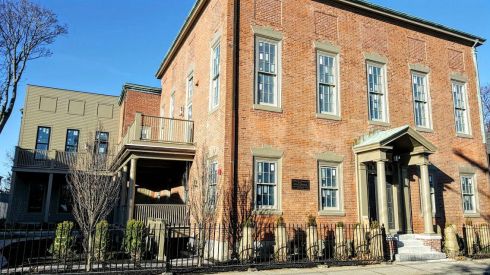
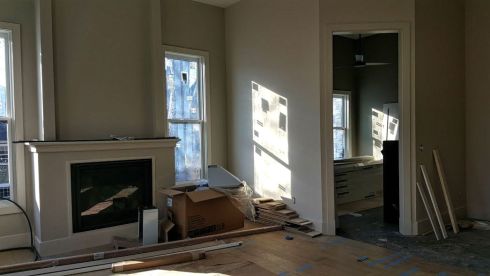
One of the projects that my husband’s architectural firm has been working on is coming to a close, so I took advantage of a holiday open house to go in and see how the much-altered former Home for Aged Men/Sons of Poland/ Emmerton Hall of the House of the Seven Gables was being transformed into six condominiums. I like my title, so I’m keeping it–but it is incorrect: 114 Derby Street is actually a building on the cusp of leading ten lives (if you count all the new units individually). It was built in 1806 for Salem sea Captain Joseph Waters, and remained a single-family residence until 1877 when the great philanthropist John Bertram purchased it for his newly-established Home for Aged Men. After the Bertram Home moved to the Common (where it remains), the Sons of Poland transformed 114 Derby Street into a fraternal headquarters and social club, and it continued to serve in the latter function, essentially, when the House of the Seven Gables Settlement Association purchased it in 1966 and renamed it after its founder, Caroline O. Emmerton. As envisioned by Emmerton, the Gables was an institution that was founded to realize the joint goals of preservation and settlement, and its social activities had outgrown the constraints main campus across the street. Everyone in Salem consequently refers to this building as the “Settlement House”, though that identity was relatively short-lived in the context of its entire history. The Frank Cousins photograph below, taken in the early twentieth century when the house was the Bertram Home for Aged Men, shows some semblance of its original Federal appearance.

settlement-2

settlement-1

duke0030-waters-house

The Waters House c. 1912 (Urban Landscape Collection, Duke University Library) and today. Third-floor ghost windows on both the main house and the 1983 addition of 114 Derby Street are reminiscent of the house’s Federal past.

Every “life” brought major architectural changes to the old Waters House, but it appears that the twentieth-century alterations were particularly extensive: the building’s exterior and interior were completely transformed by the Sons of Poland in the 1930s, and the Gables added the present addition to the back and side in 1983 (which everyone I know disdains but now looks pretty cool). The mission of the Gables has evolved over the last decade or so, and consequently its trustees made the decision to sell the building last year.This last (maybe!) evolution of 114 Derby Street has been pretty speedy, and the six (sold-out) residences should be ready for occupancy this spring.

settlement-collage

settlement-9

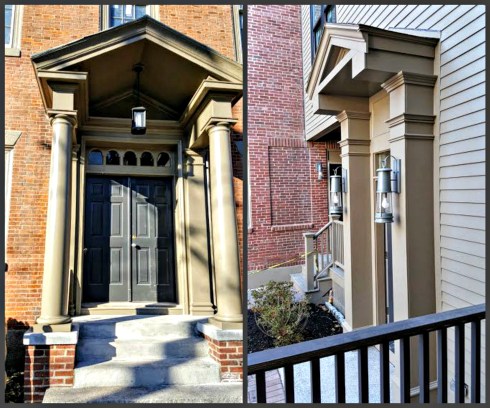
The addition s) and all those institutional uses mean that the new condominiums all (I think all!) have their own entrances.

waters-stairwell

settlement-stairway

settlement-4

settlement-7

settlement-11

settlement-12

settlement-13

settlement-14

Old stairwells and New spaces being carved out of the Waters/Settlement House: as you can see, the units are quite large (1-3 bedrooms with expansive living/dining spaces) and include parking out back.