Category Archives: Salem

Salem Sensory Overload

An amazing weekend in Salem, for the city, objectively and collectively, and for me, personally. I’m writing at the end of a long day, which will be yesterday, during which I gave a morning presentation on the Remond Family of Salem, an African-American family who operated many successful businesses in the mid-nineteenth century while simultaneously supporting every social justice cause it was possible to support (which were many) next door at Hamilton Hall, and then made my way to the long-heralded opening of the new wing of the Peabody Essex Museum. Both were really important events for me: I’ve been focused on the Remonds since I moved next door to Hamilton Hall, and in attendance at my talk was George Ford from California, a Remond descendant who is so dedicated to his family’s story and memory that he just want to be where they were. And except for a few professional events I had to attend at the Peabody Essex, I have not visited the museum since December of 2017, when the non-announcement was made that its Phillips Library, encompassing the majority of Salem’s written history, would be removed to a new Collection Center in Rowley, Massachusetts. Over time I realized that I was only hurting myself, as the Peabody Essex is indeed a treasure house, and the historical references of new Director Brian Kennedy and media reviews of the new wing and the #newpem infused me with hope, and so I was excited to return, but also a bit anxious. (There was also a big food truck festival in Salem but don’t expect me to report on that!)

20190929_104959

20190929_144507

 The Remonds in the morning, and the new PEM Wing in the afternoon!

As exasperated as I can often get with Salem, you must know that it is an entirely engaging city and place to live, always, but this weekend was particularly intense. If the famous PEM neuroscientist Dr. Tedi Asher had affixed monitoring devices to me I would have given her readings off the charts, I am sure! I was nervous about going into an institution which I have been so critical of over these past few years–not to exaggerate my influence, it was just an internal feeling. I have friends and acquaintances who work at the museum and it never felt good to criticize the place where they worked. Everything seems different now, with the new Director, Brian Kennedy, acknowledging Salem, community, founders, even slavery (i.e. historical realities rather than cultural idealizations, and potential engagement or even interest in historical interpretation!) with every passing press report. Expectations can make you anxious too though, and I was anxious to see what role the new dedicated Phillips Library gallery in the new wing would play, as an expression of priorities, as an indication of respect for the old (dry) texts which always require a bit more effort to make them shine. So here I go into the PEM, heading straight for the new wing, with all of my anxieties and expectations. What do I see first?

20190929_152615

20190929_152205

A wall! And an amazing N.C. Wyeth mural titled Peace, Commerce, Prosperity–both of which I loved. Before I looked at anything, I was struck by that wall: the side of the East India Marine Hall which I had never really seen; it must have been alongside the former Japanese garden but I never noticed it for some reason. Maybe I was just focused in my mind on the back wall of Hamilton Hall which borders my own garden, which I stare at all the time and think of the Remonds working on the other side, but all I could see when I entered the new wing was this wall. It might also have been my admiration for the Georgian Pickman House, which formerly stood in the same spot I was standing in—-maybe I was trying to conjure up its orientation—but for whatever reason, I stood staring at that wall for quite some time. (Yes, Salem’s history is weighing on me, just a bit). Then I snapped out of it, spent some time looking at the lovely Wyeth mural, and moved into the new Maritime gallery, where I was caught. There’s no other word for it, caught. I was transfixed by everything, and as soon as I got to the trio of paintings of ships in various stages of “tragedy and loss” by the Salem deaf-mute artist George Ropes, I realized that I wanted–or needed– to come back to this very intimate gallery every day, or as often as possible. Such a clever installation with its angled walls, ensuring that you discover something new around every corner, and everything so very evocative of the perils and promise of the sea. And such a thoughtful mix of old exhibits and new, including the venerable glass-encased ships’ models we can see in all the old photographs of the Peabody Museum. I saw many things that I had only seen in pictures before, but also “old friends”. There were texts, not just paintings and objects. Stunning, substantive, respectful: I was very impressed.

20190929_150104

20190929_150851

20190929_145818

20190929_145727

20190929_145423

20190929_150433

20190929_150947

20190929_150526

20190929_150342-1The treasures of the new Maritime Gallery: the George Ropes paintings are STUNNING; I can’t possibly capture their beauty here. Lovely to see many East India Marine Co. artifacts plus texts and sketchbooks; Ange-Joseph Antoine Roux, Ship America at Marseille, 1806; a reverse glass painting by Carolus Cornelius Weytz, c. 1870; Ship Models and dashing Salem Sea Captains John Carnes and Benjamin Carpenter by William Verstille; Vases by  Pierre Louis Dagoty, c. 1817.

The Asian Export Gallery on the second floor of the new wing was extremely well-designed as well, with an entrance “foyer” covered entirely in c. 1800 Chinese wallpaper from a Scottish castle showing us just how cherished, and integrated, products from Asia were in the west. This opened up into a spacious gallery, providing a vista for what can only be called a “Great Wall of China”! This space was delightful aesthetically, but it was also a teacher’s toolbox for me: all of our introductory history courses are focused on global connections and trade, so I was able to photograph about three PowerPoint’s worth of photographs, for which I am very grateful. Then it was upstairs to the new wing’s third floor, where Fashion and Design reigned—particularly the former, so many mannequins. I have to say that compared to the other two galleries, this one left me cold, but I’m sure that I’m in a minority as it was the most crowded space of my afternoon. We all respond to different materials in different ways of course, but I was struck by the contrast of the rather “old-fashioned” display of Iris Apfel’s ensembles with the modernity of the actual clothing: draped sheets à la eighteenth century with bespectacled mannequins in front? To me it looked inartful, kind of like a throwaway installation, but maybe I’m supposed to notice the juxtaposition? I’m not sure: there were just too many mannequins—it was a crowd for me. There was a readily apparent flow, or connection, between the objects in the Maritime and Asian Export galleries below, but here I could not link the fashion and non-fashion items into any semblance of a story. But again: it was crowded, so I’ll have to go back and try again.

20190929_151510

20190929_151827

20190929_152029

20190929_152125-1

20190929_153537

20190929_154325-1Perfect place to text, no? LOVED this painting of Two English Boys in Asian Clothing, c. 1780 by Tilly Kettle, “the first prominent British artist to work extensively in India”; the “Great Wall” in its partial entirety and detail; the Fashion and Design gallery on the third floor of the new wing.

By this time, I was running out of time (chiefly because I spent so much time in Maritime World) but I wanted to see how some older spaces were impacted by the addition of the new wing—namely the adjacent East India Marine Hall—as well as the heralded dedicated Phillips Library gallery. Here disappointment began to kick in, so read no further if you want a fluffy, disengaged appraisal: that’s not what I do here. The old hall, so stunning and so missed by me, was all dark, reduced to background for artist Charles Sandison’s digital projections of words and phrases from eighteenth- and nineteenth-century ship captains’ logs. I had seen this before, as PEM’s first “FreePort” installation a decade or so ago, so I was surprised to see it again. I really liked it before: it was definitely immersive. It was not what I wanted to see now; I was hungry for real words and texts after their authentic integration in the Maritime gallery and so these fleeting, ephemeral images felt fleeting and ephemeral. But this is a temporary installation so I’m not going to go on and on about it; I’m looking forward to what’s next for East India Marine Hall.

20190929_152746

20190929_152938

20190929_152822Charles Sandison: Figurehead 2.0.

On to the new Phillips Library dedicated gallery space! I was anxious, so maybe I wasn’t thinking clearly, but it actually took quite a while to find it. My very handy Visitor Map, which was handed out to everyone as we entered the PEM, indicated that it was right behind East India Marine Hall on the same floor, but because the circular staircase in the rear of the building was blocked off you couldn’t quite get there from where I was without going up, down and all around for some reason. Again, it might have been me, I was going by sheer sensation here, but the difficulty of access seemed to combine with the closet-like room I eventually found to give me a profound impression that the Peabody Essex Museum really didn’t want to showcase the collections of the Phillips Library. Here was an afterthought, thrown in behind the restrooms. I hate to rain on this parade, but that is what I felt. The “Creative Legacy of Hawthorne” exhibit seemed uninspired to me as well, but to be honest, I couldn’t really take it in, I was so disappointed by this sad space. I’ll have to go back and look at it again, if I can muster the willpower. I know that the new Phillips Librarian is happy to have this space, and I’m sure he and his staff will do as much with it as they possibly can, but there’s no way that I can say that it was anything other than a great disappointment to me, right now. The contrast between this disposable space, and all of the wonderful, powerful, thoughtful and spacious galleries I had just seen was almost unbearable: I just had to walk away. There was a large panel which gave a brief history and description of the Library and an introduction to its new reading room in Rowley which I couldn’t quite capture with my camera so I made a collage of different sections: there was no filter with tears, “broken” and “recoil” didn’t look quite right, so I settled for worn.
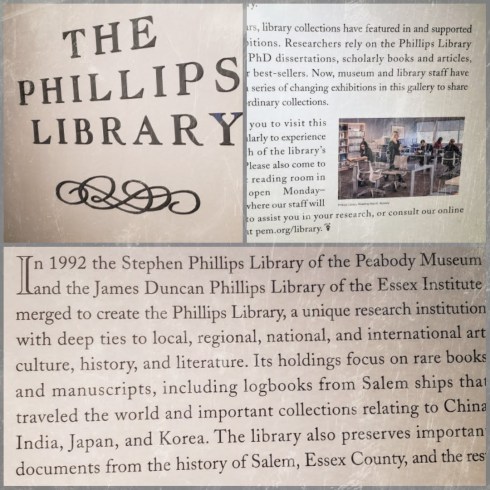
pixlr-4

20190929_160511

Well let’s try to end on a high note, shall we? No one likes a killjoy. The whole opening of the new wing was handled wonderfully by the curators and staff of the PEM: everyone was on hand, all weekend long, to help, and guide, and answer questions. The Visitor Map (and these cute buttons for all of the new galleries, except, of course, for the Phillips Library) is great. There was a wonderful spirit about the place. Not only is the new wing impressive architecturally: it offers some interesting views of Salem from its upper stories. The new garden is a thoughtful space: I’m looking forward to seeing how the plant material fills in. It was good to be back in the Peabody Essex Museum after my long absence. Salem’s mayor, Kimberley Driscoll, shared her reactions to the opening of the new wing on social media and someone forwarded her post to me. She was clearly as excited as the rest of us and why not: it was, again, a big weekend for Salem. Mayor Driscoll wrote that As we enter these doors we’ll know more about 16-year old sea captains who sailed around the globe and brought back treasures and trinkets to their hometown. Humankind is amazing when it comes to rising up to challenges. We tell those accounts, see those treasures, wonder what it was like and how it came about, marvel at the possibilities….we do all that here. In this space. In our city. Yes in our city, in Salem: but we can’t tell those accounts if we don’t have our history: trinkets and treasures are not enough. And we don’t have to wonder, we could actually learn and know, if we had our history, but we don’t: it’s not here, in our city, in Salem.

20190930_102513

20190929_154845

20190929_153255The Phillips Library Gallery is #206 on the Visitor Map + adorable buttons; the new garden; view from the third floor of the new wing.


Mary’s House

I’ve posted previously (several times, actually) on one of my favorite Salem Colonial Revivalists, the author, photographer, and photographic purveyor Mary Harrod Northend (1850-1926), but I am focusing on her again today for two reasons: 1) I’ve uncovered quite a bit of new information about her; and 2) I think those of you who live outside of Salem might not be aware of what has happened to one of her primary residences, which sustained a terrible fire in late November of 2018. I say “primary” because my new information has uncovered a variety of addresses for Mary, but I still think of 12 Lynde Street as Mary’s House, and it’s been sad to see it in a distressed state for the past year. But never fear, it is rising from the ashes: its very responsible owners have hired (SHAMELESS PLUG FOLLOWING) my husband to shepherd its restoration. Whatever fabric (brick foundation, though all the bricks had to be reset and cleaned, some wood, including the front doors which will be dipped) could be saved will be saved, and it will get new window frames, wooden siding and windows, and a rebuilt interior. It was even lifted to straighten it out! It will be stunning, but it’s still unsettling to walk by, especially as I have such a soft spot for Mary.

20190925_165127

20190925_165058

20190925_165011

20190925_164951

20190925_165303

It looks better and better with each passing day, I promise! And while I have you here, does anyone know the name of the entrance detail motif? I have not seen that before: thankfully it was unharmed. Mary’s professional life remains enthralling to me: it started late in life (when she was in her 50s) and was still going strong when she died from complications sustained in an automobile accident in 1926. Consequently it was compacted, and intense: besides her twelve published books there were literally hundreds, maybe even thousands, of magazine articles, on everything from andirons to bread crumbs. In 1914 alone, she sold over 150 articles, employed a stenographer, several file clerks, and a full-time photographer, enabling her to illustrate her own works as well as those of other authors. She had started out ten years earlier with her own camera, and a few sporadic submissions to random publications: now she was almost an industry unto herself, an industry based on highlighting the best of Salem rather than exploiting the worst, darkest days. I guess that’s why I admire her so much.

Mary's House Letter

Here is a letter documenting the very beginning of her career, ten years earlier, from the Century magazine collection at the New York Public Library’s Digital Gallery. At this point in her life, Mary, her widowed mother and younger sister, were living in what sounds like genteel poverty, in the Rufus Choate House just next door to 10-12 Lynde Street. As you can read, Mary has yet to take up her camera or her pen to highlight Salem’s streets and houses, but she is still trading on her Salem connections and heritage: in this case seeking to publish some letters from Nathaniel Hawthorne’s “most intimate friend”, Horace G. (Connolly) Ingersoll, written to her father. She is trying to get in on the big Hawthorne anniversary that year (and boy is she a bad writer! or typist. or both). The Century did not publish these letters, but they are the substance of a 1937 article published in The Colophon by Manning Hawthorne. Mary met with success with other submissions shortly thereafter, largely by abandoning her father’s connections in favor of her own perspectives on architecture and antiques, culled from living in the rapidly-disappearing world of “Olde Salem”. In a marvelous biographical article in the 1915 issue of Massachusetts Magazine, she credits her success to her “friends, the citizens of my hometown, Salem. Had they not thrown open their homes for my inspection and reproduction, I would have been nothing.” The article’s author, Charles Arthur Higgins, opines a bit after that admission, asserting that “now the owners of those beautiful Salem mansions are as proud of the fame and authority of their author as they are of her subject matter” and revealing that “Miss Northen has been repeatedly urged to maker her abode in New York; but she states that nothing can make her forsake the city that has so kindly aided her to fame.”

Mary's Houses Arts and Decoration

Mary's Success 2

Mary's DoorsFame AND Authority:  Occasionally Mary Harrod Northend would present wistful Wallace Nutting-esque views, but mostly she was all about bringing antique material culture into the modern world; notices in Who’s Who in New England and the Architectural Record, citations in trade catalogs were common from 1915 on.


The Forest through the Trees

COURT HOUSES: constant scenes of dramatic Salem history, from the seventeenth century until today. At present, we have one court house being demolished, one recently refurbished in spectacular fashion, and two long sitting vacant, waiting for their redevelopment into something deemed acceptable by the Salem Redevelopment Authority (SRA). One of these warehoused courthouses, an amazing Romanesque structure which was built in several phases over the later nineteenth century, has by all accounts an equally amazing interior library with a huge walk-in fireplace: for some reason I have never been able to make it inside but everyone I know who has raves about it. The other looks like a very pure Greek Revival structure, but again, by all accounts, it has been gutted inside. Because the interior of the Romanesque former Superior Court is so beautiful, several of the proposals for its redevelopment want to preserve areas for public space, which is of course great. And while their ideas for public access have merit conceptually, I am begging the SRA to just say no. While “The Museum of Justice of New England” and “a regional children’s museum that is themed around the Parker Brothers historical presence in Salem” (I’m quoting a September 4 article in the Salem News by Dustin Luca) sound like nice ideas with place-based rationales, the last thing Salem needs is another niche “museum”; what Salem needs, of course, is a Salem Museum, and this scenario offers up likely the last opportunity to make that happen.

20190917_162620

20190917_111025

20190917_111428

img_20190914_150104_773The Superior Court House even has turrets!

Every professional historian, whether working in academic fields or more public positions, along with every well-traveled visitor whom I have squired around Salem, always asks the same question: where is the History Museum? They all notice the commercialism, and the lack of context, and the two are related. We cannot see the forest through the trees. If you have a Salem Witch “Museum” (insert quotes around all the following “museums” please–the first four exist and its only a matter of time before the last surface), and a Salem Witch Dungeon Museum, and a Salem Witch “History” Museum, and a Salem Witch Board Museum, and a Salem Witch Ball Museum, and a Salem Witch Broom Museum, and a Salem Witch Hat Museum, and a Salem Witch Cat Museum, and a Salem Witch Spoon Museum, and a Salem Witch Pin Museum, and a Salem Witch Cauldron Museum, and a Salem Witch Wart Museum, and a Salem Witch Herb Museum, and a Salem Witch Wand Museum then you’re not going to understand anything about the cumulative origins, role and impact of the Salem Witch Trials in context. Likewise, if you go to the Pirate Museum, the Halloween Museum, and the “Lost Museum”, you’re not going to understand anything about Salem’s vast and complex history at all. There are only bits and pieces out there, trees, with Salem’s two professional museums, the House and the Seven Gables and the Salem Maritime National Historic Site, attempting to show Salem’s many visitors some semblance of a forest.

pixlr-2

Court House Costello BPLBits and Pieces of seldom-seen Salem history: Salem printer Ezekiel Russell’s July 1776 Declaration of Independence, the Holyoke family coat-of-arms by Salem artist Benjamin Blyth, a letter from Alexander Hamilton to Salem tax collector Joseph Hiller, Nathaniel Bowditch’s presidential badge from the East India Marine Society, c. 1820, the “Gerrymander” in the Salem Gazette, Salem’s bicentennial banner, Nathan Read’s steam engine, and letters from Salem and Alexander Graham Bell; a photograph of Jessie Costello leaving the Superior Court in Salem after having been found innocent of poisoning her firefighter husband in an absolutely sensational trial in 1933, Boston Public Library, Leslie Jones Collection.

The few images above represent the tip of an iceberg: I could post thousands of pictures of Salem images, stories, “facts”, and events—in fact, I have: that’s my blog! In each post I try to provide context but there is no context for the whole Salem story, and so everything is lost, except for a few well-worn tales about the Salem Witch Trials, and (thanks to Salem Maritime and the Gables) some of the key aspects of its dynamic maritime trade and the work and life of Nathaniel Hawthorne. All those Salem soldiers, in so many wars, forgotten, along with so many Salem artists, entrepreneurs, politicians, and just everyday people, leading their ordinary and extraordinary lives. Could we learn more about legal history and the Parker Brothers? Yes, absolutely, but not in isolation, but rather as part of a larger Salem story. Examples abound, from towns and cities which also draw significant numbers of tourists but seem much more intent on presenting their comprehensive history in an accessible and professional manner. Of course, a comprehensive Salem Museum in this space would have to be a collaborative effort, and it would have an impact on other institutions in the city. All of the court house redevelopment proposals stress the “point of entry” feature of their site, located just across from the train station: the new Salem Museum could also serve as an orientation center, freeing up the Salem Maritime National Historic Site to do their own programming and exhibits at the current Visitors Center on Essex Street.  The new Peabody Essex Museum may be planning historic exhibits in the former Phillips Library buildings, or it may not, but its present and future mission certainly does not include providing the comprehensive and chronological introduction to the Salem story that both our residents and our tourists deserve. There are powerful and influential people in our city who could make this happen, and they should.

pixlr-3A few of my favorite local history museums: the Newport Historical Society Museum, the Concord Museum, and the City of Raleigh Museum in North Carolina. Concord is a perfect role model for Salem: it has a historic national park, and several smaller house museums, but grasped the necessity of establishing a central historical museum for the general public in the 1970s.


Just One Remond Triumph in Salem

I’ve been collecting all sorts of information and anecdotes about the Remonds of Salem, an African-American family who are in the center of many movements and activities in mid-nineteenth-century Salem: they were zealous pursuers of the abolition of slavery and the desegregation of schools and transportation and every aspect of daily life and work, but they also advocated for other forms of social justice in their day, including women’s suffrage and the abolition of capital punishment. They were extremely entrepreneurial: the parents, John and Nancy Remond, served as the resident caterers of Hamilton Hall right, while also operating a number of sideline businesses until well in their seventies, and their children followed suit, pursuing advocacy work and building up successful businesses in the fields that were open to them. I’ve been fascinated with the Remonds—all of the Remonds—for quite some time, I guess ever since I moved into this house, right next door to what was their base of operations at Hamilton Hall, almost twenty years ago. I posted about them several years ago when Salem announced it would be naming a new park after the prominent abolitionists Charles Lenox and Sarah Parker Remond, but I know a lot more now. The Board of Hamilton Hall secured a grant last year to prepare educational materials on the Remonds, and I supervised a Salem State intern named Katherine Stone to help with the research: she uncovered some great family history, I kept going this summer, and I’ll be offering a general presentation of the family’s activities and networks on September 24 and 29 at Hamilton Hall as part of Essex Heritage’s annual Trails and Sails programming.

20190914_205430Some of my Remond files; for some reason I’ve been keeping all of the genealogical information in a notebook I bought in Portugal.

There’s a lot to say about this family: and that’s my central theme, that they worked together as a family, and as part of network of African-American families, both in Salem and up and along the northeastern coast, who all worked together to improve their lives and the lives of other African-Americans at a contentious but somehow still-hopeful time. At least it seems that way to me; I’m not trained in American history so my knowledge is impressionistic. The Remonds are kind of like my window into this time, and they are so gung-ho, I’m like, let’s go! But certainly they had their share of disappointments: they left Salem from 1837 to 1842 after Salem’s schools were re-segregated, transferring all of their energy, entrepreneurialism, and activism to Newport, Rhode Island, and poor Charles Lenox Remond, intrepid agent of the Massachusetts and American Anti-Slavery Societies, was always appealing for reimbursement of his expenses. The networks are so amazing: it’s no accident that Charlotte Forten, now herself the namesake of a Salem park, ended up with the Remonds when they returned and Salem’s schools were desegregated yet again, as well as another famous future educator, Maritcha Remond Lyons.

Remonds

Dinner 8Signatures of Susan, Nancy, and Maritcha Remond on a petition to abolish the death penalty, 1850, Harvard Antislavery Petitions Dataverse; Trade card from the Remond Family Papers, courtesy of the Phillips Library of the Peabody Essex Museum at Rowley, Massachusetts. The Library staff made lovely reproductions of several Remond items for me, and Hamilton Hall, and we’ll be using these in our educational materials.

There’s so much to say that I’m worried that my presentation will not have enough focus: it’s always easier to explain the importance of someone or something if you focus. I wish I could give an entire talk on just one of the Remond’s big dinners—and there were many: for the Marquis de Lafayette, for Chief Justice Joseph Story, for Nathaniel Bowditch, for President John Quincy Adams, and more. But I think the biggest dinner happened TOMORROW in 1828, a feast for the 200th anniversary of the arrival of John Endicott in Salem. It’s probably just because I have more sources for this particular dinner, but it seems to have been a very big deal. The Phillips Library has two menus for the dinner, a clean version and an annotated one: John Remond contracted for a fixed price with the owners of Hamilton Hall for these dinners, but if the number of attendants rose above the agreed-upon number he was paid more. He was not just the cook (in fact, I think Nancy was doing most of the cooking, with his elder daughters Nancy and Susan as they came of age–not for this dinner) he was very much the event planner: and no detail was overlooked. The newspapers recorded every detail of this dinner: all the attendees, all the speeches, and decorations, including “pictures of our distinguished forefathers, and of individuals of more recent date, whose characters, and whose services, were not forgotten in the libations of gratitude poured out upon this joyous occasion.” The article in The Salem Observer also noted “the tables loaded with the richest viandes, and the most delicious wines and fruits served up in elegant style by Mr. Remond. In the centre of the Hall, stood the identical table which belonged to Governor Endicott, and covered with a profusion of pears recently gathered from the tree which he planted.” [Where is that Endicott table?]

Dinner 6

Dinner 5

Courtesy Phillips Library, Peabody Essex Museum.

And then we have another, anonymous, account of a visitor who was in town for the big anniversary celebration and dinner. It was quite a day, a “grand celebration” in which it “seemed as if all Boston had moved to Salem. Many great men there beside myself.” This observer is constantly remarking upon the festivity of the day and wondering what the Puritan people of Endicott’s day would think of it: at the North Church for the anniversary program, he finds “the house blazing with beauty and fashion. Contrasted ladies with Puritan mothers. Imagined good dames of 1628 coming into assembly, and finding daughters decked out in such trim. Guessed they’d make fine havoc of laced veils, flounced petticoats, love-locks (???) and whole alphabet of sinful finery.” By the time that dinner rolls around in the later afternoon, however, our anonymous observer has forgotten 1628 and is completely in the culinary moment.

Anniversary Dinner Anonymous observer Salem_Observer_1828-09-27_[2]

Turk's Caps Book of Cakes

Salem Observer, September 27, 1828; turn-of-the-century Turk’s Caps from the Book of Cakes (1903) by T. Percy Lewis and A.G. Bromley.

Tables loaded with dainties of all climes…..went through the whole bill of fare from oyster-patties to transmogrified pigeon. Thought Remond best cook in the universe. I guess he still has 1628 on his mind a bit (before he gets into the champagne), as he “wonders what Pilgrim Dads would have said to such a carnival.” This is a colorful illustration of the authority that Mr. Remond (he is generally referred to as Mr., though also by just his last name) held throughout his career, and it is very clear from all the references I have collected that this is an authority that extended to his family, and that came not only from their professional achievements but also their role in the community, in Salem. So I just have to establish this is my presentation in the most succinct, but yet revealing and representative, way. And regarding this menu: it looks impressive and exotic to us, but these are some pretty conventional dishes for the early 19th century, with recipes that can be found in a succession of European and American cookbooks. I explored Pigeons Transmogrified here, Green Turtle soup is everywhere in the nineteenth and early twentieth centuries, and teals are small ducks. Molded jellies are also very popular in this time, and a “Turk’s Cap” was a tubed and scalloped mold used primarily for cakes: in Remond’s time they look like pottery versions of a bundt-cake mold, but later on they were made of cast iron and resemble muffin tins. The use of the plural in the menu suggests individual little cakes to me, and Nancy Remond was by all account a spectacular baker well-ahead of her time–but I’m not sure her Turk’s Caps would have been quite as “Victorian” as those above. So here you have the other challenge before me: not letting the delicious little details get in the way of the big picture.


An Array of Entrances

There were two very positive developments regarding Salem’s historical fabric this week: the city’s Cemetery Commission voted to close the Old Burying Point during October, thus shielding our oldest cemetery from its annual occupation by Halloween tourists, and the Peabody Essex Museum announced that it would be returning the anchor which was situated in the front of East India Hall for a century or so to Salem. I am heartened and happy and have nothing to complain about or advocate for in this post! So let’s celebrate with some color, as found on a veritable rainbow of Salem doors. My first house in Salem had a red door, and everyone would comment on it when I told them where I lived; now red is pretty commonplace, but my impression is that the most common door color in Salem is still black. Greens—especially dark green—would be next, followed by a variety of reds, blues, pinks, and orange/peach doors, and finally brown and gray doors. Of course there are lovely Salem doors which are varnished rather than painted, but I’m not including them here. There are yellow doors in every neighborhood, but cream and white doors are hard to find: generally the latter are new Home Depot-ish doors, and not very interesting. There are some pretty nice new custom doors opening out onto the streets of Salem, but if I was in need of a door I think I’d rather find an old one at Old House Parts or somewhere similar. I’ve got one white door here, with some pretty distinctive hardware, and lots in more vivid hues, beginning with the painted door installation at Salem’s Tabernacle Congregational Church, representing diversity and acceptance of all.

20190912_115718

20190910_143549

20190910_143212

20190910_142857

20190912_102040

20190907_165555

20190912_113504

20190912_105451Another reason to praise PEM: the beautiful restoration of the Daniel Bray House on Brown Street: it doesn’t have its new/old door yet as you can see–and I’m not sure if it will be painted this light orange color.

20190912_113844

20190910_140127

20190907_161345

20190907_153717

pixlr

20190907_170036

20190910_134705

20190910_134726

20190907_160454

20190910_140808

20190827_112305Dark Brown/Red is a classic Salem combination.

20190907_170015

20190912_102815

pixlr-1Turquoise is the current it-color, I think.

20190912_110512

20190910_132300

20190907_162959

20190912_114413

20190910_134446

20190910_132834-1T

20190907_170638

20190907_170219

20190907_170103


Six Hours in Salem

At the end of the nineteenth century, Salem was a mecca for architects-in-training, who came individually and collectively—most notably through the “summer school” of the Massachusetts Institute of Technology’s pioneering architecture program—to measure and draw details and outlines of its storied houses. Their work was published occasionally in the the American Architect and Building News as well as in a series of beautiful portfolios titled The Georgian Period. In volume III of the latter, published in 1899, the Rochester-based architect Claude Fayette Bragdon, a fascinating man of many interests including mathematics, set and lighting design, the occult, as well as architectural theory and practice, visited Salem for an afternoon, and rendered his impressions in both text and images. He acknowledges Salem’s two other major draws, the witch trials and Nathaniel Hawthorne, and then gets right into his categorization of Salem architecture: To the mind of an architect the buildings of Salem arrange themselves naturally into three classes: first, those very old houses, built by early settlers in the most primitive times, possessing all the dignity and simplicity and withal, the barrenness of the Puritan character, and around which cluster many strange, true histories and curious traditions; second, those built in later Colonial and Revolutionary days, usually by rich merchants and shipowners, when Salem had become a principal port of entry, and an important commercial centre, and in which the Colonial style is exhibited in its very flower, and third, those purely modern structures—confused, chaotic—which have sprung up in profusion in some part of the town, like weeds in an old fashioned garden. CONFUSED, CHAOTIC WEEDS! If this is Bragdon’s characterization of “modern” architecture in 1899, imagine what he would say now!

Six Hours 3Pickering

Six Hours 5Pingree

Six Hours 4 CH

It’s not entirely clear why Bragdon’s illustrated essay is included in The Georgian Period: he was not affiliated with MIT nor was he was particularly reverent of colonial architecture. But I am very happy to be introduced to him via Salem, as he was a very interesting, multi-faceted man, who wrote several books on theoretical architecture and seems to have worked in every single genre of the decorative arts. He strikes me as a modern Renaissance Man, and I’m looking forward to learning more about him.

Bragdon CollageJust three of Bragdon’s works on architecture, in its widest possible sense.

Bragdon’s essay is included in a volume of select reprinted Georgian Period essays published in 1988 entitled The Spirit of New England, and MIT Summer School drawings and Frank Cousins photographs are added to round out his presentation—but of course that means the presentation is no longer his. But his words are there, as well as his drawings of “old colonial work”, including an interesting rendering of an Eagle-less Hamilton Hall. Missing McIntire? That’s pretty curious. Well, no matter, I’m still struck by Bragdon’s exuberant writing style. At the end of his six hours in Salem, he is reluctant to leave this veritable mine of architectural wealth but his impressions are “permanently” formed of an exceedingly quaint and picturesque old town, striving here and there to be “smart” and modern, like some faded spinster who has seen better days, who mistakenly prefers our shoddy fabrics to the faded silks and yellow lace and other heirlooms of an opulent past. I can see that, still, especially the bit about the mistaken preference for shoddy fabric.

Bragdon collage 2

Bragdon Drawings 2

Bragdon HH


Requiem for a Carriage House

There is nothing, nothing, that is worse than neglect, of anything that is in your care. I am always material-minded so I’m going straight to architecture: demolition by neglect infuriates me. It’s expensive to own an old house: I have a long list of tasks that my house needs and I wish I could spend the money that I’m going to spend on the house on travel, or a Sheraton sofa, or lustreware from the 1820s, but I can’t: I bought this house and I therefore I must be a responsible steward of it. I work hard to maintain it in the condition that it demands, as does my husband. The down payment for this house came from money I inherited from my grandfather, who also worked long hours to provide for his extended family; his father came over on a boat from southern Italy all alone at age 10 and worked as a tailor to send all four of his American-born children to college (even the girls) and leave them legacies which they passed down to their children. My legacy is my house, and I would never neglect it: it would be an insult to my family as well as my community. So when I see families of much more ancient American lineage, with the possessions to prove it, exhibiting carelessness at best, and neglect at worst, towards their properties, I get mad. Such is the case with a beautiful brick Federal house overlooking the Ropes Garden, left to rot for years by a family that first arrived in Salem in the seventeenth century, and only recently undergoing renovation. This house will be saved, at long last, but its owner has applied for permission to demolish the mansard-roofed carriage house in the rear of the property. The Historical Commission rules through the granting of certificates: non-applicability, appropriateness, hardship. The owner of this carriage houses seeks the latter, but this is clearly a case of willful neglect over many, many years, initiated by a man who is called, incomprehensibly, “an outspoken champion of historic preservation” in his obituary and carried on by his heirs.

20190903_072519

20190903_072752

20190903_072840

Felt House and Carriage House 2

20190903_073056

As you can see from the photographs (the black-and- white is a Frank Cousins view from the 1890s and the Phillips Library of the Peabody Essex Museum), the Victorian carriage-house doesn’t exactly go with the Federal house adjoining it: it was built as an outbuilding of the Italianate George. C. Shreve house fronting Federal Street and only purchased by our “outspoken champion of historic preservation” in the late 1960s, I believe. The Shreve House was converted to condominiums a while ago, and its residents are probably very tired of having this derelict building looming over their parking lot. But what a loss: of a once-elegant structure, of historical texture and fabric, of opportunity. It’s not difficult to find examples of Victorian carriage houses transformed into residences of all kinds, and just when the City of Salem is seeking to expand its inventory of “accessory dwelling units” (ADUs) in response to an intensifying housing shortage in our region, the impending demolition of this likely candidate seems even more tragic.

Carriage House Kauffman CMA

CARRIAGE-HOUSE-2Larry Kupferman, Victorian Carriage House, Carnegie Museum of Art; the converted carriage house at A Cambridge House Inn, Cambridge, Massachusetts.


Losing our History? Two Years Later……Where are We with the PEM?

Two years ago tomorrow,  the temporary location of the Phillips Library of the Peabody Essex Museum shut down rather abruptly with a succinct notice of when it would be reopening but no reference to where. As the Library is the primary repository of documents relating to Salem’s history, there were concerns among scholars (including a friend of mine who was writing her dissertation based on materials in the Phillips and was quite suddenly shut out), but I don’t think the general public was too concerned: increasing inaccessibility in terms of hours–and then location—had been the trend for about a decade. I had never really depended on the Phillips for research or teaching (only this blog) so this was a big wake-up call for me:  I started thinking, what if it is not coming back? And then a few months later, in early December: the big non-announcement at a meeting of the Salem Historical Commission. The Phillips Library of Salem was no more: all of its holdings would be deposited in a giant Collection Center in Rowley, a half hour to the north. The special library—consolidated from collections of both the Peabody Museum and Essex Institute and housed in the spectacular purpose-built Plummer Hall on Essex Street—would now be part of a much larger modern warehouse of texts and objects located on a commercial strip of Route One. An Indiana Jones image formed in my mind, and the contrast between the genteel, accessible Plummer Hall and the post-modern former toy factory seemed too cruel, even discounting the distance factor.

raiders_of_the_lost_ark_end

pem-2

20190830_102537

Early 2018 was all about resistance and defense: there was a very dramatic public forum at the Museum during which then-PEM CEO Dan Monroe justified his decision according to the priority of preservation: it was impossible to house these materials in Salem due to the deficiencies of the Plummer and adjoining Daland buildings and there was no other sufficient space in the city.  The “preservation vs. location” argument is still authoritative: with no discussion of why the PEM did not use the substantial monies donated to it for the library to improve and expand these facilities in Salem. Also still with us is the conflation of objects and texts, justifying the move to the Rowley storage center; the Phillips Library literally gets lost in this configuration. There was lots of press coverage in January, 2018: in both the Salem News and the Boston Globe, where a front-page story included the quote below from Mr. Monroe of which I just can’t let go. A “Friends of the Phillips Library” group, established right after the December 2017 Historical Commission meeting, expanded its presence on Facebook and eventually launched its own website, which remains the essential archive of this story.

PEM billboard

pem cover (00000003)

The official way forward seemed to be through a “working group” established by the Mayor of Salem, Kimberley Driscoll, and Mr. Monroe and including members of the city’s heritage organizations, most of which (with the exception of Historic Salem, Inc. and the Salem Athenaeum) were silent during the uproar and remain so. Almost immediately the PEM announced a compromise: a reading room would be reinstated in Plummer Hall (although what would actually be in this reading room is still unknown), a Salem history exhibit installed next door, and rotating exhibits of Phillips Library materials would be installed in the main museum buildings down and across Essex Street. I don’t think we’ve really moved much beyond this agreement, but there were also discussions about digitization, as the focus on the historical collections revealed just how far behind the PEM was in such initiatives, despite misleading news stories to the contrary. Once the library collections were moved to Rowley, digitization of some of the Phillips’ most popular items began, and consequently we can now see Frank Cousins’ photographs of Salem in the 1890s at the Digital Commonwealth and a variety of interesting texts at the Internet Archive. I give all credit for this ongoing development to Collections chief and Library Director John D. Childs, as I remember him stating that digitization was a priority at the January 2018 forum, while Dan Monroe would only offer that it was “expensive”.

Cousins Kernwood

Witch of New EnglandEntrance to the George Peabody Estate, “Kernwood”, in North Salem, Frank Cousins Collection of Glass Plate Negatives at the Phillips Library via Digital Commonwealth; just one Phillips text at the Internet Archive.

And that brings us to the biggest development in these two years: the retirement of Dan Monroe, effective this past July. The new director of the PEM, Brian Kennedy, is not only an experienced museum administrator, but also a scholar, who began his first day at the Museum with a staff meeting in East India Hall referencing the vision of the founders of the Essex Institute and Peabody Museum. This was encouraging to those of us on the outside, as the founders were overwhelmingly Salem men who believed that they were contributing to a repository of Salem history and culture, but we must remember that Mr. Kennedy is learning the lay of the land and that only one trustee on the PEM’s Board is a resident of Salem. The will of the founders—and successive donors—has always been the most pressing factor in my mind: I asked Mr. Monroe about “donor intent” at the January 2018 forum but he expressed no concerns. However, I’ve heard many, many, many concerns here (and in emails) from many of you. Both founder and donor intent can rise to the level of legal action, of course, and are administered within the purview of the office of the Attorney General. Very soon after the “non-announcement” of the move, we found the Essex Institute’s incorporation charter from 1821, which asserted specifically that its “cabinet” be situated in Salem. We assumed that this article was made null and void years ago, or at the very least through the merger of the Institute and Peabody Museum in 1992, but apparently that is not the case.

Essex Institute Incorporation

And so at the invitation of Mr. Michael Harrington, former Congressman and present owner of the Hawthorne Hotel who has taken a very active interest in this “case”, a group of concerned citizens, heritage professionals, and local political leaders met with Attorney General Maura Healey and her staff this past eventful July. It was a great meeting to which I was privileged to be invited. Ms. Healey listened intently to us over several hours, and explained the process by which the PEM has to petition the court to be released from the above article, a process that is overseen by her office. Apparently the PEM has not initiated this process (at least formally) yet, but can at any time, and presumably will (although they haven’t indicated that they were bound by any restrictions to date, so I’m wondering if things will just continue as they are). I voiced all of the concerns I’ve written about and heard here at this meeting, as well as my belief that the removal of the Phillips Library will cause economic harm to Salem over the long run, as the city has no professional historical society or museum to take its place. When history is only for sale, money determines everything: the topic, the take, the truth.

20190830_100622

I’m not sure what will happen now; obviously the Attorney General’s office is invested in this issue but it has been for some time. The Peabody Essex Museum is focused, with good reason, on opening its brand new wing at the end of September and branding itself as the #newpem. No doubt Mr. Kennedy is preoccupied with that, and with learning all about his new institution. Not only has the new wing been completed recently but substantive renovations to both the interiors and exteriors of the Plummer and Daland buildings are ongoing: the 1960s “stacks” addition has been shorn off, and many wonder where the Phillips materials could be housed if they were returned to Salem. The PEM had a viable plan for the expansion of the Phillips Library in these buildings and in Salem, but that plan was abandoned in favor of the new wing and Collection Center in Rowley.

20190830_102347

20190830_101408

20190830_102159

So I think that’s where we are, but any good summary should also include what remains to be seen, or what I still don’t understand. After two years of immersion in this very singular issue: these are the concerns, problems, and questions that still linger in my mind:

  1. I don’t understand why the City didn’t try harder to retain our history. It’s been dawning on me for some time that this entire proceeding reveals more about the City of Salem than the Peabody Essex Museum. Recently I’ve heard that the City’s tourism office, Destination Salem, plans to focus on genealogy or “roots” tourism over the next few years. This makes sense on one level, as this is the most dynamic trend in the tourism industry currently and Salem is Ellis Island for many Anglo-Americans, but it makes no sense on another, as Salem has no genealogical records because they are all in Rowley.
  2. I don’t understand how the Phillips Library is going to survive as a library in Rowley: a real library, with regular patrons, events, talks, exhibits and a sense of community. I can understand how it will exist as a repository, but not a library. Every research library I’ve ever worked in–the Folger, Houghton, the Massachusetts Historical Society—is an active gathering place, but I can’t see people gathering at that sterile place in Rowley. It’s a professional operation to be sure, and researchers will go there to do their research, but that’s about it. I guess that’s what the PEM wants, as the promise to offer exhibitions of Phillips collections is being kept, with a Hawthorne exhibition opening next month in the new wing, in Salem.
  3. Speaking of comparable research libraries, I don’t understand why a “Harvard Depository” system cannot be utilized with the Phillips Library, retaining the offsite Collection Center as a storage facility from which materials can be retrieved and brought to the MAIN Library, which could be reinstated in the Plummer and Daland buildings on Essex Street in Salem. This would solve the storage issue and retain the traditional space, place, and role of the Phillips Library, and it could be operated as an accessible facility that would serve researchers and the general (curious) public. I’m sure there’s a reason why this can’t happen, but I wish I knew what it was, as it seems like the reasonable solution to a layperson like me, and one which would benefit all parties: the PEM, the City of Salem, and the Phillips Library itself.

Boats and Bells

This past weekend was beautiful, with just a touch of autumn chill in the air and no discernible humidity. I spent Saturday painting my front fence, which is just about the most social thing you can do in a small city, and Sunday we went to one of my favorite annual Salem events, the Antique & Classic Boat Festival, and then to the Salem Maritime National Historic Site for its commemoration of 1619, the year that enslaved African-Americans officially first set foot in North America. The very clangy bell of the site’s reproduction East Indiaman Friendship (back at Derby Wharf after many years in dry dock for repairs, but still missing its masts) rang out for several minutes, along with bells across America, at precisely 3 pm. We had planned to go out on our own boat, but it was just too breezy, so we were seaside (or harborside) wanderers all day long, which was not very difficult duty.

20190825_130815

20190825_130840

20190825_132638

20190825_142109

20190825_141518

20190825_132805

20190825_134859

20190825_132619-1

20190825_140113

20190825_140231

20190825_135846

20190825_135012

20190825_132345

20190825_140817

20190825_131026

20190825_140616

20190825_142406

Just some boat shots which I’m not really equipped to annotate—my favorite was the Half Circle, second to last above, a 1954 pocket cruiser. Between the boat show and the bell-ringing, we stopped at the Derby Street gallery of local artist Paul Nathan–more boats were there and these really cool eyes. The onto the Friendship.

20190825_143833

20190826_094206

20190825_144907

20190825_150005


The Dark Side of Old Salem

Slavery and servility have produced no sweet-scented flower annually, to charm the senses of men, for they have no real life: they are merely a decaying and a death, offensive to all healthy nostrils. We do not complain that they live, but that they do not get buried. Let the living bury them: even they are good for manure.

Henry David Thoreau, Slavery in Massachusetts (1854), an essay based on a speech given on July 4, 1854 in Framingham, Massachusetts, following the return and re-enslavement of Boston refugee Anthony Burns to Virginia in compliance with the Fugitive Slave Act of 1850.

My romantic appreciation for “Old Salem” the olden/golden time of daring sea captains who brought home and commissioned the material culture I so admire, must be tempered by the historical myopia of its most expressive creators. While Henry David Thoreau’s generation included many Salem residents who were ardent and influential abolitionists, several generations later the Salem’s participation in the trans-Atlantic slavery system was forgotten quite conveniently. This must have been a national trend which at long last is provoking the equally-national revisionist trend we are in now, but still, we can’t let the authors of these histories and reminiscences of limited memory off the hook, for it is a fact that the first ship which brought enslaved Africans to Massachusetts was the Salem-made Desire, captained by a Mr. William Pierce of Boston. As noted in Governor John Winthrop’s manuscript history of Massachusetts, in 1638 the Desire, returned from the W. Indies after seven months. He [stopped] at Providence[Isle] and brought some cotton and tobacco and negroes &c, and salt from Tertugo [Tortuga]. Dry fish and strong liquors are the only commodities for those parts. He met there two men sent forth by the Lords &c. of Providence, with letters of marque who had taken divers prizes from the Spaniards, and many negroes.

Dark Winthrop

This was not a one-off cargo but the beginning of a trade, rationalized by the labor demands of a colony that had already incorporated indigenous slavery into its framework and was overwhelmed by all that land on the horizon: only very cheap, preferably free, labor turn it into something of value. Winthrop’s brother-in-law Emmanuel Downing, writing from his Peabody estate in 1645 rather than the elaborate Salem house he later lived in, explained it very succinctly in a letter to the Governor:  If upon a just war [with the Narragansetts] the Lord shall deliver them into our hands, we might easily have men, women and children enough to exchange for Moors, which will be more gainful pillage for us then we conceive, for I do not see how we can thrive until we get into a stock of slaves sufficient to do all our business, for our children’s children will hardly see this great Continent filled with people, so that our servants shall desire freedom to plant themselves, and not stay but for very great wages. And I suppose you know very well how we shall maintain 20 Moors cheaper than one English servant. Winthrop and Downing are very clear, even casual, in their acceptance of slavery, but their early twentieth-century historians don’t acknowledge their clarity, or seek to engage with it. Here’s what Ralph Delahaye Paine has to say about the Desire, in his popular The Ships and Sailors of Old Salem: The Record of a Brilliant Era of American Achievement (1912).

Dark

Well, I’m sure you can characterize his interpretation by the subtitle of his book, but still, it’s a bit alarming to see “negroes” in one sentence followed by this ship Desire was a credit to her builders with nothing in between! No judgement, no context, just obvious approval of the “genius” of Salem’s merchants and shipmasters, “for discovering new markets for their trading ventures and staking their lives and fortunes on the chance of finding rich cargoes where no other American ships had dreamed of venturing.” In one of my favorite domestic remembrances of Old Salem, there is a similar dismissiveness, or non-engagement: in Old Salem, “Eleanor Putnam” (1886; really Harriet Leonora Vose Bates) recalls Salem shops, Salem Schools, and Salem sea captains, but even though she discloses that the manuscript memories of her cousin the sea captain references the slave trade, she doesn’t engage—she is much more interested in telling her readers precisely how he took his rum!

Dark Old Salem

That’s pretty much how the Colonial Revival “Old Salem” generation dealt with slavery: the occasional reference, but minimal engagement or recognition that it was a foundation of the golden era which they hold in such high esteem. It is convenient that slavery became illegal in Massachusetts in 1783, so that the Salem of Samuel McIntire and the early republic can be depicted without its taint. But this limited view would not last forever: the ultimate antiquarian George Francis Dow, the force behind Pioneer Village, the restoration of the John Ward House, and the Essex Institute’s pioneering period rooms, published Slave Ships and Slaving in 1927. Dow’s book is largely based on first-hand accounts of those who experienced the slave trade over the early modern era—except for those enslaved, of course— and while he references the Desire (though he makes her a Marblehead-built ship) he does not note either the year or the specific date of August 25, 1619, when enslaved African-Americans first stepped foot in North America, in the Jamestown port of Point Comfort, traded for rations by the crew of the White Lion, an English privateering ship sailing under Dutch authority which had captured its human cargo from a Spanish slave ship in the Gulf of Mexico. This is the date now, and the 400th anniversary of this consequential date is upon us. It’s being marked by an ambitious series in the New York Times, initiatives and events by commissions across the country, and a nationwide bell-ringing moment (at 3 pm) initiated by the National Park Service. In its recurring role as the guardian of serious historic interpretation in Salem, the Salem Maritime National Historic Site has invited the community to engage in its bell-ringing event (on the deck of the Friendship) at 2:45 on Sunday, followed by an interactive tour of slavery at the site. I can’t imagine a better place to reflect—looking out over the water, on a ship—and I love the bell-ringing ritual, as it brings us back to the days of the fiery abolitionists, and very far away from those of the Old Salemites. In the same Independence Day speech which I quoted at the beginning of this post, Henry David Thoreau remarked that Every humane and intelligent inhabitant of Concord, when he or she heard those bells and those cannons, thought not with pride of the events of the 19th of April, 1775, but with shame of the events of the 12th of April, 1851 (when the first refugee from slavery after the passage of the Fugitive Slave Act,  Thomas Sims, was returned to Georgia): the distortion of revolutionary ideals by slavery was so very clear to him, and them, and I think (hope) it is for us as well.