Category Archives: Salem

September, September

I love September: the cooler days and nights, the colors of late-summer flowers, the light, which can be both hazy and very, very clear. And then there’s that back-to-school feeling which I have experienced every year of my life with the exception of a few years ago, when I took a fall sabbatical. It’s a bit different this year, of course, with all of my classes online, but I still got that anxious/excited feeling on the first day of classes this week. Online teaching cannot compete with face-to-face instruction in my opinion, but it can “personal”, in the sense that you are staring right into the close faces (and homes) of your students; pre-packaged presentations can be more thematic and thoughtful than those which are delivered in person, especially with my conversational style. I put a lot of effort into structuring my online courses this summer to compensate for the slapdash efforts of last semester when we had to make rather quick transitions, so I think that my students will be getting a good mix of lecture, discussion, and writing. Still, with all of that said, I miss going back to school in person. But our home is a lot calmer now with the big kitchen renovation completed (big reveal next week: it’s still a bit of a mess), and it’s a good place to teach and write: I am very fortunate. I worked pretty steadily all summer, so I treated myself to a FOUR-day Labor Day Weekend, and the weather was GLORIOUS, as you can really see (I think) in these photos of New Hampshire, Maine, and Salem.

My long Labor Day Weekend: at the Wentworth Coolidge Mansion in Portsmouth on Saturday;  York’s McIntire Garrison (+my Dad) and Jefferds Tavern and some Cape Neddick and Ogunquit Houses on Sunday, on the When and If, the 1939 yacht of General Patton, on Tuesday night: it sails out of Salem in the summer and Key West in the winter.


Salem Women of Note, 1939

The very last time I was up at the Peabody Essex Museum’s Phillips Library in Rowley, last February I believe, I requested a folder within which was the transcript of a short paper given at a meeting of the Zonta Club of Salem in 1939 by Annie Balcomb Wheeler entitled “Salem Women of Note”. I thought this would be the beginning of regular trips to the Phillips, but then came the pandemic closures. It is open now, but I just don’t have time to go up there with my book contract and four courses this semester: I won’t for some time, maybe never, unless I decide to take take up another book project, tentatively titled “Dead History: How America’s Most Historic City lost its Past” in my mind (the phrase Dead History is taken from a 1915 newspaper article about Salem’s deteriorating historic sites, but obviously it is a double entendre now). There’s some interest in this, but I’ve got to get through The Practical Renaissance first, and after that it might be better to leave Salem history in my rear-view mirror except for fluffy forays here. I remain rather forlorn about the state of Salem’s historic archives and interpretation, but am happy to see that the Peabody Essex Museum is diving into Salem history headfirst this fall, with two collections-based exhibitions on the Witch Trials and “Salem Stories“. This is quite a change, and I hope not just a reaction to the pandemic, which has reoriented many museums towards local and regional visitors. A renewed and sustained interest in historical interpretation and programming by the PEM could be a game-changer for Salem.

Ropes by Purely SalemA wonderful view of the PEM’s Ropes Mansion on Essex Street by my friend Matt of PurelySalem on Instagram! (He takes the most beautiful photographs). I‘m hoping that PEM’s foray in history involves looking at old things in new light: the Ropes is a great example because there are many stories that remain untold about it. It’s not a GOOD story, but we need to know more about slavery in Salem, and the Ropes Mansion was built by one of Salem’s more prominent slaveowners, Samuel Gardner. 

Well, high hopes for “Salem Stories” but back to Annie Balcomb Wheeler and her notable Salem women of 1939. I certainly didn’t expect this little paper to be my last dive into the Phillips collection for months and I didn’t spend much time with it: I just noted the women whom Annie Balcomb Wheeler found notable, because I wanted to compare her 1939 list with my evolving list of women spotlighted in my #SalemSuffrageSaturday posts. It’s so interesting to me to chart the highs and lows of written history: who or what we deem important now as opposed to who or what was important in 1939 or 1839 or 1739. Right now in Salem I think people are primarily interested in women of color, Charlotte Forten and Sarah Parker Remond in particular, as well as the traditional philanthropists, like Caroline Emmerton, the founder of the House of the Seven Gables. None of these women made it onto Wheeler’s list, which includes the Quaker Cassandra Southwick, poet Anne Bradstreet, accused “witches” Mary English and Elizabeth Proctor, educators Abigail Fowler, Lydia Very, and Ellen Dodge, physicians Sarah Sherman and Kate Mudge, diarist Mary Vial Holyoke and author Maria Susannah Cummins. I’ve posted on all of these women, with the exception of Fowler, Dodge and Holyoke: the educators are new to me but the latter is a definite oversight! It’s very notable to me that there are no artists on Wheeler’s list–nor entrepreneurs—as Salem women’s history is so rich in these categories, but I’m happy to see the emphasis on education and medicine. I wonder why she chose Mary English and Elizabeth Proctor, and not other victims or accusers of 1692? As it happens, I had just been looking at a document of testimony against the former at Yale’s Beinecke Library as I was trying to find some seventeenth-century writing that my students could actually read: here it is, along with the deposition of Mary Walcott against Proctor from the University of Virginia’s Documentary Archive and Transcription Archive, which has been the essential repository of Salem Witch Trials records and resources for more than a decade.

Salem Women Indictment Mary English Yale

Salem Women of Note Elizabeth Proctor1692 Depositions against Mary Hollingsworth English and Elizabeth Proctor, Beinecke Library at Yale and University of Virginia’s Salem Witch Trial Documentary Archive and Transcription Project.

I cannot account for all of Salem’s female schoolteachers: there are so many! Abigail Fowler seems to have had a career which spanned 50 years: upon her death in 1771, her obituary noted that this “noted school dame” had “finished her earthly labors. She was in her 68th year, and began to teach children before she was 18, and continued so to do till her decease”. I wrote about Lydia Very here: she was both an author (or poetry and children’s books) and public schoolteacher for many years, but her legacy has always been overshadowed by that of her brother, Jones Very. Ellen Maria Dodge was a longtime instructor at the Salem Normal School, and she also wrote the School’s history upon the occasion of its move from downtown Salem to its new campus on Lafayette and Loring Streets.

Lydia Very (2)

Salem Women of Note Ellen DodgeA privately printed book of poems by Lydia Very, 1882, Boston Book Company; Ellen Maria Dodge, Salem State University Archives and Special Collections.

I’ve written about Salem women physicians and Maria Susannah Cummins, the author of the incredibly popular Lamplighter, but recently I discovered a connection between Dr. Kate Mudge, who lived in the Bowditch House (currently the offices of Historic Salem, Inc.,) where Cummins was born. Like Bradstreet, I don’t really consider Cummins a Salem girl: her parents moved to Dorchester shortly thereafter. But still, cool connection: Dr. Mudge was certainly aware that she lived in the storied house of Nathaniel Bowditch and Maria Cummins, because her contemporary, photographer Frank Cousins labeled his photograph of the house (then around the corner on Essex Street) as such.

Salem Women Bowditch House (3)The Curwen/Bowditch House, Salem, 1890s. Frank Cousins/Urban Landscape Collection at Duke University Library.

So that brings me to Mary Vial Holyoke (1737-1802), the second wife of Dr. Edward Augustus Holyoke, and her diary. I have never appreciated this text properly, I think: Annie Balcomb Wheeler has convinced me to look at it again. It’s just that Mrs. Holyoke is so matter-of-fact about everything, especially death, including the deaths of her infant children and people all around her. This is certainly not a reflective diary, or a modern diary, but I should try harder to read between its lines, because I think Mary Vial Holyoke deserves her own post.

Salem Women of Note Mary Vial by GreenwoodPhotograph of a Greenwood portrait of Mary Vial Holyoke.


Lafayette Fangirls

I just love the idea and the historic reality of the “Farewell Tour” taken by the Marquis de Lafayette in 1824: the exuberant reception, and the deep appreciation expressed by both Americans and Lafayette again and again and again, everywhere he went. I also like all the things that were produced for this occasion: prints, plates, paintings, ribbons, all manner of print and material commemorative culture. In honor of its namesake, Lafayette College has amassed a large collection of Lafayette memorabilia but it is by no means the only repository of such items. Like every American town and city where Lafayette alighted, Salem greeted him with great enthusiasm, on this very day nearly 200 years ago, and Lafayette left his mark: the main southern thoroughfare to Marblehead was named after him, as well as one of my favorite rooms (the room with the bar!) in Hamilton Hall. The Hall was the site of the elaborate dinner (including 65 separate dishes) for the General/Marquis prepared by its increasingly-renown African-American caterer John Remond and his wife Nancy, with the ladies of Salem providing the decorations: the Salem Gazette reported that the “whole effect was beyond our powers of description” on the next day.

Lafayette in Salem Collage

Even more so than the Hall, it’s these ladies that I am interested in, as I bet they were all decked out. I love the Lafayette ladies’ accessories from this era: the ribbons, hats, gloves, and fans which were worn at the parades in his honor and then tucked away in some keepsake box, perhaps brought out at the time of his death in 1834, and then packed away again. They’re not difficult to find, as Lafayette’s tour was so extensive, and women who could afford to displayed their patriotism in a very exuberant and festive fashion: we have to remember that Lafayette was not only a valiant foreigner who answered America’s call at a crucial time, he was also the last living Revolutionary General in 1824. He was more than “the Nation’s Guest”, but he was also French, so deserving of a display.

Lafayette Gloves

Lafayette Bag Cooper Hewitt

Lafayette-Ribbon-Lafayette-CollegeGloves with Lafayette’s image from the collections of the Metropolitan Museum of Art and the Museum of Fine Arts, Boston; a silk bag from the Smithsonian’s Cooper Hewitt Museum, and a ribbon from the collection at Lafayette College.

Fans are the most elaborate of Lafayette mementos, in my humble opinion, and several Salem ladies had fans for the farewell tour–whether they were domestically produced or French imports I do not know. There’s a lovely Lafayette fan featured in the Museum Collections of the Essex Institute which I assume is still in the collection of the Peabody Essex Museum, but I can’t find it, of course, because PEM. The Museum of Fine Arts has two fans which likely belonged to Elizabeth and Sarah Derby, if the initials are any indication. If they did in fact belong to the Derby girls, I don’t know if they had them in hand on that day, this day, in 1824: all of the newspaper accounts reported heavy rain in Salem. And after that he was gone, but the adoration continued: in a piece that was reprinted up and down the east coast the Salem Gazette observed that “Everything is Lafayette, whether it be on our heads or under our feet…..” in October.

pixlr

Lafayette Fan Elizabeth Derby MFA

Lafayette Fan Sarah Derby MFA

Lafayette-Salem-Oct-12-Gazette

Fans in the collections of the Essex Institute (Peabody Essex Museum?) and Museum of Fine Arts, Boston; Salem Gazette, October 12, 1824.


A Victorian View of Salem Witchcraft

I had not thought about the prolific and pioneering author Harriet Martineau (1802-1876) for years: until I encountered a portrait of her by the Salem artist Charles Osgood in the Catalog of Portraits at the Essex Institute (1936). I was looking for some lost portraits of Salem women—portraits which are still presumably in the collection of the Peabody Essex Museum but which we have no access to either digitally or in person, and for which no accessible catalog entry exists except in the Smithsonian’s Catalog of American Portraits. I found many such portraits in this catalog, but I did not expect to find Harriet, a popular British author whose many works contributed to the emerging fields of sociology, economics, and political science. Martineau was cast into the breadwinner role for her impoverished family while in her 20s, and so she picked up a pen and produced an astonishing array of texts illustrating the contemporary social and economic structures of the British Empire: taxation, the poor laws, industry and trade. While these might seem like dry topics then and now, Martineau had an extraordinary ability to interpret, translate, and distill abstract and complex theory into clear and engaging prose: both Charles Darwin and Queen Victoria were fans!  Travels to the United States and the Middle East expanded Martineau’s range of topics as well as her abilities to report and observe, and she moved beyond illustration and theory into methodology, thus contributing to social-science practice. Martineau accepted no limitations: of genre (she wrote both fiction and non-fiction) or gender, and neither her encroaching deafness or her many illnesses stopped her from writing. When diagnosed with fatal heart disease in 1855, she wrote her own obituary, noting that: Her original power was nothing more than was due to earnestness and intellectual clearness within a certain range. With small imaginative and suggestive powers, and therefore nothing approaching to genius, she could see clearly what she did see, and give a clear expression to what she had to say. In short, she could popularize while she could neither discover nor invent. She lived, and wrote, for another twenty years.

Harriet Martineau by Charles Osgood Catalogue of Portraits in Essex Institute (2)

Harriet Martineau Richard Evans 1834 NPG (2)Harriet Martineau by Salem artist Charles Osgood, c. 1835, Catalog of Portraits in the Essex Institute (1936); and by Richard Evans, c. 1833-34, National Portrait Gallery.

In 1834, the same year that her Evans portrait was exhibited in London, Harriet traveled to the United States on a research trip: she wanted to observe and analyze the dynamic economy of the new nation, as well as its “peculiar institution” of slavery. Her time in America refined her observation skills but also made her more of an activist: encountering both slavery in the south and the fervent abolitionist community in New England intensified her own anti-slavery sentiments. She published her American observations in Society in America (1837) which contains a forceful critique of the Southern economy’s exclusive reliance on slave labor and a much more favorable view of New England based on principles of the “moral economy”. In the Slave South, “one of the absolutely inevitable results of slaver is a disregard of human rights; an inability even to comprehend them”, while in the egalitarian North “every man is answerable for his own fortunes; and there is therefore stimulus to the exercise of every power.” Martineau goes on to extol the economic (and social) virtues of Salem, where she was in residence for several weeks at the Chestnut Street home of  Congressman (and future mayor) Stephen C. Phillips. She loves everything about Salem: its beautiful historic homes, its bustling tanneries, its “famous” museum, but especially its social mobility: “what a state of society it is when a dozen artisans of one town—Salem—are seen rearing each a comfortable one-story (or, as the Americans would say, two-story) house, in the place with which they have grown up! when a man who began with laying bricks criticizes, and sometimes corrects, his lawyer’s composition; when a poor errand-boy becomes the proprietor of a flourishing store, before he is thirty; pays off the capital advanced by his friends at the rate of 2,000 dollars per month; and bids fair to be one of the most substantial citizens of the place!”

brm0399-bachelder-salem-1856-1024x794 (2)Salem in the mid-nineteenth century from John Bachelder’s Album of New England Scenery.

Harriet Martineau was far more interested in the present than the past, and she predicts that the “remarkable” Salem, “this city of peace”, “will be better known hereafter for its commerce than for its witch-tragedy.” [if only!!!] Nevertheless, it happens that both one of her earliest and one of her last American publications was focused on Salem witchcraft: reviews of Charles Wentworth Upham’s Lectures on Witchcraft comprising a history of the delusion in Salem, in 1692 (1831) and Salem Witchcraft with an account of Salem Village and a history of opinions on Witchcraft and Kindred Subjects (1867). Her review of the latter in the Edinburgh Review displays her interpretive abilities perfectly, managing to both summarize Upham’s work and supplement it with a Victorian sensibility as well as the perspective of a social scientist. Like many of her contemporaries, Martineau was interested in psychological experimentation: the practice of mesmerism, in particular, was interesting to her for its curative powers as she experienced challenging medical conditions from the 1840s. Her interest in the powers of suggestion influenced her reaction to Upham’s study of the Salem trials, but so too did her sociological studies of organized religion and community interactions. She manages to display both historical empathy and the presentism which characterizes so many interpretations of the Salem Witch Trials at the same time as she emphasized “the seriousness and the instructiveness of this story to the present generation [this could have been written today]. Ours is the generation which has seen the spread of Spiritualism in Europe and America, a phenomenon which deprives us of all right to treat the Salem Tragedy as a jest, or to adopt a tone of superiority in compassion for the agents in that dismal drama.” [this could not].

Harriet Upham 1831 (2)

mdp.39015026502115-seq_593-2The first Upham work to be reviewed by Harriet, and a sketch of Miss Martineau at work in Fraser’s Magazine, November, 1833.


The Fabric of Friendship

Back to my Salem singlewomen shopkeepers and businesswomen: they continue to be my favorite subjects among these #SalemSuffrageSaturday posts. Socialites, authors and artists: too easy! I came across one of the most stunning nineteenth-century photographs I have ever seen: of Miss Eliza P. Punchard, dressed formally in black bombazine, in front of Ann. R. Bray’s dry goods store at 76 Federal Street circa 1875. The picture was taken by the very accomplished Salem photographer Edwin Peabody, and it is in the collection of the Peabody Essex Museum, although you will never find it on the PEM’s impenetrable and unhelpful website: I make most of my PEM discoveries through old publications of either of its founding institutions, the Peabody Museum and the Essex Institute. In this case, the photograph was published in Museum Collections of the Essex Institute, published in 1978. It may seem like an old-fashioned way to access a museum’s collections in 2020, but believe me, such publications are your best bet for now.

20200726_150219

This photograph is so compelling, so sharp, so curious! Miss Punchard is not posing formally, yet she looks very formal! Her cheekbones! A literal window into a shop full of fabrics! I want to see more of the sign! So what’s the story?

Miss Eliza P. Punchard and Miss Ann R. Bray worked together in the dry goods business but they were not business partners: the former was always listed as clerk in the census and directory records while the latter was clearly the shopowner. They were, however, friends and perhaps life partners: after leaving bequests to a score of nieces and nephews in her native Gloucester, Miss Bray left the bulk of her estate, and her shop, to Miss Punchard in her 1875 will: I can only assume that this photograph marks Miss Punchard’s succession to the well-established Bray business: and is she wearing mourning? Miss Bray’s will implies that they were very close but I can’t presume anything more than that—although again, they lived together and alone (except for a succession of servant girls, several from Maine and several from Ireland) for more than three decades: every time they needed a new servant Miss Bray advertised for help in “a household of two”. Following Miss Bray’s death in 1875, Miss Punchard ran the shop until her retirement in 1886; she died three years later. And that was the end of a seemingly-successful woman-owned business in Salem, one of many: I am sure I am just scratching the surface with these posts. The Bray business had a long run, from around 1821 at least, when Miss Bray began advertising her services as a tailoress in Salem: not a seamstress mind you, but a tailoress. The “trimmings”took over and she moved into dry goods dealing from a variety of Federal Street locales: ending up at #76.

Bray Salem Gazette 1821 (2) Best

Bray 1833

Bray Goods SR June 24 1848 (2)

Bray black and whiteAdvertisements in the Salem Gazette and Register, 1821-1853: Cambric and Bombazine dresses from MoMu: Fashion Museum Antwerp and the Metropolitan Museum of Art.

Miss Bray was an enthusiastic advertiser in the Salem Gazette, Register and Observer and even the Wizard of South Danvers (now Peabody) and her stock got larger and more exotic as her business expanded: she offered gingham from the beginning to the end (and you can see it in the photograph of Miss Punchard) but added many other fabrics and frills from the 1840s on. I’m familiar with lots of things (merino, tartan, worsted, muslin and linen), but clueless about others: what in the world are “Russian Diapers” and “Circassian Bombazettes”? From some fashion historian crowdsourcing, I did learn that “Quaker Skirts” were a lightweight hoop, and Miss Bray offered other hoops as well, including the “Watch Spring” and “Bon Ton” varieties, and all manner of petticoats, including the popular Balmoral Skirt inspired by Queen Victoria. BUT there is definitely a patriotic shift during the Civil War: towards simpler fabrics, manufactured domestically. Mourning wear, unfortunately, was always in demand.After the war Miss Bray returned to her vast array of fabrics and accessories, and even included pianofortes in her stock! Just brief glimpses into two women’s lives in Salem: their public roles are somewhat revealed while their private world remains just so.

Bray Collage

Bray Goods July 24 1862 (3)

20200729_115759

Bray EndSalem Register, January & July 1862; South Peabody Wizard, January 1869; Newburyport Daily Herald, November 1886.


The Grande Dame

We know her instantly when we see her: from her famous John Singer Sargent portrait painted 20 years later: she is Ellen Peabody Endicott, the Grande Dame of Salem, Boston, and Washington society, standing right behind the bride at the first presidential White House wedding of Grover Cleveland and Frances Folsom on June 2, 1886. As the wife of Cleveland’s Secretary of War, William Crowninshield Endicott, she was invited to the intimate “stand-up” wedding, along with all the other cabinet ministers and their wives and so appeared in national newspaper stories over the next few weeks: her face is strong and clear-cut. One would say it was the typical Boston face. Mrs. Endicott looks like the high-bred New England woman of long descent. She wore a red pompom in her handsome gray hair at the president’s wedding. Mrs. Endicott is her husband’s first cousin. Both are descendants of the Putnam family.

Endicott-Collage

Endicott grovergettingmarried

Screenshot_20200721-193543_ChromeThe President’s wedding from Harper’s Weekly, June 12, 1886 via the Library of Congress. Mrs. Endicott is on the extreme left above.

Yes, that’s correct: Ellen Peabody Endicott was an Endicott both my birth and by marriage, and a perfect example of how early Salem families, and slightly “newer” merchant families, liked to stick together. She was the granddaughter of Joseph Peabody, one of Salem’s richest golden-age merchants if not the richest, and was born (in 1833) and raised in two beautiful houses: 29 Washington Square on the Common (now the Bertram Home) and the summer house in Danvers, which the Endicotts later referred to simply as “the farm” (now Glen Magna, owned by the Danvers Historical Society). About a decade after her marriage to William Crowninshield Endicott in 1859 they established their primary Salem residence at the venerable Georgian mansion on Essex Street now known as the Cabot-Low-Endicott House: this house became quite notable due to Mr. Endicott’s rather spectacular career (Chief Justice of the Massachusetts Supreme Court, Secretary of War in the Cleveland administration) and their daughter’s spectacular marriage to the British politician Joseph Chamberlain. The Endicotts moved into a Boston brownstone mansion on Marlborough Street following his retirement, but still spent all of their summers in Danvers.

pixlrMrs. Endicott’s houses: clockwise, Washington Square and Essex Street, Salem; 163 Marlborough Street, the Farm (Glen Magna).

Mrs. Endicott is a perfect example of yet another theme that has been emerging from these #salemsuffragesaturday posts: the difficulty of piecing together women’s lives when you only get references through an association—usually a husband. In Mrs. Endicott’s case, we hear about her because of her husband’s cabinet position and also because her daughter married the notable British politician Joseph Chamberlain in 1888: the transatlantic marriage was big news on both sides of the ocean and the bride’s parents are always characterized as old Yankees, Boston Brahmins, Puritan and/or Codfish aristocracy in all the stories (you can read all about the “Puritan Princess” here). There was also interest in the new Mrs. Cleveland, and on the several occasions when she traveled to Massachusetts, Mrs. Endicott was sent to meet and accompany her: consequently we get to hear about what both women wore in considerable detail.

Endicott Collage 2

But later in life, after her husband’s death in 1900, we begin to see Ellen Peabody Endicott for herself: in terms of her accomplishments and quite literally.  She oversaw (with the help of her son, William Crowninshield, Jr., and her son-in-law Joseph Chamberlain) considerable improvements to the house and garden at the Danvers estate, including the installation of the beautiful McIntire summer house which was originally built for Elias Haskett Derby’s farm on Andover Street a few miles away in what is now Peabody. And then there are the two amazing portraits by John Singer Sargent: in oil and charcoal. The latter is very appropriately in the collection of the Peabody Essex Museum, and was included in the Sargent exhibition at the Morgan Library and Museum just last year.

Screenshot_20200721-150316_Chrome

ellen_peabody_endicott_mrs._william_crowninshield_endicott_1951.20.1

Screenshot_20200721-150804_ChromeWilliam Crowninshield’s death in May of 1901 was a national headline; Ellen Peabody Endicott (Mrs. William Crowninshield Endicott), 1901 by John Singer Sargent, National Gallery of Art: Gift of Louise Thoron Endicott in memory of Mr. and Mrs. William Crowninshield Endicott; Portrait of Ellen Peabody Endicott, 1905, John Singer Sargent, Peabody Essex Museum: Gift of Mrs. William Hartley Carnegie, 1957.

Appendix: Painting Ellen’s Portrait!  The Sargent oil portrait in situ in Karin Jurick’s painting “Sitting Idly By”: you can see more of her work here.

Screenshot_20200725-075532_Instagram


The First Crusader

One of the key themes emerging from my #SalemSuffrageSaturday posts is the activism and organization of women: there is a paper trail of organized advocacy for abolition, suffrage, temperance, and all sorts of reform and relief. The beginning of that trail might have begun in the 1820s with protests against the Federal government’s policy towards Native Americans: I don’t see a movement but I do see one fierce crusader in Salem. Elizabeth Elkins Sanders (1762-1851) is yet another woman about whom we never hear anything in Salem: she was born into privilege, lived a privileged life, but was aware of said privilege in an age when most of her contemporaries were not, and consequently became a fierce advocate for Native Americans and an equally fierce critic of American cultural imperialism from the 1820s on—expressing views that become much more current a century later. She was not just an armchair observer; she published Conversations, Principally on the Aborigines of North America (1828), the First Settlers of New England (1829), and the Tract on Missions (1844) as well as several literary essays and reviews. The intense presidential campaign of 1828, pitting notorious Indian fighter Andrew Jackson against Massachusetts’ native son John Quincy Adams, inspired her to pick up a pen in her sixties: the Tract on Missions was published when she was 82!

Women Sanders 2 (2)

Sanders Circular (3)

Sanders contextConversations, Principally on the Aborigines of North America, published by Elizabeth Elkins Sanders during the presidential campaign of 1828; Catherine Beecher’s Circular Addressed to Benevolent Ladies of the United States (from the Phillips Library, incorrectly attributed to Sanders), a call to action against the pending Indian Removal Act, 1829. Alisse Portnoy’s Their Right to Speak connects the anti-removal movement with the emerging abolitionist movement in the antebellum era.

Elizabeth Sanders (or Saunders) was a Salem representative of a larger movement against Indian removal which included the first national women’s petition campaign, organized by Connecticut educators Catherine Beecher (elder sister of Harriet) and Lydia Sigourney: in response to the Circular addressed to Benevolent Ladies of the United States nearly 1500 petitions were sent to Washington in 1830. I’m assuming Elizabeth sent hers, and wondering what other causes and organizations were the focus of her “expansive benevolence and strong mature intellect”.

Sanders Feb 22 1851

20200717_180254Salem Observer, February 22, 1851; 39 Chestnut Street, the home of Captain Thomas and Elizabeth E. Sanders.


An Inventory of Salem Women Artists

Today’s #SalemSuffrageSaturday post is really more of a list than a composition, and a working list at that: I want to take a stab at identifying as many female Salem artists as I can, although I know it’s an impossible task. It’s impossible because there were so many, and I’m pretty certain I haven’t tracked them all down, but it’s also a difficult task because of the historical impact of gender. In the seventeenth, eighteenth, and nineteenth centuries, women were taught artistic and creative skills as part of their informal and formal education: some excelled and were clearly artists, even though they—or anyone else—did not identify themselves as such. I think this especially applies to women who worked in the textile arts but to other women as well. In the nineteenth century we see the emergence of (a few) women who can make their living through their artistic talent and skill; this is rarely possible before.

Artists Fidelia Bridges by Oliver Ingraham Lay 1872 SmithsonianFidelia Bridges (1834-1923) by Oliver Ingraham Lay, 1872, Smithsonian: Bridges is probably the first and most successful Salem woman artist, though she traveled widely and lived in Connecticut for most of her professional life.

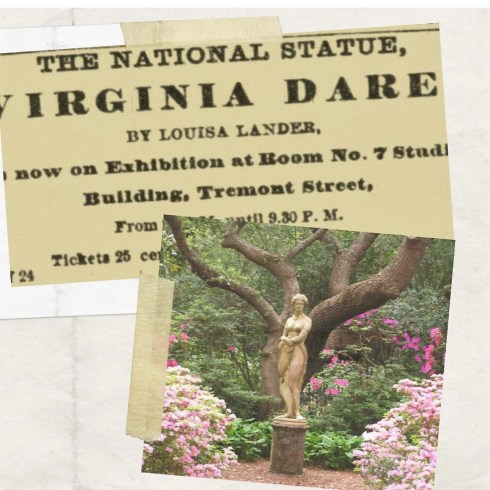
Daughters of old Salem families, Fidelia Bridges, who worked in several mediums and as both an artist and an illustrator, the Williams sisters, Abigail and Mary, who were both artists as well as art dealers, and sculptress Louise Lander, all found themselves in Rome in the mid-19th century for varying periods of time, drawing inspiration and establishing connections. The Misses Williams returned to the family home on Lafayette Street where they created a studio and loaned their works out to several prominent institutions, including the Essex Institute, which featured its very first art exhibition in 1875 featuring many Williams works. Louise Lander (1826-1923) also returned, reluctantly and eventually, to Salem and the family home at 5 Summer Street when she was shunned by the Anglo-American (and quite Salem-dominant) circle in Rome upon charges of some sort of scandalous behavior which she never deigned to answer. She exhibited her “national statue” of Virginia Dare, the first English child to be born in the New World, to raise money for war relief and moved to Washington, D.C. upon the death of her last Salem sister in 1893.

artist williams 4 (2)

Artists Williams Sisters Bulletin of Essex Institue 1875 (2)

Artist Virginia DareMary E. Williams, illustrations from The Hours of Raphael in Outline – Together with the Ceiling of the Hall Where They Were Originally Painted (Little, Brown, 1891); Just some of Mary and Abigail Williams’ works shown in the 1875 Essex Institute Exhibition; Virginia Dare in the Elizabethan Gardens & notice in the Boston Post, January 24, 1865.

To these nineteenth-century artists who seem to be awarded “professional” status I would add Mary Jane Derby (Peabody, 1807-1892) and Mary Mason Brooks (1860-1915) from the generation before and after the “Roman” circle. I’ve written about Derby many times before (see here and here) because I am the fortunate recipient of a journal she composed for her grandchildren, and Brooks more briefly here. Before her marriage, Mary Jane (a cousin of Louisa Lander) was definitely pursuing an artistic career, and she created several lithographs for the Boston firm Pendleton’s Lithography in the 1820s, including a view of her childhood home on Washington Street. Brooks, who worked exclusively in watercolors I believe, was one of the Salem artists who worked out of the famous “studio” at 2 Chestnut Street briefly, and her works were exhibited in Boston and New York. Among Mary Jane’s generation (almost) were two lesser-known artists, Sarah Lockhart Allen (1793-1877), who produced portraits in miniature and pastel, and Hannah Crowninshield( 1789-1834), both of whom were recognized as working artists by their contemporaries. Sophia Peabody Hawthorne (1809-71) is representative of the score of score of female artists who exhibited and sold their works at charitable fairs and bazaars in mid nineteenth-century Salem: always as “misses”.

brm2033-derby-nahant-ca-1827-749x1024 (2)

Artists Mary Mason Brooks

Artists reportsoffirstex01sale_0027 (2)

View of the Nahant House by “MJD” (Mary Jane Derby), Boston Rare Maps; Mary Mason Brooks, The Lumber Schooner, Grogan & Company Auctions. Just a few of the “Fine Arts” exhibitors from Reports of the First Exhibition of the Salem Charitable Mechanic Association : at the Mechanic Hall, in the city of Salem, September, 1849

And then there were all those Salem needlewomen! In her definitive work Girlhood Embroidery: American Samplers and Pictorial Needlework, 1650-1850 (1993), collector and scholar Betty Ring devotes an entire chapter to Salem, focusing on the influential school of Sarah Fiske Stivours (1742-1819) and showcasing the work of Antiss Crowninshield (1726-1768), Love Rawlins Pickman (Frye, 1732-1809), Susannah Saunders (Hopkins, 1754-1838), Betsey Gill (Brooks, 1770-1814), and Mary Richardson (Townsend, 1772-1824) among others. This was a very important Salem art form that was revived in the late nineteenth and early twentieth century by Jenny Brooks, Mary Saltonstall Parker (1856-1920) and other entrepreneurial artists.

Artists_Girlhood_Embroidery__2_-removebg-preview

artists Saunders Sotheby's (2)

Screenshot_20200618-064954_Chrome

Brooks Collage

mary-saltonstall-parker-house-beautiful-1916 (1)Betty Ring’s two-volume Girlhood Embroidery; Salem samplers by Susannah Saunders (Sothebys) and Elizabeth Crowinshield (Doyles); Jenny Brooks Co. advertisements from 1913, and Mary Saltonstall Parker’s cover embroidery for House Beautiful, October 1916.

So that brings me to the most entrepreneurial of Salem women artists, or maybe all Salem artists: Sarah Symonds, an artist-craftswoman descended from a long line of Salem craftsmen. I’ve written about Symonds (1870-1965) very recently, so I’m not going to go and on here, but she operated a very successful business selling her cast plaques of historic Salem symbols and structures in the first half of the twentieth century. Following her death in 1965 the Essex Institute, which operated as Salem’s historical society until its amalgamation into the Peabody Essex Museum in 1992, started collecting her works, as they “have enriched our local picture of the past”.

20200121_133721Sarah Symonds in her studio, Phillips MSS 0.202, Papers of Sarah Symonds, 1912-21.

How the past informs the present, and how the present acknowledges, interprets, and builds upon the past are central preoccupations of mine, and artistic perspectives on these processes can be just as illuminating as texts. I’d like to conclude this (again, working) list of women artists from Salem with a contemporary artist whose work is a great example of this illumination: book artist Julie Shaw Lutts. Julie’s a great friend of mine and I’ve featured her work before here, but she has just completed a very timely project which I love, so I wanted to showcase her talents again. The Vote is a mixed media artist’s book which commemorates the achievement of women’s suffrage in ways that are both personal and memorial, material and textual, and touching: all the best ways.

the-vote-9-julieshawlutts (2)

the-vote-8-julieshawlutts

JS Lutts 2©Julie Shaw Lutts, The Vote.


Women on a Pedestal

Obviously statues have been in the news of late, so I thought I would tap into the national (and international) focus by looking at some of our country’s more notable monuments to women, either striving for the franchise or striving in general, for this week’s #salemsuffragesaturday post. It doesn’t matter what your political inclination is, everyone seems to agree that there are not enough statues of women anywhere and everywhere, and corrective measures are being taken, along with initiatives associated with this Suffrage Centennial year. The husband and wife team who constitute Statues for Equality have established that statues of women represent less than 10% of public monuments in several American cities, and far less in most. In Salem we have only one statue to a woman: Samantha Stevens from Bewitched, situated in our city’s most historic square. She never accomplished anything (because she never actually existed) and her prominent situation and whimsical depiction mocks the real victims of the 1692 trials who were falsely branded “witches”, but nonetheless she is deemed worthy of monumental representation in Witch City. There are so many more women (real women) that deserve to be put a pedestal in Salem—that’s what this year has been all about for me.

pixlrSamantha is currently wearing an ensemble by local artist Jacob Belair, which I think is lovely on its own but also because it covers part of her up! I wish it extended to her unfortunate pedestal. I’m not in Salem now, so I asked my stepson ©Allen Seger to take the photos of Samantha in crochet.

Let’s turn to some more serious representations. Ever since it’s installation 15 years or so ago, the Boston Women’s Memorial has been one of my favorite monuments: not only is it aesthetically pleasing and immediately engaging, but it represents a spectrum of women who shaped Boston’s history (as well as that of Massachusetts and the nation): Abigail Adams, Phillis Wheatley, and Lucy Stone. These women are not just on pedestals (actually they have come off their pedestals) but depicted by sculptor Meredith Bergmann in the process of thought and activity, with their words accompanying them. Monumental women are in large part, active women, the feminine counterpart of all those masculine equestrian statues.

Screenshot_20200612-082211_Chrome

Screenshot_20200612-082224_Chrome

Screenshot_20200612-082234_ChromeThe Boston Women’s Memorial by Meredith Bergmann; photographs from her website.

Meredith Bergmann was also commissioned to create the most anticipated installation of this Suffrage Centennial Year: the Women’s Rights Pioneers Statue in Central Park in New York City, which will be unveiled on August 26, the date on which the ratification of the 19th Amendment was certified in 1920. This will be the park’s first statue honoring real women, and it also focuses on their activity: Sojourner Truth, Susan B. Anthony, and Elizabeth Cady Stanton are gathered around a table, intently focused on drafting a document. The statue had a controversial conception in that Truth was originally excluded, but public discussion and debate resulted in a more inclusive—and representative—monument.

Screenshot_20200612-082723_Chrome

Screenshot_20200612-082623_ChromeModel and Mock-up of the first and final monument to the Women’s Rights Pioneers by Sculptor Meredith Bergmann, to be unveiled in Central Park on August 26, 2020.

As the state which ultimately ratified the 19th Amendment in August of 1920, Tennessee takes its suffragist history very seriously and has produced two notable monuments to the women who worked so hard to make it happen (because it’s really not all about a wavering state senator is it?) There is the Tennessee Woman’s Suffrage Memorial (2006) in Knoxville, depicting Lizzie Crozier French, Anne Dallas Dudley, and Elizabeth Avery Meriwether, and the Tennessee Woman Suffrage Monument (2016) in Nashville’s Centennial Park, featuring Dudley along with Abby Crawford Milton, J. Frankie Pierce, Sue Shelton White and Carrie Chapman Catt. Even more recently, the Commonwealth of Virginia—always the site of so much statue furor—dramatically increased its commemorative depictions of accomplished women with its Virginia Women’s Monument: Voices from the Garden initiative, honoring the “full scope” of women’s achievements with twelve representative statues.

Screenshot_20200612-075354_Chrome

Screenshot_20200613-080549_Chrome

Screenshot_20200612-072439_Chrome

Screenshot_20200612-072336_ChromeThe Knoxville and Nashville Suffrage statues—both by Tennessee sculptor Alan LeQuire—and the unveiling of seven statues of prominent Virginia women last fall: former Virginia First Lady Susan Allen points to a statue of Elizabeth Keckley, dressmaker for Mary Todd Lincoln, and suffragist Adele Clark among the crowds (Bob Brown/ Richmond Times-Dispatch).

I like the fact that so many of these monuments are collective, featuring women engaged with each other. Sometimes they are working, sometimes they are simply “conversing”—or meeting for the first time like one of the most famous Suffragist monuments, the “When (Susan B.) Anthony met (Elizabeth Cady) Stanton” statue in Seneca Falls, New York, portraying the moment when these two icons were introduced by Amelia Jenks Bloomer in 1851. My very favorite “conversation piece” is the lovely statue of two prominent Rochester, New York suffragists, Anthony and Frederick Douglass, having a cup of tea: I would love to have been a fly on the wall (or the bench) for that conversation!

Screenshot_20200613-075828_Google

Screenshot_20200613-080112_ChromeThe Anthony-Stanton-Bloomer statue (1998) by Ted Aub in Seneca Falls; Ira Srole’s “Let’s Have Tea” (2009) in Rochester.

The most official Suffrage statue of all, Adelaide Johnson’s “Portrait” monument to Anthony, Stanton, and Lucretia Mott completed (and dedicated) in 1921, is also a collective representation but the women don’t seem particularly engaged with each other: it’s not my favorite statue but that doesn’t mean I think it should have been hidden away for most of the twentieth century! The “unfinished” appearance of the work also engulfs the women in their “pedestal” rather than placing them on it, but rumor has it that Johnson was making room for at least one more prominent woman—perhaps the first female president—to be carved out of that raw marble in the back at some point in time. Clearly not 2020.

Capitol StatueOffice of the Architect of the Capitol.


How do You Re-open a Tourist Town?

After a pandemic—or in the midst of one? Obviously the answer is very carefully. I grew up in a summer tourist town, York, Maine, and have lived in a seasonal–going on all-year tourist town, Salem, Massachusetts, for several decades, so the question is very interesting to me, and obviously far more than interesting to the residents and business owners of both communities. I’m in York now, so I thought I would start with some observations of what is going on here, and then follow up with Salem (whose many restaurants started opening up yesterday—in the streets) when I return in a few weeks. The policy in Maine is self-quarantine for two weeks for all people coming from outside: I am following that policy I believe: I came up with two weeks’ worth of groceries and supplies and am going to no public places, with the exception of parks and walkways near our home which are open. Self-quarantining in Massachusetts allowed daily exercise as well as essential shopping, so I was assuming that the former is allowed here: I found some contradictory information, but if I am the wrong let me know, Maine authorities! I stay far away from everyone on my daily walks and wear my mask at all times. We have the perfect situation here, as we have a big family house where my husband, stepson and I are staying, and my parents–who are Maine residents—are in their condominium less than a mile away. So if we run out of anything they can go and get it for us! The one time I was walking in rather public place, with my Maine parents and mask on, they insisted on going to the walk-in counter of Rick’s All-Season Restaurant for Bloody Mary’s: I stayed far away from the window and we imbibed at home. There is an ice-cream take-out window in Salem, but I don’t know if we have a Bloody Mary one—-yet.

IMG_20200607_120623_791The Take-Out Window at Rick’s Restaurant in York Village

I was quite accustomed to seeing masks on the streets of Salem as well as inside public places: here in Maine there seems to be less mask-wearing outside, but as I haven’t been inside anywhere but our home I’m not sure what’s going on there. Obviously Maine is a much larger state than Massachusetts with a much smaller population, so there is less concern about population density: in York the population typically swells in the summer, but with this two-week self-quarantine policy in effect I would guess that this would not be the case this summer. That is the pressure point. York is a really large town, geographically, with a lot of public outdoor space: three major beaches, a mountain with trails, parks, ponds, pathways—lots of room for social distancing. The beaches are open for active use: no sunbathing, but walking, swimming, fishing are allowed. In York Harbor, where we live, there are two coastal paths: the Cliff Walk and the Fisherman’s Walk. I grew up walking on the former in four seasons: but there have been some access issues over the past decade or so, and the owner of one abutting property has built a fence to block pedestrian access to part of the walk. It has been Covid-closed, but the nearby Fisherman’s Walk is open so that is where I will be taking most of my harbor walks. As you can see, it’s lovely, and very uncrowded: we’ll see what happens as June progresses.

20200609_102633

20200609_102553

20200609_095055

20200609_095449

20200609_095313

20200609_095625

20200609_101256

20200609_101139Fisherman’s Walk, York Harbor, Maine, with a new house (next-to-last photo) rising over the Harbor.