
Category Archives: History

Calendar Girls

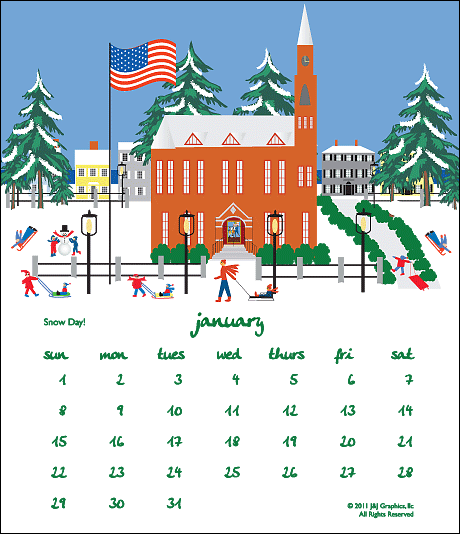
I’m a bit late for a calendar post, but then again I always buy my calendars after January 1st–sometimes well after January 1st.  While I’m not likely to engage in consistent sale-shopping or coupon-clipping, for some reason I get great pleasure from buying my annual calendars after they have gone on sale.  We usually purchase a “North Shore Folk Art” calendar from J & J Graphics at the Peabody Essex Museum shop for our refrigerator, and sometimes I even wait until they have their big January sale (this year it’s on the weekend of the 20th-22nd, definitely worth a visit if you’re in our area).  I’ll post January right here so I know what the date is until I get my own.
Upstairs in my office I generally pick something a bit more girly, whimsical, botanical, historical..whatever catches my eye.  Right now I’m liking this ethereal calendar from Irena Sophia, already on sale on Etsy!  I like the September and October girls–and Miss foxy February.

Calendars are an important form of ephemera that I haven’t featured on the blog yet, so why not now?  At the same time, they are among the timeliest and most artistic of genres.  And like all the pieces of paper we’ve examined over the last year–postcards, trade cards, book plates–they emerged as a mass-produced product in the later nineteenth century, coincidentally with the development of chromolithography.  I love the calendars from the “Penfield era”, from about 1890 to 1920, when the distinctive designs of illustrator Edward Penfield (1866-1925) graced the covers of magazines and the pages of the new poster calendars much more than those that came later with their Vargas-inspired pin-ups.  My “calendar girls” kept their clothes on!

Penfield calendars for 1897 and 1906 from the Library of Congress, above, and the work of some of his predecessors below (so you can see what an impression he made on turn-of-the-century graphic design):  an 1876 advertisement calendar for cigars and champagne, and two calendars by Boston-era publishers, also from the Library of Congress.

Calendars from Penfield’s fellow art nouveau illustrators  Louis Rhead (for Prang) and A.B. Wenzell for 1897 and 1899 are below, along with another rather less-artistic 1907 Boston calendar, for the beloved Necco wafers, all from the New York Public Library.


First Footing

I have many plans for this year, and in order to give myself as much support as possible, I adhered–as best as I could–to the Scottish New Year’s tradition of “first footing”.  According to this custom, whoever enters a house first upon the New Year determines its fortune in the coming months, and the preferable “first footer” is a tall dark man. All women are (of course) unlucky, and fair-haired men equally so, perhaps out of a long-held fear of Viking invaders.  Unfortunately for my household, only two people were in a position of entry after midnight last night:  myself (a woman) and my husband (a fair-haired man, of Swedish descent, even more problematic).  My stepson is not with us for this weekend, and as he’s equally fair-haired he would not be much help.  I thought of pushing some dark-haired neighbor over the doorstep at midnight (this is no doubt what the Scots do), but instead decided to over-compensate with the lucky gifts that the first-footer should bring into the house:  bread (or the alternative shortbread or fruitcake), whiskey, coal, salt, and coins.  Just one of these gifts should suffice, but I fixed up a basket with all of them for extra luck, and we carried it over the doorstep when we came back from our New Year’s Eve party.

Hope it works!  Good luck to everyone in the New Year.


Years of Protest

The last days of the year are always a time for reflection and assessment, perhaps personally but certainly by the media.  So far, all of the pieces that I have seen on television and in print characterize 2011 as a “year of protest”, following Time magazine’s “Protester” Person of the Year.  Like all historians, I find agitation attractive because it signals a time of (exciting) change rather than (boring) continuity, but I’m not certain that this is the case with 2011 yet.  Everyone seems so distracted by their various electronic devices, and protesting (and change) takes real engagement.  Perhaps this is too American a view, but 2011 doesn’t look quite like 1968, or 1789, or the 177os, or the 1640s, or the 1520s, or the very rebellious period of 1378-1381.

This last (or first) era of rebellion, culminating in the English Peasants’ Revolt of 1381, did not really result in change but was exiting nonetheless for its novelty:  the 99 percent seldom rebelled against the 1 percent in the Middle Ages.  But the fourteenth century changed everything, bringing forth famine, plague, war and schism in intense degrees and leaving its survivors with nothing left to lose and everything to gain.  Abandoned by their Church and very conscious of their bargaining power in a world that had lost over 30% of its laborers to the Black Death, the peasants of England marched on London to seek an audience with King Richard II after the imposition of what they perceived as unfair taxes and wage restrictions.  With the charismatic Wat Tyler and John Ball leading them onwards, they got their audience with the young King (slaughtering the Archbishop of Canterbury along the way), but were defeated soon afterwards.

The preacher John Ball leading the peasants, the murder of the Archbishop of Canterbury, and King Richard confronts the peasants, all from the Chronicles of Jean Froissart, British Library MS Royal 18 E I, circa 1483.

In retrospect, the English Peasants Revolt illustrated, rather than caused, change, but its message, articulated best by a speech attributed to Ball in which he speaks of “liberty” and asks the rhetorical question when Adam delved and Eve span who was then the Gentleman survived and was revived in the modern era, when it reflected even more change.

Edward Burne-Jones illustration for William Morris’s Dream of John Ball, 1888.


Bits of Holly History

It occurred to me that holly–the traditional symbol of Christmas and Winter–is often paired with something and seldom presented on its own.  The “holly and the ivy” is the best example, but there are many others, like this stylized little image of holly and a lyre on the cover of a Christmas concert program from 1898.  I found the program in a dusty box of sheet music at a yard sale a couple of years ago, and opened it just the other day.

That same day I also checked in with the blog of the Met’s Cloisters Museum, The Medieval Garden Enclosed, to find the “holly girls” decorating the museum’s arches with holly.  So beautiful!  I have both interior and exterior arched doorways and several flourishing holly bushes–I wonder if I could do this next year?  Probably not, but at least I can think about it.

Holly is often pictured in the margins of medieval manuscripts (usually with ivy, its companion plant) and seems to have had many associations and virtues, all positive.  With its bright red berries blooming in December, it represents light, warmth and hope, joy and goodwill.  It has always been a protective plant:  against poisons and demons, even lightning.  With the coming of Christianity, it came to be associated both with the Virgin Mary and the blood (berries) of Christ.  In the early modern era, the holly tree was prominently linked with the ars nova of printing, notably on the title age of Leonhart Fuchs’ De historia stirpium commentarii insignes (“New Herbal”, 1542-43).  The title-page device of Basel printer Michael Isengrin features a holly tree with a printing-house platen amongst its branches,representing its increasing secular symbolism.

And here are two more holly herbal images from Elizabeth Blackwell’s Curious Herbal  (1739) and Francois Andre Michaux’s North American Sylva (1819).  Blackwell illustrated her own book, while Michaux called upon one of the most famous botanical illustrators of his day, Pierre Redoute.

In the nineteenth century, the holly becomes the stereotypical holiday plant through advances in lithography and the emergence of the dynamic greeting-card industry, which produced millions of holly-embellished holiday cards.  But there were other images of the plant out there too:  elaborate theatrical costumes, ceramics, cigarette cards.  The collection of the Victoria & Albert Museum encompasses a large collection of costumes from the London theater, including these two creations by “Wilhelm” (William Charles Pitcher) for productions in the 1890s:  Holly personified, with Mistletoe and alone.  From the same era and collection is the Minton “Four Season” tile, with holly representing winter.

And then there were so many cards: cigarette cards for advertising, Christmas and New Year’s cards for “greeting”.  The first card below, issued by the Duke’s cigarette company in the 1890s, is part of a “Language of Flowers” series, which associated holly with “foresight”.  The second and third are British and from the 1920s, illustrating the uses of the (hard) holly wood (chess sets and teapot handles, apparently) and the boy scout “holly patrol” badge.  How the holly has “evolved”:  from the blood of Christ to the boy scouts!

And finally two greeting cards, both from the vast collection at the New York Public Library Digital Gallery like the cigarette cards above:  a simple New Year’s Day card from the turn of the last century and a birthday card of similar vintage on which holly is paired with something I’ve never seen before:  turquoise?


Green (Room) Christmas

Apparently it was “Silent Cal” Coolidge who initiated the customs of both the national Christmas Tree (in 1923) and the presidential Christmas Card (in 1927).  The former began as a subtle promotion for Coolidge’s state of Vermont, which sent along the tree, while the latter custom seems to have emerged from Mr. and Mrs. Coolidge’s sincere appreciation for the large number of condolence and Christmas cards they received after the sudden death of their youngest son from blood poisoning in 1924.  The Christmas Cards from the Coolidge, Hoover, Roosevelt and Truman administrations are pretty sedate, which makes sense considering they were issued in an era dominated by the Depression and World War, but things begin to liven up with the Eisenhower and Kennedy eras:  could White House Christmas cards be signs of the times?

I was going to showcase chronological Christmas cards by administration, but frankly the pre-1960 ones were pretty boring.  A completely representative example is this 1941 card below,  but its simplicity and sedateness is understandable–this was only a few weeks after Pearl Harbor.

The first National Christmas Tree, 1923; Library of Congress; the Roosevelt 1941 Christmas Card, White House Historical Association.

Looking at all these cards, I became fixated on those showing White House interiors in general, a tradition that began with the Kennedy Administration, and the Green Room in particular:  I’m a big Red Room fan too, but the Green Room Christmas cards really capture the essence of the season for me.  So here they are:  Green Room Christmas cards from the Kennedy, Reagan, and Clinton administrations.  The first one, by illustrator Edward Lehman, is obviously the most poignant (and valuable), as it was issued only a few weeks after President Kennedy’s assassination to only a select few–primarily White House staff.  Twenty years after the Lehman image, interior designer Mark Hampton reproduced the newly-redecorated Green Room in watercolor for the Reagan’s 1983 Christmas Card.  And finally, the Clinton’s 1996 Christmas card by artist Thomas McKnight.

The Green Room decorated for the Holidays this season, with wreaths and trees made of recycled newspapers and magazines, illustrating the theme “Reflect, Rejoice, and Renew”.


The Christmas Dance at Hamilton Hall

Hamilton Hall was built as an assembly house in 1805 by Samuel McIntire and it retains this essential function over 200 years later.  It has been the setting for festive fetes for important people (the Marquis de Lafayette, Nathaniel Bowditch, Andrew Jackson), debutante assemblies, lectures, forums and exhibitions, and the annual Christmas Dance.  I believe that the Christmas Dance began just after World War II, along with another annual event, the Hamilton Hall Lecture Series, but it retains traditions that herald back to earlier assemblies:  patronesses, ushers, curtseys, a lethal bourbon punch, and a “Grand March” at the end of the evening.  I never miss it.

Mary Harrod Northend (1850-1926), author, photographer, and descendant of several old Massachusetts families, recounts many Hamilton Hall traditions in her book Memories of Old Salem (1917) and Colonial Homes and their Furnishings (1912).  Like her contemporaries Wallace Nutting and Alice Morse Earle, Northend had a rather sentimental view of  the “ye olde” colonial past, Salem’s past, and her past, but her books and photographs are still charming.

I went over and took some pictures of the empty Hamilton Hall, well before the caterers and dancers arrived.  There’s something about an empty “party” hall, especially this particular one with its interesting acoustics and spring dance floor, that is compelling, even romantic.  As you can see, the Hall has an elegant but somewhat spare interior, which was disdained by the Victorian ladies of Northend’s Memories, who were always embellishing it with flowers and oak leaf garlands and swags. The gilt mirrors, which are always referred to as the Russian mirrors, were an addition of that time, along with the lighting.

The second-floor ballroom.

The Lafayette Room, with the Marquis over the mantle.

More mirrors in the Supper Room on the third floor.

Hours later, the food and attendees were assembled in the Hall, the latter not quite as orderly as in one of Northend’s photographs, despite their participation in the Grand March.


Tea Party Tempest

One of the most interesting jobs of the historian is figuring out when and why an occurrence becomes an EVENT.  Lots of things that happen never rise to the level of “history”, but those things that do often get embellished over time.  A great example is the Boston Tea Party.  As the anniversary of this big event occurs this week (December 16), I thought I’d take a break from the holidays and get back to history.

As I’m not an American historian I asked my question when did the Boston Tea Party become the Boston Tea Party to a number of experts, both in person and on the web.  There seems to be a general consensus that the event was almost immediately recognized as extraordinarily significant but that the actual term doesn’t appear until decades after the Revolution, when its last participants (particularly George Hewes ) began recording their memoirs.  Apparently the first historians of the American Revolution did not want to herald an event involving the destruction of property, but in 1826 newspaper reminiscences started to use the term “Tea Party” or “Tea-Party”, and it was consequently adopted by historians. (Apparently the first use of the term referred to the participants rather than the event).  There are comprehensive discussions and comments about every aspect of the Tea Party, and all the other pre-Revolutionary agitation in Boston, at the great blog Boston 1775.

Across the Atlantic, the historical significance of the Tea Party was realized relatively early.  Just several years into the Revolution, the German engraver Carl Gottlieb Guttenberg published The Tea-Tax Tempest, or the Anglo-American Revolution (1778), an adaptation of an earlier political print by John Dixon which was itself adapted by the British caricaturist William Humphreys as The Tea-Tax-Tempest, or Old Time with his Magick-Lantern (1783).  In both we have allegorical figures representing the world and Europe looking on at an exploding teapot and agitated Americans.

Tea Tax Tempest caricatures at the online exhibition “America in Caricature, 1765-1865”, Lilly Library at Indiana University.

With the close connections between France and America during the American Revolution, it was only natural that Europeans emphasized the American rebellion of the 1770s when the French Revolution broke out in 1789.  The Tea Party becomes a precedent, or a first act, in what may be a universal revolution.

The History of North America, E. Newberry, London, 1789.  Library of Congress.

So the occurrence of 1773 is clearly recognized as an important event well before the turn of the nineteenth century, a realization that is reinforced by the success of the American Revolution and the beginning (and drama) of the French.  But the tempest doesn’t become the “party” until James Hawkes’ Retrospect of the Boston Tea-Party with a Memoir by George R.T. Hewes (1834), and it takes off from there, in both print and image. The rest is history.

Covers of James Hawkes’ Retrospect of the Boston Tea-Party (1834) and H.W. McVickar’s children’s book The Boston Tea Party (1884), both Library of Congress.


Pine Cone Time

(Having spent more time than I have trying to determine whether “pinecone/ pine cone” is one word or two, I’m opting for two).  Along with the Christmas tree, there is no more omnipresent natural motif at Christmas time than the pine cone, which is rather ironic, given its decidedly pagan roots.  In classical mythology, the pine cone is most prominently featured on the thyrsus, the staff held by Dionysus and his bacchanalian cohorts.  The thyrsus is made from a stalk of fennel topped by a pine cone, representing the farm, the forest, and all sorts of fertility; in both classical and more modern imagery it is more representative of revelry than religion.

A.E. Becher, Bacchanal Scene (with pine cone-topped thyrsus leading the way, in left-hand corner),1903

With the coming of Christianity, the pine cone fades into the background as a natural motif and a way to bring some “life” indoors during the long winter.  I’ve seen pine cones in medieval manuscripts, but I think they become more apparent in early modern decorative arts.  Pine cone knobs are common features of eighteenth-century porcelain, like this beautiful coffee pot from the 1730s.  Fabrics and wallpapers also featured pine cones in the eighteenth and nineteenth century, as they do today.

Mulhouse Fabric, 1830s, Victoria and Albert Museum

Cotton Pine Cone fabric from the Whispering Pines Catalog.

Even if pedestrian pine cones don’t make it into the final product, they often served as objects of study for artists.  The two charming studies (made between 1950-75) by Samuel Chamberlain (also a brilliant photographer, whose Salem Interiors remains one of my favorite books) in the Smithsonian’s Archives of American Art illustrate his composition process.  The pine cone comes into its own in the recent drypoint by Jake Muirhead, from the Old Print Gallery.

Pine cones remain a popular element of seasonal decor because they’re so affordable (free!), accessible and flexible:  you can make ornaments, garlands, swags, topiaries, tablescapes, and wreaths out of pine cones, or just scatter them around.  And when the holidays are over and the glitter goes away, the pine cones can remain until the Spring, when more signs of life begin to appear.  Here are a few pine cone items that transcend holiday decor, and could (I think) be made at home (relatively) easily.

Pine cone garland from Anthropologie, map “pine cone” ornament from Turtles and Tails, and rustic pine cone mirror from Wisteria.


Oh Christmas Tree

We just put our tree up, and it’s beautiful, but almost too beautiful.  For the first time ever, we got a Scotch Pine tree rather than the usual fir, and it is so full and fluffy and perfectly shaped that it looks fake.  Everywhere there are needles that testify to its reality, but at a glance, it looks fake.  Here are a few pictures:  for some reason, my cat Moneypenny had to be in every shot.

Every year, when I am decorating my tree, I have two thoughts:  Prince Albert and Halifax.  Queen Victoria’s beloved consort-husband and the Nova Scotia port city are connected in my mind through Christmas trees.  I think of Prince Albert because he is generally credited with introducing the German/central European custom of decorating evergreen trees at Christmas time to Britain, and consequently America.  Given her Hanover roots, Victoria was probably well aware of this custom before she met and married Albert, but their Christmas trees were revealed to the public in an unprecedented manner, and so the Prince probably does deserve some credit.  A particularly influential print of the royal Christmas tree was published in the Illustrated London News in 1848, and the American periodical Godey’s Lady Book two years later. And about a decade after that, Brtish Christmas cards (also a novelty) prominently featured the Christmas tree.

Why do I think of Halifax when I’m trimming my tree?  Ironically, because of a really tragic event:  the harbor explosion of December 6, 1917.  On that day, in the crowded wartime harbor, a French cargo ship loaded with munitions collided with a Norwegian ship, causing a fire, explosion, and tsunami that leveled over 2 acres of the port and killed 2000 people.  In the ensuing rescue effort, a well-supplied Massachusetts delegation was among the first to arrive in Halifax and the last to leave.  The next year, the still-struggling city of Halifax thanked the people of Boston by sending them a 46 foot fir Christmas tree, a tradition that was revived in the 1970s and continues today.


Prang of Boston

Last month, the Peabody Essex Museum here in Salem opened a year-long exhibition of seldom-seen treasures from its Phillips Library entitled Unbound, Treasures from the Phillips Library at PEM.  Even though the exhibit includes a leaf from the Gutenberg Bible and original transcripts from the Salem Witch Trials (which, pardon my rant, are public records and should be more generally accessible), the most compelling visual images in the exhibition are the progressive proofs for a lithographic portrait of Ludwig von Beethoven produced by Louis Prang  & Company of Boston in 1870.  The collective image is very modern in its repetition and perspective, and also illustrates the intensity of the chromolithographic process.

Progressive Proofs from the Phillips Library, PEM, and the finished portrait from the New York Public Library Digital Gallery.

Prang & Company was the color printer for most of the second half of the nineteenth century.  Louis Prang learned the art of color lithography in Germany and perfected it in Boston, where he produced reproductions of great works in the spirit of “the democracy of art”.  He was a also a practical printer who produced thousands of cards, calendars, and advertisements for his always expanding market. Prang’s “views”, whether artistic, historical, or scenic, seem to have a strong American  theme; he had fled Europe right after the tumultuous revolutions of 1848 and clearly valued American democracy as well as cultural democracy.  Here are some of my favorite Prang prints from the Library of Congress and New York Public Library; given the business locale, the Boston Public Library also has a large collection of Prang prints.

A very diverse assortment from the Library of Congress:  the popular bird’s eye view of Boston (1877), a kitchen view  from Prang’s Aids for Object Teaching (1874), a baseball game(1887), and an undated still-life.

I find Prang’s advertising posters even more appealing than the products they are peddling, especially as we get closer to the turn of the century and art nouveau imagery.  Here are a few advertisements from the New York Public Library Digital Gallery, both from the 1890s.

Prang is also an important figure in the history of ephemera, quite apart from chromolithography, because of his pioneering role in the emerging greeting card industry.  I’ve seen him referred to as the “father” of the Christmas card (and the Valentine’s Day card, and the Easter card, etc…) more than once.  I’ll post some Prang cards a bit later in the season, but for now, just a preview.

