Category Archives: History

Ever Eglantine

I’ve got roses on the brain, but not just any rose, eglantine roses, a wild, shrubby variety (otherwise known as sweetbriar or Rosa rubiginosa or eglanteria) at once very common but surprisingly elusive now.  I’ve been thinking about these roses for several reasons.  It is late May, and my roses are about to bloom, and I’ve come to the realization that I just don’t like several of them:  hyper-hybridized varieties that let me down every summer. Too pumped up and showy.  I want to go back to basics, and the eglantine rose is a very old rose, pared down and rambling, with a lovely scent. Chaucer wrote about this rose, as did Shakespeare, and Elizabeth I adopted it as her favorite symbol.

A beautiful sweetbriar rose in the Cloisters Garden.

So I have personal reasons for thinking about the eglantine rose, but also scholarly ones.  Summer classes start this week, and after an administrative semester, I’m back to teaching (gratefully): a course on “Shakespeare’s England” and one on Renaissance art, science and technology.  Content from both will probably appear in future posts, and the eglantine rose definitely ties in to the first, because “Shakespeare’s England” was largely Elizabethan England, and Elizabeth loved eglantine roses. The last Tudor had her family emblem, the Tudor Rose, and she used it often, but she adopted the more natural eglantine, symbolizing royalty and chastity, as a personal device, particularly after she had forsaken marriage in favor of “marrying England”.  The “Phoenix Jewel”, from about 1574, show Elizabeth surrounded by intertwined Tudor and eglantine roses (as the Virgin Queen, she preferred white), though in the more public “Phoenix portrait”, from about the same period, she is holding the Tudor Rose. Almost two decades later, William Rogers’ print “Rosa Electa” shows her with the Tudor Rose on one side (left) and the eglantine on another:  at this last phase in her long reign, she was widely associated with eglantine roses, even sometimes referred to as the Eglantine.

The Tudor Rose in BL MS Royal 11 E xi, ff. 2v-3 (a canon for Henry VIII); The “Phoenix Jewel”, circa 1574, British Museum; The “Phoenix Portrait”, attributed to Nicholas Hilliard, c. 1575, National Portrait Gallery, London (on loan to the Tate Museum since 1965).

More visual evidence of the first Elizabeth’s association with eglantine roses is her court painter Nicholas Hilliard’s miniature, Young Man among Roses (1585-95), in which a young courtier (often identified as Robert Devereux, the 2nd Earl of Essex) pays tribute to her simply by standing among eglantine roses (with his hand on his heart).  And then there is George Peele’s exhortation to his fellow Englishmen and -women to wear eglantine, and wreaths of roses red and white put on in honor of that day, for her Accession Day, November 17.

Nicholas Hilliard, Young Man among Roses (1585-95), Victoria & Albert Museum, London.


After Elizabeth, the eglantine rose continues to be admired, though perhaps not with the symbolism it had before. It’s a simple, country rose, contrasted with more extravagant varieties:  natural, wild.  Like all roses, it acquires all sorts of romantic associations in the eighteenth and nineteenth centuries, only to be turned into a tobacco brand in the twentieth!

“Rosa Eglanteria Zabeth” (Queen Elizabeth’s Eglantine Rose), Pierre-Joseph Redoutélater 18th century;  The “Wild Rose”, W.L. Ormsby lithograph, NYPL; a lithograph by Jane Elizabeth Giraud from “The Flowers of Milton”, 1846, NYPL; Tobacco Card, Duke University Emergence of Advertising Digital Collection.

The prettiest paper eglantine roses seem to be on paper:  William Morris chose the rose and its vine for one of his earliest, and most popular designs, “Trellis” (1864), and there is a lovely, simple pattern reproduced by Carter & Company Historic Wallpapers based on paper found in a house in Georgia that dates from the 1840s.  I love this company’s slogan:  History repeating itself….

“Trellis” wallpaper by William Morris, Victoria & Albert Museum, London; “Marietta Eglantine” wallpaper by Carter & Company Historic Wallpapers, LLC.


Long Hill

Just to the north of Salem, over the Danvers River, is the city of Beverly, of similar size demographically but much larger geographically.  Beverly has a vibrant downtown, which is surrounded by lots of neighborhoods which are quite distinct: Ryal Side on the river, the historic Cove, the affluent coastal communities of Beverly Farms and Pride’s Crossing, inland Montserrat and Centerville, and North Beverly.  This is not an exhaustive list; neighborhood identities are well-established in Beverly. There are amazing Gilded Age mansions in the Farms and Pride’s Crossing, and the entire North Shore coast achieved an even more gilded reputation after President William Howard Taft made Beverly the site of his “Summer White House” in 1909, first renting the Stetson Cottage at Woodbury Point in the Cove and then “Parramatta”, a house in Montserrat.

President Taft’s first Summer White House in Beverly; after 2 summers here, his landlady, Mrs. Maria Evans, informed the President that she was replacing the house with an Italian garden (still there, in the now-public Lynch Park)!  The house was cut into halves, put on barges, and floated across the water to Peaches Point in Marblehead.  You can see all the pictures at the digital exhibition of the Beverly Historical Society.  Paramatta, the second Taft Summer White House, is below.

By way of introducing I am digressing!  Suffice it to say that Beverly had a well-established reputation as the site of a wealthy and politically-connected summer society before and after the coming of President Taft, and the architecture to prove it.  I’m going to take on a few of the greater North Shore’s more famous (and interesting) summer “cottages” myself this summer,but in the meantime you can satisfy any curiosity you may have with the wonderful book by Pamela W. Fox, North Shore Boston: Country Houses of Essex County, 1865-1930, or Joseph Garland’s Bostons Gold Coast: The North Shore, 18901929.

One theme that emerges from both books is the difference between the simple wooden structures built by the Boston Brahmins before Taft’s time and the more elaborate mansions built by non-Bostonians after.  That trend does not quite apply to the house that I am writing about today, Long Hill, built by Atlantic Monthly editor-owner Ellery Sedgwick and his wife Mabel in then-rural Centerville, away from the maddening crowd on the coast.  Sedgwick’s Massachusetts (western Massachusetts) roots go way back, but he did not choose to build a restrained Yankee cottage; instead he and Mrs. Sedgwick copied (and mined) a dilapidated Southern house:  the Isaac Ball House (1802) in Charleston, South Carolina. I tried and tried to find a photograph of the original Charleston house in situ, to no avail (only turning up images of the Ball family’s several plantations, all in sad states, and a few references to the “town house”) but Long Hill, completed around 1921, is supposed to be a close copy.

When I visited Long Hill the other day, I ran into some architect friends of mine, who pointed out details that I would have not seen on my own:  the perfect proportions (sadly missing in modern “Georgian” Mcmansions), the old, weathered, mellowed brick, certainly not circa 1920 brick, the very delicate columns, the classical details.  It is a charming house, well-situated, but it still looks a bit out-of-place to me.  I’m more impressed with the gardens, and all the surrounding woodland.  I never really understood why the Sedgwicks wanted to be so far away from coastal “society” (and breezes), because I never really knew about Mrs. Sedgwick’s horticultural interests—and achievements.  The author of The Garden Month by Month (1907, lots of illustrations and a pull-out flower color chart) wanted land, not ocean views, and she and her husband acquired 114 acres in Centerville on which to build not only their house but their very cultivated garden, even more impressive because of the contrast between it and the woodlands beyond.  Mabel Cabot Sedgwick died in 1937, but her husband remarried another horticulturalist, Marjorie Russell Sedgwick, who continued to improve the gardens at Long Hill.  The property was transferred to the Trustees of Reservations in 1979, and remains a peaceful, pastoral retreat.

The gardens at Long Hill:  woodlands surround the manicured lawns and garden “rooms” adjacent to the house:  blooming Solomon’s Seal, wisteria & peonies.


The Doctrine of Signatures

This week’s blooming plant is the lungwort, or pulmonaria officinalis, a low-lying shade plant with speckled leaves that has always been the best example of the pre-modern theory of the Doctrine of Signatures for me.  An ancient theory that was embraced and expanded by several influential Renaissance writers, the doctrine held that the appearance of plants was an indication of their potential curative powers, or “virtues”.  Just as God created disease, he also gave man cures, hidden in nature, but marked by clues, or divine signatures.  I use the doctrine in class as one example of how closely tied medieval and early modern people were to nature, as clever a manifestation of God’s creation as themselves.  Lungwort, with its speckled lung-shaped leaves, was widely believed to contain virtues which could cure diseases of the lung, hence the name.

Lungwort in my garden yesterday, in British Library MS Egerton 747 (Nicolaus of Salerno, Tractatus de herbis , c.1280-1310), and as drawn Elizabeth Blackwell for her Curious Herbal, 1739 and Magdalena Bouchard  for Giorgio Bonelli’s, Hortus romanus, vol. 2, Rome, 1774, tab. 27  (Wellcome Library).

Paracelsus, in most ways a Renaissance medical revolutionary, nevertheless embraced the ancient doctrine in his “great” surgery book (Die grosse Wundartznei), published in 1537:  “I have oft-times declared, how by outward shapes and qualities of things we may know their inward virtues, which God has put in them for the good of man.  So in St. John’s Wort, we may take notice of the form of the leaves and flowers, the porosity of the leaves, the veins [which] signify to us that this herb helps both inward and outward holes or cuts in the skin.  The flowers of St. John’s Wort, when they are purified are like blood; which teaches us, that this herb is good for wounds.”  St. John’s Wort doesn’t seem as conspicuously “signed” as lungwort to me, but this passages shows you how far Renaissance doctors were prepared to go. Paracelsus does not mention the plant’s medieval virtue (illustrated below):  that of demon repellent!

BL MS. Sloane 4016:  St. John’s Wort (Hypericum perforatum) repelling a demon, Northern Italy, c. 1440.

Later in the sixteenth century, another Renaissance “scientist” (you have to put that word in quotations before Sir Isaac Newton, at the very least) elaborated upon the doctrine in words and images.  Giambattista della Porta, who was also a relatively well-known playwright, was very interested in outward appearances, not only of plants but also of animals and humans, and how appearance affected behavior. His Phytognomonica (1588) contains wonderful, literal images of the doctrine, like the one below, of “ocular” plants like the aptly-named eyebright, which was said to improve sight.

Giambattista della Porta, Phytognomonica (1588), and a 1923 updated image from the Wellcome Library, London.

You can go on and on with the doctrine of signatures, so I’m going to end with one last image of a plant in my garden:  a maidenhair fern, which was (of course), perceived to be a plausible cure for that most common of ailments:  baldness.


Mrs. Parker and the Colonial Revival in Salem

A recent article about a beautiful garden in Litchfield, Connecticut in Traditional Home referred to that northwestern Connecticut town as the “birthplace” of the Colonial Revival movement in America, which struck me as a pretty bold claim.  It is a pretty little town that seemed to deliberately tie itself to a fixed point in time about a century ago, but certainly lots of places could claim to be the birthplace of such a widespread cultural movement.  We certainly had our share of Colonial Revivalists here in Salem in the guise of architects, photographers, artists and authors, many of whom I’ve already written about here, but one who I have not yet mentioned:  Mary Saltonstall Parker (1856-1920), author and artist, but above all, someone who captured the myriad details of the past and the present.

For the last part of her life, Mrs. Parker lived across the street from our house on Chestnut Street in the beautiful brick Federal house you see below, the only house on the street whose facade does not face the sidewalk. Her Salem and Chestnut Street roots go way back:  she was, in the words of her near-contemporary Mary Harrod Northend, “a descendant of Colonial dames”.  She grew up at the other end (and other side) of the street, in a house built by her great-grandfather, Captain Thomas Saunders, for her grandmother and grandfather, Mary Elizabeth Saunders and Leverett Saltonstall, later the first Mayor of Salem and a member of Congress. This same house, 41 Chestnut, later became the home of her parents, Lucy (Saltonstall) Tuckerman and Dr. John Francis Tuckerman , and consequently her childhood home.  She left upon her marriage to William Phineas Parker, a cousin of the Parker Brothers of game-fame, but she didn’t go far.

So Mary Saltonstall Parker grew up surrounded by the comfort of friends and family on a street lined with mansions which were filled with all the beautiful things that mercantile money could buy.  She seems to have taken none of this for granted, and starting in the 1890s she started documenting her world–first the past, then the past and the present.  Her first means of artistic documentation and expression was verse; her second, embroidery, a traditional colonial craft.  There is a flurry of little books in that last decade of the nineteenth century:  At the Squire’s in Old Salem, Salem Scrap Book, Rules for Salad, in Rhyme, A Baker’s Dozen of Charades, A Metrical Melody for the Months, and, my favorite, Small Things Antique.  This last book is a charming discourse (in verse, of course) on all the little things she finds around the house, most of which no longer have any purpose but decoration: badges (the precursors of buttons, I suppose) from the 1840 and 1850 elections, warming pans (In old New England homes their use is ended, They hang with ribbon from the wall suspended. They stood for so much comfort in the days, When all our heating came from a log fire’s blaze), toasting forks, patch boxes, knee buckles, the pink lustre china on her shelves, the old jewelry in her top drawer.

The last item she observes in Small Things Antique is a sampler, and that schoolgirl craft would be her major form of expression for the last part of her life.  With her needlecraft, however, I think you can see the difference between Colonial and Colonial Revival:  Mary Saltonstall Tuckerman Parker’s samplers might have been produced with traditional techniques, but their themes were contemporary:  war and uncertainty in the first decades of the twentieth century.  The two samplers below, from the collection of the Peabody Essex Museum, show a mother’s anxiety before and during World War One.  There are biblical passages combined with very contemporary references and images above, and below, an amazing mixture of past and present:  her own family warriors (her father, John Francis Tuckerman, a naval surgeon, and her two sons, Francis and William, presently in the service) along with an image from the Bayeaux Tapestry!  A long–very long–tradition of wartime embroidery.  The sampler has even more currency because of her “notation” that it was completed just after the November Armistice, the “Dawn of Peace”.

Mary Saltonstall Parker Samplers, from the Collection of the Peabody Essex Museum.  These images were scanned from Painted with Thread:  the Art of American Embroidery by Paula Bradstreet Richter, the Curator of Textiles and Costumes at the PEM.  Painted with Thread is the companion catalog to the 2001 exhibition of the same name.

Mrs. Parker’s samplers gained national recognition during World War One, and one was commissioned for the cover of House Beautiful in 1916:  a more traditional example, in both technique and imagery.

The last sampler completed by Mrs. Parker before her death in 1920 has an outwardly traditional appearance as well, with its house and garden and quotes (the Prior one at the top is particularly poignant) but it also reveals personal sentiments, for better or worse:  the words Armistice and Victory put us in the time, and the nearly snuffed-out candles bracketing her name tell us that her time is nearing an end.

Mary Saltonstall Parker (1856-1920), Sampler, 1920, from Paula Bradstreet Richter, Painted with Thread, The Art of American Embroidery (Peabody Essex Museum, 2001).


Aesop’s Mothers

For Mother’s Day, I was planning to do a post called “Grimm Mothers” (a title I love) about fairy-tale mothers, but I quickly realized that most of the mothers in the Grimm tales are evil stepmothers, and being one myself (not evil, just a stepmother), I decided to shift my focus from fairy tales to fables.  Aesop’s Fables, especially the larger editions, actually includes quite a few interesting mothers, most of which you don’t come across very often:  lobster and crab mothers, mole mothers, lark and moon mothers, in addition to mothers dealing with wolves and thieves.  So we have real maternal diversity today.  There are so many editions of Aesop to choose from; this title has never been out of print since the dawn of printing and there are manuscript versions before that.

Aesop telling his tales to an audience of men and beasts; the frontispiece to John Ogilby, The Fables of Aesop paraphrased in verse (London, Thomas Warren for Andrew Crook, 1651).

For images, I really like a mid-nineteenth-century edition illustrated by C.H. Bennett, The Fables of Aesop and Others, Translated into Human Nature (W. Kent & Co., 1857).  Bennett injected “humanity” into the fables by putting Aesop’s animals in contemporary clothes, situations, and environments, complete with “family pictures” on the walls.  You can find later colored versions of these plates, but those below are from the first edition.

Lobsters, apes and moles….a half-century later, “golden-age” illustrator Arthur Rackham offered up images of even more unusual mothers, a crab and a moon, for a “new translation” of Aesop’s Fables (1912) which is still in print today:  an absolute classic.

The fable of the moon:  The Moon once begged her Mother to make her a gown. “How can I?” replied she; “there’s no fitting your figure. At one time you’re a New Moon, and at another you’re a Full Moon; and between whiles you’re neither one nor the other.”


Zouaves

This poster for the Watch City Festival this weekend in Waltham, a very happening city to the west of us, caught my eye not only because of its fetching image but also because of its reference to the Salem Zouaves, a reference I’ve seen quite a few times in these past few months.  Who or what are the Salem Zouaves, you may ask, a question I’ve been asking myself.  I think I’m going to use this post to try to figure them out.

It’s not too difficult to figure out who the Salem Zouaves are here in the present:  a reenactment group who “recreate the exotic, flashy drill and uniforms of the original Salem Zouaves, including our signature bayonet and sabre fencing.”  But who were the original exotic Salem Zouaves?  Apparently they were a Civil War incarnation of the Salem Light Infantry, and among the first responders to President Lincoln’s call for volunteer militias to defend the capital after hostilities broke out in April of 1861.  They were attached to the 8th Massachusetts Regiment, and spent several months guarding Old Ironsides in Baltimore Harbor before returning home.  I doubt that their sabres or bayonets left their sides. This is hardly heroic service deserving of reenactment 150 years later:  what’s the rest of the story?

I suspect the secret of the Zouaves’ appeal, then and now, lies more in their exuberance than their service.  They looked and acted in a dramatic, romantic, even theatrical fashion, and thus captured the imagination of those who wanted to believe that war was glorious.  The mid-19th century Zouave craze was inspired by the dashing exploits of French soldiers in north Africa who adapted the native attire for their own uniforms before and after the Crimean War (1853-56), which was the first war to be documented extensively by “foreign correspondents” for the major western newspapers, along with photographers like Roger Fenton, who had himself photographed as a Zouave on the front.  The majority of his striking Crimean photographs, including his famous “Valley of the Shadow of Death” can be accessed through the Library of Congress.

Roger Fenton in the Crimea, 1855 (Library of Congress) and a mid-nineteenth-century print of French Zouaves (New York Public Library Digital Gallery).

Roger Fenton did not want to offend early Victorian sensibilities by showing pictures of the dead and wounded, so the contemporary image of the Crimean War that emerged was one of dashing exploits in an exotic locale, symbolized succinctly by the Zouaves.  In America, several voluntary militia companies–still very much in existence after their colonial foundation–transformed themselves into Zouave regiments.  The key figure in the transformation of Salem’s Light Infantry into the Salem Zouaves was clearly Arthur Forrester Devereux, the son of a prosperous Salem family who became commander of the Infantry in 1859.  In his early career, Devereux lived in Chicago, where he became a close associate of the founder of the American Zouave movement, Elmer Ellsworth, a close associate of Abraham Lincoln who would also be the first casualty/martyr of the Civil War (in the process of taking down a confederate flag in Alexandria, Virginia spied from the White House).  Devereux seems to have been more fascinated by the precision drill tactics of the Zouaves than their uniforms, but his company was well-outfitted just the same.  Pictorial envelopes of the era, one of my very favorite visual sources for the Civil War, emphasize both Zouave distinctions:  they stand out among other regional regiments on the first postcard (the Salem Zouaves are #6, at right), and are able to deftly jump confederate cannonballs in one minute and form a human hanging post in the next!

I’m having a hard time reconciling these printed exploits with the reality of the war; the very existence of the dashing Zouaves seems to point to a clash between war expectations and experience. Harem pants just don’t seem to fit into my perception of the Civil War!  And we have seen that the Salem Zouaves did not last long nor did they see any real action:  though Arthur Devereux certainly did, commanding the 19th Massachusetts Regiment at Gettysburg. Perhaps the Salem company is not representative:  there were regiments like the 114th Pennsylvania and the famous 5th New York Volunteer Infantry of Abram Duryée that were thoroughly, and heroically engaged.

The 114th Pennsylvania at Brandy Station, Pennsylvania, in April, 1864 (Library of Congress); the 5th New York Voluntary Infantry in Virginia in the winter of 1862-63 as drawn by wartime illustrator Edwin Forbes (New York Public Library Digital Gallery).

Despite the service of the brave men in these companies, it’s still difficult for me to see the American Zouave movement as much more than fashionable , a perception that is reinforced by contemporary images such as those below:  a page from Godey’s Lady Book (of all places!!!) illustrating the new Zouave jacket in 1860, and Thomas Nast’s 1862 painting The Young Zouave.  But I could be wrong.


The Milkman Cometh

Today’s post is prompted by a great photograph of Salem milkmen about to go on their delivery routes given to me by my friend Nelson Dionne.  It was taken by the turn-of-the-(last)century commercial photographer Leland Tilford, who was really good at these “daily life” scenes.  Nelson acquired about 300 of the Tilford photographs and published many of them in an Arcadia book he co-authored with Jerome Curley called Salem: Then & Now (2009).  I just love this particular photograph:  the line of earnest milkmen and their horses about to go to work, the lone man leaning out of the second-story window, the banner drink buttermilk, live forever.  This is really another world, and only a mere century away!

On Sunday, I recovered from having hundreds of people file through my house for the May Day tour (they were all lovely, but it is still an exhausting experience) by lying on the couch and watching old movies from the 1950s and 1960s, all of which seemed to feature milkmen as minor, but still contributing, characters.  There was a time when the milkman was a regular presence in homes, but certainly no longer.  I’m old enough, and spent my childhood in a rural enough place, to remember deliveries of milk in glass bottles in general, and the cream on top in particular, but there is a dairy in Salem (Puleo‘s, established in 1928) that still delivers today.  New England, of course, is a dairy dreamland, and a couple of years ago Historic New England had a great traveling exhibition, which is still archived on their site, entitled From Dairy to Doorstep:  Milk Delivery in New England, 1860-1960.  It is so interesting to see the development and transformation of this important industry, from commercialization through mechanization and pasteurization, in a regional context.  But after viewing the exhibition in reality a couple of years ago, and digitally today, I was still thirsty for more.

Scenes from the expanding dairy industry in the northeastern US, 1910s-1950s:

8-year-old Jack in western Massachusetts gets ready for his milk deliveries on a “stone boat”, from a Lewis  Wickes Hine report on rural child labor in the Library of Congress, 1915; a milkman making deliveries in the New York suburbs, 1925, and H.P. Hood milkmen and trucks in the 1950s, University of Massachusetts Special Collections.

From at least the 1920s, there were escalating emphases on sterilization and specialization; here in New England, the Hood Company definitely showcased the former, while condensed and super-creamy “swiss milk” represented new milk markets.

Milk postcard (H.P. Hood & Sons, “the most sanitary milk depot in New England”) and posters from the 1920s, New York Public Library Digital Collection.

The production and distribution of milk, like most evolving industries, has an impact on gender:  the coming of the milkman means the disappearance of the milk maid, a very prominent figure in British print culture in the eighteenth and early nineteenth centuries, but much less so in America.  Looking through the print and caricature collections in the British Museum, I see that the milkmaid takes on a number of representative roles:  she is the picture (and bearer) of health in the countryside and the yoke-bearing female representative of the “lower orders” in the city, while in the satirical prints of Thomas Rowlandson and James Gillray she epitomizes a “loose” woman, spilling her milk as she winds up in a haystack with any man who wanders into her midst.  The best way to criticize a man at the end of the eighteenth century was to turn him into a woman, and poor King George III appears as a milkmaid several times, usually during bouts of his recurrent illness.

Milk maids of England:  in the city (1804), the country (1807) and at Windsor (George III, 1792), British Museum.


Chestnut Street Days

In 1926, the year of Salem’s tercentenary, the residents of Chestnut Street threw open their doors and some old clothes and welcomed the world into their stately homes, setting the precedent for four more “Chestnut Street Days” over the next half-century. This weekend the tradition will be revived with “May Day on Chestnut Street”, an event to benefit Hamilton Hall, during which ten homes on the street will be open to ticket-bearing guests.  In a departure from the original Chestnut Street Days and the other big Salem house tour, Christmas in Salem, this tour promises to be a more low-key affair, with an emphasis on history and architecture rather than dress or decoration.

Brochures for this weekend’s tour of Chestnut Street, and the second Chestnut Street Day, held in 1939, featuring Samuel Chamberlain’s etching “Springtime in Salem”.

I am fortunate to live on this storied street and it is a privilege (and pleasure) that I never tire of, even as the tourist trolleys stop outside my bedroom window every half hour.  I see Chestnut Street as an early (circa 1805) planned development, as Salem’s merchant princes sought to distance themselves from the busy wharves from which they conducted their business and live only amongst themselves, on a big broad street of boldly American (Federal) houses, filled with the wares (to varying degrees) that they brought home from the East.  It is fortunate that the street and its houses were built, as both kept old money and old families (never a bad thing!)  in Salem as the city experienced maritime decline and industrial growth and its accompanying dynamic change later in the nineteenth century.  By the end of the century, the street had become one of the symbols of “old Salem” and a succession of postcards, produced for a national market, reinforced that image, while at the same time freezing the street in time.

Images (mostly cards) of Chestnut Street in (somewhat) chronological order, 1890s-1980s.

The first picture above, which I included in one of my very first blog posts, shows the opening of Chestnut Street–looking west–about 1891. You can see Samuel McIntire’s amazing South Church on the right hand side, and the second photo shows the church in its entirety.  It burned down in 1903, to be replaced by the Gothic Revival structure that you see immediately above, which also burned down, in 1950.  Apparently it was recognized that the lot was cursed at that time, so it remains a church-less “McIntire Park”.

Detroit Publishing Company postcard of Chestnut Street looking west, 1906, in black-and-white and colored versions.  These were reissued for many years as far as I can tell.  The last card is a rarer western perspective, printed in Germany and published by A. Kagan of Boston, Massachusetts.  The personal note on the back is dated 1918, but I can’t imagine American publishers ordering German postcards in 1918, so it must have been around for awhile.

The eastern perspective–looking towards the harbor and the center of town–is more common.  Above are examples from the first two decades of the twentieth century.  The “car card” is always striking because of its head-on view, but also because Chestnut Street has been one-way in the other direction for decades.  The canopy of elms always makes me sad; I have no idea why chestnut Street was lined with elms rather than chestnut trees, other than the fact that all great American streets seem to have been planted with elms in the nineteenth century.  Much of this land was an orchard belonging to the Pickering Family before Chestnut  Street was laid out; maybe chestnuts reigned at that time.

A bit further up the street and a bit later, but still looking east. The middle card (courtesy of the Dionne Collection) appears to have been taken in the 1950s, while the last card is from the 1980s.  Only the cars change!

I can’t resist closing with my own reissue of Felicie Waldo Howell’s (Mixter, 1897-1968) vibrant painting of the first Chestnut Street Day:  Salem’s 300th Anniversary, Chestnut Street, June 1926.  Such a great image–and a reminder that streets are all about people as well as houses.


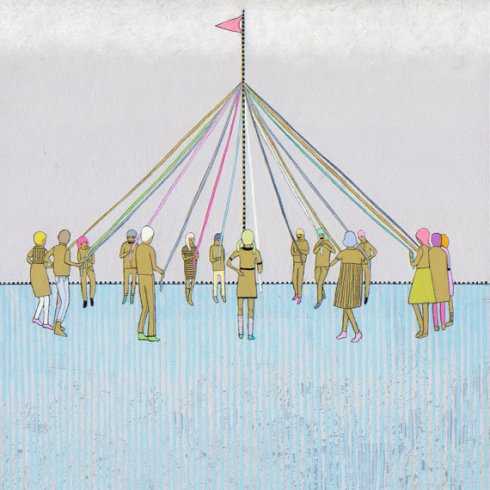
Maypoles

When I was a very little girl my family lived in a small village in central Vermont which had no preschool program, so my parents sent me to a private school the next town over.  My memories of this school are positively idyllic:  reading Peter Rabbit, singing, games, toast.  A singular memory, reinforced by a photograph of me looking like a little dark-haired Swiss girl in a dirndl, is of a Maypole, and going round and round it holding my ribbon.  Because of the Maypole, May Day was the most special holiday to me as a child, and I’ve tried to keep it up as an adult, with wreaths and May wine (made with sweet woodruff, a great spring plant) and a general spirit of merriment.  But I’ve yet to erect a Maypole in my backyard.

It is interesting to me that my experience with the Maypole happened in Vermont, the least puritanical of all the New England states. The Puritans hated Maypoles, and any ceremony or ritual or image that detracted from the word of God.  So dancing around the Maypole, a very popular custom in the medieval and Tudor eras, was prohibited during much of the very Puritan seventeenth century, both in old and New England.  There was definitely a revival in the eighteenth century, but it might have been too late for Massachusetts.  Thank goodness I had my Vermont childhood!

It’s hard to separate survival and revival in the history of the Maypole, but the custom seems to have been alive and well in the Elizabethan era, as illustrated by these amazing painted glass panels from the later sixteenth century depicting a Maypole and the various “Morris Dancers” who danced around it on May Day.  They are from Betley Hall in Staffordshire, and were somehow saved from Puritan iconoclasm and incorporated into a later house.  May Day celebrations seem to be part of every romantic history of the Elizabethan era, if only because the first Elizabeth makes a perfect May Queen.

Betley Hall glass panels, later sixteenth century, Victoria & Albert Museum, London; “May Day in the Reign of Queen Elizabeth”, Hodgson & Graves print, c. 1836, British Museum, London.

After the English Revolution, the maypoles of England reappeared, including a famously tall one in the Strand in London (to which, according to Walter Thornbury’s “St Mary-le-Strand and the Maypole” , Old and New London, Volume 3 (1878), Sir Isaac Newton attached his telescope) and in the center of the weeks-long “May Fair” in the Mayfair neighborhood.  The Great Fire and the great rebuilding of the later seventeenth and and eighteenth centuries removed maypoles from the streets of London but the custom apparently continued, as they appear in print and paintings as symbols of “Merry Old England”.  This particular symbolism seems to intensify in the nineteenth century, an age of dynamic change which threatened to sweep everything away that was both merry and old.  There is a definite revival of the Maypole motif in the later nineteenth and early twentieth century by the Arts and Crafts movement; as the old merrymaking custom endures, so too will traditional craftsmanship in the midst of mass production.

Country Dances Round a Maypole, Francis Hayman, c. 1741-42 (Supper Box Decoration at Vauxhall Gardens), Victoria & Albert Museum, London.

Edward Henry Corbould, May Day, 1873, British Museum, London; Kate Elinor Lambert, Woodcut device for the Stanton Press, 1921-22.

Another later nineteenth-century trend–the politicization of everything–also affected the maypole, which was appropriated primarily by the left side of the political spectrum, coincidentally with the association of May Day with workers’ movements.  Below are two illustrations of  a more modern Maypole:  around which monopolists and workers dance.

Frederick Barr Opper, the Monopolists’ May-pole (including lots of Vanderbilts), Puck Magazine, 1885 and Walter Crane, The Workers’ May-pole”, 1894, Library of Congress.

Back to basics:  of course, the survival (or revival) of the Maypole, in the nineteenth century and today, might simply be due to the fact that it provides entertainment for children, who probably see no greater meaning in its form than the focus of a simple dance in celebration of spring!  That’s my memory.

May Day in Central Park, c. 1905, Detroit Publishing Company, Library of Congress; May Pole by Jennifer Davis, Etsy.


Encircling Salem Artists

There’s been a lot of discoveries since I started this blog over a year ago, but one of the biggest has been a growing appreciation of the artistic environment which existed in Salem a century or so ago, well past what historians consider the city’s golden age.  Culturally speaking, Salem was vibrant not only in the 1790s, but also in the 1890s, when Frank Benson, Phillip Little, Ross Sterling Turner, Dwight Blaney, and John Leslie Breck were within its midst.  I’ve already written about Little and Benson, whose houses I can gaze upon from my bedroom window, but the other gentlemen are more recent discoveries.  Blaney, from an old Salem family (Blaney Street runs down to the Salem Ferry dock), was not only an artist but one of the first serious collectors of American antiques.  In many ways, he is a collecting link between several of these men:  Turner married his elder sister and lived in Salem, and both Blaney and Breck visited them often from their primary homes in the western suburbs of Boston.  Benson and Little were more grounded in Salem (though they summered in northern New England like all artists of means), Blaney seems to have been happily ensconced at both his main home in Weston and his summer house on Ironbound Island, off Mt. Desert in Maine (where he received many distinguished guests, including Breck and John Singer Sargent, and which you can read about here), but Turner and Breck seem like men of the world to me:  student days in Europe, considerable time at Giverny with Monet (Breck), long forays in Bermuda and Mexico (Turner).  They were both advocates of “modern” art, and seem to have been inspired by the cultural environment of greater Boston and the North Shore while at the same time occasionally at odds with it.

I found an interesting notice in the Boston Transcript from the spring of 1890, shortly after Breck had returned from Giverny to hold a one-man show at the St. Botolph Club through which Impressionism was introduced to Boston.  He had also formed a teaching studio with Turner in Salem (at the latter’s house on Bridge Street, a pretty busy thoroughfare now and then) and these developments apparently did not please the anonymous author of the “Fine Arts” column.

     Ross Turner and John Leslie Breck have returned to this country from foreign parts, and threaten to form a class for out-of-door work in painting at Salem during the month of June.  Mr. Turner will give instructions in watercolor work, and Mr. Breck in both oils and watercolors, as well as in drawing from models.  Mr. Breck is somewhat famous in a limited way as the only pupil of the impressionist Claude Monet, and we may as well be prepared for anything and everything when he lets loose a flock of sweet girl graduates, duly inoculated with the impressionistic visual virus, whose landscapes may blend the charms of amateurishness with those of other kinds of incoherence, “till all is blue”.

THE IMPRESSIONISTIC VISUAL VIRUS!  What a great line; it sounds very modern. What a reminder of how new (and apparently threatening)Impressionism was in the late nineteenth century–and also how conservative Boston was.  The reference to “sweet girl graduates” might be an allusion to Breck’s  romantic reputation, gained at Giverny.  No matter, both Turner and Breck seemed to prosper in the 1890s, both in and around Salem and beyond.  Here are some of my favorite works of both artists, representing careers that were both cut short:  Turner died in the Bahamas in 1915, “following a long illness”, while Breck died of asphyxiation in 1899–an apparent suicide–at age 39.

Ross Sterling Turner (1847-1915):  Street Scene in Munich, 1880 (Smithsonian Museum of American Art); The Old Manse (printed etching from Riverside Press’s Hawthorne Portfolio, 1884); Fairylands, Bermuda, 1890 (part of the Masterworks Museum of Bermuda Exhibit “The Wonderful World of Watercolours”, closing today); Doorway of Henry Lee Higginson Estate (outside Boston), 1894; and his most popular work, A Garden is a Sea of Flowers, 1912 (Museum of Fine Arts, Boston.

John Leslie Breck (1860-1899):  Willows (1888); Grey Day on the Charles (1894) and The Dragon in Winter, Essex (Massachusetts), 1896.  All accessed through the Smithsonian Institution Inventory of American Art and all in private collections.