Category Archives: History

Digging up the Past

All good historians, especially those who focus on the pre-modern era, know that much of history is behind a closed door which we cannot crack.  But occasionally someone comes along, usually a nice archivist or archeologist, who opens it up for us.  This week two stories which demonstrate this occurrence very well caught my attention–actually one has been holding it for a while.  So it is time to report.

King Richards Body:

The Battle of Bosworth (1485) marked the end of the life and reign of Richard III, the last of the Plantagenet dynasty as well as the last English king to be killed in battle. At his death, Richard’s reputation was already tarnished, but it would become even more so due to the energetic efforts of a sophisticated Tudor propaganda campaign, which employed the able pens of Sir Thomas More and William Shakespeare, among others.  Richard’s vanquisher and successor, Henry VII, did not want to create a shrine for Richard but he also made plans to give him an appropriate, though quiet, royal funeral. Richard’s body was taken to Leicester and put on public display after Bosworth, and then buried rather secretly in the church of Grey Friars Friary, which was destroyed a half-century later during the forcible dissolution of England’s monasteries by Henry VIII.  The burial site of the last Plantagenet was forgotten over the ensuing centuries, until just last week when a team of University of Leicester archeologists dug up the corpse of fifteenth-century man who suffered battle blows similar to Richard’s experience, and who possessed a slightly-curved spine (there were gasps when this was announced) but was clearly not the “crookback” or hunchback of Tudor narratives. If the DNA testing proves conclusive, the royal body was enshrined beneath a city centre parking lot.

King Richard III and Queen Anne during their brief reign; the great 18th century actor David Garrick in the big scene from Shakespeare’s Richard III, c. 1800 (courtesy British Museum) the excavation site in Leicester, and the press conference announcing the discovery of the skeleton, just last week (courtesy University of Leicester).

The Plague Ship:

The last major outbreak of the bubonic plague in the west occurred in Marseilles, France in 1720, when the epidemic was brought to Europe by a merchant ship named the Grand SaintAntoine on its return journey from the infected and infectious Middle East. Its passengers were allowed to disembark before authorities ordered its burning, and the process took several days, during which the disease spread to the city and its environs, eventually killing over 120,000 people. Just last week, and just as the possible skeleton of a king was being raised to the light, the ship was raised from its watery grave.

1720 print of the Plague of Marseilles by Jacques Rigaud (courtesy British Museum); a plague doctor in Marseilles (1721 engraving by Johann Melchior Füssli,Wellcome Images); and the raised anchor of the Grand Saint-Antoine last week (BORIS HORVAT/AFP/Getty Images).

So nice to see crowds observing the raised anchor in this last picture: there were crowds looking at the trenches in Leicester last week as well.  That’s the thing about archeology:  objects (and bones!) generally capture the public’s historical interest far more often than dry dusty texts.  For me, there is just nothing better than seeing people in the present captivated by people in the past.


Another Cartophilic Collection

I’ve posted on trade cards several times, and they remain a form of ephemera that I casually collect. It seems to me that these early business cards are among the least ephemeral of ephemera–so many survive.  And most of them are the standardized children/animals/flowers variety.  So I’m pretty picky:  my collection is full of Salem items, cards with unusual shapes, cards that advertise Sarsaparilla (for some reason, a new interest of mine; when sold as a medicinal tonic at the end of the nineteenth century it contained something like 18% alcohol) and apothecaries in general, and those put out by the home furnishings trades. Occasionally odd images catch my fancy, and I don’t care what they are selling. I really prefer the earliest trade cards, issued in western Europe in the seventeenth and eighteenth centuries, but I could never afford them and most of them are in rare book libraries anyway. It’s been a while since I featured any trade cards, so I thought that I’d showcase my most recent finds.

First, some Salem cards. Frank Cousins was an amazing photographer/entrepreneur who did much to capture and sell Salem a century ago:  the cards for his Essex Street shop, the Bee-Hive, were often issued in interesting shapes.  I always go for any view of the wharves and great examples of typography, and I love the font on Mr. Goodwillie’s card. The last card, presenting a western image of Chinese workers, is extremely interesting:  “others”, particularly Chinese, often appear on late nineteenth-century trade cards, and almost always in a stereotypical, racist and/or jingoistic way.  I’m not sure what’s going on with this card, issued by a Salem pharmacist; most likely it is part of a series.

As you can see, A.A. Smith is offering “petroleum remedies”:  even more unusual is the”magnetized food” on sale at a Brooklyn pharmacy.  I’ve included the back of the card so you can see the pitch:  using children to appeal to their mothers, obviously an age-old practice.  And then there are two cards issued by the Charles I. Hood Company of Lowell, Massachusetts, the leading manufacturer of the equally healthy Sarsaparilla.

Magnetized Food” trade card from the Library Company of Philadelphia Digital Exhibit: Nineteenth-Century Pharmacists’ Trade Cards from the William H. Helfand Collection.

I thought I was familiar with all the digital databases of works on paper but just recently I found the online collection of the Rothschild family’s Waddesdon Manor, which includes over 700 trade cards from the seventeenth and eighteenth centuries. This is an amazing resource for all sorts of things. The Rothschilds were probably the greatest collectors of the nineteenth century, and I was surprised to see so many humble trade cards among their more luxurious acquisitions, but apparently Ferdinand von Rothschild, the builder of Waddesdon, was interested in every aspect of French life and culture in the eighteenth century. Here are three late-seventeenth-century cards from his collection, with which urban outfitters offered their services and wares:  the first one is from a hat-maker, the second from a vestment-maker, and the last one from a furrier. Mere slips of paper that survived all these many years.


Two Memorials

This weekend the Salem Witch Trials Memorial was rededicated, 20 years after its installation and after a year of renovation and fortification by its original mason.  The Memorial remains the only Witch-trial-related initiative that I can bear in Salem, and the ceremony marking its re-dedication was, for the most part, simple and respectful, just like the Memorial itself.  Descendants of the 20 victims were present, and they placed flowers and rosemary (for remembrance) on their ancestors’ symbolic “graves”, granite benches marked with their names and dates of death built into an encompassing granite dry wall. As you enter the green rectangular courtyard that is the Memorial, surrounded by the colonial gravestones of the Old Burying Point outside of its perimeter, you can read the victims’ protestations of innocence, which are carved on paving stones.  Just like the actual words that were uttered, they are cut off , by the Memorial walls.

Exterior and interior views of the Salem Witch Trials Memorial, designed by James Cutler and Maggie Williams and built by Hayden Hillsgrove; the descendants of the victims of 1692 stand by their ancestors’ markers; John Willard’s marker/bench.

The Witch Trials Memorial is successful because it is so strikingly simple in its understatement:  it does not tell us how to feel.  The victims speak for themselves, until they are cut off.  Unfortunately, the proclaimed mission and attendant speeches associated with the Memorial and the other official commemorative initiative, the Salem Award, attempt to impose a redemptive lesson about tolerance which I believe diminishes the historical tragedy of 1692. If you emphasize the ideal of tolerance above everything else, the presupposition is that the accusers of 1692 were not tolerant of the victims’ aberrant belief systemwhen there is no historical evidence that the latter were practicing witchcraft. It is always difficult to reconcile the past and the present and not lose sight of one or the other.

Just last summer, an equally evocative memorial to the victims of another seventeenth-century series of witch trials, the Vardø trials in the Finnmark region of northeastern Norway, opened to the public. As with the Salem installation, the Steilneset Memorial is a collaboration between an architect and an artist: Swiss architect Peter Zumthor and the late French-born artist Louise Bourgeois.  The Vardø trials, which occurred in two distinct phases in the dead of the Arctic winter (in 1621 and 1662-63), resulted in the execution of 91 people for the crime of sorcery. Zumthor’s two-structure memorial is a far more elaborate construction than Salem’s, but still absolutely austere. The architecture and the art represent both the individual victims and the collective tragedy, via one illuminated window for each of the victims in the long gallery building and a perpetually-burning chair in the “cube” structure next door. Like the Salem Memorial, Steilneset focuses completely on people, and lets its viewers draw life lessons.

The Steilneset Memorial in summer and winter, overlooking the Barents Sea, and the last creation of Louise Bourgeois,  “The Damned, The Possessed and The Beloved”.  Photographs by Bjarne Riesto.


Eternal Elizabeth

Today is the birthday (in 1533) of Queen Elizabeth I, a fact that would have been well-known in her own time.  The coincidence of Elizabeth’s birthday with the eve of the nativity of the Virgin Mary was not lost on her subjects, and obviously enhanced her public reputation as the Virgin Queen. In a Protestant England shed of its saints, Elizabeth must have offered some consolation. There is so much to say about Elizabeth, but too much to say in a blog post and little that has not been said before. In addition to her rather remarkable lifetime, the thing that has always impressed me about Elizabeth is her durability; even though she was a mortal person who died in 1603 she never really seems to go away. Every generation has had its Elizabeth:  the seventeenth century brought her back as a stark orderly contrast to Civil War-strife, there were lots of comparisons between Elizabeth and the equally-long-reigning Victoria in the nineteenth century, and we have certainly had our share of Elizabeths–from Bette Davis to Cate Blanchett to Judy Dench and Helen Mirren–in the last century.

Images of Elizabeth:  her lifetime.  Except where noted, all portraits are from the collection of the National Portrait Gallery, London.

The “Clopton Portrait”, 1560, one of my favorites:  a portrait of the young queen before she became the subject of sophisticated royal iconography. Private Collection.

The “Pelican Portrait”, c. 1575, often attributed to Nicholas Hilliard.  Here we have a highly stylized Elizabeth and all sort of symbolism.  This mask-like face will be the template for some time.  The pelican brooch on her bodice is a reference to self-sacrifice:  a long-held legend told of pelicans feeding their children with their own blood.  At around this time, it was clear that Elizabeth would not marry, therefore she had sacrificed her personal desires for the English people. Walker Art Gallery, Liverpool.

One of several official Armada portraits, this painting by George Gower marks the wondrous victory over the “invincible” Spanish Armada in 1588.  Elizabeth is now well on her way to becoming larger than life.

Elizabeth does not age in her portraits in the 1590s, even though she is in her sixties.  Her waistline gets smaller and smaller, and she wears increasingly fantastical clothing.  Commissioned by Bess of Hardwick in 1592, this painting is still at Hardwick Hall.  It has been copied many times, and the amazing skirt has served as the inspiration for wallpaper and textiles in the twentieth century. The drawing, from the collection of the British Library, is dated 1775.

Elizabeth Ever After:

Line engraving by Crispijn de Passe the Elder, after Isaac Oliver, 1603.  A very influential image, disseminated widely in the seventeenth century, and influencing images of Elizabeth to the present.  As an example, look at Alix Stone’s costume design for Elizabeth in a production  of Benjamin Britten’s Gloriana, 1966.  Victoria and Albert Museum, London.

In a 1868 lithograph, a Vision of Queen Elizabeth tries to rouse Queen Victoria from her prolonged mourning following Prince Albert’s death:  snap out of it!

Modern Elizabeths:  Bette Davis, one of my favorite Elizabeths, in The Private Lives of Elizabeth and Essex (1939), and Cate Blanchett in the poster for Elizabeth (1998).  I love the poster (which is based on the “Coronation Portrait” of Elizabeth in the center–the original portrait, attributed to Nicholas Hilliard, was destroyed by fire and this is an early seventeenth-century copy), and Cate Blanchett, but the movie is a historical hot mess!

Appendix:  the best book on representations of Elizabeth:  Sir Roy Strong’s Cult of Elizabeth.  Elizabethan Portraiture and Pageantry.


Books for Back to School

The Fall Semester starts today, and I get to impose reading on college students who are, make no mistake, reluctant readers. In my opinion, and experience, this particular generation is particularly reluctant:  they have so much else to do!  They have to keep track of their friends’ activities on Facebook, they have to check their phone messages, they have to text every waking thought and state of being, and as I teach at a large public university, they have to work.  In terms of daily priorities, I imagine that reading is very far down the list.  I do not despair, because once I get them to read (by forcing them to write papers) it is clear that the majority of my students can comprehend and analyze texts quite well, but I find myself putting more and more thought and time into choosing the books for my courses as I know that these books have a lot of competition:  they have to catch my students’ attention, and hold it.

I am teaching courses on Medieval Europe, Tudor-Stuart England, World History, and the Expansion of Europe this semester, and here are some of the texts that I’ve chosen for these courses, with a little bit of the rationale for my choices.  All of these courses (except for Expansion of Europe, which is a graduate seminar) have (boring) textbooks that the students read (I think/hope) for background, and several monographs which are the basis of their papers.  I will spare you the textbooks, which are a completely different teaching issue.  I’m almost to the point of ditching the textbooks altogether but not quite yet.

Another realization that has (much too slowly) dawned on me is that my students “learn” most of their history from movies, so when I get them in a class they have preconceived notions that I have to take on. Usually I get students who love Tudor England or medieval Europe, but actually know very little about these eras.  I used to reproach them, but now I’m more inclined to take advantage of their rather romantic interests.  For the Tudor-Stuart course, I’m actually assigning a biography of Anne Boleyn, for whom a veritable cult exists.  Anne Boleyn is now clearly more popular than even her superstar daughter Elizabeth I, so they’re going to read all about the tragic queen/master manipulator in context, from a reliable source:  Eric Ives’ updated biography is accessible yet scholarly, and I’m going to give them an essay prompt for the book that will force them to dig deeper.

Speaking of digging deeper, my medieval course is going to have a strong archeological theme this semester. Too often material sources (as opposed to literary ones) are not given serious consideration by historians, but students find archeology fascinating.  So I’ve chosen tw0 texts that I think should really illuminate (and de-romanticize) the Middle Ages for my students:  Barbarians to Angels.  The Dark Ages Reconsidered by Peter S. Wells, and Colin Platt’s King Death. The Black Death and its Aftermath in Late Medieval England.
I threw some architectural history in there too with Philip Ball’s Universe of Stone.  A Biography of Chartres Cathedral, which I also chose because it was written by a non-academic.  I like to contrast scholarly and trade publications in my courses, and my students (like the general reading public) inevitably favor the latter.

World History is a tough course, for both the students and myself:  it’s “big” history, hard to grasp.  We have a two-course core curriculum world history requirement at Salem State, and so our entire department (and a battalion of adjunct professors) teaches it.  I have to admit that I bring my decidedly Eurocentric perspective into my world history courses; I just can’t help myself.  The book that I chose for this semester’s course, Paul Freedman’s Out of the East:  Spices and the Medieval Imagination, reveals this bias, as it examines “the East” from a western focus. I’m hoping some of my students might point this out in their papers.  A somewhat similar book, perhaps more successfully global in its approach, is one of the eleven books I’ve assigned for my Expansion of Europe seminar, Timothy Brook’s Vermeer’s Hat.  The Seventeenth Century and the Dawn of the Modern World.  I cannot recommend Brook’s book highly enough:  whether you know a little bit about the seventeenth century, or a lot, it accomplishes what the best history books do:  transportation to another world.  My students better like it.


Factory Girls and Boys

I always feel a bit sorry for myself on Labor Day weekend, as it’s back-to-school time and usually I am engaged in a mad dash to get my course syllabi done.  Of course this is ridiculous, as I have the cushiest job ever and most of the summer I’ve been free to do as I liked.  It’s good to remind myself what labor really is, and nothing does that better than the photographs of Lewis Wickes Hine (1874-1940), who transitioned from educator to social activist, all the while armed with a camera.  In 1908 Hine became the official photographer for the National Child Labor Committee (NCLC) and began his life’s work:  documenting child labor across the United States. This was a time when one in six children between the ages of five and ten worked outside the home in “gainful occupation”, and the percentage increases dramatically for children over the age of ten.  The members of the NCLC began a successful campaign to end child labor and Hine’s often-haunting photographs were their chief weapon.

In the fall of 1911, Hine was in New England, then at the height of its industrial history, documenting child labor in Boston, Lowell, New Bedford, Lawrence and Salem. There are 17 photographs of Salem children, all accessible at the Library of Congress, which has a vast Hine collection. Most of the child laborers are shown outside of their place of work, presumably because their employers didn’t allow the conspicuous photographer inside. My favorite has always been this group of smiling girls, workers at the Cass & Daley Shoe Factory on Goodhue Street.

Caption:  Group of girls working in Cass & Daley Shoe Co., Salem.  Saw a number of children from 14 to 16 (apparently) and two or three probably under 14.  Smallest girl in photo is Odella Delisle.

Smiling Salem girls, for the most part, a striking contrast to one of Hines’ most famous child laborers, Addie Card of North Pownal, Vermont, captured in August of 1910.  Hines’ captions for this photograph are perhaps even more poignant than the image: an anaemic little spinner, 12 years. Girls in mill say she is ten years. She admitted to me she was twelve; that she started during school vacation and now wouldstay.”  Of course many have wondered what become of Addie Day:  here is one exploration.

Back in Salem, a few more of my favorite Hine photographs from the fall of 1911:  a group of somewhat serious boys outside the factory with some very serious men (the factory owners?) behind them, and young John Parent, quite alone despite the fact that there are people all around him.

Caption:  Group, all working in #2 Spinning Room. Smallest boy (right hand end of front row) is Rene Barbin, 61 Perkins St. Next to Rene is Philip Beaulieu.  Next to Philip is Alfred Corriveau, 14 Perkins St. Smallest boy in back row is Willie Irwin, 16 Perkins St. Next smallest in back row is Ernest Dionne, 5 Prince St. 

Caption:  Boy is John Parent, 14 Congress St. Works in Spinning Room #2, Fifth Floor.

There is only one Salem photograph in which Hine was allowed into the factory, where he photographed a ragged-yet-dignified Henry Fournier before some massive machinery.  I’m sure Hine wanted to get the machines in his photographs whenever possible, because they represent both the work and the potential danger.  A Smithsonian/National Archives traveling exhibition entitled The Way We Work (opening this weekend at Historic New England‘s Governor John Langdon House) includes a Hine photograph of child laborers in Georgia that is particularly haunting with regard to danger:  small barefoot boys who appear as almost part of the machines on which they work.

Caption:  Henry Fourner [i.e., Fournier?], 261 Jefferson St., Castle Hill; has been sweeper and cleaner in #2 Spinning Room two months.

Caption:  “Bibb Mill No. 1, Macon, Ga. Many youngsters here. Some boys and girls were so small they had to climb up on to the spinning frame to mend broken threads and  to put back the empty bobbins”.


Road Trip, Part Six: The Other Naumkeag

On the last day of my road trip, before I headed home to Salem, I visited a house named for Salem: Naumkeag, the Stockbridge summer cottage of Joseph Hodges Choate (1832-1917).  The native Americans called the land encompassing Salem Naumkeag, and the Salem-born Choate, a prominent New York attorney who took on Boss Tweed and served as Ambassador to Great Britain before World War I, named his country house for his native city.  I had never been to this western Naumkeag, but I had heard great things about it for many years, and I was not disappointed.

Naumkeag (1885), an early commission of Stanford White of McKim, Mead & White, Stockbridge, Massachusetts:  rear, front & detail views.

Actually, that’s putting it mildly:  I loved this property, which surprised me.  I grew up in a house in southern Maine not dissimilar from Naumkeag:  a shingle-style Victorian with dormers, porches, and a big hallway.  And while I love this house, when I moved away and grew up I always sought more straightforward houses for myself :  Federal and Greek Revival houses with clean lines and open facades in which squares are more important than curves.  Naumkeag is very curvy; it’s the antithesis of my beloved Federal style, but it is so perfectly placed in its setting that it cannot fail to charm.  I quickly realized that it was not just the house, but the house and its surrounding landscape, that was captivating me.  Mr. Choate and his wife Caroline had summered in the Berkshires for many years before they purchased the land on which they built their summer house, and they knew just where they wanted to build it–on a bluff overlooking a pastoral valley very close to the village of Stockbridge, where terraced and sloping gardens could surround the house and link it to that same valley below.

Naumkeag today, house and grounds tied together in a series of interior and exterior “rooms” which provide vistas that look both inward and outward, is not only the result of the collaboration of Mr. and Mrs. Choate and their consultants but also of another extraordinary partnership, between their daughter Mabel and the amazing landscape architect Fletcher Steele (1885-1971).  Mabel met Steele just before she inherited Naumkeag in 1929, and they embarked on a 30-year joint endeavor which made Naumkeag even more magical.  All the details–structural, horticultural, practical, were overwhelming!  I could write a separate post on just how water was moved from place to place.

Fletcher Steele’s work at Naumkeag: the “afternoon garden”, forged steps and “runnel” leading down to the famous, iconic Blue Steps.  My photograph is followed by one by Carol Highsmith (1980; Library of Congress), obviously a much better photographer.

Those blue steps: how amazing.  Art Deco in a “Victorian” garden (or is it?) and also an interesting juxtaposition of beauty and practicality; after all, they exist to channel water down to the lower perennial garden. The use of the azure blue, carefully chosen by Steele after much deliberation apparently, brings the sky down to the ground.  Here’s charming photograph of Steele and Mabel on the blue steps before they were blue:

Back to Salem, the first Naumkeag, where a statue dedicated to Joseph Hodges Choate marks one of the entrance corridors into the city.


Road Trip, Part Four: Huguenot Houses

For the anniversary of the St. Bartholomew’s Day Massacre (24 August, 1572), on which perhaps 3000 Huguenots (French Calvinist Protestants) were slain in the streets of Paris, I am backtracking back to the New York town of New Paltz to feature some houses built by Huguenot exiles from seventeenth-century France.  These are the houses of Protestant survivors of France’s intense religious conflict and repression in the early modern era.

The Saint Bartholomew’s Day Massacre occurred during what became a very temporary truce in the French Wars of Religion (1562-1598) for the occasion of a Capulet-Montague marriage between Henri of Navarre, symbolic leader of the noble Huguenot faction in France, and the French royal princess Marguerite of Valois.  All of the most powerful Protestant and Catholic nobles were gathered in Paris for the royal wedding, and what is generally assumed to have been a targeted assassination (engineered by the bride’s mother, the very Machiavellian Catherine de’ Medici) of Admiral Coligny, the Huguenots’ military leader, spilled out into the streets and was transformed into mob violence.  The wars continued, despite a very depleted Huguenot leadership and with pan-European support on both religious sides, until the bridegroom Henri of Navarre succeeded to the throne in 1589 (becoming Henri IV, the first of the last French dynasty, the Bourbons), made a political conversion to majority Catholicism (“Paris is well worth a mass”) and granted an official toleration decree to his former co-religionists with the Edict of Nantes (1598).

Saint Bartholomews Day Massacre by François Dubois (Musée cantonal des Beaux-Arts, Lausanne) clearly shows Admiral Coligny hanging out of a window (right background) and Catherine de’ Medici (in black, left background) examining a pile of corpses.  Prints of the massacre, like that of Gaspar Bouttats below (Antwerp, 1670; British Museum) circulated around western Europe for a century and more, creating a sense of martydom on the part of French Protestants and a European-wide Protestant unity.

Even though they had been granted a limited toleration (until Henri IV’s grandson Louis XIV revoked the Edict of Nantes in 1685) many French Protestants saw the writing on the wall and left the country for more tolerant (or Protestant) places:  the Netherlands, Germany, England, and the New World. Salem had a small Huguenot community, centered around the successful merchant Philip English, but as my brother and I visited Historic Huguenot Street in New Paltz, New York, this week, I thought these Hudson River Valley houses would better commemorate the Huguenot experience.  These American colonial houses are also a great reminder for an Anglophile and New Anglophile such as myself that not all pre-revolutionary American houses are English in inspiration.

The Hugo Freer House, 32 Huguenot Street, New Paltz, NY; built in northern and southern sections, 1694 & 1735.

The New Paltz Huguenots (often alternatively referred to as Walloons, as many came from the northern French region that is now Belgium) emigrated to American in the 1660s and 1670s and established important contacts in the Dutch settlement of Wiltwyck, now nearby Kingston, New York.  Kingston, along with New York and Albany, was one of the three principal settlements in Dutch New Netherland, and there are some great old stone houses there too, but as it later served as the first capital of New York, the British burned much of it to the ground in the Revolutionary War.  Twelve Huguenot families, the original “Patentees”, established New Paltz in 1678 by purchasing 40,000 acres of land from the resident Eposus Indians; seven of their stone houses survive on Huguenot Street.

The Abraham Hasbrouck House, 94 Huguenot Street, built in 3 phases between 1720 and 1740; a 1940 HABS photograph from the Library of Congress, showing its later dormers; windows and doors of different heights and sizes testify to its structural history.

The Bevier-Elting House, Huguenot Street & Broadhead Avenue, begun in 1698.  These long, sloping roofs do remind me of English seventeenth-century houses in Massachusetts. But not the stone. I love these crooked windows!

The recently-restored Jean/Jacob Hasbrouck House, Huguenot & Front Streets, built c. 1721.

Our last stop in this preserved Huguenot village was the old Burying Ground, which has a reconstructed “Old French” church in its midst.  The gravestones were themselves testimonies to the development of this community, as the original Patentee families married both within and outside their circle over the centuries, transforming themselves from refugees to Americans.

The Old Burying Ground and the reconstructed Church; a 1951 photograph of the cemetery before the Church’s reconstruction by Erma Dewitt, Hudson River Valley Heritage; an eighteenth-century marker.


Road Trip, Part Two: Road to Ruin

I drove through south central Vermont towards the Hudson River Valley on roads still-ravaged by Hurricane Irene, a year ago, and along riverbeds of displaced rocks.  Not all was perfect and picturesque in the Green Mountain State; there has obviously been a lot of suffering.  There were poignant messages spray-painted on boarded-up houses:  why, Irene?

I checked in at my brother’s house in Rhinebeck, New York and we planned our itinerary for the next day:  first up, one of the most famous of the grand Hudson River Valley ruined mansions:  Wyndcliffe, built in an imposing Romanesque Revival style in 1853 by Edith Wharton’s paternal aunt, Edith Schermerhorn Jones (1810-1876).  Wyndcliffe has been in a state of decline for 50 years or so, and is now nearly ready to come down.  We approached it on a road marked private (in very small letters), and a very nice Kevin Kline-esque man reproached us, more for our own safety than any territorial inclination:  the “structure” does look like it could collapse at any moment and he said people had been going into it at night. We quickly took a few photographs and left, with additional protective neighbors watching us like guardians.

There are several stories swirling around Wyndecliffe.  It was the first of the really ostentatious, over-the-top mansions in the region: 24 rooms, terraced gardens on 80 acres, Norman-esque tower, elaborate brickwork.  It is said (again and again, although I could not find a contemporary source) that the house represented such a flagrant display of wealth that it inspired the phrase keeping up with the Joneses.  Better documented are Edith Jones Wharton’s visits to the house, which she did not particularly care for, but nonetheless used as a setting for at least one of her books, Hudson River Bracketed.  After her aunt’s death, the house became known as “Linden Grove” and “Linden Hall” with the tenure of industrial brewer Andrew Finck, whose descendants owned the property until 1927.  After that, a serious of owners (including a group of Hungarian nudists!) oversaw its slow but steady decline.

The house in its heyday, and in a series of exterior and interior photographs taken in 1975 by Jack E. Boucher, photographer for the Historic American Buildings Survey, Library of Congress:

And some pictures from yesterday, most of which were taken by my brother as I had forgotten to charge my camera battery!  The house is definitely beginning to cave in on itself (although the pictures above illustrate that this has been happening for some time) but maintains that strong sense of dignity and presence often apparent at the very end.


Dolphin Decoration

In my ongoing quest for the perfect mirror, and more mirrors, I came across this Carvers’ Guild mirror embellished with intertwined dolphins, gracing a San Francisco house designed by Benjamin Dhong in the current issue of House Beautiful.  It caught my eye because I have two very similar mirrors in my “mirror files”:  another reproduction one from Mecox Gardens, and a Regency example from the blog Paisley Curtain.  All similar and all beautiful, I think.

As you can see, the “dolphins” embellishing these mirrors are not your typical Flipperesque variety.  The first English explorers named the large fish they observed patrolling the waters off the eastern coast of North America “dolphins”, thus causing centuries of confusion with the better-known marine mammal.  This confusion finally cleared for me just last year, when I wrote a post about the Lady Pepperell House in Kittery Point, Maine, which features dolphin-fish decoration on its exterior, and the commentators cleared it up for me.  I’m not completely certain, but I think the source of this confusion is John White, who accompanied both Richard Grenville and Walter Ralegh on exploratory tours of the New World in the 1580s, charting and illustrating what he saw along the way.  White’s “Duratho” became Dolphin in common Elizabethan English, and endured.  The Dolphin fish later became known as “dorado”, and later still as “mahi-mahi”.

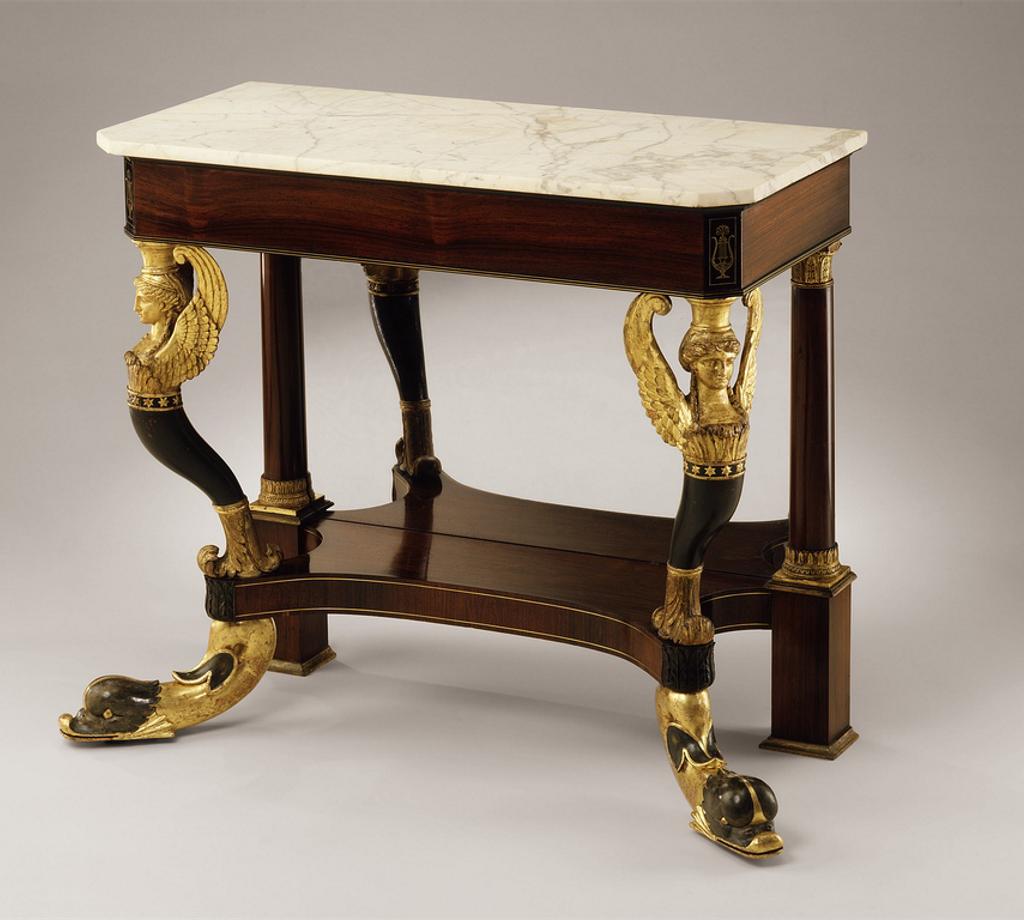
Dolphin fish seem to have been popular decorative motifs in furniture of the English Regency and American Federal and Empire periods, carved in relief or in part on sofas and tables as well as mirrors. There are lots of dolphin feet, as illustrated by the sofa (circa 1820), Lannuier pier table (1815), and Indian tilt-top table (made for the British market after 1825) below.  The American examples generally come from Philadelphia or New York, not New England, where no doubt the almighty cod was still golden.

Mahogany sofa and rosewood pier table by Charles-Honoré Lannuier, Detroit Institute of Arts via ARTstor; Indian tilt-top table, Walters Art Gallery via ARTstor.