Category Archives: History

Spring Fancy (Chairs)

The combination of the Metropolitan Museum’s current exhibition, Plain or Fancy? Restraint and Exuberance in the Decorative Arts and the onset of Spring (even though it looks very much like winter here) got my thinking about “fancy” chairs. I use this term very liberally, probably too liberally, to refer to any decorated chair with a vaguely  Sheraton and/or Empire profile produced in America in the second quarter of the nineteenth century. I have maybe 7 of these chairs, which represent the full spectrum of fanciness, from basic Hitchcock models with stenciling to hand-painted examples which I think are a bit more special. I have had more, I could buy more–they’re everywhere and I love them. I can’t imagine how many of these chairs were made:  certainly Lambert Hitchcock started the trend with his Riverton (then Hitchcockville), Connecticut factory in the 1820s, but he must have had many imitators because there are so many fancy chairs out there. Several of my fancy chairs  (the ones that are less fancy) have cushions which I had custom-made, and it’s a spring ritual to take the cushions off for the warmer seasons, exposing the rush seats, just as I put slipcovers on some of my upholstered chairs.

The (English) Sheraton inspiration and some of my chairs, the American interpretation: from fancy to plain.

Fancy Chairs Sheraton

Fancy Chair Green2

Fancy Chair music

PicMonkey Collage

Fancy Hitchcock Chairs

You still see fancy chairs in Salem dining rooms today, but the photograph below shows a room from 1916 (not sure in which house; it’s from an article in the long-defunct Mentor magazine), well after the fancy craze was over. These chairs endured and became classic, and their style was revived multiple times in the twentieth century. Back in their heyday, the prolific New England folk artist Joseph H. Davis (active 1832-37) featured very fancy chairs in many of his parlor portraits, like that of Mr. Demeritt below.

Fancy Chairs Mentor 1916

Fancy Chair Joseph H. Davis

Joseph H. Davis, John F. Demeritt, probably Barrington, New Hampshire, 1836, American Folk Art Museum, New York.

Because of a number of factors–the sheer number of chairs that were made, both in the “fancy” period and after, the great variety of chairs, and the range of imperfections on their painted surfaces–you can find these chairs pretty easily in New England, and often for a very good price. I was looking through the sold lots of several auctions at Skinner this month, and found the groups of chairs below: the entire first lot, a set of 6 chairs made in Newburyport in 1825, went for a little over $1000, while the pair of grain-painted and gilt-stenciled chairs went for $615.

987293

987293_view 02_02

Fancy chairs grain painted and gilt stenciled 1825 Skinner 615

Then again, these are rather restrained examples of the “Fancy” style, which encompassed not only furniture but all of the decorative arts in the second quarter of the nineteenth century. One of my very favorite exhibitions at the Peabody Essex Museum here in Salem was American Fancy: Exuberance in the Arts, 17901840, on view in 2004 (curated by Virginia antiques dealer Sumpter T. Priddy III, who appears to have made the study and appreciation of “Fancy” his life’s work and who wrote the beautiful companion volume). Talk about exuberance! Chairs and settees were a big part of this exhibition, and it was clear to me that the most fancy chairs were not made in New England but in the mid-Atlantic, in Baltimore to be precise. The “Baltimore Fancy Chair” makes all others pale in comparison (and fetches prices that indicate its enduring appreciation) but I think I prefer my own chairs–less perfect, less brilliant, less valuable, but still fancy.

PicMonkey Collage

More variations on the fancy chair:  a Baltimore chair by the Finlay Brothers, c. 1815-20, Metropolitan Museum of Art, New York; Portrait of Mrs. Edgar Paschall (Martha Eliza Stevens) by unidentified artist, 1823, National Gallery of Art.


Cake and the Custom House

This weekend marked the 75th anniversary of the Salem Maritime National Historic Site, the first federal heritage site (as opposed to national park) in the nation. On Sunday, a spectacularly clear and cold day, the staff of Salem Maritime presented a program of commemoration and appreciation which included lovely succinct speeches, cake, and the opportunity to wander around all of the site’s buildings at leisure. As usual, I was short on time (with a stack of midterms waiting at home), so I went straight for the Custom House (after my cake, of course), which I had not been inside for quite a while. In retrospect I wish I had had time for the Derby House as well, as it has recently been restored. But that’s alright, I can easily go back at another time–I live here.

Custom House Cake

Custom House 012

Custom House 014

Salem has been a port of entry since 1649, so there have been a succession of custom houses:  this one, built in 1819, is the last, and while beautiful, it’s a bit of a white elephant really. It was built by a new American government that expected Salem’s dynamic trade to keep expanding, but it declined precipitously almost as soon as the cornerstone of the new building was laid. In his introduction to The Scarlet Letter, Nathaniel captures this decline better than anyone possibly could, as he was a first-hand observer working (or watching) from this very custom house. Writing in 1850, he observed:  The pavement round about the abovedescribed edificewhich we may as well name at once as the CustomHouse of the porthas grass enough growing in its chinks to show that it has not, of late days, been worn by any multitudinous resort of business. In some months of the year, however, there often chances a forenoon when affairs move onward with a livelier tread. Such occasions might remind the elderly citizen of that period, before the last war with England, when Salem was a port by itself; not scorned, as she is now, by her own merchants and shipowners, who permit her wharves to crumble to ruin while their ventures go to swell, needlessly and imperceptibly, the mighty flood of commerce at New York or Boston.

Economic stagnation and historic preservation can often, ironically, go hand in hand, and as stately as it is, I’ve always thought that the Custom House has that air of a building that time forgot, where the front door was shut long ago and seldom opened afterwards. There is “minimal” interpretation, which I prefer, just old rooms without people–and the tools of the trade.

Custom House 049

Custom House 055

Custom House 057

Custom House 061

Custom House 062

The one room that doesn’t look like everyone just picked up their things and left has a HUGE gold eagle in it: this is the original eagle crafted by Salem woodworker Joseph True and installed at the front of the Custom House in 1826. When it was found to be seriously deteriorated, it was removed, restored, and replaced with a fiberglass copy in 2004. The rooms across the second-floor hall, with their period furniture on which are randomly-placed papers, really reinforce that abandoned ambiance.

Custom House 069

Custom House 075

Custom House 078

I particularly love the entrance of the Custom House, with its fanlight and sidelights, and then of course there’s the view, of Derby Wharf and the Friendship. Below, the Custom House in 1906 and this past weekend. It was a beautiful bright day, but as I write everything you see is covered with snow, again.

Custom House 1906

Custom House 010


Green with Envy

I have posted about green quite a bit on this blog:  green cards, green men, green rooms, the green fairy, my favorite shade of green. Yet it’s St. Patrick’s Day, so I’ve got to come up with something green–why not the emotion associated with the emerald hue? Shakespeare was specifically referring to jealousy with Othello’s “green-eyed monster” line, but jealousy is just a subset of the more all-encompassing envy, one of the seven deadly sins and the one conspicuous for its complete lack of pleasure: it leads not to material wealth or power or drunkenness, but only to a festering illness in which one literally eats their heart out. This self-inflicted sickness–described as a form of moral rotting–could be one source of the sin’s connection with the color green, as could its association with snakes, either alone or in the form of an allegorical Medusa-like character, but emerald (or chartreuse) envy seems to be more of a modern conception than a medieval one.

Envy 2008 by Michael Craig-Martin born 1941

Michael Craig-Martin, Envy (from the Seven Deadly Sins series), 2008.  Tate Modern, London.

Medieval manuscripts illustrate envy (invidia) in several ways:  on the iconic “Tree of Vices”, accompanied by a demon and its “sprouts” (detraction, treachery, treason, homicide, conniving, pleasure in the suffering of others–what we would call Schadenfreude–resentment, jealousy) and as a woman looking at something or someone with daggers (sometimes literally). Pride is always the root of the tree–the root all the vices– but envy is just one branch up from the fall of Man. Pride, represented by a King-like character riding a lion, and Envy, a sword-bearing woman riding a wolf, are closely associated in the fifteenth-century edition of penitential psalms below, and Envy reveals her jealous nature in a fourteenth-century Roman de la Rose. Green is not her color, yet.

L0029366 Tree of Seven Vices

Envy and Pride 2

Roy19BXIII_royal_ms_19_b_xiii_f006v_detail2 Envy1

The Apocalypse of St. John, c. 1420-30, Wellcome Library, London; British Library MS Yates Thompson 3, c. 1440-1450, and MS Royal 19BXIII, the Roman de la Rose of Guillaume de Lorris and Jean de Meun, c. 1320-1340.

Beginning with Giotto, the Renaissance shifted Envy decisively towards jealousy and generally portrayed her as an aged woman, tearing at her heart and/or eating an apple to illustrate her complete capitulation to temptation, often grotesque and emaciated, clearly suffering and sometimes chained, almost always with snakes. There’s a rather striking similarity between the depictions of Envy and witches in the sixteenth and seventeenth centuries, before the conception of envy in particular and the seven deadly sins in general become secularized. A notable exception is Hieronymus Bosch’s famous table painting, The Seven Deadly Sins and the Four Last Things, which depicts envy with an illustration of a local proverb about two dogs with one bone seldom reaching agreement. Still no green.

Envy Giotto Arena Chapel 1306

Envy George Pencz

Envy Bosch detail

Giotto di Bondone, Envy panel from the Arena Chapel, 1306; Print by George Pencz, 1541, British Museum; Hieronymus Bosch, The Seven Deadly Sins and the Four Last Things detail, c. 1485.

Looking through allegorical images of envy from the seventeenth and eighteenth centuries, I still don’t see much green, but then again, prints predominate. Lots of snakes are in appearance, which is appropriate for a St. Patrick’s Day post as the cleansing of Ireland of snakes is part of St. Patrick’s mythology. At least the connection between women and this most miserable sin is broken, as envy appears in the form of both sexes and then only as a green snake.

Envy 17th century

Envy Snake 1796

Print by John Goddard, c. 1640, British Museum; “Envy” (perhaps a caricature of the Earl of Abingdon), Anonymous, 1796, British Museum.

Envy is depicted in all sorts of ways by modern artists and illustrators, though the aged-lady-turning-green (grotesque)-with envy certainly comes back with a vengeance! I don’t usually see things exclusively through the prism of gender, but it’s really interesting to me how this most self-destructive of sins is so often associated with women. In two twentieth-century Seven Deadly Sins series, the Belgian artist James Sensor envisions a christening in which the young mother (interestingly dressed in green) is looked on with envy by everyone around her, but by the middle-aged woman to her right with particular vehemence, and Paul Cadmus’s Envy definitely harkens back to the Renaissance. As before, envy does not make for a pretty picture; I think I prefer alternative associations for the color green!

Ensor Envy 1904

Envy Paul Cadums

James Ensor, L’Envie, from the 1904 portfolio The Deadly Sins, Art Institute of Chicago; Paul Cadmus, The Seven Deadly Sins:  Envy, 1947, Metropolitan Museum of Art, New York.


The Art of Letters

I wanted to follow up my Post Office post with one featuring the art of letters, but I’m not sure exactly how to categorize these images:  these are not examples of typographic art, as they feature script rather than print, or ephemeral art, because I’m including works of art which feature letters as well as a few letters that I believe rise to an artistic level.  I looked up “scriptural art”, but that category seems to be reserved for religious works, and scribal art for calligraphy.  So that leaves me with the rather bland title “the art of letters”.***  It happens that some of my favorite images have a focus on reading or writing letters, or present an assemblage of writing materials, or a scrap of paper, with writing, that makes us wonder what’s going on here?  what does that letter say?  The letter is a great device to draw us into the painting: we want to read it!  Look at the note in the hand of this Victorian governess in Richard Redgrave’s 1844 painting:  it–or rather her reaction to its contents–has separated her from the “lighter” children under her watch. The painting was exhibited with the quotation “She sees no kind domestic visage here”, indicating that the letter brought memories of a missed home at best, and news of a death in her family at worst.

Letter Governess

Richard Redgrave, The Governess (1844), Victoria & Albert Museum, London

My very favorite letter painting doesn’t really delve into the emotional aspects of letters and their reception, but rather it presents us with a trompe l’oeil display of printed and writing materials:  an early modern bulletin board!  This is a very ephemeral painting in several ways:  the newspapers and almanac represent the “news” of Queen Anne’s accession in 1702, as does the medal representing her grandfather, Charles I. The painter has included his “signature” on the folded sheet in the center. I love trompe l’oeil in general, but this particular painting has captivated me since the first time I laid eyes on it several years ago; I think that George Tooker’s 1953 painting, The Letter Box, is its perfect companion piece.

Colyer Tromp l'oeil

George_Tooker_The_Letter_Box

Edward Collier (Collyer), Trompe L’Oeil with Writing Materials, c. 1702, Victoria & Albert Museum, London; George Tooker, The Letter Box, 1953, Hirshorn Museum and Sculpture Garden, Washington, D.C.

Moving back to my period, I noticed a while ago that the Tudor court painter Hans Holbein the Younger often included scraps of paper with writing, tucked into a book, laying on a table, or even posted to the wall, in a number of his portraits. The well-known portrait of Thomas Cromwell (of whom I am a fan) is a good example, as is the amazing portrait of Georg Gisze, a German merchant stationed in London (like Holbein). I think the use of written and writing materials is a bit more straightforward here:  Cromwell wants to present himself as a pious public servant and a master of the (written) law, while Gisze is an equally-earnest man of business who holds in his hand a letter from his brother, back home.

Cromwell Frick Collection

Hans-Holbein-the-Younger-Portrait-of-Georg-Gisze-Oil-on-Wood-Panel-1532-Staatliche-Museen-Berlin--904x1024

Hans Holbein the Younger, Portrait of Thomas Cromwell, 1532-33, Frick Museum; and Portrait of Georg Gisze, 1532, Staatliche Museen, Berlin.

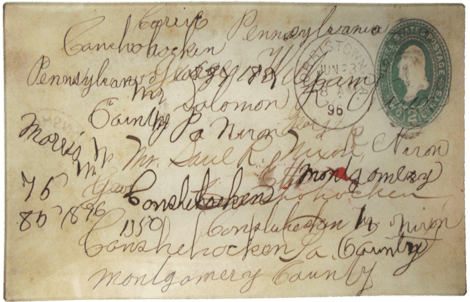
I’m including a few actual letters in this post, both because I spent quite a bit of time searching through the digital collection of the National Postal Museum at the Smithsonian for my last post and because many of the letter “covers” in this collection do rise to the level of art, in my humble opinion. The range is incredible, encompassing patriotic examples from all the American wars, letters from the prisoners of those wars which were delivered in specially-marked envelopes, and letters delivered by planes, trains, and zeppelins. These covers are also a way to look at print and script together. This first envelope, from my own collection, was issued by the Locke Regulator Company of Salem in 1899 (as you can see by the postmark), and then there’s a letter from a Union prisoner of war from 1864 and a letter carried out of Paris by balloon in 1871.

Scan0004p

Letter from Union Prisoner of War

Letter Smithsonian

Covers from 1864 & 1871, National Postal Museum, Smithsonian Institution.

These letters look like likely candidates for a John Derian decoupage tray to me: that man loves his fonts and scripts!  But letters moved to the foreground in the decorative arts a while ago, as exemplified by the beautiful silver cigarette case below, “postmarked” in 1903. I wish we could bring these cases back (with an alternative use), and while we’re at it, letters too!

LT-Script-Sampler_1_large

Silver Cigarette Case Albert Barker Ltd London

John Derian “Sample Script” decoupage tray; Silver cigarette case by Albert Barker, Ltd., London, Collection of the Victoria & Albert Museum.

***EPISTOLARY Art!!! As recommended by Secret Gardener, who has one of the most beautiful blogs out there.


Oz Everlasting

Even before the big new Oz prequel movie debuted this weekend, I was already thinking about the Wonderful Wizard of Oz, as yet another candidate for the Salem Athenaeum’s Adopt-a-Book program this year is the fourth title in L. Frank Baum’s series, Dorothy and the Wizard of Oz (1908). Like the new film (which doesn’t seem to be garnering the best reviews), this book features a wizard who plays a much larger role than in the first book and classic 1939 film. In fact, the Wonderful Wizard is really the star of the story, defending Dorothy and her companions (including a cat named Eureka rather than a dog named Toto) from fierce vegetables, invisible people and bears,  gargoyles and “dragonettes”:  all in an underground world which swallowed them up following an earthquake. The Wizard is so exhausted after his labors that he decides to remain in the Emerald City permanently at the book’s end, and so he becomes the Wonderful Wizard of Oz forever.

Oz

Oz 2

In his Preface, Baum as much admits that he was reluctant to keep writing about Oz:  It’s no use; no use at all. The children won’t let me stop telling tales of the Land of Oz.  I know lots of other stories, and I hope to tell them, some time or another; but just now my loving tyrants won’t allow me.  They cry “Oz–Oz!  More about Oz, Mr. Baum!” and what can I do but obey their commands?  He also admits that his “tyrant” readers wanted to know more about the “humbug” Wizard who blew off in a balloon, and so he brought him to earth–or below the earth–again.  Not only does the storyline of Dorothy and the Wizard of Oz focus on the latter’s heroics, the majority of illustrations in the book–both black-and-white sketches and watercolor paintings by John R. Neill, feature the Wizard, who does indeed enter the story in a balloon. Towards the end of the book, when everyone returns to the Emerald City, the Wizard reveals his and its origins, and this backstory seems to provide some of the plot for the current movie:  a humble circus performer from Nebraska whose appellation was Oscar Zoroaster (and many other names) Diggs, he emblazoned the initials “O.Z.” on all of his possessions, including his balloon, and was blown away to a strange land of rival witches whose inhabitants took him for a wizard. And so he became one.

Wizard in Balloon 1901

Wizard fightin Gargoyles

Wizard fighting Gargoyles 2

Oz Portrait of the Wizard

baum-poster 1901

A decade of the Wizard:  up and away in a W.W. Denslow illustration from the first book, 1901; fighting gargoyles in two watercolor illustrations from Dorothy and the Wizard of Oz and a “portrait” (“From the Wizard’s latest photograph taken by the Royal Photographer of Oz”) by John R. Neill, 1908; the real Wizard of Oz, L. Frank Baum, featured with his best-selling titles on a contemporary  poster issued by his publishers, Library of Congress.


Horse and Carriage Days in Salem

Until relatively recently, a friend and near-neighbor of mine operated a horse and carriage business here in Salem, catering to the tourists and brides and grooms; in fact she transported my new husband and myself from the church to the House of the Seven Gables for our reception several years ago. She and her husband have now moved to Maine, where I hope they enjoy peace and quiet and land, but I’m going to miss the sight of her in her formal driving attire and the sound of her horse’s hooves clattering down the street. There really is no better sound to take you back, while you’re sitting in your double parlor on your Duncan Phyfish sofa!  Maybe another carriage (or two) will come to town, but I suspect this is a business which looks a lot more romantic than it actually is.

It is increasingly difficult for me to be romantic about cars; in fact, the older I get, the more I wish they would all go away. Of course that is easy for me to say, indeed very easy for me to say, as I live in a small city which is connected to other cities by rail, and I walk to work. So I really could do without a car, but of course I don’t. But when I look at certain historic images of Salem, particularly art and ephemera as opposed to photographs (which show the grittier reality of streets filled with horses), I always think I want to live in that world, a world without cars. The painting that conjures up this world most directly for me shows a man driving a rather dashing horse and carriage (accompanied by an almost equally dashing dog) through the vacant, spotless streets of Salem with no encumbrances in sight. It’s a mid-nineteenth century view that hardly presents reality, and so all the more evocative of days gone by; it also reminds me of a trade card I have from a bit later in the century.

Market Square Samuel Chamberlain 1855-60

Horse and Carriage Trade Card

Samuel Chamberlain in Market Square, Salem. 1855-60 (pastel on paper). American School (19th century), Peabody Essex Museum, Salem.

Period representations of Salem streets, as opposed to photographs, seem to show horses either dashing about, like those above, or standing still, like the drawing of an apothecary shop below. Again:  spotless streets and a loyal dog, in this case standing by. The charming drawing below of James Emerton’s apothecary shop at 123 Essex Street was rendered by his brother William Henry Emmerton (I have no idea why they spelled their names differently, but they did), who was a prominent architect working in Salem, Providence, and Portland, Maine. (According to his family history, Materials towards a Genealogy of the Emmerton Family, William would fall prey to the newest transportation technology in 1871, when, coming to spend Sunday with his family, who were on a summer visit to Salem, he was one of the ill-fated occupants of the last car in the accommodation train at Revere, when it was ‘telescoped’ by the engine of the express train overtaking it. Though not mangled in the collision, he received such injuries from the steam that he survived, mostly unconscious, but a few hours.) The published advertisement for James Emerton’s shop follows, along with a circa 1900 postcard of the buildings of the old Essex Institute which shows the actual building (in the background, with the awnings, now all gone) and images of more Essex Street businesses in the 1850s.

PEM199330

Emerton Apothecary

Horse and Carriage Essex Institute Salem

Horse and Carriage ads

William Henry Emmerton, Apothecary shop of James Emerton in Salem, c. 1850 (pen & ink and sepia wash on paper), Peabody Essex Museum; advertisements from the 1851 and 1857 Salem Directory.

The more I examined the romanticized images of Salem streets scenes with horse-drawn carriages in my digital files, the more I realized that most of them were from the 1850s, the decade by which most of Massachusetts had been linked together with railroad tracks. Clearly there was an emerging awareness of how the “iron horse” was going to change town and country, but it was far too soon to envision the coming of the car.

Horse and Train meet in Salem 1851

Horse and train meet in Salem:  Gleason’s Pictorial Drawing Room Companion, 1851.


Fennec Foxes (and a Scottish Explorer)

Begging your collective indulgence for one more fox post, I want to showcase another title from the rich collections of the Salem Athenaeum that is a candidate for the annual Adopt-a-Book program:  James Bruce’s Select Specimens of Natural History Collected in Travels to Discover the Source of the Nile, in Egypt, Arabia, Abyssinia, and Nubia, the last volume of his five-volume work Travels to Discover the Source of the Nile in the Years 1768-1773 (1790).  This book had me at hello when I laid eyes on just one of Bruce’s “select specimens”, a nocturnal Egyptian desert fox with very large ears called a “Fennec”.

Fennec from James Bruce Select Speciments of Natural History Collected in Travels to Discover the Source of the Nile

Wow! You can’t get any cuter than this. I’m hardly the first person to be entranced by this desert fox; fennecs caught the eyes of several visitors to Africa after Bruce, including the French aviator and author Antoine de Saint-Exupéry, who based the wise fox character in The Little Prince (1943) on this particular species. I don’t remember noticing these ears in my childhood, but how could I have missed them?

Fennec Fox in Little Prince 1943

Fennec Foxes Tower by Joachim S. Muller

The Little Prince and the Fox, 1943; a “tower” of Fennec Foxes by photographer Joachim S. Müller.

I am so enraptured with the illustrations of the Fennec and other African animals in Bruce’s Select Specimens that the explorer himself has become the backstory for me. But the Scottish explorer and scientist James Bruce (1730-94) is very notable for being among the first modern European explorers of Africa and seekers of the source of the Nile, preceding the great Victorian expeditions by almost a century. He is generally credited with tracing the course of the Blue Nile, one of the Nile’s tributaries, and rediscovering and reintroducing Ethiopia to Europeans. Apparently his descriptions of African lands and life were viewed as so fantastic by his peers that his credibility was questioned, but his accounts were verified by later explorers. I just love his fauna, which he drew himself:  the bat-like fennec, the expected hyena and rhinoceros, a long-legged, long-tailed mouse called the “Jerboa”, a tail-less guinea pig-like creature called the “Ashkoko”, even his African insects and reptiles (though not the scary snake).

Bruce Rhinocerous croppped

Bruce Mouse Cropped

Bruce Ashkoko cropped

Bruce illustrations cropped

Illustrations from James Bruce, Travels to Discover the Source of the Nile, in the Years 1768, 1769, 1770, 1771, 1772, and 1773. Edinburgh: J. Ruthven, for G.G.J. and J. Robinson, 1790.


Reynard the Fox

That fox pulling the papal tiara off Celestine V’s head in my last post reminded me of Reynard the Fox, a very popular medieval fable which developed in the later twelfth and thirteen centuries in France and Germany, from where it spread throughout western Europe:  the many “branches” of Reynard verse are generally grouped together as the Roman de Renart cycle. Reynard is an anthropomorphic fox who is always up to no good, a cunning trickster whose escapades are both entertaining and illuminating. He is the animal representative of the medieval outlaw, far less benevolent than Robin Hood, and utilized by medieval scribes (who were of course, monks) as a form of satirical and whimsical criticism.  But Reynard is also a fox, and like all sly foxes, quite capable of feigning vulnerability (and piety) in order to elude capture and capture his next meal. One of the most common images in medieval manuscripts is of Reynard preaching, to an audience of birds whom he intends to eat.

Royal 10 E.IV, f.49v

Fox Preaching Stowe

British Library MS  Royal 10 E IV, late 13th/early 14th century, and MS Stowe 17, “The Maastricht Hours”, early 14th century.

In every Reynard tale, the fox is summoned before a court of his animal peers, headed by a lion, of course, and called to task for his bad behavior. He always manages to outfox his judges by his cunning. He feigns remorse, confesses his sins, and sets off on a holy pilgrimage of atonement, only to get into more trouble. A death sentence leads to more displays of cunning, exploits and opportunities, and consequently he becomes the sympathetic “hero”, the one for whom we root.

Reynard the Fox Bod MS Douce 360

Reynard Bod Ms Douce Reynard Dead

Reynard as a “pious” pilgrim and on the cart of a fishmonger who has presumed him dead–meanwhile, the fox is working his way through the stock of fish:  Bodleian MS Douce 360, “The Romance of Reynard and Isengrin”, 1339.

I definitely think Reynard’s popularity increased in the late medieval era along with anticlericalism and lay piety, and he makes it into print relatively early. In England, William Caxton published his own translation in 1481, and the “history” was reprinted regularly in the sixteenth and seventeenth centuries. There followed all sorts of literary adaptations, as Reynard, like any outlaw, is readily adaptable. The most famous modern adaptation is Reneike Fuchs, an epic poem produced by Johann Wolfgang von Geothe in 1794, supposedly influenced by the events of the French Revolution. The editions of this text issued from the mid-nineteenth century, illustrated by Wilhelm von Kaulbach and Joseph Wolfe, must have been extremely popular as they were constantly in print. There were also a succession of children’s versions of the fable issued in the nineteenth century, and really beautiful artistic editions published by William Morris’s Kelmscott Press in 1892 (a reprint of Caxton) and the Insel Verlag Press in 1913.

V0023068EL A fox in a monk's habit is apparently deeply engrossed in pr

Reynard the Pilgrim

Reynard Kelmscott Press 1892

Reinke Voss 1913

Reynard posing as a monk in order to access the chicken coop of a monastery, and as a pilgrim being blessed by a ram-priest, Wolfe and von Klaubach illustrations from 1853 & 1846; first page of the Kelmscott Press Caxton edition, 1892; Cover of first edition of Reinke Voss, 1913.

Reynard lives on in a variety of forms and formats in the twentieth century, and today can be found on everything from pillows to china to chess sets. He seems to have shed a lot of the satirical and moralistic messages of his medieval origins, but he was never that moral a character to begin with so I guess it doesn’t matter!

Reynard the Fox Coffee Service

Reynard the Fox Etsy

Two Reynards that I covet:  a Royal Doulton coffee service from 1935, and pencil illustration of Reynard the Fox Detective.


Retreating Popes

It’s been interesting to see scores of religious commentators draw comparisons to Pope Benedict XVI’s resignation (effective later today) and that of the next-to-last Pope to resign, the briefly-reigning St. Celestine V, who served for five months in 1294. Celestine’s renunciation is indeed a much better comparison than that of Gregory XII, whose 1415 abdication was coerced by the power politics of the Western Schism, for a number of reasons. Even though the two popes are separated by the centuries and their records of service to the Church, they might have been of like mind in their mutual desire to retreat from the very worldly powers and obligations of their office.

Harley 1340, f.3

Celestine V:  British Library MS Harley 1340, attributed to Joachim of Fiore, mid-fifteenth century.

In his statement of renunciation, Benedict expressed his desire “to also devotedly serve the Holy Church of God in the future through a life dedicated to prayer”, which was also the stated goal of his predecessor, who went further:  “I Celestine V, moved by valid reasons, that is, by humility, by desire of a better life, by a troubled conscience, troubles of body, a lack of knowledge, personal shortcomings, and so that I may proceed to a life of greater humility, voluntarily and without compunction give up the papacy and renounce its position and dignity, burdens and honors, with full freedom”.

These men were roughly the same (advanced) age, so I am certain that “troubles of body” have a lot to do with both of their abdications.  And they were both reluctant Popes, Celestine even more so than Benedict.  The so-called “hermit-Pope” was the founder of an order of friars that bore his pontifical name, and he was more comfortable in their company than in Rome.  While the reactions to Pope Benedict’s resignation strike me as largely positive, this was not the case with Celestine’s:  he was labeled cowardly, a characterization that was reinforced by Dante’s Inferno, which refers to the shade of him who in his cowardice made the great refusal. Dante’s anger derives from his hatred of Celestine’s successor, Boniface VIII, who many believed manipulated “the great refusal”.

Celestine V-cropped

The Liber Sextus:  Sextus decretalium liber a Bonifacio viii in concilio Lugdunensi editus (Venice: Luca Antonio Giunta, 1514), Courtesy Lillian Goldman Library, Yale Law School. Boniface’s foxy fox is pulling the papal tiara off Celestine’s head, while the holy dove flies above the latter’s head.

Among his contemporaries, there were those who also admired Celestine’s retreat from the world, and he was canonized in 1313 for his piety. During the Schism and after, when the Church was perceived as being corrupt and over-worldly,Celestine and his renunciation were increasingly depicted in a more positive light, both by theologians and artists, who depicted the resigned Pope as the very image of humility, in the plain grey robes of his order with the papal tiara in his hand (or on the ground) rather than on his head.

Celestine without tiara

Saint Celestine V Renouncing the Papacy, after Mattia Preti Fragonard MET

St. Celestine, the hermit-Pope; Jean Honoré Fragonard, Saint Celestine V Renouncing the Papacy after Mattia Preti, 1761. Metropolitan Museum of Art.

Beyond the label Popes who quit, there are a few more connections between Celestine V and Benedict XVI.  After the devastating L’Aquila earthquake in 2009, the present (just) Pope visited the Abruzzo region, from where Celestine hails and where he is venerated as a saint. The purpose of Benedict’s visit was clearly to comfort the inhabitants of the region in the wake of the quake, but while he was there he also made a point of visiting sites associated with Celestine, including his tomb (miraculously intact in the midst of the severely-damaged Basilica Santa Maria di Collemaggio in Aquila), where he left his inaugural pallium (a vestment, or “stole of honor” and symbol of papal authority), apparently a gesture of great significance. A year later, to mark the 800th anniversary of Celestine’s birth, Pope Benedict visited his reliquary at nearby Sulmona Cathedral, towards the end of his proclaimed “Celestine Year”. This is reverential treatment of a retreated Pope, by one who is now retreating himself.

Benedict XVI

Benedict XVI and Celestine V, 2009.  Associated Press/Boston Herald.


In the Bedroom

I’ve been spending a lot of time this past week looking at two pictures of bedrooms: we’ve been examining the justly-famous Arnolfini Portrait in two of my classes, and then I came across a painting of a mysterious bedchamber by an anonymous artist when I was (of course) searching for something else entirely:  what’s going on here? Actually, what’s going on in both paintings? Bedroom scenes are pretty provocative.

Red Bedchamber 1700 V and A

Arnolfini double portrait van Eyck 1434 National Gallery London

Scene in a Bedchamber, Unknown Artist, c. 1700, Victoria & Albert Museum; The Arnolfini Portrait, Jan van Eyck, 1434, National Gallery, London.

I’ve got very little information on this first painting, so it invites speculation and many return visits. We have a well-appointed bedchamber in which something has happened: is the person in the doorway looking at the remains of the night before?  A chair has been overturned, a little dog is running towards the door with a slipper in his mouth, wallpaper in peeling off the wall, cards are on the dressing table. Some sort of wild card party in which someone lost his/her shirt, or at least a slipper? I’m not sure if anyone is actually in the bed; we can’t quite see in there. I’ve got too much information on the Arnolfini portrait but it remains somewhat enigmatic:  ostensibly it is a double portrait of  Giovanni di Nicolao Arnolfini and his wife, but at what stage in their relationship/lives?  Is this a betrothal portrait, a wedding portrait, or perhaps a memento mori?  Does the woman’s apparently-expectant appearance represent fertility (along with the symbols in the room) or is it just a fashion statement?  Like the painting above, we have a rather flagrant display of wealth here:  Arnolfini was a member of a wealthy Italian merchant family living in Bruges and he looks the part. And who are those figures in the doorway, reflected very cleverly in the convex mirror?  We have a dog and slippers here too!

Scenes of curtain lectures purport to give us a little bit more information about what’s going on behind those bedclothes, but they are really just commentaries on nagging housewives. From its first use in the seventeenth century, the phrase referred to those moments after the curtains had been drawn and the wife would berate her (poor) husband with all the pent-up demands of the day, until he (mercifully) fell asleep.

STC 13312, title page and frontispiece

Curtain Lecture 1

Two Curtain Lectures:  Thomas Heywood. A curtaine lecture. London, 1637 (STC 13312); Richard Newton print, London, 1794, British Museum.

Rather less compelling, but still interesting to me because they are both so staged, are two Salem bedroom views published by Detroit Publishing Company in the first decade of the twentieth century:  one is a “New England Bedroom c. 1800” and the other is “Clifford’s Bedroom” in the House of the Seven Gables.  I’m not sure where the first one actually was, but the Essex Institute retains the copyright, so I assume it is one of George Dow’s period rooms (the first in the country). I love the fancy chairs in Clifford’s room at the Gables, and the portrait:  Abraham Lincoln? These two cards much have had a huge print run, as I see them everywhere.

Bedroom at Essex Institute Salem 1907

Bedroom at House of Seven Gables Salem

Back across the Atlantic, to a painting that was produced around the same time as these postcards.  Again, this image has captured my curiosity as I can’t figure out what is going on between these three people in the bedroom.  And that bed and their shoes! Like the painting at the beginning of the post, I think a creative person could conceive a complete sketch–perhaps even an entire novel–around just this one scene. Or just a funny caption.

Bedroom Lendecke

Two Men and a Woman in a Bedroom, Otto Friedrich Carl Lendecke, 1918, Metropolitan Museum of Art, New York.