Category Archives: History

Christmas Play

The invention of Christmas as not only a religious and social holiday but also as family time over the course of the nineteenth century meant that people had to find things to do while at home for stretches of time. Imagine what we now call “the Holidays” spent in the company of our extended families with no telephones, televisions, or computers and you can can quickly grasp the need for some form of distraction, occupation, or Christmas “merriment”: songs, tales, but above all, games. The Victorians were great entertainers and also avid consumers of board games, first for educational and later for entertainment purposes, so it only makes sense that they would develop parlor games which were specifically focused on their favorite holiday. The first Christmas game I found actually pre-dated Victoria herself:  Christmas circles : or amusement for the new year. A new game designed to entertain a numerous party, featuring a board of concentric circles consisting of Christmas objects and characters, dates from about 1825. There are tokens but no apparent rules, and in the center of the board said objects and characters are “staged”, suggesting a pantomime at home. This is a London-made game, and given the British propensity for pantomines at holiday time, a domestic version makes sense. Just a few decades later, Alfred Crowquil’s Pantomime (As it was, is, and will be…to be played at home) brought pantomimes into the parlor, though accessible illustrations of stock characters.

Christmas Circles VandA

Christmas Pantomines 1849

Pantomimes Harvard

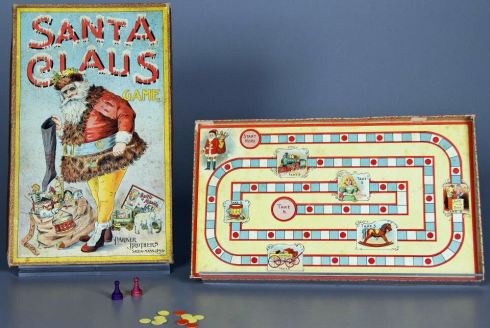
Christmas pantomimes never really caught on on this side of the Atlantic, and I don’t think a Christmas dinner party game called The Feast of Reason. A Christmas Dinner Party Puzzle did either, as I have been able to locate only two copies, one in the collection of the Boston Athenaeum and one which sold to a private buyer at auction a few years ago. Both were published by the Salem firm C. M Whipple and A.A. Smith in 1865, after a charming drawing by the artist William Emmerton (featuring marginalia that looks like a medieval manuscript) and lithography by the J.H. Bufford firm. There are multiple riddles for each course, and I have yet to figure out even one. Later in the century, another Salem producer, Parker Brothers, manufactured several games for Christmas time, including The Santa Claus Game and The Night before Christmas.

Feast of Reason BA

Feast of Reason 2p

Christmas Games Santa Claus Parker Brothers

Christmas Games Parker Brothers 1896 BGG

As the Parker Brothers’ games illustrate, by the twentieth century Christmas games seem to have evolved into children’s games primarily, rather than family or parlor games. There are a few exceptions, but there seems to be a holiday segregation of sorts, with the children preoccupied with gaming and gifts and the adults occupied elsewhere (purchasing, preparing, drinking?). At least everyone comes back together for the feast, followed by a little Crackers merriment, always over in Britain and increasingly over here.

Christmas Game 12 Days

Christmas Crackers V and A

Christmas games:  Christmas Circles, c. 1825, The Twelve Days of Christmas, c. 1950, and Batger’s Crackers, 1920s-30s, Victoria & Albert Museum Collection; Alfred Crowquil’s Pantomime, Harvard University; The Feast of Reason, c. 1865, Boston Athenaeum, Parker Brothers’ Santa Claus games, 1890s, National Museum of Play, ©The Strong.


The Merry Boys of Christmas

One of the most dramatic examples of raucous Christmas revelry happened in Salem Village on Christmas Day, 1679 when four youths barged into the home of John Rowden and started singing loudly before the fire. After a few off-key tunes, they demanded compensation in the form of spirits: perry, in particular, as Rowden maintained a profitable pear orchard and was known to make a pleasing pear cider. According to the record of the subsequent trial: it was Christmas Day at night and they came to be merry and to drink perry, which was not to be had anywhere else but here, and perry they would have before they went”. Rowden and his wife were not pleased with the songs, or the demands, so they sent the young men away, but they quickly returned with a scrap of lead which they tried to pass off as coin to pay for their perry. The Rowdens rebuffed them again, and then all hell broke loose. According to Mr. Rowden’s testimony, The threw stones, bones, and other things against the house. They beat down much of the daubing in several places and continued to throw stones for an hour and a half with little intermission. They also broke down about a pole and a half of fence, being stone wall, and a cellar, without the house, distant about four or five rods, was broken open through the door, and five or six pecks of apples were stolen.”  This was a case of Christmas wassailing gone bad, very bad, recounted by Stephen Nissenbaum in his wonderful book The Battle for Christmas as “The Salem Wassail” and a great example of why Puritans on both side of the Atlantic abhorred Christmas. Their power in both Parliament and the Massachusetts Bay Colony resulted in the great Christmas ban of the mid-17th century: from 1651 to 1660 in England and 1659 to 1681 in Massachusetts.

Vindication of Christmas

The Vindication of Christmas, 1652, lamenting the prohibition of its “keeping” in England during the Interregnum.

There were three major reasons why the Puritans hated Christmas. Their insistence on scriptural authority cast doubt on its date, as nowhere in the Bible does it say that the Nativity occurred on December 25th. They could only conclude, very reasonably, that some ancient winter festival, the Roman Saturnalia or the Winter Solstice, had determined this date, and that the Christian Church had merely adopted and assimilated it: consequently Christmas was perceived as a pagan holiday with a Christian gloss. Given their mandate to purify the Church of all its non-scriptural “traditions” and Popish trappings, it became a conspicuous target. The third reason was primarily social: the Christmas that the Puritans targeted was “Old Christmas”, or “Merry Christmas”, which they saw principally as a prolonged season–Christmastide, which could stretch beyond the twelve days of Christmas to encompass all of December and January–of disorder, misrule, and excess. In Cotton Mather’s words, the “Feast of Christ’s Nativity is spent in Reveling, Dicing, Carding, Masking, and in all Licentious Liberty….by Mad Mirth, by long eating, by hard Drinking, by lewd Gaming, by rude Reveling…..”.  By the time Mather  wrote this, “Old Christmas” had returned to England with the Restoration of the Stuart monarchy. Salem seems a little behind the times in 1679 when those young men wassailed the Rowdens so crudely; indeed in that same year the government of Charles II begin requesting that the Massachusetts General Court repeal its anti-Christmas law. If the Rowden revelers had been a bit less rude (and much better singers) one wonders if they would have been let off as mere “merry boys of Christmas”, the subjects of a popular British ballad who cast off all constraints in their keeping of Christmas: these Holidays we’l briskly drink, all mirth we will devise, No Treason we will speak or think, then bring us brave mine’d Pies: Roast Beef and brave Plum-Porridge, our Loyal hearts to chear: Then prithee make no more ado, but bring us Christmas Beer!

Christmas oldp

Christmas Merry 2p

Christmas merryp

carols

Keeping “Old” Christmas and the “Merry Boys of Christmas” broadside woodcut illustrations from 1680s; Christmas Carols return to Old England at about this time, but New England will have to wait a bit longer.

Dedicated to my friends at the Salem Historical Society and Creative Salem, big supporters of history AND revelry.


The Eyes of Saint Lucia

The astronomical winter solstice will not occur for a week or so, but the shortest day on the Christian calendar is that associated with the Feast of Saint Lucia or Lucy, occurring on December 13. John Donne referenced this connection in his poem A Nocturnal upon Saint Lucy’s Day: ‘Tis the year’s midnight, and it is the day’s,/ Lucy’s, who scarce seven hours herself unmasks;/ The sun is spent, and now his flasks/ Send forth light squibs, no constant rays;/ The world’s whole sap is sunk;/ The general balm th’hydroptic earth hath drunk,/Whither, as to the bed’s feet, life is shrunk,/ Dead and interr’d; yet all these seem to laugh,/ Compar’d with me, who am their epitaph.

Lucia’s story is part late antique and part late medieval: the earliest accounts depict her as a young virgin martyr from Sicily who was put to death in the Diocletian persecution at the beginning of the fourth century. She had devoted herself to Christ following the miraculous recovery of her mother from chronic “bloody flux” (dysentery) and afterwards devoted herself to distributing her not-inconsiderable dowry to the poor of the island. Her spurned betrothed turned her over to the Roman authorities, and she was tortured and threatened with “fouling” in a brothel. Her virtue and virginity were maintained by another miraculous intervention which rendered her body immovable, but she was martyred by a sword to her throat (after burning also failed). Her veneration seems almost immediate, and by the sixth century Lucy’s story had spread through much of Europe. Her association with “light” (lux in Latin) seems to come principally from her name, but in the later medieval era she also became a patron saint to the blind and those with eye diseases: we increasingly see her with attributes of eyes (generally on a plate) from the fourteenth century on, and this depiction becomes standard with the Renaissance.

Lucy's Eyes BL

Lucy Francesco_del_Cossa

lucy-web3

British Library MS Additional 22310 (Venice, 1460-70); Francesco del Cossa, Saint Lucy, 1473-74, National Gallery of Art (and detail); Francisco de Zurbarán, Saint Lucy, 1625-30, National Gallery of Art, Washington.

Once Lucy became associated with both light and sight, the eyes appear in her depictions and then a story is constructed and grafted onto her hagiography–but it has variations: sometimes Lucy is punished for her vision of the end of Roman rule by the gouging out of her eyes before her martyrdom; in other accounts she gouges them out herself to repel her pagan fiance. Each tales develops its own embellishments: Lucy’s eye’s were so beautiful that both the emperor Maxentius (whose reign would soon end according to her “vision”) and her evil and equally pagan betrothed wanted them gone; Lucy’s faith was so strong that she sacrificed her most beautiful feature so that she could “see” in only that way.

The Martyrdom of Saint Lucy, Watercolor, n.d., Wellcome Library and Images, London.

The equation of “light” with “sight” in these ways, over time, is just one interesting aspect of Lucy’s veneration. Another is its durability–and its range: even after the Reformation she maintained her stature in Protestant Europe and even increased it in largely Lutheran Scandinavia. Lucy/Lucia is venerated in parts of Italy and eastern Europe too, but it’s the Scandinavian rituals that really interest me, because I can’t quite figure out whether they are a continuation or “invention” of tradition. As the first references to Lucia rituals are in the eighteenth century and the first national processions in the twentieth, I’m guessing the latter, but clearly they had a cultural basis that was rooted in both the Christian and pre-Christian past. On December 13, white-clad, red-sashed “Lucias” lead singing processions out onto the streets wearing head wreaths made of lit (by wax or battery) candles; in the home, the household Lucia serves her family a substantial breakfast of special saffron buns (lussekatter–with raisin “eyes”!) after the long winter’s night. These Lucias bring light into their world on the darkest day of the year, when there is none.

Lucia Christmas Morning 1923

st-lucia-saffron-buns-vertical

Photogravure of St. Lucia’s Day, 1898, Wellcome Library; The crowned Lucia at this year’s Festival of  St. Lucia at York Minster, sponsored by the York Anglo-Scandinavian Society (© Ian Forsyth/Getty Images); Carl Larsson’s Christmas Morning, published in “Lasst Licht Hinin”; St. Lucia’s Day Saffron Buns at Simply Recipes.


Salem as Source

I’ve been fascinated by architectural drawings for as long as I can remember; actually I do remember the moment I was “caught”: I was in the attic at York Harbor, in my adolescence or early teens, when I encountered some very fundamental sketches made by my uncle Jeff, an aspiring architect. I never really knew him, and he never realized his ambition, as he died in a car crash on the Cape just after his graduation, at age 21. He was always a mystery to me, so when I saw these sketches they seemed like a clue. They drew me in, literally, and over time my appreciation for architectural studies evolved, through total immersion into the Renaissance in college and graduate school, historic preservation work, old house ownership, and marriage to an architect. Since I’ve been writing this blog, I’ve become increasingly aware of just how important Salem was to the burgeoning architectural profession in the later nineteenth century in general, and to the Colonial Revival movement in particular. The literary references are there, and the drawings, though mainly they are the work of New England architects. Just recently I’ve found a few more digital archives that contain sketches of Salem structures drawn by architects from other parts of the country. Today I am featuring the sketchbooks of two southern architects, William Martin Aiken and  Joseph Mordecai Hirschmann, who came to Salem for inspiration, forty years apart, in 1883 and 1923 respectively. William Martin Aiken was born in Charleston, South Carolina, but he studied at the Massachusetts Institute of Technology and worked in Cincinnati and later Washington, D.C., as the Supervising Architect of the Treasury Department. Joseph Mordecai Hirschmann was also a Charleston native, but spent most of his professional life working at the New York architectural firm of Walter and Gillette. Their professional papers, which include many drawings, are in the College of Charleston’s library and included in the Lowcountry Digital Library, a surprising sources for anything to do with Salem! But as institutions across the nation and around the globe digitize their collections, new sources of information pop up every single day.

SS Savannah Sketch SS Rockland Chapel

Before he came to Salem, Aiken sketched houses in Savannah, and after: Rockland, Maine.

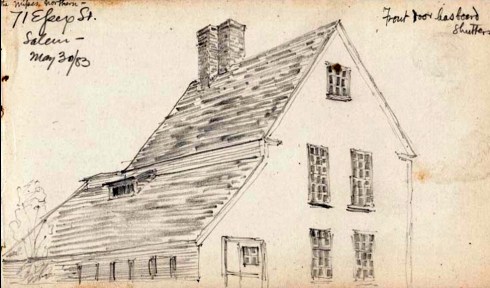
While in Salem, Aiken sketched the interior of the Pickman House on Essex Street, a famous Georgian house (then), now long gone, the first-period Narbonne House, also on Essex, a Derby Street door and an obviously early house which I can’t quite identify. The note reads “Temple Hardy”? Hardy Street? Help! (see what I mean about sketches being clues).

SS Pickman House

SS Narbonne House

SS 106 Derby SS Salem Hardy St

Where is/was this early Salem house?

His sketches indicate that Hirschmann wasn’t particularly interested in early architecture when he came to Salem: he went right to the McIntire District, where he sketched details: wrought iron fences, garden arches, classical columns. He was more of a note-taker than Aiken, and I particularly love his notation on the column sketch:  “very beautiful”.

SS Hirschmann Fences Sketch

SS Hirschmann Arch Chestnut Street Salem

SS Hirschmann Columns Sketch

The Architectural Sketches of William Martin Aiken and Joseph Mordecai Hirschmann, Lowcountry Digital Library.


Krampus Cards

Krampus, that dark monstrous creature, cloven-hoofed, horned, hairy, and long-tongued, the antithesis of Saint Nicholas but also his companion, somehow did not make it across the pond with Old St. Nick’s descendant, Santa Claus–actually, he didn’t even make it across the English Channel. I’m not sure why not, except for the fact that he is a repulsive creature, who constrains mischievous children in his basket and carries them off to somewhere bad. So who wants him? Well apparently we do now, with the new Krampus film opening tonight and Krampusnacht festivals on the rise both in the old world (especially his native Austria, Switzerland and Germany) and the new on December 5th, the eve of the feast of St. Nicholas. He’s big in Los Angeles now, and Philadelphia, and also apparently Salem: can you imagine a better environment for Krampus than modern Salem?

Krampusnacht Austria

Saint Nicholas and Krampas

Krampus in the drawing room 1812-13

Krampuses getting reading for Krampusnacht in Stubaital, Austria, 2013, photograph by Sean Gallup/Getty Images; St. Nicholas bearing gifts and Krampus carting children away, two cards from the Christmas pictures by Raschka series by Raphael Kirchner, Museum of Fine Arts, Boston; Krampus sneaking into the drawing room behind St. Nicholas, from The Journal of Carl Baumann written 1813-25 by Franz Paumgarrten.

In his latest incarnation, Krampus seems a lot scarier now than he did a century or so ago, when he appeared regularly on Krampuscarten, holiday postcards issued in much of central and eastern Europe. He’s always been a beast, but he was a comical and/or polite one (almost knocking on the parlor door above!) at that time. His origins are somewhat obscure: his appearance mirrors the pagan or Neo-Pagan horned god but also the Christian devil. He seems like the embodiment of assimilated and dualistic Christianity to me, chained to remind everyone that as demonic as he may be, he is still under the command of God. According to all the “sources”, which cite one another but never the primary source, he becomes the companion of St. Nicholas at some point in the seventeenth century, and with the “invention of Christmas” and all of its “traditions” in the nineteenth century he assumes a major role in the festivities. Given his alpine origins, the most creative Krampuscarten are those created in Austria, in particular by the artists working for the Wiener Werkstätte before the First World War. These art nouveau Krampuses are a bit more stylized and whimsical than many of their more generic postcard counterparts, and they tangle with adults as well as children. Once men in Krampus masks begin to appear at the doors of their sweethearts on interwar cards, you know the Krampus has lost his sway.

Krampus and St. Nicholas WW 3

Krampus Koehler MFA

Krampuscarten by Wiener Werstätte artists Mela Koehler (1911), Arnold Nechanksy (1912) from the Neue Galerie and Josef Diveky (1909), Jutta Sika (1912) and Dora Suppantschitsch (1907), Metropolitan Museum of Art.

Appendix: A “Krampus versus Kringle” window at the Gulu-Gulu Cafe here in Salem snapped by my friend Lance Eaton—he’s going to put it on his own blog, but I’ve got it up first!

Krampus versus Kringle Eaton


A Closer Look: Salem 1854

I’m following up on a post from a couple of years ago on urban “bird’s eye” maps from the sixteenth and nineteenth centuries, which included a lithograph map of Salem from 1854 published by Endicott & Company and the Smith Brothers and based on an original aquatint by British born American artist John William Hill (1812-1879). I was impressed by this map at the time, but I didn’t really do it justice. Here’s what I said:  Here is a map that defies categorization:  it’s part panorama, part rendering.  The detail, perhaps a bit idealized, is amazing, especially if you view it with a zoom feature.  Yet the people are stick figures; it’s all about buildings and streets. Thanks to some close cropping by the folks at Princeton University’s Graphic Arts Collection blog, I now want to revise that view: Hill’s view of Salem in 1854 is far more humanistic than I thought. Now I’m more impressed than ever by this amazing artist, whose skills are on flagrant display in this map, and others. It’s that combination of aerial perspective and architectural detail that draws me in, very evident in the close-ups provided by Princeton.

salem-mass

salem-mass3

salem-mass4

Lithograph map of Salem, Mass., 1854 by J. H. Colen after John William Hill (1812-1879). Published by the Smith Brothers, 59 Beekman Street, New York. Graphic Arts Collection, Firestone Library, Princeton University.

Yes, the people are still a bit stickish and it is certainly an idealistic impression, but the material world on display still draws you (at least me) in: 6 over 6 window panes, 8 over 8 window panes, dormers, chimneys, laundry on the line. This is a city that seems to be in transition in its orientation, from water to land, as a lot of effort seems to have been spent on those wide (clean! far more clean than they would have been in actuality) streets, home to a few stray carriages now but later to be clogged with cars. Hill’s depiction of Charleston from a few years earlier displays the alternate water-to-land perspective. Moving out of the realm of street view maps (but still encompassing people) is his beautiful watercolor of Boston Harbor, from the same era and the same collection at Princeton, and the stunning New York from Brooklyn Heights, which was issued in several variant genres in the middle of the nineteenth century.

Hill Charleston 1851

Hill Boston Harbor 1853

Hill NY from Brooklyn Heights 1850s

Bennett Hill Brooklyn Heights

John William Hill’s Charleston, 1851 (hand-colored lithograph, Historic Charleston Collection); Boston, 1853, Graphic Arts Collection, Princeton University, and New York from Brooklyn Heights, Carmen Thyssen-Bornemisza Collection on deposit at Museo Thyssen-Bornemisza. Aquatint with engraving and etching of the latter by William James Bennett, 1837, New York Public Library.


Sleeping with George

Even though we live only steps away, we packed up a few things (very few, essentially wine) and headed off to The Merchant to spend Saturday night in the very same room in which George Washington slept when he visited Salem in late October, 1789. The Merchant is the newly-christened Joshua Ward House, built between 1784 and 1788 for one of Salem’s wealthiest merchants; it has a long and interesting history, but is now completely restored, refurbished, and rejuvenated. My husband worked on this project and I’ve always loved this house, so as soon as it opened (November 25) we booked a room: #3, George Washington’s room. It is beautiful, and very tastefully (and patriotically) appointed with a starry ceiling and antique eagle, but we couldn’t possibly limit our presence to just that one room as there was too much else to see: a beautiful central hallway and hotel taproom/lounge adorned in jewel-box colors, amazing woodwork everywhere, details, details and more details. I couldn’t stop touching banisters, doorways and mantels, sanded down to their eighteenth-century origins to reveal very clean lines and then repainted in glorious colors. Once we did retire, I must say we didn’t spend too much time communing with George as the bed (which looked to me like a big Georgian chair covered in blue velvet–it doesn’t show up in the pictures well) was so enveloping: we fell fast asleep and woke up to a sunny Sunday morning which cast the room, and the entire hotel, in an even more illuminating light. But sadly we had to go (trudge) home.

George 209

George 029

George 202

George 028

George 098

Merchant Collage 2

George 059

George 075

George 113

George 127

Above, entry hall and room #3 of The Merchant, night and day, with its starry ceiling. Below, window where Washington waved to the crowd outside in 1789, the taproom/guest lounge (with bottles found during the renovation), and back deck, other guest rooms, and a few more amenities (old architectural details/ new herringbone bathroom tile), back hallway and McIntire mantel.

George 132

George 049

George 027

George 160

George 186

George 181

Merchant Collage

George 167

George 190

The Merchant, 148 Washington Street, Salem; 978.745.8100.


Small Business Salem

After a beautiful warm Thanksgiving week it was rather depressing to wake up to a cold, dark, and rainy Small Business Saturday here in Salem. We were playing football in what seemed like 70-degree weather yesterday up in Maine! I’m a big advocate of shopping local and small, not just during the Holidays but all year round. I think small business owners are absolutely heroic, particularly retailers in this internet age. The day before Thanksgiving I found myself with lots of errands to do and lots of things to buy, even though I wasn’t even cooking: off I went to the tailor, the newest French bakery, the wine store, and the cheese shop, all on foot. I’m sure I could have saved myself time and money if I had just driven to Vinnin Square (where all the big stores are), but I wouldn’t have learned that the tailor’s mother-in-law grew up in the same French town as one of the purveyor of macaroons, I wouldn’t have been able to wish several friends Happy Thanksgiving, and I wouldn’t have garnered any praise for my recent letter-to-the-editor protesting Haunted Happenings’ toll on our ancient cemeteries. Today I went out in the rain just to see who was out and about: I prefer to do my own Christmas shopping just a few days before Christmas in a single day (or maybe two) with a long lunch break.

Salem Small Business 020

Salem Small Business 022

Caramel Macaroons

Salem Small Business 032

Salem Small Business 047

Salem Small Business 042

Salem Small Business 050

Salem Small Business 052

A very random sampling of Salem wares on Small Business Saturday: vintage Christmas ornaments (including those of a political nature) at Witch City Consignment; macaroons at Caramel; fish prints at Joes Fresh Fish Prints at Pickering Wharf, a selection of teas at the Jolie Tea Company, the new tea shop/room across from the Hawthorne Hotel, rainy window and manly items at The Marble Faun.

There were people downtown, so hopefully all of Salem’s merchants had good day. In the 20 years that I’ve lived here, the retail scene has definitely improved (particularly retailers of food and beverages) but it still looks a bit challenging to me. There are many visual and literary reminders of the “golden days” before the construction of the Northshore Mall in nearby Peabody when Essex Street was clearly bustling year round, and neither its transformation into a pedestrian mall in the 1970s or the commencement of Haunted Happenings in the 1980s has been able to bring back that dynamic customer base. It’s a different commercial era for sure, but if we want a vibrant downtown offering more than witch kitsch it’s our obligation to get out there and consume: it’s a Salem tradition.

Salem Bakery

Filene's 1856 Pavilion

Filene's 1880s

I just discovered several new archives of Salem photographs which really focus on business, so here’s some historical perspective and inspiration. Above: delivery carriages for Hyman B. Miller’s Bakery on May Street in 1913–these buildings would all be wiped out by the Salem Fire in the next year, but Miller rebuilt his business (Collections of the American Jewish Historical Society). Below, the original Salem Filene’s in 1856 and 1881: this is a business which grew to become one of the biggest regional American department stores in the twentieth century (AJHS Collections and Archives of the Credit Union National Association, Inc.).


Hats off to Saint Catherine

There is a holiday more feminine than Thanksgiving and it is today: the feast day of St. Catherine of Alexandria, whose hagiography established her as the patron saint of philosophers and students in the Middle Ages, and of unmarried women and milliners in the modern era. An interesting evolution from the spiritual to the secular, like many medieval saints, with librarians and all penitents in need representing the transitional beneficiaries. According to her Legend, Catherine was a lovely young woman of noble birth in the early fourth century who converted to Christianity following a vision. She caught the eye of the Emperor Maxentius (r. 306-312) and her refusal to marry him resulted in her martyrdom: after she shattered the first instrument of her torture and execution, a spiked wheel, with a mere touch, she was put to the sword and beheaded. Catherine is seldom seen without these attributes as reminders of the strength of her faith, but there is also a genre of Renaissance depictions which show her rising above them and vanquishing the evil emperor.

Saint Catherine Pacher

Saint Catherine withe the Defeated Emperor

Friedrich Pacher, Saint Catherine of Alexandria, 15th-16th century, deYoung/Legion of Honor Museums, San Francisco; Master of the Legend of Saint Lucy, Saint Catherine of Alexandria, with the Defeated Emperor (c. 1482), Philadelphia Museum of Art.

I’m not sure of the precise transition, but at some point in the later eighteenth or nineteenth centuries, Catherine evolved in a patron saint for spinsters, or more precisely unmarried women over the age of 25. This was particularly a French development, and young women began to commemorate the day by praying to Saint Catherine for a husband, donning hats specially made for the occasion, and sending notes and cards to each other as a form of comfort and companionship. The emphasis on hats led to another evolution of Catherine’s patronage, and she became associated more specifically with unmarried women who worked in the fashion and millinery trades of Paris, where large “Catherinette” celebrations occurred on this day in the 1920s and 1930s, a “tradition” that was revived after World War II and apparently continues to this day. As would only be fitting for the women who worked in these creative industries, the hats worn by the Catherinettes were often (but not always) confined to Catherine’s colors of yellow (for faith) and green (for wisdom), but also exemplified unlimited forms of structure, substance and style. And still do.

Catherinets Paris Flammarion

Catherinettes 1950s

Catherinettes Etsy

Catherinette PC

Catherinette Paris 2013

Catherinettes in the 1930s (from Ernest Flammarion’s Paris (1931)) and 1950s; a modern print of vintage Catherinettes; a St. Catherine’s Day card from the 1940s, and a Chanel Catherinette creation, 2013.


Fabricating the Feast

Can there be any other holiday more closely associated with women than Thanksgiving? Forget the quasi-mythical “First Thanksgiving”, for which we only have references to men fowling and feasting–after that it’s all about women. What emerged as a New England tradition in the early nineteenth century was transformed into a national holiday through the intense efforts of author and editor Sarah Josepha Hale, eventually resulting in Abraham Lincoln’s Thanksgiving Proclamation of 1863. Several other New England ladies contributed to this effort, including Lydia Maria Child, whose “Over the River and through the Wood” we traditionally associate with Christmas but was first published in 1844 as “The New England Boy’s Song about Thanksgiving”. Successive presidents followed Lincoln’s precedent until 1941, when Congress established the fourth Thursday of November as a permanent Thanksgiving holiday. In the interim, a major medium for the adoption of a national harvest holiday seems to have been women’s magazines, chief among them Hale’s own Godey’s Ladies Book and later Good Housekeeping, The Ladies’ Home Journal (and Practical Housekeeper), (The) House Beautiful, and even Harper’s Bazaar. There was definitely a bit of culinary imperialism at work here: the ideal Thanksgiving menu published in Hale’s first novel, Northwood, was Yankee fare (cranberries!), but as turkey assumed the center stage (pushing out the very popular chicken pot pie and assorted other fowl) regional dishes could be assimilated as “sides”. And need I even say it? Women were making all those Thanksgiving feasts.

Thanksgiving HP 1894

Thanksgiving 1895 Bradley

Thanksgiving LHJ 1897-98

Thanksgiving 1904 Puck

Thanksgiving Pictorial Review 1906 Cover

Bearing Thanksgiving HP 1914

Thanksgiving gh 1937

Fabricating a very FEMININE Thanksgiving in the popular print media, 1894-1937: 1894-95 covers by Louis John Rhead and William H. Bradley, Metropolitan Museum of Art and Museum of Fine Arts, Boston; Ladies’ Home Journal Thanksgiving covers for 1897 and 1898; 1904 Puck Magazine cover, Library of Congress;  Pictorial Review and Ullman Manufacturing calendar page for November 1906; Harpers Bazaar and Good Housekeeping covers, 1914 and 1937, Library of Congress and Good Housekeeping archive.