Category Archives: History

The Hanged Man

Is it just me (here in Salem) or is Tarot experiencing a major resurgence? If so, I would point to our own anxieties and its flexibility, which encourages and drives myriad interpretations and paths: the Economist kicked off the year with its annual predictions issue featuring a spread of Tarot cards suggesting a dystopian future for “Planet Trump”. Regardless of their meaning, I love visual metaphors that are enduring and flexible, or so flexible that they are enduring: reflective of a particular era’s beliefs and values time and time again. One Tarot card that seems to represent this genre well is trump XII, The Hanged Man, which can represent a state of suspension, punishment, suffering, self-sacrifice, and also a critical crossroads at which one has the opportunity to change course. In the first Tarot decks, produced in fifteenth-century Italy and France, he was simply the traitor, perhaps reflecting contemporary “shame paintings” of conspirators and criminals, who were hanged by one leg for all to see.

Hanged Man collage

Shame Paintings collageHanged Men from the Visconti-Sforza deck, c. 1428-50, Cary Collection of Playing Cards, Beinecke Rare Book and Manuscript Library, Yale University and Morgan Library & Museum ; Samuel Y. Edgerton’s CLASSIC book on pittura infamante, with one of  Andrea del Sarto’s drawings (Galleria degli Uffizi, Florence) on the cover and inside.

The hanged man crosses the alps and is presented as Le Pendu in Tarot decks produced in early modern France and Flanders in the characteristic hanging-by-one-leg pose, (sometimes with bags of coins weighing him down in reference to the ultimate traitor, Judas). It’s important to note that before the end of the eighteenth century and the publication of French occultist Antoine Court de Gébelin’s The Primitive World Analyzed and Compared with the Modern World (1773-1782), Tarot cards were merely for play. The Primitive World asserted an ancient Egyptian lineage and ascribed much more power to all of the cards, and replaced the Hanged Man dangling from a rope to Prudence in the presence of a snake. A few years after the publication of de Gébelin’s tome, Jean-Baptiste Alliette reinforced and popularized his claims and offered up a more practical approach to Tarot practice in How to Entertain Yourself with the Deck of Cards called Tarot (1785), completing its transition to an occult art. The Hanged Man reappears in the nineteenth century, looking much the same as his pre-modern form but with enhanced powers and meaning.

Tarot Pack BM

Tarot Worth BMThe Hanged Man in a Flemish Tarot deck from the eighteenth century, and Oscar Wirth’s 1889 deck, British Museum.

The troubled twentieth century was a golden age for Tarot, beginning with the deck that popularized and standardized its “divinatory meanings”: the Rider-Waite Deck, with illustrations by Pamela Coleman Smith, which was first published in 1909 and reissued in a major way in 1970. In A.E. Waite’s accompanying Pictorial Key to the Tarot, the Hanged Man is described as “a card of profound significance, but all the significance is veiled…..the face expresses deep entrancement (represented by the saintly halo), not suffering…the figure, as a whole, suggests life in suspension, but life and not death”. While Tarot meanings were widely disseminated and standardized by Rider-Waite, the archetypal images were subjected to a range of modern interpretations over the next century. Perhaps the second most influential deck of the twentieth century was the “Thoth Tarot”, a collaboration between Aleister Crowley and Lady Frieda Harris which was published in 1969, well after both artists’ deaths. Much more multidisciplinary, the Thoth Deck broke the mold and inspired decades of creative interpretations–“traditional” (whatever that means when referencing Tarot), commercial, allegorical and abstract. Several Crowley-Harris paintings, the Hanged Men among them, were exhibited at the Venice Biennale in 2013, which I think began this current preoccupation with Tarot. There have been several Tarot exhibitions over the past few years, encompassing everything from emblematic installations to hooked rugs, as the Tarot cards are “reimagined” over and over again. Right here in Salem, photographs from Jim Bostick’s  “Salem Arcanum” Tarot series, featuring a Hanged Man who seems both traditional and modern and definitely illustrates “life in suspension”, are currently on view in the October exhibition at the Mercy Tavern.

Hanged Man 1909

Hanged Man Crowley-Harris

Hanged Men collage2

HWT collage

Hanged Man Woodcut

Minimalist Tarot

SONY DSC

A century of Hanged Men: Pamela Coleman Smith, from the Rider-Waite deck, 1909; Aleister Crowley and Lady Frieda Harris, 1969; Dürer & Bruegel Hanged Men by Giocinto Gaudenzi, 1989, and Pietro Alligo & Guido Zibordi Marchesi, 2003 accessed from this amazing site which showcases Tarot through the ages; the Housewives Tarot by Jude Buffum and Paul Kepple for Quirk Books, 2003; Woodcut @ HorseAndHair, 2013; photographs by Ayla El-Moussa for 25th Century, 2016; and Jim Bostick of Salem, 2017.


Where Angels Once Tread

We were so fortunate to be the recipients of an invitation to visit the vacation home of (very) close Salem neighbors and friends this weekend, and now we know why they’re always leaving town. Their house is located in Dublin, New Hampshire, overlooking the lake and at the foot of majestic Mount Monadnock—-which drew genteel and monied urbanites and scenery-seeking artists to its midst like a magnet in the later nineteenth and early twentieth centuries, creating a summer colony which shaped Dublin to a great degree, both in terms of its materiality and its vitality (not to mention the preservation of vast acreage). Our friends’ house was built by one of the founders of this colony: Miss Mary Amory Green, a great-granddaughter of John Singleton Copley, who became so taken with local artist and instructor Abbott Handerson Thayer (1849-1921) that she offered to build him a cottage/studio on her property. He took her up on her offer, and because he was apparently as enticing an instructor as he was an artist, a succession of artistic pilgrimages to Dublin ensued. So here we were staying in the house that began it all, itself a beautiful creation, both enhanced by and reflective of its setting.

Monadnock House Best

Monadnock House Best Entrance Fernlea, early morning: designed by Russell Sturgis for Miss Mary Amory Greene, 1882-1883.
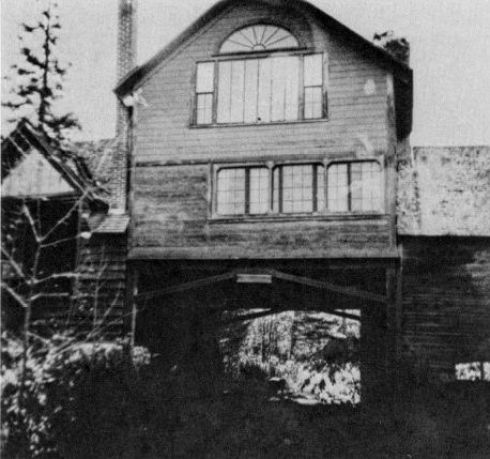
Unfortunately (for posterity but probably not for my friends), Thayer’s cottage was demolished around 1935. I began searching for images of it the moment I returned home, and as you can see below, it was more of a complex than a cottage as Thayer had some rather eccentric and austere ideas about living–and especially sleeping. Living in the age of that great “white plague”, tuberculosis, and losing his first wife to the dreaded disease, he came to believe that heat was a vehicle of its transition, a belief that his physician father apparently encouraged. The house that Miss Greene built for him was a summer house with no “conveniences”, and no alterations were made when he and his family took up year-round residence in 1901. Fires in the central house were allowed, but everyone had to retreat to open-air “sleeping huts” at the end of the day as Thayer believed that sleeping in the open, and in close communion with nature, was a particularly effective preventative against tuberculosis.

Monadnock Thayer

Monadnock Thayer Studio

downloadThe Thayer cottage complex and studio, and Gladys Thayer (Abbott’s daughter) in her sleeping hut, circa 1900. Nancy Douglas Bowditch and Brush Family papers, circa 1860-1985, Archives of American Art, Smithsonian Institution: cited in Susan Hobbs, “Nature into Art: the Landscapes of Abbott Handerson Thayer”, The Journal of American Art 14 (Summer 1982): 4-55.

And in this setting Thayer painted nature, portraits, and angels, who were not historical or theological figures but rather the characteristically-angelic women who crossed his path and touched his heart: all-the-more magnetic because of their humanity, and the wings that he gave them. You’ve got to be impressed by an artist who gave us both angels and camouflage!

Monadnock Dublin Pond Thayer Smithsonian

Monadnock 15

Thayer Angel 1903 MFA Abbott Handerson Thayer, Dublin Pond, New Hampshire, 1894, Smithsonian American Art Museum (painted as a gift for Stanford White); my early-morning view across from Fernlea; An Angel, 1903, Museum of Fine Arts, Boston.

I’ve got to leave Thayer territory and move on to Dublin at large: there are so many houses, so many stories, and I’m not even going to touch on the natural assets of the area. Probably one of the most famous public intellectuals and authors of the day (on a par with Mark Twain who also spent one summer in Dublin–is there anywhere Twain did not vacation?) was Thomas Wentworth Higginson from Cambridge, the so-called “Dean of Literary Boston” who built his Dublin cottage, the adorably-named “Glimpsewood” just down the Lake road from Fernlea in 1890. It’s now for sale. According to a very detailed 1899 article titled “Old Times and New in Dublin, New Hampshire (The New England Magazine, Volume 20) by George Willis Cooke, the colony was “complete” by about 1900, after several decades of steady cottage-building, although I think we should probably extend that up to World War One.

Monadnock glimpsewood collage

Monadnock cottages

Monadnock1

Monadnock 7

Monadnock 10

Monadnock 9

Monadnock 8

Monadnock 2

Monadnock 14

Monadnock Salem

“New” Shingle-style cottages, including a little gatehouse leading us up to the ruins of Pompelia, with its views of lake and mountain (torched by vandals in 1979), Our Lady of the Snows (1904), and a very charming boathouse; the “old” Eli Morse farmhouse, 1822, and the very new (1916) Colonial Revival “Skyfield” in nearby Harrisville, designed by Lois Lilley Howe, the founder of Boston’s first all-female architectural firm. This house apparently has several Salem mantels in it, and I need to determine from which house they were pulled.

The key to understanding Dublin is that it developed as one of several Gilded-Age alternatives to Newport: almost an anti-Newport. The “Old Times and New” article is very clear about this: the “summer resort” aims and methods have not found manifestation [in Dublin]. Almost exclusively the persons who have purchased and built in the town have sought a summer home for rest and recreation; they have not wished for society or fashion; and the life has been kept natural and simple. While there is a kindly interchange of social courtesies on the part of summer residents, any display of fashion or wealth has been discarded to a large degree and many interests bring persons together in a simple and unconventional manner. To keep to the ways of nature in yards, walks, roads and fields has been accepted as desirable; and an unwritten law has been adopted, that nature is to be interfered with as little as possible. Newport was shiny, marble grandeur for grandeur’s sake; Dublin was soft, shingled elegance for art’s (or nature’s) sake. I can completely relate to this aesthetic, having grown up in another anti-Newport, York Harbor, Maine, in a shingled summer cottage that was not quite winterized: I’m even wondering if my own father might have been exposed to the Thayer regimen!

A Harrisville appendix: driving to the town next door (in my host’s ’56 Morgan) and there we are in another archetypal New England setting: the small mill town, perfectly preserved.

Monadnock 6

Harrisville collage


Change in the Weather

The weather actually did change very perceptibly here, at about 9:30 or 10:00 yesterday morning, from muggy late summer into breezy crisp fall. In about a half hour: I felt it, and everyone I ran into yesterday felt it too. But I still have weather history on the brain, so my title is referring to a volume by the amazing antiquarian of a century ago, Sidney Perley: Historic storms of New England : its gales, hurricanes, tornadoes, showers with thunder and lightning, great snow storms, rains, freshets, floods, droughts, cold winters, hot summers, avalanches, earthquakes, dark days, comets, aurora-borealis, phenomena in the heavens, wrecks along the coast, with incidents and anecdotes, amusing and pathetic (1891). What a title! And it does not disappoint.

Weather Historic Storms of NE

I have written about Sidney Perley many, many times here before as his works are the starting place for anyone interested in Salem history and culture—and often the culmination of inquiries as well: that’s how good he was. Perley (1858-1928) was lawyer by profession but an historian by passion—I’ve met many people like this over my career but Perley managed to somehow excel at both pursuits simultaneously, publishing a steady stream of books (History of Boxford, 1880, Poets of Essex County, 1889, History of Salem, 1924, and all those invaluable articles in his Essex Antiquarian along with many texts on probate law) over the course of his career. Quite logically he was an expert in utilizing the will and the deed as a historical source, but he clearly mined any and every source he could find for essential “anecdotes”. When I begin to delve into the history of a Salem house I always start with Perley, a practice that began long ago when I first moved here and started researching house histories for Historic Salem, Incorporated. He remains an essential guide to the history of Salem for me, and I thought about him a lot last summer, when Proctor’s Ledge was formally recognized and memorialized as the execution site of the victims of the Salem Witch Trials—culminating a process that began in the 1920s with his advocacy for this site. With the inaccessibility and closure of the Phillips Library it is apparent to me that his works are probably our best connection to Salem’s early history. The other day I found an old copy of his Historic Storms on my bookshelf, opened it up, and just like that, several hours went by in what seemed like a minute. It’s one of those books that is quite easily read intermittently but I had lots of other less interesting stuff to avoid so I just settled in and read about the weather.

Perley2

Perley 3

Because the book is focused on weather events, you come away with a perception of very dramatic weather, and maybe it is just because the crisp coming-of-October breeze was coming through the windows of my study while I was reading, but it seemed to me, anecdotally, that October had the most changeable weather of all: severe drought and rain, snow, thunder, lightning, shipwrecks, earthquakes, Indian Summers, and above all, excessive winds. The first of the famous “Dark Days” (of 1716 and 1780, now attributed to forest fires in the north, then very mysterious and perhaps the wrath of God), occurred in October, the second in May, another very changeable month. During the “great” Dark Day of 1780 in Salem, the Reverend Nathaniel Whittaker’s congregation heard that the gloom was divine judgement of their cumulative sin, while out in the streets, [drunken?] sailors paraded about, “crying out to ladies who passed them by, ‘now you may off your rolls and high caps'”. A bit over a century later, Perley serves as his own source in his account of the less famous “Yellow Day” of September 6, 1881: On the morning of “the yellow day” there was no apparent gathering of clouds, such as occurred on the dark day 0f 1780 but early in the morning the sun and sky appeared red, and towards noon every part of the sky assumed a yellow cast, which tinged everything, buildings, ground, foliage and verdure, with its peculiar novel shade. All things were beautiful, strange and weird, and it seemed as if nature was passing into an enchanted state. It was at first intensely interesting, but as the hours dragged on, and but slight change occurred the sight became oppressive. The wonderful spectacle will never be forgotten by those who witnessed it. Love that line, all things were beautiful, strange and weird. Perley was also, it should be acknowledged, a very good writer.

Perley 5

Perley 6

Perley 4

Nocturne: Black and Gold - The Fire Wheel 1875 by James Abbott McNeill Whistler 1834-1903

Scenes from the first crisp Autumn day of 2017 in Salem cast in darker, yellowish hues—as preparations for our annual neighborhood party were ongoing across the street in the Chestnut Street park + James Abbott McNeill Whistler’s Nocturne: Black and Gold – The Fire Wheel (1875, Tate Museum), just because.


Storms of the (Seventeenth) Century

I’m only teaching two broad surveys this semester, a welcome departure from the more topical and graduate courses of the spring and summer. Surveys can be tricky: you can easily get lost—or lose the students–in a stream of narrative if you don’t impose an illustrative theme. The theme I chose for my Introduction to European History course —turning points—was not serving me well: it was simultaneously too loose (it was taking me forever to lay the foundation for my chosen turning points, which were not the predictable ones) and too constrictive, and also much too History-Channel-ish (cue dramatic music signally important EVENTS, primarily related to the rise and fall of the Third Reich, when the swamp people are not on, of course). So the other day I navigated a midstream change of course and plunged my students headfirst into environmental history: we were approaching the end of the Medieval Warm Period anyway! As we go forward into the devastating (weather-wise, and in other ways too) fourteenth century—and then further still into the seventeenth century, another time of dramatic climate change, I think this focus on environmental changes will highlight corresponding changes in how men and women viewed the world they lived in—plus I can take advantage of my students’ focused attention on all the weather in the news.

My approach to environmental history is more oriented towards human perceptions and responses than the scientific, structural changes which provoked expressions of the former–it is an extension of my academic interest in the concept of pre-modern wonder, or the physical manifestation of God’s power–and will. In the seventeenth century, for example, “wonderful” weather—storms, winds, floods—were all perceived as punishment for the sins of mankind, until, quite later in the century, they were not quite. The terrible floods in the west country in 1607 (possibly caused by a tsunami) were portrayed in quite a fearful manner in contemporary pamphlets, but the floods of 1674 were relayed in the form of a ballad, to be sung in the taverns and streets:  still, lives should be “amended” lest a worse thing befall us. Then as now, the details of human suffering and responsive heroism are offered up: water-men were forced to row up and down the streets with their boats, to take men, women, and children, out at their windows, and to save little children that swam in their cradles. Nature gets a bit less mysterious and a bit more objective as time goes by, though maybe we are returning to a time which emphasizes its wrath–and our requisite amendment–yet again.

Famous English floods of the seventeenth century in 1607, 1651, 1655 & 1674: I found only freshets (a word I just learned last month!) on this side of the Atlantic (at least in NEW England).

Flood 1607 Anon-1607_Lamentable_newes_out_of_Monmouthshire-STC-18021-722_05-p1

Flood 1607 Anon-More_strange_nevves_of_wonderfull-STC-22916-723_27-p2

Flood 1651 Anon-A_true_relation_of_the_great_and-Wing-T2959-2900_02-p1

Flood 1655 Anon-The_Sad_and_dismal_year_Or_Englands-Wing-S231-129_E_853_1_-p1

Flood 1674 L_W-A_true_relation_of_the_great_flood-Wing-W83-2123_2_236-p1

Lamentable Newes out of Monmouthshire in Wales, 1607; More strange nevves: of wonderfull accidents hapning by the late ouerflowings of waters, in Summerset-shire, Gloucestershire, Norfolke, and other places of England, 1607; A True Relation of the Great and Terrible Inundation of Waters, 1651; A Sad and Dismal Year, or, England’s Great and Lamentable Flood, 1655; A True Relation of the Great Flood that happened in many part of England in December and January last, to the undoing of many the drowning of cattell and driving down of bridges and houses the drowning of people and washing up by the roots which was the means of rising the prices of corn in and about the City of London; with a warning for all people to amend their lives lest a worse thing befall us. The tune is, aim not to high, 1674, all accessed via Early English Books Online. 


Hallowed House

There have been several Salem houses—houses that are no longer standing—that have haunted me; I get almost desperate to find out as much as I possibly can about them and if and when I do I’m done. If they remain inscrutable, they remain with me. There is one house that I’ve been thinking about for years: I’ve learned quite a bit about it but not enough: I’m not sure I’ll ever learn everything I want to know (at least not now, while I can’t get into the Phillips Library!). I’m posting on this house today just so I can stop thinking about it for a while.

The house in question is (was) the Colonel Benjamin Pickman house, built in either 1740 or 1750 or sometime in the decade between depending on the source, right on Essex Street, adjacent to where the Peabody Essex Museum’s East India Marine Hall now stands. Its former site was the Museum’s Japanese garden, recently transformed into a construction site–which is why I’ve been thinking about the Pickman House: have the workers found any material remains? Or does it just survive on paper–and in pieces? This is a house that was famous in its day, and well after. It was designed by an English architect–previously unknown but possibly identified as Peter Harrison, who also possibly designed the Cabot-Low-Endicott House further along Essex Street and the “King” Hooper Mansion in Marblehead. Whoever the architect or builder was, all agree that it was the client, the Colonel himself, who had carved and gilded codfish affixed to every riser of the house’s central stairway in acknowledgement of the source of his wealth and position, thus inspiring that perfect phrase, “Codfish Aristocracy”. Its elegant furnishing were much commented upon by contemporary observers and diarists, as was its rusticated wooden siding, meant to mimic stone. There’s a long list of prominent diners at the house, including Alexander Hamilton: on June 20, 1800. The house was successively celebrated, lithographed, photographed, obscured, picked-apart, measured and drawn, and ultimately demolished in 1940 or 1941.

Pickman Lithograph Boston Athenaeum

Pickman collage

Pickman Cod

Benjamin Pickman Doorway Cousins

All representations of the Pickman House are based on the c. 1830 lithograph published by Pendleton’s Lithography which shows the house in its pristine eighteenth-century state (courtesy Boston Athenaeum); an amped-up Pickman codfish from Mark Kurlansky’s Cod: a Biography of the Fish that Changed the World; A Frank Cousins photograph of the enclosed doorway which Samuel McIntire added to the house c. 1800. 

We can’t see this famous house for most of its life, which only adds to its air of mystery (and vulnerability). Charles Webber and Winfield Nevins, the authors of Old Naumkeag: An Historical Sketch of the City of Salem and the Towns of  Marblehead, Peabody, Beverly, Danvers, Wenham, Manchester, Topsfield and Middleton (1877) inform us that a certain “Mrs. LeMasters” constructed several low shop buildings in front of the house in the 1870s, and so we only see dormer windows peaking out from above in all the late nineteenth and early twentieth-century views of Essex Street and the East India Marine Hall.  The Pickman family had moved west–into the residential McIntire District–away from the increasingly-busy downtown. A correspondent from the Philadelphia Inquirer who visited Salem in September of 1918 to see all the old storied mansions noted that the charming old house next to to the Peabody Museum has been all but obliterated by the shop front built out over its first and second stories…the gambrel roof, with its picturesque dormer windows, may still be seen overlooking the horrid shops, but all the inside fixtures have been destroyed. Progress is painful!

Pickman 1912

Pickman PEM PC

Pickman 1920s

20170924_180714

You can see the Pickman House dormer windows peaking out from above the storefront on the right of the two postcards and just above the P&Q shop, c. 1920s. These images were sourced for me from the Salem State Archives and Special Collections by Jen Ratliff–thanks! The house is completely invisible in the street- view photograph above from the late 1800s and the Phillips Library–it’s just behind the shops on the left, beginning with the “Importers of Crockery” storefront.

We do get to see the the unobstructed house (or what’s left of it), as a team of architects and photographers from the Historic American Building Survey went in to document it on the eve of its demolition–no doubt inspired by a succession of architects who had made the pilgrimage to Salem to measure and sketch this house, beginning with Arthur Little in 1877. As you can see, the storefronts didn’t just obstruct the house, they cut into it on the first and second stories. From that point on it must have been open season for house parts: an archway and a golden cod went to the Essex Institute, and all the other codfish went to a Pickman descendant’s Newport mansion: I think this one (where there is also a reproduction McIntire summer house) but I’m not certain.

pickman-house-parlor-arthur-little-early-new-england-interiors

Pickman House

Pickman HABS 1

Pickman HABS 2

Pickman HABS 3

Pickman HABS 4

Arthur Little sketch of the Pickman House parlor, Early New England Interiors (1878); William Martin Aiken sketch of Pickman architectural elements, 1883, Lowcountry Digital Archive; HABS MA-332 photographs and drawing, Library of Congress.

I’m not just interested in wood or architecture; I’m also interested in Colonel Pickman–but he remains pretty inscrutable too. Ultimately the only way to get to know him is through material remnants (like the silver he left to the First Church) or his family: his son Benjamin Pickman Jr. (whom I’ve written about here and here), was a Loyalist who left Salem during the Revolution but managed to easily assimilate into its social and political society upon his return–hence the dinner with Hamilton at the house! The more patriotic Colonel had died in 1773, so he doesn’t figure very prominently in the edited volume of his son’s diary and letters published in 1928. There is a beautiful portrait of the elder Benjamin by John Greenwood in the collection of the Peabody Essex Museum, but I’ve never seen it on display–nor the fluted archway and golden cod that is all that is left in Salem of the beautiful house that was once next door.

Benjamin PIckman collage

Colonel Benjamin Pickman of Salem, 1708-73.


A Folio for the Worst Day

September 22: the first day of fall, and the worst day of the Salem Witch Trials, I am aware of both markers every single year. The beginning of the end. In successive posts on this day over the years, I’ve tried to focus on remembrance of the eight victims, the last victims, who were executed on this day 325 years ago: Ann Pudeator and Alice Parker of Salem, Martha Corey of Salem Farms (Peabody), Samuel Wardwell and Mary Parker of Andover, Wilmot Redd of Marblehead, Margaret Scott of Rowley, and Mary Easty of Topsfield. Looking over these posts, I see one big change: we finally have a memorial at the execution site on Proctor’s Ledge. No longer do I have to wander around the Gallows Hill area in search of the sacred spot (like so many before me). It’s been an incredible year of remembrance really, with our anniversary symposium and the dedication of the new Proctor’s Ledge Memorial, at which my colleague Emerson Baker, so instrumental in the verification of this site, asserted that we need less celebration in October and more commemoration and sober reflection throughout the year. I am not hopeful that Salem will see less celebration in October (or now—the celebration seems to start earlier every year), but those who seek more sober reflection now have two memorials at which to meditate: the downtown Witch Trial Memorial turns into a food court in October so head to Proctor’s Ledge if you are so inclined.

Memorial Collage The two memorials: Proctor’s Ledge this summer; downtown in October 2015.

One does not need a memorial to reflect, of course: words and images work just as well for me. The other day I rediscovered a slim (and dusty) volume in my library which I hadn’t seen for years: The Witches of Salem, a “documentary narrative” edited by Roger Thompson, with amazing linocut illustrations by Clare Melinsky. Like all Folio Society books, it’s a beautiful book, encased in its own hard-case slipcover: I think it was a gift but I don’t remember from whom! The Witches of Salem is an an annotated compilation of primary sources with a chronological format, and a good introduction to the Trials. There’s nothing really new here in terms of information, but Melinsky’s illustrations enhance the presentation in myriad ways: aesthetically, of course, but also contextually. They strike me as a cross between Ulrich Molitor’s first woodcut witches from the later fifteenth century and the chapbooks issued in the eighteenth century—after Salem–which featured deliberatively-primitive images to suggest just how backward belief in witchcraft was. To my eye, the illustrations look more European than American but there are some very familiar scenes….

Folio 2

Folio 13

Folio 3

Folio 6

Folio 8

Folio 5

Folio 7

Folio 12

Folio 11

Folio 4

So much suffering on this day 325 years ago, before and after. We do have our memorials here in Salem, so I suppose that gives us free rein to milk the Trials for all they are worth. The worst day, the beginning of fall, the beginning of the ever-longer, ever-bolder Haunted Happenings: they all converge. Even the stately Peabody Essex Museum, which has always been above the fray, has joined in the celebration, moving their monthly Thursday PEM/PM event to Friday this month: September 22.

Appendix:

 A really good article about the “holiday creep” of Haunted Happenings and Salem in general by someone much more objective than I!  http://www.atlasobscura.com/articles/salem-and-the-rise-of-witch-kitsch    


Busy Bees

I know that bees are experiencing some serious challenges at the moment, but it seems to me that there are much more of them out there than in previous summers—at least in our region. I’ve encountered mini-swarms on rural walks in both New Hampshire and Massachusetts over the past month, it seems like individual bees have been buzzing around my garden constantly since July, and just the other day I saw hundreds of bees affixed to the sunflowers in the large patch at Colby Farm up in Newbury: neither bees nor people can resist this flagrant perennial display!

Bee Sunflowers Best

Bee Sunflowers Closeup

I went into my clip file—comprised of very random digital images which I find interesting or attractive and store away for whenever or whatever (other people seem to use Pinterest this way but I just don’t)–and found several bee images there that I had clipped or snipped over the last few months: books, ephemera, creations. So clearly I’ve had bees on the brain: maybe because I decided to forego sugar over the summer and thus became more intensely focused on honey. In any case, this seems like a good time to get these images out there–Thomas Tusser suggests that the ongoing process of “preserving” bees demands a bit more human attention in September in his classic agricultural manual Five Hundred Points of Good Husbandry (1573):  Place hive in good air, set southly and warm, and take in due season wax, honey, and swarm. Set hive on a plank (not too low by the ground) where herbs and flowers may compass it round: and boards to defend it from north and northeast, from showers and rubbish, from vermin and beast. Tusser is one of many British and continental authors writing about bees and beekeeping in the sixteenth century, and over the succeeding centuries this sub-genre continued to flourish, right up to the wildly-popular Beekeeper’s Bible. I’ve written about bee books before, but my favorite recent discovery is Samuel Bagster’s Management of Bees, with a description of the Ladies’ Safety Hive (1834). Bagster has a very entrepreneurial attitude towards bees, and is striving to transform their keeping into a feminine avocation with his promotion of the “Ladies Safety Hive”: they can be built at home or delivered by Bagster, fully-equipped.

bee collage

Bees Bagster

My apian ephemera is focused less on the bees than their hives: which of course serve as an accessible symbol of industry and by extension, achievement. The most prominent uses of beehive symbolism on Salem ephemera that I have found were issued by the Salem Charitable Mechanic Association (which it clearly borrowed from the Massachusetts Charitable Mechanic Association, or vice-versa) and Frank Cousins’ many trade cards advertising his Bee-Hive store but there is also an early trade card for the Salem goldsmith and jeweler Robert Brookhouse which features the very Salemesque combination of hive and ship. I discovered a completely new type of ephemera this summer–watch papers–of which there is an interesting collection at the American Antiquarian Society, including several embellished with beehives.

Bee Certificate

Bee Hive MA Charitable HNE

Trade Card beehive

Bee Brookhouse

Bee Hive Watch Paper AAS

Ephemeral beehives: Phillips Library (printed in EIHC Volume 113); Historic New England; and courtesy American Antiquarian Society.

Another discovery of this fading summer are the amazing textile creations of Mister Finch, which you must see for yourself. His bee is among the more realistic of his species–check out his website for more surrealistic creatures. And then there is Tamworth Distilling, to which I returned several times, which manufactures several varieties of botanical gins, including the Apiary Gin pictured below. To be honest, this was a bit too honey-based for me: gin is my favorite spirit and I tend to be a London Dry traditionalist. But I love the bottle, of course (and their cordials).

bee

Bee Gin

Mister Finch Bee and Tamworth Distilling Apiary Gin.


Au Courant Classrooms

For my annual back-to-school post, I want to focus on two very distinct phases of school reform, both of which focused on the aesthetics of the classroom. This will not be the case everywhere, obviously, but when I look around Salem and its environs, I see a lot of school buildings built in the later 19th century–World War I era, and an equal number built after World War II. Rather than thinking about demographics, my mind immediately wanders to the design elements of these structures. The exteriors are pretty obvious (solid civic Classical Revival for the former era, International-style boxes for the latter), but what about the interiors? It happens that the celebrated Salem artist Ross Turner was very active and influential in a movement dedicated to embellishing classrooms in the 1890s and after, a movement dedicated to “vitalizing the dormant sense of the artistic” among Americans, “which by false and ugly environment, has been so repressed as to be of little actual value to the community”.  Arts education and the decoration of the classroom went hand in hand for Turner, and he believed that students should be exposed to both as early as possible, in the (relatively-new)) kindergartens and primary schools. He had an effective partner in the Prang Educational Company, which published his works and produced artistic products for the classroom.

Stylish Schools Art for the Eye

Prang Educational Company AAS Courtesy, American Antiquarian Society.

Here are Turner’s design recommendations for classrooms: they should be quiet, harmonious in color and arrangement [with] the color of the walls selected according to the light…the use of dull colors–brown or slate colors–should be usually avoided. The color effect should be responsive and light, never dull, heavy or cold. Remember we have under present conditions to struggle against a hideous dulled surface known as the blackboard, too large and ugly…A comprehensive group or series of art subjects…beginning with primitive work, Egyptian and Assyrian, early Greek and Etruscan, and proceeding up through the Renaissance [not after] is essential, in plaster or pictorial forms. He recommends that statues and “solar prints’ be spread liberally around the classroom, as well as architectural fragments, and decorative designs in plaster. And one last thing: every schoolroom should have a bust or portrait of some eminent American citizen or patriot placed immediately above the desk of the teacher; above and around this the colors of our common country. Here should be the shrine of American patriotism. We should display the flag above patriotic busts, or portraits, inside as well as outside the schoolroom. Art for the Eye was first published in 1895: let’s look at some Salem classrooms from about a decade later to see if it had any impact. These photographs are all from the very accessible digital collections of Salem State University Archives and Special Collections.

Stylish Schools SSU Horace Man

Stylish Classroom SSU Horace Mann3

Stylish Schools SSU HOrace Man 2

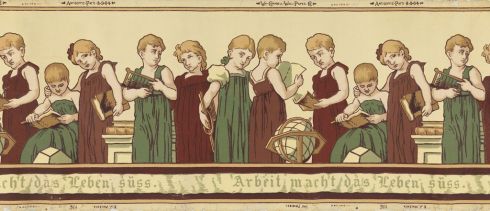
The photographs are from a series taken by Salem photographer E.G. Merrill of the Salem Normal School’s Training School, later known as Horace Mann, for the School’s 50th anniversary in 1904. It looks like the hideous chalkboard is still in the classroom (though utilized for artistic purposes via the elaborate blackboard sketching that was a speciality at Salem Normal School), but there are certainly a lot of other Turner-approved embellishments! It’s so perfect, I envision this wallpaper frieze from 1910, named after the inventor of kindergarten, in all Turner-approved classrooms!

Stylish Schools WallpaperWallpaper “Froebel” frieze, 1905, E.J. Walenta for Wm. Campbell Wall Paper Company, Machine-printed on paper, Hackensack, New Jersey, USA, Cooper-Hewitt Museum, gift of Paul F. Franco, 1938-50-15.

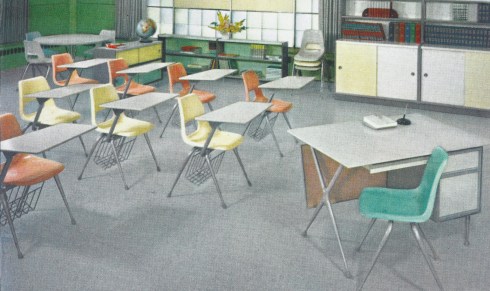
The second wave of educational aesthetic reform followed World War II, and seems largely focused on clearing out all of the elements that Turner advocated for, as well as letting in, or creating, even more light vis-à-vis the new fluorescent lighting. A model classroom was installed at Salem’s Bowditch School (then on Flint Street) by the Salem-based Sylvania factory, and promoted nationally by a serialized newspaper article in alliance with the National Education Association. I can’t get the photographs any clearer, but the description is helpful: blackboards replaced by tackboards (that won’t last), wooden floors replaced by tile, and “posture-improving desks” installed. In the permanent collection of the Museum of Modern Art there is a prototype desk designed for the Bowditch School by the architectural/engineering firm Markus & Nocka in 1946–ostensibly for this remodeling–but I can’t tell if these are the desks in the photograph (if they are, I wonder where they all went when the Bowditch was converted into condominiums!)  More likely something more conventional was chosen, like the colorful Brunswick desks in the advertisement below. These are what I grew up with, and I think there’s still more than a few in the old SSU Sullivan Building where I teach today.

Stylish Schools 1946

Stylish Schools MOMA

Stylish schoolchairs BrunswickBrunswick chairs c. 1958 from the VS Schulmuseum site. 

♣ Heads up: exhibition of Ross Turner’s works at the Kensington-Stobart Gallery at the Hawthorne Hotel opens this Friday September 8!


Losing our History

The national discussion over Confederate war memorials is centered on the implicit question: who owns history? Often that is a question that is difficult to answer because in fact everyone owns history. Interpreted in a material way, however, it’s possible to be more literal: in terms of sources, for example, it is quite apparent that the Peabody Essex Museum owns Salem’s history.  The PEM’s Phillips Library, the third largest museum library in the United States, is the largest repository of historical records of Salem and Essex County by far: its holdings encompass the papers and records of innumerable Salem families and organizations, the definitive collection of Hawthorniana, all sorts of records relating to Salem’s China Trade, including logbooks, customs records, merchant account books, hand-colored plates of ships, maps, and the Frederick Townsend Ward collection, one of the world’s largest collections of Western-language materials on Imperial China. The Library holds a million historic photographs, including rare nineteenth-century views of Asia, the archives of Edwin Hale Lincoln, Frank Cousins and Samuel Chamberlain, and the complete North American Indian portfolio of Edward S. Curtis. The Edward Sylvester Morse collection of Japanese language books is just one small part of a 400,000-volume collection which began in 1799. The physical size of the entire collection is best expressed by numbers: 5000 linear feet of manuscripts, over 1000 linear feet of archives, 3,000 linear feet of newspapers, 135 linear feet of ephemera and nearly 5000 reels of microforms. The bulk of this collection was compiled when the Phillips Library was part of the Essex Institute (established in 1848), which merged with the Peabody Museum to form the new Peabody Essex Museum in 1992. As part of a new, ever-expanding museum which privileges the global and the sensational over the local and the historical, the Phillips Library’s mission has clearly changed: to what I do not know. But more importantly, it has become increasingly restrictive and inaccessible, and absent: it was closed for renovations in 2011 and its collections were moved to a facility in Peabody and now it is moving on to another (temporary?) facility even further away, in Rowley. According to one succinct statement regarding this move, and supposedly to facilitate it, all access to collections will be suspended from September 1, 2017 through March 31, 2018.

Phillips Library 1885

Phillips Ladies

Phillips Logbook Horace

Gentlemen in the Phillips c. 1885, and ladies outside Plummer Hall on Essex Street, which housed the Library for over a century; Logbook from the ship Horace, first decade of the 19th century.  All images in this post (except those from the Essex Institute Historical Collections Volume 113, no. 3 below) are from the Library’s social media accounts: Twitter and Instagram. The Library’s wonderful blog, Conversant, has been shut down, but you can still see some of the images it featured on Pinterest.

The lingering detachment of the Phillips Library has been nothing short of tragic for Salem, as it long served, in purpose and in effect, as the city’s historical society. While other towns in Essex County developed historical societies and museums over the course of the nineteenth and early twentieth centuries, Salem did not, because it already had one: a vast repository of private (and public) records right in its midst. You can see–and read—Salem citizens engaging with the Essex Institute and the Phillips Library (with their history) in the pages of the long-running (and thankfully digitizedEssex Institute Historical Collections, which is full of recollections and memorials as well as historical analyses of materials in the Library’s collection. Given Salem’s dynamic past, the lack of an accessible and engaging repository of its heritage has resulted in historical interpretations that are entrepreneurial at best, and crassly commercial for the most part: is it any wonder that we have a statue to a television character in our central public square?

Phillips EIHC

Phillips Map 1806

Phillips Certificate

Phillips Cushing

One of my very favorite volumes of the EIHC from July 1977: focused on a coincidental exhibition at the Essex Institute on the life and times of the Salem’s famous diarist, the Reverend William Bentley. It’s full of insights and images, including: a plan of South Salem Bridge and Lafayette Street, c. 1806, a certificate for the Salem Iron Factory, c. 1800, and a print and portrait of Salem printer Thomas C. Cushing, c. 1806 and 1816. Along with social media, these volumes might be our only avenue of access into the Phillips Library for a while…..

There are many curious, engaged and energetic people in Salem who clearly crave a closer, more introspective connection to the city’s complex past but I wonder how this can be achieved when we have so little access to our material heritage? That’s the big question, but I have so many more. Why haven’t more of the Library’s collections been digitized? That seemed to be the intent several years ago, but I only see a few digitized collections on the Museum’s website (volumes of The American Neptune, images of the Great Salem Fire, ocean liner ephemera, vintage valentines, the Winthrop family papers): this is a scant amount of material in relation to the Library’s entire collection and in comparison with the efforts of other comparable libraries. What about public records? The Phillips holds the major legal records of the Salem Witch Trials, the Essex County Court Archives, which were deposited at the Essex Institute by the Massachusetts Supreme Judicial Court in 1980, as well as the records of the Quarterly Courts of Essex County. These records have been transcribed, printed, and digitized (at the University of Virginia’s Salem Witch Trials Documentary Archive and Transcription Project) but don’t we still have a legal right to access the actual documents? I would imagine that the representatives of all those Salem families and institutions (the Appletons, the Crowninshields, the Derbys, the Peabodys, the Active Fire Club, the Salem Society for the Moral and Religious Instruction of the Poor, the Salem Female Charitable Society, the Salem Charitable Mechanic Association, the Salem Marine Society……I could go on and on and on…..) assumed that when they placed their records in the safe-keeping and under the stewardship of the Phillips Library that they would form part of a public archive for posterity: otherwise what is the point? And finally, I am thinking–and wondering–about my Americanist colleagues and how they’re going to conduct their research come tomorrow, when I will have more tools and materials at my disposal as an English historian here in Salem than they will.

Phillips 1687 deed

Phillips Reward of Merit

Phillips Chairs

Phillips collage

Phillips Peabody

Phillips Cousins

More random treasures from the Phillips Library: a 1687 deed conveying Rumney Marsh to Colonel and Mrs. Paige; a reward of merit bestowed upon Elizabeth S. McKinstry; a plate from Robert Manwaring’s Cabinet and Chair-Maker’s Real Friend and Companions (1765); just two broadsides; George Peabody’s letterbooks; a Frank Cousins photograph of the entrance to the Andrew Safford House. These tweets and posts from @pemlibrary are lifelines!


The Great New England Eclipse of 1932

In my ongoing preoccupation with turning the universal into the parochial, it wasn’t difficult to determine which historical eclipse had the biggest impact on Salem, which was just on the southwest border of the total blackout zone of the eclipse of August 31, 1932. This eclipse cut a diagonal swath through New England from Montreal to Provincetown, and people converged in the White Mountains, Cape Ann and Cape Cod for viewing: there were special eclipse “packages” and special eclipse trains, and more than one observer pointed out that the frenzy was serving as a distraction from the Depression. In Salem, the shops closed at 1:00 in the afternoon on the 31st (which was a Wednesday), as everyone departed for Gloucester–apparently not content to be in the 99% zone! The headlines leading up to the 1932 eclipse were not too different than those today: watch out for your eyes, watch out for your chickens (perhaps there was more emphasis on chickens then), the best viewing places, why the scientists are so excited. I do think there was more “eclipse ephemera” produced then, but it was a period of paper.

Eclipse 1932 NE Map

eclipse collage

Eclipse 1932 Williams

Eclipse 1932 Williams 2

Eclipse glasses 1932

August 1932 headlines from the Boston Daily Globe: eclipse ephemera from the Cole Collection at the Hopkins Observatory at Williams College.

The viewing experience seems to have been uneven across New England on August 31, 1932: clouds and rain prevailed in some places, inspiring my favorite September 1 headlines: Long Awaited Eclipse is Partially Eclipsed (or some variation thereof). I have no doubt that people had fun on the New Haven Railroad’s special Eclipse Train, however, on which they could see night-time when it’s day in New England as you play. Strange things were reported for days afterwards: chickens (very sensitive to eclipses, apparently) laid eggs that bore an imprint of the corona, which appeared on several glass windows around the region as well. In my hometown of York Harbor, Maine, the artist Henry Russell Butler, who had traveled across the country in order to capture the previous three eclipses on canvas, was thrilled to see one appear in his backyard. Photography had long been able to capture eclipses, but paint still worked too.

Eclipse 1932 eclipsed

Eclipse NYT

M25823-28 001

Eclipse 1932 Henry Russell Butler

North Adams Transcript and New York Times headlines, September 1, 1932; New Haven Railroad Eclipse Train poster by John Held Jr., Swann’s Auctions; Henry Russell Butler, Solar Eclipse, 1932Princeton University Art Museum, gift of David H. McAlpin, Class of 1920.