Category Archives: History

Receptive Reenactments

I do not think that most professional historians care for reenactments of past events, primarily because of their belief that people in the present can never truly “reenact” the past and so any attempt to do so will lead inevitably to trivialization. There is also a general disdain for battle reenactments, which seem to dominate such endeavors. I share those views, but I also see a lot of positive aspects of communities coming together to explore various aspects of their past. I think activity is important, especially for the generation I’m teaching now, whose engagement in the past seems confined to video games. I was fortunate to grow up around reenactments of the more “festival” type, so I don’t associate period dress-up with formations necessarily, and here in Salem I’m an enthusiastic supporter of any attention to any event that does not revolve around profiteering from the tragic events of 1692. Looking at reenactment trends, it appears that we’re moving away from big battles and towards progressive social movements: suffragists, labor actions, protests. There are attempts to capture the spirit of the past in more engaging “pop-ups”, rather than by slavish devotion to every little stitch: just contrast this New York Times article about the diminished ranks at Gettysburg with this blog post on events celebrating Chicago’s more colorful past. Even though I am having real difficulties with the writing of PBS’s Victoria this year, I did like Lucy Worsley’s recreation and reenactment of Victoria and Albert’s 1840 wedding, which was all about the details: dress, venue, menu, CAKE. BUT Worsley was able to take all those details and weave them into something that had lasting significance: the reinvention of the British monarchy in the nineteenth century through big majestic events. Obviously we are still affected by royal weddings today.

Reenactment Cake

Leslie’s Retreat (which happened on this date in 1775), is a perfect event for reenactment as it involves both a military maneuver and social protest against that maneuver, is a local event that can be tied into a much larger context, and must be played out with both words and actions. Despite the weather, the third annual enactment went off very well on Sunday: instead of taking it outside and down to the riverside, everything happened in the confines of the First Church. Even though his role is mythical, Major Pedrick warned the congregation of the imminent arrival of the British, they marched, the compromise was reached, and the reception began.

Reenactment 2

Reenactment 10

Reenactment 1I am not showing you Major Pedrick because he should not have been there!

Reenactments can trap you in their details if you are not careful. Even though it was largely irrelevant to the day’s discourse, I became fixated on the logistics of the British soldiers’ landing and march. So off to Marblehead I went, to see the two referenced landing locations, very near to one another, and then their possible routes to Salem. There I also saw the Marblehead plaque marking the occasion, which (like the account of Samuel Roads in my last post) seemed to imply that the story was all about Marblehead!  Well there you have it: there are at least two sides to every story, so you might has well just aim for the spirit of the occasion.

Reenactment 3

Reenactment 8

Reenactment 9

Receptive Reenactment

Reenactment 5

Reenactment 6

March Map 1776 2 Des Barres

Thanks to Tom P. for leading me to what I think are Homan’s Cove and Lovis’s Cove, the landing places referenced in the sources. From there I presume that the British marched through the town of Marblehead (on what streets I do not know) and then to Salem along the above road on the 1776 Des Barres map (Leventhal Map Center, Boston Public Library).


Reports of Leslie’s Retreat

This weekend brings the third annual commemorative reenactment of “Leslie’s Retreat” to Salem, an enthusiastic event that I think everyone enjoys because of its non-commercial, non-1692 focus: at least I do! The reenactment marks an event which might have sparked the American Revolution weeks before Lexington and Concord, if shots had been fired; it was nonetheless a notable occurrence of an armed (and potentially very dangerous) resistance. In late February of 1775 General Thomas Gage, the military governor of Massachusetts, got wind of a store of cannon in Salem and dispatched Lieut. Col. Alexander Leslie and 240 soldiers of the 64th Regiment by ship from Boston to Marblehead on the 26th (a Sunday!), with instructions to march to Salem and seize them. There’s a lot of whispering and distrust in this story as the “Tory” and “Patriot” sides do not seem firm, but several Marblehead patriots rode ahead in Revere-like fashion and warned the people of Salem, and thus “the Sabbath was disturbed”. By the time the soldiers arrived in Salem a crowd had assembled in the vicinity of the (old) North Bridge, as across the North River was the blacksmith’s shop where the cannons were being affixed to field carriages. A prolonged standoff ensued with the drawbridge raised, during which the cannons were moved west, several ending up in Concord, I believe. The bridge was lowered so that Colonel Leslie could fulfill his orders, but it was too late, and so he and his troops turned around and marched back to Marblehead, their ship, and Boston. I’ve written about this event several times (here and here), there’s a nice narrative of events here, and the most insightful accounts are on J.L. Bell’s brilliant blog Boston 1775 (I especially like this post but check this one out too, and this one), so there is no need to go into any more detail, but there are three issues I’d like to raise, two “open” and one relatively new (I think, maybe not, not my period!), all from newspaper accounts written in the weeks after Colonel Leslie’s retreat from Salem.

Leslies Retreat Collage

Leslies Retreat Newport Mercury

Leslies Retreat March 15 Masthead

There is some back-and-forth, especially in the first few weeks after the Retreat, but for the most part the papers are essentially publishing the standard story first published by the Essex Gazette. There are so many details to this story, however, that it’s notable what is put in and what is left out. So here are my “outstanding” issues, in the form of a question and two comments.

How many damn cannon(s) were there in Salem?  I can’t lock down the number (and I know “cannon” is plural but I think I have to use cannons here). Apparently General Gage had received reports that old ships’ cannons were being converted in Salem and eight additional cannons had been imported from abroad, while the Essex Register’s report on the Retreat included the assertion that twenty-seven pieces of cannon were removed out of this town, in order to be out of the way of the robbers. I’ve read (and quoted) seventeen cannons, nineteen cannons, and twenty cannons. I think we’ve go to go with the eyewitness account cited by J.L. Bell, in which Samuel Gray, who was nine years old at the time, went into the smithy on the day after and asked how many cannons had been there the day before and was told twelve; understood they were French pieces, and came from Nova Scotia after the late French war; were guns taken from the French; does not know to whom they belonged previous to being fitted up on this occasion. TWELVE. Gray’s remembrances were in response to interviews that Charles Moses Endicott conducted to produce his Leslie’s Retreat; or the Resistance to British Arms, at the North Bridge in Salem, on Sunday, the 26th of February of 1775, which was first published as a separate Proceeding of the Essex Institute in 1856.

 (The remembrance and reconstruction of what became known as “Leslie’s Retreat” enable us to see how Salem’s history was collected, preserved and interpreted by the Essex Institute, one of the founding institutions of today’s Peabody Essex Museum. Contrary to the claims of the PEM leadership: yes, the Essex Institute DID function as a historical society, and that’s why its historical collections, including its publications and historical manuscripts and texts assembled in the Phillips Library, constitute an important archive of Salem’s history, and no, no institution is fulfilling that role for Salem now, so the decisions to end the Institute’s interpretation and collection missions and remove its archival collections from Salem will have far-reaching consequences. These decisions were made by Mr. Dan Monroe, and since he has announced his retirement it is time to consider his legacy—and this is a truly momentous one.) Sorry–the spirit of RESISTANCE overwhelmed me!

Back to the question of the cannon(s): for some reason Endicott goes with 17 in his account, which has become classic, but he includes Gray’s number in his footnotes, clearly giving some credence to his claim. I don’t know why we can’t believe the boy: certainly his would have been a crystalline memory.

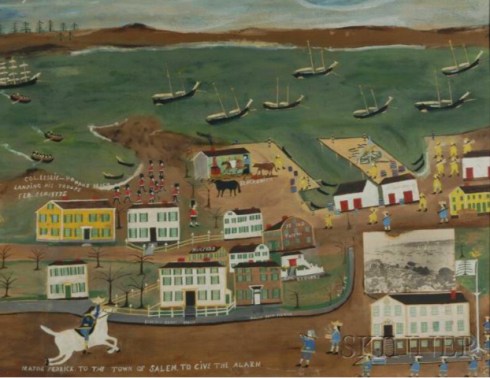
Major Pedrick was a Tory! None of the contemporary reports of the events of February 26, 1775 mention Major John Pedrick as the “alarming” figure who rode ahead of Leslie’s troops to warn the citizens of Salem of their imminent arrival, nor does Endicott. That’s because his role was made up after Endicott’s account. Pedrick was in fact a wealthy Tory who would not have been motivated to play such a conspicuous role at this time; he came around a bit later but anonymous Marbleheaders warned Salem on that Sabbath day. Again, I am relying on J.L. Bell’s succinct analysis of the “myth” of Major Pedrick, which has been perpetuated in the most recent scholarship as well as our reenactment. I was also inspired by Bell’s post to look around and see what else was made up about our event, particularly in the “creative” Marblehead accounts of the later nineteenth century. Samuel Roads Jr.’s History and Traditions of Marblehead (1880) turns Leslie’s Retreat into an all-Marblehead affair: Pedrick is prominent, of course, along with an entire Marblehead Regiment that came to Salem to take up with Leslie’s troops. Not a single Salem name is mentioned in Roads’ account, but we do hear of one Robert Wormsted, one of the young men from Marblehead,—who afterwards distinguished himself by his daring and bravery,—[and ] engaged in  an encounter with some of the soldiers. He was a skillful fencer, and, with his cane for a weapon, succeeded in disarming six of the regulars. Wow. No mention in Endicott of this cane-wielding Wormsted—or Pedrick—but Marblehead folk artist J.O.J Frost seems to have cemented the latter’s place in history in his early twentieth-century painting Major Pedrick. To the Town of Salem, to Give the Alarm.

Leslies Retreat Frost Courtesy Skinner Auctions; note the anachronistic photo inserted on the right.

“Anniversary History” was alive and well in 1775: Even in the standard reports of Leslie’s Retreat published in the week after, I couldn’t help but notice the juxtaposition of what had just happened in Salem and the imminent fifth anniversary of the Boston Massacre. Side by side we can read of Leslie’s “ridiculous” expedition and “an Oration, in commemoration of the Massacre, perpetuated in King-Street, on the 5th of March, 1770, by Joseph Warren, Esq.” and several reports made the connection between the two, which occurred on successive sabbaths. Dr. Warren actually spoke on March 6, 1775, and I wish he had referenced Salem, but he did not. Nevertheless, you can really feel the drumbeat of rebellion when you read the New England papers published in March of 1775: there are lessons to be learned and anecdotes to be memorialized. The editors of the Newport Mercury were also thinking historically when they opined that as our brave ancestors used to carry their implements of war with them to their places of worship during the Indian wars, perhaps our brethren of the Massachusetts Bay have good reason to make use of the same precaution at this day. I also can’t resist adding another eyewitness testimony here, from a “True Son of Old Ireland” who was on the spot, as well as my very favorite photograph of the First Reenactment of Leslie’s Retreat, two years ago: these guys played their roles really well.

Leslies Retreat Lessons Learned Newport Mercury March 6

Essex Gazette March 7 1775 Leslies Retreat

Leslies Retreat best photoThe Newport Mercury of March 6, 1775 and the Essex Gazette of March 7, 1775; Lt. Colonel Leslie (Charlie Newhall!!!) exasperated and outflanked two years ago.

Commemorating Leslie’s Retreat on February 24:  Reenactment at 11:15-11:30 for Redcoats (meet at Hamilton Hall) and Patriots (meet at the First Church). Reception afterwards at First Church.

A Staged Reading of Endicott’s Leslie’s Retreat at the Pickering House by Keith Trickett, 3pm: https://pickeringhouse.org/events/special-leslies-retreat-performance/.

Toast the Retreat and Salem’s Resistance at O’Neill’s Pub on Washington Street from 4-7pm.

And coming in April: the Resistance Ball at Hamilton Hall: https://www.hamiltonhall.org/full-event-calendar/2019/2/1/resistance-ball


Really Rubbish Royal Relics

Sometimes, no all the time, I think that I’m devoting too much time to social media, but occasionally you find yourself in the middle of some very interesting exchanges. The other day a really funny thread about the sheer dreadfulness of English delftware coronation plates from the late Stuart era unravelled on Twitter, and I couldn’t help but jump in, as I had just seen this William & Mary plate in a Sotheby’s auction and I needed some context and “conversation”!

William and Mary Sotheby's 2

Oh no, poor William, and even poorer Mary, with so much exposed. Neither looks very happy–or dignified. These crude plates started to appear with the Restoration, when people apparently sought them as symbols of a revived and “colorful” monarchy after years of dour Cromwellian rule. Many of the images of King Charles II in his coronation robes appear naive but charming, but by the time his niece and nephew were crowned, it looks like aesthetic standards have deteriorated quite a bit—or perhaps the potteries could not keep up with demand. When we look at these items now, they look comical, rather than reverential. The curatorial contributors to our Twitter exchange labeled these plates “Really Rubbish 17th-century Royal Memorabilia” so I am following suit, but I can’t help but also notice a distinct differentiation of display by gender in these plates: after Queen Mary’s untimely death (from smallpox, at the age of 32 in 1694), King William is depicted in a more stately fashion alone, and after he is succeeded by (poor) Queen Anne, we once again see the return of extensive decolletage. Why such excessive immodesty?

Coronation Plate Collage

William and Mary Charger BM

William and Mary Winterthur

editrs365881_603191-lpr_0

Queen Anne V and A

Delftware Queen Anne Ashmolean

William and Mary Coronation plates, c. 1690-94 from (clockwise): Samuel Herrup Antiques; Sotheby’s; and the collections of the Victoria and Albert Museum; Queen Mary does come off a bit better (or at least more covered up) in SOME of the coronation plates in which she and William are standing, but it varies, as these two examples from the British Museum and Winterthur illustrate (and occasionally he is handing her the orb, which is good). It’s hard to make Queen Anne look good, but I don’t understand why she has to display such extravagant cleavage in these delftware plates from the Victoria and Albert collections and the Ashmolean Museum of Oxford University.


A “Presidential Polka” in Salem

For Presidents’ Day, I’m focusing on one of the shortest presidential visits in Salem history: President Polk’s breezy visit on July 5, 1847 which seems to have clocked in at (well) under in an hour. There are much more notable (and longer) stopovers by Presidents Washington, Monroe, and Jackson, and both Presidents Taft and Coolidge visited Salem often while they summered nearby, but I thought Polk’s pitstop might shed some light on the popularity of abolitionism here in Salem in the antebellum era. There was an interesting reaction to my post last week on my slavery mapping project: it was shared on a few facebook pages and rather than commenting on the specific issue of slaveholding in pre-revolutionary Salem, there were references to the city’s active abolitionist community nearly a century later, as if that somehow compensated for the sins of the past. I”ve heard this sentiment from students too, but my colleagues seem a bit more reserved about the popular appeal of the anti-slavery movement. I actually don’t seek to judge the past by ahistorical standards; I’m more interested in uncovering as much of the truth as possible. So what does the response of Salem’s citizens to the arrival of President Polk on the day after the Fourth of July in the summer of 1847 tell us?

Polk 1844

blog_LansdowneSo interesting that this 1844 Polk Print (Library of Congress) mirrors the “Landsdowne” Portrait of George Washington from 1796: National Portrait Gallery, Smithsonian Institution.

The historical assessment of Polk’s presidency has traditionally focused on his successful policies of westward expansion, including the annexation of Texas in 1845, the negotiation of the Oregon Treaty with Great Britain in 1846, and the conclusion of the Mexican-American War in 1848, increasing the territory of the United States dramatically and extending its boundaries to the Pacific. He was a man who lived up to his promises, but expansion at this time cannot be viewed apart from the increasingly-intense debate over the expansion of slavery, and Polk was a slave owner not only by inheritance, but also by “investment”. The story of Elias Polk, the “faithful slave” who served the President in the White House, seems to have been utilized to portray Polk as a paternalistic slave owner, but a recent study characterizes him as far more “acquisitive” and entrepreneurial, holding “the constricted views of a Tennessee slavemaster.”  This is certainly how the most fervent of northern abolitionists saw Polk, but I’m not sure if they speak for the majority of the population.

Abolitionist MapsTwo abolitionist “Moral Maps” which illustrate fears of the spread of slavery in the United States and North America, 1847-1854, Cornell and Yale University Libraries.

The nation was at war when the President visited Salem in the summer of 1847, and the reports of his visit illustrate the divisions that were becoming ever-apparent: in side-by-side columns in the Salem Observer for July 10, 1847 we can read a stinging indictment by the Massachusetts Anti-Slavery Society and an account of the President’s reception in Salem, which was “kind and hospitable” by his own estimation. It’s quite a contrast! The Anti-Slavery Society’s condemnation takes the form of a letter addressed to the president in which he is called out (You are a slaveholder. Men, women, and children are by you held in slavery—recorded in your ledger as chattels personal—worked like brutes, without wages or stipulation, under the lash of a driver, and fraudulently and tyrannically deprived of all their just earnings), compared unfavorably to the “Autocrat of all the Russias,” and called upon to emancipate his slaves immediately. In the next column, the President is welcomed to Salem with full “civic and military honors” and a “cavalcade” (before motorcades there were cavalcades) through its “ancient” crowd-lined streets. There are conflicting assessments of Polk’s visit to Salem, but all the papers agree it was a hastily-put-together affair, as the city authorities got word of the President’s arrival only the night before.

Polk Reception Salem Register.jpgSalem Register, July 5, 1847

Here you can see the city scrambling: Boston, Lowell, Concord, New Hampshire, and Portland, Maine were presidential stops announced ahead of time, but the President seems to have added stops in Portsmouth, Newburyport, Salem and Lynn at the very last minute as he made his way back to Washington. The program announced above was pretty much how it came off, but additional details emerge in the reporting: the President’s train arrived at the Beverly Depot at 2:55 and according to the Salem Gazette, “Mr. Polk refused to leave the cars in Beverly unless he could be assured that he should not be detained more than 15 minutes in Salem,” and consequently a “gallopade” ensued through the city which was characterized as both “ludicrous” and farcical” by both the Salem and Boston papers. The Salem Register calls Polk’s visit to Salem “a Grand Presidential Polka……affording a vast fount of amusement to the lovers of the ludicrous.” There was a big crush to see “the man who made the war, but “the Comet-like flight of the Head of the Nation through the City of Peace beggars description.” [Yes, Salem was indeed referred to as the City of Peace before it became Witch City: better, no?] He came and went “like a Flash………with the President” (in an elegant barouche driven by six black horses) “bobbing his uncovered head, now this way, and now that, as a handkerchief flustered from some window, or a cheer came up from a band of his adherents, posted on some corner.” I’m not sure if this depiction has a larger message of criticism aimed at the President beyond that of the short shrift he gave Salem, and none of the reports of this “Presidential Polka” enable us to “read” the crowd: besides the brevity of this presidential visit, everyone also seems to agree that the “most pleasing part” of the whole affair was the sight of the schoolchildren of Salem aligned along Chestnut Street. As the Salem schools had been desegregated three years before, I’m assuming (and hoping) that there were African-American students in the ranks.

AHB2017q021191

The People’s Choice? A Polk campaign ribbon from 1844, Smithsonian Institution.


“Salem” Houses, 20th-century Style

There are two deep rabbit holes around which I must tread very, very carefully, or hours will be lost instantly: the Biodiversity Heritage and Building Technology Heritage digital libraries housed at the Internet Archive. One leads me through a never-ending cascade of flora and fauna; the other through the built environment–or prospective built environment, I should say, as many of its sources are building plans and catalogs. Just yesterday, when it started to snow and afternoon classes were cancelled, I thought to myself, let me just pop in there and see if I can find some inspiration for interior shutter knobs, and hours later I emerged with no knobs but lots of images of “Salem houses” instead. So here they are in chronological order: you will no doubt conclude, as I did, that “Salem” style loses its meaning over the twentieth century: the last house is from 1963, and it is difficult to see how it was inspired by Salem. Well, now that I’m looking at them altogether, it’s difficult to see how Salem was inspirational at all, except perhaps for a brief spell in the 1930s. House parts stick to their Salem inspiration, as there are plenty of mid-century “colonial” mantels, doors, and windows inspired by the craftsmen of “Old Salem”, but houses seem to break free of any connection to classical Salem influences: just look at the 1949 “Sam’l McIntire”! The concept of Salem seems to retain some currency throughout the century, but what it really means in terms of design or construction is anyone’s guess.


Salem Houses Herbert C. Chivers 1903 (2)

Salem Houses Aladdin 1915

Salem Houses 1915 collage

Salem Houses 1929 PicMonkey Image

Salem Houses 1933 PicMonkey Image

Salem Colonial 1933

Salem Houses 1936 Sears

Salem Houses Sears 2

Sam McIntire 1949

Salem Houses 1954

Salem Houses Collier-Barnett Co._0029 1963

“Salem Cottage” from St. Louis architect Herbert Chivers’ Artistic Homes, 1903; Aladdin Houses, 1915; the first “Readi-cut” Salem model, 1915; a “bungalow with the pleasing lines of the Colonial type” in The Book of 100 Homes, 1929; the reproduction “Pequot House” was included in the Ladies Home Journal House Pattern Catalogue of 1933, the same year that “a Salem Colonial” was published in Samuel Glaser’s Designs for 60 small homes from $2,000 to $10,000 : showing how to build, buy and finance a small home; two Sears “Salem” houses from 1936 and 1940; The “Sam’l McIntire” from the Warm Morning Small Homes plan book for 1949; Bennett Homes, 1954; a Salem “rambler” from There’s a Miles Home in your Future” book from the Collier-Barnett Co., 1963.


My First Visit to the Phillips Library in Rowley

Well, I knew the day had to come: my first visit to the Phillips Library in Rowley. Even as many were protesting the move of the Peabody Essex Museum’s research library, which includes the historic records of hundreds of Salem families, institutions, and organizations, to a town 40 minutes to the north, the Museum opened up its Collection Center in Rowley this summer with a new Phillips Library within the great expanse of a former toy factory. Shuttles delivered scores of curious Salemites to Rowley for an open house in July, but that’s the last we have seen of this service. If you want to go to Rowley, you must drive there, but it is indeed worth the trip for any Salem history lover (or any history lover, because Salem’s history is so rich and multi-faceted), because that’s where Salem’s history is: it is not convenient, it is not right, but there it is. 

PEM1

PEM 2

PEM3

This sign on Route One says everything: “Collection Center” rather than “CollectionS Center”. The entire rationale for the move was the conflation of object collections with the texts of the library, but libraries are very different things than storage facilities. Libraries are about community, and it’s difficult to understand how this transplanted Phillips Library is going to develop a community in this rather remote and odd place. The small and utilitarian reading room—very different from all of the research libraries I’ve worked in with texture and age and wood–is on the immediate right of the building above. Just walk in through glass-box door, register with the very nice guard at the entrance, put your coat and accessories in a locker, and go into the reading room, where you will be directed to register as a researcher. I paged the documents I wanted to see beforehand (at research@pem.org) and they were right there waiting for me when I got there, but I also asked for additional materials while I was there. The librarians were very friendly, helpful, and professional.

PEM 5

PEM 4

That’s as close to a document that I can show you—it might even be too close: I was just trying to photograph the room. The Library’s photography policy specifies study/research purposes only. I was doing some research for Hamilton Hall on the Remond family who lived and worked there, and so I was looking at amazing stuff—menus, bills and orders for all sorts of commodities, trade cards, letters—I took pictures for myself but can’t show them to you. If you find things that you want to reproduce, you must go through the PEM’s rights and reproductions process, which I did, though this too seems more oriented towards objects than texts. This is pretty standard procedure, although many research libraries now allow photography for social media purposes and you will see lots of researchers sharing their discoveries in the Houghton Library, the Folger, the American Antiquarian Society, the Beinecke Library, and more, on Twitter and Instagram: hashtags are a great way to showcase collections and build communities. This type of scholarly sharing is not the policy of the Phillips Library at present, although the Library’s old Instagram account (@pemlibrary) has been revived so you can see some of its treasures there.

PEM 6Nostalgic call slips featuring the old Salem locations in Daland and Plummer Halls.

But that’s about the extent of efforts to engage for now. Will there be exhibits, lectures, or workshops? It’s hard to envision the general public clamoring to convene in this rather remote location (especially at night!), so I’m thinking the only form of community which might form around this new Phillips Library is a virtual one of dedicated researchers. Digital crowdsourcing initiatives would be great, because so much of its collections remains undigitized. But for now, it is imperative that people go: we need to extract Salem’s stories from this place! Even if the PEM had lived up to its promises of digitization made years ago, the real Phillips Library is going to yield surprises and discoveries for decades, wherever it is. Libraries are not only essentially about community, they are also about discovery, and there is a lot to discover among the rich collections of the Phillips. I’ll give you an example from this first visit. Included in one of my Remond folders was a letter about the African-American caterer who succeeded John Remond in Hamilton Hall, Edward Cassell, dated July 25, 1910, addressed to someone named “John” and written by N.D. Silsbee of Cohasset, Massachusetts (I think this must be Nathaniel Devereux Silsbee). John had obviously asked Silsbee for his recollections of Cassell, who was lauded in a celebratory article in the Boston Globe at just about the same time. In this letter, Silsbee delivers, and I learned all sorts of things about Cassell which I did not know: I transcribed the whole thing and will report later! Unfortunately, to establish some sort of intimacy between himself and John, or some strange type of context, Silsbee also includes one of the most racist lines I’ve ever read (TRIGGER WARNING): “There, John, is a reminder of the good old slavery days,’ befo de wah’, when good servants were cheap and plenty!” (MSS 271 BI F6, “Letter of N.D. Silsbee, page 2). Discoveries, of both the pleasant and unpleasant kind, always happen in libraries with collections as large as that of the Phillips: catalogs and finding aids inevitably miss things. That’s the thrill of the hunt, and the reason that opening up a folder of manuscript materials is always going to be more exciting than clicking on a link.

Cassell Photograph HNE The always dignified Mr. Edward Cassell (who catered events at far more places than Hamilton Hall!) standing before the Peirce-Nichols House in Salem, 1907. Courtesy of Historic New England.


Enquiries and Enslavement

I’m in the process of teaching myself how to create digital maps with layers of history so I can visualize different times, places, events and environments. Such maps are a great teaching tool, and I also think it would be a great way to put all of the discoveries I’ve made while blogging into a more compact form. “Spatial history” is a very big trend in historical interpretation and the digital humanities, but it’s going to take me quite some time to reach this level of presentation. I thought I’d start small with a series of maps of Salem with one layer each: how many first period houses survived in say, 1890, houses of notable women of Salem from different periods, and houses (or locations) where enslaved people lived and worked before the abolition of slavery in Massachusetts in 1783. I decided to start with the latter topic because I thought it would be manageable, but it is not: there were far more enslaved people in colonial Salem than I thought—but this makes it all the more important that we place them.

Slave Adverts White Collage

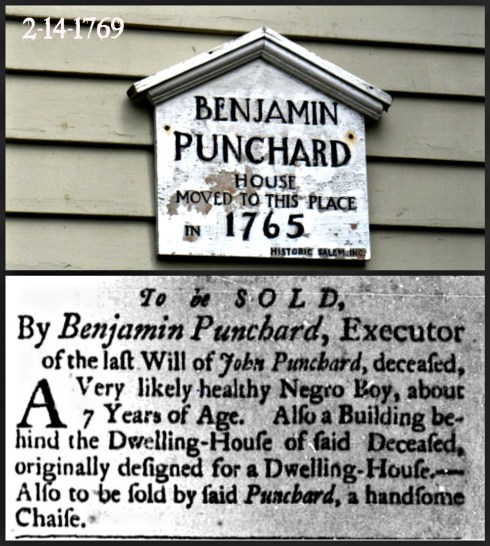
I’m still working on my “data set”, having searched through newspapers (for both “for sale” and “runaway” advertisement, vital statistics, and the amazing 1754 census at the Phillips Library in ROWLEY (yes, I’ve been there; I will report later). The latter breaks down Salem’s residents into five categories: “rateable”, males under 16, females, widows, and negroes, and according to its survey, there were 3462 people in Salem in 1754, of which 123 were African-Americans. The word “slave” is never used; only servant. There are discrepancies between this survey, the advertisements, and the vital statistics, so I’m not sure how I’m going to be able to come up with an absolutely accurate number: this might have to evolve into a collective or crowd-sourced project. I’ve identified some of the larger slave-owning families though: an analysis of their papers (most are also in the Phillips) would undoubtedly reveal more information

Slave Adverts Punchard

Slave Adverts June 13 1769 Essex Gazette

Slavery 1 collage

Slave Adverts Oct 29 1771All Essex Gazette

Enquire of the PrinterRunaway slave advertisements are very detailed; for sale notices less so. It’s almost as if people don’t want to give their names out, with some notable exceptions, like Captain David Britton, who was definitely more than personally invested in this trade. The map will require me to place the enslavers and the enslaved, but I don’t have much information on Britton: all I’ve found so far is a reference in Phyllis Whitman Hunter’s Purchasing Identity in the Atlantic World. Massachusetts Merchants, 1670-1780 to his membership in a Salem club called “The Civil Society” which met at a local inn on Tuesdays and Fridays ” for friendship and conversation”. There were club rules against cursing and unrefined behavior, but apparently not against slave-trading.

Slave Adverts Boston Evening Post July 24 1738

Slave Adverts Pompey and Horse

Slavery Waite

Slave Adverts PhelpsBoston Evening Post and Essex Gazette

Once you start researching this topic, it shapes how you look at your environment. I’m sure people in the South are used to this, but not people in New England. There were enslaved people in the House of the Seven Gables, and the very wealthy merchant Aaron Waite, whose long partnership with Jerathmiel Pierce has inspired the naming of Salem Maritime’s gift shop, enslaved at least one person, named Pompey. Nathaniel Hawthorne’s great-grandfather Jonathan Phelps, let out both his blacksmith shop and his “excellent workman” in 1773. Several enslaved men were compelled to work for their master Samuel Barnard in the Ropes Mansion, and he also loaned them out to his nephew way out in Deerfield. Richard Derby owned at least one slave, as did William Browne, Jonathan Clarke, Daniel King, Edward Kitchen, Josiah Orne, William Pynchon, and Bezaleel Toppan, and many more residents of mid-eighteenth-century Salem, both wealthy merchants and less conspicuous craftsmen. The fabulously wealthy Samuel Gardner (1712-1769), whose house was located on the corner of Essex and Crombie Streets and whose many possessions are easy to find in auction archives and museum collections, listed several enslaved men among his possessions in his will: he left his “Negro boy Titus, as a servant for life” to his “beloved wife Elizabeth”, but freed a man named Isaac, adding the provision that if Isaac was “unable to support himself, that he be supported by my sons George, Weld, and Henry, in equal shares…..so as to free the Town of Salem from any charge”.

Slavery Ropes

Samuel Gardner's Sugar Box.Samuel Gardner’s sugar box, collections of the Museum of Fine Arts, Boston.


Blank Buildings

Periods and events of the past are generally identified after they are over: history is about remembrance, and imposing order and meaning on what has happened. There’s no better way to convey this essential point than to reference wars: obviously people in the midst of the Hundred Years’ War, the Thirty Years’ War, and the Seven Years’ War had no sense that these were the historic events in which they were participating or enduring! Often historical and cultural eras overlap, and that means that styles are identified well after their expression: medieval, colonial, Victorian. But there are also cultural descriptions detached from precise historical periods: Gothic and Palladian come to mind but I suppose any “revival” style could fall into this category. This long preamble is just my mind wondering how people of the future will categorize Salem’s current architectural style: in a city long identified by its architecture, how will the buildings of the early 21st century be branded? I think we are turning a corner with the latest downtown building slated for construction—a condominium development on the site of the District Courthouse on Washington Street–but I’m not sure where this turn will take us.

Blank Architecture 1 Coming Soon on Washington Street via Building Salem.

The style–or perhaps I should say form–of this rendering is familiar: similar buildings have been built in the last decade on Federal and Lafayette Streets. But what is it? I am architecturally naive, but it looks like a Prairie-esque type design on steroids, shorn of craftsmanship and charm. I’ve often heard Frank Lloyd Wright characterized as the most influential architect of the last century, both for better and for worse. All I see when I look at these buildings are the shallow or flat roofs with their overhanging eaves, sometimes slanted and sometimes straight, and their bulk. They look vaguely Italianate, vaguely “Mediterranean”, vaguely Prairie, and like they could belong anywhere and everywhere, and as more of them are built in Salem, Salem becomes less and less Salem-esque.

Blank Architecture 2

Blank Architecture 3

Blank Architecture 6

Blank Architecture 5Ten Federal and 135 Lafayette; I think this “style” started with the Ruane Judicial Center nearly a decade ago, on the far right: it is very bulky with a conspicuous overhang. The panorama of courthouses on Federal Street makes quite a statement!

My title is a double entendre: I really don’t know what this architectural style is called or what architectural era we are in so I am inviting readers to fill in the blank______, but I also think that this architecture is blank: empty, soulless, devoid of any connection to its surroundings. We could do so much better; inspiration is all around us. A building in Lynn caught my eye just as I was driving back from the airport this morning: it features some of the very details that characterize these stark buildings in Salem but is clearly a composition rather than just a composite. It has texture, ornamentation, depth, craftsmanship: its builders were obviously proud to cast their mark on it, and mark its time, as it was built to last.

Blank Architecture 7

Blank Architecture 8The Loraine Apartment Building in Lynn’s Diamond District, designed by architect Samuel Rogers.


Edwardian Tudors

I’m back teaching this semester after a productive sabbatical, although I’m a bit out of practice. Thankfully I’ve got my favorite Tudor-Stuart survey scheduled, a course that I’ve taught many, many times but always in a different way. This semester we are focusing on “disorder” in general and crime in particular and they are reading accounts of sensational crimes interspersed with the usual narrative of Reformation and Revolution. Before we get to any of that, however, I drag my students through a lot of historiographical and cultural context, because I find that they already have so many preconceived notions about this era, even those who have never really studied it, from films and television…..and Shakespeare, even though they don’t know that their “history” is Bard-derived. Yesterday we were examining how the Victorians perceived the Tudors, as you generally have to burst through Victorian interpretations to get close to anything resembling the historical truth, and we ended up with these wonderful Edwardian murals, installed in the East Corridor of the House of Commons in 1910. They are images of Tudor monarchs (for the most part), of course, but they are also Edwardian projections, chosen to represent the ideals of that time: a more popular-based sovereignty, empire, education, and the long-term consequences of the Reformation. What is so interesting is that several of the murals are not based on any documented historic event, but rather on Shakespeare’s depiction of an historical event: with their prominent situation in Parliament, they represent a multi-layered representation of the past.

Parliamentary prints first Plucking_the_Red_and_White_Roses,_by_Henry_Payne.jpgHenry Arthur Payne, The Origin of Parties. Plucking the White Rose in the Old Temple Gardens

Let’s take the first East Corridor mural as a case in point: Henry Arthur Payne’s The Origin of Parties. Plucking the White Rose in the Old Temple Gardens, which depicts a scene taken from Shakespeare’s Henry VI, Part I in which the noble factions about to wage what would become known (much later) as the War of the Roses are choosing sides/roses. This is a pre-Raphaelite depiction of a pre-Tudor “scene”, and a bit of a stretch to consider the York and Lancaster factions as the “origin of parties”. Apparently even the artist questioned the first subtitle given to his work, but as the murals project was being overseen by the American artist Edwin Austen Abbey of the Royal Academy, who most definitely looked upon Shakespeare as his muse, the inclusion of this scene is understandable. Abbey was also responsible for the homogeneity of the East Corridor murals, as he specified the red, gold, and black color scheme which unites all six murals, as well as the uniform height and perspective of the characters portrayed.

cooper john-cabot-and-his-sons-receive-the-charter-from-henry-vii-to-sail-in-search-of-new-landsDenis William EdenJohn Cabot and his Sons Receive the Charter from Henry VII to Sail in Search of New Lands 1496

henry_vii_at_greenwichFrank Cadogan Cowper, Erasmus and Thomas More Visit the Children of Henry VII at Greenwich, 1499

katherine and henryFrank O. Salisbury, Henry VIII and Catherine of Aragon before the Papal Legates at Blackfriars, 1529.

(c) Palace of Westminster; Supplied by The Public Catalogue FoundationErnest BoardLatimer Preaching before Edward VI at St. Paul’s Cross, 1548.

mary enteringJohn Byam Liston Shaw, The Entrance of Mary I with Princess Elizabeth into London, 1553

And there you have them: representatives of Tudor history from an Edwardian perspective. The emphasis seems to be on: the story, empire, the “new learning”, and the relationship of the royal government to the people. We have an equal representation of both Protestantism and Catholicism, hinting at the secularism of the era. I’m happy to see that my favorite Tudor, Henry VII, has a larger role in this story than Henry VIII, but surprised to see such a supporting role for Elizabeth: perhaps she was too powerful an opponent of parliamentary power.

Images and more information about the murals here: https://www.parliament.uk/worksofart/collection-highlights/british-history/tudor-history.

and more context here: https://www.paul-mellon-centre.ac.uk/publications/browse/9780300163353.

edwardian sense


Wooden Houses on Beacon Hill

I had two appointments in Boston yesterday, but I parked my car in a spot that was rather inconvenient to both just so I could go over the hill: Beacon Hill, one of the few neighborhoods in which all the variant architectural styles of the nineteenth century coalesce into a completely harmonious quarter. Victorian exuberance was definitely restrained–to rooflines for the most part–for the greater good, and the Federal and Greek Revival aesthetic appears to have lingered and evolved rather seamlessly into the Colonial Revival. Brick is it on Beacon Hill, so it’s the wooden houses that really stand out: I snapped a few on my way over the hill to one appointment and back to another, but I was a bit pressed for time so I certainly didn’t capture them all. I always stop at one of my favorite Beacon Hill houses, which is also the oldest house in the neighborhood: the George Middleton House at 5 Pinckney Street, built in 1786-87. Distinguished by his service in the American Revolution as well as his roles as founder of the African Benevolent Society and Grand Master of the Prince Hall African Lodge of Freemasons, George Middleton is an important figure in Boston’s African-American history, just as Beacon Hill is an important locale: the Black Heritage Trail links his house to other important historical sites such as the African Meeting House and the Abiel Smith School. The Middleton house and One Pinckney Street, just two doors down, form a perfect little corner of Beacon Hill’s earliest built history on its North Slope.

beacon hill 5

beacon hill 5a

beacon hill 5b

beacon hill middleton house hneHistoric New England

Even though wooden houses are few and far in between on Beacon Hill, there are quite a few houses in which one or more part is clapboarded: a front facade or a side wall, or some “dependent” part. My favorite example of this is the amazing John Callender House on the corner of Walnut and Mount Vernon Streets, built in 1802 as a “small house for little money” according to Allen Chamberlain’s Beacon Hill: its Ancient Pastures and Early Mansions (1925—a really great book) and the long-term home of Atlantic Monthly editor Ellery Sedgwick a century later: every source refers to its conspicuous “boarding” along Mount Vernon Street as unusual for Beacon Hill. And then there are those bay windows made of wood, some very conspicuous and not quite so-understated: Beacon Hill was home to a vibrant artistic community in the later nineteenth and early twentieth centuries and some homeowners obviously wanted to bust out a bit.

beacon hill 6

beacon hill 6a

beacon hill 4

beacon hill 7

beacon hill walnut collage

beacon hill leon abdalian 1920s bpl

beacon hill collage 14 Walnut Street historic photographs from Historic New England, Allen Chamberlain’s Beacon Hill, MACRIS, the City of Boston’s Archives, and the Boston Public Library.