Category Archives: History

Sisters in Service: Salem 1918

When your focus is on historical women, as mine has been for these 2020 #salemsuffragesaturday posts, sometimes you find their stories are somewhat segregated from what is going on at a particular time, and sometimes it is clear that their stories are absolutely integral and central to what is going on at the time. Salem’s experience of the Influenza Epidemic of 1918 is illustrative of the latter case: nurses were not only on the front lines of this strike; they constituted primary care. And there were simply not enough professional nurses to go around in the context of both war and contagion, particularly in the panic months of September and October. Salem was actually well-positioned to meet the challenges of a contagious epidemic: it had a brand new, state-of-the-art hospital with its own nursing program and several charities which focused on “public health nursing”: the Woman’s Friend Society (still thriving today) operated a “District Nurse” (later Visiting Nurse) program under the direction of Superintendant Miss Pauline Smith, and the Committee on Prevention of Tuberculosis had an “Instructive Nurse”, Miss Teresa Trapeney, on staff. The City had been battling the “Great White Plague” for quite some time, but it had to supplement its forces to deal with the “Spanish Flu”.

Influenza-Collage

Salem-Hospital-1910-3

Sisters Oct 2 1918

20200326_114532The 1910 Associated Charities of Salem Annual Report in 1910 features a rendering of the new Salem Hospital on Highland Avenue, which was opened in 1917; Boston Daily Globe advertisement, October 2, 1918; the Woman’s Friend Society on Hawthorne Boulevard.

Before I delve into that response, a few words about the nature and mortality of the 1918 Influenza Epidemic, in general and in Salem. There have been quite a few references to it over the past few weeks, as people naturally want a historical precedent for any crisis, but many of these references have been incorrect, even wildly incorrect. For example, President Trump’s March 24 assertion thatYou can’t compare this [COVID-19] to 1918 where close to 100 million people died. That was a flu, which — a little different. But that was a flu where if you got it you had a 50/50 chance, or very close, of dying. Maybe the 100 million estimate can be overlooked as global mortality estimations are all over the place—everywhere from 20 million to 100 million—but that mortality rate assertion is ridiculous: the real number is in the neighborhood of 2.5%. The president’s sloppy statement misrepresents both the nature of the threat and the heroic efforts that were made to combat it: it is dehumanizing. I’ve NEVER understood the vagueness of the general mortality numbers until I delved into the research for this post: it is very clear from the Massachusetts records that there was both epidemic influenza as well as influenza-triggered respiratory diseases, predominately pneumonia, in 1918. Some accounts and estimates only include the primary category; others include both: these figures from 1917-1918 illustrate the connection between the two diseases and their notable increase over the year.

Influenza-1918-Table-3

This same source, the Commonwealth of Massachusetts’ annual reporting of the state’s vital statistics for 1918, lists 151 deaths from influenza and 102 for pneumonia in Salem for 1918, but this is an under-representation of the threat: the daily papers report as many as 1500 cases during some days in late September. Another factor which likely bears on all of the Massachusetts statistics is the fact that the Board of Health did not rule influenza a “reportable disease” until October 2, well into the epidemic. The Annual Report of the Salem Hospital for 1918 notes the 40% increase in patients over the year, and offers the assertions that a larger increase might have been made if during the Influenza epidemic in September and October, it had been possible to secure additional nurses to replace those who were ill. This increase affords conclusive proof of the claim of the hospital authorities that it was not meeting the needs of the community. Salem Hospital could not meet the needs of its community in the fall of 1918 not only because it had insufficient nurses: many of the nurses who were on staff, in addition to physicians, came down with influenza themselves, and so the decision was made to establish a separate, emergency hospital to limit the spread of the contagion. Tent cities sprung up all over eastern Massachusetts in the fall of 1918, but in Salem one gets the impression that that was never a consideration: this was only four years after the Great Salem Fire—which prompted the establishment of several tent cities—after all. I can’t determine whether they were asked or they volunteered, but the Sisters of St. Chretienne, recently established in the former Loring Villa in South Salem, offered up their newly-expanded building as the emergency influenza hospital, and themselves as nurses. Consider their situation: they themselves had been displaced from their Convent-Noviate on Harbor Street by the Fire in 1914, had purchased and overseen the expansion and transformation of the residential Loring Villa into a school, and had just opened that school when the epidemic hit! Only their fellow St. Chretienne sisters across the Atlantic found themselves in a more challenging situation, in the midst of the major war zone of World War I.

Influenza Lawrence

Lawrence mask room (3)

Brookline Tent City (3)

Tent Hospital Brookline (3)

Ste Chretienne SSU (3)

20200327_145600Influenza tent hospitals in Lawrence (top two–including the “mask room”: they had MASKS then!) and Brookline (more masks on display), September 1918, Lawrence History Center Digital Collections and Brookline Historical Society; The St. Chretienne Academy in South Salem, now part of the South Campus of Salem State University, served as Salem’s emergency influenza hospital in the fall of 1918, Salem State University Archives and Special Collections.

Both education and health care were encompassed within the mission of the Sisters of St. Chretienne, and their fellow sisters from Salem’s other Catholic orders, the Sisters of Charity of the Immaculate Conception and the Sisters of Notre Dame, also served as nursing aides during that fevered fall of 1918. The situation called for a sacred-secular collaboration, as the Sisters were joined by the Woman’s Friend Society and its District Nurses as well as individual Salem women answering Governor Samuel McCall’s call that able-bodied people with any medical training volunteer their services. After several intense weeks in late September and early October, the influenza “crest” (rather than curve) appeared to be subsiding—or at least that was the story in the press—but by years’ end, it appeared to be on the rise yet again: in Salem, Miss Julia E. Pratt, the matron of The Seamen’s Widow and Orphan Association on Carpenter Street, found that the majority of her charges were infected with the persistent influenza, and across Massachusetts, the call went out once again: to women. 

Influenza Immaculate

Sisters BG Oct 9 1918

Influenza Years End

Orphans CollageBoston Daily Globe: September 30, October 9, December 20 & 23, 1918.


Corona Courses: My Top Ten Sources of Digital Content

So I have just finished converting my lecture courses into online formats: difficult to do midstream. A well-designed online course is a beautiful thing, but if a course is based on a more personal form of delivery and has to become virtual overnight there are going to be challenges. Fortunately, I teach history, and not a discipline that requires a lab or a studio: I can’t imagine what those professors are going through! And I also feel very fortunate to be able to depend on a variety of institutions—libraries and museums—which have made so much of their collections accessible AND provided road maps and guides to these same texts and images in the form of interpretive essays, questions for consideration, and extra-special digital features. I’ve had digital content in my courses for the last decade or so, but again, a course based on all-digital content is another thing entirely. I could not have accomplished such a thing—in such a short time— a decade or so ago; I can now, thanks to the diligent and creative efforts of these institutions, which take the “education” and “engagement” directives in their missions seriously. So here’s my top 10 list, with one qualifier and one comment: 1) I teach medieval and early modern European history and world history, so this is not going to be a US-centric list; and; 2) these institutions are focused on general education, not just formal education: they have made their collections accessible to those who have more casual or independent interests as well as those working within a curricular framework. (oh, and this list is in no particular order and is by no means exhaustive).

1. The Newberry Library, Chicago: For an American library, the Newberry has very rich European collections and it has created online exhibitions and curated primary source sets that I find invaluable for my courses: its librarians and fellows are very attuned to key curricular and historiographical trends. The Newberry is also a leader in American history and culture in general and local history in particular: it just won the top prize for “Oustanding Public History Project” at the National Council on Public History’s virtual conference for  “Chicago 1919: Confronting the Race Riots”. Digital Newberry offers about a million high-resolution texts and images: this is a small fraction of the library’s collection but still quite a lot to see.

De_Bry_Indi_Hispanis_plt_20 Theodor de Bry’s famous 1594 engraving showing Amerindians pouring molten gold into the mouths of Spaniards driven by insatiable lust for the stuff.

2. The Heilbrunn Timeline of Art History at the Metropolitan Museum of Art: is a timeline which pairs works of art from all eras and regions of the world with curatorial essays. You can search by region, by period, or by theme, and there are many thematic essays to explore: one leads to another and before you know it, hours have gone by. I teach with images, so this is the first place to I go to find perfect visuals for my presentations, but I also encourage my students to explore this resource themselves. And they do.

Dissolute HouseholdJan Steen, The Dissolute Household, 1663-64.

3. Speaking of timelines, check out the British Museum’s History Connected: A Museum of the World, in which objects can be explored across time and place while visualizing connections, the essential links of world history, and listening to curators share their expertise and perspectives. This is the result of a partnership between the Museum and Google: Google Arts and Culture can provide a engaging platform for a cultural institution to broaden their reach in more ways than one, but there needs to be some intent in terms of design and curation. Some institutions just share images of their objects and leave it at that (I’m looking at you, Peabody Essex Museum: 323 objects; 2 stories, but what BIG story is being told? And could we possibly have some more Salem objects?): this is parking, not driving engagement.

BM HST (2)It’s all about connections at the British Museum (above) and the Rijksmuseum (below).

4. Another exemplary Google partner is the Rijksmuseum: which offers up 164,511 objects, 11 stories, and 8 museum views, taking us right into the building. We can “walk” around the galleries, focus on particular paintings, examine them in “street” or catalog views, organize them in chronological order, discover connections to other works. The collection is so comprehensive (though again, only a fraction of the museum’s 8 million objects), and the connections go on and on, in all sorts of directions.

5. This semester I really need to get my students into the Vatican, as I’m teaching the Renaissance and the Reformation, and that particular place is a powerful connecting link between the two eras and movements: while a succession of Renaissance popes reveled in its creation and majesty, Martin Luther was repulsed by it. The Vatican Museums‘ website features 360-degree tours of many rooms and a more virtual experience with headsets, but just getting us into those spaces will be fine.

Virtual Vatican (3)

6. Anniversary Digital Exhibitions: Both private and university research libraries characteristically observe historical anniversaries by putting together digital exhibitions of images and texts. 2017 was the anniversary of Luther’s 95 Theses and the beginning of the Reformation, so there were many such exhibitions which are now archived: two of my favorites are Cambridge University Library’s Remembering the Reformation and the University of Arizona’s Special Collections Library’s After 500 Years: the Protestant Reformation. This year, digital exhibitions on the anniversary of Woman suffrage abound: see my previous round-up here.

7. Digital Bodleian: 914,832 images and counting at the digital portal of Oxford University’s Bodleian Library, through which you can do your own curation and share “collections” with students (or friends!). A very diverse and visual database, including some great ephemera, which I also love to teach with: I’ve got to cover both the “old imperialism” and the New in my European and World History courses, and I think some educational ephemera will illustrate the transition.

Bodleian (3)

8. The British Library, of course, because it has everything. I like the smaller, more curated collections, the “Turning the Pages” feature for complete texts, and when I am teaching medieval history (not this semester), the digitized illuminated manuscripts collection is indispensable. This is my favorite image of Henry VIII: from another anniversary exhibition and his own personal psalter: in the bedroom!

Henry BL

9. Harvard Digital Collections, of course, because they have everything: 6 million objects assembled from all of Harvard’s libraries, which you can search through with purpose or browse through an array of diverse topic collections. Because Salem is so source-challenged, I’ve come to rely on the Colonial North America collection quite a bit for this blog, but I use several of the other collections regularly for teaching. Then I just jump in from time to time: another rabbit hole: tread with caution!

10. IDEA: Isabella D’Este Archive at the University of North Carolina: I wanted to include one specialized site which demonstrates the full potential of what digital learning can encompass, and this is it. IDEA is an open-access digital “environment” dedicated to the life and letters of Isabella D’Este, the marchesa of Mantua (1490-1539). Isabella was by no means a “representative” Renaissance woman, but she left a blazing multi-disciplinary, interdisciplinary trail, which is explored here in creative ways, including a wonderful, truly virtual, replication of her personal studioloI love to go here/there, and I bet you will too.

Цифровая репродукция находится в иThe incomparable Isabella D’Este and a site worthy of her.


The Fair’s the Thing

Like everyone else, I’m thinking about healthcare workers these days, so I wanted to focus on Salem women who were physicians or nurses for this week’s #SalemSuffrageSaturday post: I’ve found THREE practicing women physicians in Salem before 1900 and lots of wartime nurses. But I don’t have their stories straight yet: I need more context, more details, more narrative. They are not ready, or more accurately, I am not ready for THEM. So I thought I would focus on philanthropic ladies’ fairs in general, and one fair in particular, as these events were a major expression of the civic engagement of Salem women in the mid-nineteenth century. Starting in the 1830s and extending through and beyond the Civil War, Salem ladies held fairs for a host of benevolent societies and causes: seamen’s aid, widows and orphans of seamen, anti-slavery, the Sanitary Commission and other efforts to support the Union army, temperance, suffrage. These fairs were months in the planning, raised significant funds, and got a lot of press. They were not only a major form of civic engagement for women, but also of civic action and association. It seems impossible to underestimate them, although I’m sure I’m only dealing with the veneer of Salem society that had the time and the resources to dedicate to such endeavors. But still, you’ve got to follow your sources, and many of mine lead me to fairs.

Ladies Fair Boston 1858 (2)Ladies Fair for the Poor in Boston, 1858. Boston Public Library

I believe that the first fair in Salem was in 1831, but the first fair that made a big splash and set the standard for all of the fairs to follow was held two years later at Hamilton Hall as a benefit for the newly-established New England Asylum for the Education of the Blind (later the Perkins School for the Blind), the first institution of its kind in the country. Its founding director, Samuel Gridley Howe, has developed a reputation as the authoritarian husband of abolitionist and suffragist Julia Ward Howe of Battle Hynm of the Republic fame, but in the 1830s he was a handsome and dashing doctor (and also a passionate abolitionist) who had served six years in that most romantic of conflicts, the Greek Revolution, and wrote about it. It’s easy to understand how and why he inspired devotion among the ladies of both Salem and Boston: there were competing fairs for his school in 1833, which drew a lot of attention to both. There were quite a few articles on the rival fairs in a variety of newspapers, and we also have the Fair program, as well as the substantive research of Megan Marshall, who identifies Elizabeth Palmer Peabody as one of the prime movers behind the Salem event in her Pulitzer-prize-winning book The Peabody Sisters. Three Women who Ignited American Romanticism. 

samuel-gridley-howe

Peabody Sisters (3)Samuel Gridley Howe in the 1850s; Megan Marshall’s great book, although I also like the earlier text on the Peabody sisters: Louise Hall Tharp’s Peabody Sisters of Salem, which I read over and over again as a teenager—I think it’s one of the reasons I ended up in Salem! A really good example of collective biography.

Elizabeth was the eldest of the famous three Peabody sisters of Salem (who deserve their own post; I can’t believe I haven’t written about them yet!), all of whom became intertwined in a Boston world of romanticism and reform. Middle sister Mary would marry educator Horace Mann, and youngest sister Sophia would eventually marry Nathaniel Hawthorne, but in the 1830s they were all struggling in somewhat-genteel poverty. Elizabeth had made the acquaintance of Howe (through Mann) in Boston, and believed in him and his cause, but she also saw the fair as a way to promote the artistic talents of Sophia and possibly raise the family’s dwindling fortunes. This explains why Sophia’s name—(along with that of Hawthorne cousin Ann Savage)—are the only names in the entire program for the Ladies Fair.

Screenshot_20200320-064352_Drive

Screenshot_20200320-064410_Drive

Screenshot_20200320-064438_Drive

Screenshot_20200320-064450_Drive

Screenshot_20200320-064501_DriveCatalogue of Articles to be Offered for Sale at the Ladies’ Fair at Hamilton Hall in Chestnut Street, Salem, on Wednesday, April 10, 1833 for the Benefit of the New England Asylum for the Blind, National Library of Medicine @National Institute of Health.

It is so great to have the entire catalog for this fair, evidence of the creative craftsmanship—and scavenging I suspect—of Salem ladies! Lots of dolls and figures (I would love to see the “large” Queen Elizabeth): so much needlework, so many pincushions, and the two “splendid” paintings by Miss Sophia Peabody, of a place she had never seen—but would much later, after she married Mr. Nathaniel Hawthorne. It was a huge success in terms of proceeds, a fact acknowledged even by the Boston papers, and inspired many repeat performances.

Ladies Fair Boston Post April 12 1833

20200321_091856

20200321_091844$3000! in proceeds reported in the Boston Post; Hamilton Hall this morning: still the site of much civic engagement, but unfortunately not today, or for a while……..


New Salem

So now I am on my “spring break” with the reality of no return to my classrooms: everything is converted to digital/remote in this new corona community. This is ominous for me; I prefer to teach in person. I can rise to the occasion—I know how to access all the digital tools and resources—but I see them as appendices rather than the story. Nevertheless I will rise to the occasion. With no prospects of long-distance travel or local entertainment and the task before me, my spring break will therefore have to consist of a few road trips, and on Sunday I drove west for a couple of hours into north central Massachusetts in search of a a real destination and a few ghost towns. New Salem was founded in the mid-18th century by investors from Salem, who enticed farmers from “old” Salem to settle in the Swift River Valley. With settlement and incorporation the town was well-established as the most northern of a chain of towns in the valley, and the sole survivor after adjoining Dana, Prescott, Greenwich, and Enfield were all flooded to form the Quabbin Resevoir, the water source for Metropolitan Boston, from 1936-40. New Salem is the touchstone for all of these lost towns, and for old Salem as well: as I wandered through its oldest cemetery, I saw so many familiar names on the old stones: Southwick, Putnam, Pierce, Cook.

20200315_145106

20200315_145246

As you can see from the photographs, it was a beautiful day, which made my visit all the more poignant, as no one was about. New Salem seemed like a beautiful ghost town—the perfect place for social distancing! It was almost eerie, but of course I was distracted by the architecture—and there were cars in the driveways.

20200315_145442

20200315_150614

20200315_150446

20200315_144852

20200315_145937

In North New Salem is the Swift River Valley Historical Society, a regional historical society devoted to preserving the memory of both the living and lost towns. It was closed, of course, but just outside was this amazing sign post (I don’t think that’s the right word???) with all the historical place names intact. I love this more than I can say. I love that it is preserved. I love the manicules. I love that the names of its maker and restorers are preserved. I have no idea why “Indianapolis” is on the sign!

20200315_143141

20200315_143354

20200315_143337

20200315_143253

20200315_143304

This sign made me want to search for more signs, as ways and links to the past, so I drove down every single road with any of the above place names—those with the “lost” place names led to water, and that was that: the point was driven home.

20200315_141835

20200315_153235

20200315_151926An abandoned farmhouse on Old Dana Road, and the Quabbin Reservoir.


The Battle of the Roses

For this #salemsuffragesaturday, a look at the contest between Massachusetts suffragists and anti-suffragists at the turn of the last century, with particular reference to the Massachusetts suffrage referendum of 1915. Though Massachusetts had (and still has) a well-deserved reputation for progressiveness, it was (and still is) a very traditional state, and has the distinction of producing one of the earliest and strongest anti-suffrage organizations in the later nineteenth century: the Massachusetts Association Opposed to the Further Extension of Suffrage to Women, founded in 1895 (on the foundation of an earlier association, established right after the notable school suffrage victories in 1880). Like their opposition, the Massachusetts Woman Suffrage Association, the Anti-Suffragists had a central office in Boston, and branch committees throughout the state, including Salem. By 1915, their periodical, The Remonstrance against Woman Suffrage, claimed to represent the views of anti-suffragists around the country as well as the over 33, 000 Massachusetts members in 423 municipalities and 130 branch committees. They rallied all of their resources and members to defeat suffrage in the 1915 referendum, thus winning a significant battle but not, ultimately (and fortunately!) the war.

Remonstrance 1915 (3)

Screenshot_20200310-154555_Chrome

One has to do some real historical reorientation to understand the anti-suffragist position, as it is contrary to everything we believe now. As professed by both men and even more stridently by women, it centers on the family within the home, the natural domain of women, and where they were empowered to make their most important contributions to society. In order for society to function in an effective way, separate spheres for men and women must be maintained: public affairs for men; domestic life for women—and domestic life was perceived as the “higher” sphere. Suffrage would impose civic responsibilities on women which they did not seek or need: as you can see from The Remonstrance above, the message was that the vote was being imposed on women by a radical minority of their gender. It gets a bit more complicated (and confusing!) when you consider that many Anti-Suffragists were active club and society members, striving for moral, educational, and social reforms outside the home: one would think that their various missions would be aided by suffrage, but somehow this was not the belief. When I look at the list of Salem women who were members of the city’s anti-suffrage committee, I recognize familiar names of active women: Mrs. Edward C. Battis, Miss Sarah E. Hunt, Mrs. S.E. Peabody, Mrs. John Pickering, Miss P.M. Waldo, Mrs. William Rantoul, Miss Anna L. Warren and Miss Ellen Laight. I also realize that these women who lived right next to women who were notable Suffragists, so there must have been some interesting neighborhood discussions! More specifically and alarmingly, the Anti-Suffragists expressed their fears that votes for women would lead to discord in the existing marriage relation, which would tend to the infinite detriment of children, and increase the alarming prevalence of divorce throughout the land, and made associations between suffrage and socialism, Mormonism, and pro-German sentiments during World War I.

AS Pro German (2)

AS Madonna (2)

The Anti-Suffragists wrote and distributed flyers and pledge cards, published their newspaper, and held rallies and other public events, just like the Suffragists, although their meetings were clearly less numerous and less open: the committee’s records, among the digital collections of the Massachusetts Historical Society, reveal an apparent desire to control the interplay and messaging of public events. They adopted the red rose as their symbol from the beginning—a contrast with the suffragists’ yellow sunflowers and roses—but utilized it with increasing intensity from 1914 on, in their initiatives aimed at the defeat of the 1915 referendum. As Election Day of 1915 approached—and particularly the big Suffrage Parade planned for October 16— the efforts of the Anti-Suffragists became more focused and more public, with a big showdown on Parade Day, when over 100,000 red roses draped individuals and structures lining the street as the Suffragist marchers, wearing yellow banners and/or roses, walked by.

Screenshot_20200313-075639_Chrome

Screenshot_20200310-151752_Chrome

Red Roses

AS Schlesinger

Screenshot_20200313-215403_Chrome

Screenshot_20200313-080054_Chrome

And a few weeks later, a terrible defeat at the polls for Massachusetts Suffragists: with nearly 65% of Massachusetts men voting against universal suffrage. Salem’s return mirrored that of the Commonwealth. Both the Suffragists and the Anti-Suffragists continued their efforts, with the former focusing on the national campaign and a constitutional amendment. Massachusetts became the eighth state to ratify the 19th amendment in June of 1919, and it became law in August of 1920 when Tennessee’s legislature ratified it by one surprising vote: that of first-term representative Harry T. Burn, wearing a red rose on his lapel, who voted “aye” upon the very personal plea of his mother.

Suffrage Returns

Image sources: Ann Lewis Women’s Suffrage Collection; Library of Congress (The Anti-Suffrage Rose); Schlesinger Library, Harvard (Margaret Foley with “the RoseStands for Chivalry sign); Bryn Mawr College Suffrage Ephemera Collection(yellow banner and flower). Newspaper clippings:  Boston Globe, 1914-1915.


Copley Cousins

Two portraits of young Salem women of the mid-eighteenth century, both named Mary and newly-wed, painted by John Singleton Copley wearing the same dress! Whether you’re delving into the reform-minded Salem women of the nineteenth century or the merchant princesses of a century earlier, you quickly form the impression that both groups lived in small worlds. Mary Turner Sargent (1743-1813) and Mary Toppan Pickman (1744-1817) were born and married into money, and their portraits reflect their wealth and status: their shared dress shimmers and glows in Copley fashion, and handcrafted Georgian detail creates a solid background for their portrayals.

Copley mrs._daniel_sargent_(mary_turner_sargent)-large

Copley Pickman ag-obj-8802-001-pub-large

Copley Detail (3)Mrs. Daniel Sargent (Mary Turner), Fine Arts Museums of San Francisco; and Mrs. Benjamin Pickman (Mary Toppan), Yale University Art Gallery + plus a crop of the serpentine trim on their dress.

I love John Singleton Copley’s American portraits: they seem far more authentic, engaging, and artful than the English paintings from his later career. These women lived in a world he knew well, and into which he would eventually marry. Unlike our two Salem Marys, he was not born into wealth and privilege, but his marriage to Susanna Farnham Clarke, the daughter of the prominent Boston merchant Richard Clarke (who lost a valuable cargo to the Boston Tea Party) as well as his talent and productivity enabled him to rise quite high in pre-revolutionary society. He painted famous patriots and loyalists alike, but he was firmly in the latter camp, and thus he decamped to England in 1774. Mary Turner Sargent married into a family of Gloucester patriots; Mary Toppan Pickman’s husband Benjamin was a Loyalist exile—I’m wondering if he ran into Copley in London, as that was another small world.

Copley John_Singleton_Copley_-_The_Copley_Family_-_Google_Art_Project

Copley family cropJohn Singleton Copley, The Copley Family, 1776-77, National Gallery + a crop of Susanna’s blue dress.

There are two other Copley portraits of Salem women that I know of: that of Lydia Lynde Walter (1741-98), a contemporary of the two Marys, and Abigail Pickman Eppes Gardiner (1733-1980), Mary Pickman’s sister-in-law! One imagines lots of chatter among these women about their portraits—and comparisons. Were the two Marys jealous of Abigail, who is clad in indulgent drapery in more individualistic fashion? Abigail had to go with a more classical look, perhaps, so not to look too provincial when she departed for England and Loyalist Land. Lydia Lynde Walter lived with her husband William, the rector of Trinity Church, until 1776 and then they fled to Nova Scotia, a Loyalist destination for those who wanted to remain in North America, where they sat out the Revolution and remained until 1791.

Copley lydia_lynde-large

Brooklyn_Museum_-_Mrs._Sylvester_GardCopley iner,_née_Abigail_Pickman,_formerly_Mrs._William_Eppes_-_John_Singleton_Copley_-_overallLydia Lynde Walter,Virginia Museum of History and Culture; Abigail Pickman Eppes Gardiner, Brooklyn Museum.

Of all these women, only Mary Toppan Pickman remained in Salem throughout her life. Mary Turner Sargent was the great-granddaughter of the John Turner who built the house which would eventually become known as the House of the Seven Gables, the granddaughter of the John Turner who would replenish the family fortune, and the daughter of the John Turner who lost it all—so I guess it’s a good thing that she resided in her husband’s native city of Gloucester, somewhat removed from the scene of her family’s failing fortunes. Mary Pickman remained in Salem even as her husband left for London, managing those properties that were not confiscated and raising their four young children (+ taking care of elderly parents). She seems to have done a a more than capable job, as tributes to her capabilities and pleasant nature are numerous. She and her husband exchanged letters during the course of the Revolution, but of course only ONE of hers survives compared with many of his. Fortunately it is revealing. In June of 1783, she wrote:

I am happy my dear Mr. Pickman that I have once more heard the glad tidings of peace, but my happiness will not be complete until till you return. The satisfaction you received from my letter could not be greater than I felt as seeing yours of the 20th February. I am glad you are disposed to return to America and have no doubt that in a short time every obstacle will in a short time be removed—our fortune is not so much depreciated perhaps as you imagine. We have a very good one left enough to answer any purpose. It has not been in my power to purchase any bills lately but will if possible send you sufficient to pay all demands before you leave England….. (George Francis Dow, ed., The diary and letters of Benjamin Pickman (17401819) of Salem, Massachusetts).

He had been gone for TEN years, leaving her with all of their family responsibilities and instead of writing the war is over, come back immediately, I’m exhausted she writes of her incomplete happiness in his absence and promises to send money to settle his debts before his departure. By all accounts the Pickmans had a very happy marriage, strong enough to withstand this separation: they had two more children in the years following his return.

Looking at the portraits of the blue-dressed Marys and Lydia Lynde, painted in 1763-64, it seems impossible to imagine how much their lives will change with the Revolution; Abigail, posing in the 1770s, looks a bit more wary. Copley captured a waning colonial world, and then left it.


Witness to the Massacre

This week is filled with events in commemoration of the Sestercentennial  (or Semiquincentennial?) of the Boston Massacre on March 5: the usual reenactment, and much more. For a full calendar check out this post on Boston 1775, one of my very favorite history blogs. For my commemoration, I am focusing on a Salem witness for the prosecution in the ensuing trial of Captain Thomas Preston of the 29th Regiment of Foot, the commander of the soldiers who fired on the crowd on that dark, cold night, killing five colonists. William Wyatt, a Salem coaster, happened to be on the scene, and was consequently called to provide testimony on several occasions. He is one of two notable Salem people connected to the Massacre and its aftermath: the other, Judge Benjamin Lynde, is arguably more “notable”, but I’d like to experience the event through the eyes of an average bystander, and Lynde was neither average nor a bystander.

Screenshot_20200303-093449_Chrome-removebg-preview

A Short Narrative of the Horrid Massacre in Boston, Perpetrated in the Evening of the Fifth Day of March 1770, by Soldiers of the XXIXth Regiment, Which, with the XIVth Regiment, were then Quartered There, with some Observations of the State of Things Prior to that Catastrophe. Printed by Order of the Town of Boston: London: Re-printed for E. and C. Dilly, and J. Almon, London, 1770.

Though their separate trials did not take place until seven months later (so that tempers might simmer down), Captain Preston and the eight soldiers under his command were taken into custody and indicted immediately, as the Town of Boston put together a committee to investigate, gather evidence and depositions, and get the narrative (and the Pelham/Revere image) out there. Wyatt’s deposition is included among many in the appendix of A Short Narrative of the Horrid Massacre in Boston, perpetuated in the Evening of Fifth Day of March 1770. It is quite detailed, and he is firm in his conviction that Captain Preston, referred to as the said officer below, ordered his men to load and fire: damn your bloods, fire, be the consequence what it will. And then, after the “consequences” were all too apparent, the said officer waved his sword in front of his men and said damn ye, rascals, what did ye fire for? This characterization of Captain Preston’s character, or lack thereof, caused John Adams, the defense attorney for the accused soldier, to challenge Wyatt in court several months later, asserting that his “diabolically malicious” portrayal of the Captain was in contradiction to all of the other testimony presented.

Wyatt Testimony Horrid (2)

William Wyatt testimony 2 Horrid (2)

William Wyatt testimory 3 Horrid (3)

Wyatt Testimony Horrid 4 (3)

I am always fascinated to find instances of regular people going about their business and then bumping into HISTORY: this seems to be the case with Wyatt. He was not a dashing Salem sea captain or wealthy merchant, but rather a “coaster”, plying his trade along the coast between Salem and Boston in his sloop Boston Packet. He seems to have supported himself and his family doing this quite well: he had a house on lower Essex Street as well as some land in Northfields that he sold a year after the Massacre. But there’s not much more to tell than that.

Wyatt Boston Harbor (3)

Wyatt 1775 Intrenchments Map 1775 (3)

pixlr

William-Wyatt-Salem_Gazette_1796-12-13 A coaster’s approach to Boston Harbor and its wharves: John Hills, Boston Harbor and Surroundings, c. 1770-79 & A plan of the town of Boston with the intrenchments &ca. of His Majesty’s forces in 1775 : from the observations of Lieut. Page of His Majesty’s Corps of Engineers, and from those of other gentlemen, Boston Public Library Leventhal Map Center; Essex Gazette, 1771-1774; Salem Gazette, 1796
Given the importance of the Massacre and the remembrance which was almost immediately assigned to it, this must have been a huge event in William Wyatt’s life. I wonder if he was disappointed—or angry—that Captain Preston was acquitted. I wonder if he felt that he bore some responsibility for this acquittal, given the fact that Adams made such a point about his contradictory characterization of Preston as well as his display of some confusion about the color of the Captain’s “surtout” in his trial testimony:

I heard the Bell, coming up Cornhill, saw People running several ways. The largest part went down to the North of the Townhouse. I went the South side, saw an officer leading out 8 or 10 Men. Somebody met the officer and said, Capt. Preston for Gods sake mind what you are about and take care of your Men. He went down to the Centinel, drew up his Men, bid them face about, Prime and load. I saw about 100 People in the Street huzzaing, crying fire, damn you fire. In about 10 minutes I heard the Officer say fire. The Soldiers took no notice. His back was to me. I heard the same voice say fire. The Soldiers did not fire. The Officer then stamped and said Damn your bloods fire be the consequences what it will. Immediately the first Gun was fired. I have no doubt the Officer was the same person the Man spoke to when coming down with the Guard. His back was to me when the last order was given. I was then about 5 or 6 yards off and within 2 yards at the first. He stood in the rear when the Guns were fired. Just before I heard a Stick, which I took to be upon a Gun. I did not see it. The Officer had to the best of my knowledge a cloth coloured Surtout on. After the firing the Captain stepd forward before the Men and struck up their Guns. One was loading again and he damn’d ’em for firing and severely reprimanded ’em. I did not mean the Capt. had the Surtout but the Man who spoke to him when coming with the Guard. 

This is confusing and apparently Adams made the most of it, as Preston’s blazing crimson overcoat was universally acknowledged. But Wyatt corrected his statement—as you can see above— and was in good company in his descriptions of the unruly crowd and the general confusion over competing cries of fire. Perhaps he did see the Captain in back of his men at one point, while others saw him in front at another, indicating that he would not have given such an order in the interest of self-preservation. At the very least, I hope that William Wyatt felt heard and the records of the Boston Massacre and its aftermath indicate that he was.

For more views and sources, check out the Massachusetts Historical Society’s online exhibition Perspectives on the Boston Massacre.


What they Wore

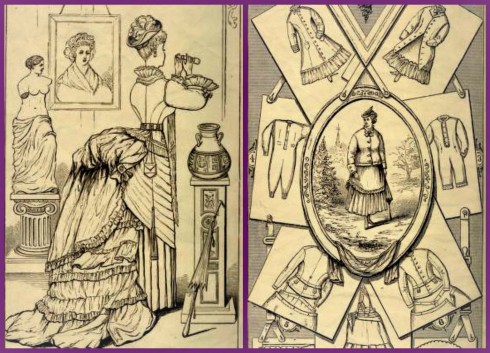
My previous #SalemSuffrageSaturday posts have been pretty wordy—and pretty serious; I think we all just need to see some Salem women of that gilded, reforming era at the end of the nineteenth century. Ever since that Phillips Library digitized part of their large collection of glass plate negatives created by photographer Frank Cousins I have been pouring over these images at the Digital Commonwealth looking mostly at streets and structures. But Cousins captured people as well—lots of people—even if they were not always his primary (or secondary) consideration. Sometimes he lets them pose; often he captures them unobserved, mostly on busy Essex Street. Now that I know how active Salem women were, for abolition, suffrage, temperance, and other causes, I’m wondering if they also embraced dress reforms, but I’m not enough of a sartorial scholar to tell! The other issue is dating: Cousins’ photos date roughly from 1880 to 1915, but very few are dated precisely, and fashion changed within these decades.

Dress Reform CollageUnreformed dress and reformed suit, from Abba Goold Woolson’s  DressreformA Series of Lectures Delivered in Boston, on Dress as it Affects the Health of Women, 1874.

Of course the women on the streets of Salem, going about their business, or striding or sitting on a Willows avenue or beach, are not going to represent either the “ideal” corseted and bustled or sturdy-suited model figures above, but something in between, clad for their real lives. I don’t see a lot of “tight lacing” in the photos below, but I definitely discern corsets, and the skirts are only shorter for the girls. I’m a bit wary of extreme photo manipulation (photographs are sources) but I have no problem with extreme zooming!

At Salem Willows: the first images is dated 1880; not sure about the rest—but I believe that draped skirts of the second photograph are from the later 1880s.

WTW Willows Pavillion 1880 (2)

WTW Willows 2 (2)

WTW Willows Hospital Point (2)

WTW Willows (2)

Streetwear, 1890s? Again, the first image is dated—it is Columbus Day, 1892—but the rest are not. Young women were always allowed to wear shorter skirts, apparently (like the girls in front of the old Salem Hospital on Charter Street and the Pickering School on North Street). Shop windows (like Cousins’ own Bee-Hive) and signs are also clues for evolving fashion. Lots of parasols on the streets of Salem, in rain or shine. The “leg of mutton” sleeves worn by ladies in the last two photographs clearly date to the later 1890s: sorry she is so blurry, but my very favorite anonymous “bicycle girl” on Essex Street seems like a perfect match for the famous Gibson Girl.

WTW Columbus Day 1892 (2)

WTW CHarter Street Hospital (3)

WTW Pickering School (2)

WTW Bee-Hive (3)

WTW Beehive2 (2)

WTW 207 Essex (3)

WTW Essex 153 (2)

WTW Brooks (2)

WTW St Peter Essex (4)

WTW Gardner Street (2)

WTW Margin Street (2)

pixlrFrank Cousins Collection of Glass Plate Negatives at the Phillips Library via Digital Commonwealth +ephemera at the Library of Congress.


Suffrage in Salem: a Big Election!

I always tell my students that history is not necessarily linear: movements and ideas move forward and then fall back and “progress”, however you choose to define it, is always a result of struggle. The struggle for women’s suffrage is a case in point, played out on a national stage as well as a local one. I’ve had to piece together the history of the Salem Suffrage movement from a variety of sources, as the records for its main organization have disappeared, but I think I have it down now, and it was definitely characterized by fits and starts. The connection between the abolition and suffrage movements before the Civil War is very clear: while a petition calling for universal suffrage was submitted to the Massachusetts legislature in 1850 by a group of active Salem reformers, both women and men, abolition was the higher priority during the following decade and the suffrage initiative remained on hold during the Civil War and its aftermath. The debate over the 15th Amendment caused a schism in the national suffrage movement, with some leaders (Susan Anthony and Elizabeth Cady Stanton) opposing the enfranchisement of black men before women had achieved the vote and others (Julia Ward Howe, Lucy Stone) favoring a more incremental approach to suffrage with the enfranchisement of black men as a first step. This split resulted in the formation of two associations, the National Woman Suffrage Association (NWSA) of Anthony and Stanton, and the American Woman Suffrage Association (AWSA), led by Lucy Stone, as well as a cascade of regional, state, and local associations. Supporters of suffrage in Salem, both women and men, were firmly in the Stone camp, and we can follow their efforts through Stone’s weekly newspaper, the Woman’s Journal. Even though the 1870s started with division, there was also an air of optimism in the air: women in Wyoming and Utah won the vote in 1869 and 1870, so why couldn’t reformist Massachusetts be next?

20200114_110638Courtesy Peabody Essex Museum’s Phillips Library.

The Woman’s Journal reports that yearly conventions were held in Salem, generally at the Lyceum, along with regular meetings of the Salem Woman Suffrage Club, which included woman and men and were clearly as much social occasions as strategy sessions. The editors of the Journal  seem to have favored an approach that was not only incremental but “pleasant”, as the account of the 1874 convention (below) illustrates: much praise for the food and flowers, and an observation that “other clubs may take a lesson from this of Salem, which draws members by pleasant means—clergymen, lawyers, judges, editors and not least in influence, women. What remains to do now is the steady and continuous circulation of tracts as a means of enlightenment, and with the light will come the end”. Yet there were several women in Salem who made it clear that tea parties and the dissemination of pamphlets was not enough, writing letters to the editor that expressed the general opinion that while the Salem club was popular, it wasn’t actually doing anything: such expressions seem to be coming from those women who were also involved in other causes like temperance, settlement, and the “moral education” of “fallen women”. As was the case before the Civil War, suffrage was interwoven with other calls for reform.

Suffrage Collage 1874

But maybe the “pleasant” approach was working. In 1879 the Massachusetts legislature passed a “school suffrage” bill, enabling Massachusetts women the right to vote in school committee elections. This definitely seems like a big step forward, but apparently it was an action that represented the traditional belief that education matters were within the realm of female expertise more than any desire to move towards universal suffrage on the part of Massachusetts legislators. Nevertheless, Salem women offered up four female candidates and really turned out at the polls in December of 1879, with the result that all four women were elected to the Salem School Board, the highest number in Massachusetts. The Boston Globe reported that there was “great activity at the polls” with “undertain” results on Election night (December 9), but on the next day the election of the four women was confirmed.

Suffrage Boston Globe December 9, 1879 (2)

Suffrage 1879 Election Library of Congress (2) Boston Globe headline, December 9, 1879; Library of Congress.

And suddenly there was a brand new School Committee in Salem! The four women elected were Mrs. Mary G. Ward of Federal Street, a noted activist for suffrage and temperance in the city, Dr. Sarah E. Sherman, who I believe was Salem’s first female physician, Emma B. Lowd, very active in veterans’ affairs as an officer in the National Woman’s Relief Corps Committee, and Mrs. Lurana N. Almy, the wife (and partner, really) of James. F. Almy, the founder of Salem’s famed Almy’s, Bigelow and Washburn store. Unfortunately Mrs. Almy died before she could take up her seat on the committee, but the other three women served for several years, paving the way for more women members. The ground-breaking year of 1879 was capped off by the submission of a suffrage amendment petition to the U.S. Congress by the Salem Woman Suffrage Committee, signed by the men who could vote in one column and the women who could not in another.

SUffrage School Committee Colored

SUffrage Sarah Sherman 1877 Salem Directory (2)

Suffrage Emma Lowd historyofdepartm01woma_0129 (2)

SUffrage petition CUNYSalem School Committee Annual Report, 1880; Official Souvenir Program of the 24th National Encampment, Boston, MA, 1890……also the Eighth Annual Convention of the Woman’s Relief Corps;“Petition from the Citizens of Massachusetts in Support of Women’s Suffrage,” HERB: Resources for Teachers, accessed February 21, 2020, https://herb.ashp.cuny.edu/items/show/1683.

But two (or three or four or five) steps forward were followed by several steps back. In typical contrary Massachusetts fashion, the multi-layered suffrage movement provoked a counter-movement in the form of the Massachusetts Association Opposed to the Further Extension of Suffrage to Women, established in 1895 and with a Salem branch headed by Miss Anna L. Warner and Miss Ellen B. Laight. Two Massachusetts suffrage referendums were soundly defeated—in 1895 and 1915—before the Commonwealth ratified the 19th Amendment on June 25, 1919.


It Seems as if Hannah is Hiding

These #SalemSuffrageSaturday posts are challenging:  and it’s only February! Especially as I am drawn to the more “hidden” women: whose stories, it seems, you can only get to through men. I’ve been interested in Hannah Crowninshield (1789-1834) for a while: she was part of the large and dynamic Crowninshield family in its most powerful era, she was a “maker” and an artist, she was the protegee of the Reverend William Bentley, she was the wife of a naval commodore who married her younger sister after her untimely death. Fortunately we do have some things that she created that can, in effect, “speak” for her, because otherwise I could only shed light on Hannah through her father, her mentor, her husband, or a cat. My interest in Hannah actually began when I spotted a charming watercolor of a cat named Pompey, who accompanied her father and brother in their voyage across the Atlantic in the famous pleasure yacht Cleopatra’s Barge, built for their wealthy cousin George Crowninshield in 1816. Pompey was lost at sea on the voyage, “a victim to his patriotism.”

20200211_120717

Screenshot_20200210-231757_Twitter

I needed to know who created this charming “memorial,” hanging in the reconstruction of Cleopatra’s Barge cabin at the Peabody Essex Museum, almost as soon as I saw it: Hannah Crowninshield (an attribution found at the Smithsonian, rather than the PEM), daughter of the ship’s captain. There are extant and unattributed portraits of her father Benjamin (known as “Sailor Ben” to distinguish him from other Benjamin Crowninshields) and brother “Philosopher Ben” in the collection of the PEM (though inaccessible in its spare database): did Hannah paint these?

Hannah Collage

20200211_120818

Like many people of her era, we can see Hannah Crowninshield through the Reverend William Bentley’s eyes and diary. Actually we can “see” much more of Hannah than most of her contemporaries, as she and the Reverend were very close. They were next-door neighbors, living in two sides of what is now known as the Crowninshield-Bentley House: Bentley baptized Hannah, and married her to James Armstrong on March 29, 1819. His diary entry for that day indicates just how heartfelt his feelings were for her: this day I passed through the most interesting scene of my life. I came to the family of H. [Crowninshield] in 1791. In 1789 I had baptized Hannah, d. of Benj. and Mary Crowninshield, two years before I came into the family, tho I had before lived in a branch of it. As soon as Hannah was of age for instruction she was put into my care. She has rewarded it with her virtues & accomplishments. This day I delivered her in marriage to an officer of the Navy [Lieut. James Armstrong]. He is from Virginia, but to me unknown. What the prospects are I cannot guess. The event is not from my wishes or at my will. The sympathy was beyond description. The hundred I have united never gave such emotions. I knew nothing contrary to the hopes of the young man & that is the evil, that even this consolation is not borrowed from the ample means to render it happy, being rather my ignorance than my observation. The branches of the family were represented on the occasion & after the ceremonies H. retired to her Father’s in Danvers. The questions were Will she go to Virginia? It is said not, but the property was not then conveyed. Thus after nearly 30 years all our hopes are unknown. Why did not so accomplished a girl find a bosom friend in Salem. They who respected her did not dare to ask without means to support, and they who looked for fortune could not find it. All the domestic relations were not such as ambition could desire. I hope H. will be happy. It will be my happiness. My best wishes attend her. This rather anguished entry speaks to one of the most cherished relationships in the Reverend’s life, I believe.

20200211_125837PEM’s Bentley-Crowninshield House, which used to be located a bit further along (eastward) Essex Street.

But back to Hannah. Or Hannah and the Reverend. He refers to several of her compositions: an illustration for Marblehead mariner Ashley Bowen’s autobiographical journals, depicting his life as a ship’s voyage, a rather scary chalk drawing of 82-year-old Major-General John Stark, whom they visited in New Hampshire in 1810 (so scary that it was quite modified in lithographic and portrait form, but still, there are contemporary comments that it was “lifelike”), a reworked seventeenth-century portrait of Captain George Corwin which Bentley found “defaced,” and a much nicer watercolor portrait of James Tytler. All of these portraits are supposedly in the collection of the Peabody Essex Museum according to Catalog of Portraits in the Essex Institute and the Catalog of American Portraits, but I can’t find any reference to them on the PEM’s site. It seems as if Hannah is indeed hiding—somewhere in the Peabody Essex Museum!

Hannah Bowen

Hannah Stark Collage

Hannah C. Corwin 1819

Hannah Crowninshield James TylerThe Catalog of American Portraits, accessed via the Smithsonian’s National Portrait Gallery, lists the following portraits by Hannah Crowninshield as part of the PEM’s collection: a self-portrait, a portrait of the Reverend Bentley, and the portrait of James Tytler, in addition to a portrait of Simon Bradstreet in the collection of Historic New England. Hannah’s portrait of Scottish radical publisher/apothecary Tytler, who lived briefly (and died) in Salem, illustrates his Oxford Dictionary of National Biography page.

As I was writing this post up on Thursday morning, I did see that there were some materials on Hannah in the Benjamin Crowninshield Family Papers (MH16) at the Phillips Library up in Rowley, and thus a dilemma presented itself: do I have time to run up there before my grad class at 4:30 so I can do justice to Hannah in this post? What if I run up there and there’s not much to see? The answer to the first question was “no”, so I might have to provide an addendum to this post at a later date: and for local history afficionados like myself out there, never take for granted the luxury of a historical society/repository in your own town! For now, I can only discern this much about Hannah Crowninshield Armstrong: she and her husband did not confirm the Reverend Bentley’s worst fears and head to his native Virginia after their 1819 marriage, they did not have any children, and she died in May of 1834 at age 45, after which her husband married her younger sister Elizabeth. The dating of her works in the Catalog of American Portraits indicates that she continued to paint after her marriage—-but that’s about all the light I can shed on that time of her life at this point. The Peabody Essex Museum actually credits and showcases one of her works on its website, although you will never, never find it by searching on the website itself:  only an external search engine will take you to it! It’s a painted work box made for her mother, and apparently the PEM also possesses a portable desk painted for her sister Maria (again–you will not find this at or through PEM but rather in Betsy Krief Salm’s Women’s Painted Furniture, 1780-1830. American Schoolgirl Art). I remain hopeful that some day, one day, the hidden figures  of Salem history, both women and men, will have their day when the Peabody Essex Museum, decides to cast some light on them.

Hannah Crowninshield Work Box (2)Hannah’s painted work box, made for her mother Mary Lambert Crowninshield, Peabody Essex Museum—this seems to exist only on an earlier incarnation of the PEM website here, and not the current one. You can really access much more of the collection–and much more information– if you search externally rather than through the current website.