Category Archives: Design

The Spider and the Fly

A little tweet from one of my favorite history bloggers brought me to a charming web illustration in the collection of the Library of Congress and then I was off–there is nothing better than a parable, especially one as universal and flexible as the spider and the fly. There have been all sorts of illustrative variants on this age-old story over the centuries, and I must begin with my very favorite, John Heywood’s 1556 illustrated poem, The Spider and the Flie. I understand that literary scholars have little love for this poem, but it is a very illuminating historical source, and a window into a very contentious time.  Heywood was a passionate Catholic in a time of surging Protestantism:  he envisions this religious conflict as a war between devious Protestant spiders and stalwart Catholic flies, with insect allies on both sides. The Catholic Queen Mary (“Bloody Mary” to the Protestants) is portrayed as a housemaid, squishing spiders and sweeping England clean.

The inspiration:  a couple caught up in a web of romance on the sheet music cover of the 1901 song, “The Spider and the Fly”, J.D. Cress, Library of Congress.

More serious matters at stake:  illustrations from John Heywood’s Spider and the Flie (LondonThomas Colwell, 1556).  Heywood looks on as a Catholic fly gets caught in a web with a Protestant spider army approaching, and then as the maid/queen Mary rids England of the spider.

An emblem engraving from the later sixteenth century: print made by Johann Theodor de Bry, Frankfurt, 1592 (British Museum).

The satirical and metaphorical use of the Spider and the Fly parable only intensifies in the nineteenth and twentieth centuries, with new printing and printmaking technologies and the publication of Mary Howitt’s famous poem in 1829, with its leading line:  will you walk into my parlor?  But even before Howitt, the device was used by British caricaturist Thomas Rowlandson (1756-1827) to depict the central figure of his age, Napoleon:  pictured below surrounded by an army of European flies. After Howitt, cunning spiders armed with webs were everywhere, luring naive young me into taverns and the big city.

Thomas Rowlandson, “The Corsican Spider in his Web”, 1808, Metropolitan Museum of Art; a London temperance poster from the 1820s, Wellcome Library, London; a 1916 New York cartoon, New York Public Library Digital Gallery.

You can always count on Puck magazine for this type of anthropomorphic visual satire, and I found two “Spider and the Fly” illustrations among its archive of covers:  I’m afraid that the precise issue regarding the Interstate Commerce Commission escapes me in the first (1907) image, but the second one, from 1913, looks pretty timely.


Etsy Harvest

I haven’t done an Etsy post for a while, and my basket is overflowing.  There’s too much creativity and diversity on display to restrict myself to Salem offerings (which tend to be dominated by kitschy witchy stuff and grotesque paintball helmets) so I have cast a wider net, although some Salem items landed in it. For some time, since I spotted some silver lustreware in Maine early last summer, I have been obsessed with silver-covered pottery, so I snapped up this “weeping” silver planter as soon as I saw it.  It was produced by the Swetye Pottery Company of SALEM, Ohio, which specialized in silver and gold glazed pieces–the gold looks a bit gaudy to me but I really like the silver.

And speaking of silver, there are several Daniel Low silver Witch Spoons on Etsy now, including the one below:  these little souvenir spoons almost singlehandedly transformed Salem into Witch City in the 1890s, and they remain very collectible.

More Salem stuff:  a Spode transferware jug, Greeff “China Trade” fabric yardage, and a May 1933 issue of Antiques with an article entitled “Salem Secretaries and their Makers”.

Decorating for Fall:  a few items that have the autumnal vibe that I’m craving right now:  a mixed media illustration (with real pressed leaves) entitled “The Hawthorne Sisters Endeavor to Grow their own Forest” by Fauna Finds Flora, a red squirrel watercolor by harebit, felted pumpkins by feltjar, a paper skull wreath by cardboard safari, and a red leather “green man” mask from MythicalDesigns. (Just click on the image to get to the listing).


Variations on Blue and White

I’ve never been a blue person; there is no blue in my house except for my turquoise dining room which I think of as green.  When I went through my transferware phase, I collected red (pink) and white rather than the more attainable blue and white, and in the summer time, when it seems like all of my favorite shelter magazines feature blue and white portfolios, I leaf quickly through.  That said, I have been quite taken by the latest installation of the Peabody Essex Museum”s ongoing “FreePort” exhibitions, through which contemporary artists engage with and respond to the museum’s collections, creating completely new works in the process.  FreePort [No.005]:  Michael Lin takes the traditional blue and white of Chinese export ware and runs with it, as Mr. Lin has emblazoned the armorial and heraldic crests of porcelain produced in China for the European market on the staircase walls and floors of the Museum’s Asian Export galleries.  The effect is modern and baroque at the same time.

And then, as  if these vibrant blue-and white walls and floors were not enough to make us look at plates in a completely different way, Lin also produces a mass of “Mr. Nobodys”, the first Chinese representations of Europeans, with their anonymity enhanced by the massing, and their commercial qualities (we are talking about the Chinese export trade here) enhanced by the fact that you can buy one in the PEM Museum Shop.

For comparison’s sake, another Mr. Nobody from the collection of the Victoria & Albert Museum, London.  This one, however, was produced in England in the later seventeenth century.

The motifs and the figurines are interesting examples of cross-cultural exchange, an important dynamic in world history.  I can’t imagine a better way to (literally) illustrate it.  The Lin installation reminds me of another artistic expression, Blue and White by the Silk Road Ensemble, a multimedia performance that traces the migration of blue-and-white porcelain around the world.

This is a big task, because there are a lot of varieties of Asian-influenced blue and white porcelain and pottery:  delftware, fritware, transferware, just to name a few. Blue and white earthenware is everywhere, crafted in very diverse forms, over many centuries.  Here are two particularly disparate examples:  Iranian rasps in the form of shoes from the eighteenth century, and an image of omnipresent “oriental” planters from Victorian England.  Because I was so inspired by Lin, I tried my hand at my own blue and white Salem fabric design via Spoonflower with limited success:  Samuel McIntire’s sheaths of wheat look a bit too tropical in blue!  Obviously Christopher Dresser’s stenciled ceiling (a nice counterpart for Lin’s walls and floors) is much better.

Fritware and late 19th century songsheet, Victoria & Albert Museum, London; design for a stenciled ceiling, Christopher Dresser, Studies in Design, 1876.


Millinery Marvels

Look at these hats!  And fair warning:  the last one is a little racy. Besides the re-dedication of the Witch Trials Memorial ceremony, the other big Salem event of this past weekend was the opening of Hats: An Anthology by Stephen Jones  at the Peabody Essex Museum.  The exhibition features over 250 hats from the last millennium (although most were fairly modern), chosen by Jones in collaboration with the curators at the Victoria & Albert Museum in London, where the exhibition was first on view a couple of years ago.  The hats, sourced from Jones’ own workshop, private collections, and the Victoria & Albert, are showcased in an innovative and interactive way that emphasizes not only the objects but also hat-making and hat-wearing. Every time the PEM ventures into the fashion realm–from shoes to wedding dresses to the celebrated closet of Iris Apfel–there are crowds, and I’m sure this exhibition will be extremely popular as hats are immediately accessible. As Stephen Jones says, “With hats, what you see is what you get.”

I went to the exhibition preview late last week and snapped some photographs, but many of them came out murky or flashy so I’m supplementing this preview with images from the Victoria & Albert collection for the sake of clarity: details are very important with hats!

Philip Treacy hat (1995) in Salem and the V & A image.

A display from the Salem exhibition,  a straw hat by Madame Suzy (1937) and Jo Gordon’s “Kiss of Death” hat (1994).

A mock-up of a milliner’s workshop.

In addition to these hats, there was a Tudor cap, a leather Jester’s hat, several Schiaparelli “shoe hats”, baroque nightcaps, bonnets, fascinators, helmets, and avante garde creations of all kinds, including the x-rated example below: Kirsten Woodward’s aptly-titled Sex on the Brain (1996).  Pretty intricate–and intimate.

And pictured below is the master millinery among his hats, from the companion volume to the exhibition, also called Hats:  an Anthology by Stephen Jones (with Oriole Cullen,V & A Publishing, 2009).


Two Memorials

This weekend the Salem Witch Trials Memorial was rededicated, 20 years after its installation and after a year of renovation and fortification by its original mason.  The Memorial remains the only Witch-trial-related initiative that I can bear in Salem, and the ceremony marking its re-dedication was, for the most part, simple and respectful, just like the Memorial itself.  Descendants of the 20 victims were present, and they placed flowers and rosemary (for remembrance) on their ancestors’ symbolic “graves”, granite benches marked with their names and dates of death built into an encompassing granite dry wall. As you enter the green rectangular courtyard that is the Memorial, surrounded by the colonial gravestones of the Old Burying Point outside of its perimeter, you can read the victims’ protestations of innocence, which are carved on paving stones.  Just like the actual words that were uttered, they are cut off , by the Memorial walls.

Exterior and interior views of the Salem Witch Trials Memorial, designed by James Cutler and Maggie Williams and built by Hayden Hillsgrove; the descendants of the victims of 1692 stand by their ancestors’ markers; John Willard’s marker/bench.

The Witch Trials Memorial is successful because it is so strikingly simple in its understatement:  it does not tell us how to feel.  The victims speak for themselves, until they are cut off.  Unfortunately, the proclaimed mission and attendant speeches associated with the Memorial and the other official commemorative initiative, the Salem Award, attempt to impose a redemptive lesson about tolerance which I believe diminishes the historical tragedy of 1692. If you emphasize the ideal of tolerance above everything else, the presupposition is that the accusers of 1692 were not tolerant of the victims’ aberrant belief systemwhen there is no historical evidence that the latter were practicing witchcraft. It is always difficult to reconcile the past and the present and not lose sight of one or the other.

Just last summer, an equally evocative memorial to the victims of another seventeenth-century series of witch trials, the Vardø trials in the Finnmark region of northeastern Norway, opened to the public. As with the Salem installation, the Steilneset Memorial is a collaboration between an architect and an artist: Swiss architect Peter Zumthor and the late French-born artist Louise Bourgeois.  The Vardø trials, which occurred in two distinct phases in the dead of the Arctic winter (in 1621 and 1662-63), resulted in the execution of 91 people for the crime of sorcery. Zumthor’s two-structure memorial is a far more elaborate construction than Salem’s, but still absolutely austere. The architecture and the art represent both the individual victims and the collective tragedy, via one illuminated window for each of the victims in the long gallery building and a perpetually-burning chair in the “cube” structure next door. Like the Salem Memorial, Steilneset focuses completely on people, and lets its viewers draw life lessons.

The Steilneset Memorial in summer and winter, overlooking the Barents Sea, and the last creation of Louise Bourgeois,  “The Damned, The Possessed and The Beloved”.  Photographs by Bjarne Riesto.


Dolphin Decoration

In my ongoing quest for the perfect mirror, and more mirrors, I came across this Carvers’ Guild mirror embellished with intertwined dolphins, gracing a San Francisco house designed by Benjamin Dhong in the current issue of House Beautiful.  It caught my eye because I have two very similar mirrors in my “mirror files”:  another reproduction one from Mecox Gardens, and a Regency example from the blog Paisley Curtain.  All similar and all beautiful, I think.

As you can see, the “dolphins” embellishing these mirrors are not your typical Flipperesque variety.  The first English explorers named the large fish they observed patrolling the waters off the eastern coast of North America “dolphins”, thus causing centuries of confusion with the better-known marine mammal.  This confusion finally cleared for me just last year, when I wrote a post about the Lady Pepperell House in Kittery Point, Maine, which features dolphin-fish decoration on its exterior, and the commentators cleared it up for me.  I’m not completely certain, but I think the source of this confusion is John White, who accompanied both Richard Grenville and Walter Ralegh on exploratory tours of the New World in the 1580s, charting and illustrating what he saw along the way.  White’s “Duratho” became Dolphin in common Elizabethan English, and endured.  The Dolphin fish later became known as “dorado”, and later still as “mahi-mahi”.

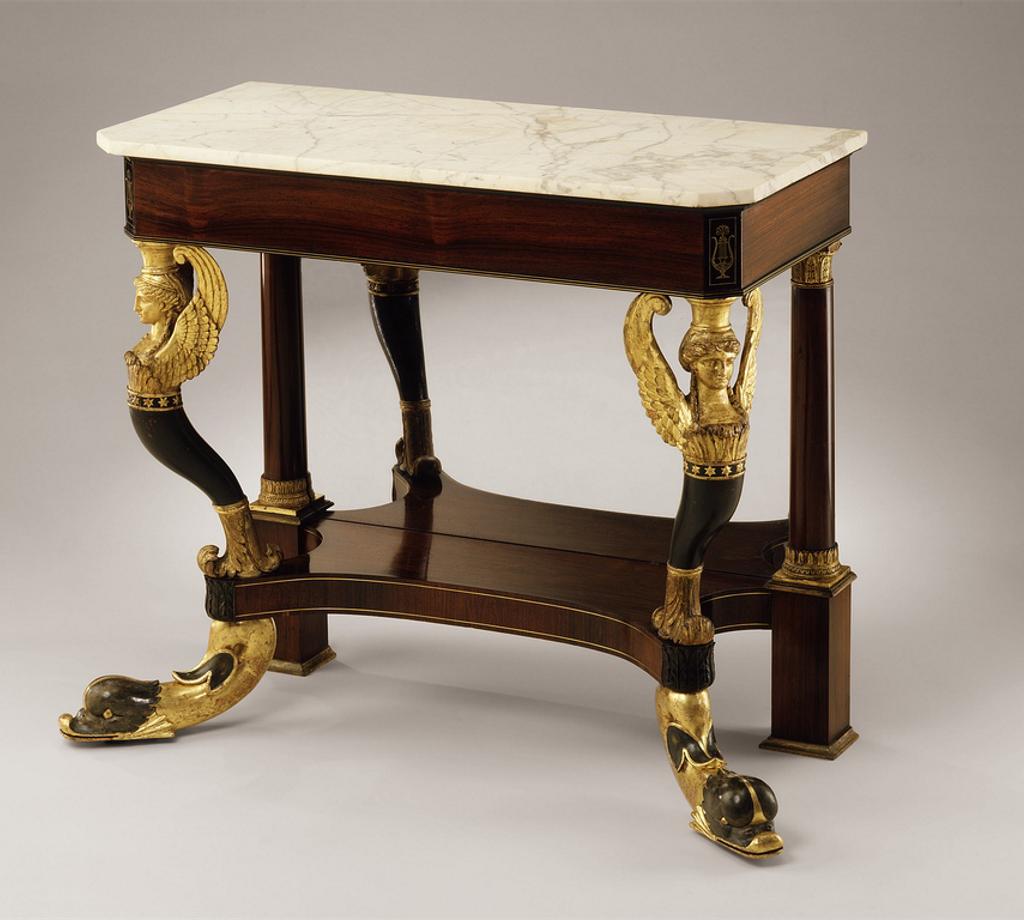
Dolphin fish seem to have been popular decorative motifs in furniture of the English Regency and American Federal and Empire periods, carved in relief or in part on sofas and tables as well as mirrors. There are lots of dolphin feet, as illustrated by the sofa (circa 1820), Lannuier pier table (1815), and Indian tilt-top table (made for the British market after 1825) below.  The American examples generally come from Philadelphia or New York, not New England, where no doubt the almighty cod was still golden.

Mahogany sofa and rosewood pier table by Charles-Honoré Lannuier, Detroit Institute of Arts via ARTstor; Indian tilt-top table, Walters Art Gallery via ARTstor.


Ladies of Salem

Looking down upon the streets of Salem this summer are 12 “Ladies of Salem”, nautical figureheads created by local artists to commemorate Salem’s maritime past and highlight its present role as a “port of culture”.  The Lady of Salem festival, spearheaded by the city’s Beautification Committee, is the most recent of a succession of positive public arts initiatives designed to draw the attention of both residents and visitors away from the tacky exploitation of Salem’s witch-trial past, or at the very least to put the events of 1692 (and their “interpretation”) in context.  These ladies, affixed to lampposts on downtown streets adjacent to their sponsoring businesses, peer down at passers-by with their characteristic open gazes.  Here’s a sampling:  as the organizers of the festival are encouraging the public to vote for their favorites, I’m starting with mine, and then proceeding in no particular order.

Figurehead by Jeanne Pare, sponsored by Treasures over Time, Washington Street.

Figureheads by Mary Ellen Halliwell for the Salem Beautification Committee, Amberlynn Narvie for Beverly Cooperative Bank, and John Devine for the Palmer’s Cove Yacht Club on Essex Street.

Two more Essex Street ladies:  figureheads by Jade Mason for Body & Soul Massage/Collins Cove Appraisors and Sheila Billings for Cabot Money Management, Inc.

Figureheads were a prominent feature of ships built from the seventeenth century to the age of steam and were often, but not exclusively, female. The general consensus seems to hold that for very superstitious seamen, real women on board were bad luck, so this was the only way to have a feminine presence on seagoing vessels, which were, of course, also characterized as feminine.  At the same time, figureheads represented the “spirit” of their ships and offered protection on long, arduous voyages. The Peabody Essex Museum has a lovely collection of figureheads, many of which are very majestically displayed in East India Marine Hall, but the largest collection of figureheads from merchant ships can be found at the newly-restored Cutty Sark in Britain, part of Royal Museums Greenwich. I love this picture of them all together.

Figureheads in the East India Marine Hall of the Peabody Essex Museum, and one attributed to Samuel McIntire in the PEM’s collection; the Cutty Sark figureheads, collection of the Royal Museums Greenwich.

She’s not from Salem, but as most of us rarely have the vantage point of viewing a figurehead from above, I wanted to include this interesting photograph by Alan Villiers of the bow of the Herzogin Cecilie from 1928–the very last days of figureheads.


Hats Off to London

The Anglophile in me cannot resist one more post on London, but this one will not be about sports, but rather about hats.  And I will put a little Salem in here, because I am inspired.  As part of the Olympics celebration as well as the Mayor of London’s summer-long schedule of happenings called “Surprises”, twenty of the city’s most conspicuous statues have been topped with hats designed by eminent British milliners. For the next few days, Londoners will be amused (I hope) with very clever juxtapositions of hard and soft, traditional and fanciful.  The event is called “Hatwalk“, and here are some of my favorite pairings:

Queen Victoria wearing what appears to be an Olympic-flame hat, by Justin Smith, Esq.

Another flame: Admiral Nelson in a hat by James Lock & Co., Hatters.

General Sir Henry Havelock in a Philip Treacy “spectator”.

The Poet Robert Burns (A Red, Red Rose) wearing a hat by William Chambers Millinery.

General Sir Charles James Napier wearing a Sophie Beale hat.

King George IV and his horse, resplendent in Brighton pavilion-inspired hats by Stephen Jones.

Sir Arthur Sullivan and The Lady, wearing Gina Foster and Victoria Grant hats.

Franklin Delano Roosevelt and Winston Churchill on Bond Street, wearing hats by John Boyd and Herbert Johnson, respectively.

All photographs by Getty Images.

I love this installation (for lack of a better word–I’ve been struggling with what to call this happening) because it’s creative and historical at the same time–drawing attention to both design and the people, along with their eras and accomplishments, who are “modeling” the hats.  Several of these statues are in very prominent places like Trafalgar Square, but others might have been overlooked and forgotten.  Even before I became aware of Hatwalk, I had been thinking about several statues here in Salem and its environs which I pass by every day and never really look at, much less take the time to stop and read their plaques and inscriptions. If these statues had jaunty hats on their heads, perhaps I would!  One Salem statue in particular which needs more attention (or interpretation) is that of Roger Conant (1592-1679), who settled in Salem in 1626 and became its first governor, after brief stays in the Plymouth and Cape Ann colonies (he really disliked the Pilgrims).  The Conant statue was erected in 1913 after the Conant Family Association commissioned sculptor Henry H. Kitson (who had designed the famous “Minuteman Statue” and whose amazing home, Santarella, I featured in a previous post) for the design.  It is a commanding and majestic statue, but it suffers from its proximity to the dreadful Salem Witch Museum:  too many dim-witted tourists casually assume that Conant has something to do with the Witch Trials because of his seventeenth-century attire.  They never even bother to read the plaque–and the things I have heard them say as they have their pictures taken with poor Roger!  I think that Kitson did a good job with the hat, but perhaps the occasional placement of a slightly more Cavalier-esque one would help?  I hate to call on the Gunpowder Plotters for fashion advice, but I’ve always admired the depiction of their hats in the contemporary broadside below.


Olympic Posters

It was nice to see and hear the traditional ringing of the bells in Britain yesterday, signalling the beginning of the London Summer Olympics. Nearly all of the British institutions that I regularly “visit” have their own take on the Olympics this summer:  the Museum of London has a general exhibit, while the British Museum focuses on medals and the British Library offers up Olympex 2012, an exhibition on collecting the Olympics. My favorite Olympic-themed presentation, thankfully very accessible on-line, is the Victoria & Albert Museum’s presentation, A Century of Olympic Posters . It’s so interesting to see how the posters reflected the times in which they were produced, while at the same time projected national images to the world which were carefully chosen by the host countries.

There was no official Olympics poster until the 1912 Stockholm Olympics, but it seems appropriate to begin with the program(me) cover for the first London Olympics, held in 1908 at the newly-constructed White City Stadium in Shepherd’s Bush.  This Olympiad was originally scheduled to be held in Rome, but the eruption of Mt. Vesuvius diverted it to London. It’s a nice nostalgic image, and you can see the White City in the background.

The first official Olympics poster, printed in 16 different languages and alternative formats, was the work of Swedish artist Olle Hjörtzberg,. The original design, featuring completely naked athletes in a reference to the ancient Olympics, was replaced by this version, with its strategically-placed streamers, but this was a bit controversial too.

After a long break due to World War One, the Olympics resumed in war-devastated Belgium for the 1920 Antwerp games. Maybe it’s just my own national bias, but that looks like a very prominent American flag on the poster:  perhaps an expression of gratitude for the timely entry of the US into the war?  The poster for the 1924 Paris Olympics by Jean Droit has become iconic, and we first see the five Olympic rings representing the continents of the world on the posters for both the 1928 Olympics:  summer (Amsterdam) and winter (St. Moritz).

The poster for the 1932 Los Angeles Olympics, the first to be held outside of Europe, looks a bit odd to me:  apparently the artist Julio Kilenyi sculpted the figure and then photographed it, and I’m not sure how the lettering was produced.  There’s very little sense of place here; it does not read Los Angeles or America to me, but it’s interesting that “California” had to be added.  I suppose that the City of Angels was not yet the international city that it would become.

Few images are as ominous as the official poster for the 1936 Berlin Olympics with its menacing Nazi symbolism and the Four Horsemen, which can only be seen as the Four Horsemen of the Apocalypse in historical perspective.  And then there are two very similar, one might say identical, posters from the canceled 1940 and 1952 Helsinki Olympics.  Clearly Finland–and perhaps the world–decided to pick up where they left off.

There is some semblance of place in the Helsinki posters, but I think that emphasis becomes pronounced in the post-war era, beginning with the image of the second British Olympics, the so-called “Austerity Olympics” of 1948. Jumping forward to the early 1960s, the sense of place seems to overwhelm the sheer athleticism of the earlier posters in the images from the 1960 and 1964 Olympics in Rome and Tokyo.

Of course, the images get more abstract and symbolic in the later 1960s:  the poster for the Mexico games represents the psychedelic age perfectly, as does one of the slightly-cynical images of the 1976 Montreal Olympics.

The posters for the more recent games just don’t seem as textured to me as those from the past, although I really like the official poster #1 from the 2000 Sydney games, “Peace Roo”, designed by David Lancashire. The trend seems to be for whole series of posters to be produced rather than just one, representing individual sports as opposed to the entire event. This was certainly the case for the Barcelona Olympics in 1992, which was represented by over 50 posters, and the organizers of the third London games commissioned posters from 12 eminent British artists. Pictured below is “For the Unknown Runner” by Chris Ofili, who used the vase outline to reference the Greek origins of the games.


An Array of Elephants

I know that they’re trendy now and have been for some time, but I’ve been an elephant afficionado since I was a little girl, so I have many, many elephants that run the range from extreme tackiness to quite elegant.  I’ve had to edit my collection of elephants down rather dramatically to avoid their takeover of the house, so most of them are in boxes in the basement now (I could not, of course, get rid of them!)  I think that I should forgo future pachyderm purchases, unless they are of the ephemeral variety and don’t take up much room. Nevertheless, I am always looking…and several very different and unattainable elephants  have caught my eye over the past few weeks, renewing my appreciation for those in my own house at the same time.

Three great elephants: a “change packet” (a kind of ephemera I didn’t even know existed! nineteenth-century shopkeepers would give you your change back in these cute little paper packets, which provided them with another avenue for advertising) from the Graphics Arts Collection at the Princeton University Library, the mechanical elephant of the Machines of the Isle of Nantes, which can carry around up to 49 people for 45 minutes, and an elephant embroidered by Mary, Queen of Scots about 1570 from the collection of the Victoria & Alfred Museum in London.

I like this last embroidery panel because it indicates that the Queen had access to the first great Renaissance zoological work, Conrad Gessner’s Historiae Animalium (1551-1558).  Mary’s elephant clearly seems to be based on the image in Volume One of Gessner, and I like to think of the plotting Queen and her ladies leafing through the tome for inspiration.

Elephants in my house:  a few of my favorite elephants, still upstairs, beginning with the wallpaper in my first-floor powder room. I can’t remember what the maker or pattern is.

The little guy below is my very favorite elephant:  I have no idea what he is made of or how old he is. He was in a box with some other little elephants–all cast iron–which I bought for a $1.00, but he is not cast iron but rather a hard plaster-like material.

A recent purchase from an antiques shop in Maine:  this guy seems to be made of old college pennants.  I have no idea what to do with him, so he just sits on a chair in the guest bedroom.

A sixteenth-century book illustration:  I purchased it after it was already cut out, but I still feel guilty.

Moneypenny, one with the elephant garden seat.