Category Archives: Culture

The Rebecca Nurse Homestead

As I write this on a sunny warm Saturday afternoon, there’s a line of cars extending down my entire street which has been continuous since about 10:00 this morning; I’m sure every other entry road into Salem is the same. My windows are open so I can hear and smell the exhaust as well as booming radio music; the situation has been much the same over the past three weekends and it will be the same for the next two. Salem in October! Of course we’re all supposed to grin and bear it because it’s good for local businesses, and we do. Generally I make plans to get away but that hasn’t been the case this year for some reason: a big mistake. Last week I didn’t even provision properly before the weekend: an even bigger mistake! This week, I provisioned properly and went on a lovely twilight tour of the Rebecca Nurse Homestead in Danvers, a town which approaches its Witch Trial history with far more reverence than Salem. So today I am not only better-provisioned but also considerably calmer than a week ago: the cars are annoying but really I just feel sorry for their passengers.

A Tale of Two October “Salems”: Salem Town and Salem Village, part of what is now Danvers.

I’ve been to the Nurse Homestead before, but I wanted to return this year as I’ve been teaching a course on the trials, and Rebecca’s experience has been the most impactful on my somewhat jaded freshmen, who are taking a required “first year seminar” rather than a course (and a subject) of their particular interest. They are cool customers, all majoring in business or criminal justice or nursing or something “practical”, and I’m not sure they know what to think of hyper-historical me, perpetually indulging my curiosity! But I’m making them read all sort of primary sources, and I can tell that Rebecca’s trial moved them: this well-respected grandmother, supported by her Salem Village neighbors and exonerated first by a jury, only to indict herself because she couldn’t hear a second round of questions clearly, one of three Towne sisters to be accused in 1692 and two to die. This year marks the 500th anniversary of her birth, in Yarmouth, England. Rebecca and her husband Francis spent most of their married life in Salem town, citizens of good standing, but moved out to the Village when they were in their fifties along with their married children, creating a family compound, in the center of which was and is the c. 1678 house now under the stewardship of the Danvers Alarm List Company. Not far from the house is a family graveyard, where Rebecca is supposedly buried, along with another accused and executed “witch”, George Jacobs. In its midst is the very first memorial to a victim of 1692, erected by her descendants in 1885.

I was among descendants on the tour, making a regular pilgrimage to this sacred site, happy to be on familiar and familial territory on such a beautiful October evening. The young guide was great, eager and happy to answer as many questions as we could direct her way. Not a single reference to ghosts! The only discordant element of the entire evening was a woman wearing a frilly witch hat, the only one among us so adorned, of course. How odd to see someone snapping a photo of a memorial to someone who was falsely accused of witchcraft, a martyr, in that hat, a party hat, from the other Salem.

No flash allowed inside, and as you can see it was quite dark, but this is believed to be the very “great” room in which Rebecca Nurse was arrested in the spring of 1692.


A Picky Guide to October in Salem

I think this might be the first time I’ve written up a “things to do” in Salem for Halloween, a holiday that lasts for at least two months here and seems to be on the way to becoming a year-long “celebration” with perhaps a month break for Christmas. I’m the ultimate Halloween Scrooge, I’ll never be able to get past the opportunistic exploitation of tragedy issue, and Salem has enough boosters already. BUT, this year is a bit different as I am teaching the Salem Witch Trials for the very first time, in a couple of seminars for freshmen designed not only the explore the historical event and its impact but also to introduce them to the requisite skills of critical thinking and effective discourse. None of my students are from Salem, so I want to introduce them to the city as well. They are excited to be here and the last thing they need is a Halloween Scrooge: every Thursday after our last class of the week they ask for weekend recommendations and it would terribly wrong for me to simply say LEAVE. They should form their own impressions about Salem in general and Salem in October, so here is my guide to helping them do that. It’s not just for students and those new to Salem: I get emails about October every year so I’m trying to address general queries as well.

Get the story straight and the lay of the land. Where to go for general orientation when there is no Salem Museum? The only option is the Salem Visitor Center on Essex Street, right in the midst of the sprawling Peabody Essex Museum campus. The Center is a collaboration between the National Park Service and Essex Heritage: at present there’s not much there besides flyers, books for sale, banners, and restrooms, but you can purchase tickets and view the best introduction to the trials: Salem Witch Hunt: Examine the Evidence. We’ve spent the last month in class doing just that, but I still recommend this documentary to my students and anyone visiting Salem with the goal of learning more about the trials.

The Salem Armory Visitor Center and the Peabody Essex Museum’s Plummer Hall and Daland House adjacent: empty in the midst of much activity!

Choose your tour carefully. Walking tours are the best way, and really the only means, for the student/visitor to get both the lay of the land and the Salem story, but it’s important to know which Salem story you want to hear. I have no idea how many walking tours are offered now: I was walking down Charter Street the other afternoon (a relatively short street) and I encountered six, encompassing amplified guides each surrounded by 30+ tourists. It felt like a gauntlet. It’s impossible not to hear what guides are saying as you walk down the street, and they are spinning very different tales. So this is an opportunity for consumer research. Use the crowd-sourced tourism review sites: they are very illuminating. I’m taking my seminar students on their own walking tour in November, but I’m sure many of them want to go on ghost tours now and are are too afraid to ask for recommendations from me: I have none, so I would just tell them (and any visitor so-inclined) to do their research. There are a few below-the-radar historical and architectural tours that I’d like to mention here, however. Dr. Donald Friary, the former executive director of Historic Deerfield who now lives in Salem, is giving two focused tours of the Salem Maritime National Historic Site sponsored by Essex Heritage, and you can also book tours with him (and other guides) here. Two other tour companies which seem to be offering more intimate and focused (cultural and architectural) experiences are here and here.

In addition to Dr. Friary’s tours, the Salem Maritime National Historic Site offers several audio and digital tours of their site; The tour group in Derby Square above is about the average Salem size in October: this particular guide was doing a great job explaining the changing coastline of Salem while keeping their rapt attention: I’m sure I couldn’t do that!

Salem museums are not created equal. Salem has only two museums which are accredited by the American Alliance of Museums, whose core standards are available here: the Peabody Essex Museum and Historic New England’s Phillips and Gedney Houses. Actually the small museum administered by Essex Heritage out at Bakers Island is also accredited, but I doubt that very many October visitors are going to make it out there and it is closed for the season. The word museum is used very loosely in Salem, so beware: this is another realm for which online reviews will be helpful. Last year, the Peabody Essex Museum decided to engage with the Witch Trials by offering its first exhibition on the events of 1692 in quite some time, and it was truly wonderful to see objects and texts which I had only read about for the first time. This year, the PEM is continuing its engagement with The Salem Witch Trials: Reckoning and Reclaiming. I’m a bit confused by this exhibition so I’m going to go back again myself as well as with my students, but I will say that, once again, the authenticity of the objects and texts is striking when contrasted with so much faux in Salem, and I know from reading all these reviews that authenticity is something that very many Salem visitors are seeking. Historic New England offers a bit of specialty programming for both of its Salem properties in October: just the other day I went to a stirring presentation of Poe poems at the Gedney House, and the Phillips House is presenting Wicked Wednesdays for children.

Poe at Gedney House by Theater in the Open: these performance are over but remember, remember for next year. They use the house really well.

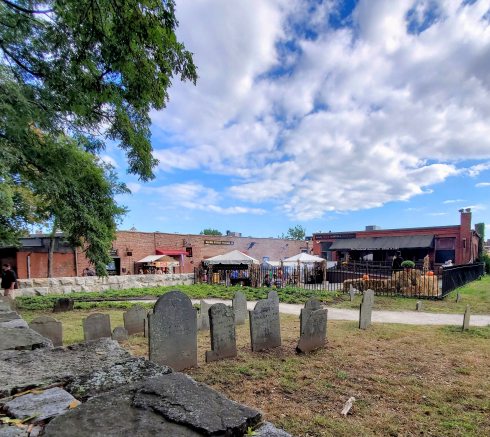
The Salem Witch Trials Memorial and Charter Street Cemetery. A big change here in terms of stewardship, so I can recommend a visit to these important, sacred sites. In past years, they were both overrun, but a partnership between the Peabody Essex Museum and the City of Salem has created a more protected and interpretive environment, based at the adjacent first-period Pickman House. The cemetery has been restored very carefully, and it’s really one of the most poignant places in Salem. Unfortunately the tackiest attractions in Salem are adjacent, literally blowing smoke into the cemetery, but that’s the reality of Salem in October: poignant and tacky.

FilmsThere are many opportunities to see timely films in Salem during October: on the Common, at the recently-revived Cinema Salem, on the patio of the East Regiment Beer Company. I’m looking forward to a screening of the animated House of the Seven Gables at Cinema Salem on the 28th in an evening sponsored by the Gables which will also feature a Q and A with the creator/director, Ben Wickey.

Just walk around: I suspect that my students just want to walk around in the midst of the packed Instagram crush that is downtown Salem, although a few of them did express concerns about the density of the crowds last weekend. So for them, and any visitor seeking a bit more space, I would recommend just walking around the neighborhoods: in the McIntire District, adjacent to the Common, along  and off Derby Street. There’s lots of beautiful houses to see, many decorated for the season, and lovely gardens behind the Ropes Mansion and Derby House. I’m hearing that the Haunted Happenings Marketplace, now on Salem Common, is a bit more carefully curated than in years past, so I might even venture over there today (a Saturday!) on foot, of course: opinions may differ about the character and impact of Salem’s Halloween, but the one thing everyone agrees on is the need to discourage driving dramatically: traffic and parking are just too scary.

Derby and Ropes Gardens, Federal Court, and WAY further afield on Lafayette Street.


A British & Bucolic Gaze on Salem

I adore the venerable and very traditional British magazine Country Life, which has been showcasing stately homes, lush gardens, and rural pursuits since 1897. I’ve had indulgent subscriptions and purchased my share of back issues: there can never be enough manors, fields, and drawing rooms for me! Despite my obsession, I had no idea that Country Life featured Salem in a 1972 issue with Salisbury Cathedral on the cover until just last week, and as soon as I saw the table of contents I searched for a copy and snapped it up. The timing is interesting to me: 1972, as Salem’s long struggle with urban renewal was coming to a close, or at least one phase. Of course, the editors at Country Living were not at all interested in anything new: they were seeking what survived.

The article is interesting and the photographs are great—but rather dated: they had been published by Samuel Chamberlain in several publications prior. Perhaps British readers would not have seen his New England views before but they might have appreciated Salem in color! The author, Helen Hall, observes that “the architectural richness of Salem is not so immediately apparent as it is in Deerfield or Marblehead,” so I assume this article is part of a series. She is not very complimentary about most of the city, actually, noting that “you are not especially aware of being in a town that was once so dependent on the sea for its existence” (I think you might be more aware of that now, but maybe not) and that certain parts “give the impression of never really having recovered from the decline of the Depression years.” She does note the recent renewal but also that “the results so far have been negative, with extensive demolition of often potentially restorable buildings, mostly in the central shopping district, creating blitz-like (!!!!!!) spaces that have become, inevitably, parking lots.” But she does love the Essex Institute and its houses, the Custom and Derby houses of the Salem Maritime National Historic Site, the Common, and Chestnut Street. The latter is still elm-lined when she visited, and while she finds American elms “much more graceful” than their European counterparts, they also hindered her views of the houses.

Samuel Chamberlain photographs of Salem in the August 31, 1972 edition of Country Life.


Venus Rising

As we enter/endure that season where hordes of tourists come to the Witch City for ghost tours, I’d like to celebrate some dynamic local history initiatives: over the past five years or so, there’s been a virtual Renaissance of African-American history, and consequently we know much more about how some REAL people lived and worked in Salem. Charlotte Forten, our city’s first African-American public school teacher, remains the focus of continuing commemoration at her alma mater, Salem State University, and is now the namesake of a relatively new city park. Her hosts in Salem, the Remond Family of Hamilton Hall, also have a park named after them, and a variety of real and digital resources documenting their entrepreneurial and advocacy activities is available at both the Hall and its website. Hamilton Hall was also the site of an exhibition on African-American enfranchisement by Salem United, Inc. this summer (soon to be on view at the Lynn Museum). The Salem Maritime National Historic Site has made a substantive commitment to regional African-American history in its recent interpretive initiatives, which include a general “History of Slavery in Salem” walking tour as well as more focused “Pathways in Freedom” and “Business of Slavery” digital tours.

The West India Goods Store, one of the “stops” on the “Business of Slavery” tour of the Salem Maritime National Historic Site.

This is all very exciting; such cross-institutional initiatives almost compensate for Salem’s lack of a historical museum, at least in reference to this one aspect of the city’s history. With so much focus on African-History in general, and in the immediate pre- and post-emancipation periods in particular, discoveries will doubtless be forthcoming. Another initiative is both a literal and metaphorical expression of this rising interest in African-American history: the restoration of several graves long neglected in the Howard Street Cemetery. The graves of Prince Farmer and his wife Mary, Samuel Payne, and Venus Chew have been lifted up and repaired, so that the lives of these three distinguished Salem African-American residents are once again marked. This important work was a pro bono, close-to-the-heart project of the two gravestone conservators who make up Epoch Preservation, Rachel Meyer and Joshua Gerloff. As far as I know, the only thing that the Farmers, Mr. Payne, and Mrs. Chew have in common besides their final (segregated) resting place is the fact that they all died in the 1850s. Farmer and Payne were both respected businessmen and by all accounts quite wealthy; Chew died in the Salem Almshouse at the very end of 1852, despite a life of hard work. She was the victim of marital misfortune, despite her very public attempts to defend herself and her property. Venus Thomas Chew was born in nearby Lynn to Peter Thomas, “a free Negro man” and Lavinia/Lucretia Trevet, “a mulatto girl,” in 1779 (The Marblehead Museum has a wonderful history of her famous tavern-keeping sister and brother-in-law here). She married Henry Chew, a mariner, in 1801 and they had at least three children before they separated, by her account, in 1819. They never lived together again, but remained married and thus entangled: this was problematic for Venus as she was clearly the most consistent wage earner. She “declared her independence” in September of 1841 but lost a legal case brought on my her husband’s creditors’ attempts to empty her bank account a year later. She wouldn’t be free of Henry until his death in 1848, and over the next few years her moves from Lemon to Dearborn Street and finally to the Salem Almshouse indicate that she was never completely free.

Notices in the Salem Gazette, 28 September 1841; the segregated listing in the Salem Directory, 1842; “Caleb M. Ames vs. Henry Chew & Trustee, November 1842, in Reports of Cases Argued and Determined by the Supreme Judicial Court in Massachusetts, ed. Theron Metcalf, Volume V (1858); Salem houses associated with Venus: 198 North Street, built for Henry Chew and apparently financed by Venus, 15 Dearborn St. and 18 Lemon Street; Massachusetts Report of the Commissioners of Alien Passengers and Foreign Paupers (1852; I have no idea why Venus was considered “Alien” or “Foreign”).

I went over to see Rachel and Josh of Epoch Preservation and a few other history-minded people on this rainy afternoon for a toast to Venus, and the Farmers, and Samuel Payne (“once a slave, but the last 17 years a resident of Salem. He was an industrious, honest man, and by strict attention to business had acquired a good estate, and a full share of the confidence of the citizens of Salem” in the words of his touching obituary) upon the completion of the restoration of their graves. We toasted with Joe Froggers, the famous molasses, rum and seawater cookie invented by Venus’s sister Lucretia for visitors to the Marblehead tavern which she and her husband Joseph Brown operated for many years. Cheers to these hardworking people that came before us, as well as to the historians, educators, preservationists and restorers whose hard work sustains their memory and memorials.

Venus T. Chew, Died December 31, 1852, Aged 73. Josh Gerloff and Rachel Meyer stand behind their work. Joe Froggers (made by Josh!)


Cogswell’s Grant

Like several summers in the past, this was supposed to be my “Historic New England Summer” in which I made a determined attempt to visit and write about as many HNE houses as possible. I started out very close to home at the Phillips House, and then was supposed to go on from there, but other plans and places interfered, and so I’m just now getting back to the “plan.” Yesterday I spent a delightful hour or so at Cogswell’s Grant, an expansive eighteenth-century farm which was long the summer house of two prominent collectors of Americana, Bertram and Nina Fletcher Little. The house is in the midst of glorious farmland surrounded by river and bays in Essex: a New England home in the midst of “Constable country” has always been my impression, reinforced by the golden early-September ambiance. I was so fortunate to have been given a tour by the site manager, Kristen Weiss, who knows the collections, and the family, so well. And that’s the key to Cogswell’s Grant: it is full to overflowing with the Littles’ collections, but also the stories of the things they collected as well as their own stories as collectors. The collections and the stories are inseparable and integral to the story of the house, from the 1930s until today.

A front parlor and Mrs. Little’s charming closet office.

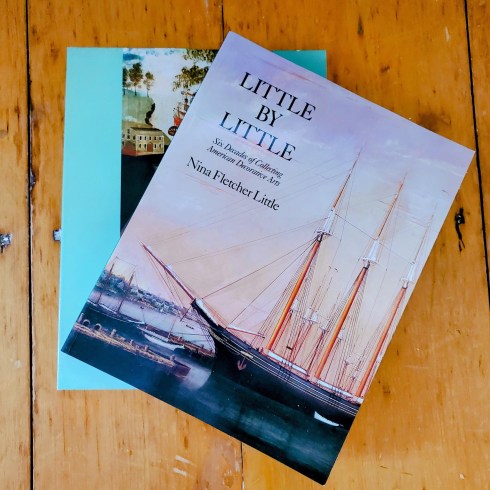
My perspective on the Littles was far too Salem-centric, as Bertram Little was the son of Salem Mayor (as well as naval architect, photographer, silversmith, military officer, bank director, and the last collector of the Custom House) David Mason Little and grew up on Chestnut Street in the midst of other Littles. But his purview, along with that of his wife and and collecting partner, Nina Fletcher of Brookline, was regional rather than parochial. They were New Englanders, who lived in Brookline during most of the year and at Cogswell’s Grant during the summers, from the late 1930s. I did not appreciate the professionalism of their collecting activities to the extent that I should have, or their partnership, or her scholarship: I returned home with just a few of her many books. Generally, when I visit a historic house I feel that I can sum it up in a somewhat representative way pretty quickly, but there’s just too many stories at Cogswell’s Grant: I’ve got to go back for more. It’s probably best to approach the vast collection through categories, which Mrs. Little does in her narrative of how their collection grew, Little by Little. Six Decades of Collecting American Decorative Arts (although as Kristen pointed out, this very accessible book employs a chronological framework as well). Again, so many stories: she was collecting stories as well as objects. Beginning with her first piece of blue and white Staffordshire she leads us through fireplace accessories, hooked rugs, clocks, “useful wares,” furniture, maritime art (the collection of which was tied to her husband’s Salem heritage), decoys, textiles, pictorial panels, all manner of portraits and paintings, and interesting miscellaneous items, like the engraved ostrich eggs the Littles purchased at a North Shore auction on the eve of World War II: they had to use a good amount of their precious gas ration to attend, but it was worth it! The portraits stand out in my photographs, just as they do in the house, but they are only part of a much larger story.

The open hearth kitchen/dining room and various halls of objects. An anonymous couple in their finery by Royall Brewster Smith, c. 1830.

With so much visual stimulation, you can either get overwhelmed or adopt a very personal perspective on what you are seeing: I always try to do the latter. Of all the portraits at Cogswell’s Grant, the one that I had the most immediate reaction to was of eighty-four-year-old Jacob Gould [Jacop Goold] by Benjamin Greenleaf, painted in 1803. He has an open book and a conspicuously-pointed finger, but all I could see was his red cap! I had just been proofing the copy edits to my forthcoming book the day before, and one chapter has a section on Renaissance suggestions for better sleep: wear a red cap!

Mr. Gould in his red cap; second-floor parlor and bedrooms; an amazing pictorial collage of the arrival of the first Oddfellows in America (there they are in the bottom left corner!); the BIG barn.


Mushroom Summer

The combination of my absence and the tropical weather has turned my garden into a wild jungle: I tried to tame it the other day but succeeded merely in clearing out all the mushrooms. I’ve never seen so many in my small patch, and pretty much everywhere I go. Mushrooms are endlessly fascinating, whether approached through a scientific, artistic, culinary, psychotic, folkloric, or toxic focus, or all of the above. Like many natural phenomena, mushrooms can dwell at the intersection of science and art, along with their greener companions in the forest and garden. And as is the case with other botanical categories, mycology is a field where women were able to make their mark before they could ever be considered proper and professional scientists. The most celebrated example of a female mycologist is Beatrix Potter, who illustrated over 350 species of fungi in the 1890s, before she turned to Peter Rabbit. Potter included cross-sections and even experimented with germination, and presented a paper (through a gentleman proxy) to the Linnean Society of London a decade before women scientists were admitted into membership.

Beatrix Potter’s drawings of Hygrophorus puniceus and Hygrocybe coccinea, Armitt Museum and Library.

I wonder if Miss Potter was influenced by the mysterious Miss M.F. Lewis, who produced three beautiful volumes of mushroom illustrations entitled Fungi collected in Shropshire and other neighborhoods beginning in the 1870s? You can check them all out at the Biodiversity Heritage Library, along with the bestselling Mushroom Book. A Popular Guide to the Identification and Study of our Commoner Fungi, with Special Emphasis on the Edible Varieties by the American mycologist, or mycological compiler, Nina Lovering Marshall.

Just across the Hudson River from Kingston, the birthplace of Miss Marshall, is the beautiful Montgomery Place, which is visited last week. In the first few decades of the twentieth century, Violetta White Delafield lived in the mansion and utilized its beautiful river-front grounds (supplemented by foraging trips throughout the Northeast)  to study mushrooms, producing several scholarly works and a portfolio of lovely annotated drawings.

Delafield, Violetta White (botanist, mycologist, and garden designer, 1875-1949), “Boletus spectabilis [?],” and “Clitocybe virens,” Stevenson Library Digital Collections, accessed August 30, 2021, https://omekalib.bard.edu/items/show/2483, 2346. Bard College, which now owns Montgomery Place, digitized a selection of Delafield’s mushroom renderings for the exhibit “Fruiting Bodies: the Mycological Passions of John Cage (1912-1992) and Violetta White Delafield (1875-1949).”

There seem to have been so many women enchanted by mushrooms in the early part of the twentieth century, I thought: there MUST be a Salem woman mycologist! And indeed I found one, at the very least a mushroom enthusiast and a long-time member of the Mycological Club of America, Eliza Philbrick. Miss Philbrick lived with her sister on Orne Street in North Salem, and she was extremely active in several organizations, including the Massachusetts Anti-Slavery Society, the Samaritan Society, and the Daughters of the American Revolution. She even exhibited a painting at the Essex Institute, so I know there must be one of her mushroom illustrations out there somewhere, but I can’t find one. She is memorialized by the homemade period dress she made for a DAR anniversary dinner, which was bequeathed to the Peabody Essex Museum and featured in Laurel Thatcher Ulrich’s Age of Homespun, rather than her mushrooms. So in lieu of a Salem mycologist, I’ll just offer up some of my own mushrooms, found or assembled rather than discovered and drawn: material mushrooms, of the seasonless variety.

Mushrooms in the dining room and kitchen: I just bought this cutting board at my very favorite Rhinebeck shop, Paper Trail.


Renaissance Refresh in Worcester

This past Wednesday was my stepson’s 20th birthday and lo and behold, instead of all the outdoorsy things we have done on birthdays past he wanted to go see the collection of armor and arms at the Worcester Art Museum, which absorbed the John Woodman Higgins Armory Collection in 2014. This is the second largest arms and armor collection in the US, and I have been speaking about it to my stepson for a decade or so, so I was thrilled that he wanted to dedicate his birthday to this little trip: Salem is all about the coast and the sea for him in the summer, so going “inland” was quite a change. I hadn’t been to the Worcester Museum for quite some time, but I remembered it as a treasure, and so it remains: it’s just the right size, you don’t get overwhelmed, and you can see a curated timeline of western art from the classical era to the present. Taking their cue from the Renaissance court at its entrance, the galleries are humanistic in their proportions and colors, so the whole experience is rather intimate. We started with the medieval galleries on the first floor, and worked our way to the top: I lingered in the Renaissance rooms, but also really enjoyed those that featured art from Colonial and 19th century America, as it was nice to see some familiar favorites in “person”.

Wednesday at the Worcester Art Museum: the Renaissance Court with These Days of Maiuma by Robert and Shana ParkeHarrison on the wall; Chapter House of the Benedictine priory of St. John Le Bas-Nueil, later 12th century, installed in 1927; armor & weaponry are clustered in the Medieval galleries but spread about in the Renaissance and early modern galleries upstairs; Christ Carrying the Cross, 1401-4, by Taddeo di Bartolo; Vision of Saint Gregory, 1480-90, a FRENCH Renaissance painting; Jan Gossaert, Portrait of Queen Eleanor of Austria, c. 1516 (I was quite taken with this portrait, but the photograph doesn’t really capture it very well–her fur glistened!); Steven van der Meulen, Portrait of John Farnham, 1563. Follower of Agnolo Bronzino, Portrait of Giovanna Chevara and Giovanni Montalvo, early 1560s.

While Queen Eleanor above was captivating, I am obsessed with the “Madonna of Humility” by Stefano da Verona, a painter with whom I was not familiar. She dates from about 1430, and I think this painting is the essential Renaissance encapsulated: I stared at it for a good half hour, and could have spent hours before/with her.

There was a “Women at WAM” theme running through the galleries, perhaps a holdover from the suffrage centenary last year, and I did find myself focusing on the ladies, both familiar and “new,” from near and far.

Women at WAM: Mrs John Freake and Baby Mary, 1670s; Joseph Badger, Rebecca Orne (of Salem!), 1757; Thomas Gainsborough, Portrait of the Artist’s Daughters, 1760s; Philippe Jacques Van Brée, crop of The Studio of the Flower Painter Van Dael at the Sorbonne, 1816; Att. to John Samuel Blunt or Edward Plummer, An Unidentified Lady Wearing a Green Dress with Jewelry, about 1831; Winslow Homer, The School Mistress, about 1871; Frank Weston Benson (from Salem), Girl Playing Solitaire, 1909.

And then there are those charming “primitives” in the collection, including the very familiar Peaceable Kingdom of Edward Hicks with its odd animals and the Savage family portrait with its odd people! I looked at the latter every which way to try to perfect their proportions, but it’s just not possible.

Edward Hicks’ Peaceable Kingdom, 1833; the big-headed Savage family by Edward Savage, about 1779 (the artist is on the far left–“Savage’s initial struggles with perspective and anatomical proportions are evident in this work”).

As I said above, the Worcester Art Museum dedicates the majority of its space to its own collections, but there are two very special—and very different—temporary exhibitions on now: one on baseball jerseys, as Worcester is enjoying its first year as home to the Triple A WooSox who have relocated from Pawtucket, and a very poignant display of the processes of theft and retrieval of Austrian collector Richard Neumann’s paintings, the target of Nazi plunder. The story told was fascinating and the pictures presented lovely, but what really caught my attention were their backs, displaying the numbers by which they were added to the “Reichsliste,” the Nazis’ centralized inventory of cultural treasures, and considered for inclusion in Hitler’s Führermuseum. So chilling to see these mundane Nazi numbers.

Baseball jerseys and Nazi numbers at the Worcester Art Museum.


The Howard Street Church

The Howard Street Church was a short-lived institution, but it had an enormous impact on Salem’s nineteenth-century social and political life, far beyond the brevity of its existence or size of its membership. It is also a great example of how Salem’s history has been distorted by the exploitation and commodification of the Witch Trials: today the Church is little-known, and the adjacent Howard Street Cemetery is significant primarily as the place where accused victim Giles Corey was pressed to death upon his plea of “standing mute” and the imposition of peine forte et dure.

The Howard Street Cemetery in 1949 by Life photographer Nina Leen: it looks much the same now and the vantage point is approximately the location of the Howard Street Church.

The Church was founded out of a schism, and it too experienced schisms during its brief existence, from 1803-1864: both it pastors and its membership were active and engaged citizens, often to the extreme. As its last pastor, the Reverend C.C. Beaman, concluded in his 1861 history (Essex Institute Historical Collections, Vol. 3): “the Church has been likened in reference to its trials to the bush that was in the fire and yet not consumed. On the slavery question and on temperance it has been a marked church, having early spoken boldly upon them;—and if the being cast into prison is a proof of regular descent from the apostles, this church has a strong claim, inasmuch as one of its ministers died in prison and another was confined there.” The men in question were the Reverends Charles T. Torrey and George Barrell Cheever. The latter was a passionate proponent of temperance, who targeted one of the wealthiest and most powerful men in town, John Stone, Deacon of the First Church and simultaneously Salem’s largest distiller (who also built my house), in The Dream, or, The True History of Deacon Giles’ Distillery and Deacon Jones’ Brewery: Reported for the Benefit of Posterity, which was first published in Salem in 1835 and later in New York City for national distribution. After its publication, Cheever was accosted in the streets, horse-whipped, and sued, convicted, and imprisoned for slander, but his campaign for temperance, waged from the pulpit as well as in print, did not cease. I wrote about this story way back in 2011, and now we have a distillery named after Deacon Giles (a perfect Salem story).

One of Deacon Giles’ Distillery’s great illustrations, from an edition at Boston Rare Maps.

So the Howard Street was a center of a temperance storm in the 1830s, but it was the center of Salem’s abolitionist activities from its foundation to its end. Its first pastor, the Reverend Joshua Spalding (sometimes spelled Spaulding) had welcomed African-Americans into his new congregation from the beginning, after his dismissal and his flock’s “separation” from the Tabernacle Church in 1802, and with each successive pastor the commitment to abolition became stronger. Spalding was an early advocate of public education for Salem’s African-American children, and he appointed an African-American man, Israel Freeman, as one of his new church’s deacons. A short-lived successor of Cheever, Charles Turner Torrey clearly could not stand to just talk about the evils of slavery in somewhat-enlightened Salem: he went south and became a conductor on the Underground Railroad, dying in a Baltimore jail of consumption after facilitating the freedom of some 400 enslaved persons. In jail, he wrote his memoirs to support his family back in Massachusetts: Home or The Pilgrims’ Faith Revived was first published in Salem in 1845; following his death in the following year, Torrey “returned” to Massachusetts and was buried in Mount Auburn Cemetery with considerable ceremony. One of Salem’s most eminent educators and abolitionists, William B. Dodge, was a long-time member and Elder of the Howard Street Church: he first taught Salem’s African-American students in its vestry, where the Salem Female Anti-Slavery Society (among whose founding members were Dodge’s wife Sarah Dole Dodge and daughters Lydia and Lucia) also met frequently. The whole congregation, and indeed the city, was summoned to the Howard Street Church on occasions for prayer services for the end of slavery, as was the case in June of 1835.

There is ample evidence that the Howard Street Church served as a hub for abolitionist activities in Salem over the first half of the nineteenth century, but it’s hard to pay tribute to a site that is no longer there. I can’t even come up with a photograph (well, there is a semblance, see below), which is really frustrating as the Church was the creation of Samuel McIntire! It had a tower, and a very famous bell, which might have ended up the adjacent Central Baptist Church on St. Peter Street after the Howard Street congregation was dissolved (but the City of Salem had a claim, so I’m not sure). The Church was almost in constant flux: it started out as the Branch Street Church, named for the lane that connected Brown and Bridge Streets, later called Howard, and assumed the name Howard Street Church in 1828. Its denomination changed too: from Congregational to Presbyterian and back to Congregational. It’s the individuals that stand out in the history of this church, though: Spalding, Cheever, Torrey, Dodge and more, It seemed to draw men and women of great conviction. And if Howard Street’s abolitionist history was not illustrious enough, there is the role that the Church played in one of the most deadly battles in pre-20th century naval history: the defeat of the USS Chesapeake by the HMS Shannon on June 1, 1813. The former ship’s crew was annihilated in the 12-minute battle, which was watched by North Shore residents from atop Legg’s Hill. The Chesapeake‘s captain, James Lawrence of “Don’t Give up the Ship” fame, died shortly after that famous plea, along with several of his officers. The Chesapeake was sailed to Nova Scotia by the British with its dead and wounded aboard, and Salem’s George Crowninshield retrieved the remains of Captain Lawrence and Lieutenant August Ludlow from Halifax at his own expense and returned them to Salem for a formal funeral at the “Rev. Mr. Spauldings Meeting-house” in late August 1813. And thus the Howard Street Church became the center of national attention.

Massachusetts State Library; Newburyport Reporter and Country Gazette, August 24,1813.

The Howard Street congregation began to dissolve in 1864 and the end of the material church (in Salem) came in 1867 when everything was auctioned off. The McIntire Church building was removed, not destroyed: it was floated (I assume) over to Beverly, where it became the new Avenue Methodist Episcopal Church in 1869, with some adjustments and alterations at that time, and more in the 1880s, so I don’t think that the photograph below represents what the Howard Street Church looked like—though perhaps some semblance. Its former location became the site of a new Salem public school, the Prescott School, but not for long: the growing Polish Catholic community represented by the Church of St. John the Baptist purchased the closed Central Baptist Church in the first decade of the twentieth century, and expanded its property to Howard Street in the 1960s. The history of Salem’s churches is indeed quite dynamic!

Salem Gazette; 1874 Salem Atlas @State Library of Massachusetts; photograph of the Avenue Methodist Episcopal Church, Historic Beverly. The displaced congregation of St. Alphonse began worshipping in this Church after the Great Salem Fire of 1914, and it was destroyed by arson in 1963.


Postal Perspectives, Salem Edition

I was enthralled this week with news of the new technology which has unlocked “letterlocked” letters from the sixteenth and seventeenth centuries: before the onset of the envelope in the nineteenth century there were often-intricate practices of folding, cutting, creasing and sealing letters to secure their contents, making it impossible for modern scholars to pry them apart without causing considerable damage to invaluable sources. With every discovery of a locked letter, or a cache of locked letters, the pressure mounted to discovery another way to reveal the writing inside, and this very week, a team of scientists announced their process of “Unlocking history through automated virtual unfolding of sealed documents imaged by X-ray microtomography.” This is BIG news: the letters are scanned and “virtually unfolded,” rendering their physical integrity intact. Secrets are revealed! I just can’t think of anything more exciting.

I’ve worked with seventeenth- and eighteenth-century letters before but they had already been opened up: hopefully they weren’t quite as “locked” as some examples and no harm ensued. It’s so interesting that envelopes became common so late in western history: really only from the 1830s. With the completion of my manuscript (and before readers’ comments come in) I had the time to indulge my curiosity a bit this week, the first opportunity in over a year, so I engaged in one of my favorite pastimes, putting a Salem spin on a much larger and more global topic. I haven’t engaged in “ephemeral history ” for a while so it was also nice to look at some pieces of paper. Both epistolary and postal history can reveal all sorts of interesting things, even on the surface, and two great sources for all things philatelic are the Stamp Auction Network in general and Daniel F. Kelleher Auctions in particular: all the letters below come from the latter source unless otherwise noted. First up, some folded 18th-century Salem letters from the Kelleher archive: addressed to Mrs. Hannah Pickering, Widow from 1725, and the nephews of John Hancock, Thomas and John, from 1796 (via the Salem “packet”).

Once envelopes arrive, they become increasingly elaborate, especially with the coming of the Civil War. The Phillips Library has a large collection of Civil War Covers which I hope to see one day but the one below is from Kelleher: as you can see, it contrasts quite strikingly with the simple letter addressed to Mr. Robert Manning, Nathaniel Hawthorne’s uncle. The Salem printer-publisher J.E. Tilton specialized in embellished envelopes: here is one showcasing John C. Frémont’s western expeditions in support of his presidential campaign in 1856. In the next decade Tilton moved his business to Boston, but other Salem printers took up the patriotic paper trade. The envelope illustrations seem to get larger and more colorful over the second half of the nineteenth century, leaving little space for the address—illustrated by the Spanish-American War cover from 1898.

In addition to patriotic purposes, envelopes were great means for advertising and commemoration: all sorts of engines start to appear from the 1870s on, along with a variety of other industrial (and agricultural) goods and of course, the company headquarters. Salem’s famous hotel, the Essex House, appeared on numerous envelopes in the later and early twentieth centuries. Clothing and shoe manufacturers took full advantage of their stationery (the 1895 letter to the Naumkeag Clothing Co. in Salem is from Downeast Stamps), and before the stamp became the chief expression of commemoration, it was all about the envelope.


Under Cover in the Renaissance

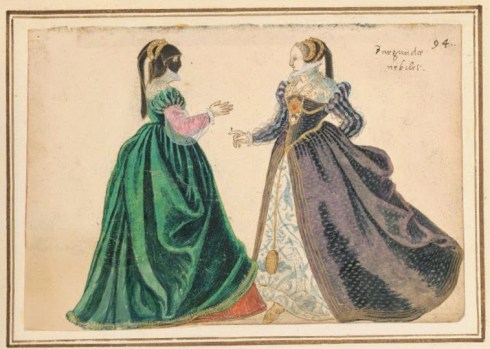
It’s a beautiful day here in Salem, but I’m in lockdown in my study, more than halfway through the very last chapter of my book! I am taking a break to show you some early modern masks, just because they are so wonderful. There is no material culture in my book: it’s all about information culture. But some of the instructive information I am coming across refers to very mundane matters like personal and household hygiene: one of my very favorite books is all about how to remove spots and stains from both precious and mundane fabrics, with dyeing advice if they won’t come out. Out, damned spot! Out, I say! This was of course a huge problem, as I am not dealing with a disposable society. Cleanliness was increasingly important for health reasons as well: sixteenth-and seventeenth-century people were living through constant pandemics of plague and various poxes and fevers, and while they knew nothing about germ theory, they had associated disease and squalidness. When they went outside, into the pestilential air, they covered up for protection if they could afford to: with hats, hoods, gloves and fans and yes, even masks. Everyone is now familiar with the beaked plague masks of the later seventeenth century, but this was just one, rather dramatic, form of early modern masks, which were also worn for “disguising,” for protection against the weather, for festivity, and for fashion. The most elaborate of fashionable early modern masks for women, the vizard or visard, which covered the entire face except for the eyes, seems to have had Italian origins, like so many fashions then (and now): when they began appearing in England, many commentators, especially of the Puritan disposition, were not impressed. In his Anatomy of Abuses (1583), Phillip Stubbes wrote: When they use to ride abroad they have invisories or visors made of velvet, wherewith they cover all their faces, having holes made in them for their eyes, whereout they look. So that if a man, that know not their guise before, should chance to meet one of them, he would think he met a monster or a devil, for he can see no face, but two broad holes against her eyes with glasses in them. Nevertheless, the household accounts of Queen Elizabeth’s reign list vizards among her purchases, and a century later, these “visors” were fashionable apparel for women of some means, who would wear them out and about, particularly when attending the theater. Samuel Pepys was so struck by one vizard-wearing lady at a performance that he went right out and bought a mask for his (long-suffering) wife. There are several digital sources for early modern apparel: I chose the images below from a late sixteenth-century album of costumes in watercolor at the Morgan Library and the “Friendship Album” (Album Amicorum) of a German Soldier in the collection of the Los Angeles County Museum of Art.

An Album of Costumes, Morgan Library.

Album Amicorum, LACMA.

Wenceslaus Hollar’s engravings of English women clothed for every season from the mid-seventeenth century illustrate the bit more utilitarian masks worn by women of means during the winter: many more Hollar images are at the Fisher Library at the University of Toronto and the Rijksmuseum, where I obtained these images—there is a new “Rijkstudio” where you can get creative with collection items; no time for that now, but later……..

Wenceslaus Hollar at the Rijksmusum.