Category Archives: Culture

The Aesthetics of Ancestry

I’m still simmering with anger and frustration over Salem’s “new” “Heritage” trail, confined to the downtown, anchored by commercial establishments presenting the sad tale of 1692 with pathetic mannequins which inspire laughter rather than learning, marked by a line of yellow paint applied in an egalitarian manner to both new concrete and old brick. All of my original objections are still standing, but they’ve had almost a year to fester. I’ve lost faith in so many people and institutions: city councillors, various public officials, even fellow historians and organizations which I thought were committed to the preservation and presentation of Salem’s rich heritage. I don’t see any understanding of what heritage tourism is in the realm of official or quasi-official Salem, much less any desire to follow its path. Indeed I wonder what heritage means to the people who have put together this heritage trail.
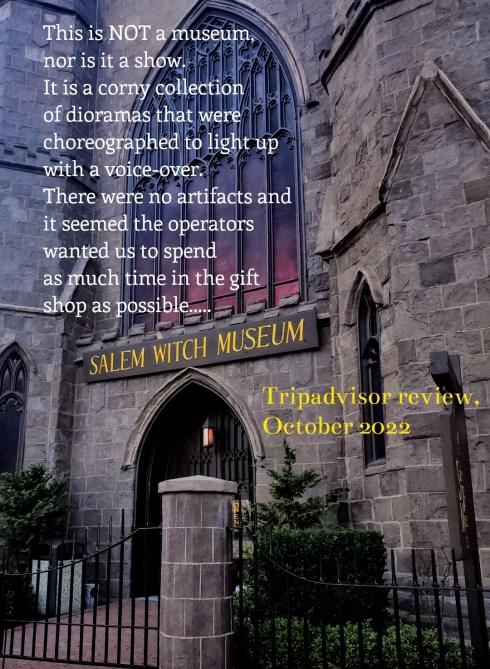
The words in the graphics above illustrate my concerns: a recent review of one of the two commercial institutions featured on the trail, the Salem Witch Museum, and some definitions of heritage by the Center for Heritage & Society at the University of Massachusetts, Amherst. I find the review to be very representative of those that the Salem Witch Museum has received, but of course, I am biased. There are certainly much better reviews, and there are also those which are substantive indictments: you can read them for yourself at the Tripadvisor site. But even many of the good reviews point out the dated nature of the presentation, the fact that the attraction is not a “Museum,” and its blatant commercialism. What is fascinating to me is that these reviews go back years (the Salem Witch Museum recently celebrated its 40th anniversary) and they are very repetitive, yet still the people keep coming and the dated dioramas endure: this is the most successful business in Salem, I believe, certainly the most successful attraction. There’s no attempt to update or improve the presentation, and why should there be? The people keep coming. But what does this institution have to do with Salem heritage and why does it have to be on the Salem Heritage Trail? The Witch Trials are certainly part of Salem’s heritage, though not, I would argue, as large a part as the City of Salem presents them to be—but that argument is certainly a lost cause! But is a dated diorama how we want to acknowlege this tragedy? Is there anything public or in any way reflective of the inclusion of the Salem Witch Museum on on the Salem Heritage Trail? The Salem Witch Museum will continue to be successful, no doubt, regardless of its inclusion on the Heritage Trail, so why can’t this one trail represent a more public and thoughtful presentation of Salem’s heritage in the fullest sense of the word? (I will never get an answer to this question)

I am not a tourism naysayer; I simply respect the past and want both Salem’s visitors and residents to experience its heritage in a layered and an engaging way. As I am writing this, I am looking up Chestnut Street as the Salem Trolley is making its way down, and I’m glad to see it. At least the tourists on board are exposed to more of Salem’s material heritage. It remains absolutely mystifying to me why the Salem Heritage Trail would not include the city’s oldest and largest Historic District, home to the Pickering House, the Phillips House, Hamilton Hall, the Salem Athenaeum, the Ropes Mansion, the Quaker Burying Ground, and streets of beautifully-preserved houses. There are no shops or restaurants or witch “attractions” over here: could that be the answer? Unfortunately the selection of paint in general, and that striking shade of yellow paint in particular, made the exclusion of residential historic districts a foregone conclusion: I know that most of my neighbors would welcome more walking tourists, but I doubt that many of them would like to see that yellow line run in front of their houses. The trolley is running past houses associated with a trio of brothers from a famous Salem family, the Bensons, and I’m wondering if the tourists on board are hearing anything about them, because I think their lives and works are representative of several important strands of Salem’s heritage. I’m sure Frank Weston Benson (residing at 14 Chestnut, 1862-1951) is getting a mention, as he was a pretty famous artist in his day, producing accessible paintings in a light-filled American Impressionist style as well as a succession of distinctive etchings primarily focused on wildfowl. His younger brother Henry (1866-1942) lived around the corner on Hamilton Street and served two terms as Salem’s mayor as well as the president of Salem’s largest business, the Naumkeag Steam Cotton Company. But I think it’s the brother between them, John Prentiss Benson (1865-1947), who is more evocative of an enduring Salem heritage, even though he seldom lived here in his adulthood (though he did design the massive and fantastic Colonial Revival mansion at 30 Chestnut Street).

A 1943 self-portrait by John Prentiss Benson and photograph of his younger self in Salem; Captain Samuel Benson of Salem as depicted by his grandson, John Prentiss Benson and Benson’s copy of “Reaper of Salem, S. Benson, Master, painted originally by Antoine Roux. All of the images and much of the text from this point on is taken from a lovely book entitled The Artistic Legacy of John Prentiss Benson, which was edited and published by the husband of Benson’s granddaughter in 2003. It’s really fabulous–with lots of family pictures and anecdotes.

I’ve never really appreciated maritime art, but I saw a painting that I really liked last week and looked at the signature: John P. Benson! I thought he was an architect by profession and an artist by hobby, but I was wrong: he had two careers, first architecture, then painting. This one painting took me down a rabbit hole of John P. Benson paintings, and I found some really lovely Salem ones, inspired by his birthplace and his heritage, primarily his descent from Captain Samuel Benson, of Reaper fame. All three Benson brothers plus their siblings grew up in an Italianate house which once faced the Common, on a site which is now the parking lot of the Hawthorne Hotel. Frank’s predisposition towards an artistic career was evident pretty early, as was John’s, but apparently there could only be one artist in the family so their father steered the latter towards the more practical architecture. He went to Paris for training, and returned to a job at the prestigious New York architectural firm McKim, Mead & White before setting up his own partnership. By all accounts, Benson had a successful architectural practice focused on the greater New York area, while living in Plainfield, New Jersey and later Flushing, New York with his wife Bessie and their four children. He retired from architecture in his later 50s and began painting full-time, primarily in his studio at a house called Willowbank in Kittery, Maine. He was prolific, and even though he had not lived in his native city since his departure for Paris, a notable number of his paintings are of Salem ships and harbor scenes.

Ship Eliza of Salem, Salem Coal Wharf, and Derby Wharf, John Prentiss Benson.

I particularly like a series of paintings which Benson produced as murals for his son Philip’s Cohasset home, entitled Salem Harbor memories. I trust that they still survive and I wish they could be on public view, because they are a perfect illustration of a family’s heritage and the endurance of a city’s heritage: it’s so interesting that these images were in the home of a man (Philip) who was not born in Salem, who never lived in Salem, but still saw Salem as part of his heritage. I’m not a fan of the witch trials vs. maritime history either/or debate as I believe that Salem’s heritage is both plus MUCH more but these maritime views are so poignant, especially in their invocation of memories which we can “enjoy, regret, and learn from” at the same time. Believe me, I know that the Benson brothers cannot compete with the suffering mannequins of the Salem Witch and Witch Dungeon Museums of the Heritage Trail. I think there are some other Chestnut Street stories that might be able to do so, but that’s not my point or my concern. If this trail was called the “Tourism Trail” or the “Witch City Trail,” I would have no concerns. But it isn’t: it’s called the Heritage Trail. So I ask my fellow Salem residents: does it represent your heritage?

A Memory of Salem Harbor, in Cohasset.


What the Judge Ate

And drank. Today I have a new source (to me anyway) for food history: the diary of a Colonial judge who rode the circuit, keeping accounts of his tavern food and drink along the way. I’ve been immersed in Salem diaries for the past few weeks, preparing a talk I’ve giving for Salem Ancestry Days and the Pickering House on April 23. I’ve got diaries from the seventeenth century to the twentieth, and Judge Benjamin Lynde Sr.’s is one of the earliest. He’s an early transatlantic man: born in Salem in 1666, he was sent to England by his parents in his teens for an education. I don’t know if the law was the plan, but he ended up reading it at the Middle Temple in London, and when he returned to Masssachusetts he became the first judge in the Massachusetts Superior Court of Judicature with formal legal training. He became chief justice in 1729 and his son and namesake succeeded him later in the century, serving as one of the justices in the Boston Massacre trial. I think Benjamin Lynde Jr. lived in more interesting times but I find Benjamin Lynde Sr. more interesting!

Two very different views of Judge Lynde: by the Pollard Limner, c. 1730 (Peabody Essex Museum) and John Smibert, c. 1731 (Huntingdon Library).

Given his legal training and experience, you would think that Judge Lynde would analyze some of his trials in his diary but that is not the case: very few legal concepts are discussed, although the occasional execution is referencd. He is more forthcoming about his travels and his tavern accounts, and he is tireless, riding the circuit from York, Maine (my hometown—then part of Massachusetts province), to Plymouth and Springfield. He rides out to the Cape, and sails out to Nantucket for a session. When he returns home to Salem for a spell he immediately goes out to his farm at Castle Hill and works the fields. He is hale and hearty and on the job into his seventies. Can we attribute this to his diet? Well, I don’t think so, but here it is.

Breakfast:  frequent “chocolate breakfasts” but sometimes the Judge liked heartier fare: cheese and bread, fowl, lobster in the summer! But you can’t underestimate the colonial consumption of chocolate, it was food, drink, stimulant, even medicine all in one. The most popular transatlantic recipe called for the chocolate (sold in brick form and ground or shaved) to be mixed with sugar, long pepper, cloves, aniseed, almonds and other nuts, and some sort of flower water, “the hotter it is drunke, the better it is.” On those days which were not commenced with a Chocolate Breakfast, he went for ale, particularly sage ale, and a few times he referenced “superior wine” in the morning. No mention of coffee; tea pops up once or twice.

Lunch: is never referenced by the Judge. It’s more of a nineteenth and twentieth century concept, although I have found references to it in the 18th: one English author admits that he “clapp’d a good Lunch of Bread into my Pocket” in 1707. But Judge Lynde was busy, or on the road. Maybe he did have something in his pocket, but he doesn’t tell us—or his diary. When he stops in the middle of the day, he would have more ale, cider, the occasional “lime punch” and some plum cake, sometimes with cheese, sometimes without.

Dinner: a regular range from simple to substantive. There are quite a few “milk suppers” and also those of “three eggs” but he also orders up large dinners: lamb, mutton, turkey, fowls, bread with cheese and “isle butter,” lobster. Sometimes he is very detailed: he enjoyed a dinner of “fine chowdered cod” on one occasion, on another he dined on “puff apple pie and cheese with a bottle of ale, an ear of corn, and sugar brandy dram.” He ate “minced veal” and “neats tongues,” beef tongues which were seasoned and dried to preserve them and used in a variety of recipes (I included one below). He really liked sauces for his fish, and his lobster, and plum cake, any time and anywhere. Gingerbread and apple tarts are also referenced, and all sorts of beverages: madeira, madeira, and more madeira, “green Fyal wine,” cherry and brandy drams, strong beer, cider, different ales, flips, “Florence” flasks (I’m not sure of what this is: general “Florence” was a reference to olive oil at this time, but this seems to be something he is drinking), various punches, and “sangaree,” a form of sangria. And rum of course. Judge Lynde’s detailed tavern accounts are clearly intended for his compensation by the provincial authorities, but when he is at home the only commodities he records purchasing are gallons of rum and madeira, plum cakes, and “bread with cider for the poor.” Presumably someone else was keeping his household accounts.

Francis Symonds advertised the “first” chocolate mill in Salem in 1771 (Essex Gazette, 17 December 1771) so I’m not sure where the Judge got his supply when he was at home earlier in the century; a recipe for Neats Tongue and Udders Alamode for a late 17th century cookbook at the Folger Library; the Lynde family tankard, Sothebys.

Thanks to my friend Alicia Diozzi for the title! She envisioned the Judge’s meals as an Instagram account.


Mid-Atlantic Majesty

This has happened to me before: I have this notion of Boston/Salem pre-eminence in all material Federal, and then I see something from Philadelphia or Baltimore, or on my most recent trip New Castle, Delaware. I visited three museums on my recent spring break trips to the Delaware River Valley: at the Court House Museum in New Castle I learned all about Delaware’s nearly simultaneous separation from Great Britian and Pennsylvania, at a return visit to Winterthur I saw some old favorites and learned some things from new perspectives in the galleries, and at the Read Museum and Gardens I was quite simply blown away by the magnificence of a mansion built and embellished by Philadelphia craftsmen in down-river Delaware. The Read House, a National Historic Landmark owned and operated by the Delaware Historical Society, was built by George Read II, the son of a signer of the Declaration of Independence and Delaware Constitution, between 1797 and 1804 on New Castle’s the Strand, running alongside and overlooking the River. Its size (14,000 square feet) and scale and surrounding gardens give it a majesty that rivals the grandest urban townhouses of the era, evident even before you step inside. And then you step inside! The Gardner-Pingree House here in Salem used to be my standard for Federal perfection, but now I think it has been surpassed.

There’s just something about the scale of this house: everything is about a foot  or two bigger than you expect it to be, or I expected it to be, with my Massachusetts standards. But it’s not just about size, of course, it’s the details that make this mansion truly majestic: the plaster, the woodwork, the hardware. Mr. Read had to have the best of everything, and that meant everything Philadelphia. And as he didn’t really have the brilliant career of his father and namesake, this mansion represents something quite beyond his means, and something that could not remain in the family for very long after his death. It passed to a succession of owners, but fortunately remained relatively intact. In 1920 Philip and Lydia Laird acquired the property and installed a “ye olde British pub” for prohibition entertaining in the basement while also amplifying a Colonial Revival image for the rooms upstairs. Mrs. Laird bequeathed the house and grounds to the Delaware Historical Society in 1975, and a comprehensive (and ongoing) restoration ensued. My tour began in the prohibition pub, but I’m going to leave it until the appendix as I want to showcase the house as a contemporary visitor might have entered it, but it is a great cue that you’re about to enter a house which has both “Colonial” and Colonial Revival elements. (I’m putting Colonial in quotes as all the Colonial Revivalist authors I know extend that period up to about 1820, very conveniently).

Double Parlor: just a complete WOW. I couldn’t catch my breath! Fortunately I had a charming guide who told  me everthing I wanted to know because I couldn’t manage to ask. This was your not-so-standard convertible double parlor which served many occasions and capacities: Mr. Read set up his office in what is now the dining room across the hall, so the front (peach) parlor served as a dining room in addition to other functions. Amazing “punch and gouge” carving by Philadelphia craftsmen EVERYWHERE. The (nearly) floor-to-ceiling windows in the rear (green) parlor open up at the bottom, creating doorways to the garden outside. Across the hall (featuring more punch & gouge and unfinished floors to facilitate clearning, according to my guide is the Lairds’s Colonial Revival dining room.

The Dining Room: features a scenic hand-painted mural of a romanticized “Colonial” New Castle from the 1920s with the “three flags” messaging that I also saw at the Court House Museum. William Penn landed in New Castle in 1682, very close to the Read House, and he is pictured being greeted by Dutch, Swedish, and English settlers as well as a members of the native Lenape tribe. On (back) to the kitchen…………..where there was a surprise!

The Kitchen: has a variant Rumford Roaster! My guide explained to me that Mr. Read had to have the best of everything, and the latest technology, so of course he had to have a Rumford Roaster, but somehow the original Rumford design was adapted: the second photograph is the Read House and the third is Hamilton Hall’s roaster right next door to me in Salem: as you see the firing compartments (for want of a better technical term) have been moved over to the main hearth. This was tremendously exciting to me as we have SEVEN Rumford Roasters in Salem and this was quite different! The first photograph in this group shows the bell display for service; the last,  a warming station for dishes and plates, also quite ingenious. And on to a few singular shots and details:

Details, a model New Castle house, and Mrs. Read’s bedroom: how to summon servants, door hardware, stair detail, a model of another New Castle house (and more of the unfinished floors), and lots of soft furnishings in Mrs. Read’s bedroom. Regarding service and the many hands that must have been required to maintain this large house, I did ask about slavery, which was legal in Delaware right up until the ratification of the thirteenth amendment (which it notably did not participate in—OR the 14th and 15th!). Reseach is still ongoing, but account books indicate that the Reads’ cook was a free woman of color.

Appendix: the taproom downstairs, which I prefer to call the “Prohibition pub,” and back in its heyday.


Ladies’ Choice: the “Boy Mayor” of Salem

I know: why am I writing about a man on this first day of Women’s History Month? Arthur Howard was the short-termed 35th mayor of Salem, elected in late 1909 and serving through 1910. Despite the briefness of his term, he made a lot of news, before, during and after, and on more than one occasion the ladies of Salem came to his rescue and defense, excercising a form of political power (or political expression?) even before they were enfranchised a decade later. Howard himself is a captivating character, but his brief moment in Salem’s history also gives us an opportunity to see how women used their influence beyond/before the ballot box. I’ve had Salem mayors on my mind anyway: we’re presently in the midst of a special mayoral election here in Salem—something that hasn’t happened for quite some time—as our previous mayor has ascended to the office of Lieutenant Governor. Arthur Howard did not leave his mark on Salem in the same way that Mayor Driscoll did, but his story is interesting nonetheless.

Howard was born in New York City in 1870, the son of a prosperous jeweler and grandson of a Salem physician, whom he later described as a “classmate of Nathaniel Hawthorne’s.” He was based in New York for much of his early life, and he seems to have been a bit of a wastrel: spending his father’s money on lavish living and gambling, and writing the occasional little book (on cooking, Wall Street, and Shakespeare “for the unsophisticated”). He was married in 1893 but separated from his wife (and their child) a decade later. Somehow he ended up in Boston, and after reading about the closure of the venerable Salem Gazette in the summer of 1908, decided to make his way up to his ancestral city to save it from becoming a one-newspaper town. He had very little money, but he was undaunted: he operated the new Salem Despatch with the press of the old Gazette, and hired a reporter who told him all about the political “gangs” of Salem. To make a name for himself and his paper, Howard became a “reformer,” attacking the powers that were, the Salem police, the “liquor licensors,” and his competitor, the Salem Evening News. With about a year’s residence behind him, he decided to run for Mayor: a bit of a lark that became increasingly serious. Despite two libel suits brought by a Salem alderman and the editor of the News and a brief stint in jail, Howard was elected and installed as Mayor in January of 1910: he attributed his victory to his ability to speak French to the residents of Ward Five. He vowed to clean up the city of “graft,” to dedicate his mayoral salary of $1500 to its playgrounds, to reform the Police Department (even to the extent of appointing himself Chief of Police), and to identify and close down all the locations where liquor was sold illegally (referred to as either “speak-easies” or “kitchen barrooms”). Howard’s “meteoric” rise, ambitious reform agenda, and “straight talk” attracted considerable press coverage in the first few months of his administration, and he was often referred to as the “boy mayor” even though he was 40 years old. Among his most notable early acts was the transformation of Salem Common into a skating rink at his own expense and the appointment of two of Salem’s most prominent society women, the active social reformers Aroline Gove and Caroline Emmerton, to the Board of the Plummer Farm School of Reform for Boys. And then the honeymoon was over.

Boston Globe stories about Arthur Howard, December 1909-January 1910. I’ll have to do a follow-up on the coverage of Howard by the(non-digitized) Salem Evening News: after all, its editor was suing him for libel!

In March of 1910, the man who had furnished Howard with funds for his bond while awaiting his second libel trial withdrew said funds (he was a liquor broker, and not happy with Howard’s crackdown on the 18 speakeasies he had identified in Salem) and the penniless Mayor was faced with jail: the ladies of Salem came to his rescue with a three-day campaign that raised the required $800 in $1 increments. Some individuals, both male and female, offered to donate the entire amount, but a certain circle of ladies (led by Charlotte Fairfield, who was taking on Salem’s coal cartel at about the same time) pushed for an expression of wide, feminine support. This effort captured national headlines: a United Press story appeared in nearly every newspaper in the country on March 31 and April 1. A week later in the New York Times, Mayor Howard admitted that he “owed a great deal to the women of Salem” who were “helping the cause of pure city government.” He was acquitted of the libel charges later in the spring: good fortune that was countered by his declaration of bankruptcy at around the same time. By the summer, he was publishing “woe is me” (very bad) poetry in his paper, which also attracted headlines. I had no idea what to make of another Howard headline from the summer of 1910, referencing his proclamation for the compulsory attendance of all Salem children at a circus parade through downtown, until I read his obituary: apparently it was an attempt at sarcasm by a man who was tired of the disdain directed at his other edicts.

It was all bad news after that. Howard did not serve out the entirety of his two-year term: he 1911 he stepped down, ostensibly to run for Congress but that campaign seems to have gone nowhere. He decided to run for mayor again the next year, but was not elected. His newspaper office sustained two serious fires in 1912; he was assaulted on the street in 1913. There are references to campaigns for both lieutenant-governor and governor (on the Temperance ticket) which were not sustained. He was divorced in 1916, after which he ended up in Vermont and then New Haven, where his ex-wife happened to live. He died there in January of 1920, aged 51 and handsome as ever, from complications following an intestinal operation.

Boston Globe, January 14, 1920.


Adorning Hearts

Something light and bright, fluffy and joyful and merely decorative for Valentine’s Day: I wanted to use the occasion to reaquaint myself with some decorative arts databases. Between my last book project and the two that I’m working on now, and teaching, and being frequently frustrated with Salem heritage and preservation issues (as you know all too well here) I don’t have much time for wandering about in digital image archives. But I gave myself permission to do so this weekend, and here are the results! If you have a universal symbol like ♥♥♥ as your keyword, you’re going to get thousands of results: I limited mine to textiles, and then just chose my favorites by purely aesthetic standards. Whether these fabrics were created for the table, or the wall, or a person, they are more about adornement than adoration.

Above: Furnishing Fabrics from Alsace, c. 1840, Metropolitan Museum of Art, A.C. Pugin, 1851, Victoria & Albert Museum, France, later 19th century, The Design Library, C.F.A. Voysey (who clearly loved hearts!), 1900-1929, Victoria & Albert Museum, and a heart handkerchief by Sylvia Chambers, 1940s, Glasgow School of Art Archives. Below: “Hearts & Flowers” from Folly Cove designer Peggy Hamilton, 1955, Cape Ann Museum.

Happy Valentine’s Day! Great sites for exploring decorative motifs (not just HEARTS) here.


Some Great Early Gloucester Houses

I feel like I should know more about Gloucester, the port city about a half hour to the north of Salem. I have quite a few Salem friends who have summer homes in Gloucester, or have moved to Gloucester, or just go to Gloucester often: it’s like an escape hatch of sorts. 2023 marks Gloucester’s 400th Anniversary, and I have been super impressed with the city’s commemoration efforts: they are creative, comprehensive, and most importantly, expressions of the community rather than of a limited pool of “stakeholders,” as seems to be the case with Salem as it gears up to its 400th in 1626. I’ve been to Gloucester often, but I can’t even begin to characterize it as a place: it doesn’t seem like one city to me, but rather several. It’s certainly big: I decided to drive around in search of some of its earliest houses the other day and it took me all afternoon and I feel like I barely scratched the surface! I’m not even sure that I have the neighborhoods straight, to be honest: I started out in West Gloucester, then drove downtown, then to East Gloucester and Rocky Neck, then through Rockport to the northern side of Gloucester, stopping in Lanesville and Annisquam. Depending on where you are, you can find any style of house you want in Gloucester: big old shingled “cottages,” smaller cottages in a variety of styles, Greek Revivals, vast Victorians, stucco Craftsmans and even a Tudor or two. Not too many three-story Federals so prevalent in Salem, Newburyport, and Portsmouth: Gloucester was/is a fishing port so not as many wealthy merchants. I was looking for Colonials on this little expedition, the older the better, so that determined my route. Unfortunately, I forgot my sources: Prudence Paine Fish’s excellent books on Gloucester’s old houses (Ms. Fish died recently; a great loss for Gloucester) and Edwin Whitefield’s Homes of our Forefathers. On my own I missed quite a bit of this sprawling old city with its innumerable inlets so expect return trips over the next year or so!

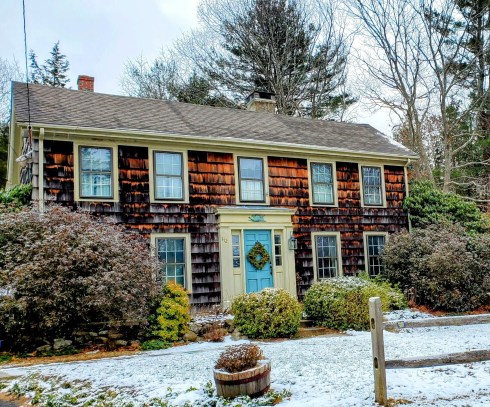
I started out in West Gloucester where I drove way out along Concord Street: in my experience streets named for other Massachusetts towns have the oldest houses. At least part of the first house below, the Ella Proctor Herrick House, was built in the seventeenth century and the last one proudly bears a first-period plaque as well.

Along Concord Street, West Gloucester.

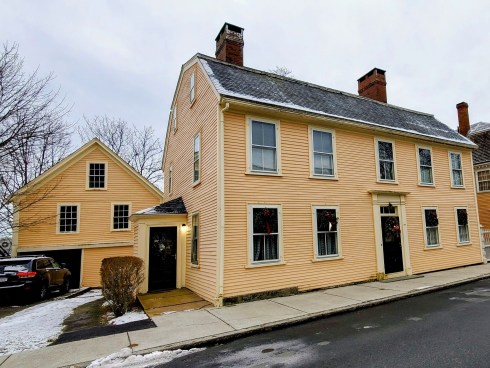
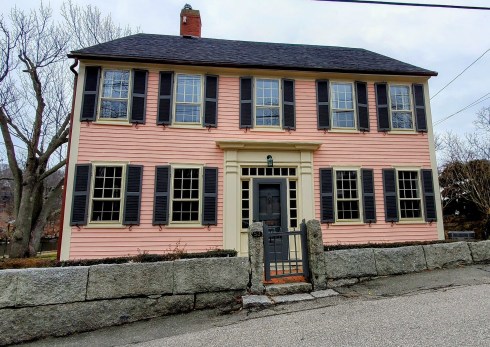
Then I drove miles to downtown Gloucester, overlooking its expansive harbor. This is the most densely-settled area of the city, obviously, and also where you can find the most architectural variety. It’s also where the Cape Ann Museum (CAM) is, a museum of art and history which also owns and operates several house museums. Of course I’m jealous that Gloucester has a professional local museum, but CAM’s existence is just one of several indicators that Gloucester is serious about preserving and interpreting its heritage, material and textual: I also like the way older houses are interwoven with newer, professional and institutional structures in the city center. The first house below, on Middle Street, is wedged between a bank and some other professional office building, and has lots of Georgian neighbors.

Along Middle Street, Gloucester.

On the way to the Green, where CAM owns and operates two historic houses, I passed by this first cute and very characteristic of Gloucester house and one of the city’s oldest houses, the Whittemore House (1700), now a frame shop. The Green, situated right on Gloucester’s traffic rotary on Route 128, features three historic structures (the White Ellery House, 1710 and the Babson-Alling House, 1740 are below) and CAM’s newest exhibition space, the Janet & William Ellery James Center (2020), which has expanded the museum’s exhibition and archival space signficantly.

I hopped right on the rotary and drove to East Gloucester, which was a pass-through for me as I didn’t have my sources! So I did the Cape Ann loop, enjoying the views and driving through Rockport, and ended up in Lanesville and Annisquam on Gloucester’s northern shore. As you can tell from these photographs, it was a cloudy, dreary day (as has been the case for most of January in our parts) and so I had to snap this bright orange cottage in Lanesville and then it was on to Annisquam, which is really almost too precious and perfect (and with too many “private drives”!) but I had to see the Edward Harraden House (c. 1660)—one of several structures built by this family in Gloucester. It’s a storied name in Salem too as Jonathan Harraden was one of our most famous revolutionary privateers. It did not disappoint.

Eighteenth-century houses in the Lanesville (ORANGE!) and Annisquam villages of Gloucester, and the Edward Harraden House, c. 1660.


Secret Staircases

Every old house has secrets, but every old house does not have deliberately-constructed secretive places for hiding or hidden means of conveyence: such spaces are special. Novelists love secret staircases, and historians do too: they are evidence of intent. Well, I think everyone is fascinated by secret spaces in general: I have been since I was a child and my mother told me all about priest holes in England and that was that. When I was older and in England I was determined to find as many as I could, armed with the books below. When I was older still, and looking at the house I now live in, its owners (who were also realtors) showed me its two secret spaces: a door hidden in the master bedroom closet that opens up into the in-law apartment next door and a tunnel in the basement that opens up under the street. There’s a big door, with a big lock, leading to some underground space! I always call it a tunnel but I’m not sure how far it goes under Chestnut Street: as soon as the previous owners opened up the door and I saw black I ran upstairs! Twenty years later, I still haven’t been in that space: it’s too scary. I can assure you, however, that my husband and every single contractor who has worked in this house has been in there—they all seem to think it’s some sort of large coal bin but of course the previous owners told me it was a stop on the Underground Railroad. I have a theory that it might have been a space to store rum, as the man who built my house was Salem’s biggest distiller and he lived right across the street, but I’ve yet to find proof. So all of this is just an introduction to say: I’m interested in secret spaces! (And I was a Nancy Drew fan too and the Hidden Staircase is my favorite.)

I think that the American equivalent of priest holes are secret staircases and one of the most important secret staircases in America is right here in Salem, at the House of the Seven Gables. For generations of children in our region and beyond, myself included, the first impression or memory of the Gables is undoubtedly of the secret staircase: every child (and many adults) that I have taken to the Gables has been struck by both the idea and the experience of the secret staircase. Its aura is very interesting because it is a twentieth-century installation rather than an original feature of this seventeenth-century house. The House of Gables Settlement Association’s founder, Caroline Osgood Emmerton, and her architect James Everett Chandler, were “inspired” by Nathaniel Hawthorne’s novel in their restoration of the house: and so it acquired four more gables, a rebuilt central chimney, a second-story overhang, and a cent shop as well as additional room for the companion settlement mission. I love the headline for this Boston Sunday Globe article from January 1910:  all is revealed!

The house also acquired a secret staircase, right alongside the new chimney, even though there is no secret staircase in The House of the Seven Gables. So why? There are several reasons. The house’s previous owner, Henry Upton, maintained that there had been a secret staircase and so Emmerton believed that she was putting something back that had been there before. She also believed, apparently, that the novel needed a secret staircase and so she was giving the house one: “For it seems to be that we feel the absence of the secret staircase in the story just as we feel the absence of a bit of a picture-puzzle that has been lost and has left an unfiled place in the picture.” [The Chronicles of Three Old Houses,1935]. This seems like a bit of a rationalization to me, so I’m wondering if she merely wanted a secret staircase in the house to increase its allure: such discoveries made headlines in those days and they still do.

Boston Evening Transcript 8.5.1911 (not the word “museumized”!); the era of secret staircases: that found in Governor Tilden’s Gramercy Park mansion made national headlines in 1905.

And once the secret staircase was there, it took on a life of its own. I’m working on an article on the Colonial Revival in Salem, and just read a wonderful study on interpretation at the House of the Seven Gables over the last century, based on a succession of scripts [Tami Christopher, “The House of the Seven Gables. A House Museum’s Adaptation to Changing Societal Expectations since 1910,” in Amy K. Levin, ed., Defining Memory: Local Museums and the Construction of History in America’s Changing Communities (2007); the chapter on the Gables in Colin Dickey’s Ghostland is great too.]. In the beginning, the staircase was explained in terms of smuggling/tax evasion or “a means of escape in witchcraft times.” Then there was a shift to the Underground Railroad, and finally an admission of its 20th century origins. The staircase has reflected historical interests, and historical inquiry over time, but it has also been a means to express simple (childhood) curiosity, and there’s nothing wrong with that.

Early twentieth-century postcard and the secret staircase in 1950 (National Geographic) and today (or recently).


When the Frame is in the Picture

Starting 2023 off with some color and creativity; I need some brightness. There is a portrait of Queen Elizabeth I which I have long admired: it’s from relatively early in her reign, and the artist is anonymous. It’s a serious portrait of a young woman of faith: holding a book (for prayer, presumably) and with a poetic inscription about transubstantiation below: it’s certainly not an official portrait as she would never be so open about her personal religious beliefs in her quest to be Queen of the English people rather than just Queen of the English Protestants. The other notable aspect of the portrait is the frame: there really isn’t one, it’s a faux gilt “frame” which is painted on the same board as the portrait. Later on, much later on, this will become a more common trompel’œil technique, but I think it was pretty novel in 1565!

@Christie’s Images Ltd. The caption reads: Twas God the Word that spake it: And what that Word did make it, That I believe and take it.

When I was looking for a nice image to post for Elizabeth’s birthday this past fall, I came across one of the “Runneth Over” adaptations by DVM/Maloos: and that of another Renaissance Woman! More Rainbow portrait and Mona Lisa, you can’t beat that.

Then I was off and running, discovering lots of cool images. I like to use a relatively narrow focus to discover things, but as I moved forward in time I realized that “frame as part of the picture” is not a discreet search term for modern art. There are indeed quite a few such playful paintings, so I’m just including a few of my discoveries below: I really like the work of Jorge Alberto, whose encased queen card is just one of his faux frame paintings, and I also like this shadowy lemon. As their titles suggest, Sarah Gilman’s Trompe l’oeil after Gijsbrechts paintings reproduce the framed “memo-board” paintings of seventeenth-century Dutch and Flemish artists rather deliberately.

As the Runneth Over works demonstrate, not all “integrated frame” paintings need to be illusory: my last featured artist is Carolyn Misterek, whose “Everyday Occurences” paintings feature an assemblage of botanicals, flat color, and frames. They seem unassuming yet striking at first glance, but the frame adds something besides dimension: formality, finish, fancifulness?

Three “Everyday Occurences” paintings by Carolyn Misterek.


Anniversary History: Local Edition 2023

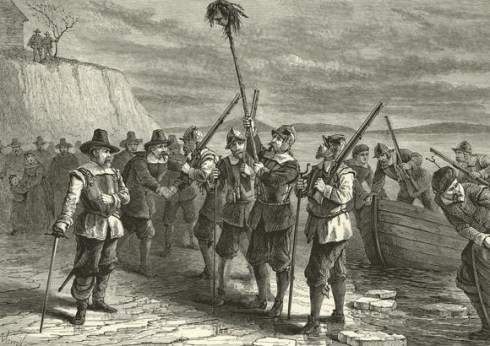
Looking ahead to the new year from a local history perspective, there are commemorative moments for at least six events: five European settlements and a tea party, the 250th Anniversary of the Boston Tea Party, to be precise. A century and a half earlier, there were settlements at Gloucester, Massachusetts and Portsmouth, Rye (the Pannaway Plantation) and Dover (the Cocheco Plantation), New Hampshire. The ill-prepared and -fated Wessagusset Colony was established in Weymouth, Massachusetts in 1622 but its demise came the following year after the brutal Wessagusett “Incident,” more appropriately referred to as a massacre. Commemorative history should acknowledge both the good and the bad, the heroic and the tragic, the kind and the cruel, and so the Wessagusett Massacre of March 1623, a veritable “red wedding” which harmed relations between Native Americans and English settlers for years to come, demands a spotlight. Like the first Gloucester settlement by the Dorchester Company, Wessagusett was decidedly not a plantation in the seventeenth-century sense, but rather a fishing and trading station of 60+ men financed by London merchant Thomas Weston. “Weston’s Men” were completely unprepared for the New World and by the winter of 1622-1623 they were starving, and altogether dependent on both Plymouth and the Native Americans in the region. But foodstuffs were scarce for everyone that winter, and everyone was anxious. Rumors of an impending Native American raid on both settlements drove the Wessagusett men to seek aid from Plymouth, and militia leader Myles Standish and eight men sailed a shallop to the northern settlement and issued an invitation to Massachusett tribal leaders Pecksuot, Wituwamat, and others to attend a summit during which commenced a slaughter just as they all sat down to dinner. I’m going to let Charles Francis Adams tell the tale, as he presented it in his anniversary address on the occasion of the 250th anniversary of Weymouth: the savages were taken by surprise, but they fought hard, making little noise but catching at their weapons and struggling until they were cut almost to pieces. Finally Pecksuot, Wituwamat and a third Indian were killed; while a fourth, a youth of eighteen, was overpowered and secured; him, Standish subsequently hung. The massacre, for such in historic justice it must be called, seeing that they killed every man they could lay their hands on, then began. There were eight warriors in the stockade at the time,—Standish and his party had killed three and secured one; they suddenly killed another while the Weston people despatched two more. Only one escaped to give the alarm, which spread rapidly through the Indian villages. Interesting language for 1873: savages is employed, but Adams does not refrain from calling this slaughter a “massacre” unlike many of his contemporaries who labeled it a pre-emptive strike. Several Wessagusset men also died during the massacre, and the rest opted to abandon the settlement; Standish returned to Plymouth with the head of Wituwamat on a pike in ancient English warrior fashion, “to ornament the Plymouth block-house as a terror to all evil-disposed savages” in the words of Adams. This massacre seems worthy of a bit more commemorative reflection, at least a fraction of what the Boston Massacre receives continuously.

“The Return of Myles Standish from Wessagusset,” from Pioneers in the settlement of America: from Florida in 1510 to California in 1849 by William August Crafts, 1876. Ironically, nearly 300 years later (299!) Myles Standish lost his head when the Standish monument in Duxbury was struck by lightning: according to this post by Carolyn Ravenscroft, archivist of the Duxbury Rural and Historical Society, his replacement head was too heavy for the damaged “body,” so an entirely new Standish was created by Boston sculptor John Horrigon, pictured here in 1930.

I’m not sure what the plans for the commemoration of the Wessagusset Massacre are but all the early settlements have been planning their 400th anniversaries for quite some time, particularly Gloucester, which has assembled a multi-layered calendar of commemorative initiatives and offerings focused overwhelmingly on the city’s social history. I’ve been so impressed with the “400 Stories” project, which aims to collect, present and preserve stories from 400 of Gloucester’s residents from 1623 to 2023, thus connecting the past to the present. There are books, an artistic competition for a new commemorative medal, walking tours, festivals, and a gala: the evolving celebratory schedule is at Gloucester 400.

Portsmouth is all geared up too, although its big reveal party is on January 6 so I don’t know all the details. The PortsmouthNH400 site is here, and so far its signature product is a lovely bookA History of Portsmouth NH in 101 Objects, to which both my Salem State History colleague Tad Baker and alum Alyssa Conary have contributed. There’s an ongoing speakers’ series and exhibition based on the book, and on January 6 Portsmouth’s Memorial Bridge will be illuminated in blue, PortsmouthNH400th’s commemorative color. Like Gloucester, Portsmouth is also collecting stories (of 400 words) from its residents, to be compiled in a commemorative book designed to update its 350th anniversary history. Rye and Dover also have their 400th anniversary committees and calendars, derived from considerable public participation: the mission of Dover400 is “to honor our past, celebrate our present, and to inspire our future through meaningful and creative community engagement.”

The 250th anniversary of the Boston Tea Party is going to be big: after all, from the Boston perspective, it was “the single most important event leading up to the American Revolution.” I’m excited about all of the offerings by Revolutionary Spaces at the Old South Meeting House and the Old State House, including an exhibition on the power of petitions, an “immersive theatrical experience,” and various programs on the nature and expression of protest. Of course the Boston Tea Party Ships & Museum has plans as well, and is already counting down to the big reenactment on December 16, 1773. And there will be merch, including lots of commemorative tea.

Teas from Elmwood Inn & Oliver Pluff & Co.


Christmas Shopping in Salem: the Macabre and the Merry

I try to shop local whenever possible: compared to decades past, it’s not difficult as Salem seems to have become as much of a shopping destination as a dining one. But you’ve got to pick a side: goth or gleeful? dark or bright? macabre or merry? Krampus or Santa Claus? Because of the ever-increasing exploitation of the tragedy of 1692 and its contrived connection to Halloween, “witchy” shops, an aesthetic very broadly defined in Salem, have proliferated over the past few years, reaching the level of self-sustaining demand. This article asserts that Salem has become an “alt fashion hotspot” for those seeking gothic garb, and explains the supply and the demand far better than I can! Maybe you can have it both ways—there are certainly some Salem shops that manage to merge the macabre and the merry quite creatively—but with a list consisting of babies and mostly middle-aged people, I’m squarely in the Merry Christmas camp.

It’s difficult to take photographs of shop windows in the daytime, but Witch City Consignment’s windows represent Salem Christmas shopping well: all is bright but there are looming monsters!

So let’s take a walk down Essex Street from the Witch House to the Hawthorne Hotel and I’ll point out some of my favorite shops along the way and on the side streets. Remember my “merry” bias: this is not an all-inclusive tour! I’m so down on witch-kitschiness that I’ve sworn not to patronize businesses that even have “Witch City” in the name, but I have to make occasional exceptions. I can’t resist Witch City Consignment: there’s so much to see and buy there, though generally I end up buying more things for myself rather than friends or family. I can’t resist the Salem stuff and right now I’m into “apothecariana” or whatever you call it: I love these turn-of-century gold-lablel pharmacy bottles and they are on sale! Witch City Wicks across the way has great candles: I’ve been buying them from the pre-brick-and-mortar days. This section of Essex Street is pretty gothy with the looming Vampfangs and the new Blackcraft, a southern California company which transformed a Colonial Revival bank building into an all-black emporium with a red witch descending from the center ceiling medallion. I skipped the former and went into the latter, for a very brief spell. There’s a lot of black in the store, but very little craft: strictly made in China as far as I could tell. On to Town House Square past the Christmas Tree in Lappin Park.

Witch City Consignment wares; nice to see the cheery windows of the Gulu-Gulu Cafe after I left Blackcraft.

I craved more craft and more merry after Blackcraft, so I headed right for a trio of shops on the corner of Washington and Front Streets owned by a very creative and entrepreneurial couple: the brand new Spruce Home, Oak+Moss, and Roost & Company. Much shopping ensued: these shops have something for everyone, and their wares are unique yet usable, tactile and textural, both decorative and utilitarian. I scooped up napkin rings and onesies, managed to resist all manner of cocktail culture, but had to have my very own merry & bright banner!

Spruce Home and Oak+Moss.

There is great shopping on Front Street (particularly at J.Mode for women’s clothing) which runs paralell to Essex on either side of Derby Square, but I did so well at the Spruce/Oak/Roost triumvirate that I headed straight for Emporium 32 on Central, before getting back on Essex. Here we have the curation of yet another creative couple, who have packed their tin-ceilinged shop with more whimsical wares, including nostalgic Christmas decorations, jewelry, prints, very visual books, barware and outerware. It’s a great accessory shop, and also a wonderful place to shop for men with hats, gloves, and shaving stuff galore. Plus it’s just a merry place, which always cheers you up, no matter the season (and they always have the best windows, in every season). At this point, I have to admit that I had my husband with me and we had nearly reached his shopping capacity, so it was time to break for lunch at the tavern at the Hawthorne Hotel (and drinks, of course: I had this delicious blood orange & bourbon cocktail, below). 1925, the latest venture from the Emporium entrepreneurs, will be opening in the corner shop of the Hotel in the new year.

Shopping at Emporium 32 and drinks (+ food and a pointsettia Christmas tree) at the Hawthorne Hotel.

With sustenance, my husband declared he could do two more shops and no more, so we set off for the Peabody Essex Museum shop and DiehlMarcus & Company, a lovely store located in a Bulfinch building almost across from Emporium 32 on Central Street. Even when I was furious with the PEM for removing the Phillips Library to Rowley (five years ago!) I still shopped in its lovely shop: its buyers have always found the best things. This particular year, the PEM shop seems to have embraced all things Salem, commissioning little wooden replicas of all of its buildings from The Cat’s Meow. I want them all and I couldn’t possibly choose, so I “settled” for some Ropes Mansion placemats, among other items. There’s no question that more damage would have been done if my husband wasn’t with me, and I will have to return to do some actual shopping for others. It does seem a bit odd to me to be featuring all these buildings that are not presently open to the public, particularly the empty Plummer Hall, long home to the Phillips Library, and its adjoining and also-dark Daland House: maybe these little houses are a sign of future openings?

All the PEM houses! The Museum even installed a ye olde Salem Christmas neighborhood in the windows of one of its empty storefronts on Essex Street.

After DiehlMarcus, my husband dropped out and I was on my own in the shops of Church Street and at Pickering Wharf: the former is a sparkling street of signs while the latter is looking a bit shopworn, I must admit (no fault of the shopowners but rather of their landlord, of course). But I always like to buy a few things at the Marble Faun at the Wharf, a book and gift shop for anglophiles and Hawthorne-philes (more books at the PEM shop and Wicked Good Books on Essex Street), and I knew that Joe’s Fish Prints had some cute coffee cups which would work for everyone on my list except the babies.

Candles (+ great tea and soap and lots of other things) at Diehl-Marcus, fish impressions at Pickering Wharf, very pretty hand-crafted jewelry at Jenni Stuart Fine Jewelry and more apothecary bottles at Hive and Forge/Red Antler Pharmacy. This combined and eclectic shop also features a lot of taxidermy, so be forewarned if that’s not your thing, but also the crafts of 30+ makers.

I realize that my shopping guide is a bit late and long, but I’d like to mention a few online local makers and sellers as well: please add more in the comments!

Kamillascrochet for cute hats, made very speedily.

JandJGraphicsLLC for merry and bright calendars with local scenes.

EVArtandDesign for merry and bright “windows of Salem” digital illustrations.

Chloesgoodstuff for cat drawings.

WidowsWeedsAntiques for interesting ephemera.