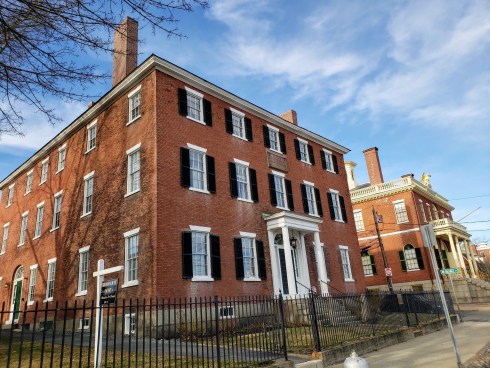
Category Archives: Art

The Lynde Ladies of Salem

I’ve always admired these three portraits of women from the Lynde family: the wife and daughters of Benjamin Lynde Jr., chief justice of the Massachusetts Superior Court of Judicature and one of the justices who presided over the trial of Captain Thomas Preston following the Boston Massacre. As the portraits were produced by very esteemed and in-demand artists, their existence seems to me to represent the extreme wealth and prestige of the family, and by extension Salem, with which they were all identified. But since I’ve had my “enslavement enlightenment” lightbulb moment, I find I can’t look at them in the same way I used to: a little personal perspective on a challenge faced by many towns, cities, and universities these days. I can’t admire the rich folds of velvet and silk swathing these women without thinking of their other “possessions”.

Lynde Jr Wife Mary Feke Huntington

Robert Feke, Mrs. Benjamin Lynde Jr., c. 1748. The Huntington Library, Art Collections, and Botanical Gardens. Gift of the Virginia Steele Scott Foundation.

01-02_full

Joseph Blackburn, Mary Lynde Oliver, c. 1755. National Gallery of Art.

Lynde Lydia Copley

John Singleton Copley, Lydia Lynde (Walter), c. 1762-64. Lydia Lynde, ca. 1762-64.  New Britain Museum of American Art, Stephen B. Lawrence Fund and through exchange.

Maybe I can look at the silk without guilt: there are references to at least two enslaved men in the various accounts of Justice Lynde’s household, implicating his wife Mary (Bowles) Lynde (1709-91), but I do not know if the Lynde’s two daughters, Mary Lynde Oliver (1733-1807) and Lydia Lynde Walter (1741-1798) are so-tainted. As Mary Jr. was married to a gentleman scientist (Andrew Oliver) and Lydia married the Rector of  Trinity Church in Boston (the Reverend William Walter), I would like to think that they despised the institution and practice of slavery, but that might be anachronistic wishful thinking on my part as science, religion, and slavery seem to be compatible in the eighteenth-century Atlantic world. Mary’s 1751 diary is among other Oliver collections at the Massachusetts Historical Society, and I bet that would yield some clues. Slavery was abolished in Massachusetts during the lifetimes of all of these women, and it would be interesting to know their reactions to that epic event. While the two Marys led much of their lives in the Lynde family home on the corner of Essex and Liberty Streets (demolished in 1836, and then of course the PEM engulfed that latter so that no longer exists either) in Salem, Lydia lived with her husband in Boston until 1776 when they decamped for Nova Scotia with other Loyalists, to return only in 1791. While The Loyalists of Massachusetts described both of Benjamin Lynde’s sons-in-law as “staunch Loyalists”, I’m just not sure that is the case with Andrew Oliver, Mary’s husband. He was certainly part of a conspicuous Loyalist family as his father was the last royal Lieutenant Governor of Massachusetts and his uncle its last royal Chief Justice, but he seems to have been more passionate about science than politics and he and Mary remained in Salem during the Revolution.

Lynde Andrew Olliver

Joseph Blackburn, Andrew Oliver, Jr., c. 1755, National Gallery of Art. In the companion portrait to that of Mary above, Andrew Oliver looks even more resplendent, with his waistcoat and dovecote!

Andrew Oliver by Copley MFA

John Singleton Copley, Andrew Oliver, Jr., 1758. Museum of Fine Arts, Boston

At least I think they did: they’re pretty quiet, only emerging towards the end of the war as executors (she with her maiden name) of her father’s estate. I’d like to think that Mary and Andrew fulfilled the dictates of Benjamin Lynde Jr.’s will and freed his long-term “man” Primus joyfully, and on the most generous of terms. No advertisements for lost or runaway humans before that, thank goodness, only books. We do get some insights into Mary’s character from the ever-quotable Reverend Bentley, although they are not very complimentary: she was “of real piety but not of that mind which could have rendered her a fit companion for her husband who took a high rank in American Literature. She was feeble limited in her enquiries, & a century too late in her manners.” (Diary II, 335-6).

Lynde Salem Gazette 1781

Lynde Essex Gazette 1769

Addendum: There is a fourth portrait of a Lynde lady: Benjamin Lynde Jr.’s mother, Mary Browne Lynde, in the collection of the Peabody Essex Museum: I don’t remember ever seeing it, but it is featured in Lorinda Goodwin’s book An Archaeology of Manners: The Polite World of the Merchant Elite of Colonial Massachusetts (2002) as well as the Smithsonian’s catalog of American portraits, where it is attributed to none other than Sir Godfrey Kneller, the “Principal Painter” of the late Stuart courts. It is quite something to think of a Salem girl being painted by the same artist who portrayed James II, William and Mary, Anne, Locke and Newton! There is no online catalog of its object collections on the PEM website, so I can’t check out their attribution, though Goodwin lists it as unattributed. Mrs. Lynde Sr. appears to have been a very beautiful woman, but not only were her father and husband slave owners, she lived in an age in which slavery became integrated inextricably with the British Atlantic Empire. In 1713 Britain was granted the asiento, the exclusive contract to supply the Spanish American colonies with slaves, in the treaty that ended the War of the Spanish Succession, thus enabling its domination of the Atlantic Slave Trade for the rest of the eighteenth century. 

Mary Browne Lynde

Queen Anne Kneller

Two Kneller portraits? Mary Browne Lynde and Princess Anne before her accession in 1702, Sir Godfrey Kneller, Chirk Castle © National Trust.  After the asiento was granted to Great Britain by the terms of the Treaty of Utrecht, the South Sea Company, in which both Anne and her successor George I were large shareholders, was awarded the contract to supply slaves to Spain’s colonies. 


Edwardian Tudors

I’m back teaching this semester after a productive sabbatical, although I’m a bit out of practice. Thankfully I’ve got my favorite Tudor-Stuart survey scheduled, a course that I’ve taught many, many times but always in a different way. This semester we are focusing on “disorder” in general and crime in particular and they are reading accounts of sensational crimes interspersed with the usual narrative of Reformation and Revolution. Before we get to any of that, however, I drag my students through a lot of historiographical and cultural context, because I find that they already have so many preconceived notions about this era, even those who have never really studied it, from films and television…..and Shakespeare, even though they don’t know that their “history” is Bard-derived. Yesterday we were examining how the Victorians perceived the Tudors, as you generally have to burst through Victorian interpretations to get close to anything resembling the historical truth, and we ended up with these wonderful Edwardian murals, installed in the East Corridor of the House of Commons in 1910. They are images of Tudor monarchs (for the most part), of course, but they are also Edwardian projections, chosen to represent the ideals of that time: a more popular-based sovereignty, empire, education, and the long-term consequences of the Reformation. What is so interesting is that several of the murals are not based on any documented historic event, but rather on Shakespeare’s depiction of an historical event: with their prominent situation in Parliament, they represent a multi-layered representation of the past.

Parliamentary prints first Plucking_the_Red_and_White_Roses,_by_Henry_Payne.jpgHenry Arthur Payne, The Origin of Parties. Plucking the White Rose in the Old Temple Gardens

Let’s take the first East Corridor mural as a case in point: Henry Arthur Payne’s The Origin of Parties. Plucking the White Rose in the Old Temple Gardens, which depicts a scene taken from Shakespeare’s Henry VI, Part I in which the noble factions about to wage what would become known (much later) as the War of the Roses are choosing sides/roses. This is a pre-Raphaelite depiction of a pre-Tudor “scene”, and a bit of a stretch to consider the York and Lancaster factions as the “origin of parties”. Apparently even the artist questioned the first subtitle given to his work, but as the murals project was being overseen by the American artist Edwin Austen Abbey of the Royal Academy, who most definitely looked upon Shakespeare as his muse, the inclusion of this scene is understandable. Abbey was also responsible for the homogeneity of the East Corridor murals, as he specified the red, gold, and black color scheme which unites all six murals, as well as the uniform height and perspective of the characters portrayed.

cooper john-cabot-and-his-sons-receive-the-charter-from-henry-vii-to-sail-in-search-of-new-landsDenis William EdenJohn Cabot and his Sons Receive the Charter from Henry VII to Sail in Search of New Lands 1496

henry_vii_at_greenwichFrank Cadogan Cowper, Erasmus and Thomas More Visit the Children of Henry VII at Greenwich, 1499

katherine and henryFrank O. Salisbury, Henry VIII and Catherine of Aragon before the Papal Legates at Blackfriars, 1529.

(c) Palace of Westminster; Supplied by The Public Catalogue FoundationErnest BoardLatimer Preaching before Edward VI at St. Paul’s Cross, 1548.

mary enteringJohn Byam Liston Shaw, The Entrance of Mary I with Princess Elizabeth into London, 1553

And there you have them: representatives of Tudor history from an Edwardian perspective. The emphasis seems to be on: the story, empire, the “new learning”, and the relationship of the royal government to the people. We have an equal representation of both Protestantism and Catholicism, hinting at the secularism of the era. I’m happy to see that my favorite Tudor, Henry VII, has a larger role in this story than Henry VIII, but surprised to see such a supporting role for Elizabeth: perhaps she was too powerful an opponent of parliamentary power.

Images and more information about the murals here: https://www.parliament.uk/worksofart/collection-highlights/british-history/tudor-history.

and more context here: https://www.paul-mellon-centre.ac.uk/publications/browse/9780300163353.

edwardian sense


Allegorical Arrows

Historical imagery often contains symbols and emblems that we don’t understand:  we must learn to read them; whereas a contemporary audience could simply see them and understand the message within. I enjoy teasing out the meanings behind images from the past both here and in class–though here I’ve got a bit more creative freedom, and can chart the evolution of images all the way up to the present, when they have often lost their associations and exist simply as images. A great case in point (literally) is the simple and straightforward arrow: once I’ve swept away my seasonal decorations at home I’m often left with a bunch of arrows here and there as they are seasonless, timeless, and largely meaningless: I simply like their form. This is an Americana week for several auction houses, and yesterday as I was perusing the digital catalog for an important auction of folk art at Sotheby’s (The History of Now: The Important American Folk Art Collection of David Teiger|Sold to Benefit Teiger Foundation for the Support of Contemporary Art) all I could see was arrows, which for the most part had assumed their modern directional meaning on myriad weathervanes.

artful arrows horse weathervane

artful arrows diana the huntress sothebys

artful arrows soaring bird sothebys

artful arrows goddess of liberty sothebysPrancing Horse, Diana the Huntress, Soaring Bird, and the Goddess of Liberty weathervanes from the Teiger collection, Sotheby’s.

Another lot in this same auction is an incredible later nineteenth-century Chinese wall plaque representing the Great Seal of the United States, with the emblazoned bald eagle clutching a cluster of arrows in his left talon—thirteen to be exact, representing the thirteen colonies, but also strength through unity. There is an explicit sense of martial strength on display as well, projected through the contrast with the olive branch in the eagle’s right talon. The Great Seal’s designer, Charles Thompson, was influenced in his use of arrows by other confederations such as the Iroquois (with their five nations) and the Dutch Republic (with its seven provinces) as well as by early modern emblem books such as Joachim Camerarius’s Symbola et Emblemata (1590-1604), merely substituting them for the more classical lightening bolts.

artful arrows chinese eagle sotheby's folk art auction 20 jan

Obverse Great Seal.tif

arrows symbols 16th c.The Chinese Great Seal and Charles Thompson’s original sketch, US National Archives; Joachim Camerarius, Symbola et Emblemata.
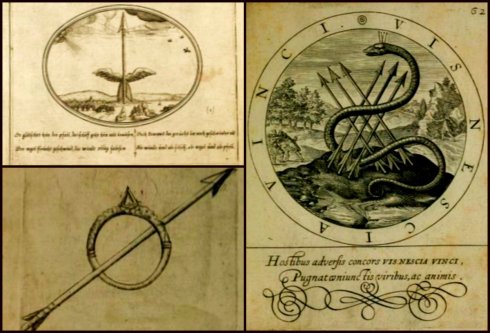
Emblem books are one of the rabbit holes of early modern literature, as you will see if you go here: but you can also find many arrows, representing not only military force, but also time and inevitable mortality, flight, children (Psalm 127), punishment, and of course love, when in one of the countless cupids’ bows. Medieval arrows are never ambiguous: they represent force and violent death in general, and martyrdom in particular. Saint Sebastian (died 288) and King Edmund the Martyr (d. 869) were both attacked by hordes of pagan/heathen archers, and so often depicted as shot so full of arrows they resemble porcupines; arrows remained their essential attributes as their cults developed over the medieval era. In the later medieval era, Sebastian re-emerged as the most popular plague saint, as the arrow came to symbolize the plague itself: the most dramatic expression of this motif is a fourteenth-century fresco on the wall of the former Benedictine Abbey of Saint-André-de-Lavauadieu in France, depicting a faceless woman armed with the arrows of plague and her pierced victims all around her.

arrow 2 collage

love removed

arrows of black death

arrows pub

Some early modern arrow emblems: “Ich fliehe sehr schnell”– Fly far and fast; “Vis nescia vinci”–force cannot be overcome with force; “Supplicio laus tuta semel”—he that was worthy of praise was one free from punishment; Cupid holds up the world: “Sublato Amore Omnia Ruunt“–When Love is Removed, All things tumble down; the Lavaudieu fresco, and a street sign in Bury St. Edmunds, bearing the three arrow-crossed crowns that have come to symbolize the Anglo-Saxon king Edmund the Martyr.

Back to the future: I guess arrows are just arrows, or mundane symbols telling us where to go, BUT who knew there was a hidden arrow in the FedEx logo? Not me.

arrows collage

arrow fed ex

Mid-century textile design by Tommi Parzinger, Cooper-Hewitt Museum.


Fadeaway Women

Since I discovered the earlier version (1883-1936) of Life magazine this fall, I’ve been browsing through its content and covers: this Life 1.0 was a very different medium than its successor! I put together a portfolio of Christmas covers for a post, and then I realized that the work of one particular illustrator was more interesting, whatever the seasonal expression. These covers are the work of Clarence Coles Phillips (1880-1927), known first as C. Coles Phillips and for most of his career as Coles Phillips: an innovative illustrator who utilized the technique of negative space (and imagination) to portray a series of stylish and independent women on the covers of Life (and other periodicals) from 1908 to the end of his short life. The Christmas cover from 1909 caught my attention first, but it is not my favorite: I just love the ladies playing with boy toys in 1911—-a far cry from the Gibson Girls who preceded them!

Life xmas

December 22, 1909

Life 1909-10-14

Life 1910-03-03 C. Coles Phillips

Life C. Coles Phillips

Life 1911-07-27 C. Coles Phillips

Life mghl_phillips-5 Aug 24 1911

Life 1911-08-31 C. Coles Phillips

Life 1911-09-28 C. Coles Phillips Fade Away Women

Life 1911-11-30 C. Coles Phillips Fadeaway

Life 1912-06-13 C. Coles Phillips Fadeway

Life1912-12-26 C. Coles Phillips

Life phillips_l7apr21

Life mghl_phillips-9

October 14, 1909/ March 3, 1910/ May 12, 2010/ July 27, 1911/ August 24, 1911/ August 31, 1911/ September 28, 1911/ November 30, 1911/ June 13, 1912/ December 26, 1912/ April 7, 1921/ May 13, 1926. All covers from MagazineArt.org.


Pilgrim Life

Life magazine was a different sort of periodical in its first incarnation, from 1883 to 1936, than after, when photographs characterized its style and substance. The earlier Life was all about illustration, and all the famous graphic artists of the era contributed to its pages: everyone from Charles Dana Gibson to Norman Rockwell. It seems to have been a humorous society magazine with some very cutting caricatures, and as I was leafing through a succession of Thanksgiving “numbers” I found a very dark view of the “Ye Merrie New England Thanksgiving of Earlier Dayes” by illustrator F.T Richards from 1895. Dark. Even Hawthornesque, you might say.

Life Thanksgiving Puritans 1895

Pilgrim LifePuritans and Witches 1895

And quite a departure from the more playful portrayal of Thanksgiving Pilgrims published in Life and other contemporary periodicals in the first decades of the twentieth century: First Thanksgivings, amorous encounters and myriad in-the-stocks scenarios. Then the war comes and changes everything for longer than its duration, followed by the cult-of-celebrity culture that still seems to define us.

Life 1904-11-

Life 1910-11-03

Life 1913-11-06

Life1923-11-22 (2)Life covers from 1904, 1910, 1913 & 1923.


Dark Flora

I picked up this beautiful coffee table book the other day: Foraged Flora by Louesa Roebuck and Sarah Lonsdale, floral designer and writer/editor respectively. The photographs were so beautiful, I had to have it, but I hesitated, as apart from those on architecture, I tend to leaf through coffee table books only once or twice so they are extravagant purchases. But this one seemed different: it’s like a farm-to-table book for floral arranging. Think local and seasonal; forage and embellish every day. And it is so beautiful…..so I bought it, and I’ve been looking at it quite a bit. I have a small urban garden which I tend to ignore as soon as September comes around, but there are lots of fluffy white spent flowers out there now, and berries come later, so hopefully this book will help me to take advantage of my natural resources.

Foraged Flora Book

The other reason I keep turning the pages is this book reminds me of some of my favorite Dutch Golden Age still lifes, particularly those by two women: Clara Peeters (c. 1594-1657–who was actually Flemish) and Rachel Ruysch (1664-1750). Ruysch was much more well-known in her day than Peeters’ in hers, but there was a big exhibition of the latter’s works at the Prado a couple of years ago so at least she is getting some recognition hundreds of years after her death. The work of both women is amazing, and you’ll see why I was reminded of it as I glanced at the photographs of Laurie Frankel in Foraged Flora. The first images below are Frankel’s photographs; the next two paintings by Peeters and Ruysch.

Foraged Flora Laurie Frankel

Photograph by Laurie Frankel for Foraged Flora

Foraged Flora Laurie Frankel 2

Photograph by Laurie Frankel for Foraged Flora

Foraged Flowers Clara Peters Prado

Clara Peeters, , Museo del Prado

Ruysch, Rachel, 1664-1750; A Spray of Flowers

Rachel Ruysch, A Spray of Flowers with Insects and Butterflies on a Marble Slab, The Fitzwilliam Museum

I just love the combination of flowers against a dark background—I had to pick up a pillow along with the book! The Dutch paintings generally show special flowers in full bloom; Foraged Fauna follows suit, but its hunter-gatherer-renderers are a bit more adventurous with their materials, which is inspiring.

Foraged Flora garden

Garden October 2018The last rose of 2018 (?) and more plant material in my garden + my new pillow and what remains.


Considerations on Color

I teach what is commonly known as the “Scientific Revolution” in several of my courses, and I always endeavor to expose my students to the broad range of the “new science” in the seventeenth century as they tend to have a very narrow view of what this revolution entailed. We come to the topic from very different perspectives: for them, it’s all about the heliocentric universe (conception, proof, acceptance? I’m not sure which); for me, it’s about nothing less than a new conception of truth and a new methodology of inquiry. To demonstrate its truly revolutionary impact, I stress the universality of this methodology by exposing them to the range and variety of “ingenious pursuits”, encompassing everything from botany to medicine to chemistry to mechanics to navigation and from the theoretical to the practical. I’m a bit more interested in the latter–and that’s what I’m studying during this sabbatical–but sometimes it’s hard to separate the two approaches: a case in point is Robert Boyle’s Experiments and Considerations Touching Colourswhich was first published in 1664. Boyle is primarily known for his pioneering work in chemistry and physics, but his interests were varied: like his contemporary Isaac Newton, he also experimented with alchemy. As its title indicates, Experiments and Considerations Touching Colours consists of experiments and observations which “enquire seriously into the Nature of Colours, and assist in the investigation of it [them]”, and his empirical data consists of examples of craftsmen creating color, including the English dyers who had perfected the process of transforming a red acid extracted from the American cochineal insect into scarlet and crimson dyes: and voilà, Redcoats! (Well a bit later). It is these intersections of “science”, industry and art that really demonstrate the spirit of inquiry in the seventeenth century.

COnsiderations of Color

Wright, John Michael, 1617-1694; Mary Fairfax, Duchess of BuckinghamFirst edition of the Experiments and Considerations Touching Colour, 1664, Skinner Auctions; The Duchess of Buckingham with her crimson wrap, after 1659, York Museums Trust.

Just two years later, Robert Waller, another fellow of the Royal Society (which we should remember was very interested in technology as well as theoretical science) published a really cool color chart in the Philosophical transactions of the Royal Society of London. As you can read below, Waller had seen a “table of simple colors” some years previous but was resolved to “give a more philosophical and useful one by the addition of some mixt colors”. The vocabulary is similar to that of medicines–simple and compound–and like materia medica, everything was composed from nature but man was starting to amplify the process of production—or creation.

Creating Colors Waller 2

Creating Color Waller

Color Chart 1686Robert Weller, Tabula colorum physiologica (Table of Physiological Colors), Philosophical transactions of the Royal Society of London, 1666.

And then there is the remarkable Dutch manuscript brought to (internet) light by the book historian Erik Kwakkel a few years ago containing a “proto-Pantone” code of colors: the Treatise on Colors for Water Painting (1692) by A. Boogert. A single and singular copy forgotten and full of the most amazing colors and color compositions, this book set the design world on fire back in 2014—understandably so.

color-guide-960x731

Color Chart 1690sA. Boogert, Traité des couleurs servant à la peinture à l’eau, Aix-en-Provence, Bibliothèque municipale/Bibliothèque Méjanes, MS 1389 (1228). Photographs by Erik Kwakkel.


August Anglo-Americana at Auction

August is high season for antique shows and auctions in New England: generally featuring Americana items with global goods mixed in, as our Yankee forebears, particularly those who dwelled in regional seaports like Salem and Portsmouth, were very worldly, of course, and lived with things that came from other parts of the world. A decade or so ago I was in full-court hunting mode during this season; now I’m an armchair/laptop peruser, although next weekend’s sale at Northeast Auctions looks so good I’m certainly going to attend a preview, at the very least. Such interesting wares! All my picks are from the two (or one long) auctions which will be held on August 18-19: the “Lifelong Collection of Susan MacKay and Peter Field” on Saturday with a general auction following, into the next day. There is no rhyme or reason to these selections: they just caught my fancy.

Auction GlobeAmerican Terrestrial Pocket Globe made in Wethersfield, CT, c. 1850. A pocket globe is surely better than a pocket atlas.


Auction Stumpwork 2English Stumpwork Profile Portrait of King Charles I of England, 1646.  How amazing is this—and there are more seventeenth-century lots in the MacKay/Field collection as well, including two more representations of King Charles I during the Civil War, or perhaps even after his execution! Royalist relics–from either side of the Atlantic.


Auction Silk Needlwork Silk Needlework Picture of a Gentleman wearing a Tricorn Hat, c. 1770. I like this guy from the next century too.


AUction Highboy

English William and Mary Japanned Pine and Hardwood Highboy. I do not have a highboy, or a William and Mary piece, and I would really like both: this doesn’t really suit my present house but who knows where we might end up? I like the subtle Japanning and it has a very low estimate!


Auction Chairs

Set of Eight American Sheraton Fancy Red Painted and Decorated Side Chairs. Do I need chairs? No, absolutely not. But these are RED fancy chairs. Hard to resist.


Andres JournalAndre’s Journal: an Authentic Record of the Movements and Engagements of the British Army in America from June 1777 to November 1778 as recorded from day to day by Major John Andre,” Edited by Henry Cabot Lodge, Boston: The Bibliophile Society, 1903. This is a beautiful two-volume book which was limited to 487 copies for Bibliophile Society members: I continue to be fascinated by how fascinated Americans were (are?) with Major Andre!


Auction Lady LibertyLady Liberty Standing on the Head of Great Britain underneath the Great Seal of the United States, American School, War of 1812. LOTS of War of 1812 items in this auction: this is my favorite.


Arbella NortheastThe Frigate “Arbella” of Salem. American School, early 19th Century. I guess I have to have a Salem item–this is a lovely ink & watercolor painting of a ship with which I am not familiar: the original Arbella brough John Winthrop to Salem in 1630, but I don’t know anything about this Arbella. Only the Phillips Library can tell us, I’m sure!


Auction Young SailorThe Young Sailor. American School, 4th quarter, 19th century, Mrs. Mary Ide Spencer/Artist. I just love this painting: I know it would make me happy every day if it were mine.


A Displaced Doorway

It’s August, so we’re coming up on the day a year ago when the Peabody Essex Museum quite suddenly closed the doors of its temporary Phillips Library facility in Peabody and issued an ominous and mysterious statement that the Library would be opening up in a “new location” in the spring. In December, the Museum announced admitted that this new permanent location would be the town of Rowley, where it had purchased a utilitarian structure to house its amalgamated “Collection Center” (why is it not Collections Center—just not indiscriminate enough?) And just like that, Salem’s oldest and most comprehensive archive was gone, along with the very special library that had housed it for well over a century. The Collection Center Library, which I cannot bear to call the Phillips, is now open and able to accomodate 14 researchers in what is by all accounts (I haven’t been there yet, but I fear I will have to at some point) a massive structure, yet another indication that this facility was built to house material objects rather than texts: the announcement of its opening featured a curator examining a Chinese object. I’m quite aware that the PEM requires a vast amount of space to house its vast collections: I just don’t understand why this space could not have been found in Salem or why the Library had to be assimilated within it. Through this whole saga, I’ve talked to many people who have been just as upset over the removal of objects from Salem as texts: the assorted Americana and maritime memorials of the former Essex Institute and Peabody Museum. For me, it’s always been exclusively about paper. But just the other day, someone took a picture of the crated doorway of the Gideon Tucker House, being readied for its departure to Rowley I presume, and I started to think about the loss of material culture for the first time when I went over to see it for myself.

Gideon Tucker Doorway 2

Gideon Tucker Doorway

I guess I should be glad that this doorway still exists and is still—or has been–in Salem, as it is a long-admired example of Samuel McIntire’s work; indeed when students from MIT’s pioneering architectural school came to Salem in the summer of 1895 to measure and draw its storied buildings, their professor Eleazer B. Homer identified the elliptical doorway of the Gideon Tucker House (also called the Tucker-Rice House) as the “best-proportioned” in the city. We have photographs of the doorway in situ, but most images of it date from after 1896, when the Tucker house was acquired by the Father Mathew Total Abstinence Society and transformed into an institutional headquarters. By 1910 the famous doorway had been removed and donated to the Essex Institute, which eventually affixed it to the rear of Plummer Hall. I’m not sure when it was removed and placed in storage: Bryant Tolles refers to its relocated situation in his Architecture in Salem (1970) but the doorway of the “Grimshawe House” on Charter Street is affixed to the rear of Plummer at present–and has been for some time.  Across Essex Street, the Gideon Tucker house was further “denatured” by the addition of commercial storefronts in the mid-twentieth century, but fortunately rehabilitated for residences under the supervision of Newburyport architect Jonathan Woodman in the 1980s, at which time it acquired its reproduction entrance.

Tucker collage

Gideon TUcker Brickbuilder 1915

Gideon Tucker NYPLDG

Gideon Tucker PC

gideon-tucker-house-with-commercial-storefront

Gideon Tucker todayThe Gideon Tucker Doorway and House (1804): Frank Cousins photographs from the 1890s; the Brickbuilder, January 1924; New York Public Library Digital Gallery, n.d.; Essex Institute postcard, MACRIS (1979) and present.

The Essex Institute garden must have been a very interesting place to visit in the midst of the twentieth century with its eclectic mix of houses and house parts assembled by George Francis Dow: in addition to the Tucker Doorway, there was a McIntire cupola from the Pickman/Derby/Rogers/Brookhouse Mansion which was demolished in 1915. It was infested with beetles and destroyed in the 1970s, and only its eagle survives. I am grateful that this beautiful doorway has not met a similar fate, along with all the architectural fragments in the PEM’s collections, but the removal from the cultural context which created them makes me anxious for their future significance—and meaning.

Napoleon “Eh bien, Messieurs! deux millions”: Napoleon displaying the treasures of Italy—in France, 1797, Library of Congress.


Art+Science

The Salem Arts Festival was this past weekend in Salem: its tenth anniversary. Last year plastic-bag jellyfish were suspended above Derby Square and Front Street; this year it was all about bees. Salem’s art scene is very vibrant now, but this little city has always had a bustling community of artists (well, after the Puritans morphed into the Congregationalists) and craftsmen. I’ve written about quite a few individual artists, but I thought I would look for more collective precedents, and that quest took me directly to the fairs of the Salem Charitable Mechanic Association (1817-1932). The records for this association, like those of nearly every Salem institution and organization, are relatively inaccessible, as they are in the Peabody Essex Museum’s Phillips Library, which has been closed in Salem, removed to Rowley, and for which digitization plans are nonexistent at present. But fortunately the Association wanted to showcase the creations of all its exhibitors, and so compiled a wonderful program for its first fair in 1849 that has been digitized in several places. This was held in its very own Mechanic Hall, built a decade before.

Art + Science collage

Art + Science The_Salem_Charitable_Mechanic_Association

Art + Science Mechanic Hall SSUTwo copies of  Reports of the First Exhibition of the Salem Charitable Mechanic Association, 1849, a certificate from the exhibition (Boston Athenaeum), and Mechanic Hall at the corner of Essex and Crombie Streets in Salem, built in 1839 and destroyed by fire in 1905 (Dionne Collection, Salem State University Archives).

This program makes for very interesting reading for several reasons. First of all, the judges of each category are very detailed and opinionated about their criteria for awarding diplomas and silver medals–although it appears that everyone who showed up got the former. The sheer eclecticism of the entries is notable, as is the relatively small number of industrial entries–surprising as the exhibition was occuring in the midst of the Industrial Revolution in Massachusetts. The organizers address this deficiency in their introduction: it is to be regretted that there was not a greater display of the Manufactures of Old Essex, especially of Cotton and Woolen Goods. Andover and Newburyport, with their numerous and extensive Cotton and Woolen Manufacturing Establishments, did not exhibit a single article. Saugus with her Flannel and Yarn Factories—-none, and Danvers, with her Carpet and Tweed Factories, was also deficient. When we consider that Essex County produces more than the whole State of South Carolina—-that her products are more than twenty millions of dollars—and a fair share of it in the articles alluded to—the display was not what it should have been. But notwithstanding these adverse circumstances, the energy and the perseverance of the mechanics of Salem, essentially aided by the Ladies, produced one of the most beautiful exhibitions ever witness in this vicinity. I guess they just didn’t get the word out! And yes, “the Ladies” are very well-represented in this 1849 exhibition, which showcased every possible type of art: mechanical and utilitarian, “fine” and decorative.

PicMonkey Image

1849salemmechassoc_obvDiplomas and medals for “drab” clothing, an artificial leg, mineral teeth, a miniature steam engine and a Patent Cloth Folder used at the Naumkeag Steam Mills in Salem, among other exhibits; a rare medal from the 1849 exhibition, from John Kraljevich Americana.

Above all, the integration of art and science seems very apparent in this exhibition: perhaps it is highlighted by the paucity of industrial exhibits but there are still many categories that we would consign to an arts festival today rather than one celebrating “mechanics”. Besides “Fine Arts”, everything created with a needle was on display, along with everything for the house and the body. This exhibition was all about creation, pure and simple. I love this universality and lack of separation between the artistic and the scientific: it illustrates the continued influence of the culture of the Renaissance, the period in which I was trained, during which everything was an art. But the Charitable Mechanic Association had its categories too, some of which seem rather arbitrary: the sole Daguerreotype exhibitor, one of Salem’s three practitioners at the time, was D.S. Bowdoin, who won a silver medal in the Fine Arts category for “a very admirable collection of Specimens, showing great skill in the mechanical execution, good taste in the arrangement of subjects, and in the management of light and shade”.  To me, the daguerreotype seems a near-perfect combination of art and science.

Bowdoin collageI couldn’t find any D.S. Bowdoin daguerreotypes from 1849, but here are two cartes de visite from later: studio portraits portrait of Robert Daley (or Daily), a Salem “expressman”, c. 1855 (Historic New England) and John Lewis Russell, a well-known botanist and Unitarian minister (Wisconsin Historical Society). According to the later photograph, Bowdoin’s studio was in the Downing Block, Salem.

Back in the present and now that I think about it, this arts festival does indeed bridge the gap between art and science in its own way: what could be more technological than transforming commissioned plastic bees into building materials? I have never really understood the stem vs. steAm debate, and let’s throw an H for history in there somewhere!

bee collage 2

Arts Festival 1

Arts Festival 3

Arts Festival 2

Arts Festival 4

Arts Festival 8

Arts Festival 6

Arts Festival 7

Arts Festival 9Scenes from the Salem Arts Festival on Saturday: my neighbor Racket Shreve’s “Best in Show” painting in the gallery in Old Town Hall along with “Remembering Georgie” by Heather M. Morris; the Mural Slam—just loved this work-in-progress of “Salem from Above” by Casey Stanberry, especially in its partially finished state.