
We don’t have any portraits of Salem women before the eighteenth century: the (European) women of Salem’s (European) founding century are therefore difficult to picture. We are left with nineteenth- and early twentieth-century romanticized and idealized images of dramatic women: persecuted Quakers, the two Annes, Hutchinson and Bradstreet (who never lived in Salem), and above all, the women who were accused of witchcraft. The latter are always represented by illustrations from long after their deaths, or by images of English or continental witch trials, utilized even on the covers of scholarly books on the 1692 trials. Why am I always seeing the Pendle “witches” from 1612 depicted as the Salem “witches” from 80 years later and across the Atlantic?

Because “public-facing” history, presented in digital formats and disseminated through social media, needs pictures: texts just won’t do! And book covers need to draw the reader in. I’m as guilty as the next blogger of using the later nineteenth-century images (of which there are so many!) to illustrate some of my posts, although I never substitute depictions of one event for another. I’d love to have some contemporary illustrations of Salem women in the seventeenth century doing all the things I know they did: parent, cook, sew, garden, make all sorts of stuff, keep taverns, worship, wonder. But there aren’t any. I’d love to have a portrait of Lady Deborah Moody, who settled briefly in Salem before she moved on to New York and was labeled a “dangerous woman” by John Winthrop for her heretical Anabaptist views (and I think her independence), but there aren’t any—I’ve checked through all the English sources as well. I’d love to have an image of the adversaries Martha Rowlandson, who divorced her husband for impotence in 1651, and Eleanor Hollingsworth (mother of Mary English, who I’d also like to see), who operated her own tavern, brewed her own beer, and cleared her husband’s considerable debts. But nothing. There are several portraits of seventeenth-century Massachusetts women, so I guess they need to stand in for their Salem sisters: anything to avoid disseminating those simplistic “Puritan” images!

 Real 17th Century Massachusetts Women and a “Puritan Woman, 17th Century” from Cassel’s Historical Scrap Book, c. 1880.
As an English historian, I have a wide range of texts and images available to me with which to explore seventeenth-century women: many portraits of wealthy ladies, prescriptive writing, prints and broadsides, recipe books and diaries, theatrical performances as social comment and criticism (with women as the focus quite a bit in the earlier seventeenth century). So English women seem more diverse, more interesting, more active, more layered, while their sisters across the Atlantic seem a bit…..one-dimensional in comparison. I guess that’s why the authors of books on the Salem Witch Trials pinch English images so often. Of course if we move away from the reliance on the visual we can learn a lot more, but I worry that the exclusive reliance on “picture history” in the public sphere erases those who do not leave an image behind.

I think I can illustrate my concern a bit better by examining some women from the nineteenth century, certainly a much more visual age, but not universally so. There’s been a lot of interest in Salem’s African-American history over the past few years, which is of course great. Two women in particular, have claimed the spotlight: Charlotte Forten Grimké (1837– 1914) and Sarah Parker Remond (1824-1894). Both were incredible women: Charlotte came north from Philadelphia to live among the always-hospitable Remond family to attend Salem’s desegregated schools in the 1850s, and went on to graduate from Salem Normal School (now Salem State University, where I teach) and become Salem’s first African-American teacher in the public schools, while Sarah grew up in Salem in the midst of a very activist Abolitionist family and became a much- heralded advocate herself, before emigrating to first England and then Italy for her undergraduate and medical degrees. Charlotte remained in her teaching position for only a couple of years before returning to her native Philadelphia and then launching an amazing career of advocacy herself, in the forms of teaching, writing, and public speaking. Both women were illustrious, and completely deserving of the two Salem parks which now bear their name. But I can’t help thinking about another African-American woman, Clarissa Lawrence, who spent her entire life in Salem, running her own school for girls, founding the country’s first anti-slavery society for African-American women as well as a benevolent society, with only a brief trip to Philadelphia for a national Abolitionist convention in which she gave the riveting “We Meet the Monster Prejudice” speech. Where is Clarissa’s park or statue in Salem? Why is Charlotte, whose family is from Philadelphia, the feature of Destination Salem’s Ancestry Days, which seeks to serve as “a gathering point for descendants of Salem’s families as well as a research opportunity for people who want to learn more about their family history”? Her family history is not here! (well actually, none of Salem’s history is here). I suspect the answer to these questions is in good part based on the fact that we have no picture of Clarissa Lawrence, so it’s almost as if she didn’t exist.


 Charlotte Forten between the two Salem Nathaniels, Hawthorne and Bowditch on the Ancestry Days poster. This sounds like a great genealogy event, but none of Charlotte’s family records are held by the participating institutions: why not feature Sarah Parker Remond, whose are? We even have several photographs of Sarah!


 Photographs ©Marianne Majerus Garden Images and ©Stacy Bass: much, much more @


 Photographs by Tessa Traeger, including her marvelous portrait of Valerie Finnis in 2000, National Portrait Gallery. Garden People includes this amazing Valerie Finnis portrait of Rhoda, Lady Birley.


 Photographs by

 The Laing daughters, Iris (younger) and Janet (older) in their mother’s photographs, 1908-14. More on autochromes
 Caroline O. Emmerton, The Chronicles of Three Old Houses, 1935
 Louise duPont Crowninshield (center) surrounded by the ladies of the Kenmore Association in Virginia, one of her first preservation projects, Hagley Museum & Library.
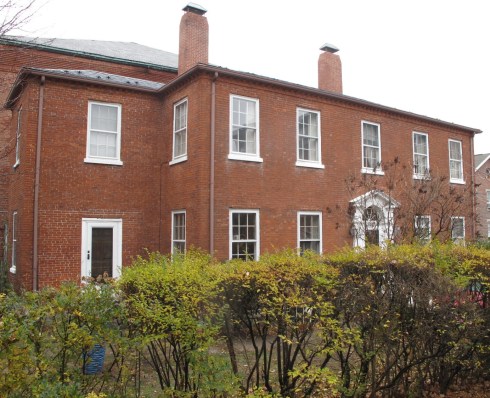 Seeing red (demolition) in 1965; 7 Ash Street, the Bessie Munroe House, today.
 Ada Louise Huxtable’s condemnation of Salem’s 1965 Urban Renewal Plan in October of that year, the first of several pieces published in the New York Times.
 1965! What a year that must have been—-Salem’s preservationists had to have been functioning 24/7.
 A Boston Globe (glowing) review for Ms. Farnam’s exhibition, Dr. Bentley’s Salem. Diary of a Town in 1977 and 1992 photograph of Ms. Pollack.

 The “OLD Mansion” above is the Sewall House or Coventry Hall in York, Maine, my hometown: growing up in a large shingle house in the Harbor, this was always my touchstone for what a “proper” house should look like.
 Can anyone tell me about this house in Saco, Maine?
 WOW. This is (was) the “Dearborn House” in Grove Hall, in Boston. You can read more about this amazing house


 The Tufts House in Medford, an unknown (???) Boston house, and some exterior and interior details, including amazing “portable paneling”. Mr. Berry also went down south, but I am not going with him.
 The MEN: pro-veil John Endicott and anti-veil John Cotton.
 The WOMEN: what were they wearing? Well, these are English women rather than Salem women but they are contemporary and this first portrait is one of my very FAVORITES: an anonymous painter and subject, it it titled “A Puritan Lady”, 1638, Berwick Museum & Art Gallery. I think it was back to the “steeple-crowned hat”, if they ever took them off! You tend to see veils for particular occasions and times of life: the second portrait is of Jane Trevor, Lady Myddleton as a WIDOW, so she is wearing a mourning veil. National Trust, Chirk Castle, c. 1670.


 News clips from Works Progress Administration Bulletins, 1936-39, Boston Public Library; National Youth Administration Photos and Records, NARA.


 HABS records, Library of Congress.


 The Patton Homestead, Hamilton


 Ipswich: the Whipple & Heard houses and just a few beautifully preserved Colonials—there are so many more!


 Newbury and Newburyport: one of my favorite houses in the County, on Newbury’s Lower Green, plus the Spencer-Pierce-Little


 Boston Sunday Post, February 3, 1918 & Boston Sunday Globe, April 7, 1918.
 The standard war-time recipe for grape “catchup”, sometimes called catsup and later ketchup: it evolves into a relish over the twentieth century, but earlier in the century there were many different types of catchups: cranberry, mushroom, any fruit or vegetable really, and it was recommended that such sauces be served with roasts. I bet Mrs. Gibney had a more economical recipe for her grape catchup as 2 pounds of sugar would have been very dear in 1918.
 We just discovered that Hamilton Hall served as a Surgical Dressings center for the Salem Red Cross in the summer of 1918, so Mrs. Gibney might have worked there—my attempt at a ghost sign for the Hall!





