
I was out and about in Lexington and Concord last week as my favorite nurseries are in that area, and between bouts of perusing plants I walked around Lexington Green and along the Battle Road at the Minute Man National Historic Park. In both locales you will see eighteenth-century “witness houses” which overlooked the opening acts of the Revolutionary War and now stand as physical reminders. The National Park Service also utilizes “witness trees” to enhance historical interpretation, particularly at Civil War sites. Certainly both the houses and the trees add to the ambiance of these historic landscapes, but their roles are much more important than that. The trees might bear scars, the houses might have served as refuges or makeshift hospitals: every physical remainder is a reference point or a touchstone. One can grasp their landmark status immediately by glancing at photographic records like Alexander Gardner’s photographic sketchbooks of the Civil War, which documented the contemporary significance of the Matthews House in Manassas and the Burnside Bridge in Antietam among other structures: the house still stands as does the sycamore tree by the bridge, connecting us to the past with their very presence.


 Pages from Gardner’s Sketchbook, Volume One at Duke University Library’s Digital Repository; the Stone House and Burnside Bridge at Manassas National Battlefield Park and Antietam National Battlefield.
The importance of place—both in general and in many specific instances—can also be gleaned from accounts of the long process of reconciliation and remembrance following the Civil War. The grave of Calvin Townes, a Salem shoemaker who fought and was wounded with the valiant 1st Regiment of Massachusetts Volunteer Heavy Artillery at Spotsylvania, drew me into the heady history of memorialization for and by these men, who lost 55 of their comrades at the “engagement” at Harris Farm on May 19, 1864, and 484 men during the entire war. The surviving members of the Regiment met annually after the war, and raised funds for a monument on the battlefield near the farmhouse which was the focus of so much of their collective remembrance. The monument was dedicated in 1901; it endures but unfortunately Harris Farm does not, despite its inclusion on the National Register of Historic Places: it was purchased by a developer in 2014 and rather promptly demolished.


 Calvin Townes of the First Regiment; the surviving Regiment at Salem Willows, 1890; Memorials at Spotsylvania and in the Essex Institute, from the History of the First Regiment of Heavy Artillery, Massachusetts Volunteers, formerly the Fourteenth Regiment of Infantry, 1861-1865 (1917); the demolished Harris Farm.
Revolutionary remembrance does not seem as intense, or we don’t have as much evidence of its expressions. Nor do we have opportunities for dramatic photographic contrasts, but the witness houses of Lexington and Concord remind us that these 1775 battles took place within a very human context—-settlements, not barren battlefields. And they also played their roles within the narrative of events. In Lexington Center the houses are privately-owned, and located around the Green; along the Battle Road they are part of the public park.


 The Munroe House on Lexington Green (which is presently for sale); the Smith House, Hartwell hearth and Tavern, Minute Man National Historic Park.
The term “witness” implies to something: an act or an event. Salem’s historic structures witnessed many events: the arrival of precious cargoes, military maneuvers, political parades, the progress of transportation technology, fires, men going off to war, hordes of Halloween revelers. But of course one event looms large over Salem’s long history: the Salem Witch Trials. There is only one surviving structure which “witnessed” that tragedy: the Jonathan Corwin House, better-known (unfortunately) as the Witch House. Despite Salem’s (unfortunate) dependence on the witch trade, it bears remembering that the Corwin house was not saved and restored by the City, but rather by Historic Salem, Inc., which was founded in 1944 for the purposes of saving the storied house (and its neighbor, the Bowditch House) from demolition due to the widening of Route 114, one of Salem’s major entrance corridors. After its slight relocation and restoration (or recreation? or creation?) by the Boston architect Gordon Robb, the Witch House opened to the public in 1948. Historic Salem, Inc. went on to play key roles in preventing full-scale urban redevelopment in the later 1960s and early 1970s and advocating for both preservation and sensitive redevelopment for decades—a particularly pressing responsibility now. This year marks its 75th anniversary, a notable achievement which will be celebrated this very weekend with an event at the Hawthorne Hotel. Come one and all, and congratulations to HSI!


 The Jonathan Corwin (Witch) House, in all of its incarnations in an early 20th century postcard, Historic New England; in 1947 as restored by Gordon Robb and Historic Salem, Inc., and photographed by Harry Sampson, and in the tourist attraction in the 1950s, Arthur Griffin via Digital Commonwealth.


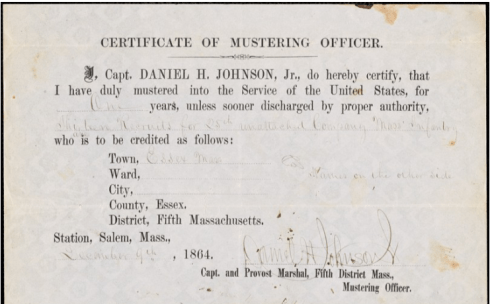 Recruiting posters from 1861-1863, New York Historical Society via New York Heritage; Town of Essex Civil War records, 1864 via Digital Commonwealth.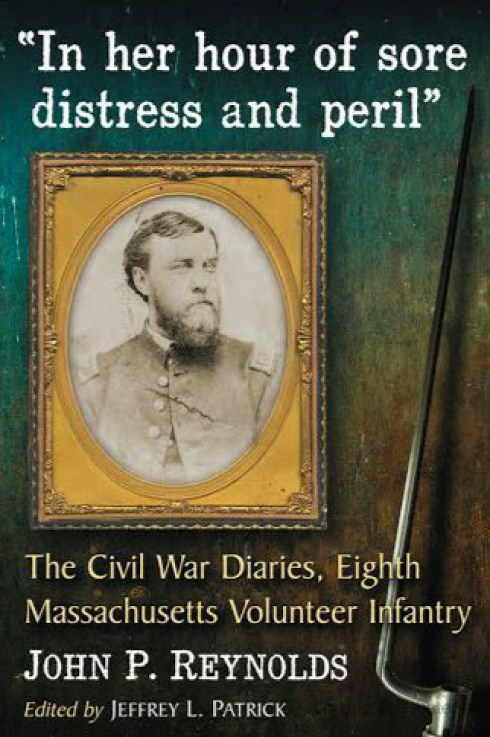

 Valentine’s Virginia vignettes, 1863-64, National Archives.

 Library Company of Philadelphia and Richard Frajola.
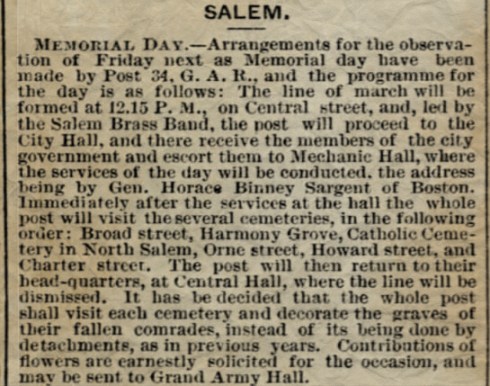

 The evolution of Memorial Day: C.H. Webber outfits participants for the occasion, Salem Register, May 19, 1870; Boston Globe May 1873, 1923, and 1944: the last GAR members in Massachusetts, including Thomas A. Corson of Salem, who died later that year at age 103.


 Salem Gazette, July 1796.
 .
.


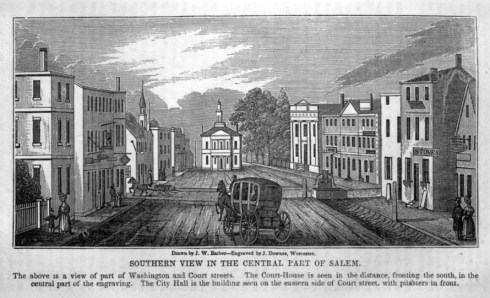

 The Tabernacle Church of 1777-1854, from Samuel Worcester’s Memorial of the Old and New Tabernacle (1855); payments to Daniel Bancroft in the Tabernacle Church administrative

 There is a facsimile edition, but how amazing to see the original 1693 maritime atlas of Pierre Mortier, the “most expensive sea-atlas ever published in Amsterdam in the seventeenth century” according to the eminent Dutch cartographical historian Cornelis Koeman. Stunning plates of beautiful European ships: here is a “Tartane de Pesche”.
 Mr. Monroe at the 1/11/18 public forum at PEM.


 See what I mean about the weather? But Kappel’s Ropes Mansion and Witch House hint at brighter and warmer days, even with no color!


 The Custom House (which is celebrating its 200th anniversary this year) Derby Wharf Lighthouse, The Little Studio (just above the compass star)–where both Philip Little and Philip Kappel worked, in different seasons—and the House of the Seven Gables.
 Chestnut Street

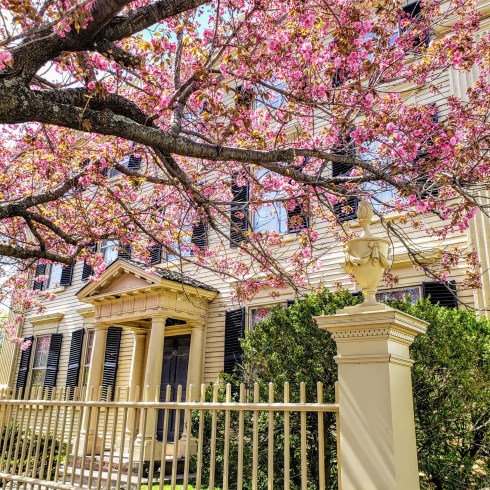 Is the Red Line going to take us across North Street to the beautiful Peirce-Nichols House? Of course not, sharp left to the Witch House, after we’ve just been to the Witch Dungeon Museum.
 Two empty courthouses downtown: can’t ONE play a key public role?
 Thank goodness for Wicked Good Books and the Hotel Salem, otherwise there’s not a lot going on on the Essex Street pedestrian mall, day or night.


 Bridge Street Neck was not “home to a large population of African Americans” in the 19th century: just check the city directories!


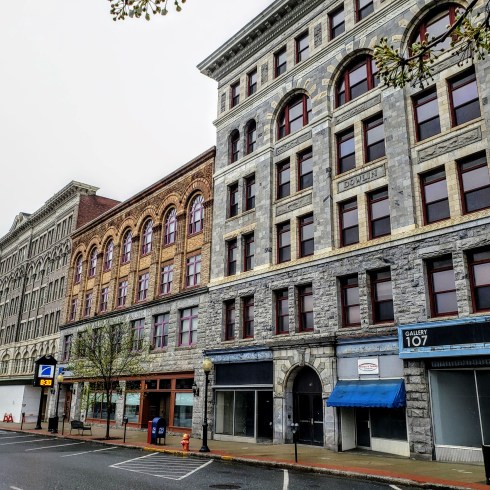


 Some of the larger Victorians on Church Street (just above) need some help, but just up the hill is a lovely neighborhood of mostly-restored structures. Below: the Arnold Print Works produced a full line of textiles over their long history, but one of their popular products in the 1890s were these stuffed animal templates (examples below from the collections of the Rhode Island School of Design Museum & Cooper Hewitt): the finished products are very collectible and you can buy reproductions too (here are some Etsy


 Port Royal Parlor at Winterthur and South Drawing Room at Sir John Soane’s Museum, photograph by Derry More.


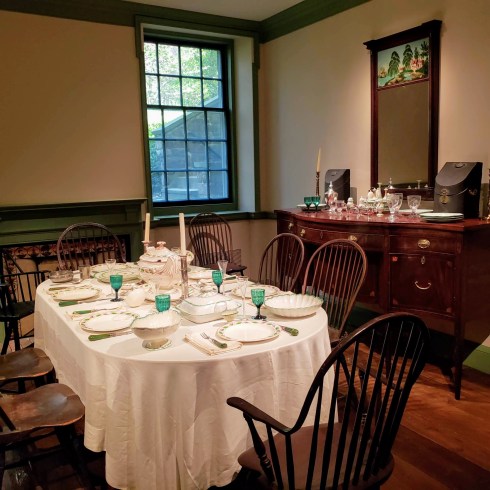
 So many rooms—and stuff—for eating and drinking, of course, but dining rooms can be very revealing in their details. After the famous Chinese Parlor are several shots of the Du Pont Dining Room, with the Derby family’s green knives and knife boxes (+ McIntire chairs and Needham secretary, and adjacent candlestick closet. I can’t remember the name of the second, simple dining room, which is one of my favorite Winterthur rooms, but the photograph just above is of Queen Anne Dining Room, which really represents Mr. du Pont’s creative abilities (as well as his collecting efforts).

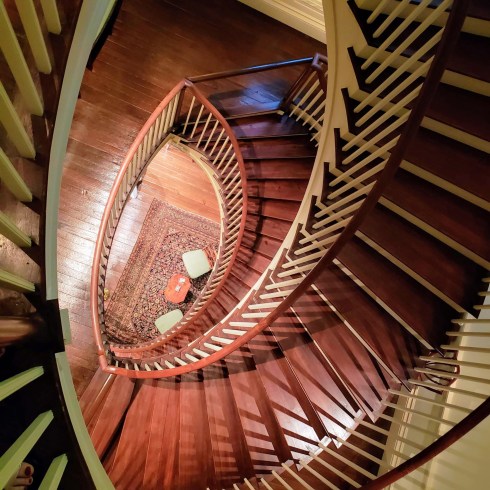


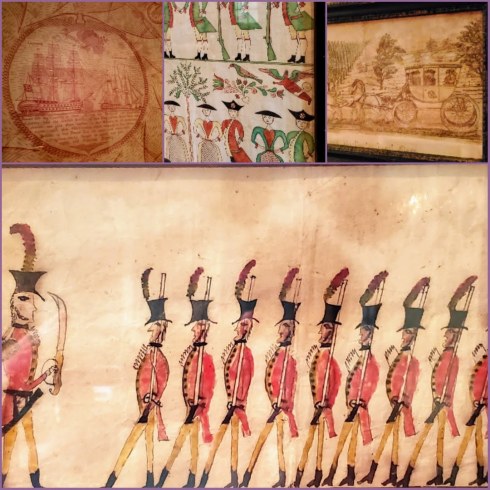


 The Montmorenci stair, taken from a North Carolina house, replaced the “baronial” staircase which Mr. du Pont’s father installed. Folk objects and images, just a few tea tables, and just one china room. Several Salem items: the chimneypiece embroidered by Sarah Derby Gardner, a Silsbee chair, Mr. du Pont’s secretary (and bed), and the Corné mural from the Lindall-Barnard-Andrews House.






