
I am just back from a long weekend spent in the Brandywine Valley spanning the border of Pennsylvania and Delaware. A few friends and I drove down principally to visit Winterthur, but I think we were blindsided by all the attractions of this beautiful region: the lush landscape was a welcome escape from still-Spartan New England too! As usual, time was limited, so I felt like I was rushing around trying to see and capture as many houses, gardens, and treasures as possible, but there was simply too much. I’m going to have to go back and spend a week or more. So what you will see in these next two posts are rather impressionistic views of the region in general and Winterthur in particular. When I return, the first thing I’m going to do is drive down every single road slowly (or maybe bicycle) so I can see as many old houses as possible: stone, brick, wood, and combinations thereof, small and large.


Just a sample of the many beautiful houses in the Brandywine Valley: you can see that I was drawn to the stone as it’s more unusual in New England. We were fortunate to be taken to see Primitive Hall, a 1738 manor house in Chester County, Pennsylvania, with its double (“pent”) roof, a common architectural feature of early houses in the region, including the Gideon Gilpin House at the Brandywine Battlefield site. The Battle of Brandywine was the Marquis de Lafayette’s first American battle, and he was quartered at the Gilpin House.


Primitive Hall exterior and interior and the Gideon Gilpin House at the Brandywine Battlefield site; outbuildings of both houses—I could write an entire post on historic Brandywine sheds!
The region is beautifully preserved, in large part due to the work of the Brandywine Conservancy, as well as the institutional presence of the Brandywine River Museum, Winterthur, and Longwood Gardens, and the efforts of farm (horses! mushrooms!) owners as well, I am sure. What really stood out for me, besides the abundance of open land, were a number of really stately trees—and I am no tree girl. Looming over the public part of the Brandywine Battlefield site is an American sycamore tree dating to 1787–almost a witness to the Revolution. We saw a seventeenth-century “Penn Oak” on the grounds of the London Grove Friends Meeting House in West Marlborough, Pennsylvania, and many old trees in Longwood Gardens.


Longwood Gardens, the lifetime passion and achievement of industrialist and philanthropist Pierre S. du Pont (1870-1954) was almost overwhelming in its beauty, scale, organization and administration. What a resource for this community! I would live there if I lived nearby. I think we visited at the perfect time with abundant spring blooms everywhere, but I’m sure it’s beautiful in every season and I intend to visit in every season. There was rather dreary day on the Friday we visited, but the sun miraculously appeared for the afternoon, so no filters were needed for these photos!


 Longwood Gardens + Conservatory and “Green Wall” surrounding restroom doors!
I don’t think that we were completely prepared (yet again) for just how charming the Brandywine River Museum of Art is, with its comprehensive yet intimate focus on multiple generations of the multi-talented Wyeth family. I was pretty familiar with patriarch N.C. Wyeth’s illustration work,, somewhat familiar with that of his son Andrew, and a bit familiar with that of his grandson Jamie, but I had no idea that all of his children were so talented, that he was mentored by my favorite illustrator of all time, Howard Pyle, and that he suffered such a tragic death (crushed by a train, along with his little grandson, in 1945). There was also a poignant tribute to Phyllis Mills Wyeth, the wife and muse of Jamie Wyeth, who died just this past January, in the form of an exhibition of Jamie’s works which depict and were inspired by her—including a series of charming Christmas cards which he made for her every year. A visit to the Wyeth family home and N.C.’s studio nearby enhanced the whole experience, and also highlighted how and why the Brandywine Valley was and is so inspirational.


 Treasures of the Brandywine River Museum of Art, including: Howard Pyle’s influential “historic” illustrations and a N.C. Wyeth cover, Andrew Wyeth’s Snow Hill and Jamie Wyeth’s Lime Bag, N.C.’s studio exterior and interior and in Andrew’s North Light, N.C. Wyeth, framed by his parents and looking down on his talented family, a Jamie Wyeth Christmas card for his beloved wife Phyllis.


 AP Photo by Thibault Camus
 The Cathedrals of Reims and Nantes in their present glorious condition. Photographs by Nicolas Janberg for


 Edwards’ book and paintings; two 1914 postcards; Charles W. Wyllie, The Burning of Reims Cathedral after the Severe Bombardment of the Germans, 17-24 September 1914. From The Sphere, 7 December 1914.
![[The Angel of the Resurrection on the Roof of Notre-Dame, Paris]](https://i0.wp.com/streetsofsalem.com/wp-content/uploads/2019/04/notre-dame-angel-of-resurrection-1853-getty-charles-negre.jpg?resize=490%2C690&ssl=1) Nantes Cathedral in flames on the night of January 28, 1972, Museum of firefighters Loire-Atlantique. Hervio Fund; Charles
Nantes Cathedral in flames on the night of January 28, 1972, Museum of firefighters Loire-Atlantique. Hervio Fund; Charles 

 Essex Register
 The taproom of the Buckman Tavern, where Elijah Sanderson fell asleep by the fire; early 19th century view of the Battle of Lexington, New York Public Library Digital Collections.




 Tried to get more juxtapositions of historical and modern dress but what can I say? I was enjoying the party! Above is my beautiful friend and a very talented seamstress, Louise Brown, in her own creation of course. Below is our committee (with a few conspicuous absences) with chair Michael Selbst in the middle, to the right of me! And then we have some swag…..thanks to all our sponsors too!


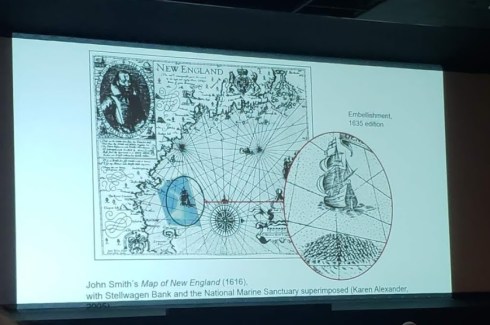

 Scenes from the Salt Cod for Silver Symposium, and the demolition of the Stacks next door.
 Madame Beavoir’s Painting

 Madame Leroy and Rest in Peace; Revolutionary Dress Top (detail).

 Marie Antoinette is Dead; Boucher’s Portrait of Madame de Pompadour (Neue Pinakothek, Munich); Passing and Violin of the Dead. All photographs by Fabiola Jean-Louis with more + commentary at her website:






